A MATTER OF INTEREST FOR CHILD SUPPORT CASES
February 7, 2011 § Leave a comment
MCA § 75-17-7 provides:
All judgments or decrees founded on any sale or contract shall bear interest at the same rate as the contract evidencing the debt on which the judgment or decree was rendered. All other judgments or decrees shall bear interest at a per annum rate set by the judge hearing the complaint from a date determined by the judge to be fair but in no event prior to the filing of the complaint.
It is error for the trial court to fail to award interest on the amount adjudicated to be owed for arrearage in child support. Ladner v. Logan, 857 So.2d 764 (Miss. 2003).
Although the statute expressly states that pre-judgment interest may not extend back prior to the filing of the complaint, the rule does not apply to due and unpaid child support. That is because each payment in arrears is vested when due and becomes an automatic judgment against the obligor. Pope v. Pope, 803 So.2d 499, 501 (Miss. App. 2002). Each unpaid monthly installment begins to accrue interest at the legal rate, not from the time it may subsequently be reduced to judgment by a court, and it is error for a chancellor to reduce or eliminate the interest. Dorr v. Dorr, 797 So.2d 1008, 1015 (Miss. App. 2001). Amounts paid by an obligor in arrears are applied first to the interest obligations, and then to extinguish the principal amount of the oldest outstanding child support payment, and then the next oldest, and so on. Brand v. Brand, 482 So.2d 236, 238 (Miss. 1986).
The appellate courts have allowed the trial judges deference in setting the rate of interest. Rates from three pecrent (Brawdy v. Howell, 841 So.2d 1175, 1180 (Miss. App. 2003)) to eight percent (e.g., Houck v. Ousterhout, 861 So.2d 1000, 1003 (Miss. 2003)) have been upheld.
There is no prohibition that I know of for a property settlement agreement to provide a contract rate for interest on unpaid child support or other obligations such as alimony, but I have never seen a property settlement agreement with such a provision. The rarity is due, I am sure, to the difficulty of getting an agreement. An advantage would be that the court would be bound to the contract rate. See, e.g., Tower Loans, Inc. of Mississippi v. Jones, 749 So.2d 189, 190 (Miss. App. 1999), where the court of appeals reversed a circuit judge’s imposition of eight percent interest where the contract called for a 34.71% rate, and the contract rate was not usurious. Another advantage would apply to alimony and other non-child-support obligations in that it would allow pre-judgment interest back to the filing of the complaint for enforecement; a nice perk if you can get it. Finally, setting an interest rate at least for non-child-support obligations might be prudent in view of the authority that, if the court does not impose interest on a judgment it renders for non-child-support obligations, it is presumed that the judgment does not earn interest. Aldridge, August 28, 1998, A.G. Opinion #98-0507.
I WISH WE COULD ESCAPE TO PARIS
February 4, 2011 § Leave a comment
But since we can’t, you can go there yourself with this slideshow from my last trip in 2005. You may have to enable popups to view it on YouTube.
There are many postcard sights you won’t see in this collection, but you will find some favorites as well as some out-of the way places. See if you recognize Notre Dame, Place St. Michel, Tuilleries, St. Germain, the Marais, Orsay, the Louvre, Père LaChaise, Montmartre and Sacré Coeur, Hotel de Ville, Moulin de la Galette, Place des Abbesses, Les Invalides and the tomb of Napoleon, the Conciergerie, St. Germain l’Auxerrois, Musée Cluny, Rue Rivoli, Jardin du Luxembourg, Place République, Brasserie Jenny, Pompidou, La Coupole, Sainte Chapelle, Versailles, the quais of the Seine, Galléries Lafayette, many shop windows, and street scenes, among others. it’s a stroll through the city and Versailles from early morning until early evening on a day that turned snowy and chilly, not too different from the weather today.
Better yet, take your own trip and make your own slide show. You owe it to yourself.
The music is Herbie Hancock’s version of Gershwin’s Lullaby.
I hope you enjoy.
WHAT’S BREWING IN THE CAPITOL THAT MAY AFFECT YOUR PRACTICE
February 3, 2011 § 2 Comments
Here’s a link to legislation pending in Jackson that may have some effect on your practice.
It’s early, and some things fall by the wayside while others get amended, but here are a few to take note of based on my own cursory, limited review:
- HB 55 appears to take adult guardianships in the same direction that UCCJEA took child custody some years ago. As our population ages, and younger people are taking responsibility for older adults, the tug-of-war between siblings for parents across state lines can create some head-scratching jurisdictional battles that this measure seeks to address.
- HB 170 addresses an anomaly in the law created by the emancipation of a child. The case law has held that the cause of action for past due child support becomes the enforceable obligation of the child after emancipation, even though the child support payments were due to the custodial parent. This bill would allow the parent who was owed the support to collect it despite emancipation.
- HB 689 is of high interest in chancery court since the supreme court handed down McDonald v. McDonald, 39 So.3d 868 (Miss. 2010), which held that hearsay in a guardian ad litem’s report is inadmissible. This bill would correct that. It spells out how hearsay in the report would be handled, and the procedure spelled out is similar to that proposed by Justice Pierce in his dissent to the majority opinion.
There are other bills proposing to: revise requirements for durable powers of attorney; change acknowledgment requirements for recordation of certain instruments; revise procedures for filling judicial vacancies; clarify procedures for renewal of a judgment; specify where and when enforcement of liens takes place; spell out how disability payments are credited against child support; allow distribution of wrongful death damages without opening an estate; and filing-fee-funded increase in judicial salaries. There’s plenty more there that might interest you.
LIMITED SCOPE REPRESENTATION NOW A FACT IN MISSISSIPPI
February 2, 2011 § 1 Comment
I’ve talked here before about “unbundling” of legal services, also called “limited scope representation,” as a way of opening legal services to people who otherwise can not afford a lawyer for matters that they consider routine or uncomplicated.
On January 27, 2011, the Mississippi Supreme Court adopted amendments to the professional rules that allow limited scope representation. You can read the press release, which includes a link to the amended rules, here.
On the whole, I think this is a positive development in that it will help open up access to lawyers and courts. I do have a couple of practical concerns:
- What does the lawyer do when the client insists that you limit the scope of your representation, but you know it is definitely not in the client’s best interest, and may even be to the client’s detriment, not to address other matters?
- How do you draft a limited scope representation agreement that protects the lawyer from action by the client claiming inadequate representation?
Other states have trod this path before us, so there are possibly bar opinions and case law that can provide some guidance to practitioners.
From the court’s perspective, I can tell you that there is a serious need for low-level involvement of attorneys in those so-called simple and uncomplicated matters. I could go on and on about experiences with pro se litigants going forth boldly where no lawyer has set foot before, using pleadings and guidance material from the internet or from so-called legal software, or from kits purchased at office supply stores. These cases are a judge’s nightmare because the judge should never be put in the position of assisting any party with correcting and putting pleadings and other papers right, and the judge certainly can not do so when there is an opposing party. It can be painful and demoralizing to watch a pro se party inflict serious legal damage on herself, usually without a clue as to the extent of the injury. Even minimal involvement of an attorney in those cases would be a major benefit.
Another aspect of pro se proceedings often overlooked is that the pro se litigant has no professional or ethical duty to the court or to the opposing party. The possibility for fraud and misrepresentation is significant. There is no attorney, with his or her license and professional responsibility on the line to reassure the court. Likewise, these companies that sell the kits, software and advice owe their customers no duty at all. The insurance that a client obtains by hiring a lawyer is non-existent.
Finally, lawyers need to be aware that the DIY legal industry stands to keep chipping away at the edges of the practice of law until there will be real competition for clients. Your license and substantial investment in legal education, as well as your dedication to legal ethics and duty to the courts are all going to be in competition with nameless and faceless paper mills and internet sites that have no professional standing, no investment in education, and no ethical responsibilities.
I hope limited scope representation helps reduce the trend toward more DIY litigation. I encourage lawyers to look into limited scope representation and discover how it can enhance their practice as well as aid laypersons who feel that they can not afford legal services.
CONTINGENT FEES IN DOMESTIC CASES
February 1, 2011 § Leave a comment
Rule 1.5 (d) (1) of the Mississippi Rules of Professional Conduct provides that “A lawyer shall not enter into an arrangement for, charge or collect any fee in a dmoestic relations matter, the payment or amount of which is contingent upon the securing of a divorce or upon the amount of alimony or support, or property settlement in lieu thereof.”
In their treatise, PROFESSIONAL RESPONSIBILITY FOR MISSISSIPPI LAWYERS, MLI Press, 2010, at § 22:10, professors Jeffrey Jackson and Donald Campbell state:
Under Rule 1.5 (d) (1), a contingent fee is unethical in a “domestic relations matter” where payment is contingent upon securing a “divorce or upon the amount of alimony or support or property settlement.” The policy behind this traditional prohibition is to prevent lawyers from taking a fee position that might give the lawyer an incentive to oppose reconciliation of the parties. The language of the prohibition refers to “domestic relations matters” rather than only to divorce. As such, that language would prevent a contingent fee in cases involving separation of persons who cohabited but were unmarried. Too, the reference to “domestic matters” and to “property settlements” would prohibit a contingent fee in negotiating pre-nuptial and post-nuptial agreements between parties about to join as a couple, or considering the possibility of separation. The state bar’s opinion is that Rule 1.5 (d) (1) does not, however, prevent a lawyer from charging a contingent fee for the collection of past due support or alimony. [Citing Miss. Bar Ethics Opinion 88]
MAKING SURE YOUR CLIENT GETS THE PROPER TAX TREATMENT OF ALIMONY
January 31, 2011 § Leave a comment
An important factor in determining whether to award alimony is the tax consequences of the court order. We all know that periodic alimony is income to the payee and deductible by the payer if it meets the IRS’s requirements.
So what does the IRS consider to be the essential ingredients of an alimony award, either by agreement or by adjudication? Section 71(b) of the Internal Revenue Code (IRC) provides that the following must apply:
- There must be cash payments to the recipient or third-party payments;
- Payments must be required by a written instrument;
- Instrument must not designate the payment as “not alimony” or as some other form of payment;
- The payer and payee must not be members of the same household;
- Payments may not be treated as child support;
- Payments must cease on death of the recipient;
- The parties may not file a joint tax return.
Payments that will not be treated as alimony by the IRS include: child support; noncash transfers; payments that are part of a spouse’s community property income; payments for use of property; and payments for maintainenance or upkeep of the payer’s property. Lump sum alimony, which is really an equalizing payment in equitable distribution, is not considered alimony by the IRS.
If you’re planning to use the form to prove the tax effects of alimony that I posted previously, you need to update it to conform to the latest version of IRC § 71(b).
It’s important to give some thought to these provisions regardless of which side you are on in an alimony dispute. If you represent the client trying to get some cash, you might consider proposing to the court or negotiating for it to be in the form of a property division; as such, it would not be considered income. Likewise, you can propose to the judge or negotiate for the payment to omit one of the ingredients above. If you represent the party who will have to pay, make sure you get all of the essential ingredients included so that your client’s payments will be deductible.
MR. FAULKNER UP CLOSE AND PERSONAL
January 28, 2011 § Leave a comment
I found this remarkable material on Oxford’s William Faulkner recently. Some of the photos are priceless, like the one of Faulkner and Welty. The Q and A session offers an insight into one of America’s greatest authors — at least as he saw writing and the world in that still-unsettled era in the aftermath of World War II and at the beginning of the Cold War.
* * * * *
In spring of 1947, the English department of the University of Mississippi had William Faulkner address one class a day for a week. The teacher of each class was barred from attending the sessions.
Faulkner spent the entire time answering questions from students.

In the side yard at Rowan Oak
Q: Which of your books do you consider best?
WILLIAM FAULKNER: As I Lay Dying was easier and more interesting. The Sound and The Fury still continues to move me. Go Down, Moses – I started it as a collection of short stories. After I reworked it, it became seven different facets of one field. It is simply a collection of short stories.
Q: In what form does the initial idea of a story come to you?
WF: It depends. The Sound and The Fury began with the impression of a little girl playing in a branch and getting her panties wet. This idea was attractive to me, and from it grew the novel.
Q: How do you go about choosing your words?
WF: In the heat of putting it down you might put down some extra words. If you rework it, and the words still ring true, leave them in.
Q: What reason did you have for arranging the chapters of The Wild Palms as you did?
WF: It was merely a mechanical device to bring out the story I was telling, which was one of two types of love. I did send both stories to the publisher separately, but they were rejected because they were too short. So I alternated the chapters of them.
Q: How much do you know about how a book will turn out before you start writing it?
WF: Very little. The character develops with the book, and the book with the writing of it.
Q: Why do you present the picture you do of our area?
WF: I have seen no other. I try to tell the truth of man. I use imagination when I have to and cruelty as a last resort. The area is incidental. That’s just all I know.
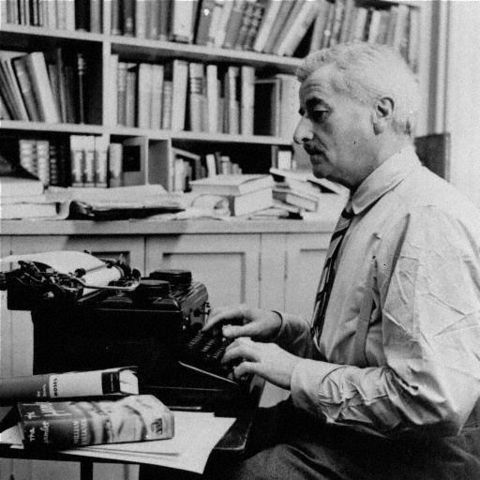
The writer at his craft
Q: Since you do represent this picture, don’t you think it gives a wrong impression?
WF: Yes, and I’m sorry. I feel I’m written out. I don’t think I’ll write much more. You only have so much steam and if you don’t use it up in writing it’ll get off by itself.
Q: Did you write Sanctuary at the boilers just to draw attention to yourself?
WF: The basic reason was that I needed money. Two or three books that had already been published were not selling and I was broke. I wrote Sanctuary to sell. After I sent it to the publisher, he informed me, “Good God, we can’t print this. We’d both be put in jail.” The blood and guts period hadn’t arrived yet. My other books began selling, so I got the galleys of Sanctuary back from the publisher for correction. I knew that I would either have to rework the whole thing or throw it away. I was obligated to the publisher financially and morally and upon continued insistence I agreed to have it published. I reworked the whole thing and had to pay for having the new galleys made. For these reasons, I didn’t like it then and I don’t like it now.
Q: Should one re-write?
WF: No. If you are going to write, write something new.
Q: How do you find time to write?
WF: You can always find time to write. Anybody who says he can’t is living under false pretenses. To that extent depend on inspiration. Don’t wait. When you have an inspiration put it down. Don’t wait until later and when you have more time and then try to recapture the mood and add flourishes. You can never recapture the mood with the vividness of its first impression.

At Rowan Oak
Q: How long does it take you to write a book?
WF: A hack writer can tell. As I Lay Dying took six weeks. The Sound and The Fury took three years.
Q: I understand you can keep two stories going at one time. If that is true, is it advisable? WF: It’s all right to keep two stories going at the samet ime. But don’t write for deadlines. Write just as long as you have something to say.
Q: What is the best training for writing? Courses in writing? Or what?
WF: Read, read, read! Read everything – trash, classics, good and bad; see how they do it. When a carpenter learns his trade, he does so by observing. Read! You’ll absorb it. Write. If it is good you’ll find out. If it’s not, throw it out the window.
Q: Is it good to copy a style?
WF: If you have something to say, use your own style: it will choose its own type of telling, its own style. What you have liked will show through in your style.
Q: Do you realize your standing in England?
WF: I know that I am better thought of abroad than here. I don’t read any reviews. The only people with time to read are women and rich people. More Europeans read than do Americans.
Q: Why do so many people prefer Sanctuary to As I Lay Dying?
WF: That’s another phase of our American nature. The former just has more commercial color.
Q: Are we degenerating?
WF: No. Reading is something that is in a way necessary like heaven or a clean collar, but not important. We want culture but don’t want to go to any trouble to get it. We prefer reading condensations.
Q: That sounds like a slam on our way of living.
WF: Our way of living needs slamming. Everybody’s aim is to help people, turn them to heaven. You write to help people. The existence of this class in creative writing is good in that you take time off to learn to write and you are in a period where time is your most valuable possession.
Q: What is the best age for writing?
WF: For fiction the best age is from 35-45. Your fire is not all used up and you know more. Fiction is slower. For poetry the best age is from 17 to 26. Poetry writing is more like a skyrocket with all your fire condensed in one rocket.

Q: How about Shakespeare?
WF: There are exceptions.
Q: Why did you quit writing poetry?
WF: When I found poetry not suited to what I had to say, I changed my medium. At 21 I thought my poetry very good. At 22 I began to change my mind. At 23 I quit. I use a poetic quality in my writing. After all, prose is poetry.
Q: Do you read a good bit?
WF: Up until 15 years ago I read everything I could get a hold of. I don’t even know fiction writers’ names much now. I have a few favorites I read over and over again.
Q: Has “The Great American Novel” been written yet?
WF: People will read Huck Finn for a long time. However, Twain has never written a novel. His work is too loose. We’ll assume that a novel has set rules. His is a mass of stuff – just a series of events.
Q: I understand you use a minimum of restrictions.
WF: I let the novel write itself – no length or style compunctions.
Q: What do you think of movie scriptwriting?
WF: A person is rehired the next year on the basis of how many times his name appeared on the screen the previous year. Much bribery ensues. In the old days they could give a producer three hundred pounds of sugar and be reasonable sure of getting their names on the screen. They really fight about it and for it.
Q: To what extent did you write the script for Slave Ship?
WF: I’m a motion picture doctor. When they find a section of a script they don’t like I rewrite it and continue to rewrite it until they are satisfied. I reworked sections in this picture. I don’t write scripts. I don’t know enough about it.

The "motion picture doctor" in Hollywood
Q: It is rumored that once you asked your boss in Hollywood if it would be permissible for you to go home to work. He gave his approval. Thinking you meant Beverly Hills, he called you at that address and found that by home you had meant Oxford, Mississippi. Is there anything to this story?
WF: That story’s better than mine. I had been doing some patching for Howard Hawks on my first job. When the job was over, Howard suggested that I stay and pick up some of that easy money. I had got $6,000 for my work. That was more money than I had ever seen, and I thought it was more than was in Mississippi. I told him I would telegraph him when I was ready to go to work again. I stayed in Oxford a year, and sure enough the money was gone. I wired him and within a week I got a letter from William B. Hawks, his brother and my agent. Enclosed was a check for a week’s work less agent’s commission. These continued for a year with them thinking I was in Hollywood. Once a friend of mine came back from England after two years stay and found 104 checks enclosed in letters that had been pushed under his door. They are showing a little more efficiency now, so those things don’t happen much anymore.
Q: How do you like Hollywood?
WF: I don’t like the climate, the people, their way of life. Nothing ever happens and then one morning you wake up and find that you are 65. I prefer Florida.
Q: On your walking trip through Europe how did you find everything?
WF: At that time the French were impoverished, the Germans naturally servile, I didn’t find too much.
Q: Did your perspective change after travel to Europe and to other places?
WF: No. When you are young you are sensitive but don’t know it. Later you seem to know it. A wider view is not caused by what you have seen but by war itself. Some can survive anything and get something good out of it, but the masses get no good from war. War is a dreadful price to pay for experience. About the only good coming from war is that it does allow men to be freer with womenfolks without being blacklisted for it.
Q: What effect did the R.C.A.F. have on you?
WF: I like to believe I was tough enough that it didn’t hurt me too much. It didn’t help much. I hope I have lived down the harm it did me.
Q: Which World War do you think was tougher?
WF: Last war we lived in constant fear of the thing catching on fire. We didn’t have to watch all those instruments and dials. All we did was pray the place didn’t burn up. We didn’t have parachutes. Not much choice. World War II must have been tougher.
Q: Is association (such as a boarding house) good or bad as a background for writing?
WF: Neither good nor bad. You might store the facts in mind for future reference in case you ever want to write about a boarding house.
Q: How much should one notice printed criticism?
WF: It is best not to pay too much attention to a printed criticism. It is a trade tool for making money. A few critics are sound and worth reading, but not many.

Faulkner and Welty
Q: Whom do you consider the five most important contemporary writers?
WF: 1. Thomas Wolfe. 2. Dos Passos. 3. Ernest Hemingway. 4. Willa Cather. 5. John Steinbeck.
Q: If you don’t think it too personal, how do you rank yourself with contemporary writers?
WF: 1. Thomas Wolfe: he had much courage and wrote as if he didn’t have long to live; 2. William Faulkner; 3. Dos Passos; 4. Ernest Hemingway: he has no courage, has never crawled out on a limb. He has never been known to use a word that might cause a reader to check with a dictionary to see if it is properly used. 5. John Steinbeck: at one time I had great hopes for him – now I don’t know.
Q: What one obstacle do you consider greatest in writing?
WF: I’m not sure I understand what you mean. What do you want to do? Write something that will sell?
Q: I mean whether the obstacle is internal conflict or external conflict.
WF: Internal conflict is the first obstacle to pass. Satisfy yourself with what you are writing. First be sure you have something to say. Then say it and say it right.
Q: Mr. Faulkner, do you mind our repeating anything we have heard outside of class?
WF: No. It was true yesterday, is true today, and will be true tomorrow. If I were reincarnated, I’d want to come back a buzzard. Nothing hates him or envies him or wants him or needs him. He is never bothered or in danger, and he can eat anything.

Faulkner's interment at St. Peter's Cemetery in Oxford, July 7, 1962
Thanks to This Recording blog.
YOU’D BETTER FILE THOSE POST-TRIAL MOTIONS AFTER ALL
January 27, 2011 § 9 Comments
Back on November 16, 2010, I posted here that you don’t have to file a motion for a new trial in chancery non-jury trials to preserve error for an appeal. As I pointed out, it has never been the law in chancery court that such a motion was necessary, and MRCP 52(b) would appear to dispose of the issue. I do believe that was an accurate statement of the law in chancery court.
Until Tuesday, January 25, 2011.
On that date, the court of appeals handed down its decision in Robinson v. Brown, in which the appellant attempted to argue that it was error for the chancellor to assess her with child support because she claimed that he had failed to make the appropriate findings of fact. Justice Carlton’s opinion, to which there was no dissent, holds at ¶ 18 that the appellant:
” … failed to assert this alleged error post trial to the chancellor, and such failure waived her right to now complain as to this issue on appeal. Mississippi Rule of Civil Procedure 52 allows the court to amend its findings, or make additional findings, upon motion of a party filed not later than ten days after the entry of a judgment or entry of findings and conclusions of law. Watts v. State, 492 So.2d 1281, 1291 (Miss. 1986) (appellant was procedurally barred from raising an issue on appeal where he failed to raise it in his post-trial motion).”
The only case cited to support the point is a criminal case from circuit court, presumably from a jury trial.
The opinion does not mention MRCP 52(b), which specifically states:
When findings of fact are made in actions tried by the court without a jury, the question of the sufficiency of the evidence to support the findings may thereafter be raised regardless of whether the party raising the question has made in court an objection to such findings or has filed a motion to amend them or a motion for judgment or a motion for a new trial.
Would that exact language not apply in this case since the appellant was complaining that the trial court’s ruling was not supported by sufficient evidence? And, as with nearly all chancery court cases, this was a case “tried by the court without a jury.”
The lone justice with chancery experience on the court of appeals, Justice Myers, is listed as “not participating.”
Practice Tip: For chancery practitioners, I believe that this decision means that from now on you had better file a post-trial motion in every case if you have any thought of an appeal, and you’d better list every error you think might be in the record.
For chancellors, this will mean an abundance more work, on top of the lengthy opinions we are required to write to pass scrutiny of the appellate courts.
There’s a lot I could say about this, but I guess I’d better not. If you want my views, drop by my office and we’ll talk.
PARENTAL LIABILITY
January 26, 2011 § 3 Comments
When a child commits a tort, can the parents be held responsible to pay the damages?
MCA § 93-13-2 sets out the rules for when the parents of a minor will be held liable for the acts of the minor, and the limits on that liability. Here are the principal points:
- The statute states that “Any property owner …” may recover damages. Does this limit the scope of the statute to actions for damage to property, or are personal injury claims included? It would seem that damage to property is what was contemplated, since subsection (1) specifically refers to any act of the minor that ” … damages or destroys property belonging to such owner.” Subsection (2) refers to ” … damages [not injuries] to [sic] which such minor or other person would otherwise be liable.
- The limit of recovery is $5,000, plus “necessary court costs.”
- The statute applies to minors under the age of 18 and over the age of 10.
- The act of the minor must have been malicious and willful. Purely negligent acts or mere carelessness are not included.
- The statute does not apply to a parent whose “parental custody and control” have been removed by court order or decree. Thus, where the child’s custody is awarded by court order to one parent, the non-custodial parent will not be subjected to liability. This raises an interesting point when the child commits a maliciously destructive act while on visitation with the non-custodial parent, since visitation time is tantamount to custodial time. Cox v. Moulds, 490 So.2d 866, 870 (Miss. 1986). The language of the statute appears to hinge on the parental control, so that the parent who should be in control of the child at the time of the damage is the parent who will face liability. When the child is placed by court order in the control of a non-parental guardian, that guardian will be the one to deal with the liability issue.
- The statute does not limit any other recovery under any other applicable provision of law.
- The purpose of the law is both to authorize recovery from parents in situations where they would not otherwise be liable, and to limit their liability.
The act is in derogation of the common law, and therefore must be strictly construed. I do not find any case law construing this statute or interpreting its applicability.
PUBLICATION TO CLOSE AN ESTATE: A STATUTE-RULES CONFLICT
January 25, 2011 § 2 Comments
MCA § 91-7-295 addresses summons or publication for a final account in an estate, conservatorship or guardianship. The entire statute reads as follows:
The final account so presented with the statement as to parties, shall remain on file, subject to the inspection of any person interested. Summons shall be issued or publication made for all parties interested, as in other suits in chancery court, to appear at a term of court, or before the chancellor in vacation, not less than thirty (30) days from the service of the summons or the completion of the publication, and show cause, if any they can, why the final account of the executor, administrator, or guardian should not be allowed and approved. [Emphasis added]
MRCP 4 (c) (4) (B), which governs procedure in “suits in chancery court,” states: “The defendant shall have thirty (30) days from the date of first publication to appear and defend.”
So which is it? Thirty days from completion of publication as the statute says? Or thirty days from first publication as the rule says?
The Order Adopting the Mississippi Rules of Civil Procedure issued by the Supreme Court on May 29, 1981, expressly states that ” … in the event of a conflict between these rules and any statute or court rule previously adopted these rules shall control.”
That language would seem to dispose of the matter, but for MRCP 81 (a) (8), which limits the applicability of the rules to matters under MCA Title 91. There is also the fact that the law of executors and administrators is entirely a creature of statute, which requires strict application.
What should you do? I would follow the statute. Doing so does not run afoul of MRCP 4, and actually allows more time for interested parties to act. I would also publish returnable to a day certain more than thirty days after the completion of publication, so there is no doubt on the part of those summoned as to the date by which they are required to act. If you do not follow the statute, you run the risk that a disgruntled party may file suit at a later point attacking your accounting on the ground that the court lacked jurisdiction to proceed.
Thanks to Chancellor Gene Fair for pointing this out.

