ADMITTING A PHOTOGRAPH INTO EVIDENCE
January 24, 2011 § 2 Comments
One of the simplest tasks of a trial lawyer is to get a photograph admitted into evidence, but I have seen some painful exercises as lawyers strive mightily against repeated objections in their task.
Only two things are required to be shown:
- That the witness knows relevant facts about the scene or objects represented in the photo; and
- That he or she can say that it correctly and accurately portrays those facts (or, as many of us say, “It is a true and accurate depiction …”).
It is not necessary for the witness to establish the date when the photograph was taken because it does not matter what date it was taken if the condition is unchanged. It is not required that the witness describe how the camera mechanism was properly calibrated, or to establish a chain of custody or any other such thing, although I did have a chancellor years ago sustain objection after objection until I guessed that he was requiring me to ask the witness to identify who took the photos. But that judge was in error; who took the photos is not relevant to admissibility. All that is necessary is for the witness to establish knowledge of the matters depicted and to affirm that the photo does truly and accuractely depict the conditions he observed.
For example:
Q. Where is the field located where the body you described was found?
A. Adjacent to my farm house.
Q. Are you familiar with that field?
A. Yes, I am in and around that field every day.
Q. Did you observe the field on the day that the body was found, and in particular the area where it was found?
A. Yes, it was I who found the body while I was working in that field.
Q. Let me show you a photograph and ask you if you can tell me what it shows.
A. This is a picture of the field.
Q. Is this picture a true and accurate depiction of the condition of the field that you observed on that day?
A. Yes.
Then offer it into evidence.
I hope this helps.
A FEW RANDOM THOUGHTS ABOUT JOINT CUSTODY
January 21, 2011 § 3 Comments
- An award of joint legal custody was reversed where the reason assigned by the trial judge was to allow the mother to participate in and keep up with the children’s activities. Joint legal custody requires the parties to confer in the joint decision-making about decisions affecting the children’s lives. Concern for access to information does not warrant award of joint legal custody. Lowrey v. Lowrey, 25 So.3d 274, 296 (Miss. 2009).
- The trial court is not required to consider the Albright factors in determining whether to award joint legal custody, since they apply only to physical custody. Palculict v. Palculict, 22 So.3d 293, 297 (Miss. App. 2009).
- MCA § 93-5-24(2) provides that the trial court in an irreconcilable differences divorce may award joint custody only “upon application of both parents,” but in all other cases the court may award joint custody “upon application of one (1) or both parents.” But where the parties have consented to an irreconcilable differences divorce and agreed for the trial court to adjudicate custody, the chancellor may award joint custody. Crider v. Crider, 904 So.2d 142, 148 (Miss. 2005).
- “There are … significant legal consequences attached to each form of custody. If parents accustomed to joint decision-making disagree, the parent with sole legal custody has authority to make unilateral decisions regarding the child. A move by one of two joint custodians triggers an Albright analysis to determine which parent should take sole physical custody. In contrast, when a parent with sole custody relocates, the relocation is not in itself a reason to modify custody.” Bell, Mississippi Family Law, § 5.04[4].
- Joint custdy is inappropriate where the parties are unable to communicate and cooperate. Lewis v. Lewis, 974 So.2d 265, 266 (Miss. App. 2008).
“QUOTE UNQUOTE”
January 21, 2011 § Leave a comment

Ibsen
“‘Your money or your life.’ We know what to do when a burglar makes this demand of us, but not when God does.” — Mignon McLaughlin
“Money may be the husk of many things, but not the kernel. It brings you food, but not appetite; medicine, but not health; acquaintances, but not friends; servants, but not loyalty; days of joy, but not peace or happiness.” — Henrik Ibsen
“”When we truly discover love, capitalism will not be possible and Marxism will not be necessary.” — Will O’Brien
LSAT: CATCH YA ‘ROUND THE GRILL*?
January 20, 2011 § Leave a comment
The WSJ Law blog reports that the ABA is seriously considering doing away with the requirement that candidates for admission to law school pass the LSAT. The thinking is that law schools should decide their own entrance requirements, and that the ABA, in its accrediting role, should concern itself instead with whether or not graduates are qualified to practice law. Will the LSAT go the way of the dinosaur? Stay tuned.
In the paleolithic era when I decided to attend law school, there was no debate about the LSAT. One took it to complete the admission requirements, or one did not attend law school.
And so I showed up at Lamar Hall (later renamed Farley), which was then the Ole Miss law school building and now houses the School of Journalism, to undergo my LSAT on Saturday, October 17, 1970. The exact date is easy to pinpoint, as you will see.
We were collected in the large lecture room on the west end of the building on the main floor, around 40 of us. Among the crowd I recognized fellow students with whom I had shared undergraduate classes, and I picked my way to the back of the room where eventually four or five former Ole Miss football players were esconced nearby. I remember the room being quiet and subdued.
Notwithstanding the quiet atmosphere inside the lecture hall, things were popping outside. It was a campus football weekend, and no doubt most of us would have preferred being outside with the fans. The classroom windows were opened slightly to admit the crisp, fresh fall air, and we could hear some of the hubbub from outdoors. In those days tailgating at Ole Miss was markedly different from its current form. Vehicles back then were driven directly into the Grove for tailgating. There were no such things as SUV’s or even minivans. People pulled their cars, pickups and stationwagons (i.e., primitive SUV’s) into the Grove, opened the trunk or tailgate, and laid out their spread. On this Saturday the happy football fans, expectant of glorious victory over our accustomed whipping-boy to the south, were gathering, grilling, visiting, imbibing and back-slapping directly across the street from our lecture hall.
Professor Bill Champion, our proctor, entered the room and distributed the LSAT tests. He wrote the starting time on the blackboard and stayed for awhile before slipping out of the room. In the meantime we set at laboring over the exam.
Everything verbal on the LSAT was a snap for me. The reading comprehension was like English 101. The logic questions took a little thought, but I was doing fine. I began to get that exhiliration that comes from being on the upside of the challenge.
Outside, we could hear the cheering crowds as the afternoon crept past us. It was a heady day for football on campus. The Rebels had finished the previous season ranked 8th in the nation, and now we were ranked in the top 5, having won our first four in a row, crushing Memphis State, Alabama and Georgia, and managing to get by Kentucky. Archie Manning led the powerful Rebel squad. Our opponents this fine Saturday were the Southerners of Southern Miss, a team we had thrashed 69-7 the year before and to whom we had never lost. Confidence wafted through the air like barbecue smoke. The sports page of the Clarion-Ledger on Friday before the game carried a photo of Archie seated in front of his locker putting on his cleats, with the headline: “Does He Really Need to Dress Out for This One?” If the LSAT caused one to miss any football game this promising season, this minor skirmish with the hapless Hattiesburgers would be a good candidate.
And as if on cue, from beyond the Grove we could hear the roar of the crowd in the stadium as the game kicked off.
Meanwhile, I was zipping through the verbal and logic parts of the test and it was seeming like high school stuff.
Now, these were the days before computers, cable tv and cordless phones. There were no smartphones or FaceBook. There was no ESPN. No text messages. No wireless internet because there was no internet. None of the LSAT participants in that room would have expected a play-by-play report for the day’s events, but we had our updates regardless.
Professor Champion re-entered the room and wrote on the blackboard: “1st Quarter Score …” and it looked good for the home team. We were ahead by a touchdown, and with Archie at the wheel, one could assume that victory was assured.
The LSAT, however, had taken a nasty turn. I had departed the relative comfort of verbal and logic questions and found myself in the quagmire of some general knowledge questions that were part of the test back in those days. There were a few questions that posed geometrical problems, some algebra, and even chemistry. All of that might as well have been Greek to me, but I strove valiantly against it. Guesswork became my primary stratagem. The snap had become somewhat of a struggle.
I was not the only one struggling a little with the test. I noticed some of those football players in my vicinity showing some signs of distress. The test was too much for them. This one ran his hand over his forehead and then through his hair in exasperation. That one sighed mightily, put down his number two pencil and cracked his knuckles. Another slumped at his desk and rubbed his neck. The test was taking its toll.
But in the background we could hear roars from the stadium.
Champion entered again a while later and there was a grumble of consternation as he posted the half-time score with USM ahead. Still, no reason at this point for concern with Archie in command. Besides, we had this blankety-blank exam to complete.
As we kept at the test over time the roars from the stadium became noticeably fewer. Champion’s next update showed Southern with a decisive lead, and I noticed that the football boys were decidedly uncomfortable. Heck, I was decidedly uncomfortale.
When Champion chalked up the final score there was a unanimous gasp: USM 30 and Ole Miss 14.
Even with all that hoorah, most of us managed to limp to the end of the LSAT and turn in our score sheets. We were relieved to have come through the LSAT ordeal, but the relief did not outweigh the shock of losing to Southern.
We emerged from our LSAT cloister to learn that Southern had outrushed Ole Miss 205 yards to only 85, behind the electrifying Willie Heidelberg. Phenomenal USM punter Ray Guy had kept Archie Manning bottled up all day with booming punts that averaged 49 yards a pop. Archie had completed two TD passes in the first quarter to take a 14-7 lead, but Southern was too much in the next three quarters, including a 60-yard punt return for a TD that was the back-breaker.
It was the first time ever that Southern beat Ole Miss in football. Southern Miss coach P.W. “Bear” Underwood understated after the game: “We whipped their butt.” Indeed. The next week legendary Ole Miss coach John Vaught suffered the heart attack that ended his career except for an interim return later.
Despite all the distractions, I apparently did well enough on the LSAT to get admitted to law school. Thanks to USM, what would have been another unremarkable day in the grind of my academic career was transmuted into an unforgettable, if not happy, one.
* “Catch Ya ‘Round the Grill” was a ubiquitous saying among Ole Miss students in the 60’s and early 70’s until the new student union was built. The Grill was the students’ nickname for the then student union, which is now Weir Hall. Loosely translated the saying meant: “See ya later.” Some cynics morphed it into: “I hope I don’t see you again anytime soon.” Whichever, my opinion as far as the LSAT is concerned: “Catch ya ’round the grill.”
ATTORNEY’S FEES IN AN ESTATE
January 19, 2011 § 2 Comments
Every administrator or executor is required by Uniform Chancery Court Rule (UCCR) 6.10 to have an attorney to represent him or her in connection with administration of the estate.
The attorney’s fees of the administrator or executor are not the obligation of the estate, but are the personal obligation of the fiduciary, but they may be allowed by the court as part of the administration expenses. Scott v. Hollingsworth, 487 So.2d 811, 813 (Miss. 1986). In order to be properly allowed by the court as administration expense, the attorney’s fees must benefit the estate, and fees which do not benefit the estate are properly disallowed. Estate of Collins v. Collins, 742 So.2d 147, 149 (Miss. App. 1999).
In making his determination of an attorney fee award, the chancellor must weigh several factors:
“The factors which the chancery court considers in fixing the amount of reasonable compensation are varied. Among those factors, however, are the following: time, skill, the responsibility, the monetary value of the estate administered and its liquidity, the speedy disposition of the business, the services of the attorney, the practice of attorneys in that court and the charging of fees for similar services, the complexity of the issues, and the necessity of litigation concerning the estate business.” Scott at 814.
I disallowed a claim of more than $20,000 for attorney’s fees in an estate where no action had been taken in 18 months after the qualification of the fiduciary, the fiduciary and not the attorneys had done most of the work, the attorneys were charging more than $350 an hour, the reasonable hourly rate in this district is $185, the estate was fairly simple and should have been closed in less than a year, and a substantial portion of the fees were attributable to the fiduciary resisting the sole beneficiary’s efforts to have him ousted for inaction.
If you want to get paid for your services to the fiduciary, you had better become very familiar with UCCR 6.11 and 6.12.
This judge will require that an itemized statement of services rendered by filed in the court file and, preferably, be attached as an exhibit signed and sworn by the fiduciary. The old practice of filing a broad, general statement of services without showing the time expended, is no longer acceptable. The purpose of an itemized statement is to disclose to all interested parties what services were rendered for the benefit of the estate, and to allow them an opportunity to be heard, pro or con. The best practice in a final account is to attach the attorney fee statement as an exhibit to the petition to close so that all interested parties will have notice and opportunity to agree by joining in the petition or to contest it.
If the petition for fees is based on recovery of damages for wrongful death, UCCR 6.12 imposes some specific and stringent requirements. The fee allowed ” … will be fixed by the chancellor at such sum as will be reasonable compensation for the service rendered and expense incurred without being bound by any contract made with any unauthorized persons.” Any agreement for a contingent fee must be approved in advance by the chancellor. In other words, if you don not get your contract approved in advance, you will be working on a quantum meruit basis rather than on a contingency.
THE FAMILY USE DOCTRINE IS ALIVE AND WELL
January 18, 2011 § 2 Comments
It is well settled in our jurisprudence that a gift to or inheritance by one of the parties during the marriage is separate property unless it loses its separate character through some act of the parties. Title, for instance, may be changed from individual to joint. Or separate funds may be commingled to the extent that they lose their separate character. Or there may be investment of marital assets in the separate property so that the marital estate has a substantial stake in it.
In 2000, the concept of the “family use doctrine” made its appearance in Mississippi in the case of Brame v. Brame, 98-CA-00502-COA, ¶20 (Miss. App. 2000), in which the husband’s clock, piano and dining set, all of which had been gifted to him took on a “new personna [sic] of full family use,” and was converted from separate into marital property.
In Rhodes v. Rhodes, decided by the court of appeals on January 11, 2011, the court found that a Florida vacation home purchased by the husband three years before the marriage was converted into marital property under the family use doctrine based on the facts that: the wife engaged in “extensive efforts” in the property’s upkeep and maintenance; the wife “undertook efforts” to improve the property; the wife decorated the home on her own; the husband made payments on the home from his earnings through the marriage; the wife made contributions through deposits into a joint checking account; the wife contributed housekeeping efforts to the home; the wife and “her family” regularly vacationed and spent holidays there; the wife lived there for a considerable time and considered it her second home; and she and her daughter used it as a residence for “several months” after Hurricane Katrina. Rhodes at ¶ 36. The court held that as a result of the combination of factors, “the vacation home lost its character” as separate property of the husband. Thus, as of January 2011, the family use doctrine is alive and well.
On the facts of this case, with the many factors apparently supported by the evidence, it’s hard to quibble with the outcome. Most practitioners and trial judges grasp without any difficulty the equitable principles involved in finding a conversion from separate to marital when there has been financial investment of marital money and/or “sweat equity” in the property.
What gives most of us at the trial level pause, though, is the concept that an item may be converted from separate to marital property simply because it is used in the marriage by the family.
If I were a lawyer whose client just inherited a mortgage-free beach home in Gulf Shores and was concerned about the future of his marriage, would I not be wise to advise him under our current law: to prohibit any use of the property by his wife and children; and to pay all taxes and expenses of the property from entirely separate funds and not from any current income. Or what if the wife inherits an antique Baldwin grand piano from her aunt, would she not be best advised to store it where neither the husband nor the children could touch it and possibly convert it into marital property, even though the daughter has considerable musical skills and would benefit from its use?
Assuming I am correct about the above advice, how in the world does such a policy promote what is best for the family as a whole? Policy and its consequences often have a strong influence on people’s actions. Is this one of those unintended consequences we’ve talked about here before?
FREEDOM FOR ALL … OF US
January 16, 2011 § Leave a comment
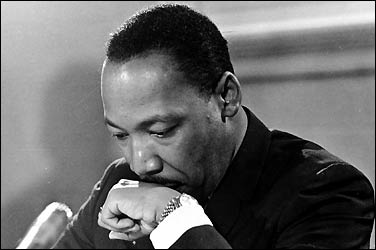 Martin Luther King, Jr.
January 15, 1929 – April 4, 1968
He fought to set us free from the bondage of racism.
Read his Letter from the Birmingham City Jail, annotated, here.
THERE ARE WORSE JOBS THAN BEING A LAWYER
January 14, 2011 § Leave a comment
CareerCast has rated 200 jobs for 2011, ranking them from best to worst. You can read the complete ranking here, and their methodology is here. The jobs are ranked and assigned an overall score using a combination of criteria, including salary, hiring outlook, stress, physical demands and work environment.
I’ve gone through the list and selected some jobs of interest to the legal profession, some directly law-related, and some purely for comparative purposes. The number in parentheses before each job title is the job’s rank. The number following each job title is the job’s stress factor, which I have included so that you can compare your profession’s to others.
The top three most desirable jobs are (1) Software Engineer 10.400, (2) Mathematician 12.780, and (3) Actuary 16.040.
The highest law-related job is (13) Paralegal 12.650. Next comes Court Reporter at (31) 18.560.
And another legal job does not show up until the 50’s, where Judge 21.390 pops up at (53).
(82) Attorney 36.110 is the next and last job of the legal-judicial field.
Some jobs rated above attorney are:
(10) Dental Hygienist 12.070
(18) Parole Officer 12.550
(32) Chiropractor 13.580
(68) Clergy 21.26
Some jobs rated lower than Attorney are:
(83) General Practitioner Physician 25.650
(92) Psychiatrist 24.420
(94) Registered Nurse 30.140
(101) Surgeon 16.32
(114) Senior Corporate Executive 47.4
(121) Commercial Airline Pilot 59.530
(140) Bartender 13.070
The worst three jobs are (198) Lumberjack 40.90, (199) Ironworker 31.270, and (200) Roustabout 26.430.
I did not find Chancery Clerk on the list. Does that mean that that job is ranked lower than 200 (Roustabout)?
It was no surprise to me that the stress level for Attorney is as high as it is, even higher than a general practice physician. But cleaning plaque from people’s gums and rooting around in their mouths is rated higher than any legal job? Sheesh.
INSOLVENT ESTATES
January 13, 2011 § 5 Comments
When the debts and expenses of the estate exceed the value of its assets, the estate is said to be insolvent, and there is a procedure for adjudication of insolvency, satisfaction of creditors, and payment of administration expenses that is spelled out in MCA § 91-7-261 through -268.
The estate is insolvent when its debts and the expenses of administration exceed the value of the real property and the other property that is not exempt. You can find out more about exempt property here.
Either the administrator or a creditor may petition the court to adjudicate its insolvency.
MCA § 91-7-261 sets out the procedure to determine insolvency. The administrator is required to “take proper steps speedily to ascertain whether the estate be solvent or insolvent.” If the administrator finds that the estate is insolvent, she files a “true account” itemizing all of the personal estate, assets of every description, the land of the deceased, and all of the deceased’s debts. Notice is given to the devisees or heirs, and the matter is presented to the court for hearing. If the court determines from the account that the estate is indeed insolvent, the chancellor will order that the assets be sold and that the expenses of ” … the last sickness, the funeral, and the administration, including the commissions …” are first paid out of the proceeds,” and that any remaining proceeds be divided among the creditors ” … in proportion to the sums due and owing them respectively …”
The procedure for distribution of remaining proceeds among the creditors is provided in MCA § 91-7-269. After the time to probate claims has elapsed, a notice is published for three consecutive weekss in a newspaper published in the county that the claims against the estate will be taken up by the court on a day and at a time certain, that any and all claims not required by law to be probated shall be filed with the clerk by a stated date, and that all creditors may attend. A hearing is held at which the administrator may object to any claim, evidence is presented pro and con, and the court may either allow it in whole or in part, or reject it in whole or in part. The administrator may file a verified application to be reimbursed for claims paid peior to the adjudication of insolvency, and the court shall treat them as if they had been properly probated.
MCA § 91-7-271 provides that the allowed claims shall be paid pro rata, and any creditor not paid within ten day of the court’s order shall have execution against the executor or administrator and the sureties on his bond.
Any suit pending against the executor or administrator at the time of insolvency does not abate, but may be prosecuted to final judgment, according to MCA § 91-7-273, but -274 bars suits from being filed after the estate is declared insolvent. You should read -273 carefully for the effect of and payment of a judgment against the estate for suits that were pending when the insolvency is determined.
UNDERSTANDING THE BEST EVIDENCE RULE
January 12, 2011 § 8 Comments
I would nominate MRE 1002 for second-most misunderstood rule of evidence (the all-time front-runner, without peer, would be the hearsay rule).
It’s fairly common to hear an exchange like this in court:
Atty 1: How much did you pay for the house?
Atty 2: Objection. The best evidence of what was paid would be the closing statement.
That objection and every one like it should be overruled.
MRE 1002 states:
To prove the content of a writing, recording or photograph, the original writing, recording or photograph is required except as otherwise provided in these rules or by law. [Emphasis added]
The rule only applies and requires the original when a party is seeking to prove the content of the original. Farris v. State, 906 So.2d 113, 115 (Miss. App. 2004). It does not apply simply because there exists a writing, recording or photograph that may be considered the “best” evidence of the matter.
The rule comes into play only when (a) the content of the writing, recording or photograph is itself the thing a party is trying to prove, or (b) a party is trying to prove a matter by using a writing, recording or photograph as evidence of it. The rule applies only when one seeks to prove the contents of the writing, photograph or recording so that they may be construed, and does not apply when one is seeking only to prove the existence of a writing, recording or photograph. Kinard v. Morgan, 679 So.2d 623, 625 (Miss. 1996).
An example of (a) would be where the party is trying to testify to the terms of a written contract. The contract itself would be the best evidence, and the original would need to be produced.
An example of (b) would be where the witness is testifying about the a claim based on an invoice that shows the items purchased, dates of purchase and prices. The original invoice would itself establish the claim and would be the best evidence of the transaction.
The rule would not apply to the following situations:
A witness with personal knowledge can testify about how much he earned in a pay period without producing the original pay records. Simply because written documents pertaining to a matter exist does not mean that a witness may not testify on personal knowledge about the matter. On the contrary, though, if the witness does not have personal knowledge and relies on documents for her information, she would be required to produce the original documents.
A witness may testify that a document exists without producing the original, but any testimony about the document’s content will require production of the original.
A person who heard another make a statement that was recorded may testify about what she heard without having to produce the recording.
The rule does not apply to physical evidence that is not writings, photographs or recordings. Riley v. State, 1 So.3d 877, 882 (Miss. App. 2008). In Riley, the appellant argued unsuccessfully that the State had violated the best evidence rule by not offering the original firearm involved in the crime into evidence.
The evidence qualifies as a “duplicate,” as defined in MRE 1001(4).
So here is the bottom line: A witness may testify on personal knowledge about a matter even if there is a writing, recording or photograph that documents the same thing, and the writing, recording or photograph need not be produced in such an event; but you must produce the original if you are trying to prove its content.
An important caveat: Just because you have satisfied MRE 1002 by producing the original does not in and of itself make that original admissible. The document or recording must still meet authentication and hearsay objections, and a foundation must be laid for admission of the photograph.
MRE 1004 provides some exceptions to the requirement for the original, such as loss or destruction of the original, original not obtainable, or original in possession of an opponent. Production of the original may also be dispensed with if the document, recording or photograph pertains only to collateral matters.

