You make the call: Will interpretation
March 31, 2026 § Leave a comment
Based on the facts below, how do you think the court should decide? The answer is in the first comment.
Mary Martha Wiggs died on June 10, 1913, with a valid holographic will. The court is faced with the following provisions:
1st. I give my husband, Capt. J.A. Wiggs, the land known as my home place upon which I now reside, to have and to hold for his natural lifetime, and at his death same to be equally divided among my legal heirs.
2nd. I give my heirs the following described property, to wit: The land known as Chapel Hill place, the land known as my Outlaw place, and all my personal and mixed property to be divided as follows: One share to the children of my sister, Margaret Spencer, one share to the children of my sister Ella Harvey, and one share to be equally divided between my brother Dorsey Outlaw and his children.
The will uses the word “heirs” in each section. In the first section she does not qualify who is meant by “legal heirs”. In the second provision she leaves to her “heirs” but then sets out who she identifies as her “heirs.” The problem is that the individuals listed as her “legal heirs” in the second provision includes individuals who are not her next of kin under the statute of descent and distribution.
So here is the question: how should the court interpret the word “heirs” in the will. There are three options:
- (1) Interpret the word “heir” using its legal meaning under the statute of descent and distribution – disregarding those listed in the second provision who are not legal heirs;
- (2) Use the testator’s definition of “heirs” in the second provision and have that definition apply to the first provision as well so that the individuals listed in the second provision would also get the remainder interest after Capt. Wiggs dies (and her statutory heirs would get nothing if not listed).
- (3) Use the legal definition of “legal heirs” in the first provision to take the remainder interest after Capt. Wiggs dies and use the testator’s definition of “heirs” in the second part and allow those named to take the property identified.
What language creates a fee simple absolute?
March 27, 2026 § Leave a comment
When I come to the present estates and future interests section of my course, the first estate that we discuss is the fee simple absolute. This is the easiest estate to conceptualize – there is no limitations or conditions placed on ownership. It is the largest estate that can be created. The only thing that can cause confusion is the language used to create the grant. It makes sense that a grant provides “O conveys to A” – that conveys all of O’s interest in the property to A. However, a fee simple absolute is also created with the language “O conveys to A and his heirs” or “O conveys to A his heirs and assigns.” This creates confusion. How can this be a grant only to A when it says “and his heirs”? Don’t the heirs have some interest in the property by the language. The answer is no — and to understand why requires, as a lot of things in property do, a trip through history.
This post was triggered by a recent case from the Fifth Circuit out of Texas: Brown v. Carrington (5th Cir. 2025). Brown is a pro se plaintiff who believes that he owns property that was originally conveyed by the State of Texas to Zachariah Godfrey in 1871. The patent (below) conveyed 160 acres from Texas to “Zachariah Godfrey his heirs or assigns forever.”
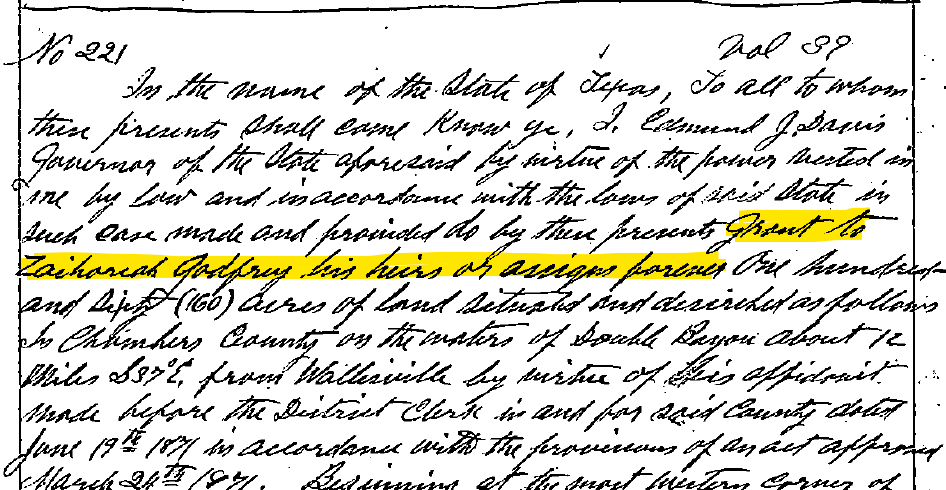
After a great deal of geneological sleuthing, Brown determined that he was Godfrey’s seventh-generation descendant. In his complaint, Brown argues that the grant expressly states that it is to Godfrey and “his heirs and assigns forever”; therefore, the property passed through intestate succession to him. The panel (Judges Barksdale, Willett, and Duncan), in a per curiam opinion, dashed Brown’s hopes for the property:
The basic problem is Brown’s mistaken notion that the original patent’s reference to “heirs and assigns” somehow conveyed title to him as Godfrey’s descendant. It did not. As the district court explained, “heirs and assigns” are “words of limitation” describing the quality of an interest in land, not “words of purchase” indicating who will receive the interest….The phrase signifies only that a deed conveys a fee simple interest as opposed to a life estate….
But Why? The historic development of the Fee Simple Absolute
Scott Brown found out the hard way that words aren’t always what they seem in the law. How did we get here?
Picture it – it is 1066 and William the Conqueror has taken over England. To reward his supporters, William distributed land taken from the Saxons to the barons that supported him. In return for the right to possess (not own) the land, the barons would provide services to the king. In return, the barons would transfer interests to others – perhaps knights who would then provide service (on behalf of the baron) to the king, or to tenants who worked the land (villeins). All the transfers were presumed to be for life. At first, it was likely that, at the death of the tenant, the king (or baron) could deny rights in the property to the heirs of the tenant, but, over time, the custom became established that the property would go to the heirs of the tenant. In fact, the grants began to recognize this custom and include the language to the new tenant “and his heirs.” By the mid-twelfth century, this grant would entitle the heirs a legal right to the property. Over time (by the mid thirteenth century), the common law began to recognize the right of a tenant to transfer property during their lifetime – and extinguish any rights of the heirs.
It was in 1290, with passage of the statute Quia Emptores that the rights of ownership began to exist as we have them now. Feudal rights fell away and a conveyance to a grantee “and his heirs” conveyed a fee simple absolute. That statute established that the fee could be transferred during life to a grantee – and the heirs of the grantor would have no interest in the property. With the enactment of the Statute of Wills in 1540, fee holders could also convey an interest in property at death through a valid will.
Therefore, by 1540 in England, any rights that heirs held in fee simple absolute property were eliminated. Furthermore, the fee could be conveyed during lifetime or at death (either by will or by intestate succession). The common law continued to require the traditional language to create the fee simple estate that had been used in feudal times – “and his heirs.” While not giving any interest to the heirs, it did indicate the estate being transferred was a fee simple absolute. It also meant that, if the grant was merely “to A” – it would be interpreted as conveying a life estate and not a fee simple absolute.
*Drawn from Stoebuck & Whitman, The Law of Property (3rd ed.)
The Law in Mississippi
While many English laws regarding property were incorporated into the common law in Mississippi, the legislature early on (as early as 1848), abrogated the common law presumption that a conveyance “to A” would create a life estate. The legislature also eliminated the need to use the magic language “and his heirs” to create a fee simple absolute. The current statute is Miss. Code Ann. § 89-1-5:
Every estate in lands granted, conveyed, or devised, although the words deemed necessary by the common law to transfer an estate of inheritance be not added, shall be deemed a fee-simple if a less estate be not limited by express words, or unless it clearly appears from the conveyance or will that a less estate was intended to be passed thereby.
If you would like to see the most recent case that I can find in which a court held that a grant which reads “to A” creates a life estate because it does not include the language “and his heirs”, see Cole v. Steinlauf, 136 A.2d 744 (Conn. 1957). The holding in Cole was overturned four years later in Dennen v. Searle, 176 A.2d 561 (Conn. 1961). All states now follow the same rule as Mississippi.

