KING IS A SUPREME
February 24, 2011 § Leave a comment
As expected, Governor Barbour appointed Judge Leslie King of the Court of Appeals to replace Presiding Justice James Graves, who has left the Mississippi Supreme Court to serve on the US Fifth Circuit Court of Appeals.
The press release from Chief Justice Waller:
February 23, 2011
Mississippi Supreme Court Chief Justice Bill Waller Jr. welcomed Justice Leslie D. King to the state’s highest court and thanked Gov. Haley Barbour for his appointment.
Chief Justice Waller said, “Judge King has provided strong and effective leadership of the Court of Appeals for nearly seven years. The Court of Appeals reviews hundreds of legal decisions each year, giving prompt and thorough attention to each case. It is essential that matters affecting people’s lives and liberty be addressed quickly, yet thoroughly. Judge King has guided the Court of Appeals in fulfilling its mission.”
“I welcome Justice King to the Supreme Court. His work ethic and extensive knowledge of the law will be a tremendous asset to the state’s highest court,” Chief Justice Waller said.
Justice King will fill the position vacated by Presiding Justice James E. Graves Jr.,who was appointed to the 5th U.S. Circuit Court of Appeals.
Gov. Barbour will appoint a judge to the vacancy on the Mississippi Court of Appeals. Justice Jess H. Dickinson of Gulfport, third in seniority on the Supreme Court, has become a presiding justice of the Supreme Court.
Mississippi has a two-tier appellate court system. The Mississippi Supreme Court is the court of last resort among state courts. The Mississippi Court of Appeals, an intermediate appellate court, hears cases assigned by the Supreme Court. The Supreme Court has discretion over whether to review decisions of the Court of Appeals. If the Supreme Court declines review, the Court of Appeals decision stands.
RESCUING THE FORGETFUL WITNESS
February 24, 2011 § 3 Comments
It’s a familiar scene. The witness is asked a crucial question and suffers that dreaded lapse of memory. “I don’t remember,” she says, and the lawyer knows the answer is right there on counsel’s table. How do you recover?
Unfortunately many lawyers follow the “I don’t remember” response with a leading question in an attempt to suggest the answer. That provokes a series of objections to leading questions and even, “The witness has already said she doesn’t remember, so she can’t answer any questions about this!” Often the examining lawyer gives up and moves on to something else.
The solution is in MRE 612, which allows a witness to use just about anything, admissible or not, to refresh his or her recollection.
Instead of asking that suggestive question, simply ask the forgetful witness whether there is anything she could refer to that would refresh her recollection. When she says she needs to look at her calendar, or her checkbook, or her diary, or her driver’s license, hand it to her and ask her to take a moment and look it over, and then ask the question again. Any objection should be overruled because she said she needed to refresh her recollection, and she should be allowed to do so. Note that any object can be used. It may be a photograph of a loved one, or a pencil, or a cell phone. The rule does not require that it be admissible in evidence.
Whatever object is used is subject to examination and inspection by the other side. And, of course, that is the practice as to any document or object used by a witness on the witness stand. The other party has the right under Rule 612 to offer into evidence those portions relating to the witness’s testimony, and there is a procedure for objecting to portions of the document that are not relevant, and preserving for appellate review any matter not made a part of the record.
It is quite common in court for a witness to say, “I need to look at some papers on the table to answer that.” The court will routinely allow the witness to look at what he or she needs to answer.
Rule 612 is the only procedure available to refresh a witness’s recollection. It is limited to a writing or a tangible object, and does not apply to an out-of-court oral statement, which would simply be an attempt to circumvent the hearsay rule. Eastover Bank v. Hall, 587 So.2d 266, 269 (Miss. 1991).
Some lawyers apparently confuse attempts to refresh the recollection of the witness with MRE 803(5), which pertains to the admissibility of a recorded recollection in a memorandum or record in lieu of the witness’s testimony when the witness has no recollection of the facts in the record. The two rules address different problems: Rule 612 is a method to refresh the recollection of the witness; Rule 803(5) is a way to get the facts in the record via documentary proof when the witness has no recollection.
Another source of confusion for older lawyers is that Rule 612 is a departure from pre-MRCP practice. In the era before MRCP it was much more cumbersome to refresh a witness’s faulty memory. But that was then (now 28 years ago) and this is now. If you’re still playing tapes of pre-rules practice in your head after all these years, you need to get out a rule book and get up to date.
GET BELL ON YOUR CALENDAR
February 23, 2011 § 1 Comment
If you’re practicing family law in Mississippi, you need to add professor Deborah Bell’s seminars to your calendar every year. There is one within an easy drive of where you are. This year, for the first time in my feeble memory, the seminars are in the summer. They are usually in May.
You get a book with a synopsis of every family law case decided in the appellate courts in the preceding year, a lecture focusing on the most significant cases, a bonus lecture focusing on a specific area of family law, and an ethics hour.
Save the date. Here’s the email I received:
| The 15th Annual Family Law CLE Professor Deborah Bell, Seminar Leader This year’s Family Law CLE will be presented on the following dates and locations: Jackson · Friday, July 22, 2011 Oxford · Friday, July 29, 2011 Gulf Coast · Friday, August 5, 2011 _______________ Save the dates for this annual 6 hour CLE providing comprehensive overviews of the last year’s family law developments. Includes one hour of ethics credit.
Family Law CLE
P.O. Box 40 Taylor, MS 38673 Make check payable to: phone: 662-513-0159
|
“A DEPOSITION IS NOT A TAKE HOME EXAMINATION”
February 22, 2011 § Leave a comment
Has this ever happened to you? You suffer through a stupefying day of depositions of the opposing party and his witnesses, and you receive the signed, sworn copies, only to discover that the witnesses have used the errata sheets to rewrite their testimony. The points you thought you had conclusively nailed down are now unnailed.
In the recent case of Hyundai Motor America v. Applewhite, the supreme court ruled that defendants were entitled to a new trial because plaintiffs’ expert had used the errata sheet to revise the formulas he had relied on to make the calculations upon which his opinion was based in the deposition. Defendants argued that they had never received the errata sheet, and that they were surprised by the changed testimony at trial. The supreme court opinion stated at ¶ 34:
“The trial judge did not make a factual finding as to when Hyundai became aware of the contents of Webb’s errata sheet, but such a finding is unnecessary and irrelevant to our analysis. Even if Hyundai did receive the errata sheet, simply giving the defendant this document did not relieve the plaintiffs of their duties under Mississippi Rule of Civil Procedure 26(f). The purpose of an errata sheet is to correct scrivener’s errors or provide minor clarification; it is not a means of making material, substantive changes to a witness’s testimony. See e.g., Garcia v. Pueblo Country Club, 399 F.3d 1233, 1242 n.5 (10th Cir. 2002) (“A deposition is not a take home examination.”) If a witness changes his testimony in a manner that conflicts with prior discovery responses, the sponsoring party has a duty under Rule 26(f) seasonably and formally to amend or supplement the response. Choctaw Maid Farms, Inc. v. Hailey, 822 So. 2d 911, 916 (Miss. 2002). This is the responsibility of the party or parties sponsoring the witness, not the responsibility of the witness.”
This decision is a welcome clarification. It’s frustrating when you think you have covered all the bases in your depositions only to find that you are back at the beginning. This decision removes an element of gamesmanship from discovery.
ROUXOLOGY 101
February 21, 2011 § 3 Comments
“First, make a roux.” How many times have you seen that line staring at you from a recipe for a Cajun dish? Does it give you a little shiver of anxiety? Do you wonder whether you should just skip that step?
Roux is one of the holy mysteries of Cajun cooking, and if you’re going to cook Cajun dishes like Cajuns do, you are going to have to get a handle on how to make a roux. You will have to understand some of the basics of rouxology (don’t bother to check that on Wikipedia; it’s a word I made up). Here are the basics. But before you proceed, you might want to take a moment to read over some of my thoughts about Cajun cuisine here and here.
Roux, of course, is simply flour cooked in fat. But that is like saying that a jet airplane is sheet metal and fasteners. Both statements are essentially true, but neither even begins to convey the complexity and gestalt of the thing. How roux interacts with the ingredients and what it adds to a dish is anything but simple. The nuances of roux vary with its color and consistency, and its variations can confer an immense array of flavors and consistency to your dishes. Roux is almost infinitely variable and malleable in what it can do for your recipes.
The tools you will need to make your roux will be a heavy pot (I like Creuset enamelled cast iron, but any heavy pot will do) and a wooden spatula. The heavy pot will evenly distribute the heat and help you manage the cooking. The spatula will enable you to stir the mixture thoroughly, keeping it from burning. As you will see, stirring is most important, and the greater quantity of roux you can stir at a time will make you more efficient and effective. A spoon will work, but the amount of roux you are able to move with a spoon is miniscule compared to the spatula.
What are the quantities of ingredients? Depends on what you are cooking. A white roux for a béchamel sauce may require no more than a tablespoon each of butter and flour. A “red” or golden roux for a courtbouillon or jambalaya may require several tablespoons each of vegetable oil and flour. If you are making a big pot of gumbo with a dark roux, you may need a cup or more each of flour and vegetable oil. As you learn to use and manage roux, you will learn about how much or little is needed.
What is the ratio of flour to fat? Again, it depends. A safe ratio is one to one, but individual preferences come into play. I prefer the consistency of a little more oil than flour. Your mileage may vary.
What flour? Any all-purpose white flour will do the job. I have heard of people using whole wheat flour, but whatever you read here is based on using white flour.
What fats will work? It boils down to this: Lighter fats (e.g., butter and olive oil) work fine for white rouxs. Stouter fats (e.g., vegetable oil, bacon grease, shortening) are needed for darker rouxs. You cannot use a light oil for a dark roux because it will burn before the roux gets to the color you need, and a burned roux is a failed roux. The one exception I have read about but never tried is that you can use clarified butter to make a dark roux. My preference is for a good quality vegetable or canola oil. It is healthier than bacon fat or shortening, and it works perfectly fine.
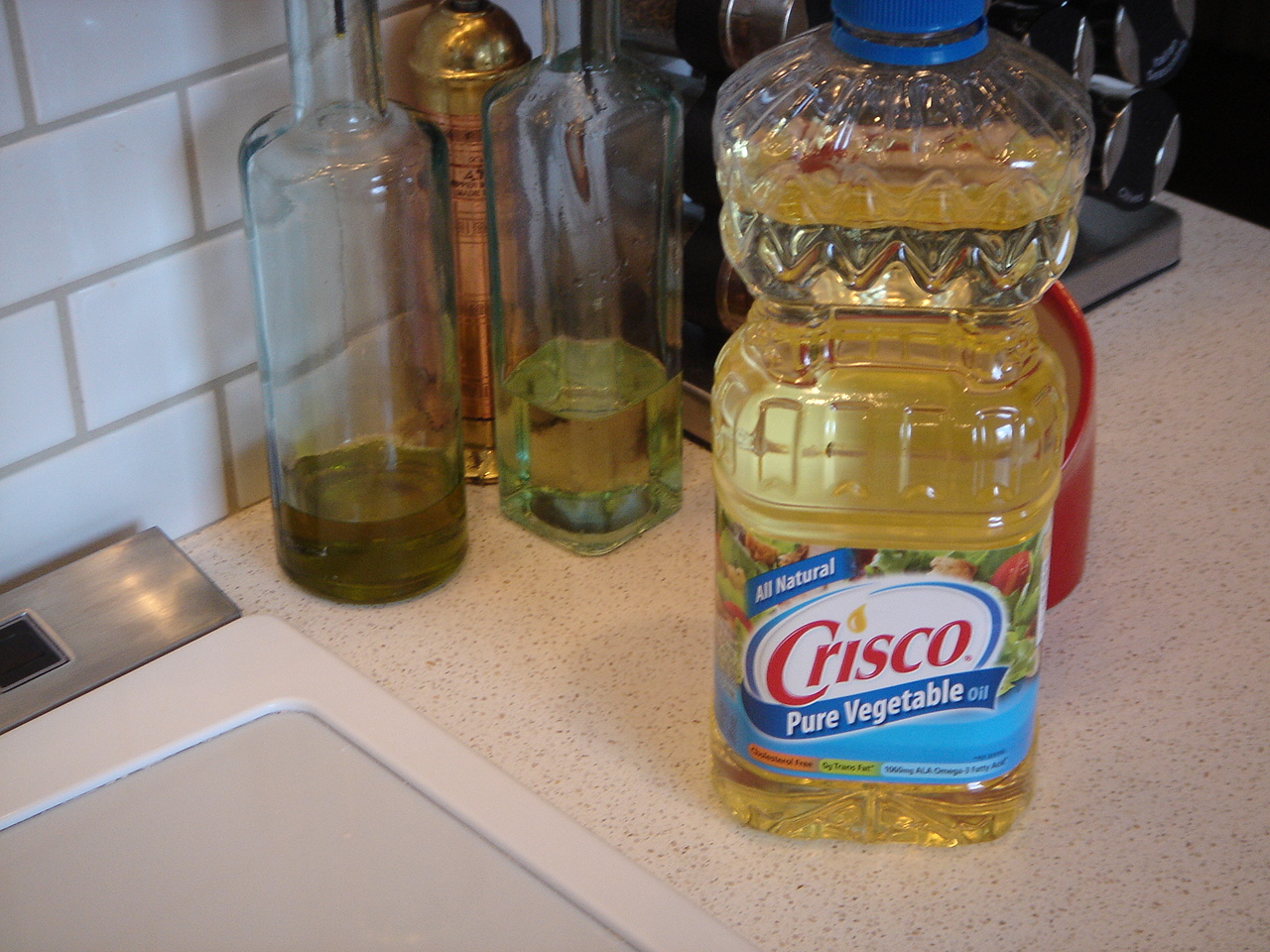
I prefer a good quality vegetable oil
Before you start cooking, here are a few principles of rouxology you need to know:
- The lighter the roux, the greater its thickening power and the less flavor it adds to the dish.
- Conversely, the darker the roux the less thickening power it has, but the greater flavor it imparts.
- A medium (red or golden) roux will thicken the dish and add some flavor, but not as much flavor as a darker roux.
Bottom line: There is no “one size fits all” roux. That is why I will not buy or use the canned or bottled roux products one sees in so-called Cajun groceries on the interstate or New Orleans or up north (although, sad to say, I have seen it on the shelf in groceries in sw Louisiana; I guess convenience and busy schedules rule). The roux you use to make a sauce picante is entirely different from the roux you use to make a wild duck and sausage gumbo. Besides, why would you want to buy a canned version of something that is so easy and entertaining to whip up yourself once you understand how?
So let’s get started with a golden or dark roux.
Pour the oil into the pan and then add the flour. Mix together to make a thin paste, being sure that any lumps are dissolved. Turn the heat to medium-high or high. I have heard people say that a roux should be cooked on low heat for a long time. I once hunted with a guy from Demopolis, Alabama, who took two hours to cook a dark roux for the hunting camp. More power to him, but my roux is every bit as good in a fraction of the time. That’s the way I learned to do it.
In a few minutes, the paste will begin to bubble. If you haven’t already started stirring, now is the time to start. Stir, stir, stir, making sure that you keep redistributing the mixture over the heat and that you keep it turning color evenly. As it cooks, the roux will take on a darker and darker color, turning first from white to a creamy gray, then to tan, then a golden, tawny brown (some call this “red” because it can give a reddish tint to your dish), and then shades of brown, from a fricasee-ochre color to dark brown ranging from milk chocolate to dark chocolate, and then, finally and fatally black, as in burnt. To stop cooking at the color you want, pull the pot off the fire and mix the vegetables in; adding the vegetables will arrest the cooking process.
Stirring is vitally important in the cooking process, but be careful in your zeal not to splash. Cajuns call hot roux “Cajun napalm” for the reason that it will stick to you and burn if it escapes from the pot. Handle with care.
Golden roux (aka red roux) is more or less the color of a paper bag, and will add that golden or reddish hue to your dish and significantly thicken it. Because of its thickening properties, don’t use as much of a golden roux in your dish as you would a darker roux. A golden roux is best for a courtbouillon, jambalaya, sauce picante or étoufée (if you’re one of those people who makes étoufée with a roux).
A shade darker is a brown roux between dark brown and golden, which will be the color of your dish. It doesn’t thicken as well as a golden roux, but it adds a rich, deep flavor that a golden roux lacks. It’s the best roux for a chicken gumbo and for more delicate ingredients like crab meat or oysters.
The darkest dark roux adds a distinctive nutty flavor and a dark color that can make a simple dish memorable. It lacks much thickening power, so you will generally use more in your recipe than you would with a lighter-colored roux. Dark roux is best for dark-meat gumbos (e.g., wild duck and sausage), and crawfish, crab, shrimp or chicken stews.
A black roux is, simply put, a failure. It’s burnt and will make your dish bitter and inedible. And the entire roux does not have to be black. Black specks mean burned ingredients and bitterness. Unfortunately, as with most things in life, there is a fine line between success and failure. Likewise, there is a fine line between the best dark roux and the inedbile black roux. Knowing when to stop comes with experience. Expect some burned rouxs in your roux-cooking career. They are part of the learning experience.
What about a white roux (roux blanc)? Roux blanc is used as a base for some white sauces such as béchamel and as a thickener in many recipes. Cook and stir as you would any other roux, and follow the recipe’s instructions as to the color. Some roux blancs must be very white, and others creamy. I am not aware of any Cajun recipes that call for a roux blanc, but if you’re going to learn about rouxs, you need to have this one in your repertoire.
Here’s a video, avec la musique Acadienne, that I made to guide you step by step …
So you’re cooking merrily away and you suddenly get the feeling that your roux is cooking too fast. Maybe it’s beginning to smoke, or you sense that it is thickening too quickly, or one area is turning pasty brown while another is still milky white. What to do? Pull the pan off the heat and stir, stir, stir. Remember that the pan retains its heat, and if you don’t stir, the roux will burn, even if it is off the fire. Make sure while you stir that you keep making contact with every bit of the roux. Try to contact one third of the mixture with one sweep, then the next third, and then the last third and repeat, repeat, repeat. When you feel that things are back under control, return the pan to the heat and continue on.
Or what about when everything seems to be going well and you are on your way to that perfect color. The phone rings, or you see the dog peeing on the kitchen floor, or that annoying security-system salesman is back at the front door ringing the doorbell and you’d love to give him a piece of your mind. Should you just turn off the heat and answer the phone, or let the roux simmer while you throw the dog out into the back yard, or pull the pan off the burner and go yell through the door at the salesman? Should you just leave your precious roux for that teensy minute to address the distraction? NEVER!!! If you stop stirring, even for 30 seconds, the roux will burn. Never stop stirring after the roux first bubbles. Never. Return the call later, or deal with the dog after you cook your roux, or let yourself take zen satisfaction at the mental image of that salesman futilely ringing away on the front porch while you’re stirring serenely. The roux results will be worth your efforts and attention.
It takes time and experience to master the art of cooking a successful roux. One stab at it or attempting it once a year for five years will not do it. As my dear grandmother used to say, “Lâche pas la patate.” Literally, it means in Cajun French “Don’t drop the potato,” which was her way of saying, “Stick with it; hang in there and you’ll make it.”
Now you know the basics of making a roux and how to use it. Will this knowledge make you an honorary Cajun? No, but it is an important first step in improving your Cajun cooking dramatically.

LINCOLN’S NOTES ON THE PRACTICE OF LAW
February 18, 2011 § 4 Comments
 Among the many facets of his notable life, often overlooked, is Abraham Lincoln’s career as a lawyer. It’s not hard to imagine the rough-hewn Lincoln in country courthouses questioning witnesses, holding forth to the court, and regaling juries. Even though he achieved respect of his peers and some wealth in his practice in his representation of a railroad, he retained his homespun country lawyer patina.
These notes are some he roughed out for a speech on the practice of law that he never delivered. Despite the fact that they were never refined to the point of oratory, they reflect the philosophy of an everyday lawyer that we can appreciate nearly 150 years later.
I am not an accomplished lawyer. I find quite as much material for a lecture in those points wherein I have failed, as in those wherein I have been moderately successful. The leading rule for the lawyer, as for the man of every other calling, is diligence. Leave nothing for to-morrow which can be done to-day. Never let your correspondence fall behind. Whatever piece of business you have in hand, before stopping, do all the labor pertaining to it which can then be done. When you bring a common-law suit, if you have the facts for doing so, write the declaration at once. If a law point be involved, examine the books, and note the authority you rely on upon the declaration itself, where you are sure to find it when wanted. The same of defenses and pleas. In business not likely to be litigated, — ordinary collection cases, foreclosures, partitions, and the like, — make all examinations of titles, and note them, and even draft orders and decrees in advance. This course has a triple advantage; it avoids omissions and neglect, saves your labor when once done, performs the labor out of court when you have leisure, rather than in court when you have not.
Extemporaneous speaking should be practised and cultivated. It is the lawyer’s avenue to the public. However able and faithful he may be in other respects, people are slow to bring him business if he cannot make a speech. And yet there is not a more fatal error to young lawyers than relying too much on speech-making. If any one, upon his rare powers of speaking, shall claim an exemption from the drudgery of the law, his case is a failure in advance.
There is a vague popular belief that lawyers are necessarily dishonest. I say vague, because when we consider to what extent confidence and honors are reposed in and conferred upon lawyers by the people, it appears improbable that their impression of dishonesty is very distinct and vivid. Yet the impression is common, almost universal. Let no young man choosing the law for a calling for a moment yield to the popular belief — resolve to be honest at all events; and if in your own judgment you cannot be an honest lawyer, resolve to be honest without being a lawyer. Choose some other occupation, rather than one in the choosing of which you do, in advance, consent to be a knave.
Discourage litigation. Persuade your neighbors to compromise whenever you can. Point out to them how the nominal winner is often a real loser — in fees, expenses, and waste of time. As a peacemaker the lawyer has a superior opportunity of being a good man. There will still be business enough.
Never stir up litigation. A worse man can scarcely be found than one who does this. Who can be more nearly a fiend than he who habitually overhauls the register of deeds in search of defects in titles, whereon to stir up strife, and put money in his pocket? A moral tone ought to be infused into the profession which should drive such men out of it.
The matter of fees is important, far beyond the mere question of bread and butter involved. Properly attended to, fuller justice is done to both lawyer and client. An exorbitant fee should never be claimed. As a general rule never take your whole fee in advance, nor any more than a small retainer. When fully paid beforehand, you are more than a common mortal if you can feel the same interest in the case, as if something was still in prospect for you, as well as for your client. And when you lack interest in the case the job will very likely lack skill and diligence in the performance. Settle the amount of fee and take a note in advance. Then you will feel that you are working for something, and you are sure to do your work faithfully and well. Never sell a fee note — at least not before the consideration service is performed. It leads to negligence and dishonesty — negligence by losing interest in the case, and dishonesty in refusing to refund when you have allowed the consideration to fail.
Thanks to Legal Ethics Blog.
“QUOTE UNQUOTE”
February 18, 2011 § 1 Comment

Sartre with Simone de Beauvoir
“Words are loaded pistols.” — Jean-Paul Sartre
“Mind your thoughts, for they become words. Mind your words, for they become actions. Mind your actions, for they become habits. Mind your habits, for they become character. Mind your character, for it becomes your destiny.” — Old saying
“A kind word is like a spring day.” — Russian Proverb
NO VOTE TODAY
February 17, 2011 § Leave a comment
The judicial pay raise bill was called for a third time today to keep it alive until the ultimate deadline around mid-March. This is a tactic commonly used when the sense is that there are not enough votes to pass. It gives more time to marshal votes.
My sources suggest that there was plenty of misinformation floated today. There were astronomical figures circulated about how much the bill will cost the counties due to county court, although only 5 counties would be affected. DHS weighed in against it due to the increase in filing fees, despite the fact that the chancellors can and do assess costs against the defaulting child support payors.
I hope this turns out all right, but I’m not optimistic. I look at judges like Mason and Bailey who have served the state faithfully and have done a phenomenal job with only a rare reward of a pay increase, and I wonder what the message is that our legislators are trying to send. The judge is nearly always the lowest paid lawyer in the room, yet they manage to uphold the dignity and authority of the State of Mississippi day in and day out.
I sincerely believe that if the members of the bar will get behind this and push their legislators, it will pass.
One last request: Please talk to your legislator. We need the best government we can afford, not the cheapest we can get by with. I won’t bother you with this any more.
THE PAY RAISE BILL TODAY
February 17, 2011 § Leave a comment
The judicial pay raise bill comes up for a vote before the full House today at 2:00 p.m. If you support the bill, and I hope you do, it’s critical that you contact your legislators and tell them how important it is to you for them to vote for it.
As lawyers, you can appreciate the importance of an independent judiciary. Adequate pay is an important component of independence. Trial judges in Mississippi have not had a pay raise in seven years, and our pay is the lowest in the United States. In that seven year period, other state employees have had significant pay increases, some of which have been quite large. The judges have been told repeatedly to wait. When we had the money to fund judicial raises, the “time is not right” for one reason or another. Now that we do not have the money and we are seeking to fund the raise with an increase in our court fees (which will still be the lowest in the southeast after the increase), there are still objections:
- Some argue that the bill does not fund itself. Justice Waller insists that the numbers do work. The prosecutors hitched themselves to our bill, and those numbers are being crunched, but the hope is that it will work. If the bill will not pay for itself, Governor Barbour will not sign it.
- I am hearing that the board of supervisors association is working against the bill on the basis that it is an unfunded mandate for the five counties whose county court judges are tied to the trial judges salaries. This is an interesting argument since the supervisors made no such objection to the dramatic increases in justice court judge and county prosecutor pay increases. I understand from one source that there were brochures being circulated within an hour or so of the bill coming out of Judicial “A” on this issue.
- DHS has pointed out that the bill will impose additional court costs on its child support filings.
- Members of the conservative caucus are against any increase of anything. If your legislators were among those who voted against any funding of the judiciary at all, it would help if you would give them a call and explain why the judicial branch not only needs to be funded, but why the trial judges need pay increases.
I’ve spelled out these objections so that you can be prepared to meet them when you talk with legislators. It would also help to arm yourself with the facts from Justice Waller’s message below.
The entire judicial branch budget is not even one percent of the entire state budget. We say that we have three equal branches of government that balance each other, but our budget does not bear that out.
This issue is important to your trial judges. If you feel the same as a member of the bar, I ask you please to exercise your influence with your legislators. A simple call or email will do the job. Thanks.

