“QUOTE UNQUOTE”
April 8, 2011 § Leave a comment
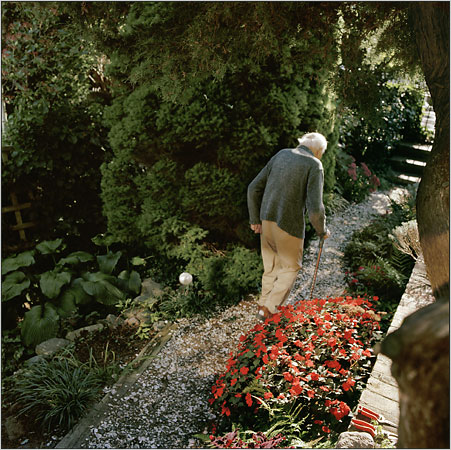
The way I look
at it, I’m passing through a phase:
gradually I’m changing to a word.
Whatever you choose to claim
of me is always yours;
nothing is truly mine
except my name. I only
borrowed this dust.
— Stanley Kunitz
APPEARANCES CAN BE DECEIVING
April 7, 2011 § 5 Comments
When do your actions constitute an appearance in court on behalf of your client? It’s an important question, because your actions or non-actions can result in professional liability for you.
Take for example this scenario:
Joey, an old client, and his daughter meet with you one morning. Joey is upset because his wife, Betty, has filed a divorce complaint against him. He wants you to represent him, but he can’t afford your retainer, and you know from past experience that he probably won’t pay your bill. In an effort to mollify Joey, you call the lawyer on the other side and tell him that Joey is willing to agree to a divorce, and if Betty will provide a list of property she wants, the case can be settled. You hang up the phone, Joey and daughter leave thinking all is taken care of, and you promptly put it out of your mind, turning your attention to paying clients.
Fast forward a few months. Joey returns to your office quite upset. He hands you a judgment granting Betty a divorce and giving her most of the marital assets. Oops.
What happens next? In the case of Simmons v. Simmons, with facts almost identical to those above, Joey’s lawyer filed a motion to set aside the divorce on the basis that the phone call constituted an appearance. The opposing attorney took the position that he had a vague recollection of a phone call from someone, but could not even remember who called him, and he went forward with the divorce when his client insisted he finalize the case. The chancellor overruled Joey’s motion, and Joey appealed. The COA held that the chancellor’s finding that the phone call did not amount to an appearance was one of fact, and would not be disturbed on appeal.
So how do you protect yourself in these situations? A few suggestions:
-
Don’t do it. Don’t make that call. Explain to Joey that you can not just call the other lawyer without being retained. If you call, Joey will likely believe that you now represent him, retainer or none, and you may well have a professional responsibility to him.
-
Okay, if you simply can not resist, then don’t make the phone call without a representation agreement. If the client can’t pay the full freight tab, consider a limited scope representation agreement at a lesser rate, and reduce your services accordingly.
-
Document, document, document. Write a letter and follow up. Fax the letter; that fax transmission notation and receipt may be just the proof you need if the lawyer on the other side claims he never received the letter.
You’ve probably thought of a few other measures you could take. Good. Protect yourself.
Just last week I continued a divorce trial (for two weeks) because a lawyer had gotten into a similar swivet. To make matters worse, the lawyer has a letter from the defendant, who is in Rankin County Correctional Facility, thanking him for his efforts in representing her, although all he did was make a couple of phone calls to counsel opposite. He has two weeks to get straight with his client/non-client.
Another post on this subject is here.
STAY OF EXECUTION
April 6, 2011 § 5 Comments
In a divorce the judge grants your client a judgment in the amount of $115,000 for her interest in a marital-asset business. The judge orders the husband to pay the judgment at the rate of $500 a month. Can you execute on the judgment even if the husband is making the payments as ordered by the court?
The answer is Yes, you may execute regardless of his payment history.
In the case of Jenkins v. Jenkins, handed down March 29, 2011, the COA cited Peeples v. Yarbrough, 475 So.2d 1154, 1158-59 (Miss. 1985), and reversed a chancellor’s ruling that execution on the judgment was stayed as long as the defendant made the payments as ordered. The COA held that the chancellor has no authority to stay execution on the judgment, although the judge does have the authority to order and enforce a payment schedule.
So what to do if the chancellor does include a stay with entry of the judgment? I would suggest that you file a timely MRCP 59 motion to reconsider citing Jenkins and Peeples. If you don’t, you run the risk of running afoul of your trial judge, even if his or her judgment was contrary to the law.
DICTA
April 5, 2011 § 1 Comment
- National Affairs has a thoughtful article on The Auto Bailout and the Rule of Law that will get you thinking about what happens when political and economic exigencies collide with the law.
- Wondering how to retire with no savings? You may be surprised to learn that many people do. Pop Economics takes a look at the phenomenon.
- What would it be like to fly as a passenger on the world’s fastest bird, the peregrine falcon? Find out here via this BBC video.
- Is it contradictory to claim to be a conservative and be in favor of tort reform? If you hate the federal health care mandates, how can you love federal tort reform? Some food for thought on the subject here.
- Are Apple and Nokia headed the way of the stegosaurus? Bruce Everiss thinks they are.
- So with Apple and Nokia easing into oblivion, is Windows Phone 7 the next big thing? Maybe not.
- The dramatic death of Soviet cosmonaut Vladimir Komarov in 1967, with sound track.
- If you’re wanting to keep up with just about every reported instance of police misconduct across the country, check out the daily-updated Injustice Everywhere blog.
- And is the Tasmanian Devil headed down the fateful path of Apple and Nokia? It seems that an epidemic is taking its toll on the creatures, claiming as much as 90% of the wild population to date.
Tasmanian devils:

THE UNDESIGNATED EXPERT
April 4, 2011 § 3 Comments
Uniform Chancery Court Rule (UCCR) 1.10 states that, “Absent special circumstances the court will not allow testimony at trial of an expert witness who was not designated as an expert witness to all attorneys of record at least sixty days before trial.”
The question arises from time to time whether Rule 1.10 requires disclosure where there has been no discovery request asking information about expert witnesses. The question was answered succinctly in City of Jackson v. Perry, 764 So.2d 373, 383 (Miss. 2000), in which the Mississippi Supreme Court was confronted with a situation in a circuit court trial where the trial judge had allowed the testimony of two expert witnesses who had not been designated under the circuit court rule counterpart to UCCR 1.10. The high court’s opinion states the law as follows:
“The City and Edwards argue that the trial court erred in allowing Officers Charles Smith and Tim Corbitt to testify as experts without being designated pursuant to Rule 4.04A of the Uniform Rules of Circuit and County Court. Rule 4.04A of the Uniform Circuit and County Court Rules, states that, “[a]bsent special circumstances, the court will not allow testimony at trial of an expert witness who was not designated as an expert witness to all attorneys of record at least 60 days before trial.” The City argues that Perry did not offer any special circumstances, at trial for not having designated either Officer Smith or Officer Corbitt and therefore, the trial judge abused his discretion when he allowed them to testify. The City argues that this Court should rule that the testimony from Officers Smith and Corbitt inadmissible.
“¶ 52. The City’s reliance on Rule 4.04A is misplaced. Rule 4.04A does not stand alone. In order for there to be a violation of a discovery request, there must first be a discovery request. Here, neither party made a discovery request pursuant to Rule 26(b)(4) of the Mississippi Rules of Civil Procedure. Here, the City failed to propound any discovery and conceded there is no discovery violation. The trial court stated that a party “can[not] object to them [Perry] offering it [expert witness] if you don’t ask for it in a discovery request.”
“¶ 53. There was no violation of Rule 4.04A because there was no discovery request pursuant to Rule 26(b)(4).”
If you want to invoke Rule 1.10, you must have made the discovery request for designation of experts. And on the the flip side, if you’re asked to designate experts in discovery, you’d better do so more than sixty days before trial unless you can prove “special circumstances.”
I recently found special circumstances and allowed the testimony of an expert on less than sixty days notice where the case had been put on a fast track to trial due to exigent circumstances, no order expediting discovery had been sought or entered, and the discovery responses were not due under the rules until the day of trial.
Thanks to Professor Guff Abbott at Ole Miss Law School for the cite.
WHEN THE JUDGE RESERVES RULING
March 31, 2011 § Leave a comment
So you just made the most brilliant objection of your legal career and the blankety-blank judge reserved ruling. How could this be? You begin to stew and fret, so much so that you let the witness conclude her testimony and be excused.
Guess what. Your brilliant objection went out the window as the witness left the courtroom. Why?
Uniform Chancery Court Rule 3.04 deals with objections to testimony. It specifically states, “If the Chancellor shall reserve his ruling, counsel interposing the objection shall make a note thereof and renew his objection at the conclusion of the testimony; otherwise he shall be deemed to have waived his objection.” You didn’t renew the objection, so it is waived.
It is fairly common for Chancellors to reserve ruling on an MRCP Rule 41(b) motion to dismiss at the conclusion of the plaintiff’s or petitioner’s case. If the judge reserves ruling, you must renew your motion at the conclusion of your case, or it is deemed waived.
In similar fashion, if the judge reserves ruling on a question or line of questions, be sure to renew that objection in a timely fashion, or you may be “procedurally barred” from raising the point on appeal.
THE VALUE OF THINKING LIKE A LAWYER
March 30, 2011 § 1 Comment
In law school we were taught not so much the law as how to think like lawyers. That is, we were taught to think analytically, to break complex issues into comprehensible components, and to bring creative solutions to bear using the framework of the law.
Michelle Harner of the University of Maryland School of Law has written a remarkable paper entitled, The Value of “Thinking Like a Lawyer,” which you can download here as a .pdf file. The abstract of the paper summarizes it succinctly:
The legal profession was hit particularly hard by the recent recession. Law firms laid off lawyers in record numbers, and law school graduates found few if any employment opportunities. Clients also started rethinking the terms of the lawyer-client relationship, at least in the larger law firm context. Some commentators suggest that these changes are indicative of things to come; that the legal profession is undergoing a long-overdue paradigm shift that will permanently change the nature of the legal profession. This Essay examines these developments through the lens of Larry Ribstein’s The Death of Big Law and Richard Susskind’s The End of Lawyers?: Rethinking the Nature of Legal Services. It compares and contrasts Ribstein’s and Susskind’s analyses of the profession and assesses potential lessons for lawyers, clients, and legal educators. This Essay concludes by encouraging professionals to remain open to changes that improve efficiency and client service. It also stresses the value of preserving and promoting the hallmark of being a lawyer – that is, thinking like a lawyer.
Professor Harner begins by accepting some of the premises offered by Ribstein and Susskind: that forces are at work changing the legal profession; that the legal profession is becoming commoditized and generic; and that survival as a lawyer, and indeed, survival of the legal profession, will demand evolution in the way lawyers offer and market services.
Where she ends up is with the idea that legal thinking has a marketable value, and that lawyers should evaluate the services they offer in terms of the value that their legal thinking can add, as opposed to simply doing all the traditional tasks that lawyers have assumed and which do not require legal thinking, many of which nowadays are being taken over by non-lawyers.
Her challenge is for lawyers and the legal profession to re-examine our ways of looking at the ethical framework in which we operate to determine whether it really does promote the best interest of clients and the profession.
I encourage you to read professor Harner’s paper, and to begin to think about the future of your profession.
OMG, FYI IT’S IN THE OED, LOL! I ♥ IT! OOPS, TMI?
March 29, 2011 § 2 Comments
If anyone has a legitimate claim over authority to have the last word, it’s got to be the Oxford English Dictionary, aka the OED to English word afficianados everywhere. The OED is recognized as being the authoritative source for what is and is not an actual English word (as any accomplished Scrabble fan can tell you).
When one thinks dictionary, however, one may think stuffy, hidebound, behind the times, snooty, pompous. After all, dictionariologists are ivory-tower academicians far removed from the slangy stew that we here in the real world actually speak, right?
Au contraire, mon frère (as George Carlin used to say). The OED is updated almost continuously, as I recently discovered. You can read updates weekly. Yes, weekly. Here is the latest update page; check it out for yourself.
It seems that the OED, in its never-ending quest to remain both authoritative and relevant is constantly prowling around, sniffing through pop culture and its detritus, detecting newly acceptable entrants into our ever-expanding language.
This particular update includes newly-recognized words (really initialisms): OMG (Oh my God, or gosh or goodness), LOL (laughing out loud), FYI (For your info), IMHO (in my humble opinion), TMI (too much info) and BFF (best friends forever), all from the internet. And here’s a stunning addition: ♥, as in “I♥NY.”
A few other neologisms of interest: La-La land; non-dom (non-domiciled); fabless (great word meaning the opposite of fabulous); muffin top (as in waistline flab); dotted line (think organizational chart, not legal document); happy camper; and lumpenintelligentsia (faux German for what I am not sure). There are others.
I am bringing these to your attention for the possibilities they open to spice up your appellate briefs and pleadings. Imagine what this new infusion of vocabalury would add to even the most prosaic pleadings. Take, for example, this paragraph of an Answer to a Complaint for Divorce:
In answer to Paragraph 6 charging him with habitual cruel and inhuman treatment, defendant can only say OMG, she must have been in la-la land when she dreamed that up! FYI the defendant has never manhandled or even been rude to plaintiff, except for one heated argument about whether or not she had developed a muffin-top. Affirmatively, defendant would show that he is not a happy camper due to these charges, even though the relationship was pretty much fabless, defendant has nonethess ♥’d the plaintiff with all his ♥ and truly believed that he and the plaintiff were BFF. He also objects to this airing of the parties’ private business in these pleadings and resulting discovery as TMI.
How could any court frown on such a masterpiece of the language, bearing as it does the stamp of approval of the esteemed OED?
The possibilities appear endless, what with regular updates that literally ladle scoops of delicious new words onto your plate every week.
A MOTHER LODE OF PROOF
March 28, 2011 § Leave a comment
Suppose in an equitable distribution case that you have to prove the balance in a PERS account and its balance on a past date? Or in a contempt case that you have to prove it was a hail storm that did the damage on May 15, 2008? Or in a modification of child support case that the consumer price index has increased by x percent since 2006?
And suppose that in each of the scenarios above counsel opposite will not stipulate to the facts or allow you any easy way to go about proving what you need to prove?
Do you have to subpoena a witness from PERS to bring the records and do calculations in person? Do you have to subpoena a meteorologist to testify as an expert? Are you required to enlist a respected economist to testify about the CPI?
There’s an easier, more efficient way that opens up endless, inexpensive opportunities to prove even the most esoteric matters.
It’s MRE 803(8), which states that, even if the declarant is available to testify, the following are not excluded by the hearsay rule:
Records, reports, statements, or data compilations, in any form, of public offices or agencies, setting forth (A) the activities of the office or agency, or (B) matters observed pursuant to duties imposed by law as to which matters there was a duty to report …
There’s more to the rule involving reports such as police reports and investigative reports, but that’s a subject for another post.
To utilize that part of Rule 803(8) stated above, all you have to do is produce a certified copy of a record or report of a public agency that sets forth either activities of the agency or matters observed pursuant to a duty imposed on the agency by law.
To prove the balance in the PERS account and its balance on a past date, get a certified copy of a report from PERS itself showing that information.
The hail storm on May 15, 2008, can be proven through a certified report from the National Weather Service.
The U.S. Department of Commerce can give you a certified copy of a report showing the CPI information you need.
MRE 902(1) and (2) say that those documents are self-authenticating.
The late Lawrence Rabb, who was a respected lawyer in Meridian, often astonished me with the proof he was able to marshal using certified reports he obtained from state and federal agencies. Many times he was able to prove critical elements of a case with a simple, self-authenticating document. With a little imagination, I am sure that you can come up with dozens of ways you can put Rules 803(3) and 901(1) and (2) to use for you.
 The Better Chancery Practice Blog