IF YOU EXPECT TO REAP, YOU HAVE TO SOW (AND SOMETIMES YOU REAP WHAT YOU DIDN’T KNOW YOU SOWED)
September 12, 2011 § 2 Comments
Riff Raff: I ask for nothing, Master!
Frank: And you shall receive it, IN ABUNDANCE!
— From The Rocky Horror Picture Show
In chancery court, be careful what you ask for — or don’t ask for. What and how you plead can make a big difference in your outcome.
Take the case of Caudill v. Caudill, 811 So.2d 407, 408-9 (Miss. App. 2001), in which Douglas, acting pro se, filed a response to a contempt petition raising his inability to pay as a defense. When Douglas tried to argue at trial that his pleading was sufficient to support a reduction in separate maintenance, the chancellor rejected his claim on the basis that “there is no petition to relieve you of paying …” and that he “needed to have filed a counterclaim asking for affirmative relief.” Douglas appealed, pointing out that pro se litigants are held to a less stringent standard of pleading than are lawyers. McFadden v. State, 580 So.2d 1210, 1214 (Miss. 1991). Citing West v. Combs, 642 So.2d 917 (Miss. 1994), Douglas argued that the trial judge should have looked to the substance of his pleading rather than its form.
The COA rejected Douglas’s argument and upheld the chancellor:
“While it is true that a pro se litigant may not be held to the same standard in drafting his pleadings as an attorney, the chancellor is not held to the task of a mind reader. If the chancellor is not able to determine a request for relief from the pleadings, he may not grant such relief. Douglas did not make a specific request for a reduction in separate maintenance and did not amend his pleadings to include such a request. The chancellor did not abuse his discretion or commit manifest error in refusing to consider Douglas’s pro se answer as a counterclaim for a reduction in his obligation.”
MORALS:
-
If you don’t include a request for specific relief in your pleadings, don’t expect to get it.
-
Chancellors (thankfully) are not expected by the appellate courts to be mind readers — at least in the realm of pleadings.
-
This case involved a pro se litigant; you, as a lawyer, are held to a higher standard.
-
If you do overlook pleading for certain relief, try putting on proof on the point anyway, and, if you do put in the proof you need, ask the court for leave to amend the pleadings and conform the pleadings to the proof. If the other lawyer blocks your attempts, as for leave to amend per MRCP 15.
-
If you ask for nothing, you shall receive nothing — in abundance.
In the recent case of Knighten v. Hooper, decided September 6, 2011, the COA upheld the chancellor’s decision not to award the child dependency tax exemption on the basis that the issue was not raised in the pleadings. Both parties had, at the court’s behest, presented proposed findings of fact and conclusions of law, and Knighten had inserted the issue for the first time in his submission. There had been no proof on the point at trial. The COA held at ¶ 16:
“After reviewing the pleadings and trial transcript, we find that Knighten did not properly raise the issue through his pleadings or evidence presented at trial. See MRCP 8, 15. As a result, Hooper was not given notice and an opportunity to respond. The issue was not subjected to the adversarial process and, as such, was not properly before the chancellor for consideration. Therefore, the chancellor did not err when she refused to address the issue in her judgment.”
While we are on the subject, keep in mind that once a pre-trial order is entered, it controls and determines the issues and relief, no matter what was in the original pleadings. In Singley v. Singley, 846 So.2d 1004 (Miss. 2002), the trial judge allowed in proof supportng a claim for alimony over objection on the basis that, although alimony had been omitted from the pre-trial order, it had been pled for in the original pleadings. The COA reversed, and the MSSC, in upholding the COA, stated, at page 1013:
“”The pre-trial statement approved by order of the chancellor controls. It is clear and concise, easily understood and substantially complies with M.R.C.P. 16. We hold that the chancellor cannot modify the statement unless it is done by mutual agreement with the parties as was initially done, or the chancellor finds manifest injustice, neither of which occurred. The Court of Appeals is affirmed on this issue.”
As it is true that you may not receive something for which you have not pled, the converse is true: that you may receive something for which you pled, but did not exactly foresee.
Take, for instance, the case of Rose v. Upshaw, handed down by the COA on August 30, 2011. In that case, Rose registered a Louisiana judgment in Mississippi, and asked the chancery court to severly restrict Upshaw’s visitation under the Louisina judgment. Instead, the chancellor found that the visitation provisions of the Louisiana judgment were not working, and modified the visitation in Upshaw’s favor. Rose appealed, contending that it was improper for the chancellor to grant any modification relief other than the restricted visitation he had prayed for. The COA disagreed:
Rose essentially argues, since he was the one to plead modification, the chancellor could only modify the visitation order to meet Rose’s specific request that Upshaw’s visitation be restricted. But, procedurally, the chancellor was not limited to granting all-or-nothing relief — either enforcement of the unmodified Louisiana order or restriction of Upshaw’s visitation rights. “On visitation issues, as with other issues concerning children, the chancery court enjoys a large amount of discretion in making its determination of what is in the nest interest of the child.” Haddon v. Haddon, 806 So.2d 1017, 1020 (¶ 12) (Miss. 2000)(citing Harrell v. Harrell, 231 So.2d 793, 797 (Miss. 1970).
So there you have it. Two general principles of pleading that you need to bear in mind:
- If your pleading does not include a clear request for relief that a chancellor can comprehend, you can’t expect to receive that relief; and
- Be careful of the issues you introduce into the proceedings because that whipsaw effect can sting.
“QUOTE UNQUOTE”
September 9, 2011 § Leave a comment

Big Bill Broonzy
“I worked on levee camps, extra gangs, road camps and rock quarries and every place, and I hear guys singing uh-hmmmm this and mmmmm that, and I want to get the thing plainly that the blues is something that’s from the heart — I know that, and whensoever you hear fellows singing the blues — I always believed it was a really heart thing, from his heart, you know, and it was expressing his feeling about how he felt to the people.” — Big Bill Broonzy
“We’re blues people. And blues never lets tragedy have the last word.” — Wynton Marsalis
“I fancied I could smell the Mississippi, which for me is southern America in a liquid form, signifying fried catfish, roasting ears dipped in butter, and watermelon in the cool of the evening, washed down with corn liquor and accompanied by the blues.” — Alan Lomax
Q & A WITH JUDGE DAVIDSON
September 8, 2011 § Leave a comment
Chancellor Jim Davidson of Columbus sits in the 14th District (Chickasaw, Clay, Lowndes, Noxubee, Oktibbeha and Webster). Here’s a brief interview with the learned judge.
Q: Tell us some of your personal preferences that lawyers from outside your district need to know before they come before you.
We decide temporary issues by affidavits. Don’t file 500 of them however. This defeats the purpose of doing so by affidavits. We find that we hear the same proof on both. The purpose of the temp. is to maintain stability and status quo until the final hearing. 8:05 requires form, tax returns and pay stubs. It is not sufficient to have the client take it lightly. Please agree on as many issues as possible. Stipulations work better than trying to prove something that you may fail to do. Prepare summaries of the assets and prepare your client to testify about them. 500 exhibits requires a lot of time to assimilate and organize and we might , I say might, not have 3 days to wade through it. Don’t be baited into arguing for two hours about whether the other party said a curse word to your client. This is especially true if it is a custody case. Keep your eye on the ball!
Q: What are the three attributes that you would consider to set the good lawyers apart from the bad ones?
a. Organized and efficient b. Respect to the Court and the other parties and their attorney c. Brevity but with effect. Don’t belabor the small stuff.
Q: What is the main thing lawyers should know to avoid doing in your court room during a trial?
Never misrepresent the facts or the law, no matter how much it may hurt. This will come back in a big way to haunt you. Never argue with the Court even if you are right. This is why we have motions to reconsider and appeals. Don’t speak at the same time as the judge or the other lawyer. Most judges wish to keep their court reporters happy and they cannot take down two or three conversations at the same time. In spite of what many people think, the practice of law is a noble profession. That nobility can be destroyed by the actions of a few. Don’t lower yourself in any way, win or lose.
Q: What part of your job do you enjoy the most?
I enjoy most everything about my job. I especially enjoy adoptions because I am playing a big role in the change in that child’s life. I sometimes tear up and whenever possible we make a picture and give them a hug.
Q: What part of your job do you enjoy the least?
I struggle most with custody. Most of the time the reason we are there is that both parents want the child or children. someone is going to be disappointed. Adults can cope, but what if I make the wrong decision and that child’s life is change dramatically merely because of me. This is why they pay us the big bucks, I guess.
Q: Tell us a funny story about something that happened in your court room.
Law provides so many funny stories. It is truly the most colorful profession-this is illustrated by the huge number of lawyer jokes. Do you know one of the two CPA jokes-I didn’t think so! I was in a custody trial and one of the lawyers discovered that the mother may have been in the back of the house with her boyfriend while the children were in the front. He asked her, ” So while you were in the back doing Smoochy, smoochy, hoochy coochy (sp) the children were 20 feet away.” He had a straight face, but nobody else did.
Q: Who do you model yourself after as a judge?
I think Judge [John Clark] Love is probably the judge I would most emulate. He was thorough, fair and knowledgeable. Early in my career I was called out in the Courtroom by a judge for a very minor thing. He did this to most of the young lawyers. I vowed that if I was ever in that position, I would never embarass a lawyer in the courtroom. The courtroom is a place where people should expect not only justice but to be able to be there without fear or intimidation.
ESSENTIAL PROCEDURES IN A GUARDIANSHIP AND CONSERVATORSHIP
September 7, 2011 § 1 Comment
MCA 93-13-38 (1) states:
All the provisions of the law on the subject of executors and administrators, relating to settlement or disposition of property limitations, notice to creditors, probate and registration of claims, proceedings to insolvency and distribution of assets of insolvent estates, shall, as far as applicable and not otherwise provided, be observed and enforced in all guardianships.
MCA 93-13-255 provides that a conservator appointed by the court shall have “the same duties, powers and responsibilities as a guardian of a minor, and all laws relative to the guardianship of a minor shall be applicable to a conservator.”
That means that in your guardianship or conservatorship you will need to file your affidavit of creditors in the proper time, publish to creditors, file an inventory, and do all the other acts and things required of fiduciaries in estates.
And keep in mind that the MSSC has made it abundantly clear that there are dire consequences for both the fiduciary and the attorney for failing to do so.
AGREEING TO FOREGO CHILD SUPPORT
September 6, 2011 § 5 Comments
We’ve talked here before about forgiving child support arrearages. In a nutshell, the law is that the court can not order a reduction or forgiveness in child support arrearage except in the case where the father’s parentage of the child is subsequently disproved by DNA testing. In such a case, the statute permits the trial court to remit the arrearage to prevent an unjust enrichment.
What about the situation where the parents agree to forego child support altogether? Should the court approve it? Here’s a scenario:
R.C. and Esther obtain an irreconcilable differences divorce in which R.C. agrees to pay Esther $30 a week for child support. Later, however, R.C. and Esther into an extra-judicial agreement in which R.C. conveys his interest in a home to Esther and agrees to pay the mortgage debt; in consideration, Esther signs a “Covenant not to Sue” by which she agrees not to sue R.C. for the child support ordered. Esther ignored the agreement and sued R.C. for contempt when he paid the mortgage instead of the child support. The chancellor found the “Covenant not to Sue” unenforceable, and adjudged R.C. to be in contempt.
Confronted with these facts in the case of Calton v. Calton, 485 So.2d 309, 310 (Miss. 1986), the Mississippi Supreme Court stated:
… this jurisdiction has held that a child support judgment is awarded to the custodial parent for the benefit and protection of the minor child, the underlying principle being the legal duty owed to the child for the child’s maintenance and best interest. Wilson v. Wilson, 464 So.2d 496 (Miss. 1985), Hailey v. Holden, 457 So.2d 947 (Miss. 1984). There is a fiduciary duty owed to the child by the custodial parent. Wilson, supra, Trunzler v. Trunzler, 431 So.2d 1115, 1116 (Miss. 1983). The duty to support children is a continuing duty on both parents and is a vested right of the child. Wilson, supra, Simpson v. Rast, 258 so.2d 233 (Miss. 1972).
The court held that the parties’ agreement was unenforceable as against public policy.
As for the extra-judicial agreement, the court said at page 311 that “Further, the parents cannot by contract alter a court judgment entered for the benefit of a minor, for only the court granting such judgment can alter such a judgment.”
Aside from its obvious and express holding, Calton is a major component in my reluctance to approve agreements that provide that “Husband shall support the child when the child is with him, and Wife shall support the child when he is with her.” That kind of agreement, in my opinion, leaves open the question whether the parents are indeed fulfilling their fiduciary duty to the best interest of the child.
TRIAL BY GRIDIRON
September 2, 2011 § Leave a comment
Football season is here.
Lawyer 1: When did you learn that your husband had used the retirement funds to pay off his debt?
Lawyer 2: Objection. Irrelevant.
Judge: How is that relevant?
Lawyer 1: It’s probably not. I just threw a “Hail, Mary” hoping to hit something.
Judge: Well, the pass is incomplete. Call another play.
These referee signals might come in handy next time something like that comes up again in court …
 Having a logic referee might help. But even with a referee, things usually look more like this …

A previous post with a link to a catalogue of logical fallacies is here.
Referee signals from Marginal Revolution.
Q & A WITH JUDGE BREWER
September 1, 2011 § Leave a comment
Chancery Judge Cynthia Brewer serves the 11th district (Holmes, Leake, Madison and Yazoo). She graciously agreed to a brief interview with 12CCDM.
Q: Tell us some of your personal preferences that lawyers from outside your district need to know before they come before you.
A: The parties sign all irreconcilable differences divorce orders prior to presentation. Also, present 8.05 in all divorces which include kids, alimony and/or continuing financial obligations one to the other.
Q: What are the three attributes that you would consider to set the good lawyers apart from the bad ones?
A: Good time management within the time set for the trial/hearing. Preparedness once in the setting. And, witness prep!!!!!!!!!!
Q: What is the main thing lawyers should know to avoid doing in your court room during a trial?
A: Facial (nonverbal) reaction(s) when the opposing attorney and/or witness is testifying or presenting an argument.
Q: Cell phone ringing during a trial: death penalty, stern look, dismay, or no reaction?
A: The cell phone is seized by the bailiff. It is placed in the bailment category, only to be returned after the matter is completed.
Q: Tell us your favorite quote.
A: Winston Churchill: “Never give in, never give in, never, never, never …” and W.C. Fields: “If at first you don’t succeed, try, try again. Then quit. No use being a d___ fool about it.” (it depends upon the day of the week which person I quote).
YEAH, BUT THEY’RE APPOINTED FOR LIFE
August 31, 2011 § 8 Comments
Federal judges have it made.
They can say what’s really on their minds without fear of an inflamed bar, or elective repercussions, or the judicial performance commission.
As Exhibit A, I offer this court order from a Texas federal district court in a discovery dispute:
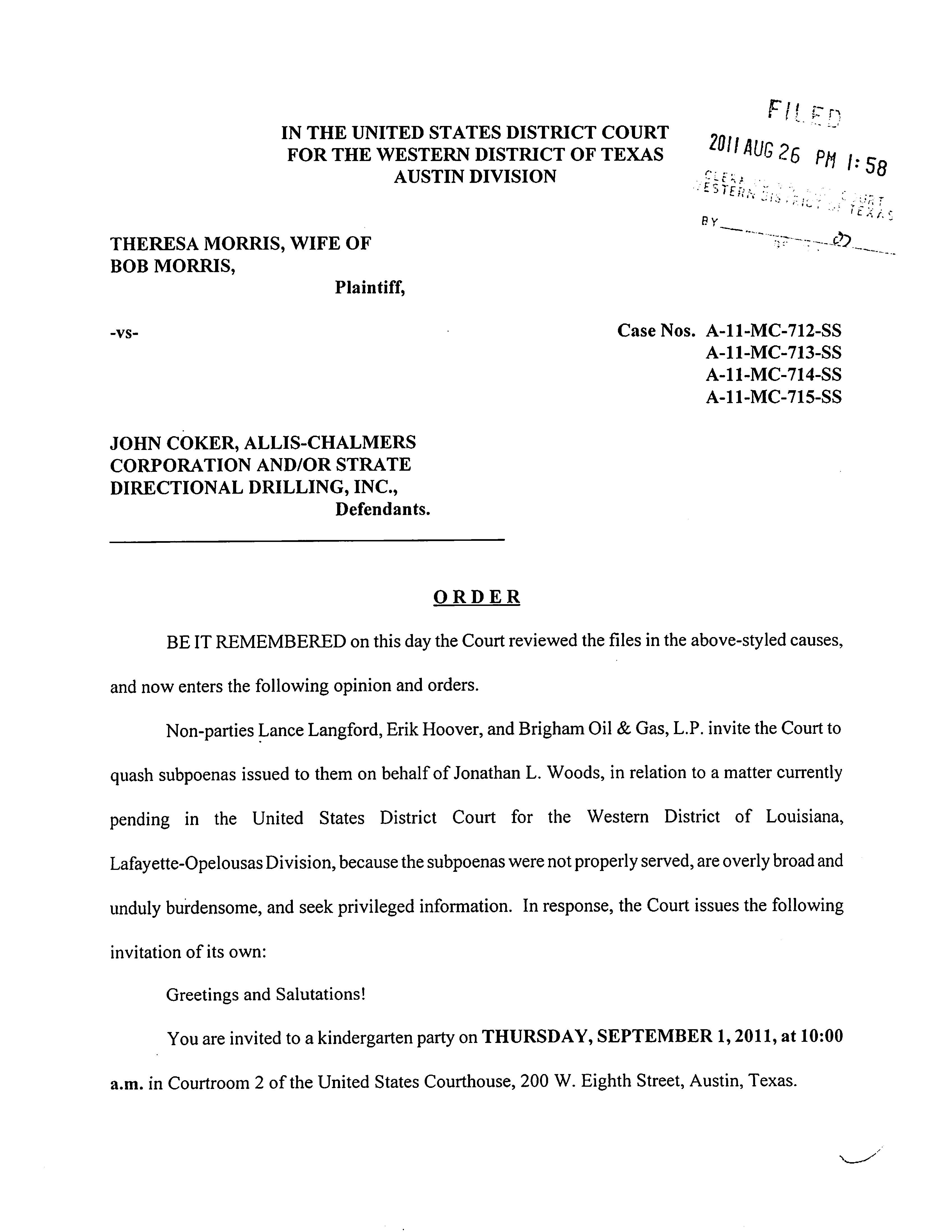
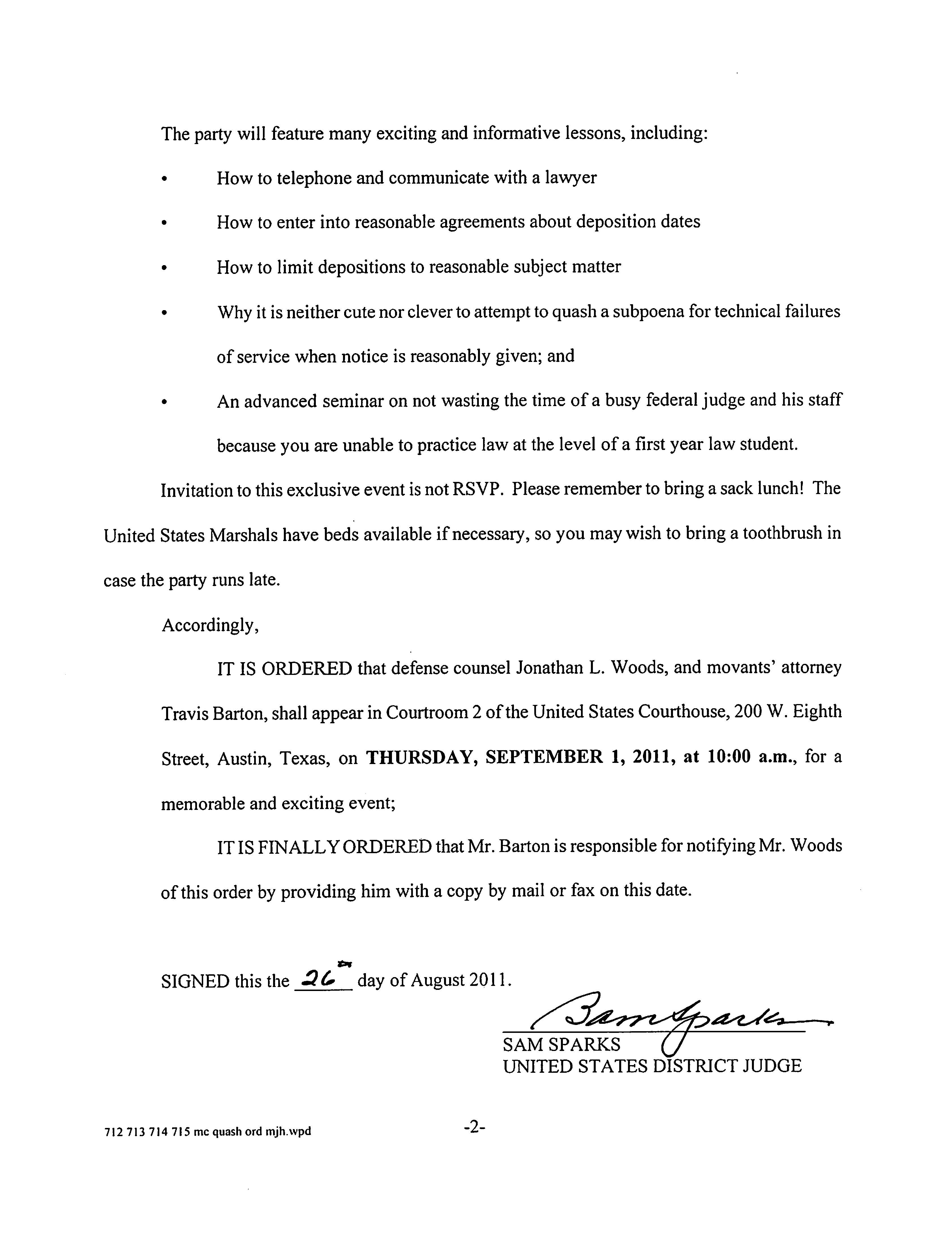
As I’ve said here before, some judges have no patience for discovery disputes.
Thanks to Attorney Marcus Evans
NEW DISCIPLINARY AND LJA RULES FOR COMMENT
August 30, 2011 § Leave a comment
The MSB is asking for comments on some fairly sweeping proposed changes to the disciplinary rules. You can click on this link to comment.
Unfortunately, you will need to read paragraph by paragraph, comparing your current rules, because there is no redline/italicized version. For that reason, I haven’t had the time to go through the changes and digest them for us here.
The Bar is also asking for your comments on a proposed rule setting up a separate Lawyers and Judges Assistance (LJA) committee. You can click on this link to get to it. This change is part of an ongoing effort to differentiate and separate the LJA function from the disciplinary function. Historically, some lawyers have been reluctant to submit to LJA intervention because it was linked to the disciplinary process, and they were concerned that they were placing their license in jeopardy. The new arrangement focuses on help to resolve self-destructive behaviors.
As always, I encourage you to offer your constructive comments. It’s your profession.
MISSISSIPPI’S DIVORCE RATE AND THE CURRENT STATUTORY SCHEME
August 29, 2011 § 4 Comments
The Clarion Ledger reported on August 25, 2011, that Mississippi’s divorce rates are among the highest in the nation. You can read the article here. The findings come from the Census Bureau’s “Marital Events of Americans: 2009,” which was released this week. The article did not explain why the conclusions are based on data two years old.
Key points of the report:
- Mississippi’s divorce rates for men and women are among the highest in the nation, while its marriage rates rank in the bottom half.
- Mississippi had the sixth highest divorce rate among women and the 11th highest for men.
- Even in the South, which recorded the highest divorce rates (the Northeast had the lowest), Mississippi’s numbers exceeded at least seven other Southern states’.
- Calculating “marital events” per 1,000 men or women ages 15 and older, the rates for Mississippi were 12.5 for women, compared to 9.7 for the nation; and 11.1 for men, also above the national average of 9.2.
- The marriage rate for Mississippi women was slightly less than the national average: 17.3, compared to 17.6, for a No. 32 ranking.
- The marriage rate for Mississippi men edged out the national average: 19.3, compared to 19.1, but was only the 29th highest.
- Although the South had the second-highest marriage rates of any region, Mississippi’s numbers were some of the lowest among its neighbors.
- The study explains the variations in rates between men and women this way: Men remarry more than women do, so their marriage rates are higher.
- Women tend to live longer than men and tend to marry older men, so widowhood rates are higher for them than rates men.
No doubt the economy is exacerbating these numbers. Anyone who has done much domestic legal work can tell you that financial issues play a predominant role in marital dissolutions.
It’s not easy to get a divorce in Mississippi unless both parties agree on how to settle every issue, including the knotty issues of custody, support, division of property and alimony. Our current system gives rise to and even encourages a strategy in which one party holds the divorce hostage until the other comes to terms, a phenomenon that some lawyers refer to as “divorce blackmail” or “economic blackmail.” I have heard for years that there are legislators who have blocked reform of our archaic divorce statutes because they don’t want divorce to be “too easy.” This data is evidence that the existing statutory constraints on divorce have been singularly ineffective in accomplishing that goal.
I think it’s time for us to consider a change in our statutory scheme for divorce. Deborah Bell’s suggestion is that we amend our statutes to provide that when parties have lived separate and apart for a year or more either may obtain a divorce on the ground of irreconcilable differences, with some temporary relief. That seems sensible to me. It would avoid precipitous and impetuous actions, and would recognize that there is no sense in perpetuating dead relationships. It would also reduce, and hopefully eliminate, the economic coercion that so often intrudes into the divorce process under our current law.

