THE INFORMAL CUSTODY ARRANGEMENT AND ITS IMPACT ON PERMANENT CUSTODY
September 26, 2011 § 3 Comments
I talked here before about the Varner case, which holds that a child-support-paying parent (the father in that case) who has a child come to live with him may receive a credit against unpaid child support for that de facto custodial time. In Varner, the mother had court-ordered custody, but the parties made a handshake deal for the child to go and live with the father for a time.
Taking a similar set of facts, would the father have a basis to ask the court to modify custody?
In Arnold v. Conwill, 562 So.2d 97 (Miss. 1990), the father had the son with him for 16 months because of the mother’s unsettled living situation. The mother had asked the father to take the boy until she could get settled. When she did get into a stable situation, she asked the father to return the child to her custody. When he refused, she picked the child up from school, enrolled him in a new school, and resumed full-time custody of the son. The father filed a modification action, and the chancellor granted him custody due to the 16-month period.
On appeal, the MSSC recited the familiar material change-adverse effect-best interest test for changing custody. Applying that test to the facts of the case, the court said (at 100):
“To her credit, when she fell upon hard times, appellant called the child’s father for help. The custody was temporarily interrupted because of conditions over which she had no control. When she stabilized the situation, she asked appellee to restore custody to her and he declined. The parties’ act, in temporarily modifying the decree, was not binding on the court. The only change in circumstances, upon which the appellant can rely, and which the court accepted, was the fact that the father had custody for sixteen moths while the appellant, the mother, had liberal visitation withh the child.
Simply, the facts of this case do not reflect a material change in the circumstances of the parties and the child, which adversely affected [the child], to the extent that his custody should be changed from appellant to appellee.”
A lot of water has flowed under the bridge in the 21 years since this case was decided, but I believe it is still good law for the above points, and it has never been overruled or criticized. There are, however, two wrinkles:
- At page 100, there is this statement: “The courts do not favor separating siblings when their parents divorce.” That concept has been refined since then to provide that, although separation is not favored, there is no hard and fast rule about separation, but it is one of many factors to be considered by the court among the Albright factors for determination of best interest. See, for example, Kimbrough v. Kimbrough, decided by the COA May 3, 2011.
- And on the same page is the statement that the facts of the case did not reflect material change-adverse effect-best interest, and “Neither did the motion so charge nor the chancellor so find.” As we’ve discussed before, the law now is that if you fail to plead the elements of custody modification, your case is subject to being dismissed for failure to state a claim upon which relief can be granted.
THE UNDISPUTED CHAMP
September 23, 2011 § 1 Comment
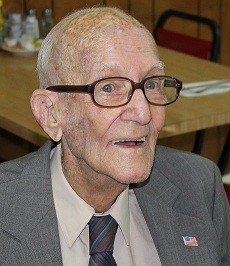 Today marks the 90th birthday of Meridian attorney Champ Gipson. That is Champ on the left.
Champ served in the Army Tank Corps in World War II.
He graduated from Cumberland Law School in Birmingham in 1947, and returned to Meridian to practice with his dad. Champ was in general practice for decades, and now spends his days visiting with his friends in several breakfast and lunch groups, running errands and at home in Tamola with his wife.
Q & A WITH JUDGE McKENZIE
September 22, 2011 § 2 Comments
Judge Frank McKenzie presides in chancery district 19 (Jones and Wayne). Here is an interview with 12 CCDM.
Q: Tell us some of your personal preferences that lawyers from outside your district need to know before they come before you.
A: Court starts on time. If you are not there when your case is called and have not notified the Court Administrator of a good reason for your tardiness, your case will go to the end of the docket for that day. If you make no appearance before the docket is concluded, you may have to return another day.
I have a local rule requiring that all contested trial exhibits be pre-marked by the attorneys prior to trial and that an exhibit list be furnished to the clerk, court reporter, and the court at the time of trial. This requires the attorneys to confer in advance to exchange exhibits and agree on the numbering sequence. Exhibits shall not be designated by the party offering them, i.e. P-1 or D-1, but shall be numbered beginning with 1 and concluding in numerical sequence to the final exhibit. Rebuttal exhibits are not within the rule. At the start of trial all pre-marked exhibits are received by the clerk for identification purposes only. They come into evidence by agreement of the parties or ruling by the Court when proffered.
The 19th District has a website where you may access the dockets and request hearing dates from the Court Administrator. www.uscourtdockets.com.
Q: What are the three attributes that you would consider to set the good lawyers apart from the bad ones?
A: Good lawyers seek corroboration of their clients’ claim before filing a complaint. They ask for the identity of witnesses to the clients claim, interview those witnesses, and conduct a tough cross-examination of the client to detect problems.
Good lawyers come to the courthouse prepared. They will have reviewed all discovery materials, prepped all witnesses for their testimony, interviewed all opposing witnesses, and come armed with the legal authorities germane to the issues to be tried.
Good lawyers are courteous and respectful to opposing counsel, witnesses and court personnel.
Q: What is the main thing lawyers should know to avoid doing in your court room during a trial?
A: I tend to give lawyers wide leeway in trying their cases. The capital offense is when a lawyer lies to me.
Q: What part of your job do you enjoy the most?
A: I enjoy most everything I do. Sometimes it is a trying experience but that is a necessary part of the job of Chancellors . The appellate courts have placed upon Chancellors a duty to address many “factors” in our rulings, so much so that a chancellor’s findings of fact and conclusions of law often exceed in scope the eventual ruling by the appellate courts. When lawyers don’t put on adequate evidence of the “factors” it makes the job more difficult.
Q: Cell phone ringing during a trial: death penalty, stern look, dismay or no reaction?
A: It is going to happen no matter how many times the bailiff announces to turn off all cell phones. It embarrasses the offender and I rather enjoy seeing the panic on their faces as they frantically try to locate the phone. For repeat offenders I may say to them: “Next time that happens you’re going to have to run around the Courthouse three times yelling ringy-dingy.”
Q: What is your pet peeve as a judge?
A: The failure of lawyers to comply with Rule 3.05 UCCR which requires that a copy of all trial exhibits be furnished to opposing counsel and to the court. I guess they expect all of us to gather around the witness who is testifying about an exhibit. I also hate roman numerals. They don’t even teach them in schools now. Why are we still using them in legal documents?
Q: Who do you model yourself after as a judge?
A: From 1972 until 1995 the vast majority of my chancery practice was before Hon. J. Shannon Clark of Waynesboro. Judge Clark was always fair and consistent in his rulings and was courteous to the lawyers and those appearing before him. I try to model myself after him.
COURT IN OLDE CLARKE COUNTIE
September 21, 2011 § Leave a comment
 I’ve posted before here and here about the renovation of the upstairs court room in the Clarke County Court House in Quitman. The photo to the right shows the court room when the renovation had just begun. You can see the plywood panelling that sheathed the room, as well as the placement of the jury box at that time. Glory be for the renovation!
The court room was encased in plywood panelling in the 1970’s. Before then, there was a large, pot-bellied stove in front of what you see in this photo as the witness stand. The stove provided heat for the entire court room. In cold weather, lawyers would stand by the stove and warm their hands during trials as they questioned witnesses (who sat on the judge’s left-hand side in those pre-panelling days) or addressed the jury. When the panelling was added, the ceiling was lowered and central air and heating were installed in the balcony. The lowered ceiling concealed the machinery, pipes and conduits. The panelling also concealed all of the windows, so that the court room was a fluorescent-lit, windowless chamber.
In the court room today, you can observe two doors, one in the jury box and one in the rear of the court room, that open out onto the balcony. Until those doors were concealed behind the panelling, it was the practice when court was called into session for the bailiff to go out on the balcony and announce loudly to the bystanders in the streets below that court was in session, and inviting all who may have any business to come forward and be heard.
By the 1990’s, before the addition to the east side of the building, with its new court room, the court house had fallen into a sad state of disrepair. Some of the windows behind the panelling were broken, letting in rain and inviting birds to nest in the walls. It was not uncommon to hear cooing pigeons throughout a trial. Eighteen-wheelers lumbering in low gear along Archusa Avenue in front of the building made the windows rattle and shake to such an extent that it was often necessary to pause in questioning a witness until they passed. The disrepair was not limited to the windows. In one case I tried, my client and I had to move our table several feet when a sudden thunderstorm sent a stream of water from the ceiling right onto my case file.
It’s all better now, thanks to forward-looking Clarke County leadership.
____________________________________
Thanks to George Warner, former DA and Chancellor, for some of these recollections.
Photo courtesy of Jonathan Ivey
DISESTABLISHING PARENTAGE, STEP BY STEP
September 20, 2011 § 5 Comments
As I posted here before, the legislature has adopted a procedure to disestablish parentage (paternity) in light of Williams v. Williams, 843 So.2d 720 (Miss. 2003), and its progeny, which hold that a man who is determined by DNA testing not to be the father of a child should not continue to be responsible for the support of that child.
The new code section, MCA § 93-9-10, went into effect July 1, 2011. The very first sentence of the statute states that “This section establishes the circumstances under which a legal father may disestablish paternity and terminate child support when the father is not the biological father of the child.” In my opinion, this code section is now the exclusive remedy for a father in these circumstances. Any proceeding such as a petition to remove the father from the birth certificate, or a joint petition to disestablish paternity, or a modification pleading that does not meet the requirements of the statute will be ineffective.
You may well ask, “But if the father and mother agree, what is the harm? Why not simply approve their agreement?” First of all, there are the welfare and rights of the child to consider. See, Kelly v. Day, 965 So.2d 749 (Miss. App. 2007). And secondly, if the procedure is ineffective, the child will have a later cause of action for support, making the whole earlier procedure a waste of time.
Before I step through the statute with you, please let me urge you to read the statute. I swear, it won’t take more than five minutes. If you’re going to advise clients about this, you need to be familiar with what it says.
So here is the procedure, step by step (statutory requirements in bold, my comments in regular font):
- The father must file a petition in the court having jurisdiction over the child support obligation. This means that if the county court, or chancery court in another county, has entered a child support order, the petition must be filed in that court.
- Process and a copy of the petition must be served on the other parent or guardian; if DHS is or has been a party to the paternity action or collection of child support, the Attorney General of the State of Mississippi must be served with process. In my opinion, since this action is under the chapter dealing with parentage (bastardy), 30-day process would be required pursuant to MRCP 81 (d)(1).
- The petition must include: (a) an affidavit executed by the petitioner that he or she (there is nothing in the statute that says that the mother is precluded from filing a petition) has newly-discovered evidence since the paternity determination relating to parentage of the child, and (b) the results of a genetic or other scientific parentage test administered within one year of the filing of the petition excluding the legal father as biological father of the child or an affidavit executed by the petitioner that he did not have access to the child for testing before the filing of the petition; in the latter case, the petitioner may request that the mother (if available), child and father submit to such testing.
- The court shall grant the relief on a properly filed petition if the court finds all of the following: (a) There is newly-discovered evidence as averred; (b) the scientific testing was properly conducted; (c) the legal father has not adopted the child; (d) the child was not conceived by artificial insemination while the legal father and mother were married; (e) the legal father did not prevent the biological father from asserting his parental rights with respect to the child. I recommend that your petition include allegations (a) through (e). Your client is swearing that all of these statements are true, and you are vouching under MRCP 11 (a) that the pleading has “good ground to support it.” And make sure your client reads it before signing. He is swearing all of this is true, andd if he balks or hems and haws, you might want to think about going back to the drawing board.
- The court shall not set aside the paternity determination or child support order if the court finds that the legal father did any of the following: (a) Married or cohabited with the mother and assumed parental obligation and support of the child after having knowledge that he was not the biological father; (b) consented to be named as father on the birth certificate or signed an acknowledgment of paternity and failed to withdraw within the time periods mandated by MCA §§ 93-9-9 and 93-9-28, unless he can prove fraud, duress, or material mistake of fact; (c) signed a stipulated agreement of paternity that has been approved by order of the court; (d) signed a stipulated agreement of support that has been approved by order of the court after having knowledge that he is not the biological father; (e) been named as legal father or ordered to pay support after he declined to undergo genetic testing; or (f) failed to appear for a genetic testing draw pursuant to a valid court order. Same advice here about incorporating these as allegations in your petition. Make your client swear that he has not done any of the foregoing. The rationale above applies here.
- If the petitioner does not make the required showing, the court shall deny the petition.
- Relief is limited to prospective (future) child support, past-due child support payments, termination of parental rights, custody and visitation. The statute does not create a cause of action to recover child support paid before filing of the petition. The statutory procedure can not be used to litigate previously-paid child support. It can be used to address past-due child support, parental rights, custody and visitation.
- The court may not suspend the child support obligation while the petition is pending, although the court may order that such payments may be held by the court or DHS pending a final determination. My suggestion is to plead for the court or DHS to hold the child support funds pending litigation, if that is what your client wants. If you don’t specifically ask in your petition for that relief, you likely will not get it.
- The party requesting genetic testing shall pay its fees. There is no provision in the statute for the court to tax the fees other than to the party who requests it.
- The usual authority of the court on motion or its own motion to order the parties to submit to genetic testing applies.
- The unsuccessful petitioner shall be assessed with court costs, genetic testing fees and reasonable attorney’s fees. Here’s the reason why I suggested above that you specifically plead all of those qualifying and possibly disqualifying facts and make your client read carefully before signing. Clients sometimes will lead you to believe that they have a case, and will omit some important detail, like the execution of that acknowledgment of paternity. They think they can pull a fast one on the court, or that it somehow will slip by unnoticed. The result of failure for the petitioner is being assessed with some significant expenses. The result for you is egg on your face and slipping a notch in the court’s regard of your own credibility.
This statute should go a long way toward eliminating the welter of approaches that lawyers have taken to address the disestablishment of paternity. Now there is a single statutory provision. Read the statute, follow it, and you might accomplish something for your client.
EXPERT OPINION TESTIMONY: SOME BASICS
September 19, 2011 § 5 Comments
Experts often testify in chancery. They address child custody, business valuations, property appraisals, surveys, tax issues, handwriting, competency, medical and health matters, and many other subjects almost too varied to imagine. MRE 702 allows you to call a qualified witness who has “scientific, technical, or other specialized knowledge” that will assist the chancellor in understanding the evidence or to determine a fact in issue.
The catch is that the witness must be (a) qualified, and (b) have scientific, technical or specialized knowledge that will assist the court in adjudicating the case. It’s up to you to make a record that your witness meets the criteria of the rule.
You won’t get off the starting line, though, if you haven’t done your pre-trial work vis a vis your expert. Remember that if you are asked in discovery to identify your expert(s), you must do so not less than 60 days in advance of trial, per UCCR 1.10, or run the extremely likely risk that you will be denied the opportunity to call that witness as an expert. Merely including the name of an expert in a general witness list is not enough to meet the requirement of the rule. And if you are asked to provide the expert information required in MRCP 26(b)(4), you must timely provide it — all of it, in a responsive manner — or you may be left expert-less in that trial.
Calling an expert as a witness at trial is a two-phase process:
First, you must qualify the expert and tender the witness as an expert, at which point the other side will be given the opportunity to voir dire the witness as to qualifications to testify as an expert. The court will then hear any objections to the qualifications. If the court rules that the witness does have expert qualifications, you move to the next phase.
Second you take the expert testimony itself. Before you get into the substance of that testimony, though, you must establish that the expert’s opinions will be reliable, using the factors set out in Daubert v. Merrell Dow Pharmaceuticals, 509 US 579 (1993).
Here is the process, step by step:
- Identify the witness.
- Establish the witness’s knowledge, skill, experience, training and/or education that qualifies her as an expert.
- Tender the witness as an expert.
- Address any objections to qualifications.
- Have the witness testify about the facts and data upon which the opinion will be based. MRE 702(1) requires that the opinion must be based on “sufficient facts or data.”
- Have the witness establish by testimony the principles and methods she used in arriving at her opinion, and she must establish their reliability.
- Have the witness testify how she applied those principles and methods in this particular case, and why the method she used does produce reliable results in her field.
- Develop the expert opinion.
Some factors you might want to consider in developing whether the expert applied the principles and methods of his field reliably to the facts in your case:
- Have the principles and methods used been tested, or can they?
- Have the principles and methods been subject to professional critique, peer review, and publication?
- What is the known error rate for the principles and methods, and what are the means to control or reduce the error rate? What measures were taken to control the error rate in this case?
- What is the extent to which the principles and methods have been accepted in the field?
- Is the opinion based on research or study that the expert did independent of the litigation?
- Has the expert adequately addressed and accounted for alternative or contradictory explations? How did the expert rule them out?
- Did the expert employ the same standards and techniques in reaching the opinion in this case that he does in the normal course of his professional work?
- Is there a discrepancy between the data and the conclusions reached by the expert? How does the expert explain the discrepancy and rule out other conclusions?
- How does the expert’s opinion tie in to the facts in this particular case?
Obviously the way you develop your expert’s testimony will depend both what is at issue in the case and the expert’s field of expertise. A child psychologist in a custody case will require a different approach than, for example, a handwriting expert in a will contest.
With respect to qualifications, it’s a good idea always to get the expert’s CV (curriculum vitae) and offer it into evidence. Once it gets into evidence, it may prompt counsel opposite into stipulating that it does, in fact, state the witness’s proposed qualifications, which may eliminate lengthy testimony. With no jury to impress, there’s no need to put on a show about the witness’s impressive credentials.
The court always has the discretion whether to allow an expert’s testimony at all. If the court finds that the subject matter of the opinion is not sufficiently scientific, technical or otherwise specialized, the court can rule that an expert need not be called. For example, if the judge or any other lay person can determine that the ground became wet after a rain, it is not necessary to have expert testimony on the point. Likewise, an expert on the law is unnecessary and superfluous because the trial judge is the expert on the law of the case (at least until the COA reviews it).
TWO PRAYERS FOR LAWYERS
September 16, 2011 § 4 Comments
My Lord God, I have no idea where I am going.
I do not see the road ahead of me.
I cannot know for certain where it will end.
Nor do I really know myself, and the fact that I think I am following your will does not mean that I am actually doing so.
But I believe that the desire to please you does in fact please you.
And I hope I have that desire in all that I am doing.
I hope that I will never do anything apart from that desire.
And I know that if I do this you will lead me by the right road, though I may know nothing about it.
Therefore I will trust you always though I may seem to be lost and in the shadow of death.
I will not fear, for you are ever with me, and you will never leave me to face my perils alone.
This next prayer comes from Alan Lomax’s The Land Where the Blues Began. He recorded it at a black Baptist state convention in Clarksdale in 1942. The sentiment, especially with its reference to a “war coat,” could not be more appropriate for the litigation gladiator.
You know I can’t help from loving You.
Because You loved me myself,
Long before I knew what love is.
And when my time have come
I’ve got the king’s crown in coming glory.
And when I come down to the river,
Help me to pull off my war coat and enter.
I’ll enter in the name of the Lord,
Make my enemies out a liar,
Make us able to bear our burdens.
Q & A WITH JUDGE FAIR
September 15, 2011 § Leave a comment
Chancellor Gene Fair is one of four chancery judges presiding in District 10 (Forrest, Lamar, Marion, Pearl River and Perry). Here is an interview he gave to 12 CCDM.
Q: Tell us some of your personal preferences that lawyers from outside your district need to know before they come before you.
I would appreciate their reviewing our local rules, particularly in setting cases.
We have Mondays established as ex-parte days to which Rule 81 returns may be made to the Court in which a chancellor is sitting without a “setting order” or “fiat”. They should be aware that Rule 81 provides for Rule 81 return days to be set by (1) local rules – our Monday rule (2) a “setting order” for the specific case and (3) a general order. We don’t have a general order.
Our Administrators will give a date to a lawyer or secretary to which a return may be made with the understanding, on occasion not verbalized to out of district lawyers, that the person getting the setting will have read and will follow the rules and send a “setting order” to be signed by the Chancellor if the day for a setting preferred not a regular ex-parte Monday.
We are happy to set cases for Tuesday through Friday on a fairly regular basis, but require a special order to insure that those who have trial settings are not delayed justice they have worked toward for weeks or months by a plethora of last minute seven day returns.
Our web page is “www.chancery10.com” and reflects where all four chancellors will be and their dockets for each day they will be in open court. The Local rules also appear.
Otherwise, I prefer to try to follow the Uniform Chancery Rules and the statutes as closely as possible, and believe that, except for those things set out in our local rules, my actions should and would be the same as any other chancellor in the state. I would appreciate applicability of those rules and statutes being noted by Counsel if I seem to be ignoring them.
Q: What are the three attributes that you would consider to set the good lawyers apart from the bad ones?
Good Chancery Court Lawyers:
- Have read and understand the local rules.
- Have read and understood the Uniform Chancery Court Rules.
- Have read and understand as much as is possible the statutes governing the matter they are presenting and the interpretations of the Appellate Courts applicable to their case, since the Civil Rules do not apply to the more than 90% of Chancery filings governed by Titles 91 and 93.
Bad ones have not.
Good lawyers who litigate also understand and follow the Rules of Evidence, particularly when they follow the rules about making objections and submitting relevancy at the time of objection.
Q: What is the main thing lawyers should know to avoid doing in your court room during a trial?
Being ignorant of and not following the Uniform rules governing chancery trials and the Rules of Evidence.
Q: What part of your job do you enjoy the most?
A good presentation by two good lawyers of an interesting question not easily answered under the case law and statutes, which they also present honestly and with clarity.
Q: What part of your job do you enjoy the least?
“Weevil cases” as defined by a retired judge of my acquaintance, referring to custody cases in which both parents, the only choices for custody, are less than impressive if not downright awful and the choice is therefore one of “two weevils”.
Q: What is your pet peeve as a judge?
Failure by lawyers to follow the Rules and Statutes and confusing quantity with quality in presenting evidence.
In divorce cases I would note particularly failure to follow Rule 8.05 of the Uniform Chancery Court Rules, (including a work history) and Miss. Code Ann. §93-27-209, the disclosure requirements of names, exact addresses and present whereabouts of those who have lived with a child or children whose custody and visitation are in issue. Those two documents contain, or should contain, the majority of basic evidence necessary to establish perspective and to decide the average divorce case – or to at least focus on matters of custody and visitation. I might also point out that the child support guidelines statute also requires presentation of evidence of health insurance and cost thereof by both parties in cases involving children.
In estate matters, I note Rule 6 of the Uniform Chancery Rules and the statutes in Title 91, (along with checklists on the Blog of Judge Primeaux referring to them).
Finally I am generally perturbed by introduction of documents by a party which either directly impeaches his or her own 8.05 disclosure or, on the other hand, supports an undisputed 8.05 disclosure . For instance – real estate, jointly owned, having been appraised and having an agreed balance owed on it and on which both parties agree in four lines of their 8.05 forms. Having established that, they then file 75 to 150 pages of numbered exhibits including a deed, a deed of trust, a note, a payment history, a payment schedule, the appraisal, photographs, and more than one copy of a bank verification of the balance due, and then never refer to any of those documents in trial. “Why all this stuff?” the Court wonders when writing an opinion. “And why all these tax returns?” A Rule 1006 summary of pertinent items on tax returns for the last 10 years is much more helpful than the ten copies of such returns, which should have been exchanged with opposing counsel and which can be used to impeach if necessary but which don’t need to clutter up the record and make the writing of an opinion by a judge take longer time and require more verbiage, and make him or her wonder what in those many pages might turn the decision one way or another.
The social security three or four page summary of lifetime earnings and entitlements is, likewise, a good document to accomplish the work of a number of others.
Less is more.
Q: Lawyer tells you, “That’s not how we do it back in ________ County.” Discuss.
Ask the lawyer how they do it and who the judge or judges are in ____ County who allow it to be done their way. Call the judge or judges for information and advice. Who knows, we may be doing things wrong in our counties. I definitely know judges who know more than I do and have much more experience, as well as some definitely worth listening to who are younger and have been on the bench for shorter periods of time.
On the other hand, Judge Dale told me about a respected lawyer in this district who made a similar statement in an estate matter before him. The lawyer emphasized how he “always did it and never had a problem” before another judge in our district. Judge Dale replied to the lawyer that the lawyer “was not going to keep on doing it wrong any more and was lucky to have got away with it as long as he did”.
Q: Who do you model yourself after as a judge?
My grandfather, who was not a judge, but was, in his own words, “a lawyer and a good one”, and my uncle, his son, who was a chancellor and a presiding justice of the Supreme Court when he retired. Both suggested that the proper role of a trial judge, and particularly a Chancellor, was to apply the law as written, as interpreted by the Appellate Courts, and in the interest of justice, with the emphasis on justice and on equity. My uncle, when on the Supreme Court, pointed out that in his opinion his role on the Supreme Court was to interpret the law in accord with statutes, rules and prior case law in a manner so that the attorneys and trial judges of the state would clearly understand how to take care of their business. He made it a point to actually read the entire trial record as a Supreme Court Judge, something I saw him doing on Sunday afternoons on more than one occasion, even during the period the appellant and appellee were required to provide a summary of the record to be relied on rather than the record itself. I try to read all exhibits and a rough printout of trial testimony before writing an opinion because of his example and his statement to me when I was a law student that “I presume that the lawyer who sent this to me meant for me to read it all myself and I don’t want to disappoint him or show him or his clients disrespect.”
Q: Who do you consider to be the best chancellor you ever appeared before, and what set that chancellor apart?
Naming one is impossible, though three immediately come to mind: Sebe Dale, John Clark Love and Bob Oswalt. My uncle Stokes would be number four, but I never appeared before him for obvious reasons. All three I have named radiated a love of the law and a concurrent respect for the litigants and the lawyers. All accepted the awesome responsibility of their duties to children and disabled adults with equanimity and confidence that they would and could do everything possible to protect them, which they did. All maintained a “students of the law” perspective, reading the Court file in full, and new cases and new statutes as they appeared. All attempted to change with the times and the decisions, even if they personally disagreed with them.
Q: Share your innermost thoughts and feelings about MRCP 81.
Sometimes I like it. Sometimes I don’t. Sometimes the Appellate Courts say it must be followed strictly. Other times they don’t. I just try to follow it, whatever it says and whatever they say it says. In the context of Title 91 and Title 93 matters, which constitute over 90% of chancery filings being excepted from the Rules of Civil Procedure in favor of statutes, we have to consider only the Rule 81 process paragraphs, which are detailed and specific as to “no answer”, setting in specific ways, and the minimum number of days between service and return day (30 days or 7 days). Judge Ishee, in a recent dissent opined that the Supreme Court should move that process portion of the Rule into Rule 4 of the Civil Rules, a suggestion in which I concur.
Q: What do you do to try and get control of your probate docket?
Judge Gambrell and I share a clerk a clerk and have assigned, in addition to research and writing duties, the duty to learn the ins and outs of a probate proceeding and to draft letters to lawyers and fiduciaries pointing out deficiencies, and suggestions for resolving them. Most result in “oops” type replies and corrective action.
It is occasionally necessary to point out the requirements that fiduciaries (including conservators and guardians, who occupy the same status as executors and administrators according to Miss. Code Ann. §93-13-38) and also their lawyers of record cannot just quit and/or ignore such matters. They have duties mandated by statute and controlled by contempt determinations, which a Court must occasionally enforce that way. I have issued only a very few “show cause why” a contempt adjudication should not be made, and mercifully have had only a smaller number when no cause at all was shown.
In addition, we are blessed with County Probate Administrators who can, and do, step in when fiduciaries die, disappear or refuse to act.
Q: There are 19 appellate judges. What would be the ideal number of former chancellors serving on the two appellate courts?
The perfect courts would have equal numbers of former Circuit Judges and Chancery Judges along with equal numbers of former practitioners in each type of court, along with, on the Supreme Court, one or more judges, in an odd number of those who have (or has) participated in both courts, either as judge or practitioner (Judge Jim Roberts comes to mind as having served as both Chancellor and Circuit Judge (and as a Supreme Court Justice as well) . Even though there are more Circuit Court appeals to the Appellate Courts, there are way less long opinions mandated in Circuit Court cases, so the time for research and thinking required overall in the chancery matters would appear to be equal to that of the circuit matters.
Q: Tell us your favorite quote.
“Wherever you go, there you are.” Yogi Berra.
Q: Tell us your favorite court room movie.
To Kill a Mockingbird.
AN OBJECTIONABLE OBJECTION
September 14, 2011 § 4 Comments
One of the most baffling objections is “Object to the form of the question.” It’s baffling because it doesn’t tell the judge what the real problem is.
It’s actually a lazy objection because it is several objections in one. Problems with the form of the question arise from nine distinct sources, each of which is a separate objection in its own right.
These are the real objections to the form of the question:
- Leading. MRE 611(c) says that “Leading questions should not be used on the direct examination of a witness except as may be used to develop his testimony.” Which means that the judge may grant some leeway in order to ensure that testimony is developed. Leading is, of course, permitted on cross examination, for hostile or adverse witnesses, and for preliminary matters.
- Compound question. You can ask only one question at a time. Often the witness answers only one of multiple questions, not always making it clear which one she is answering.
- Argumentative and Harrassing. This is really two different things. A question is argumentative when it is merely a comment on the evidence, or a legal argument, or an attempt to get the witness to adjudge his own credibility. A question is harassing when the probative weight of the information sought is outweighed by the embarassment to the witness or its outrageous nature. UCCR 1.01 states that “The counsel, parties, and witnesses must be respectful to the court and to each other,” and “Bickering or wrangling between counsel or between counsel and witness will not be tolerated.”
- Asked and answered. You enjoyed the answer so much the first time that you just can’t resist doing it again.
- Assumes facts not in evidence. You have broad scope within the bounds of relevance to develop new facts, but not by framing your questions in such a way that they take as true facts that have not been established. In chancery, with no jury, this is a touch-and-feel objection that the judge may overrule and then disregard the answer.
- Ambiguous and confusing. A question is ambiguous when it is susceptible to more than one interpretation. A question is confusing when it is phrased in such a way that it can be misunderstood.
- Misleading. Misstatement of the witness’s or another witness’s prior testimony.
- Narrative. The question calls for a recitation of the whole story, which may or may not include objectionable material.
- Repetitious. You already made that point. Move on to something else.
Unless you’re objecting just to hear yourself talk, you want your objections to accomplish something for the benefit of your client. General objections like “Object to the form of the question” are an objectionable waste of time. Your chances of getting your objection sustained go up when you make a specific objection.
RECUSAL IS FOREVER
September 13, 2011 § Leave a comment
Here’s an important principle to bear in mind:
Once a chancellor has recused himself in a case, he is without further authority to act in that case, even in the most trivial procedural matters.
The case of Covington v. Montgomery, 43 So.3d 1193 (Miss. App. 2010) illustrates how and why that principle can be so important. Here’s what happened:
Covington, an attorney in Harrison County, filed a petition in chancery court seeking modification of custody from his ex-wife to himself. All four chancellors, including Judge Carter Bise, recused themselves because one of the parties was a practicing attorney in the district. Judge Frank McKenzie of Jones County was appointed to serve as special chancellor. He heard the case and denied the modification. Covington decided to appeal.
On the last day of the appeal deadline, Covington filed a motion to extend the appeal time, and got the signature of Judge Bise on the order. He subsequently filed his notice of appeal within the enlarged time.
The COA, on its own motion, raised the issue of its jurisdiction and held that Judge Bise’s order “had no effect” because Judge Bise had recused himself and had no further authority to act in the case. The opinion, written by Judge Roberts, pointed out that the duration of the special chancellor’s appointment is determined by the supreme court’s order appointing him, and there was nothing in it to indicate that his authority ended before the trial court’s jurisdiction terminated with the filing of the notice of appeal.
I have been approached by parties in cases where I have recused myself seeking procedural orders. Often the parties are there by agreement. In one case, I was asked to sign off on an agreed final judgment because the special chancellor was on vacation. I told them to wait. Once I got out I had no more authority. It’s a point to bear in mind.

