BROKEN RECORD
December 12, 2011 § 1 Comment
Do you ever stop to think about what kind of record you are making as you try a case?
When I first took the bench, I was called upon to judge a case that had been tried two years before, but had never been decided. I was asked by counsel for both parties to read a 200-page trial transcript to determine whether I could adjudicate the case based on it, or whether a trial date needed to be set, all as provided in MRCP 63(a). The attorneys were all experienced and skilled trial lawyers.
It did not take many pages to discover that the record was in woeful shape. Here are some of its problems:
- The first 22 pages consisted of banter among the lawyers about a hunting camp, a weekend cookout, and exchange of good-natured barbs. That’s 22 pages, not a page or two.
- When the first witness was called, the questioning was interrupted repeatedly by jokes among counsel.
- When objections were made, they degenerated into exchanges back and forth among the lawyers.
- Witnesses were asked questions like, “Let me show you this paper,” followed by questions without a clue as to what the paper might have been.
- Many of the questions lacked context: “Can you tell us what he was doing when you saw him there?” Who was doing what and where?
There were other flaws, but the coup de grace came in the last pages of the transcript where the then-chancellor announced that the trial would be continued to another day (it never was), so I decided they would just have to start over, given the passage of time and the state of the record. I ordered a new trial.
As a lawyer, you have to realize that putting on your case in a way to persuade your judge is only part of your job. It’s also critically important that you make an effective record for review. That means at least that you need to:
- Keep banter and comments to an absolute minimum.
- Confer with counsel opposite off the record or aside at counsel’s table with permission of the court and record any agreements or stipulations with a coherent announcement affirmed on the record by the other side.
- Before you begin announcing a stipulation, make sure you have an agreement on every point, and on the wording of every point. Even better: your stipulations should be in writing, even if it means asking for a recess to hammer out the language.
- Always make sure your questions are clear, which means either limiting the number of pronouns and indefinite descriptives or being quite precise in defining them.
- Make sure that any document, photograph or other item referred to by a witness is clearly identified for the record.
- If the witness’s response is unclear or confused, ask the witness to restate it or clarify.
- Don’t interrupt someone else who is speaking, and don’t speak over someone else. Don’t let your witnesses do it.
I try to make sure that the record is free of interruptions, clear of colloquy between attorneys, uncluttered with thinking out loud and other particles of nebulae, any and all of which can obscure the record, even to the point of being unintelligible. But I’m not always 100% successful, and it’s the duty of the attorneys to make their own record.
FYI, here are links to a few posts on trial techniques that can help you make a better record:
A few pointers for more effective chancery trials
Making sure the chancellor sees what you want him or her to see
VINDALOO
December 10, 2011 § 3 Comments
JSP, Esq. pointed out that I have been neglecting food posts herein, so here’s something for you foodies.
 My friends, I offer you Vindaloo for your cooking and dining pleasure. “Vindaloo?” you ask. Yes, Vindaloo, I answer. It’s an exotic melange of Indian flavors, aromas and subleties that will intrigue your palate and comfort you in cold weather without leaving you stuffed and bloated. It’s fairly easy to make, and will reward you with a deeply satisfying meal.
Vindaloo is actually India’s version of a Portuguese recipe that found its way into Indian cuisine through Goa, Portugal’s former colony on India’s west coast. The Indians added potatoes, which enrich the recipe. Goan Vindaloo is fiery pepper-hot. Mine is tamed down for Mississippi tastes, but you have the option of adding heat. My recipe also has an option for broccoli or peas to increase its nutritional value. This version calls for chicken, but Indians also use pork, beef or even lamb. I imagine venison or duck or other game would work as well. You could substitute eggplant for the meat for a vegetarian version. I encourage you to give this a try. You’ll enjoy it. And don’t be discouraged by the long list of ingredients. This is actually a simple dish. Most of the ingredients are seasonings that, in combination, add layers of interesting, delicious flavors.
Before you dismiss this dish as too exotic, I ask you to leave your comfort zone for a bit and try it. After all, you enjoy gumbos and other savory, spicy fare. Indian cuisine only differs by the kinds of spices used. I think you’ll be pleasantly surprised at how flavorful and enjoyable Vindaloo is. And maybe it will open your mind to try some other Indian dishes.
VINDALOO
3 Cups chopped onions
1 1/2 Cups chopped tomatoes, seeded, or grape tomatoes
2 1/2 Tbsp. distilled white vinegar
1 Garlic clove, chopped or minced
1 Tsp. minced, peeled fresh ginger
1 Tsp. tomato paste
1 Garam Masala (store bought or simple recipe below)
1 Tsp. ground turmeric
1/2 Tsp. paprika
1/2 Tsp. ground cumin
1/2 Tsp. ground coriander
1/4 Tsp. cayenne pepper, plus more if desired
3 Tbsp. vegetable oil
Salt and black pepper
6 Boneless chicken thighs, cut into 1 1/2-inch pieces
1 Pound new potatoes, peeled and quartered
1 1/2 Cups chicken stock or water
1 Cup broccoli florets or sweet peas (optional)
Combine the onions, tomatoes, vinegar, garlic, ginger, tomato paste, garam masala, turmeric, paprika, cumin and cayenne, and blend in a food processor until the mixture is the consistency of a paste.
Season the chicken with salt and black pepper to taste.
Heat 2 Tbsp. of the oil in a heavy pot over medium-high heat and brown the chicken. Remove chicken and set it aside.
Add remaining Tbsp. of oil and paste from the food processor to the pot and cook until the mixture turns golden brown, stirring occasionally, about 5 minutes.
Add chicken and potatoes and sauté 5 minutes.
Add broth and bring to a boil.
Reduce heat to medium low.
Add broccoli or peas, if desired.
Cover and simmer until potatoes are tender, about 15 minutes.
Uncover and simmer until chicken is cooked through, around 5-10 minutes more. Season with salt and black pepper.
For a hotter dish, add more cayenne.
Serve over jasmine or white rice or roti (unleavened Indian flat bread, simple recipes available on the internet). Garnish with fresh cilantro leaves, if desired.
__________________________________
Garam Masala. Mix 3/4 Tsp. ground cumin, 3/4 Tsp. ground coriander, 1/2 Tsp. ground pepper, 1/2 Tsp. ground cardamom, 1/4 Tsp. ground cloves, and 1/2 Tsp. ground cinnamon.
DICTA
December 9, 2011 § 1 Comment
- Cocktail parasols if your drink is expecting rain, or for your next party or re-enactment of the killer at the piano bar scene from High Anxiety.
- Ever find yourself yearning for the old drive-in movies? You can actually rent a full sized, inflatable screen for your next gathering of a “few hundred friends” from Southern Outdoor Cinema. Screens are availale in several sizes, from back yard to cow pasture.
- The classic 1949 movie Intruder in the Dust, based on Faulkner’s novel, is available on DVD now, just in time to screen at your inflatable drive-in! The film was shot in and around Oxford, and offers views of what the then-sleepy town looked like in the first half of the twentieth century. Caution: some of the language in the film may offend modern sensibilities, but it’s a fair representation of the era it depicts.
- In 1963, sixteen-year-old San Diego high school student Bruce McAllister sent out questionnaires to writers asking their opinions about the use of symbolism in their and other writers’ work. He received 75 responses, 65 of which survive. The astonishing results of his survey are captured in this Paris Review article, which reproduces the responses of Jack Kerouac, Ayn Rand, Ralph Ellison, Ray Bradbury, John Updike, Saul Bellow and Norman Mailer. Some of the other solicited writers, not excerpted in the article, were A.J. Budrys, Fritz Leiber, Henry Roth, Isaac Asimov, John Cheever, John Updike, Judith Merril, Lloyd Biggle Jr., MacKinlay Kantor, Norman Mailer, Saul Bellow, William Golding and William Melvin Kelley. Wow, just wow.
- If you’ve ever been to the Sistine Chapel, you will agree that the experience is lacking something special when you’re crammed in there with hundreds of other tourists. So here’s a virtual Capella Sistina, complete with baroque choir, sans the tourists, for your Christmas-tide enjoyment.

WHO OWNS THE FILE?
December 8, 2011 § Leave a comment
In the past few months, on two separate occasions, I have heard a witness say that he or she did not have certain documents because “my previous lawyer has them, and won’t give them to me until I pay my bill.”
When I was in practice I heard the same thing from time to time in various forms.
Now, I have no way to know whether what those statements were true, or whether they were based on a misunderstanding.
But the fact is that it is a long-standing ethical rule in Mississippi that the client has a right of access to the file file in the attorney’s office, regardless whether the client has any unpaid balance of fees or expenses.
Ethics Opinion 144, issued March 11, 1988, includes the following language:
This committee concludes that M.R.P.C. 1.16 modified the prior ethical rules of the Mississippi Bar Association only to the extent that the prior opinions required the unconditional delivery of the file by the lawyer. The current Rule only requires that the lawyer surrender papers and property to which the client is entitled. The Rule recognizes the lawyer’s right to retain papers to the extent permitted by law. Thus, the issue is primarily a legal matter concerning the ownership of the items in the file and the legal enforceability of the attorney’s lien. However, the ethical issue which the lawyer must weigh in the balance with his legal rights is at what point will the enforcement of his legal right breach his ethical duty under 1.16(d) to “take steps to the extent reasonably practicable to protect a client’s interest.” Each case will turn on its own facts, and it is not possible to anticipate each situation. Generally, if retaining the client’s file prevents the client from obtaining another lawyer or from proceeding with his case in a timely manner, then the lawyer may have breached the ethical duty owed to the client.
The ownership of the specific items contained in a file is a matter of law. Informal Opinion ABA No. 790 (Oct. 26, 1964). The client’s file consists of the papers and property delivered by the client or which the client caused to be delivered to the lawyer. DR9-102(b) (4). In addition, the “end product”, or in other words, what the lawyer was hired to do, is usually also considered to belong to the client. Wisconsin Bar Bulletin, June 1970 Supplement (Memo Opinion 4-78). On the other hand, the notes and memorandums are usually considered to belong to the lawyer and be his work product. Missouri Bar Bulletin, May 1978, Informal Opinion (Jan. 6, 1978). Contrary opinions can be found which indicate the client has no absolute right to the files. Maryland Opinions Informal Opinion 76-50 (March 1, 1976). This committee concludes that the better-reasoned opinions generally recognize that to the extent the client has a right to his file, then his file consists of the papers and property delivered by him to the lawyer, the pleadings or other end product developed by the lawyer, the correspondence engaged in by the lawyer for the benefit of the client, and the investigative reports which have been paid for by the client. San Diego Bar Association, 25 Dicta, May 1978 (Opinion 1977-3). However, the lawyer’s work product is generally not considered the property of the client, and the lawyer has no ethical obligation to deliver his work product. [Emphasis added]
That language arises out of professional rules that preceded the current ones, and are no longer in effect. Nontheless, I think the rationale is sound, and the opinion is still on the state bar’s website among the many other ethics opinions.
The kicker in the language above is the phrase ” … which have been paid for by the client” at the end of the italicized language. The problem usually arises when the lawyer wants to keep all those items until they have been “paid for by the client.”
You should read the entire opinion and draw your own conclusions, but I think that a fair reading is that the client is entitled to all documents he or she delivered to you and all end products, and you are entitled to keep all of your own notes, research and paperwork you generated. The client’s entitlement to the file documents should not be based on payment or non-payment, but rather on the prejudice that might result to the former client in the aftermath. For many years before EO 144, the inflexibile rule in Mississippi was that the lawyer had no right to deprive the client of the file due to non-payment.
May you charge the client to copy the file before you let it go? Ethics Opinion 105, issued September 9, 1985, includes this language: “… in the absence of controlling language in any applicable employment agreement, a lawyer discharged by his client in a pending matter may ethically charge his client for the actual cost of duplicating the client’s file but that the lawyer may not ethically condition release of the duplicate file on the prior payment of the copying costs. Because there is no apparent potential for prejudice to the client where the subject of the representation is concluded, the Committee concludes that after the conclusion of a matter the lawyer may charge a client for the actual copying costs for duplicating a file and condition the release of the duplicate file on the prior payment of the copying costs.”
DOING SOMETHING
December 7, 2011 § Leave a comment
Joe Kieronski and Leonard Cobb, both of whom are Meridian lawyers, are in Haiti this week with a work group from First Baptist Church. Their job is to do what they can while they are there to make life even a wee bit better for the people of that island who have been shattered by earthquake, hurricanes, cholera, corrupt government, and crushing poverty.
I’m proud that members of the bar are in the number of those who would make this sacrifice. They are taking time away from busy and lucrative law practices to subject themselves to primitive living conditions (they are living in tents), as well as the risk of malaria and cholera, amidst unreliable police protection and almost non-existent government. That they would do so is in the most noble spirit of our profession.
The cynics among us might snicker at this paltry effort, and it can not be argued seriously that the work of this little band is more than a mere pittance that will do precious little to overcome the monumental problems of this dysfunctional island. But these volunteers are doing something, and for that they deserve our praise. As Edward Everett Hale said …
I am only one; but still I am one.
I cannot do everything; but still I can do something;
and because I cannot do everything,
I will not refuse to do the something that I can do.
“Well done, good and faithful servants.” Matthew 25:23
TEMPORARY SUPPORT AND ITS IMPACT ON THE FINAL OUTCOME
December 6, 2011 § Leave a comment
I argued with sporadic success when I was in practice that the court should consider the amount of temporary spousal support paid when making its final determination of equitable distribution. It’s only logical, when you think about it. The paying spouse is having to defer further accumulation of wealth to support the other, and, in some cases, is required to deplete a separate estate to do so. Many divorce cases take months, even years, to come to trial, and the payments for temporary support do mount up.
So what is the likelihood that you can prevail with such an argument?
A case you can cite for authority is Wells v. Wells, 35 So.3d 1250, 1258 (Miss.App. 2010). In that case, the chancellor had considered in her Ferguson analysis under “Any Other Factors That Should be Considered” the fact that the husband had paid the wife over $80,000 a year since the temporary judgment, including $1,500 a month in temporary alimony, and $650 a month as a grocery allowance. The COA affirmed the chancellor’s division of the marital estate, concluding that “We cannot find that the chancellor’s division was clearly erroneous. The Ferguson factors were thoroughly considered, and the division was made in such a way as to eliminate alimony.”
An arrow you might want to have in your quiver next time you’re looking to score a bullseye for your client.
UCCR 8.05, AMENDED
December 5, 2011 § Leave a comment
The Mississippi Supreme Court approved an amendment to the financial reporting form requirement on December 1, 2011. You can read the entire, amended rule here.
The amendment adds the following language:
The disclosures shall include any and all assets and liabilities, whether marital or non-marital. A party is under a duty to supplement prior disclosures if that party knows that the disclosure, though correct when made, no longer accurately reflects any and all actual income and expenses and assets and liabilities, as required by this Rule.
The amendment adds two significant provisions: (1) The duty to disclose both marital and non-marital financial matters; and (2) the duty to supplement.
Both of the added requirements clarify the duty of disclosure and give the courts clearcut authority when called upon to address less than candid financial reporting.
If I were practicing nowadays, I would create a handout for my clients detailing the duty of disclosure and the duty to supplement, and I would have my client sign a receipt for the handout to keep in my file. It could come in handy when the client gets burned to a charred ember for false or inadequate disclosure, and the client tries to point the finger of blame at the attorney.
I would also take great care with my 8.05’s. I would go over them with my clients to make sure they are complete and accurate.
If you still aren’t convinced of the importance of adequate, timely, up-to-date and supplemented 8.05 statements, I invite you to read yet again about the disastrous (for the non-disclosing party) case of Trim v. Trim. Fair warning, however: don’t read Trim right before bed time; it might keep you awake.
I’ve tried to stress on this blog just how crucial it is to your case to present a well-prepared financial statement. Here are some links:
“QUOTE UNQUOTE”
December 2, 2011 § 1 Comment
 “There is no earthly reward for our spiritual efforts. There isn’t even a connection. The payoff for turning to God is more God, not more world.” — Hugh Prather
“I have only a small flickering light to guide me in the darkness of a thick forest. Up comes a theologian and blows it out.” — Denis Diderot
“That you need God more than anything you know at all times in your heart. But don’t you know also that God needs you — in the fullness of his eternity, you?” — Martin Buber
RIP BILL WALLER
December 1, 2011 § Leave a comment
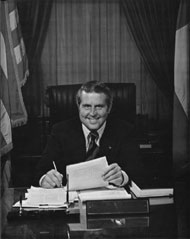
Gov. Waller at work
Former Mississippi governor (1972-1976) and distinguished member of the bar, William Lowe Waller, Sr., died November 30, 2011. He was 85.
He was a champion of the people, and was ahead of his time on civil rights issues. As a District Attorney, he unsuccessfully attempted to prosecute Byron De La Beckwith for the murder of Medgar Evers. He did away with the state’s spy agency, the infamous Sovereignty Commission, by vetoing its appropriations. He opened state government jobs to African Americans, appointing many to fill positions. His son, William L. Waller, Jr., is Chief Justice of the Mississippi Supreme Court.
Philip Thomas’s reminiscence of the governor as adverse counsel is worth a read.
ELOQUENCE FROM THE GRAVE
December 1, 2011 § Leave a comment
We all have had a client or two who wished to wax eloquent in his or her will. You know what I’m talking about: a sermonette; a poem; an admonishment; a reproof; or even a love note. It happens, and you accommodate the client, blending the proffered language into your more prosaic will form, tucked strategically in among the bequests and devises.
I came across a rather extreme example in the blog Futility Closet, and decided to share it with you:
At a dinner for law alumni of New York University in 1907, Walter Lloyd Smith of the New York Supreme Court read “the most remarkable document that ever came into his possession” — the will of an inmate of the Cook County Insane Asylum at Dunning, Ill.:
I, Charles Lounsbury, being of sound mind and disposing memory, do hereby make and publish this, my last will and testament, in order as justly as may be to distribute my interest in the world among succeeding men.
That part of my interest which is known in law and recognized in the sheep-bound volumes as my property, being inconsiderable and of no account, I make no disposal of in this my will.
My right to live, being but a life estate, is not at my disposal, but these things excepted all else in the world I now proceed to devise and bequeath.
Item: I give to good fathers and mothers, in trust for their children, all good little words of praise and encouragement, and all quaint pet names and endearments, and I charge said parents to use them justly and generously, as the needs of their children may require.
Item: I leave to children inclusively, but only for the term of their childhood, all and every, the flowers of the fields, and the blossoms of the woods, with the right to play among them freely according to the customs of children, warning them at the same time against thistles and thorns. And I devise to children the banks of the brooks, and the golden sands beneath the waters thereof, and the odors of the willows that dip therein, and the white clouds that float high over the giant trees. And I leave the children the long, long days to be merry in, in a thousand ways, and the night and the moon and the train of the Milky Way to wonder at, but subject nevertheless to the rights hereinafter given to lovers.
Item: I devise to boys jointly all the useful idle fields and commons where ball may be played; all pleasant waters where one may swim; all snowclad hills where one may coast, and all streams and ponds where one may fish, or where, when grim Winter comes, one may skate; to have and to hold the same for the period of their boyhood. And all meadows with the clover blossoms and butterflies thereof, the woods and their appurtenances, the squirrels and the birds, and echoes and strange noises, and all distant places which may be visited, together with the adventures there found. And I give to said boys each his own place at the fireside at night, with all pictures that may be seen in the burning wood, to enjoy without let or hindrance and without any incumbrance of care.
Item: To lovers I devise their imaginary world with whatever they may need; as the stars of the sky; the red roses by the wall; the bloom of the hawthorn; the sweet strains of music, and aught else by which they may desire to figure to each others the lastingness and beauty of their love.
Item: To young men jointly, I devise and bequeath all boisterous, inspiring sports of rivalry, and I give to them the disdain of weakness and undaunted confidence in their own strength, though they are rude; I give them the power to make lasting friendships, and of possessing companions, and to them exclusively I give all merry songs and brave choruses, to sing with lusty voices.
Item: And to those who are no longer children or youths or lovers, I leave memory, and I bequeath to them the volumes of the poems of Burns and Shakespeare and of other poets, if there be others, to the end that they may live over the old days again, freely and fully, without tithe or diminution.
Item: To our loved ones with snowy crowns I bequeath the happiness of old age, the love and gratitude of their children until they fall asleep.
The original, it turns out, was written by Williston Fish in 1897 and published in Harper’s Weekly the following year. He had intended it as a poetic trifle, but newspapers around the country had picked it up and run it as fact, often embellishing the language, until, Fish wrote in 1908, “this one of my pieces has been translated into all the idiot tongues of English.” Charles Lounsbury was the name of an old relative of his — “a big, strong all-around good kind of man,” but not, evidently, insane.

