DICTA
April 20, 2012 § 7 Comments
- Some helpful ideas to consider when designing or revamping your law firm web site.
- Speaking of which, here’s a link to a web site that focuses on strategies for using the internet to promote your law firm and improve your practice.
- Using LinkedIn to help market your law practice — seven tips.
- Like or Unlike. Facebook will have a billion users by the summer. Robert Lane Greene expounds on how FB is changing us and how the internet operates. All I can tell you about this is that 99% of communications I receive on FB are game requests (I don’t play so I don’t respond) and 80% of posts are tiresome rants about President Obama.
- I don’t get why Florida Circuit Judge Jessica Recksiedler has recused herself from the Zimmerman case involving the death of teenager Trayvon Martin. Of course, all I have to go on is news reports, which can be relied upon to omit important details, but I understand that she recused herself because Zimmerman contacted another member of her husband’s law firm to inquire about representation, and the member turned the case down. That does not sound like a basis for recusal to me, but maybe it was all about an appearance of impropriety in a nationally sensitive case. Until I see the court order, I’ll stay puzzled.
- The ratio of lawyers to the general population in the US is now 1 to 257, according to this article in the ABA Journal online. The piece questions whether the legal profession is due for a shakeout.
- Clichés in your legal draftsmanship should be as unwelcome as a skunk at a lawn party and as rare as hen’s teeth, but, unfortunately, they’re a dime a dozen. The cliché site can at least tell you what that hackneyed phrase really means, so maybe you can find a more original way to say it.
- “We’re from the government and we’re here to help.” <Sigh> TSA extends its protective activities to a city bus stop.
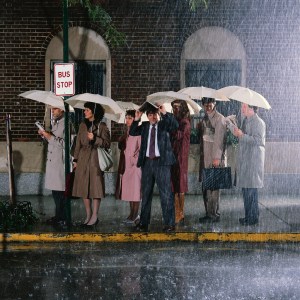
Potential terrorists awaiting strip search by TSA

UPDATE ON LEGISLATION
April 19, 2012 § 2 Comments
I posted here and here about pending legislation that might affect your chancery court practice.
Here is a list of pending bills affecting the judiciary that are still alive (or as the legislators say, “not dead”).
As you can see, most of what has survived has to do with criminal laws and procedure, or domestic violence, with a couple of exceptions.
HB 484. Judicial and DA pay raise, 2012 version passed both houses and was signed into law.
HB 1268. Makes several significant changes to the adoption statutes, including a provision that an attorney representing an adoption agency must complete training, is in conference.
Believe it or not, that is all from the previous lists I posted that has made it this close to the finish line.
WHO ARE THE PARTIES IN A GRANDPARENT VISITATION CASE? PART TWO
April 18, 2012 § 1 Comment
In an earlier post we talked about how critical it is under the grandparent visitation statutes to join the natural parents.
The COA in Bolivar v. Waltman, decided April 3, 2012, raised the issue on its own and tossed out the appeal, vacating the trial court judgment in the process.
The natural parents of two minor children were divorced in 2006. The mother got custody and the father had visitation. In 2008, the Waltmans, who were maternal grandparents, got guardianship of the children due to both parents’ substance abuse. Initially the Waltmans afforded Bolivar, the paternal grandmother, the same every-other-weekend visitation that her son had enjoyed. Over time, however, the Waltmans began to curtail the time they allowed Bolivar, and she filed suit against the Waltmans in Jones County Chancery Court asking to be restored the full extent of her son’s visitation. The natural parents were not made parties.
Following a hearing the trial court granted Bolivar the same visitation that her son had under the original divorce judgment, and the Waltmans appealed.
In his opinion for the court, Judge Maxwell said:
¶6. Although neither party raises the issue of jurisdiction, we must do so on our own initiative. E.g., Michael v. Michael, 650 So. 2d 469, 471 (Miss. 1995) (citing Common Cause of Miss. v. Smith, 548 So. 2d 412, 414 (Miss. 1989); Cotton v. Veterans Cab Co., 344 So. 2d 730, 731 (Miss. 1977); Byrd v. Sinclair Oil & Refining Co., 240 So. 2d 623 (Miss. 1970)). Whether the chancery court had jurisdiction over a particular matter is a question of law, which the appellate court reviews de novo. In re Guardianship of Z.J., 804 So. 2d 1009, 1011 (¶9) (Miss. 2002) (citing Burch v. Land Partners, L.P., 784 So. 2d 925, 927 (¶7) (Miss. 2001)).
¶7. Mississippi Code Annotated section 93-16-5 establishes the necessary parties to a proceeding for grandparent visitation:
All persons required to be made parties in child custody proceedings or proceedings for the termination of parental rights shall be made parties to any proceeding in which a grandparent of a minor child or children seeks to obtain visitation rights with such minor child or children; and the court may, in its discretion, if it finds that such visitation rights would be in the best interest of the child, grant to a grandparent reasonable visitation rights with the child.
(Emphasis added). Section 93-15-107(1) lists as necessary parties in an action to terminate parental rights: “the mother of the child, the legal father of the child, and the putative father of the child, when known[.]” Miss. Code Ann. § 93-15-107(1) (Rev. 2004). Likewise, we find these same parties are also indispensable in a custody determination. See Miss. Code Ann. § 93-27-205 (Rev. 2004) (requiring service of process on “any parent whose parental rights have not been previously terminated” in interstate custody disputes); see also generally Deborah H. Bell, Bell on Mississippi Family Law § 19.01[3] (2005); cf. Smith v. Watson, 425 So. 2d 1030 (Miss. 1983) (finding a third-party with custody of a child is a proper party to a custody dispute between parents but not a necessary party).
¶8. We find section 93-16-5’s mandate clear and unambiguous that the natural parents whose parental rights have not been terminated must be parties to a grandparent-visitation proceeding. And we conclude that the requirement for the joinder of necessary parties in section 93-16-5 is jurisdictional. See Garrett v. Bohannon, 621 So. 2d 935, 937-38 (Miss. 1993) (holding similar mandatory “shall” language in Mississippi Code Annotated section 91-7-25 (Rev. 2004), which establishes necessary parties to will contest, is a jurisdictional requirement); In re Estate of McClerkin, 651 So. 2d 1052, 1058 (Miss. 1995) (holding trial court lacked jurisdiction over will contest because “necessary and proper parties were not before the court.”) (citations omitted). As the supreme court similarly found in Garrett, we find that to give validity and credence to the trial court’s judgment without joinder of necessary parties would undermine the legislative mandate in section 93-16-5. Garrett, 621 So. 2d at 937.
The court vacated the judgment and remanded the case to the chancery court for further proceedings.
Earlier this year, an astute lawyer raised the non-joinder of a natural parent as a defense in a grandparent visitation case and stopped a trial in my court dead in its tracks. To be honest, had he not raised the issue, I would have gone ahead with the trial simply because I had no reason to read the statute. If I had granted visitation, as the learned chancellor did in Bolivar, I guess it would have been reversible on the same ground.
As a practitioner, don’t rely on your rusty memory of the ins and outs of the code sections you are relying upon when you bring an action. Read the code. And, for Pete’s sake, don’t just blindly do a cut and paste job on the last similar set of pleadings you filed back in 2008. Code sections get amended. Case law changes things. Read the code. Stay current. Produce a quality product for your client that can’t be overturned.
DEAN GERSHON RESPONDS
April 17, 2012 § 5 Comments
I posted here about the disappearance of Evidence from the subjects required to graduate from law school, and sent an email to law school deans at Ole Miss and MC, inviting any reply.
Dean Richard Gershon of the Ole Miss School of Law sent this …
Judge,
Thank you for your email, and your blog post. I will share it with our faculty.
One thing you should know is that 90% of the law students at the University of Mississippi School of Law take Evidence, even though it is not required. Also, we are adding a required skills curriculum starting with our 2012 entering class. This program will be taught by lawyers and judges. It will take place the first two weeks of spring semester all three years. The first year they will take contract drafting and negotiation. The second and third year, they will choose from a selection of courses, many of which will have elements of trail tactics and evidence.
The truth is, I didn’t learn evidence in evidence class in law school. I learned it in trial advocacy class. That is where it made sense, because I was applying it.
All best wishes,
Richard
I. Richard Gershon, Dean and Professor of Law, University of Mississippi School of Law
If I receive a response from Dean Rosenblatt of MCLaw, I will publish it.
JUDICIAL PAY RAISE BILL SIGNED
April 16, 2012 § 2 Comments
HB 484 was signed into law Friday by Governor Bryant, putting into effect the first pay raise for Mississippi judges in nearly 10 years. The bill increases pay for appellate and trial judges in five increments over five years, beginning 2013. It is funded entirely by an increase in court filing fees that still leaves our state last in the southeast in the amount one has to pay to initiate a legal proceeding.
Many people helped get this done, and if I tried to name those who did, I would surely offend someone by omission, but this was a team effort by judges, legislators, leadership of the bar, lawyers, and laypeople who understand the importance of an independent, adequately-compensated judiciary.
The bill also establishes a group to study judicial compensation and make recommendations that would hopefully remove judges’ pay from the political-football status it has enjoyed hitherto. Maybe pay could be tied to a percentage of federal judges’ pay, or the southeastern average, or some other objective standard.
The entire budget for the judiciary in Mississippi is less than 1/2 of 1% of the state budget. Yes, less than 1/2 of 1%. The third, constitutionally co-equal branch of state government gets 1/2 of 1% of the entire state budget to fund its entire operation, which includes: salaries and state portion of benefits for 19 appellate judges and approximately 100 trial judges; salaries and state portion of benefits for staff attorneys and/or law clerks for judges who have them; an office expense allowance for each judge; the mini-bureaucracy in Jackson; in-state travel (some limited funds are available, rarely, to attend out-of-state conferences); and the judicial college in Oxford that provides much-needed training for judges. That’s a lot to squeeze into 1/2 of 1%.
A nearby legislator who voted against the bill was asked by an attorney why he voted against the bill. His response was, “They make enough.” I hope he gave the issue more thought than that. Even with the pay raise, Mississippi judges rank at or near the bottom of the southeastern average. As it stands now, it is a considerable sacrifice for most of us to take a job as a judge. What we give up financially is the possibility to earn more, the advantage of owning a business that can pay many expenses that judges have to shoulder personally, and the possibility of entering business ventures with others. But the limitations are not only financial. We have to submit to the code of judicial ethics, which limits us in many ways, and any judge who has done the job for even a short time can describe the feeling of isolation that comes with the wall of separation that is required to do it properly.
Despite the limitations, Mississippi has a remarkably talented, dedicated and competent judiciary. It struck me from the beginning as I saw judges at meetings and conferences how seriously they take their jobs. Judges work in our state, and they work hard, trying their best to follow the law and making difficult decisions.
Maybe our legislative leaders will find a new way in the future to give the judiciary adequate tools to do its job. Commerce depends on courts that are sound, consistent and clear in their rulings. Society depends on courts that are fair and equitable in resolving disputes among citizens, and sure and just in addressing criminal behavior. Government depends on the balance that the judicial branch provides.
It’s true that it all boils down to money, but we need to have the best government we can afford, not the cheapest we can get by with.
“QUOTE UNQUOTE”
April 13, 2012 § Leave a comment
 “I have found the paradox that if I love until it hurts, then there is no hurt, but only more love.” — Mother Teresa
“Guard well within yourself that treasure, kindness. Know how to give without hesitation, how to lose without regret, how to acquire without meanness.” — George Sand
“Waste no time arguing what a good man should be. Be one.” — Marcus Aurelius
DISMISSED FOR LACK OF EVIDENCE
April 12, 2012 § 12 Comments
Evidence is no longer a required course of study at either of the law schools in Mississippi.
That may be old news to you, but I heard of it for the first time only last week. You can click on either or both law school links over there on the right and check for yourself. You’ll have to do a lot of digging to find the info; I recommend you go straight to the school catalogs in .pdf format.
I am sure the academicians have a good reason for this development. I’m guessing – I haven’t “interviewed” any deans or anyone else – that it has something to do with the bar exam, and not law school itself, being what they consider the real certification of skills.
Still, when I think of subjects at the core of being a lawyer, evidence certainly ranks right up there in the top few. A good grasp of the law of evidence requires one to bring to bear the very analytical legal skills that distinguish the legal profession from other fields of endeavor.
Moreover, the law of evidence informs much of what a lawyer does in the everyday practice of law, regardless whether that lawyer ever personally sets foot in the court room. A lawyer’s advice about the drafting of a contract is shaped by the distinct possibility that it may have to be in evidence at trial some day. Advice to clients about how to make a proper paper trail and document activities is based on evidentiary considerations. When a client asks advice about what his or her liability might be if sued, the lawyer has to evaluate the evidence, taking into account what may or may not be admissible in evidence.
As I see it, law school has three primary functions: (1) to teach the law; (2) to teach how to find the law when one is not sure what the applicable law might be; (3) and to analyze the problem like a lawyer so as to bring (1) and (2) to bear.
Of the many areas of study that might be required, I nominate evidence as one that may be unparalleled in its ability to teach law students how to think like a lawyer. Now, I am not an academician. I am a mere trial court judge toiling away in an obscure corner of Mississippi, so my opinion, I am sure, carries little weight on this subject. But based on 33 years of practicing law and 5 years on the bench, I have to say from a purely nuts-and-bolts standpoint that a solid grasp of evidence would be in my top 3 of essential subjects to have if you expect to succeed as a lawyer (FYI, I nominate contracts, civil procedure and evidence).
And yet, by making evidence an elective, the subject has been assigned the same academic weight as other elective courses, which include Venture Capital, Law and Literature, and Legislation at MC; and Gaming Law, Bioethics, and Legal History of Slavery at OM. Not to say that any of those courses are not worthy of being included in a proper curriculum, but are they as essential to the core function of a lawyer as is Evidence?
It seems that the function of law schools has shifted from my era, when we were admitted to practice by diploma privilege after completing a rigorous, mostly required curriculum, to the current, when completion of law school is merely the gateway to admission to the bar exam, and it is up to the students to select (with a few exceptions) what he or she prefers to study.
In 1980, or thereabouts, Mississippi abolished “reading for the bar,” under which an aspiring lawyer would study the law on his or her own under the tutelage and supervision of a lawyer in good standing. After the prescribed period of study, with a certificate of the tutorial lawyer in hand, one applied to take the bar exam. Wisely, under that system, the experienced lawyer directed his tutee’s attention to the things that mattered, which included a hefty dose of Wigmore.
Now one must pay a law school – handsomely – for the same experience, sans the same dose of practicality.
I shiver at the thought of lawyers setting foot in my court room who have no grasp of the nuances of the best evidence rule, parol evidence, hearsay, or even how to get a document into evidence. I shiver for myself and for their poor clients. Some point out that the MRE is so much easier to understand and apply than the old mix of statutes and case law. True. But having a set of rules and understanding them enough to use them properly and effectively are entirely different things. Rules only take you so far. There are cases interpreting those rules that one must learn about. And the rules are neither crystal clear nor do they address everything one needs to know. Cite me a rule, for example, on what objection applies in any given situation. Or tell me how MRE 803(3) pertaining to wills applies in a will contest? Or when does past recollection recorded apply instead of refreshed recollection, and vice versa? Some elucidation is required for even the most astute student.
But, you say, prospective lawyers still have to pass evidence on the bar exam. Yes, but I would be more comfortable knowing that the student who was certified by the law school as being ready to take the bar exam had actually studied and passed evidence courses rather than merely mastered enough of an outline to pass the bar exam.
In the UK there is a two-tiered system: solicitors, who sit in their offices, advise clients, draft wills and other papers, do property work; and barristers, who are certified to have the skills to do litigation.
Maybe we could adopt a similar dichotomy here. I propose that our two-tiered system would be divided along the lines of who has not studied evidence and who has. Those who have not, we could call “shopkeepers” or “legal retailers.” And those who have studied evidence we would call “Lawyers.”
THE MARITAL DEBT CONUNDRUM
April 11, 2012 § Leave a comment
I posted here about allocating marital debt. Debts that are clearly for the benefit of the household are debts that the court should assign to one or both parties in a divorce, applying the equitable principles laid out in Ferguson. No distinction is made between secured and unsecured debt.
Under our case law, we treat debts the same as we do assets for the purposes of equitable division. We classify them as marital or non-marital, place a valuation (the loan balance) on them, and equitably assign responsibility for them. That approach works well in general for debts that are secured by assets that are subject to equitable distribution. The debt in most instances reduces the asset value and goes with the person who gets the asset. Fair enough.
But what about where the debt is for expenses such as day-to-day living expenses or other family expenses that do not result in an asset in the household? I’m talking about credit card debt to pay the light bill, or to buy Christmas presents, or to pay for a family weekend in Gatlinburg, or to buy groceries at Wal-Mart? None of that kind of debt produces an asset. It’s debt that produced cash that was spent up in the ordinary course of living. Had the parties lived within their means, those expenses would have been paid out of ordinary income by the parties, but they chose to incur debt for them instead.
Expenses of the types described immediately above are part of routine, everyday life. If it is reasonable to allocate marital debts for those kinds of expenses to the parties, then why would it not be reasonable to track back through the marriage and account for all expenses, whether charged on a credit card or not, and allocate them between the parties? Say, for instance, that the parties in a hypothetical case spent $30,000 in a hypothetical year on groceries, household goods, utilities, toys for the children, medicine, cable tv, internet access, yard work, medications, property taxes, and on and on and on. If they filed for divorce, why would it not be reasonable, under the same logic we apply to marital debt, to go back and investigate how much they each contributed and then charge the one who contributed less with the difference? And if it is reasonable to do that, why do we not do it in all cases, even where the parties have been married 10, 20 or 30 years or more? Why not examine each year of the marriage, reconstruct the expenditures and equitably allocate the expenditures? Imagine what it would be like to try such a case. Horrors.
As absurd as the above sounds, we take exactly that approach in regard to marital debt. There is no limit on it. There is no threshhold. Whatever the debt is, and however long it took to amass it, we allocate it equitably. As it stands now, there is no limit to how far one can go back to claim reimbursement for or an allocation of marital debt or for how much.
It is logical, of course, that the debt is merely the residue left over after the expenses have been paid. In a divorce, debt is literally the ashes of a failed marriage. The debts are still there long after the expenses have gone away, and equity requires that the parties who enjoyed its benefits should share its burden. I understand that. What I don’t understand is that we have not imposed any reasonable parameters on it.
INCOME FOR CHILD SUPPORT
April 10, 2012 § 3 Comments
MCA § 43-19-101 should be familiar to you. It sets out the child support award guidelines. Since the guidelines are based on the payer’s income, it’s critical to understand just what and what is not included in income.
Subsection 3(a) tells us that we first have to “Determine gross income from all potential sources that may reasonably be available to the absent (i.e., noncustodial and paying) parent.” That’s an interesting phrase, “potential sources that may reasonably be available.” Notice that it does not refer to actual income. Potential sources that might come into play are to be considered.
Income under 3(a) includes, but is not limited to …
- Wages and salary income. There is no exception for overtime; it’s included.
- Income from self employment. Both reported and unreported income in this category is covered.
- Income from commissions. Variable and seasonal income is included, and there are different approaches that the court can use to address it. Bonuses are included.
- Income from investments. Dividends, interest and capital gains are income.
- Interest income.
- Interest earned from any trust account or property. It makes no difference whether it came from a “family trust” or similar creature; if it is income, it is included.
- Paying parent’s portion of joint income of both parents. As reflected on the joint tax return.
- Worker’s compensation.
- Disability. You can read the rules for calculating child support when the payer is a social security recipient here.
- Unemployment. No exemption from child support when the income source is unemployment benefits.
- Annuity and retirement benefits.
- IRA disbursements and withdrawals.
- Any other payments made by any person, private entity, federal or state government, or any unit of local government. Any 1099 income would be included. Any refund of taxes paid in would be included.
- Alimony.
- Income earned from an interest in inherited property.
- Any other form of earned income.
At the end of 3(a) is the statement: ” … gross income shall exclude any monetary benefits derived from a second household, such as income of the [paying party’s] current spouse.”
Section 3(b)(i) requires that overpayments of taxes are to be included in gross income. That means that income tax refunds must be added back in. For low-income taxpayers who claim benefits such as earned income credit and head of household status, this can mean an increase in gross income by as much as $3,000 to $5,000, based on what I’ve seen in court. The trick is to figure out how much of that refund was attributable to the paying parent, and not to his spouse, and then to calculate his tax rate, social security deduction, etc. Don’t expect the judge to do all that math for you on a hunch as to what the proper percentages might be.
As a rule of thumb, you would do well to include anything that might even remotely be considered income. The judge will. If it looks like income, sounds like income, smells like income and feels like income, it most likely is.
One would think that the statute and its intent are straightforward and unmistakeable, but not from what I see in court. Witnesses often testify that they did not include bonuses “because I don’t know whether I’ll get one this year,” or commissions because “I never know from month to month what my commissions will be,” or overtime because “I don’t know when I’ll get some more overtime.” That’s simply not the law. Irregularity and umpredictability are factors that the court can consider, but they don’t warrant completely excluding those items from income.
As a practice matter, are you asking questions in your interrogatories, depositions and requests for production that address all those types of income?

