CARROLLTON
May 5, 2012 § Leave a comment
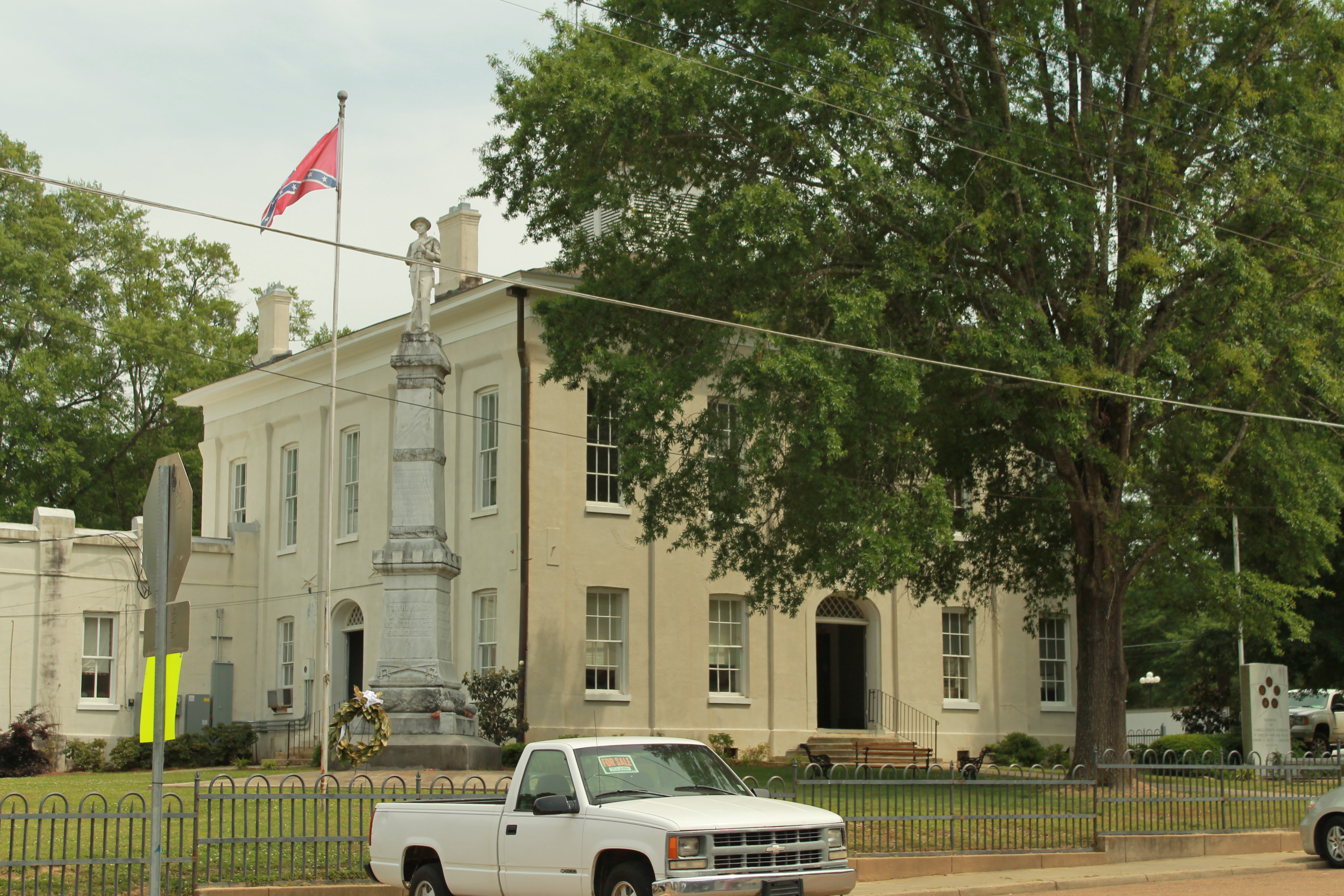
 Carrollton, population 400, County Seat of Carroll County, population 10,500, a hillcountry county for the most part, falling off into the Delta along its western edge. The Carroll County Picture Show in Bobbie Gentry’s Ode to Billy Joe was here. The movie version of Faulkner’s The Reivers, starring Paul Newman, was filmed in Carrolton. The extinct hamlet of Avalon, in northwest Carroll County, was the birthplace of bluesman Mississippi John Hurt.
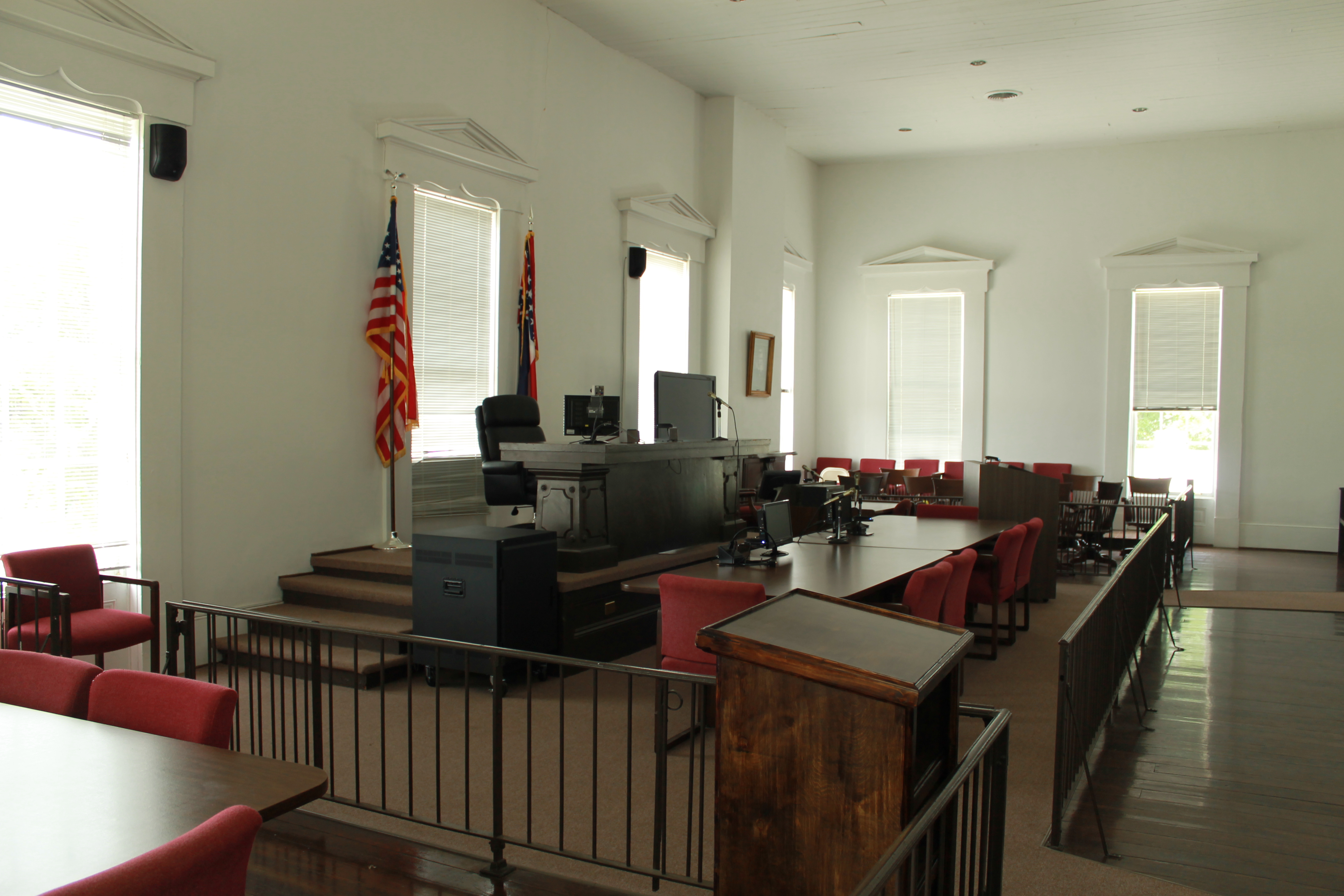
The courthouse in Carrollton was built around 1870 and features breezeway halls that cross perpendicularly. The halls are cool in the summer and cold in winter. A dog was enjoying the cool of the concrete floor on the warm afternoon when we dropped in. Upstairs is the old court room, its electronic trial gadgets adding a discordant punctuation to the plain, stately setting.
The day we visited, jail trustees had just finished moving all of the Justice Court records out of the old courthouse to the newer, storefront version in Vaiden, in the southern part of the county. Vaiden is the largest town in mostly rural Carroll County, and is the seat of the County’s other judicial district. Carroll is one of around 10 Mississippi Counties that have 2 judicial districts, making them for court purposes like two separate, distinct counties. It’s an archaic concept, but unlikely to be undone any time soon, since Carrollton and Vaiden are unfriendly rivals.
Across from the courthouse to the north is the white frame building that was the 19th-century law office of James Zachariah George, a formidable figure in Mississippi history. You can see it in street scene photo below. J.Z. George was a native of Georgia who moved to Mississippi. He fought with Jefferson Davis in the Mexican-American War and later became a lawyer. He was a reporter for the Mississippi Supreme Court, and signer of Mississippi’s Ordinance of Secession. He was an officer in the Civil War, and was taken prisoner twice. After the war, he served as Chief Justice of the Mississippi Supreme Court, and later as US Senator. His statue is Mississippi’s offering in Statuary Hall in the US Capitol.
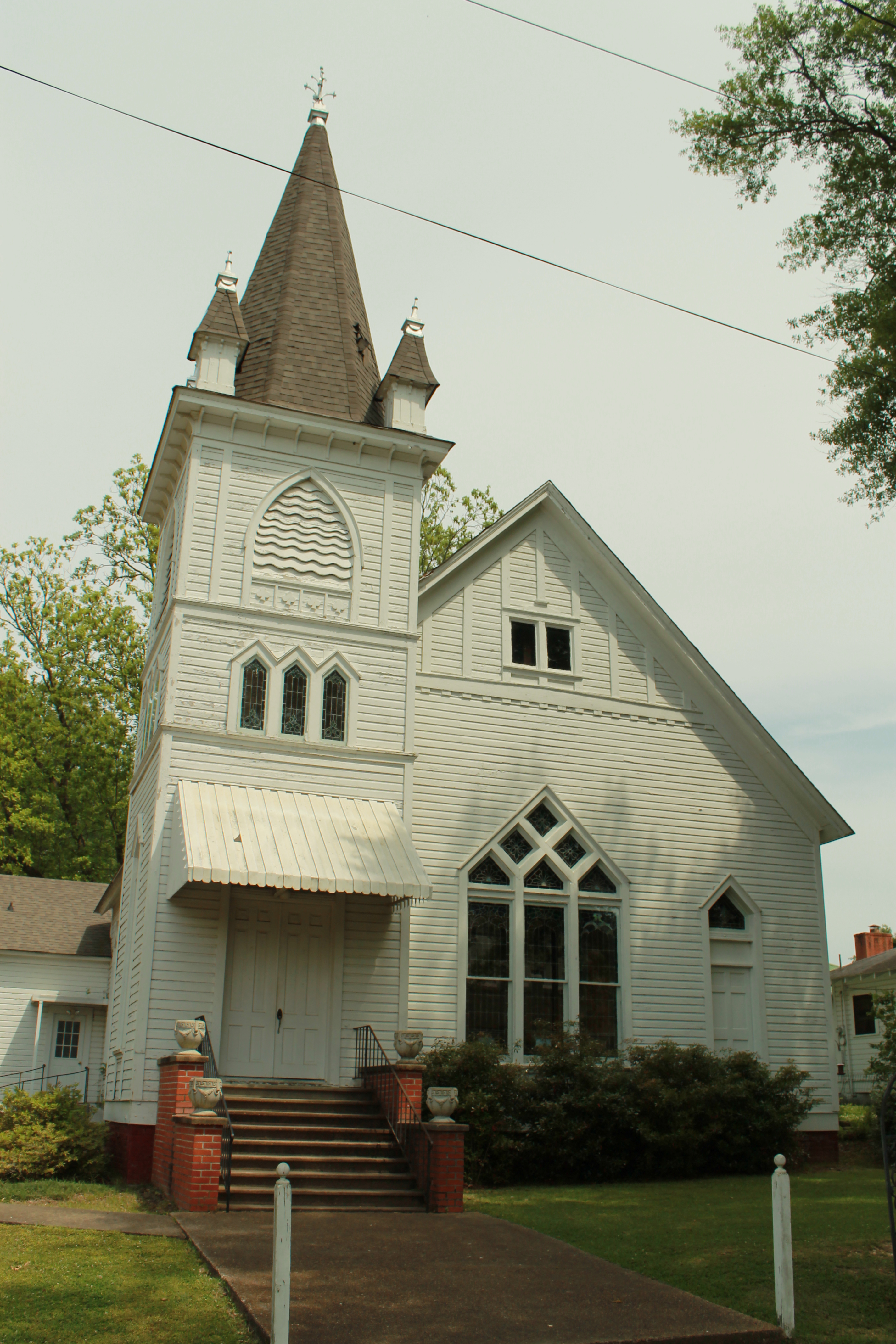
Carrolton is a sleepy town that seems to cling tightly to its past, as the photos suggest. There are old homes and old churches, the flag of a defeated cause, and a patina of faded glory.









TOP TEN TIPS TO IMPRESS A CHANCELLOR AT TRIAL: #9
May 3, 2012 § 4 Comments
This is the second in a series counting down 10 common-sense practice tips to improve your chancery court trial performance. If you’re a long-time reader of this blog, some of these will be familiar. That’s okay. They bear repeating because they are inside tips on how to impress your chancellor, or at least how to present your case in a way that will help her or him decide in your favor.
TOP TEN TIP #9 …
Make sure your witnesses are prepared.
I am regularly astonished at how unprepared and consequently inept some witnesses are at trial. Some examples:
-
The party who testifies to her 8.05 as if it were a runic stone tablet that fell to earth from the planet Uranus instead of as if it were a document she herself helped to originate.
-
The lawyer who slams his head repeatedly against objections for leading because he can’t come up with any other way to clue his witness in to what he expects the testimony to be.
-
The client who probably presented herself as a roaring lion in the intial interview, and is now a mewing pussycat, much to the obvious chagrin and buffaloment of her attorney.
These and many, many other unpleasant witness experiences can be avoided, or at least ameliorated, through the simple expedient of trial preparation in which the lawyer familiarizes the witnesses with what is headed down the tracks right at them. It’s what your client paid you for.
Prepare your witnesses for trial. Go through their testimony. Test their recollection.
Go over that 8.05 with your client. Remember that although it’s not the first one you’ve ever seen, it probably is the first one your client has. Clients have no concept how important and even crucial the financial form is to their case. Consequently, they are haphazard and careless in prepping them, omitting important items, overstating (often absurdly) some expenses, while drastically understating others. Challenge your client’s memory as to what was included in each category and how the figures were determined. Make her defend her figures. If she can not, suggest she reconsider and adjust as necessary to make it true. Is each and every asset listed, and are the values realistic? Ten tips for more effective financial statements are here. And five more are here.
Explain for your client what the trial factors are that will apply in your case, and what the important facts are that you need to get into the record. For instance, if you have a child custody modification case, explain material change, plus adverse effect, plus best interest, Albright factors, and how his or her testimony fits into the picture. Go over some expected questions and critique your client’s answers.
Weed out self-destructive language. It’s not ethical to tell a witness what to say, but it’s perfectly ethical to tell the witness how to say what they have to say. In other words, you can’t change the facts, but you can help the witness select a better, truthful way to state those facts.
Encourage your witness never to volunteer or guess. “I don’t know” is a better answer than “Well, you didn’t ask me, but I guess I was at fault, if you think I am.”
Train your witness to paint a word picture of what happened instead of just babbling a bunch of labels. “The windows were all busted out of the house, the wallpaper was ripped down, there was a puddle of blood on the floor as big as a sow pig, and there was a fire burning in the kitchen trash can making a scorched spot on the ceiling,” is a lot more effective than “The house was tore slam up.”
And while you’re at it, teach your witness some points of court room etiquette: don’t speak over the lawyers or judge; speak loudly and clearly; don’t chew gum or chewing tobacco in court; stand when directed by the bailiff. Every judge has his or her own preferences and quirks. Any lawyer who has spent even a short time in my court can tell you, for example, that I can’t abide witnesses and lawyers speaking over each other. That’s a quirk of mine that you should warn your witnesses about. Your judge has similar idiosyncracies. I practiced before a chancellor decades ago who could not stand to see women in short or low-cut dresses. I know it’s so un-twenty-first-century, but if you find yourself in a similar throwback situation, prudence would suggest that you warn your client in advance so that she could adjust her trial-day wardrobe accordingly.
Warn your client not to get argumentative or sarcastic with opposing counsel no matter how big a jerk he acts like he is.
Tell the witness how the proceedings will go and what to expect. Most people headed to court only have tv as a frame of reference for what to expect. Tell them how the case will proceed and who all the people will be in the court room.
Explain that it’s a lot less damaging to be hurt by the truth than to be caught in a lie.
If you take your client’s money and don’t prepare him or her for trial, you are taking money under false pretenses. And if you think you will slide it by an oblivious judge, think again. The unprepared witness is usually the second-most embarassingly conspicuous aspect of a trial, right after the unprepared lawyer.
A 54(b) HICCUP
May 2, 2012 § 4 Comments
MRCP 54(b) provides that, when a case involves multiple claims for relief, or multiple parties, the court may enter a final, appealable judgment as to fewer than all of the issues, or as to only certain parties, upon a determination that there is no just reason for delay, and at the trial court’s expressed direction for entry of the judgment. We have referred to it here as “Rule 54(b) certification.” Without such certification, the court’s ruling is not appealable, does not terminate the action, and is subject to revision at any time before entry of a final judgment disposing of all claims against all parties. It’s a subject we’ve dealt with here repeatedly: here, here, here, here and here.
In Wilton Acquisitions Corp. v. First Methodist Church of Biloxi, decided by the COA April 3, 2012, the chancellor dismissed Wilton’s pleadings for discovery violations and took under advisement the plaintiff’s claim for attorney’s fees in the case ” … until the Defendant submits sufficient information on which the Court can base its decision …” The judgment also recited “Ordered and Adjudged that this is a final judgment under Rule 54(b) as to all matters addressed herein.” The judge went on to explain that the court needed further information upon which to base its decision on attorney’s fees, and that ” … there is no just reason for delay and that judgment shall be final pursuant to [Rule] 54(b) as to all claims in the matter with the exception of the amount of expenses and attorney’s fees to be awarded, if any.”
Wilton appealed, complaining about the merits of the dismissal.
The COA, however, sidestepped the merits, finding that the chancellor had abused his discretion in ruling that the judgment was final and appealable under MRCP 54(b). The court noted at ¶8 that 54(b) judgments are reviewed under an abuse-of-discretion standard.
Citing Myatt v. Peco Foods, 22 So.3d 334, 340 (Miss. App. 2009), the court pointed out that Rule 54(b) is an attempt to strike a balance between the undesirability of piecemeal appeals and “the need to review a case at a time that best serves the needs of the parties.”
At ¶13, the opinion states that “We find the record unclear as to why the chancellor certified this judgment as final under Rule 54(b) when an item of requested relief, First Methodist’s request for attorney’s fees, was still pending. We find no apparent reason, from the record to review a partial judgment; therefore, we must dismiss this appeal.” [Emphasis added] Thus, the COA concluded that the chancellor had abused his discretion in certifying the case as a final, appealable judgment.
What you need to take away from this case is that if you want the partial judgment to be properly certified under 54(b), make sure that it includes the reasons why a review of the case on appeal before disposition of fewer than all of the issues will best serve the needs of the parties. In this particular case, perhaps an immediate review was necessary in order to prevent prejudice in related litigation, or a statute of limitations is ticking perilously away on a claim that might arise out of the outcome of the case. We really have no idea because the judge did not tell us. The COA is telling us that it is not sufficient merely to quote the language of the rule that “there is no just reason for delay;” you have to be sure that the judgment recites why, and why the best interest of the parties will be served thereby.
As a practice matter, if you intend to appeal, make sure you get that 54(b) judgment to recite what it needs to recite to pass muster under Wilton. If you are not allowed to draft the judgment yourself, or to have input into its language, file a timely MRCP 59 motion and ask the judge to add the specific wording you need. Otherwise, you may have the unpalatable choice of filing that appeal just in case, with full knowledge that it may well be a wasted effort.
DEAN ROSENBLATT RESPONDS
May 1, 2012 § 3 Comments
I posted here on April 12, 2012, about what, to me, was the startling discovery that Evidence is no longer a required course at either MCLaw or Ole Miss Law. The post prompted quite a response. Ole Miss Dean Richard Gershon submitted a brief reply here.
On April 24, 2012, I received this response from MCLaw Dean Jim Rosenblatt …
Judge Primeaux (Your Honor)
I appreciate the opportunity to provide follow-up information regarding your blog posting regarding the teaching of Evidence courses in Mississippi’s law schools.
At Mississippi College School of Law (MC Law), we share your commitment to prepare our students for the courtroom. We take the view that if a law student is confident in the courtroom, that student confidence will carry over to non-courtroom aspects of a legal practice.
I took some time to review the records of our MC Law graduates from May 2008 through May 2012. For this most recent 5-year period, 819 of our 833 graduates took Evidence (98.3% of our graduates). We offer 4 sections of Evidence each year to afford all our students an opportunity to fit this important course into their schedule.
During this period Evidence was not generally a required course in our catalog, but was a required prerequisite course in order to take Trial Practice—one of our most popular elective courses which we offer 8-9 times a year with a class size of 12-16 students. Each student in our Trial Practice course is required to demonstrate throughout the course an understanding of the elements of a trial and the evidentiary principles involved. At the end of the course each student serves as counsel for a full trial as a capstone experience. A thorough knowledge of evidence is essential to be successful in this course. In addition to our tenured faculty members who teach Evidence, we are fortunate to have Presiding Justice Jess Dickinson from the Mississippi Supreme Court and Judge Kenny Griffis from the Mississippi Court of Appeals who teach Evidence at MC Law (Justice Dickinson was voted by our students as Adjunct Professor of the Year, so he must be doing all right with his Evidence teaching).
Many of these law students go on to compete in one of the 26 regional and national trial or appellate moot court competitions in which our law school participates. In addition we offer school-based competitions in the trial arena such as our Opening Argument Competition (1L), Closing Argument Competition (1L), and Top Gun Competition (upper level) for our future litigators. The Mississippi bench and bar are tremendously supportive of these competitions and assist as coaches, advisers, practice round judges, or competition judges. I am grateful to you and your fellow members of the bench for your involvement in legal education.
Some years ago (before my time), our Faculty made the policy decision to mandate curriculum only for the first year. The exception to this policy was requiring Appellate Advocacy (taught in the fall semester of the second year), Professional Responsibility/Ethics (a course required by the standards of the American Bar Association), and a writing requirement course or seminar. Constitutional Law was formerly a required course in the first-year curriculum and kept that status when it was moved to the upper level.
Recently, we instituted a “Guided Curriculum” for our students who have a grade point average of less than a 2.5 at the end of the first year. Evidence is one of the five courses that these students are required to take in their upper level curriculum.
There is an additional factor that motivates our students to take Evidence in such large measure–the subject is tested on the bar examination. Evidence is routinely tested on the Multistate Bar Exam (MBE) and the Multistate Essay Exam (MEE) and is potentially testable on the Mississippi Essay Exam. This fact is not lost on our students, which is another reason for the robust enrollment rate for our Evidence courses.
I am confident that our policies, curricular offerings, and programs emphasize the importance of Evidence as a subject and that our students emerge from their legal education with a theoretical and practical understanding of this subject so crucial to the practice of law. I appreciate the opportunity you have afforded me to respond and thank you for allowing discussions such as this on your blog.
Please also allow me to share with you a resource that may be of benefit to you and your blog readers. We have created the Judicial Data Project–a data base on our Law Library web site at http://judicial.mc.edu/ that is available free of charge to members of the legal community or to the public. One can watch videos of oral arguments at our appellate courts, view briefs filed in the cases, and search the statistical data base using a whole host of parameters. For example, one could type in the name of a trial judge and see how many cases of that judge went up on appeal. One can also search by type of case, party name, attorney name, date, jurisdiction, and many other data items either singularly or by using a combination of these parameters to narrow a search. I would appreciate you examining this web site and sharing with your readers information about the Judicial Data Project and how it can be used by judges and practitioners.
I hope you are finding your copies of the Mississippi Rules Annotated to be of use to you on the bench. We are pleased to furnish complimentary copies to Mississippi judges.
I am grateful for your judicial service on behalf of the citizens of Mississippi. Warm regards.
Jim Rosenblatt
Dean and Professor of Law, Mississippi College School of Law (MC Law)
“Let Justice Roll”



FLYING SOLO
April 26, 2012 § Leave a comment
A couple of weeks ago there was a news item about a woman who had to pilot a small plane to an emergency landing when her husband, who had been at the controls, had a sudden heart attack and collapsed. The story had a happy ending due to the assistance of a good-samaritan private pilot who took to the air, flew beside the first craft, and instructed the woman into a safe, but bumpy, landing.
Pro se litigants are like those untrained pilots who take the controls of their own aircraft. Only there is not a helpful, experienced pilot to guide them to a happy conclusion. Most of them crash and burn, some fatally, others with considerable cuts and bruises, and all the worse for wear. Here are my 3 most recent experiences:
- Man appears self-represented for temporary hearing, refuses the opportunity to negotiate with opposing counsel, and turns down any continuance. He sits mute through direct examination (heavy on leading questions), raising no objections. He has no questions on cross examination. After plaintiff rests, he says he has no testimony or evidence to present, after being told he may take the stand, or call other witnesses, or present any documentary evidence. Needless to say, the results were not in his favor.
- Woman appears pro se in defense of DHS contempt action for non-payment of child support. She has filed no pleadings, but claims in her testimony that the child has been living with her, and that her income is reduced anyway, so that the child support ordered 9 years ago should be modified downward. I explain that she must file pleadings to put DHS on notice of her claims, and I recess the hearing to allow her to do that. I could have simply rendered a judgment against her, but … well … nevermind.
- Man files pro se complaint for custody. At hearing he calls a single witness who testifies that he has never seen the plaintiff and the minor child together. It’s not clear to me how this helps promote his claim for custody. He then says he has no other testimony, even after I explain that he may take the witness stand and testify in his own behalf. Then he has a change of heart and says he has some papers he wants me to look at. One by one he offers several County Court judgments for child support for other children, which opposing counsel graciously allows in. Then the plaintiff rests. After the 41(b) motion is granted the defendant testifies and, based on her testimony I order visitation and award her the tax exemption for the child.
None of these top the pro se “partition” case I had several years ago. Both plaintiffs and defendant were self-represented. The plaintiffs’ pleadings asked for partition. At hearing, though, the proof was that defendant had lived in the home in which the heirs had an interest and had dismantled the fireplace. The plaintiffs wanted it restored or to recover their damages. I dismissed the complaint and sent them to County Court to pursue a lawsuit.
A Meridian air guardsman in the 70’s crashed his F-4 and suffered a broken back. As he was being wheeled on a stretcher into the hospital, a local tv news reporter stuck a microphone in his face and asked what had caused the accident. Through his pain the pilot replied,”I ran out of air speed, altitude and experience all at the same time.” That about sums it up.
TOP TEN TIPS TO IMPRESS A CHANCELLOR AT TRIAL: #10
April 25, 2012 § Leave a comment
Starting with this post, I’m going to count down 10 common-sense practice tips to improve your chancery court trial performance. If you’re a long-time reader of this blog, some of these will be familiar. That’s okay. They bear repeating because they are inside tips on how to impress your chancellor, or at least how to present your case in a way that will help her or him decide in your favor. Some of you may find them elementary. Okay. But read them anyway as a reminder. And you just might recognize some bad habits you could work on. Here goes …
TOP TEN TIP #10 …
Make sure your exhibits make sense in the record.
I can’t begin to count the number of times I have seen a lawyer hand a witness a sheaf of photos or documents, admit them in a clump, and then proceed to ask the witness questions about individual items. “This is a picture of my son’s room, showing the hole in the wall.” Problem is, the judge has no clue which picture the witness is looking at, and the lawyer and witness are successfully conspiring to keep it out of the record so that a snoopy appellate judge won’t find it either.
So here’s the deal: if you’re offering a series of items like twenty photos of the former marital residence, separately put a clearly printed number or letter on the back of each one. Then ask the witness on the record to identfy them and explain what their markings are. For example, the witness says: “The photos are numbered 5 for Exhibit 5, and each is lettered separately A through M.”
That way they can all go into evidence together as a composite exhibit, and you can then question the witness about “the photograph in evidence as Exhibit 5-D, or Exhibit 5-8,” so that the record will be clear and the judge will be sure what you are referring to.
The same applies to any documentary evidence that consists of several items that will be included in a composite exhibit about which you will ask the witness questions directed to the individual items. For instance, if you have a contract consisting of 23 pages, and you’re going to question the witness about provisions scattered over several pages, make sure the pages are numbered and refer the witness to that page number for the record, or make a circle or some other kind of distinguishing mark so that the witness, opposing counsel, trial judge and appellate judge will know what you’re talking about.
Of course, none of this makes much difference at trial if you don’t comply with UCCR 3.05. That’s the rule that requires you, for every exhibit you offer into evidence, to have an original, a copy for the judge, a copy for the witness, and a copy for opposing counsel. I get grumpy whenever a lawyer wants to take the exhibit away from me to question the witness, and I don’t have a copy to follow along. A grumpy trial judge is not a good thing for your case, believe me. Always have enough copies to comply with UCCR 3.05.
NEW RULES FOR MARRIAGE
April 24, 2012 § 4 Comments
Governor Bryant signed into law SB 2851, which makes some sweeping changes in how one applies for and obtains a marriage license in Mississippi. You can read the new law here for yourself.
The law, which takes effect July 1, 2012, changes much of MCA § 93-1-5. The new law clarifies the age limitations to provide that any male 17 years and older, and any female 15 years and older, may apply for a marriage license, provided that they have parental consent or have an order of a circuit, chancery or county court judge waiving the requirement.
Other changes: the three-day waiting period is eliminated, as is the requirement for a blood test for syphilis. You may not obtain a marriage license if it appears to the circuit clerk that you are intoxicated, or are suffering from mental illness or intellectual disability to the extent that you do not understand the nature and consequences of the application for a marriage license (there’s a lot I could say about this last provision, but I’ll let it go for now).
MCA § 93-1-7 is repealed. That is the section that provided the right of “any interested party” to contest issuance of a marriage license.
The biggest change here, of course, is elimination of the waiting period and blood test. Those two requirements in combination sent many a couple here in east Mississippi scurrying off to Alabama to tie the knot on impulse. Now they have no reason to run off somewhere else.
What impact will this have on the divorce rate? Too soon to say for sure. My own purely opinionated, unscientific guess is that most marriages that are entered into without much thought and reflection beforehand are marriages that don’t last too long. That being said, I don’t think the three-day waiting period accomplished much in the way of time for thought and reflection anyway. Besides, for couples who are “hotter than a pepper sprout,” like the song says, could hop over the line to Alabama and “get married in a fever” no matter what Mississippi law required. All in all, I think these changes eliminate some requirements that were outmoded in the 21st century and we can do without.

