ONE MORE CONSIDERATION OF RECONSIDERATION
February 21, 2013 § 8 Comments
I posted here not too long ago about the vernacular use of “Motion for Reconsideration” as the post-trial motion that is MRCP 59.
It’s pretty widespread. I recently had a four-page post-order motion challenging a temporary ruling of mine. The motion did not invoke any MRCP at all, but every page included the words “reconsideration” or “reconsider” at least once. When I took the bench and announced that I would treat the motion as made per MRCP 59 (which was an indulgence, since I am convinced that MRCP 59 relief lies only as to final judgments; See, Trilogy Communications, Inc. v. Thomas Truck Lease, Inc., 733 So.2d 313, 317-318 (Miss.App. 1998)), the proponent lawyer corrected me and said that it was actually a MRCP 60 motion for relief from judgment. Excuse me.
Judge Southwick back in 1999 addressed the subject in the case of Barber v. Balboa Life, 47 So.2d 863 (Miss.App. 1999), where he stated in footnote 3 at page 869:
“Pursuant to Rule 59 of M.R.C.P., relief following judgment is on motion for a new trial, not on motion to reconsider. Motions to reconsider, as previously known in practice and procedure in Mississippi prior to the adoption of the Mississippi Rules of Civil Procedure, have for all purposes and intent, been abolished and superceded [sic] by the aforementioned Rule 59 of M.R.C.P. It is suggested that the appellant apply Rule 59 of M.R.C.P. in the future under similar circumstances.”
That was 14 years ago. The footnote apparently didn’t have much impact.
I think the main reason most lawyers ask for reconsideration rather than rehearing, as the rule states, is that they absolutely do not want a rehearing. I mean, who really wants to retry what one has already tried? What they want the judge to do is take another look at the facts and/or the law and render a different result. That’s what rehearing has always looked like in chancery where the fact-finder and the judge of the law are one and the same. When the trial is over the fact-finder is not scattered to the far reaches of the county, as is the case with a jury. The fact-finder is right there in in the courthouse where she rendered the judgment in the first place. And she just might realize when confronted with the motion that a different outcome might be more equitable.
But the rule expressly says “rehearing.”
We judges are supposed to look past the form to the substance. When you use confusing language and do not invoke the proper rule, at best you will confuse the judge. At worst, you may find you’ve messed up your record for appeal.
WORTHWHILE READING ON ATTORNEY’S FEES
February 20, 2013 § 1 Comment
A subject of vital interest to lawyer is, or should be, what it takes to get an award of attorney’s fees at trial. The cases on the subject are all over the proverbial ballpark, so I found the following language from Judge Fair’s specially concurring opinion to the COA’s decision in Jordan v. Jordan, handed down December 11, 2012, affirming Judge McKenzie, to be quite helpful.
¶23. I write separately to address the award of attorney’s fees by a trial judge, a subject the Mississippi Supreme Court has discussed directly only twice in the last five years.
¶24. It is not disputed by judges and practitioners that the “best practice” in awarding fees is a ruling by the trial judge in which each of the factors set out in McKee v. McKee, 418 So. 2d 764, 767 (Miss. 1982), is specifically addressed.
¶25. Ronald argues that the lack of such a discussion should require mandatory reversal as is the case in other “factor determination” cases. See Lowrey v. Lowrey, 25 So. 3d 274, 280 (¶7) (Miss. 2009) (factor tests, as provided in Ferguson and Armstrong, must be considered on the record in every case); Powell v. Ayars, 792 So. 2d 240, 244 (¶8) (Miss. 2001) (holding failure of trial court to address each Albright factor in awarding custody was reversible error).
¶26. Not so, says the Mississippi Supreme Court. In West v. West, 88 So. 3d 735, 747 (¶57) (Miss. 2012), the supreme court upheld the chancellor’s award of attorney’s fees “because it was not manifestly wrong.” The court explained that “[a]lthough the trial judge did not include an analysis of the McKee factors in his judgment, his award was not unreasonable, so we affirm.” Id. at (¶58) (citation omitted).
¶27. The same standard was applied to a circuit court. In Collins v. Coppers, 59 So. 3d 582, 593 (¶35) (Miss. 2011), the court noted:
The trial judge began his discussion of the reasonableness of the defendants’ attorneys’ fees by noting that his analysis was to be guided by the McKee factors . . . . The judge noted that this litigation has been ongoing for over four years, requiring several hearings, and the pleadings are voluminous. After considering those factors, the court’s knowledge of what is charged for legal services in the area, and all other [McKee ] factors, the trial judge found that the amount of attorneys’ fees submitted by the defendants was reasonable.
¶28. While I would continue to recommend an on-the-record analysis of each McKee factor to support an award of attorney’s fees, the failure to do so has not been considered reversible error.
That’s about as good a practice guide on the subject as you will find anywhere.
Remember that, in a divorce case, you must establish inability to pay before the judge can reach the issue of reasonableness. Gray v. Gray, 745 So.2d 234, 239 (Miss. 1999). After you have laid that predicate, then the question becomes whether the chancellor had sufficient evidence to support his decision on attorney’s fees, whether or not all of the McKee factors are proven or addressed. A case illustrating these points is Tatum v. Tatum, decided December 11, 2012, by the COA.
FAILURE TO AMEND
February 19, 2013 § 1 Comment
It’s pretty common for lawyers to file pleadings subsequent to their initial pleading with updated allegations, added issues, and the word “Amended” prominently displayed in the document’s title. Quite often the lawyer on the other side treats the subsequent pleading(s) as the one(s) at issue, and the proof proceeds accordingly.
That practice, however, is not what the rules require, and, as we shall see, can cost your client big time. The proper procedure to amend pleadings is set out in MRCP 15:
(a) Amendments. A party may amend a pleading as a matter of course at any time before a responsive pleading is served, or, if a pleading is one to which no responsive pleading is permitted and the action has not been placed upon the trial calendar, the party may so amend it at any time within thirty days after it is served. On sustaining a motion to dismiss for failure to state a claim upon which relief can be granted, pursuant to Rule 12(b)(6), or for judgment on the pleadings, pursuant to Rule 12(c), leave to amend shall be granted when justice so requires upon conditions and within time as determined by the court, provided matters outside the pleadings are not presented at the hearing on the motion. Otherwise a party may amend a pleading only by leave of court or upon written consent of the adverse party; leave shall be freely given when justice so requires. A party shall plead in response to an amended pleading within the time remaining for response to the original pleading or within ten days after service of the amended pleading, whichever period may be longer, unless the court otherwise orders.
and
(d) Supplemental Pleadings. Upon motion of a party the court may, upon reasonable notice and upon such terms as are just, permit the party to serve a supplemental pleading setting forth transactions, occurrences, or events which have happened since the date of the pleading sought to be supplemented. Permission may be granted even though the original pleading is defective in its statement of a claim for relief or defense. If the court deems it advisable that the adverse party plead to the supplemental pleading, it shall so order, specifying the time therefor.
So to amend after the deadline in R15(a), you have to get leave of court. Otherwise, that “Amended” pleading is a nullity.
That’s what happened in McKnight v. Jenkins, decided February 14, 2013, by the MSSC.
Holly McKnight filed a petition to modify custody against Walter Jenkins, the father of her child whom she had given custody in a prior judgment of the court. Walter countered with a counterclaim for contempt and for modification. The contempt allegation was based on Holly’s alleged failure to return all of the child’s belongings at the conclusion of visitation. Some time before the date set for hearing, Walter filed a motion to amend his pleading to add the allegation that Holly had failed to pay her share of the child’s medical expenses, but Walter never presented the motion to the court.
Following a hearing, the chancellor denied Holly’s petition to modify, but found her in contempt for failure to pay the medical bills, and ordered her to pay Walter $21,000 for her share.
The MSSC reversed, pointing out that in order to recover on a contempt claim, there must be a pleading putting the other party on notice. The unamended pleading simply did not support the relief granted. By failing to get a court order granting leave to amend, Walter’s award of $21,000 was reversed.
There is language in the opinion to the effect that the parties understood that the issue of contempt for failure to pay the medical bills was not properly before the court, and the judge acknowledged as much, but he went ahead and adjudicated contempt anyway, which was error. Of course, had the issue been tried without objection, Walter’s lawyer could have made a timely motion to conform the pleadings to the proof, as set out in MRCP 15(b):
(b) Amendment to Conform to the Evidence. When issues not raised by the pleadings are tried by expressed or implied consent of the parties, they shall be treated in all respects as if they had been raised in the pleadings. Such amendment of the pleadings as may be necessary to cause them to conform to the evidence and to raise these issues may be made upon motion of any party at any time, even after judgment; but failure so to amend does not affect the result of the trial of these issues. If evidence is objected to at the trial on the ground that it is not within the issues made by the pleadings, the court may allow the pleadings to be amended and shall do so freely when the presentation of the merits of the action will be subserved thereby and the objecting party fails to satisfy the court that the admission of such evidence would prejudice the maintaining of the action or defense upon the merits. The court may grant a continuance to enable the objecting party to meet such evidence. The court is to be liberal in granting permission to amend when justice so requires.
REVENGE OF THE PONY-BIRD
February 15, 2013 § 1 Comment
Don’t you just hate that whooshing sound of a joke sailing right over your head?
Like when the Chinese People’s Daily online reported that the American media had named N. Korean leader Kim-Jung-Un the “Sexiest Man Alive.” >WHOOSH!< It was a joke, man! The American article was published in The Onion. (I hope I don’t need to explain what that means).
I imagine it would be especially distressing to expound in a scholarly fashion on a particular subject only to find out that the authority or data on which that scholarly opinion was a >WHOOSH!< joke.
Like Michael J. Bean and Melanie J. Rowland, who authored a book entitled The Evolution of National Wildlife Law. It’s certainly a worthy subject; I’ll grant that. On page 5, the authors touch on the subject of legal disputes over ownership of new breeds. In footnote 5 on that page, they state:
To illustrate the bizarre results that can sometimes happen when courts consider such questions, see the Canadian case of Regina v. Ojibwa, 8 Criminal Law Quarterly, 137 (1965-66), (Op. Blue, J.), described in United States v. Byrnes, 644 F.2d 107, 112, n. 9 (2d Cir 1981). The Canadian court concluded that a pony saddled with a down pillow was a “bird” within the meaning of a statute defining the term as a “two legged animal covered with feathers.” The court reasoned that the two legs were the statutory minimum, and that the feather covering need not be natural.
Clue: Op. Blue, J. = Opinion by Judge Blue. Or, in Canadian parlance, Blue, J. As in Blue Jay. The bird.
You see, it was a joke. Regina v. Ojibway was a joke, a scholarly one, to be sure, but a joke nonetheless. It was a parody of legal reasoning. I posted about this faux opinion here before, pointing out that ” … scarily, it could easily be mistaken for the real thing.” I guess so. >WHOOSH!<
Thanks to Colette Corr.
THE HIGH COST OF FALLING OUT OF LOVE
February 14, 2013 § Leave a comment
A contract to devise property by will is enforceable under Mississippi law. It’s not something one sees every day, but it is something one bumps into every now and then.
Take the case of Hall v. Lewis, decided February 12, 2013, by the COA, a most appropriate case to look at on Valentine’s Day.
Howard Hall and Varnell Lewis were in love. They had been involved in a romantic relationship for several months when, in 1998, Howard purchased a piece of property in his sole name and built a home on it at his expense. At the time of trial in this case, many years later, the property was valued at $80,000.
In 1999, Howard and Varnell, still lovebirds, executed a document entitled “Intervivous [sic] and Testamentary Contract” [is the proper use of Latin phrases yet another thing they’ve stopped teaching in law school?] and each executed a will. The contract provided that Varnell would have a life estate in the property, or have one-half of the proceeds if sold during her lifetime, or have a life estate in any property acquired to replace the property. The agreement required both of them to execute a will contemporaneously to effect its terms. The agreement also provided that it “shall remain in full force and effect and may not be changed by either party,” and “a violation of this agreement may result in a suit for damages for the value of the property.”
By 2005, Howard and Varnell, alas, were out of love, and they parted ways. Howard changed his will to make his grown children the sole beneficiaries and devisees, cutting Varnell completely out.
In 2007, Varnell tried to move a mobile home onto the property based on her contract rights, but Howard refused. Varnell filed suit to enforce the contract, and the chancellor ruled in her favor that it was, indeed, an enforceable contract. Based on the final sentence of the contract as to damages, the judge awarded Varnell a judgment for $40,000 against Howard, and ordered that, upon payment of that amount, Varnell’s right to a life estate would be extinguished. Howard appealed.
After disposing of Howard’s assertion that he did not actually sign the contract, Judge Ishee’s opinion states:
¶10. Additionally, Mississippi law provides that a contract to devise or bequeath property by will is enforceable. Williams v. Mason, 556 So. 2d 1045, 1048 (Miss. 1990) (citing Trotter v. Trotter, 490 So. 2d 827, 830 (Miss. 1986) (citation omitted)). With regard to oral promises to devise property, the Mississippi Supreme Court has held that “[a] will, when written in conformity and compliance with the agreement, was a consideration which belonged to the appellee. The testator had no right to revoke it, and its attempted revocation, if deliberately made, constituted a fraud upon [the appellee.]” Johnson v. Tomme, 199 Miss. 337, 347, 24 So. 2d 730, 732 (1946).
¶11. Here, not only did Hall’s and Lewis’s wills reflect the agreement between them, the agreement itself was written by an attorney, signed by both parties, and notarized. This constitutes “clear, definite[,] and certain evidence” of the parties’ intentions. Trotter, 490 So. 2d at 830. Hall’s assertion that the contract is unconscionable is, therefore, also meritless. Accordingly, we cannot find error in the chancery court’s enforcement of the contract.
As illustrated in this case, a contract to bequeath or devise property by will is one of those planning tools that can be used to help unmarried parties to formalize their relationships, as I have discussed here before. You will want to be sure you advise them both in advance, in writing and acknowledged by each of them, that the contract may not be unilaterally rescinded later.
Another interesting point in this case is that the appellant’s 19-page brief cited not a single authority in support of the argument. As the opinion pointed out, “Failure to cite authority to support an argument renders an issue procedurally barred.”
Finally, it’s a hard but immutable principle of law that falling out of love is simply not a reason to abrogate any legal agreement. Happy Valentine’s Day!
ACCESS TO JUSTICE
February 13, 2013 § 5 Comments
Anyone who has spent any time in chancery court has witnessed the hapless flailings of people ineffectively trying to represent themselves in legal matters, some of which would be challenging enough for an experienced legal professional, much less someone completely unversed in the complexities of the substantive law, evidence, due process and procedure. It is never a pretty sight.
Last Friday I attended a symposium at Ole Miss on Poverty and Access to Justice. I should say, more accurately, that I attended the morning sessions. I came away with some misconceptions corrected, hope that something constructive can be done, and an idea of some steps I can take in my own district.
The symposium papers are published at Supra, which is the online publication of the Mississippi Law Journal. I encourage you to click on the link and read them to get an idea of the scope of the problem, as well as ideas that people are pursuing to address it.
And it is a problem with several facets:
- There are the poor and illiterate who could not afford even a modicum of legal representation, and so are prey to loan sharks, unscrupulous merchants, and sharp dealers of every imaginable stripe. Legal Services, which is on the verge of extinction, has tried with underfunded and understaffed offices to provide representation to as many as possible, but there are not enough resources to keep up with the numbers.
- There are the growing numbers of people who no longer have the financial means to hire an attorney, and take on the task themselves.
- There are the few who simply believe that they will somehow be equal to the task, or that the judge will help them.
- There are the online purveyors of self-help legal kits. I’ve posted here about them.
The dilemma created by these cross-currents is that on the one hand we have people whose poverty and lack of education create nearly insuperable barriers to accessing the legal system, and, on the other hand, we have too few legal resources available to low- and no-pay clients.
In the court room, the judge is responsible to be fair to both sides. The opposing lawyer has a duty to zealously represent his or her client. It’s not called an adversarial system for nothing.
In my district, I am going to organize a group of lawyers who are interested in doing something to work on solutions. We are going to work with the Mississippi Access to Justice Commission and try to alleviate the problem in our corner of the universe. Our efforts will likely not eradicate the adverse impact of poverty vis a vis the legal system, but that’s no reason not to try.
ALIENATION OF AFFECTION: A DISH BEST SERVED COLD
February 12, 2013 § 3 Comments
Alienation of affection survives the Mississippi legislature yet again, per Randy Wallace.
Here’s Philip Thomas’s take.
In the 21st century, what is the justification for continuing this cause of action in effect? Don’t the equitable distribution principles take care of this? Doesn’t the tort simply add a distorting feature to the equitable distribution arrangement?
Our family law has been evolving away from the nineteenth-century retribution-based model to today’s equitable relief, based on valuations and equities. This tort just does not fit.
Maybe some day all of our marital-dissolution law, including associated tort law, will move into the 21st century (hopefully before the 22nd century).
POLICE REPORTS AS EVIDENCE
February 11, 2013 § 2 Comments
Police investigations and reports not infrequently play an evidentiary role in divorce and modification trials in chancery court.
A recent example is Heimert v. Heimert, handed down by the COA on November 13, 2012. In this case, Sheri and Walter Heimert had a history of physical altercations involving allegations of biting, strangling, hitting, and on and on, with the physical marks to show for it. The police were called multiple times to intervene, and two police reports, one from August, 2007, and the other from December, 2008, were offered into evidence. The December report showed that Sheri was charged with domestic violence. Her attorney objected that there was an inadequate foundation to admit it, but the chancellor let it in anyway, and Sheri complained on appeal that the report should not have been admitted.
The COA rejected Sheri’s argument. Judge Lee, for the court:
¶16. “Even though police reports, if offered in evidence to prove the truth of the matter asserted[,] are hearsay and the information within them may be based on hearsay, they may be admissible under the hearsay exception in [Mississippi] Rule [of Evidence] 803(8).” Rebelwood Apartments RP, LP v. English, 48 So. 3d 483, 491 (¶36) (Miss. 2010). Rule 803(8), entitled “Public Records and Reports,” states:
Records, reports, statements, or data compilations, in any form, of public offices or agencies, setting forth . . . (C) in civil actions and proceedings and against the state in criminal cases, factual findings resulting from an investigation made pursuant to authority granted by law, unless the sources of information or other circumstances indicate lack of trustworthiness.
¶17. The police report was taken after an investigation of domestic violence reported by Sheri. No assertion has been made that the document lacks trustworthiness. Sheri argues the police report was inadmissible because it was not authenticated. However, a document may be authenticated by the testimony of a witness with knowledge “that a matter is what it is claimed to be.” M.R.E. 901(b)(1). Sheri was a knowledgeable witness, and she submitted the police report as part of discovery. Sheri testified she was familiar with the document; thus, Sheri’s testimony was sufficient to show that the document was “what it [was] claimed to be” – the police report from December 5, 2008. See Cassibry v. Schlautman, 816 So. 2d 398, 403-04 (¶¶20-23) (Miss. Ct. App. 2001) (finding medical records submitted by plaintiff in discovery were authenticated by plaintiff’s own testimony).
¶18. Further, Sheri testified consistently with the information in the police report, and Walter testified consistently with his version of events in the police report. Thus, even if the police report was admitted into evidence erroneously, the admission was harmless, as it was cumulative. Id. at 404 (¶24) (holding admission of hearsay may be held harmless where corroborating evidence exists). Sheri complains she was prejudiced by the report because it only contained information provided by Walter. However, this is not the case. The report clearly contains information gathered from both Walter and Sheri.
¶19. Sheri was familiar with the police report, and she submitted it as part of discovery. Further, the contents of the police report were corroborated by the testimony. We find the police report was properly admitted into evidence. This issue is without merit.
In other words, Sheri was hoist with her own petard. She herself corroborated the facts in the report in her testimony, and she herself had sifted the poison pill into the recipe by providing it in discovery, thus weakening her arguments against authenticity and trustworthiness.
One is left to wonder whether Sheri’s objections would have been upheld if Walter had been the sponsor of the report, and if Sheri had truthfully denied the facts in the report. What do you think? Don’t overlook this statement by Judge Lee: “The report clearly contains information gathered from both Walter and Sheri.”
WEBSTER COUNTY COURTHOUSE RUINS
February 8, 2013 § 1 Comment
The Webster County Courthouse in the Village of Walthall, pop. 170, burned during the night of January 17, 2013. You can see some photos taken in res gestae at the Mississippi Preservation web site.
The courthouse, located in the geographic center of the county, is four miles north of the nearest town, Eupora. The village has a handful of homes, an Exxon station/convenience store, an appliance repair shop with 50-60 washers and dryers out front, a beauty salon, and a sizeable Baptist church. I stopped en route and took these pictures of the ruins.
This is the front of the courthouse, with the main entrance, facing east …

Sunlight where the courtroom was …

South entrance …

Rear, facing west …

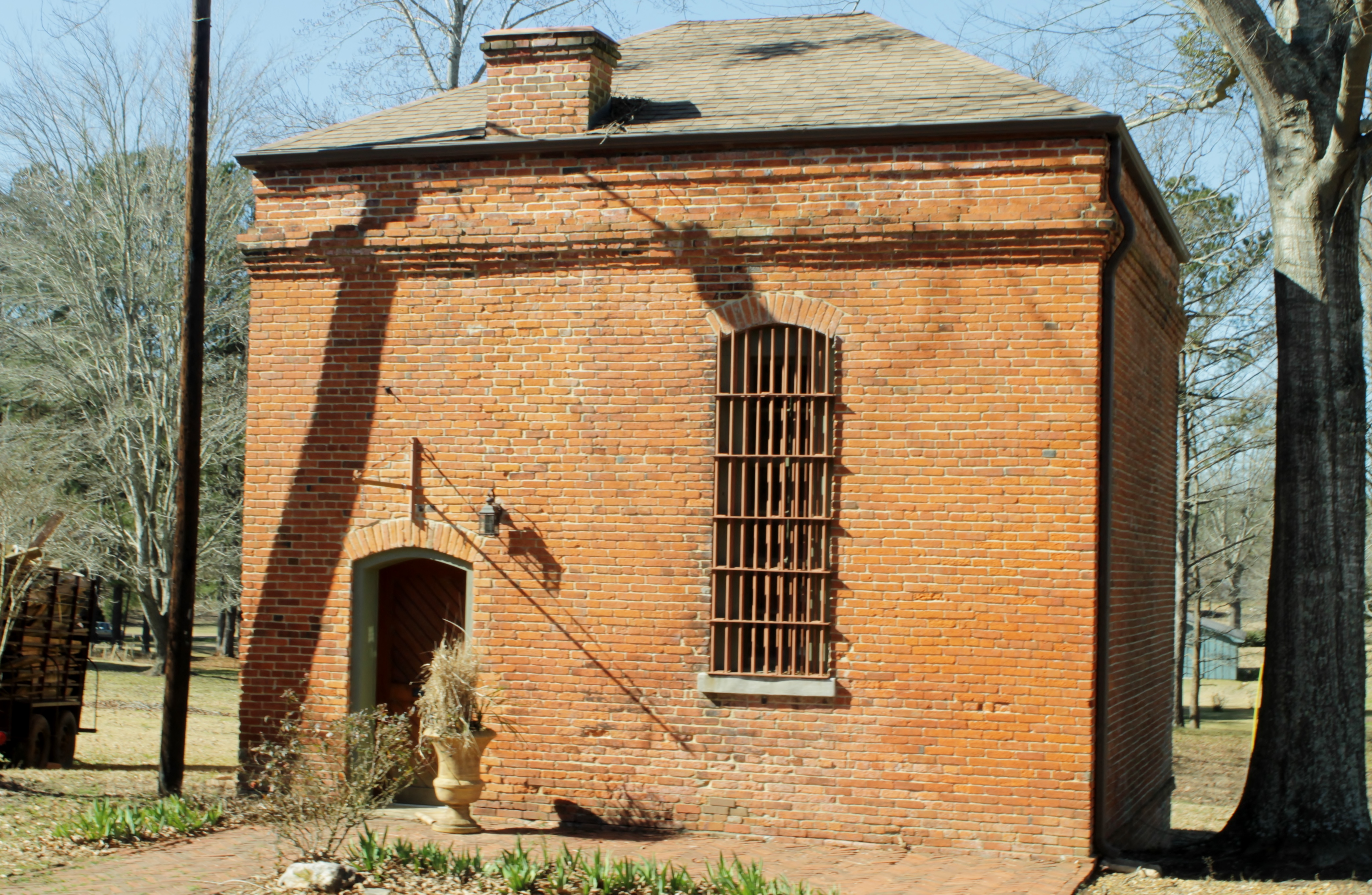
The old jail, immediately behind the courthouse, was not damaged …
North entrance …

Reserved parking …

I read somewhere that the building was constructed in 1915. It was two years short of a century old when it burned.
It’s sobering to ponder what all is lost when a courthouse burns. There are the records, the furnishings, the courtrooms, the equipment, the workplaces. But there also is all of the lore and local history. Buildings can be replaced, but not their souls.

