How Much to Pay Your Witnesses
July 15, 2014 § 9 Comments
Of course you can’t pay witnesses for their testimony (except experts, sortof), but you are required by MRCP 45(c)(1) to pay “to a non-party witness at the time of service [of a subpoena] the fee for one day’s attendance plus mileage allowed by law.” That payment may be waived by court order for indigence, and is not required of the State of Mississippi.
The witness fee is set out in MCA 25-7-47, which has provided that the witness is to be paid $1.50 per day and five cents per mile for travel to and from the courthouse “by the nearest route,” plus tolls and ferriage.
The usual practice in this district up to now for those who have not ignored the requirement is to issue the subpoena and tender a check for some nominal sum, like $2.00, to local witnesses.
The cost of witnesses, however, has gone up significantly, effective July 1, 2014. SB 2676, amends MCA 25-7-47, as follows:
Witnesses in the county, circuit * * *, chancery and justice courts shall receive * * * the same pay per day as is set by the board of supervisors under Section 25-7-61 for service as a juror plus mileage as authorized under Section 25-3-41 for each mile going to and returning from the courthouse to their homes by the nearest route, and such tolls and ferriages as they may actually be obliged to pay; but * * * a charge shall not be made for mileage except that traveled in this state. * * * Witnesses in all other cases shall receive the same compensation as they receive before the circuit court. It shall not be necessary to issue subpoenas for police officers as witnesses in city cases of cities having a population of more than ten thousand (10,000) according to the federal census of 1930; and * * * officers, when used as witnesses in * * * cases, are not to be allowed witness fees. A law enforcement officer who has retired or otherwise ceased employment as a law enforcement officer but who is required to testify in any case based on matters that arose during the course of the officer’s employment shall be entitled to the same compensation and expenses from the former employing law enforcement agency as an officer on active duty under the same circumstances.
So let’s try to figure this out:
- First, you have to look at MCA 25-7-61 to determine what “pay per day as is set by the board of supervisors … for service as a juror …” To arrive at that figure, you’ll have to consult with your board of supervisors, because the statute allows them to set the fee between $25 and $40 per day.
- Second, you will have to read and decipher what is the allowable mileage reimbursement under MCA 25-3-41. Good luck with that. If you conclude as I do that the applicable rate under MCA 25-7-41 is the county reimbursement rate, then MCA 25-3-41(2) applies, and it allows a mere twenty cents per mile unless the board of supervisors has adopted the mileage reimbursement rate allowable for state employees.
Bottom line is that your per diem cost to obtain a witness’s attendance has gone up from $1.50 to somewhere around $25 – $40 per day of attendance. That does not include mileage, which must be computed in addition to the per diem. I doubt that there are any boards of supervisors clinging to the antiquated twenty-cents mileage rate. The state mileage reimbursement rate now is $.565 per mile. If your supervisors have adopted the prevailing state rate, then you are looking at paying your witnesses more than 10 1/2 times more than the current five cents per mile statutory rate.
Hypothetically, then, if your non-party witness has to travel 17 miles to court, and your board of supervisors has adopted $40 a day for jury pay and mileage at the state rate, and there are no ferries or tolls to pay, then you now have to tender that witness $59.21 ($40 per diem, plus 34 mi. x $.565) each day for attendance. The cost before the amendment would have been a mere $3.20 ($1.50 per diem, plus 34 mi. x $.05).
For lawyers who are going to observe the requirement of R45, this should have a dampening effect on the vexatious practice of issuing subpoenas for 30 witnesses for trial and calling only four. It should also discourage those lawyers who like to subpoena a witness aligned with the other side, and then to keep that witness waiting in the hall two, three or four days, only calling him or her for a few brief questions at the end of the trial. Both unprofessional practices will now be more expensive than one could reasonably justify to a paying client.
As I said, these new rates are in effect now, and have been since July 1, 2014.
NOTE: In East v. East, 775 So. 2d 741, 747 (Miss. Ct. App. 2000), the COA ruled that a witness who had not been tendered payment per R45 had not been properly served. Who gets to raise the issue? In Roberts, it was the witness himself who brought up the matter via ex parte communication with the judge, which the COA did not find improper. No doubt the affected witness may always raise the non-payment issue, but may a party? Stay tuned.
Thanks to Anderson for the cite to Roberts in a comment to this post.
Clarifying Readoption
July 14, 2014 § Leave a comment
Readoption — the process of recognizing foreign adoptions in Mississippi — has become a more frequent phenomenon as parents wanting to adopt have found adoptable children in Russia, China, Thailand, and other countries.
Quite often readopting parents who have run a financially and emotionally exhausting gauntlet of obstacles in a foreign country return to Mississippi only to be confronted with similar hurdles in their home state.
SB 2180 amends the adoption statutes to allow a more streamlined procedure for readoption, and even includes forms for use in chancery court. It clarifies various nuances of readoption, including that only one readoption, in either this state or another state, is necessary, and that any subsequent adoption of the child would be a standard adoption, and not another readoption. The new provisions go into effect July 1, 2014.
If you handle readoptions you need to become familiar with these new provisions.
Chukfi Ahila Bok
July 11, 2014 § Leave a comment
Chukfi Ahila Bok, Choctaw for Dancing Rabbit Creek, was the subject of the “Scene in Mississippi” earlier today. I actually thought someone would guess it right away, since Dancing Rabbit Creek is arguably the most famous creek in Mississippi.
The photos show the National Historical Landmark site of the Choctaw gathering place where the infamous Treaty of Dancing Rabbit Creek was imposed on the Choctaw people in 1830. The site, in SW Noxubee County, is on the US National Register of Historic places, and has been designated a Mississippi landmark. It is now used primarily as a cemetery. The bottom photo should have been a clue, since it shows Choctaw stickball implements on the tombstone.
Under the treaty, the Choctaws agreed to give up their remaining fertile lands in Mississippi and Alabama in return for scrub lands in Oklahoma. Any Choctaws who chose to remain were granted citizenship, the first Native Americans granted that privilege.
This monument is at the site.
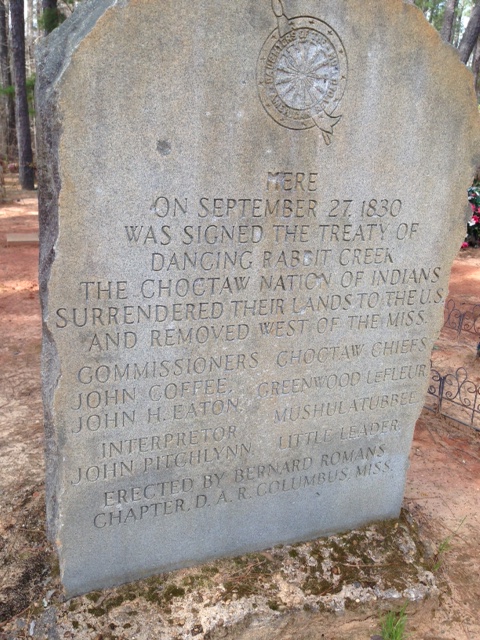
The site is not easy to find. You will need a good map or GPS. There’s no cell phone service, so the Google Maps app on your cell phone will not get you there. Also, after several miles of paved roads, you’ll find yourself on dirt roads, some of which pass through bottoms that look like they would wash out in a hard rain, so you might prefer to get there in a truck or SUV.





New Procedures in Adult Guardianships and Conservatorships
July 10, 2014 § 1 Comment
SB 2240, which went into effect July 1, 2014, makes significant changes in the way we handle adult guardianships and conservatorships. You can access it at this link.
The purpose of this post is to alert you to it, and to recommend that you read and begin to apply it. In a future post, I’ll break it down further.
For now, here are some highlights from the new law:
- The law clarifies the distinction between a conservator and a guardian. A conservator now is a person appointed by a court to “administer the property of an adult, including a person appointed under Section 93-13-251, et seq.” A guardian under the new law is a person appointed by a court to “make decisions regarding the person of an adult, including a person appointed under Section 93-13-111 and Sections 93-13-121 through 93-13-135.”
- The new statute provides for “protective orders,” which are either emergency or permanent orders for management of a protected person’s property.
- It states that it provides the sole jurisdictional basis for courts of this state to appoint guardians or issue protective orders.
- It details jurisdictional and venue requirements for courts of this state to exercise jurisdiction.
- The new provision sets out elaborate procedures for courts of Mississippi to communicate with courts of foreign states in determining jurisdiction, acquiring testimony and other evidence, and in registration of judgments. It establishes procedures for transfer of guardianships between states.
- It creates a new Title 14, in Chapter 93. The law begins at § 93-14-101.
I can’t tell you categorically that this new law will be an improvement of the cobbled-together mishmash of provisions governing adult guardianships and conservatorships that we have now, because I have not fully digested it. I am willing to bet, however, that it will be a big help.
One improvement that this new law makes is in the area of interstate proceedings. Up to now there has been no way to transfer guardianships and conservatorships between states, and there has been no clarity in cases where elderly relatives are removed from one state and taken to another to set up fiduciary arrangements. This has been a significant problem in an age where it is more common for adult children to live in one state and the parents or elderly relatives live in another state and are in need of management.
Section 93-14-504(a) states that “This act applies to guardianship and protective proceedings begun on or after July 1, 2014.”
An Effect of Affirmance
July 9, 2014 § Leave a comment
Richard Dean filed an adverse-possession lawsuit, and the chancellor found that he failed to prove his case. Dean appealed, and the COA affirmed. He then filed a petition for cert to the MSSC, which the court denied.
Not to be deterred, Dean then filed a R60(b) motion with the chancery court that had originally denied his relief. The chancellor overruled his motion, and Dean once again appealed.
The COA again affirmed, in Dean v. Slade, et al., decided April 22, 2014. Jurisdictional nerd that I am, I found the court’s discussion of the effect of affirmance on trial court jurisdiction interesting enough to share. Here is what Judge James wrote for the court:
¶7. We first question whether the chancery court had the necessary jurisdiction to entertain Dean’s motion for reconsideration. Upon Dean’s initial appeal of the chancery court’s judgment, the chancery court lost jurisdiction. See City of Cleveland v. Mid-S. Assocs. LLC, 94 So. 3d 1049, 1050 (¶4) (Miss. 2012) (Jurisdiction is transferred to the appellate court once a notice of appeal is filed.). And because we affirmed the judgment, as opposed to remanding the judgment, and the Mississippi Supreme Court denied certiorari, jurisdiction did not return to the chancery court. See id. As the Mississippi Supreme Court noted in Collins v. Acree, 614 So. 2d 391, 392 (Miss. 1993):
From time immemorial, we have adhered to the basic and elementary rule that our appellate affirmance ratifies, confirms, and declares that the trial court judgment was correct as if there had been no appeal. Upon issuance of our mandate, the trial court simply proceeds to enforce the final judgment. The execution of the mandate of this Court is purely ministerial.
Although in Collins the supreme court noted that there may be occasions when application of Rule 60(b) may be appropriate following an affirmance and issuance of a mandate, we do not find such an occasion present here. There is nothing in Dean’s motion that suggests that the judgment should be altered following affirmance by this Court and denial of certiorari by our supreme court. As we discuss below, Dean’s allegation of earwigging was litigated prior to his initial appeal, and the evidence he purports to be newly discovered is merely impeachment evidence that was discoverable prior to trial. As the supreme court has stated, “Rule 60(b) is not an escape hatch for lawyers and litigants who had procedural opportunities afforded under other rules and who[,] without cause[,] failed to pursue those procedural remedies. Rule 60(b) is designed for the extraordinary, not the commonplace.” [Sabal Corp. v.] Howell, 853 So. 2d [122,] at 124 [(Miss. Ct. App. 2003)] (¶4) (quoting Bruce v. Bruce, 587 So. 2d 898, 904 (Miss. 1991)) …
So you can’t create an endless loop of litigation with post-trial motions ad infinitum and absurdum.
Dean is the subject of a prior post wherein I excoriated the practice of so-called (pre-) trial briefs.
Making Amends
July 8, 2014 § 6 Comments
A recurring mistake that I see lawyers making is to file amended pleadings without complying with MRCP 15. Here’s what the rule says:
(a) Amendments. A party may amend a pleading as a matter of course at any time before a responsive pleading is served, or, if a pleading is one to which no responsive pleading is permitted and the action has not been placed upon the trial calendar, the party may so amend it at any time within thirty days after it is served. On sustaining a motion to dismiss for failure to state a claim upon which relief can be granted, pursuant to Rule 12(b)(6), or for judgment on the pleadings, pursuant to Rule 12(c), leave to amend shall be granted when justice so requires upon conditions and within time as determined by the court, provided matters outside the pleadings are not presented at the hearing on the motion. Otherwise a party may amend a pleading only by leave of court or upon written consent of the adverse party; leave shall be freely given when justice so requires. A party shall plead in response to an amended pleading within the time remaining for response to the original pleading or within ten days after service of the amended pleading, whichever period may be longer, unless the court otherwise orders.
and
(d) Supplemental Pleadings. Upon motion of a party the court may, upon reasonable notice and upon such terms as are just, permit the party to serve a supplemental pleading setting forth transactions, occurrences, or events which have happened since the date of the pleading sought to be supplemented. Permission may be granted even though the original pleading is defective in its statement of a claim for relief or defense. If the court deems it advisable that the adverse party plead to the supplemental pleading, it shall so order, specifying the time therefor.
So, you may amend:
- As a matter of course at any time before a responsive pleading has been served, or
- If the pleading is one to which no responsive pleading is permitted and the matter has not been set for trial, then at any time within 30 days of filing the pleading sought to be amended, or
- On whatever terms the court directs, if the court dismisses the pleading for failure to state a claim upon which relief may be granted, or
- By order of the court on a motion to amend.
Many lawyers routinely file amended pleadings whenever the spirit moves them to do so, well after conditions 1 and 2, above, have elapsed. That is wrong, and against the express language of the rule. The requirement to obtain leave of court to modify is mandatory, and a so-called amendment without court authorization is ineffective. Miss. DHS v. Guidry, 830 So.2d 628, 634-635 (Miss. 2002).
What about that language “If the pleading is one to which no responsive pleading is permitted …”? What exactly does that mean? When is a pleading ever not permitted? The COA has interpreted that language to include pleadings to which no responsive pleading is required. See, Faye v. State, 859 So.2d 393 (Miss. App. 2003). That would include most, if not all, R81 matters.
The party seeking an amendment should spell out in her motion the substance of the amendment, and the court should assign a reason why it denies the motion. Price v. Price, 430 So.2d 848 (Miss. 1983). That way a record is made. I would add to the motion language spelling out why granting it will result in no prejudice to the other side. Most lawyers attach a proposed amended pleading as an exhibit to the motion. But remember that attaching it to the motion does not mean that the pleading has been filed as a pleading. After the court grants leave to amend, the pleading must be properly filed and noticed.
Mere filing of a motion to amend does not do the job, as happened in the MSSC case McKnight v. Jenkins, handed down February 24, 2013. A post dealing with this case is here.
It’s has long been a principle of our law that amendments should be freely allowed so that cases can be presented on their merits and fully adjudicated. That does not mean, however, that anything filed in the court file is to be considered a competent amendment. If you want to amend your pleadings, you have to comply with R15, or you might wind up trying less of a case than you really wanted to try.
Im-Mobile Home
July 7, 2014 § Leave a comment
The COA’s June 24, 2014, decision in O’Neal v. Ketchum is notable primarily because it deals with an unmarried couple and their joint property issues.
But the case also addresses an issue that arises with some frequency in real property litigation, divorces, and probate matters: when is a mobile home considered to be real property?
In O’Neal, the appellant argued that the chancellor erred in concluding that the mobile home was not a fixture because, the chancellor held, neither party had proved that it was.
The COA affirmed. Judge Lee’s opinion spells it what it takes to establish that a mobile home is a fixture:
¶14. For a mobile home to be considered real property, the specific requirements of Mississippi Code Annotated section 27-53-15 (Rev. 2010) must be met. Under section 27-53-15, first, the mobile home’s wheels and axles must be removed, and the home must be affixed to a permanent foundation by anchoring and blocking it to comply with the rules and procedures of the Commissioner of Insurance of the State of Mississippi. Then, the mobile home must be entered on the land rolls of the county tax assessor, and it must be taxed as real property from that date. Lastly, the county tax assessor must issue a certificate certifying that the mobile home is real property, and the tax assessor must file the certificate in the land records. For a security interest to be perfected, the mobile home’s description must be included in the deed of trust. See Deutsche Bank Nat’l Trust Co. v. Brechtel, 81 So. 3d 277, 279 (¶8) (Miss. Ct. App. 2012).
¶15. At trial, no evidence was presented that the mobile home’s wheels and axles had been removed or that it had been attached to a permanent foundation. Additionally, no evidence was presented that a certification of the mobile home as real property had been entered with the county tax assessor. The deed encompassed the land “together with all improvements and appurtenances now or hereafter erected on [it], and all fixtures of any and every description[,]” but the deed made no mention of the mobile home.
¶16. Neither party asserted that the mobile home had become a fixture on the property. The chancellor determined that because no evidence was presented that the mobile home’s wheels were removed, that the home was attached to a foundation or placed on blocks, or that the home was assessed as real property for tax purposes, the mobile home had not become a fixture. The chancellor’s findings were supported by substantial evidence. This issue is without merit.
Evidence of Pre-Divorce Conduct in a Modification
July 3, 2014 § 1 Comment
The chancellor granted Marquis Stevenson’s petition for modification of custody, taking the child from his ex-wife Tanisha Martin. Tanisha appealed. One assignment of error was the chancellor’s exclusion of evidence of Marquis’s past domestic violence.
The COA, in Martin v. Stevenson, decided February 11, 2014, found no error. Judge Carlton, for the majority, said this:
¶32. We review a trial judge’s decision of whether to admit or exclude evidence under an abuse-of-discretion standard of review. Rushing v. Rushing, 724 So. 2d 911, 914 (¶11) (Miss. 1998) (citations omitted). In Lackey v. Fuller, 755 So. 2d 1083, 1085 (¶¶6-7) (Miss. 2000), the parties obtained an irreconcilable-differences divorce, and the wife later asked for modification of the final judgment. At the hearing, the chancellor allowed into evidence testimony regarding the wife’s predivorce conduct. Id. at 1086 (¶11). In its discussion of
res judicata as it applies to divorce proceedings and child-custody issues, the Mississippi Supreme Court stated:
We begin with the principles of res judicata[,] which command that a final judgment preclude[s] thereafter all claims that were or reasonably may have been brought in the original action. The familiar rule that a judgment for alimony, custody[,] or support may be modified only upon a showing of a post-judgment material change of circumstances is a recognition of the force of res judicata in divorce actions.
Id. at (¶13) (citations omitted). The supreme court concluded that the wife’s predivorce conduct was res judicata and that the only evidence the chancellor should have admitted was evidence pertaining to post-judgment conduct. Id. at 1087 (¶18).
¶33. In the present case, the record shows that at the September 28, 2011 hearing, Tanisha’s attorney tried to question Marquis about charges that arose prior to the divorce proceeding. Upon the objection of Marquis’s attorney, the chancellor asked Tanisha’s attorney whether there had been any continuation of Marquis’s conduct since the divorce decree and stated: “[U]nless you can tie some current conduct to that past conduct, I’m going to have to sustain the objection.” Because Tanisha’s attorney could not provide any evidence
of domestic violence by Marquis since the divorce, the chancellor found the evidence not relevant and sustained the objection. The issue arose again during Tanisha’s testimony, and the chancellor again explained that he would sustain the objection as to any matters that occurred prior to the divorce decree but would allow testimony regarding any actions since that time.
¶34. Based on the record and applicable law, we find no abuse of discretion in the s past acts of domestic violence. At the hearing for modification of custody, Tanisha was only able to offer proof of acts that divorce. Tanisha failed to offer any evidence of current conduct occurring since the divorce. Because Tanisha failed to properly raise this claim for consideration in the original divorce decree, she is barred from raising the issue now. This assignment of error therefore lacks merit.
This is a fairly common situation in modification cases, and this case is a helpful guide to how the chancellor should address it.
This case is also an interesting wrinkle on application of the statutory principle that a history of domestic violence may be a basis to deny custody. A previous post on that subject is here.
 The Better Chancery Practice Blog