TWILIGHT OF THE GODS
July 25, 2010 § 2 Comments
 They were so powerful that they thought they were gods, immune from the misfortunes of mere mortals. They were Dickie Scruggs and all of his allies and fellow-travelers who rose to unparalleled power and wealth through bribery and corruption, until their un-god-like downfall. Their story is an epic Mississippi saga.
The next book on the grotesquerie of Dickie Scruggs and his ilk will be out soon. THE FALL OF THE HOUSE OF ZEUS, by Mississippian Curtis Wilkie, former BOSTON GLOBE foreign correspondent and current Ole Miss professor, is set to be released October 19, 2010, and the author will be at Square Books in Oxford that day to talk about his book and autograph copies.
Author Richard Ford made these comments about the book on the Square Books web site …
Addictive reading for anyone interested in greed, outrageous behavior, epic bad planning and character, lousy luck, and worst of all, comically bad manners. Wilkie knows precisely where the skeletons, the cash boxes and the daggers are buried along the Mississippi backroads. And he knows, ruefully — which is why this book demands a wide audience — that the south, no matter its looney sense of exceptionalism, is pretty much just like the rest of the planet.
I reviewed Alan Lange’s and Tom Dawson’s book on the Scruggs downfall here.
JUDGE EVANS’ MEMORIAL SERVICE
July 24, 2010 § Leave a comment
Chancellor Frank McKenzie attended the memorial service yesterday in Raleigh for Circuit Judge Robert G. Evans. He sent his observations in the form of a comment to another post, and I though they should be on the front page, so they would not be missed.
Chancellor Frank McKenzie, 19th District July 23rd, 2010
Bob donated his body to the University of Mississippi Medical Center for medical research. His wife, who pre-deceased him, did the same.
Everyone I know who practiced in Judge Evans’ court spoke of it as a privilege and an enjoyable experience. If I could sum up all the comments, it would be “Trying a case before Judge Evans was what trying a case should be like.” His wit, integrity, demeanor, experience and fairness will be missed.
THE MARK OF THE BEAST
July 1, 2010 § 12 Comments
And he causeth all, both small and great, rich and poor, free and bond, to receive a mark in their right hand, or in their foreheads; And that no man might buy or sell, save he that had the mark, or the name of the beast, or the number of his name. Here is wisdom. Let him that hath understanding count the number of the beast: for it is the number of a man; and his number is Six hundred threescore and six. Revelations 13:16-18.
666. The number of the mark of the beast.
Irony of ironies, that is the section of the federal criminal code under which Dickie Scruggs and his cohorts were indicted for the crime of corruptly influencing a public official. 18 U.S.C. §666.
And so it was that Dickie Scruggs and his minions, bearing the mark, bought and sold justice in Mississippi.

I have read KINGS OF TORT by Alan Lange and Tom Dawson, the enthralling story of how Dickie Scruggs and Paul Minor, in league with others, corrupted our legal system. The story is stomach-turning and fascinating at the same time, in the same way that one is revolted by seeing a person leap to his death from a tall building, yet can not look away. It is a story that will repel and anger honest lawyers and judges, and yet it is one that they must know. I feel strongly that it is a must-read for anyone who has practiced law or sat the bench in Mississippi, as well as anyone else who is interested in our state legal system.
KINGS OF TORT is the story of the rise and fall of some of the richest and most powerful lawyers ever known in Mississippi, and indeed in our republic, along with the judges they corruptly influenced. They are all here: Dickie Scruggs, Zach Scruggs, Paul Minor, Bobby DeLaughter, Joey Langston, Sid Backstrom, Tim Balducci, John Whitfield, Wes Teel, Ed Peters, Steve Patterson and others who, for money, or out of lust for power and control, or for sheer egotism, stole from one another and tried to manipulate and corrupt the legal system to achieve their ends. It’s all too unfortunately true, and it happened here in our state during our careers as we went about our quotidian legal tasks, unmindful of the cesspool growing only a few miles down the road that would engulf so many.
Authors Alan Lange and Tom Dawson each had a favored vantage point from which to view this Greek tragedy, act by act. Lange amassed literally tons of information on the various scandals by his untiring reporting on his blog, Y’all Politics. Dawson was one of the lead prosecutors in the Oxford U.S. Attorney’s office who helped design the strategy that brought down the Scruggs house of cards, from coordinating FBI investigation and search warrants to drafting the indictments and preparing for trial.
The downfall of Dickie Scruggs was a national story, reported as it unfolded in the New York Times and Wall Street Journal. Several Mississippi-based blogs followed the story closely and actually served as sources for the national press. Lange’s own Y’all Politics was a major player in revealing much information. Folo, now in hiatus, was energetic in pursuing the story, often breaking news that others missed, and one of its most astute contributors, NMC (who is Oxford atty Tom Freeland), continues with his own blog, NMissCommentor.
The improbable hero of this sordid saga is District 3 Circuit Judge Henry Lackey of Calhoun City, who toppled the kings of tort from their thrones by going to the U.S. Attorney and reporting that they were attempting to bribe him. He then wore a wire and captured the crucial evidence that first snared Balducci, and then took down Scruggs, Backstrom, Patterson and Langston. Judge Lackey is an engaging and self-effacing man with a wry humor. When the prosecutors warned him of the stress that his role as undercover witness would place on him and his heart problems, he smiled and said with country assurance, “Boys, don’t mind the mule, just load the wagon.” He would be the first to disclaim the hero label, pointing out that he only did what his oath and judicial ethics expected of him.
Most readers will find the writing in large part clear and easy to read. The authors do a good job of explaining complicated legal proceedings and concepts in a way that non-lawyers can easily grasp. What is unfortunately lacking in a book such as this with national exposure, however, is decent editing. It is bothersome that the writers appear not to know the difference between “affect” and “effect,” or that the correct pronoun to refer to a person is “who” rather than “that” (e.g., “He is the person that who loaned the money”), or that “tortuous” does not mean the same thing as “tortious,” or that the word “divulge” does not mean “deprive,” or that proper usage is “between him and … ” and not “between he and … “, or that the court room of the Calhoun County Court House is in Pittsboro and not Calhoun City, and that some of the clauses within clauses will make your head spin. Good editing would have cured those defects. Warts and all, though, it’s still a worthwhile and even essential read for Mississippi lawyers.
Buy this book and keep it in your law office library. Keep it handy. When you feel an itch to stretch ethical limits, even ever so slightly, to score big in a case, or to gain an upperhand, or you feel the temptation to shaft another lawyer who has been loyal and helpful to you, pull this book off the shelf and hold it. Remember those lawyers and judges marked with the number of the beast and ask yourself: “Do I really want to be like them?”
CHANCERY COURT IN DAYS OF YORE, PART ONE
June 29, 2010 § 3 Comments
Last week in Clarke County I took the bench one day in a dark suit and dispatched the day’s business in that attire because my robe was in chambers with a Circuit Judge whom I did not wish to bother. The Chancery Clerk pointed out later that the younger lawyers were abuzz about it. They had never seen such a thing. Imagine — a judge adjudicating sans black robe.
Down through the decades it was a hallmark of our courts that the Chancery Judge did not wear a robe. The Chancellor presided in his (yes, in those days there were few female Chancery Judges) dark suit, dispensing equity like an ancient Titan loosing thunderbolts.
Long after Circuit Judges donned the robe, Chancellors continued unrobed. It was not until the late 80’s, as far as I recall, that Chancellors donned robes in our part of the state, and then not every Chancellor did. Judge John Clark Love in District Six never wore a robe until the day he retired in 2005. Neither did his counterpart, Judge Ed Prisock.
The philosophy behind the robe is that it instantly lends authority and recognition of office to the wearer, but Chancellors in those pre-robe days didn’t really need a cloak to lend them weight. Authority emanated from them like deadly radiation from a chunk of uranium. For those of us who practiced before some of the really great old lions of the Chancery bench, there was no question of authority. A wilting glance or stabbing remark could inflict a wound in one’s case that would bleed to a fateful conclusion. Heaven help the unprepared lawyer.
Billy Neville of Meridian was the commander of his court room. He sat on the bench, pipe jutting MacArthur-like out of his face, whittling on a cedar plug until he carved an eye-shaped piece — rounded in the middle and sharp on each end — whence he would start another. A lying witness never escaped his ire. “Suh!” he would thunder, “Do you expect me to believe that?” You knew that was coming because only a few questions before he had begin running his hand across his forehead and then over his scalp as first his cheeks and then his temples and then his forehead changed hues from peach to crimson to scarlet. “Mr. Bailiff, suh! Take this man upstairs!”
Judge Neville was also a master at communicating subtly to the attorney the futility of one’s case. “Yes, suh, I will sustain the objection because this has nothing to do with the case, and even if it did there is no law in Mississippi that would permit me to do what the Complainant has prayed for. Now you may proceed, suh.” Okay, how do you frame the next question when the judge has just let all the air out of your case?
Judge Ed Cortright of Yazoo City was a gentleman of the first order and a scholar of note in his long career on the bench. He was reversed on appeal only once that I know of, and that by Frank Coleman, now County Judge Coleman, of Meridian. As gentlemanly as he was, there was a steely side to Judge Cortright, and he could communicate his displeasure at a lawyerly gaffe in no uncertain terms. His disdain for the illogical argument or a position unsupported by the law was unmistakable.
Judge Mike Sullivan of Columbia was so revered and respected that he was elevated to the Supreme Court, where he made his mark as a voice for Chancery Court in the appellate court. His calm demeanor and measured speech left no doubt who was in control of his court room.
Judge John Clark Love of Kosciusko had a way of eviscerating lawyers who wandered ill-prepared into his lair.
Judge Ray Montgomery of Canton could shrink your head two to three sizes from his tirade if you wound up on his wrong side or if your case did not impress him.
There were many robeless Chancellors, too many to mention, some great and some forgettable. We sometimes quaked in their presence, but in the crucible of their courtrooms we were molded into better lawyers.
CLARKE COUNTY’S OLD COURT HOUSE
June 28, 2010 § 3 Comments
I ran across these two old post cards depicting the Clarke County Court House that preceded today’s building. You can click on the pictures to see a larger version with more detail. My guess is that the pictures were taken in the 1890’s to early 1900’s, judging from the buggies parked around the building. The current court house does not have a cornerstone that I could find in a very brief saunter around the outside last week, but it does have the names of the Board of Supervisors 1912-1916, which would indicate to me that the building was built during their term. 
I showed these to Gilford Dabbs, and he told me that he had heard that the old court house was located on what is now a vacant lot next to First Baptist Church in Quitman. By the way, Gilford is old, but he’s not old enough to remember this old building himself.
Does anyone know why this court house was replaced? Was there a fire like there had been in Meridian that precipitated the building of the new version? Does anyone have any other pics of it, inside or out? Does anyone know what happened to the eagle?

That object dangling in front of the building in the bottom picture is a street light suspended on wires.
These photos, along with around 4,600 others showing scenes from all around Mississippi during the period from 1892 to the 1940’s, are available at the Mississippi Department of Archives and History’s website here.
NEW LEGISLATION THAT MAY AFFECT YOUR CHANCERY PRACTICE
June 25, 2010 § 6 Comments
A number of bills passed in the 2010 Regular Session of the Legislature that you may find will have some effect on your practice in Chancery Court. Below is a bulleted list with a brief description of the pertinent portions of each bill. You can read the full text of the bills here. Thanks to Steve Horne, Representative in District 81 for providing me with the summaries. I will provide more detailed summaries of some of the bills in later posts.
All laws are effective July 1, 2010, unless noted otherwise.
- HB 277. Statutory method for renewing a judgment.
- HB 704. DHS may obtain income tax and sales tax information without a subpoena for individuals who are delinquent in child support payments.
- HB 886. Prohibits a deed restriction or other covenant running with the land that requires a transferee or his heirs, successors or assigns to pay a property transfer fee, and any such provision is void and unenforceable. The prohibition does not apply to certain property owners’ associations.
- HB 1400. Increases from $10,000 to $20,000 the amount of money or value of property that may be transferred to a ward without a guardianship, in the discretion of the Chancellor.
- SB 2413. Amends § 93-5-34, MCA, to clarify custody and visitation procedures when a parent receives military orders for temporary duty, deployment or mobilization.
- SB 2929. Youth Court has exclusive jurisdiction over delinquent acts committed by a child until the child’s 18th birthday. Circuit Court may assume jurisdiction when transferred to it from Youth Court.
- SB 2800. Remedies of lien laws available to suppliers and construction contractors are made available on the same basis to rental and lease equipment suppliers.
- HB 1479, effective July 1, 2011. The name of Oakley Training School is changed to Oakley Youth Development Center.
- HB 1049 and 1525. Makes many changes in the mental commitment law. The changes are too numerous to list here, and they will be detailed in a subsequent post.
RECEPTION
June 23, 2010 § Leave a comment
Around 120 people gathered Tuesday afternoon to honor Judge J. Max Kilpatrick, who retires from his seat in District Six (Attala, Carroll, Choctaw, Kemper, Neshoba and Winston).

Enjoying the company and refreshments in the beautifully-refurnished Neshoba County Court House.
Among the crowd were elected officials from throughout the district, lawyers, court house personnel and judges.
Judges included Mississippi Supreme Court Chief Justice William Waller, Circuit Judges Clarence Morgan of Kosciusko and Vernon Cotten of Carthage, and Chancellors Ed Fenwick of Kosciusko, Ed Patten of Hazelhurst, and I, as well as incoming Chancery Judge Joey Kilgore.
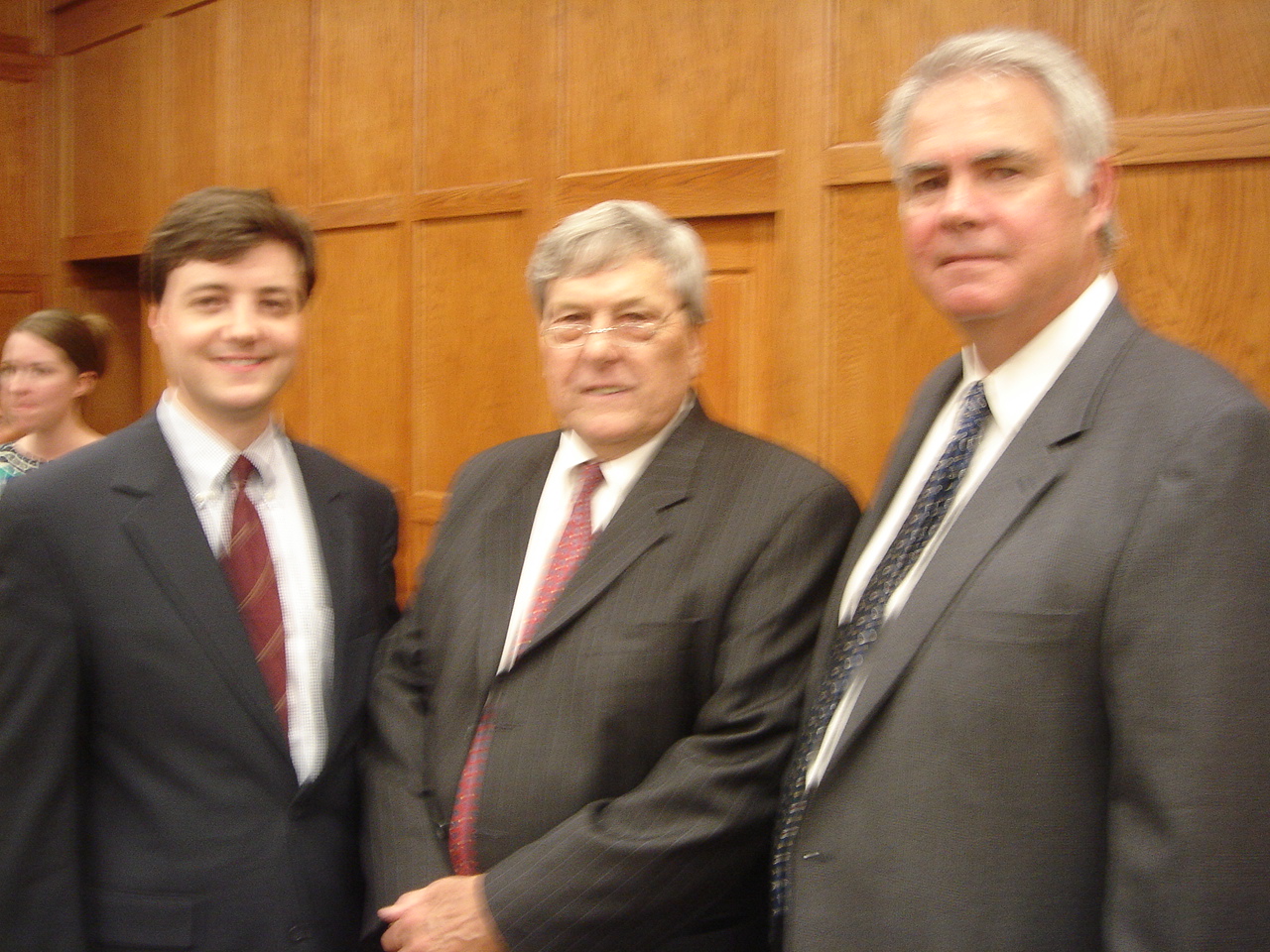
(L to R) Incoming Judge Kilgore, Judge Kilpatrick and Judge Patten
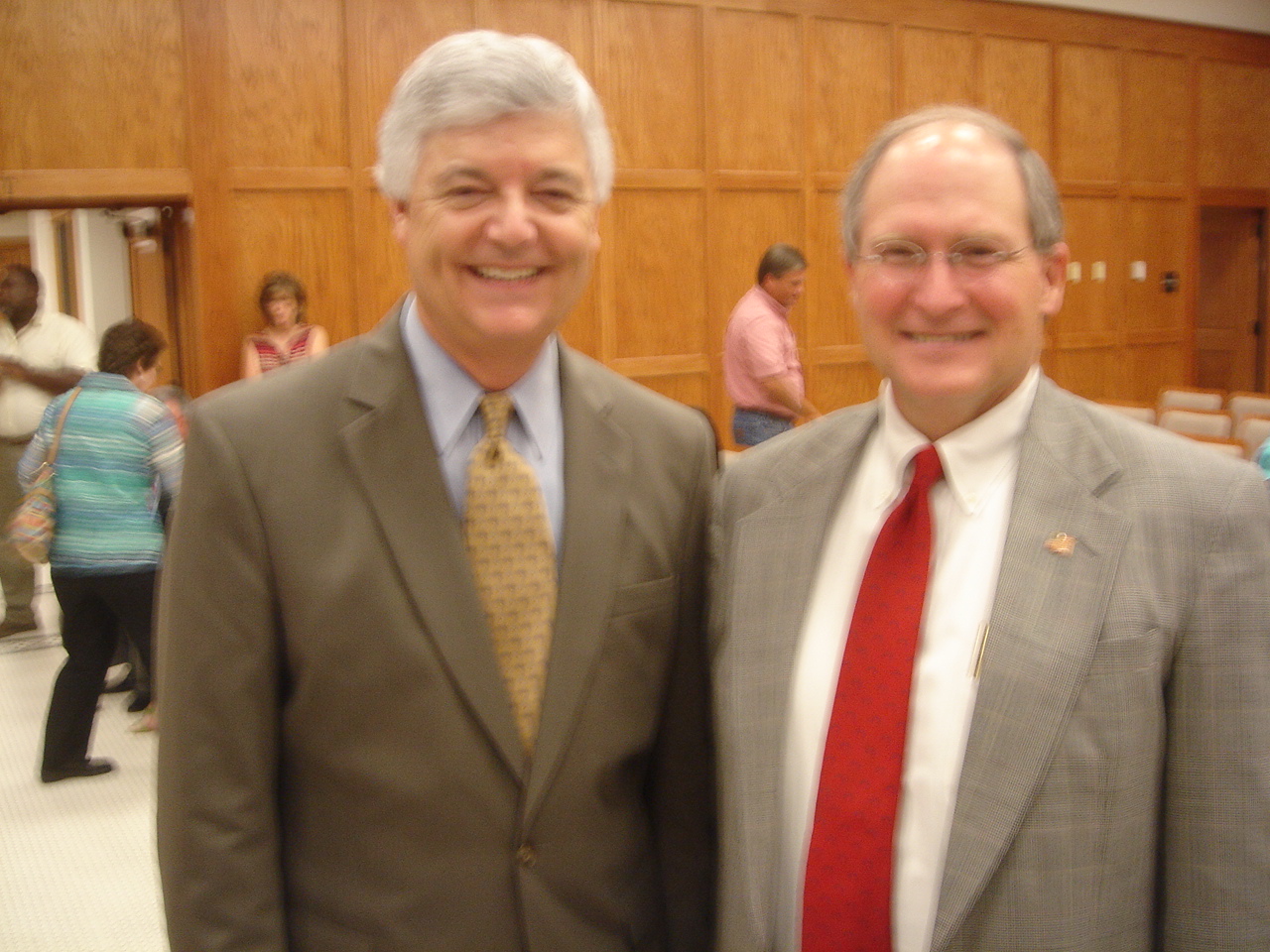
Choctaw Attorney General Don Kilgore and Chief Justice Waller
AMAZING GRACE
June 22, 2010 § Leave a comment
Lauderdale County Deputy Clerk Cerlenza Grace is STAR OF THE WEEK in Monday’s MERIDIAN STAR. You can read all about it here. 
Congratulations, Cerlenza.
RECEPTION FOR JUDGE KILPATRICK
June 21, 2010 § Leave a comment
There will be a reception honoring Chancellor J. Max Kilpatrick Tuesday, June 22, 2010, at the Neshoba County Court House from 4 pm to 6 pm. Judge Kilpatrick is retiring from the bench effective June 30.
Kilpatrick was appointed by Governor Barbour to replace Chancellor John Clark Love of Kosciusko, who retired in 2005. Kilpatrick was unopposed for the seat in 2006, and he will have served three and a half years of the four-year term to which he was elected.
We wish “Max” much success and hapiness in his return to politics and the prectice of law.
SOMETHING TO BE PROUD OF IN QUITMAN
June 21, 2010 § 7 Comments
Court time in Clarke County is always enjoyable thanks to the friendly staff in the court house who go out of their way to be helpful and hospitable. As good as it is, though, that favorable atmosphere is about to improve.
The new court room upstairs in the main building is near completion. The supervisors and the contractor are in the final phases, going over punch lists. When the work is finally accepted by the supervisors, Clarke County will have a shining jewel that every citizen can be proud of.

The new court room is airy and modern
It wasn’t too many years ago that the Clarke County Court House was shabby and inadequate. Cheap plywood panelling covered the walls and the windows in the court room — someone’s ineffective notion about how to keep out the roar of the big trucks passing on Hy 45 in front of the building. The balcony and vintage pressed-tin ceiling were concealed by a suspended celotex ceiling. The building had a shabby sense of decay that was heightened by its dusty, dirty state.
I tried many cases in that old court room. It was common to hear the cooing of pigeons nesting between the panelling while a witness droned on. Before the bypass took the heavy trucks out of town, one could hear the big windows shaking behind the panelling as they rumbled through the stoplight. I remember during one trial a thunderstorm raged outside and a water leak flooded counsel’s table. Sad to say, but the court house back then reflected what many people thought of Quitman and Clarke County: A community in decline, its better days in the past.
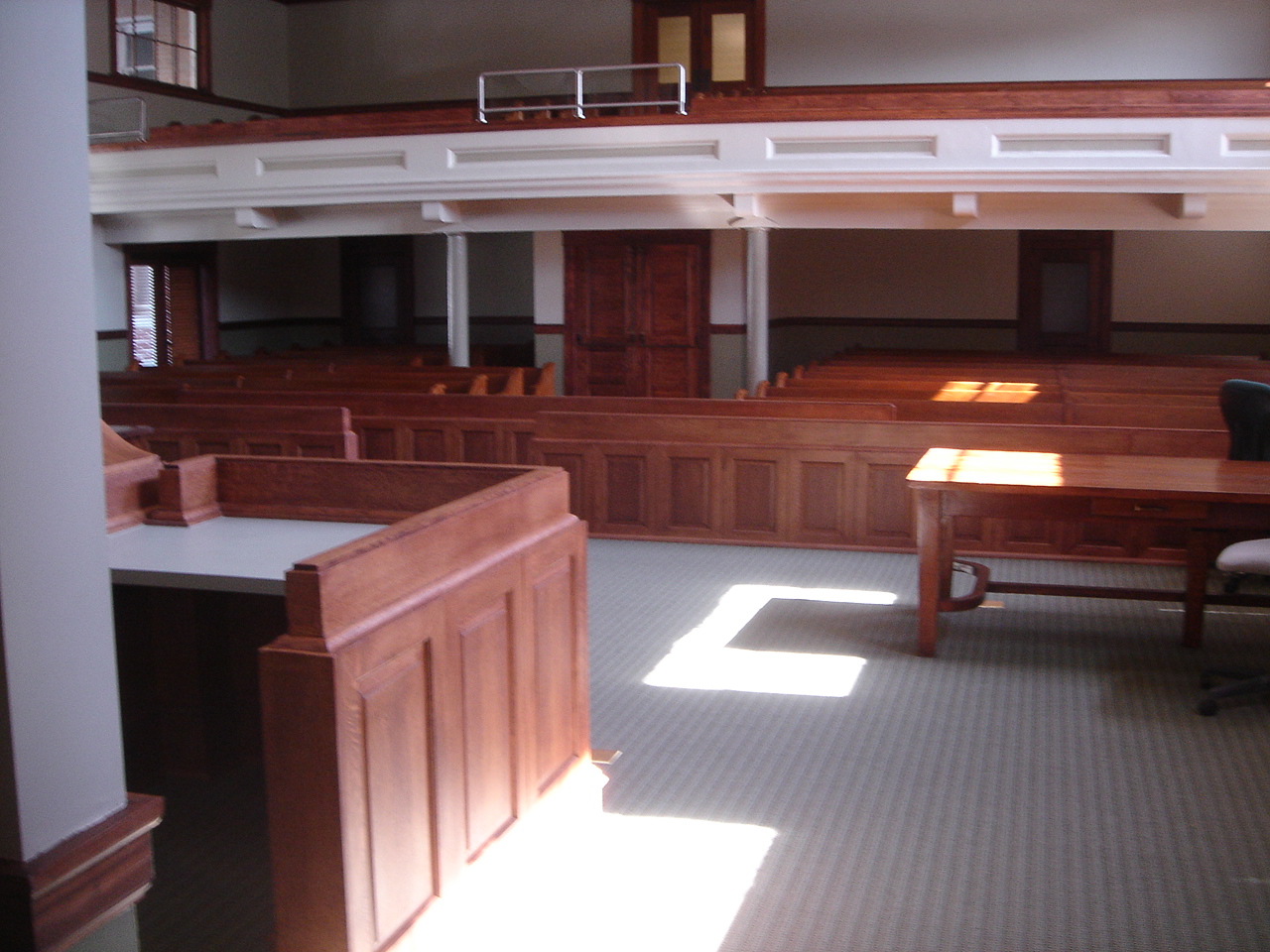
Looking from behind the bench toward the audience and balcony
All that changed in the late 90’s, when the Board of Supervisors took an interest in upgrading the court house. They added the new building with its new, modern court room and offices. The new building provided plenty of space for the courts, with meeting space for the Grand Jury and a D.A.’s office, as well as a library. With the new building came a renewed sense of pride, and the dust, dirt and grime were banished in both the new and old buildings. Floors were polished and windows cleaned. The court house staff was energized.

A treasure concealed for many years
Meanwhile, the lights were turned off in the old court room, which was left to languish. Before long, however, some Clarke Countians interested in preserving the best of the past were nosing around the old court room to see whether it could be restored to its pre-plywood-panelling days. They found the old, pressed-tin ceiling, an Edwardian architectural detail that can not be duplicated today. They also found behind the celotex a labyrinth of ventialtion ducts and utilities. Conventional wisdom would have dictated that it was simply too big a job for little Clarke County, with its shrunken tax base and many other priorities. It seemed too much to hope for that the court room could actually be restored.
To their credit, the supervisors stepped up and committed to the work. It has taken around 5 years, but the work is nearly completed now, and when the court room is furnished it will be ready for business.
Clarke County deserves praise for recognizing that a clean, orderly, businesslike court house with attractive court facilities is not only a service to its citizens, but also is a reflection on the community as a whole. Where Clarke County’s Court House used to send the message of a tired, dying community in decline, the new facilities speak loudly of a progressive community alive with potential and ready to roll up its sleeves and go to work.
Clarke County: Give yourselves a pat on the back.
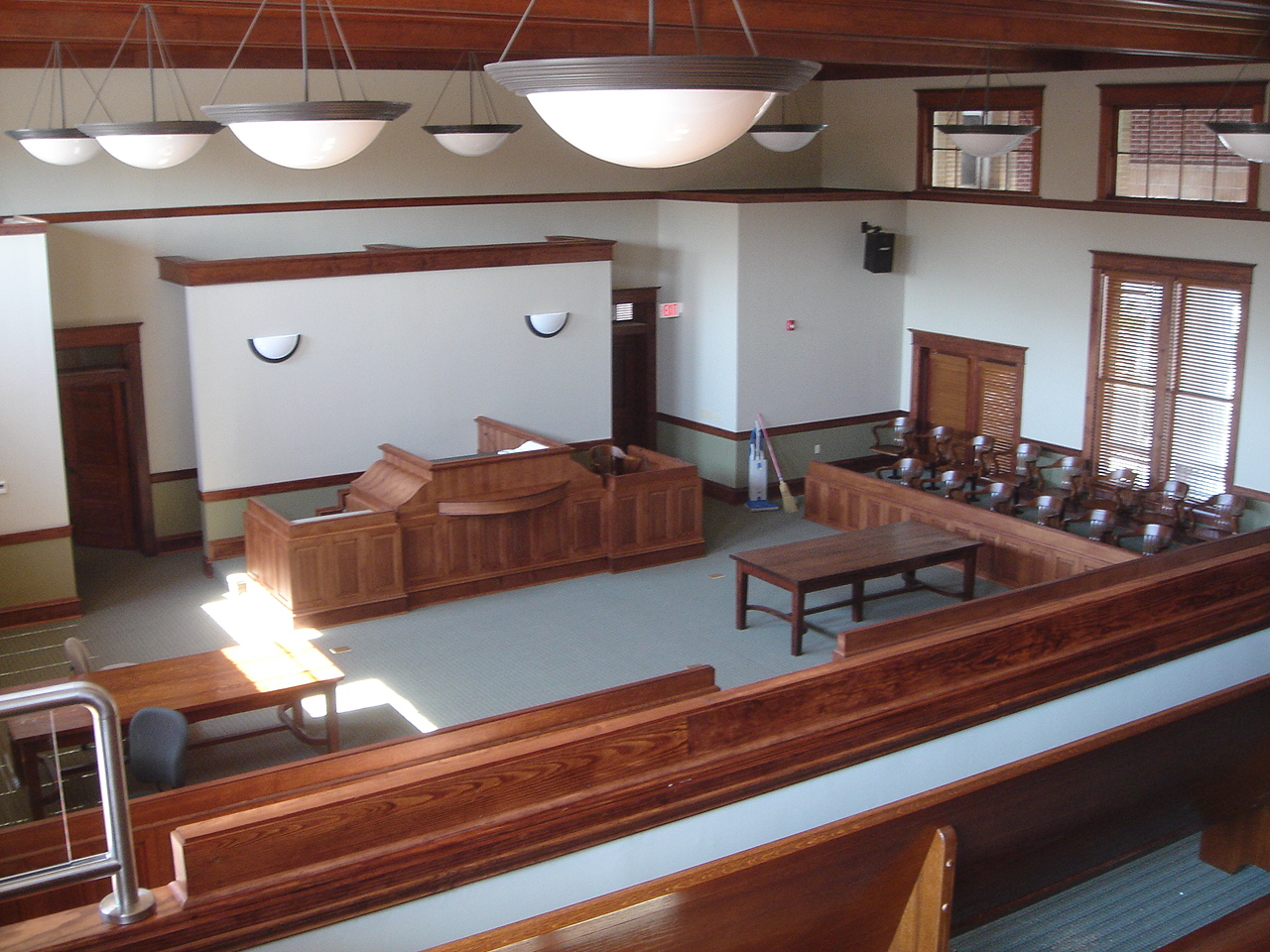
Something to be proud of in Quitman
 The Better Chancery Practice Blog
I attended the Memorial Service today for Circuit Judge Bob Evans at the Smith County Courthouse in Raleigh.
Bob’s brother was a part of the service and he shared with us a framed note from a grammer school student that Bob kept on his desk.
The note stated: “Thank you for letting our class come to Court. I wanted to be a lawyer but after coming to Court it looks like being a lawyer is hard work. So I have decided to be a Judge.”
That was Bob’s sense of humor that he kept that on his desk.
Bob was a great Judge and he will be missed by many.