JUDGING IN THE BLIND
August 2, 2010 § 5 Comments
Is this you? Your client, Otis, is on the witness stand. Otis is testifying about his finances from Exhibit 2 in evidence, which is his Rule 8.05 financial statement — $350 a month for groceries, $100 for entertainment, $360.48 car note, and so on — and the only ones in the court room who are looking a copy of at his Rule 8.05 financial statement while he testifies are Otis, you and the lawyer on the other side. You glance at the judge, who is sitting there staring off into some faraway void, eyes glazed, his mind drifting off into starry space where Otis’ crucial testimony will never penetrate. The judge is missing the most important evidence in your case!
Where did you go wrong?
If you answered that the Chancellor doesn’t have a copy of the exhibit about which Otis is testifying and so is deprived of the most potent tool you have for the judge to follow and later recall Otis’s testimony, you are absolutely correct. Give yourself a gold star and a pat on the back for a correct answer to this quiz. Give yourself a big, fat F for your trial technique.
Uniform Chancery Court Rule 3.05 states that, “Unless excused by the Court, it shall be the duty of an attorney to distribute copies of any exhibits to the Court and opposing counsel when offered.” That includes the Rule 8.05 financial statements.
Some attorneys not only offer the exhibit; they also offer the court a separate, extra copy for the judge to mark up. That’s a pretty shrewd practice.
If you aren’t making sure that the court has the original exhibit or a copy when you ask a witness about it, you are asking the court to judge your case in the blind. Put yourself in the judge’s shoes: Without the exhibit, you are asking the judge to listen to, comprehend, copy down and digest literally dozens of figures, often delivered in rapid-fire, machine-gun fashion, when the figures are right there on the exhibit, and the judge could be following along, thoughtfully assimilating the testimony and jotting down a few helpful notes.
The principle is not limited to financial statements. I once had an attorney take a stack of photos in evidence from the bench, present them to the witness one by one, and ask the witness to describe and make observations about each. To this day, I have no idea what the witness was talking about. Had I had a separate copy, I could have looked at each photo simultaneously with the description, and perhaps that would have influenced the outcome of the case.
A week does not go by that I am put in the position of judging in the blind, and it is always to the detriment of the client. How do you expect the judge to get the benefit of your client’s testimony about her financial statement or other exhibit if you take the document away from the judge before she testifies about it?
A variation on this theme occurs when the lawyer actually begins questioning the client about the financial statement and the witness, for crying out loud, does not even have a copy to look at. That’s like sending the poor client into a knife fight without a knife.
I have actually begun stopping trials and ordering attorneys to comply with Rule 3.05. The lawyer who complies with Rule 3.05 not only appears to be prepared, professional and effective; she is prepared, professional and effective. Surely you don’t want to be embarassed by appearing unprepared and clueless.
Practice Tip: Always have the original and FOUR copies of all exhibits. That’s the original for introduction into evidence, copy one for yourself, copy two for your client, copy three for opposing counsel, and copy four either for the opposing party or for the court to mark up. Copies are cheap, compared to cost to your client of not having them.
PIGGING OUT ON REAL CAJUN
July 31, 2010 § 4 Comments
Being possessed of a genuine Cajun pedigree, I am sensitive — perhaps overly so, I admit — to the use of the term Cajun when it comes to cuisine. In the land of my upringing, the word “Cajun” emphatically is not synonymous with “obnoxiously seasoned,” as it is most everywhere else.
Authentic Cajun cuisine is rustic, simple, earthy and straightforward. The ingredients are what have been traditionally available locally in Cajun country: fresh seafood, pork and beef, crawfish, rice, okra, peas, yams and corn. The seasonings are uncomplicated: salt, red and black pepper, and the “trinity” of onions, bell pepper and celery (in place of the mirepoix that serves as the base of so many other cuisines). Done properly, the flavors of Cajun cuisine are to be savored and enjoyed, not suffered through and sweatily wrestled with.
Thus, I approached Chef Donald Link’s restaurant COCHON (PIG en francais) in New Orleans last night with doubt bred from many disappointing experiences that have taught me through the years that the only good Cajun cooking is in Acadiana.
Only this time there was no disappointment.
Link’s success with Cajun food comes from his focus on a much-ignored aspect of the region’s cooking: Boucherie. As in locally produced pork and beef butchered locally and turned into the most delectable morsels that one could imagine.
In my own home town of Abbeville in southwest Louisiana there were several boucheries that prepared and sold superb boudin (noir and blanc), andouille, gratons (cracklins), sausages, tasso, pork roasts and chops, stuffed chickens, steaks and beef roasts, and every imaginable piece of pig that the law allows (and some that it doesn’t). Hebert’s and Richard’s (that’s pronounced Ree-shard’s for the uninitiated) are the two best in Abbeville, in my opinion.
Where Link succeeds is in evoking the fantastic flavors and textures of the boucherie in his cooking.

The wood-fired oven
The first thing that one senses on entering COCHON is the smoky atmosphere. The chefs cook in a wood-fired oven. Now, one could consider that an affectation in the sense that you just won’t find a wood-fired oven in any boucherie that you visit in southwest Louisiana, but honestly, I can’t argue with the results.
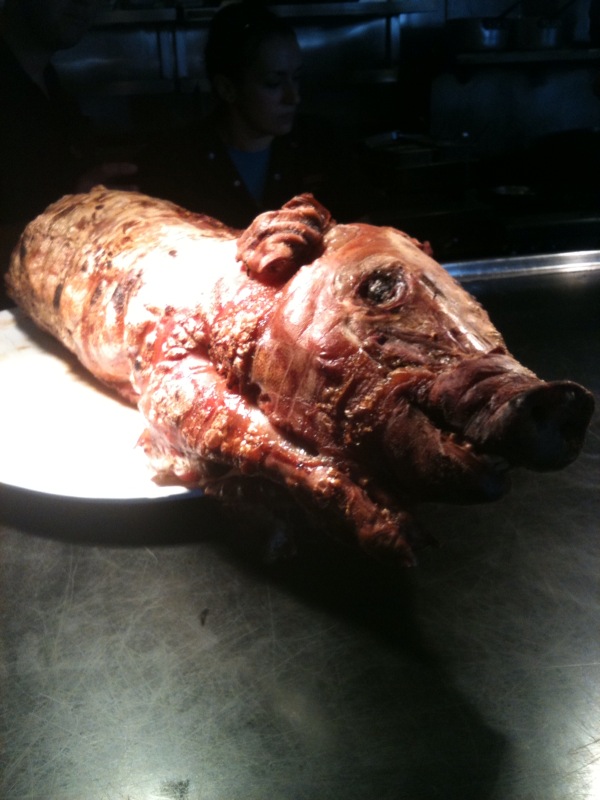
Cochon de lait ready to be carved
My dish was cochon de lait — suckling pig — served on a bed of grits, corn and okra. The best cochon de lait is seasoned by slitting the uncooked meat and stuffing in a mixture of garlic, parsley and other savory herbs, then roasting on a spit over an open fire. The result should be a crispy, cracklin’-like skin and tender, melt-in-your-mouth meat with delicate flavors. And that is exactly what I got. The skin was crisp and salty, a perfect counterpoint to the succulent, sage-y tenderness of the meat.
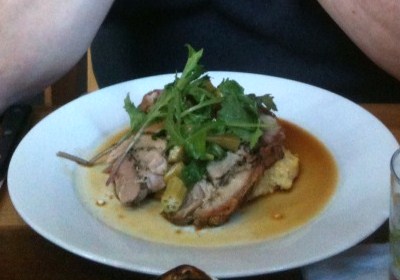
Cochon plated

Lisa's ham hocks with eggplant and shrimp dish
Lisa ordered ham hocks with black-eyed peas and maque choux (sauteed corn, tomato, onions, bell pepper). The ham hocks were dusted in corn flour, roasted and fried. Although they were flavorful, we found them a little on the tough side. Braising would probably have been as kind to the flavor and yet produced a more tender dish. The maque choux was quite good.
We shared a dish of eggplant and shrimp, a concoction commonly found on the Cajun household table, and although it was not traditional in its presentation, it was every bit as good as what one might enjoy on a home visit to Carencro or Erath.
All in all, we found the cooking superior and the atmosphere exceptional. The service was attentive without being intrusive. Our questions were answered knowledgeably and accurately.
Chef Link comes by his Cajun cooking honestly, having been raised in southwest Louisiana and having learned from his German-Cajun grandparents to cook and enjoy the cuisine. He is the author of Real Cajun, a cook book that introduces the best of boucherie in Cajun cuisine for American kitchens.
Be sure you make reservations or you will be disappointed. We arrived a little early and were seated without a problem, but the placed filled quickly around 7 pm. COCHON is located in the warehouse district at 930 Tchoupitoulas, a few blocks west of Lee Circle. Parking on the street did not appear to be a problem, but we found it easier to take a cab in lieu of wrangling with the traffic.
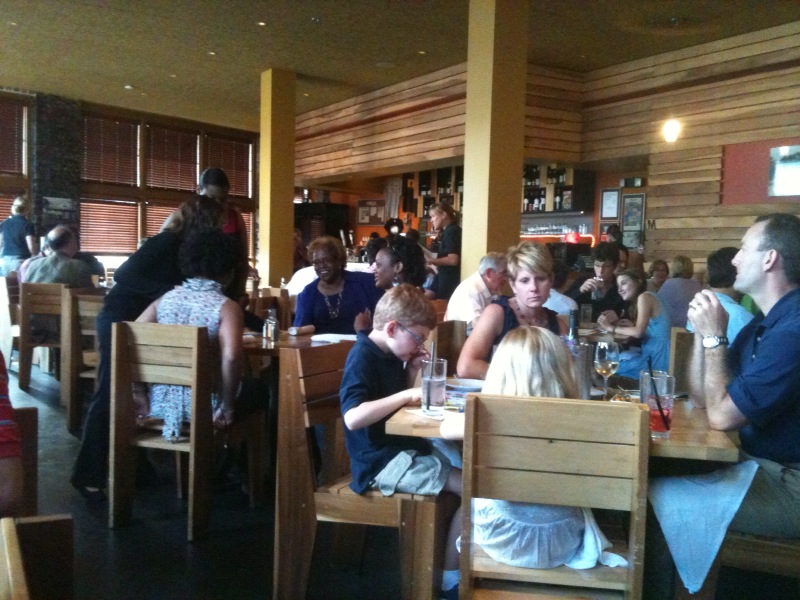
On the way to a full house
COCHON is a restaurant we will visit again. I am drawn to the catfish courtbouillon, fried boudin with pickled peppers, and the pork cheeks. Lisa would like to try the smoked beef brisket with horseradish potato salad and the caramelized onion and grits casserole. We know it will all be good.
EVOLUTION OF THE LAUDERDALE COUNTY COURTHOUSE
July 30, 2010 § 2 Comments
When Lauderdale County was established in 1833 out of Choctaw lands ceded in 1830 at Dancing Rabbit Creek, there was already a settlement at Marion, named for the famous South Carolina “Swamp Fox” of Revolutionary War fame. Since the community was located near the center of the new county, it was the logical place to name as county seat.
Meridian was incorporated in 1860, and, except for a setback in 1864 thanks to General Sherman, grew rapidly. In 1870, as a result of a public referendum, the county seat was relocated to Meridian, a few miles to the southwest of Marion.
The county’s first courthouse was built in 1890 at the present site, where it stood until 1903, when it was destroyed by fire. If there is a photograph of that first building, I have been unable to locate it, even after checking with the Lauderdale County Archives.
In 1904-1905, a new courthouse was built on the original site. It was in the Beaux Arts style in fashion at the time, and featured a dome with cupola and sculpted figures.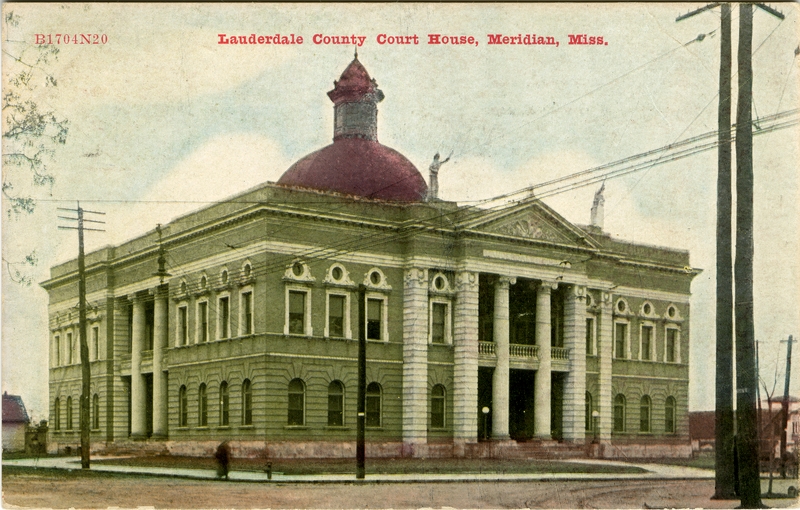
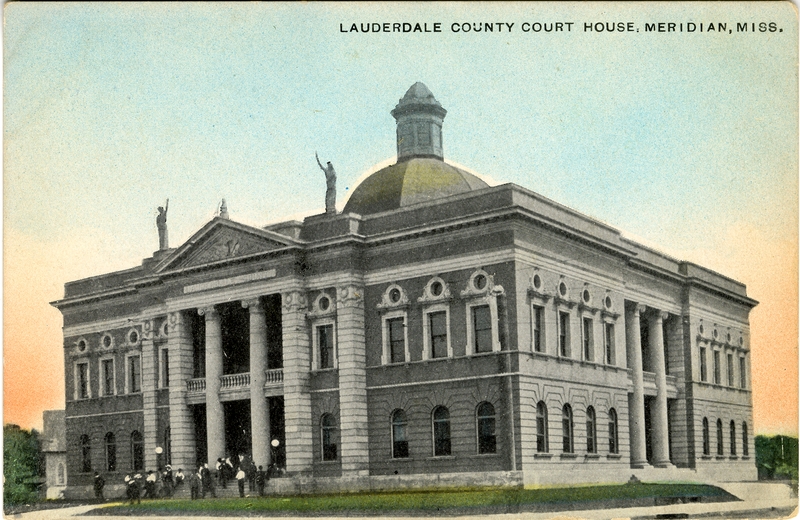
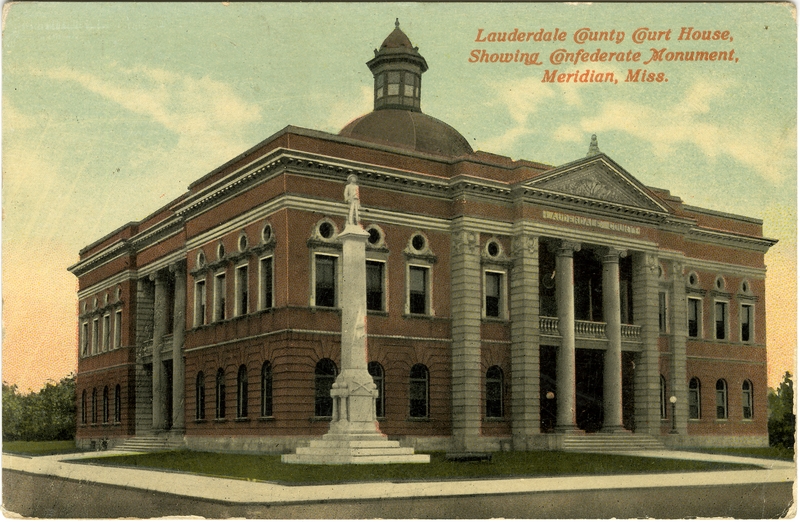
Some time later, the statues were removed, and even later, probably in the 1920’s, a Confederate memorial was erected on the northwest corner of the site. You can click on the photos for larger, more detailed view.
In 1939, the building was enlarged and extensively remodeled in Art Deco style. A jail was added on the top floor. The work was part of President Roosevelt’s federal works projects aimed at creating jobs to get the country out of the Great Depression.
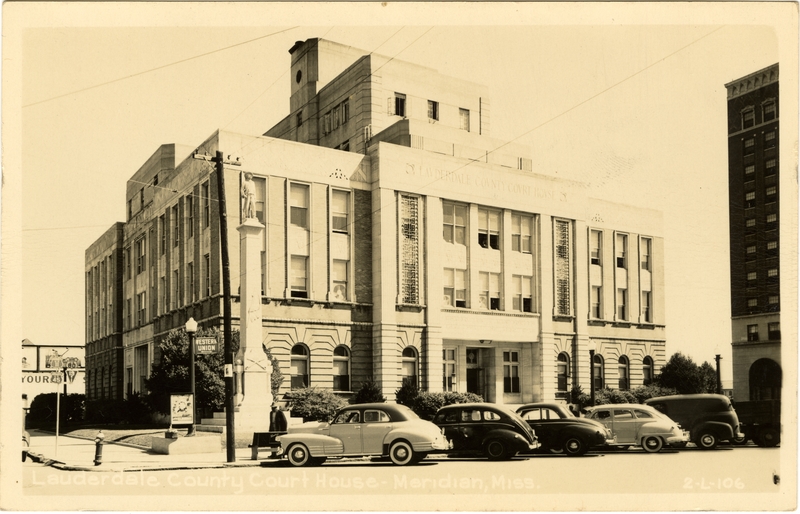 The building has remained essentially unchanged in appearance since the 1939 renovation. The photo to the left shows the west entrance in the early 1950’s.
In the 1970’s, a ramp was built at the west entrance for handicap accessibility. The ramp originally bore the inscription LAUDERDALE COUNTY COURTHOUSE, but the lettering was replaced in the 1980’s by a marble memorial honoring and naming the military of Lauderdale County who were killed in war.
A porch with benches was added at the south entrance in the 1980’s.
In the late 1990’s, before the new jail on Fifth Street could be built, a metal fire escape enclosed by chain-link fencing was constructed on the east side, giving jail inmates an escape onto Nineteenth Avenue into a chain-link enclosure in case of fire. The fire-escape apparatus was removed after the new jail was completed and put into operation.
The courthouse was designated a Mississippi Landmark on April 6, 1999, and is listed on the National Register of Historic Places as a contributing element of the Meridian Downtown Historic District.
The photos above, along with around 4,600 others showing scenes from all around Mississippi during the period from 1892 to the 1940’s, are available at the Mississippi Department of Archives and History’s website here.
 Above is a view of the courthouse as it appears today. It shows the DA’s office lit up in trial preparation on a rainy evening. This unusual photo was taken by Meridianite Ken Flynt, and is used with his permission.
SHOULD WE RETHINK ALIENATION OF AFFECTION?
July 29, 2010 § 3 Comments
Philip Thomas, the Jackson lawyer who blogs at MS Litigation Review & Commentary has posted some trenchant thoughts about the cause of action for alienation of affection in Circuit Court that is sometimes used either for vengeance or to coerce a settlement in Chancery.
I found his comments so thought-provoking for family law practitioners that I have copied and pasted it below rather than simply providing a link.
I recommend Mr. Thomas’s blog to you as a regular read.
Sick of Alienation of Affection Lawsuits?
I’m sick of alienation of affection lawsuits. Who’s with me?
I’m sick of this one, which ironically was filed by a former Miss. Supreme Court Justice (McRae) who advocated abolishing the cause of action while he was on the Court. I’m sick of this one, which is just getting started. I’m sick of the one involving my old law firm that recently was the subject of a Supreme Court decision. I’m sick of the entire cause of action.
Here are just a few of the problems that I have with the cause of action:
- fault—in an alienation of affections lawsuit, fault is placed on the third-person involved in the affair instead of the cheating spouse. But it was the cheating spouse who broke a vow.
- causation—who can really say that the “alienation of affection” is what caused the marriage’s demise? Anyone who has ever been married knows that marriages are extremely complicated.
- damages—as pointed out by Justice Dickinson in a concurring opinion in Fitch v. Valentine, there are no standards for compensating the plaintiff.
- quasi-extortion—there is a quasi-extortion element to the cause of action. I’ve heard that many alienation of affection claims settle before suit is filed in order to keep the allegations out of the public record. Once suit is actually filed, the case is likely to go to trial because the plaintiff has shot his/ her biggest bullet. Compare that to the rest of the civil justice system where cases are rarely settled before suit is filed, but most do settle after suit is filed.
- resolution—I do not believe that an alienation of affection case promotes the orderly resolution of the acrimony between the individuals involved. In fact, I think that it does the opposite.
- 42 states do not recognize the cause of action. That fact standing alone does not make the action bad, but it does suggest problems.
- the danger of entrapment—an enterprising couple who are grifters could set up an alienation of affection lawsuit and then share in the proceeds. A new couple moves to town. The wife is seen around town flirting with doctors and other wealthy men. This leads to a notorious affair followed by an alienation of affection lawsuit by the woman’s husband. In the lawsuit, the woman testifies that the affair did alienate her affection from her husband and destroyed their marriage. After a big settlement the couple then moves to North Carolina or another state that recognizes the action and starts the whole scam over. This is not that far-fetched to me. In fact, I would be surprised if there has never been collusion in an alienation of affection lawsuit.
In summary, it’s a bad cause of action that should be abolished
“QUOTE UNQUOTE”
July 29, 2010 § Leave a comment
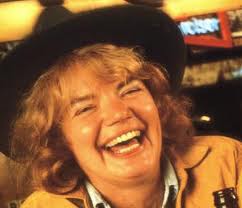
The late, great Molly Ivins
“The first rule of holes: When you’re in one, stop digging.” — Molly Ivins
“History teaches us that men and nations behave wisely once they have exhausted all other alternatives.” — Abba Eban
“It isn’t that they can’t see the solution. It is that they can’t see the problem.” — G.K. Chesterton
TRIAL BY CHECKLIST: GRANDPARENT VISITATION
July 28, 2010 § 16 Comments
A practice tip about trial factors is here.
Martin v. Coop, 693 So.2d 912, 913 (Miss. 1997), factors for grandparent visitation:
- Potential disruption in the child’s life;
- Suitability of the grandparents’ home;
- The child’s age;
- The age and physical and mental health of the grandparents;
- The emotional ties between grandparents and the child;
- The grandparents’ moral fitness;
- Physical distance from the parents’ home;
- Any undermining of the parents’ discipline;
- The grandparents’ employment responsibilities;
- The grandparents’ willingness not to interfere with the parents’ rearing of the child.
Except in unusual circumstances, grandparent visitation should not be the equivalent of parental visitation. Martin v. Coop at 913.
If the court awards grandparent visitation equivalent to parental visitation, the court must make specific findings to support the award. Settle v. Galloway, 682 So.2d 1032, 1034-35 (Miss. 1996).
INS AND OUTS OF GRANDPARENT VISITATION
July 26, 2010 § 4 Comments
[This outline is based in part on the 15th Chancery Court District Newsletter published by Chancellor Ed Patten]
Who is entitled to grandparent visitation?
Category One: Grandparents who have a change in status. § 93-16-3 (1), MCA.
— Child of the grandparents lost custody of the grandchild to the grandchild’s other parent, or
— Child of grandparents had parental rights terminated, or
— Child of grandparents is deceased.
Category Two: Grandparents who are not in Category One and have a “viable relationship.” § 93-16-3 (2), MCA.
— If grandparent had established a “viable relationship” with grandchild and grandchild’s parent or custodian hs unreasonably denied visitation with the grandchild, and
— Visitation rights will serve the grandchild’s best interest.
A “viable relationship” is where the grandparent has supported the grandchild in whole or in part for not less than six months prior to the filing of the petition, or the grandparent had frequent visitation for one year prior to the filing of the petition.
In order to determine whether visitation rights will serve the child’s best interest, and the extent of the visitation that should be ordered, the court must address the factors set out in Martin v. Coop, 693 So.2d 912, 916 (Miss. 1997), which are set out here.
Grandparent visitation is not available to grandparents of children given over for adoption, unless one legal parent is also a biological parent, or unless one adopting parent was related to the child by blood or marriage prior to the adoption. § 93-16-7, MCA.
Visitation is available to persons who become grandparetnts by virtue of adoption. § 93-16-7, MCA.
Siblings and other third parties have no common law or statutory right to visitation. Scruggs v. Satterfiel, 693 So.2d 924, 926 (Miss. 1997).
Venue is in the county where a child custody order was previously entered, or in the county where the child resides, if no custody order has been previously entered. § 93-16-3 (4), MCA.
Summons and service of process is had on the custodial parent(s), pursuant to Rule 81, MRCP.
TWILIGHT OF THE GODS
July 25, 2010 § 2 Comments
 They were so powerful that they thought they were gods, immune from the misfortunes of mere mortals. They were Dickie Scruggs and all of his allies and fellow-travelers who rose to unparalleled power and wealth through bribery and corruption, until their un-god-like downfall. Their story is an epic Mississippi saga.
The next book on the grotesquerie of Dickie Scruggs and his ilk will be out soon. THE FALL OF THE HOUSE OF ZEUS, by Mississippian Curtis Wilkie, former BOSTON GLOBE foreign correspondent and current Ole Miss professor, is set to be released October 19, 2010, and the author will be at Square Books in Oxford that day to talk about his book and autograph copies.
Author Richard Ford made these comments about the book on the Square Books web site …
Addictive reading for anyone interested in greed, outrageous behavior, epic bad planning and character, lousy luck, and worst of all, comically bad manners. Wilkie knows precisely where the skeletons, the cash boxes and the daggers are buried along the Mississippi backroads. And he knows, ruefully — which is why this book demands a wide audience — that the south, no matter its looney sense of exceptionalism, is pretty much just like the rest of the planet.
I reviewed Alan Lange’s and Tom Dawson’s book on the Scruggs downfall here.
JUDGE EVANS’ MEMORIAL SERVICE
July 24, 2010 § Leave a comment
Chancellor Frank McKenzie attended the memorial service yesterday in Raleigh for Circuit Judge Robert G. Evans. He sent his observations in the form of a comment to another post, and I though they should be on the front page, so they would not be missed.
Chancellor Frank McKenzie, 19th District July 23rd, 2010
Bob donated his body to the University of Mississippi Medical Center for medical research. His wife, who pre-deceased him, did the same.
Everyone I know who practiced in Judge Evans’ court spoke of it as a privilege and an enjoyable experience. If I could sum up all the comments, it would be “Trying a case before Judge Evans was what trying a case should be like.” His wit, integrity, demeanor, experience and fairness will be missed.
 The Better Chancery Practice Blog
I attended the Memorial Service today for Circuit Judge Bob Evans at the Smith County Courthouse in Raleigh.
Bob’s brother was a part of the service and he shared with us a framed note from a grammer school student that Bob kept on his desk.
The note stated: “Thank you for letting our class come to Court. I wanted to be a lawyer but after coming to Court it looks like being a lawyer is hard work. So I have decided to be a Judge.”
That was Bob’s sense of humor that he kept that on his desk.
Bob was a great Judge and he will be missed by many.