CHECKLIST FOR CLOSING AN ESTATE
September 27, 2010 § 20 Comments
- _____ Judgment opening the estate or admitting will to probate is filed, and there is no contest.
- _____ Oath of Executor/Administrator filed.
- _____ The Executor/Administrator has properly filed his or her bond, or it was waived by the will or by sworn petition of all heirs with entry of a court order authorizing the waiver.
- _____ Letters Testamentary or of Administration issued.
- _____ The affidavit of known creditors required by MCA § 91-7-145 was properly executed by the Executor/Administrator and filed before publication to creditors.
- _____ Publication of Notice to Creditors was made in “some newspaper in the county” that meets the criteria in MCA § 13-3-31, for three consecutive weeks, and it has been more than ninety days since the first publication.
- _____ Inventory and appraisement were done and timely filed, or were waived by the will or by all heirs by sworn petition with order so waiving.
- _____ All accountings were timely filed and approved by court order (other than the final accounting, which is now before the court), or waived by the will or excused by the court.
- _____ In the case of an administration, publication for unknown heirs has been completed, and a judgment determining heirs has been presented, or will be presented in advance of presenting the final accounting.
- _____ All interested parties to this estate have been served with the petition to close and all other closing documents, including the final account, and they have joined in the petition or have been duly served with a Rule 81 summons, and there is a proper return or properly executed waiver or joinder for each interested party.
- _____ All probated claims have been paid, and evidence of such payment is in the court file, or the probated claims will be paid in the course of closing the estate, and a final report will be filed evidencing payment.
- _____ The attorney’s fees and expenses, as well as those of the Executor/Administrator have been disclosed to all interested persons, and they have no objection.
DEDICATION DAY
September 26, 2010 § 1 Comment
The renovated “old courtroom” upstairs in the Clarke County Courthouse was dedicated today in a program attended by Clarke Countians and elected officials.
This is what the official program said about the renovation:
“Clarke County’s present Court House was constructed in the heart of the county seat in 1912. Nearly 60 years later, in 1969, the courtroom was remodeled, closing in the full-length windows on the east and west walls, and covering the balcony by the addition of a suspended Celotex ceiling. This provided a location for the large boiler system to heat and cool the building, since the third floor offices were no longer in use, except for use as storage space.
“By the year 2000, county officials discovered the availability of federal and state grants to be used for improvements to government buildings. Through grants provided by the Mississippi Department of Archives and History and the Historic Preservation Division of the “Save America’s Treasures” Act, work was begun to restore our historic 1912-era courtroom to its original grandeur.
“In 2008, Supervisor Tony Fleming organized the demolition process, using county employees and inmates from the Clarke County jail, to gut the area so that accurate blueprints could be produced. By January of 2009, local architect David Henderson of AEDD Plus and contractor BP Roofing and Construction of Laurel, Mississippi, had begin work.
“Since all historic structures are required to adhere as closely as practicable to the original design, every effort was made to replicate the original handiwork. Most of the flooring is original to the building, as are the large ceiling beams. The metal ceiling panels are exact duplicates of those used in the original construction.
“Today we proudly present our newly-restored courtroom to the people of Clarke County. Let us remember to be grateful for the foresight of our county officials in providing a stately and securebuilding in which to conduct our county’s business.”
My previous post about the renovation is here.
Photos from the program:

The crowd gathers for the program

Board of Supervisors President Arthur Nelson chairs the program

Circuit Clerk Beth Doggett recognizes the judges and elected officials

L to R, Chancellor Primeaux, Circuit Judge Bailey, retired Ciruit Judge Williamson, Circuit Judge Williamson, retired Chancellor Warner

L to R, Dist. 4 Supervisor Paul Mosley, Sheriff Todd Kemp, Dist. 2 Supervisor Cleveland Peebles, Dist. 3 Supervisor Willie Roberson, Dist 5 Supervisor Tony Fleming, and Dist 1 Supervisor and Board President Arthur Nelson

Chancery Clerk Angie Chisholm hosts the reception refreshments downstairs

Father and son: Circuit Judge Lester F. WIlliamson, Jr. on the left and retired Circuit Judge Lester F. Williamson, Sr. on the right
WHAT DO PROSPECTIVE CLIENTS WANT TO KNOW?
September 24, 2010 § Leave a comment
Not a knock on anybody’s web site or advertising strategy, but I thought this clever venn diagram pointed out a weakness in many law office marketing strategies: lawyers don’t really know what information prospective clients are really wanting to know as they make a lawyer selection decision.
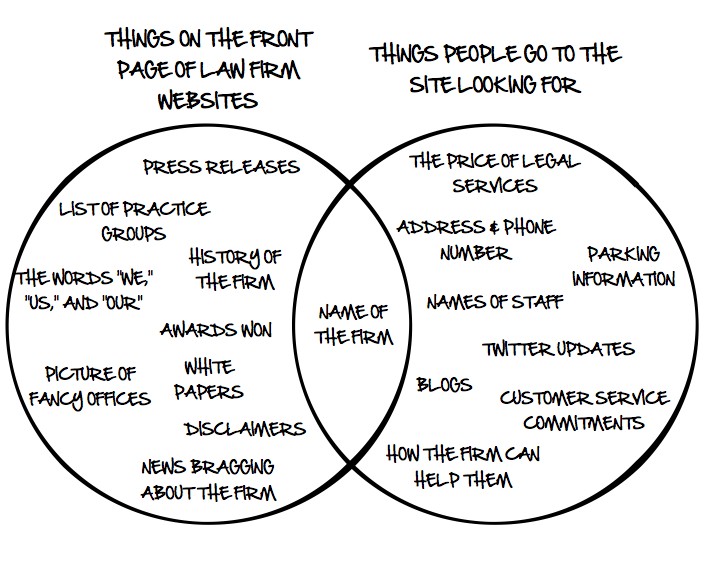 I found this and some other pretty interesting professional marketing ideas at the[non]billablehour blog. You might find it useful, too.
A MILESTONE WORTH NOTING
September 24, 2010 § Leave a comment
Meridian attorney Champ Gipson celebrated his 89th birthday yesterday. He graduated from Cumberland Law School and has been a member of the bar for more than 65 years.
Champ is still active, and even makes a court appearance now and then. He was in my court this spring filling in for his former law partner of many years, Jim Williamson. I see Champ most Wednesday mornings for breakfast at Jean’s, where he always has only one cup of coffee.
If you see Champ, wish him a happy birthday and commend him for his long legal career.
“QUOTE UNQUOTE”
September 23, 2010 § Leave a comment

Lao Tzu
“No one can get inner peace by pouncing on it.” — Harry Emerson Fosdick
“It is an ironic habit of human beings to run faster when we have lost our way.” — Rollo May
“Nature does not hurry, yet everything is accomplished.” — Lao Tzu
VOUCHERS YOU CAN VOUCH FOR
September 23, 2010 § 6 Comments
by Jane Stroble Miller, Senior Staff Attorney for the Twelfth Chancery Court District
Shortly after graduating from law school I was confronted with a baffling legal question. An older and more experienced attorney was attempting to do something that Mississippi statutes and case law clearly stated he could not do. In my naiveté I assumed he knew of a statute or case about which I was ignorant that allowed him to act as he did. After several hours of exhaustive research I called a former professor and mentor, the Honorable William Champion. On hearing my dilemma, he chuckled and informed me that I had just encountered an attorney who had been practicing law for so long that he had lost touch with what the law was.
Recently I again encountered this phenomenon in my duty as staff attorney in monitoring probate matters. One of my tasks is to try to explain to attorneys why the chancellor feels that their accountings do not meet the requirements of both the statutes and the Uniform Chancery Court Rules (UCCR). In a meeting with an older attorney, I pointed out that he had failed to attach vouchers to his accounting. He insisted that he could not provide the necessary documentation “because the banks no longer returned the original canceled checks,” and remained firmly stuck to that position. I realized that I would have to do some research to arrive at a definitive answer.
Section 91-7-277, MCA, requires that the annual account show ” … disbursements, every item of which and the amount thereof to be distinctly stated and supported by legal voucher …” Sections 91-7-279 and 93-13-71, MCA, prescribe the form for vouchers and provide that the account shall be rejected by the clerk unless the vouchers are in the proper form. The only exception to the voucher requirement is when the guardian is an approved financial institution.
Over time, attorneys began using original canceled checks as “legal vouchers,” and the courts recognized them as such. Although neither the statutes nor case law identify canceled checks as “legal vouchers,” there is authority in UCCR. In fact, UCCR 6.04 does specifically refer to “a receipt or cancelled bank check …” as a voucher.
The problem with canceled checks as vouchers, however, is that if you stop at the check, you have omitted the most important, and meaningful, part of Rule 6.04. The sentence of the Rule dealing with vouchers, in its entirety is as follows: “Every such voucher shall consist of a receipt or cancelled bank check showing to whom and for what purpose the money was paid.” [Emphasis added]
In other words, if the canceled check fulfills the function of showing “to whom and for what purpose the money was paid,” then it is a proper voucher within the meaning of the Rule. If the canceled check does not do that job, it is not an acceptable legal voucher. Put even plainer: if the canceled check would not otherwise be acceptable as a receipt, it simply is not a legal voucher.
UCCR Rule 6.06 (Lost Vouchers) reinforces my conclusions. It states that if the original voucher is lost or destroyed, a duplicate or ” … receipt from the person or corporation to whom the money was paid or the property was delivered … ” may be accepted by the court. Again, the function of a voucher is to document actual payment, the recipient and the purpose.
I even looked at Black’s Law Dictionary, which defines voucher as ” … an account, receipt, or acquittance, that shows on its face the fact, authority, and purpose of the disbursement.”
Given no hard and fast definition of a “legal voucher,” I formulated the following requirements for a voucher to be sufficient to comply with our laws:
- A voucher must first and foremost be legal evidence that the money was disbursed for the purpose for which it is authorised or allowed.
- It must be in writing or printed and show the payee, amount and date, and services or goods for which the disbursement was made.
- A check made out to “cash” , even an original canceled check is not a “legal voucher.”
Canceled checks, whether copies or original, really only prove that a payee was paid a certain amount of money. In some circumstances, canceled checks may not be adequate proof. For instance, when a court has authorized the purchase of a computer for a minor ward, a canceled check to Best Buy or Sam’s Club does not prove the money was disbursed for a computer. The check could have just as likely been used to purchase a big screen television or a new set of tires for the guardian’s car. The same holds true for many canceled checks for clothing or personal items. Since vouchers are supposed to be “evidence,” the better practice is for an attorney to have printed receipts that match the date and amount of a canceled check. The guardian should provide the attorney with register tapes, tags or price stickers from the items purchased to prove that the disbursements were actually made for the ward and not for another party or purpose.
The best yardstick that both a judge and attorney could employ in determining the adequacy of a voucher would be to ask whether or not the proof would be of such a nature and sufficiency to be admissible as evidence at a trial and contains all the information necessary to convince the average person that the disbursement was made for what the guardian claimed it was made.
It took me a little time, digging and thought to arrive at my conclusions, but I had Professor Champion’s wisdom as a starting point and a reminder that sometimes we can practice law so long that we lose touch with what the law is.
TRO’S THAT WORK
September 22, 2010 § 1 Comment
There are two types of temporary restraining orders (TRO’s): The ones that work and the ones that fail. Since your client is paying you to get a TRO that works, you might want to read on about how to be successful in getting this relief.
A TRO usually arises where the plaintiff claims he is entitled to more extensive injunctive relief, but needs immediate intervention of the court to prevent irreparable injury until the full claim for injunction can be heard. A TRO is, simply put, a temporary injunction issued in exceptional circumstances without notice to the opposing party or his attorney, to expire no later than ten days after its entry by the court. It is intended to be an action to hold the parties in place until the court can have a full hearing on more comprehensive, extended injunctive relief.
The procedure to obtain a TRO is set out in Rule 65, MRCP. Everything you need to know about a successful TRO is there. So pause a moment here and Read Rule 65 all the way through. It’s not long and will take you no more than four and one-quarter minutes. I’ll wait. <humming to myself; checking my e-mail>
Okay, now that you’ve read the rule do you see now why you were turned down the last time you tried to get a TRO? Yep, I thought so.
The rule is clear that if you want an injunction issued without notice, you must present a pleading to the court that meets the following requirements:
-
It must recite specific facts by affidavit or verified complaint that immediate and irreparable injury, loss or damage will result to the applicant before the opposing party or his attorney may be heard in opposition; and
-
The applicant’s attorney certfies in writing what efforts, if any, have been made to give notice, and reasons why notice should not be required.
Some scenarios that will fail:
-
You file the complaint on behalf of your client. The rule requires a verified complaint or affidavit, either of which would be required to be on personal knowledge of the underlying facts by the person seeking the relief.
-
The complaint includes only conclusory statements and no facts. The rule requires “specific facts” that support the relief sought.
-
The harm that plaintiff seeks to avoid will likely occur in 30 days, and there is no explanation why notice for a hearing can not be given within that time.
Some judges require the personal appearance of the plaintiff or affiant to testify as to the facts set out in the complaint or affidavit. I take the position that, since the application is required to be verified or supported by affidavit, testimony in person is not required at this stage; the only inquiry by the court is whether the application meets the requirements of the rule.
When the TRO is entered, it is endorsed with the date and hour of issuance and is entered of record “forthwith.” The order must define the injury and why it is adjudged to be irreparable, and state why it was granted without notice. The order includes on its face the expiration date.
A TRO is effective for not longer than ten days, except in domestic relations cases to which the ten-day limitation does not apply. The court may “for good cause” extend the effective date of the TRO “for a like period.” That means that if the original TRO were effective for 5 days, the court may extend it another five, and a TRO originally effective for 10 days could be extended for 10 more days. The court may also extend the TRO if the party against whom the order is entered consents to the extension. In any extension, the reasons for the extension must be stated in the order.
The TRO must state in reasonable detail, and not by mere reference to the pleadings, the act or acts sought to be restrained. It is binding only upon the parties to the action and their officers, agents, servants, employees and attorneys, “and upon those persons acting in concert or participation with them who receive actual notice of the order by personal service or otherwise.”
When the TRO is entered, a hearing date and time is set for a hearing on the preliminary injunction. Scheduling of the hearing takes precedence over all other matters except “older matters of the same character.”
At hearing, the party who obtained the order proceeds first, and if the proponent fails to appear, the court shall dissolve the TRO.
The party against whom the order is issued may appear and request dissolution of the TRO or modification on two days’ notice to the obtaining party, or on such shorter notice as the court may prescribe. In such event, the court will hear the motion “as expeditiously as the ends of justice require.”
Except in domestice relations cases, a TRO or preliminary injunction may issue only on giving of security by the applicant in the amount that the court may direct, for the payment of costs, damages and reasonable attorney’s fees that may be suffered by any party later deemed to have been wrongfully restrained. No security is required of the State of Mississippi or its officers or agencies, and the court may waive security in a domestic relations case. In all cases where security is required, the provisions of Rule 65.1, MRCP, apply.
The order issuing the injunction must set forth the reasons for its issuance and describe in detail the act or actions sought to be restrained. It is binding only upon the parties to the action and their officers, agents, servants, employees and attorneys, “and upon those persons acting in concert or participation with them who receive actual notice of the order by personal service or otherwise.”
In the case of both a TRO and an injunction, if a reasonable person can not ascertain from the four corners of the document exactly what conduct is enjoined, the order should be set aside on appeal.
Practice Tip: Before you file an application for a TRO, read Rule 65 carefully. The requirements are technical and precise, and you will not succeed in having your TRO issued if you do not comply with the express requirements of the rule. Include in your pleading for a TRO a request for a preliminary injunction; otherwise, the other party may simply let your 10-day relief expire, and you will be back at the starting line.
ANATOMY OF A WILL CONTEST II: PROVING UNDUE INFLUENCE
September 21, 2010 § 5 Comments
We already took a look at testamentary capacity here. This post deals with the other pole of the will contest: undue influence.
A presumption of undue influence arises where a confidential relationship is proven to exist. Estate of Holmes, 961 So.2d 674, 680 (Miss. 2007). A confidential relationship does not have to be a legal one, and the relationship may be moral, domestic, or personal, and ” … the confidential relationship arises when a dominant over-mastering influence controls over a dependent person or trust, justifiably reposed.” Murray v. Laird, 446 So.2d 575 (Miss. 1984).
A confidential relationship exists where one person is in a position to exercise dominant influence over the other because of the latter’s dependency on the former due to weakness of mind or body, or due to trust; the law considers such a relationship to be fiduciary in character. Madden v. Rhodes, 626 So.2d 608, 617 (Miss. 1993). The party seeking to prove existence of a confidential relationship must do so by clear and convincing evidence. Whitworth v. Kines, Id. at 230.
In making its determination whether a confidential relationship exists, the trial court must consider the seven factors set out by the Mississippi Supreme Court in Dabney v. Hataway, 740 So.2d 915, 919 (Miss. 1999). Those factors are:
- Whether one person has to be taken care of by others.
- Whether one person maintains a close relationship with another.
- Whether one person is provided transportation and medical care by another.
- Whether one person maintains joint accounts with another.
- Whether one is physically or mentally weak.
- Whether one is of advanced age or poor health.
- Whether there exists a power of attorney between the one and the other.
After considering the seven factors, the court returns to the core question, which is whether the proof establishes that the dominant person in the relationship was in a position to exercise undue influence due to the other’s weakness of mind or body, or due to trust, and whether such has been proven by clear and convincing evidence. The question at this point is not necessarily whether the dominant person did or did not exercise dominant influence; rather, the issue is whether he was in a position to do so. If the answer to the inquiry is that there is clear and convincing evidence that the dominant person was indeed in a position to exercise undue influence, the presumption arises, and the burden shifts.
Once the presumption arises, it must be rebutted by clear and convincing evidence. Estate of Pigg v. McClendon, 877 So.2d 406, 411 (Miss. App. 2003).
The proponent then has the burden of going forward with clear and convincing evidence in a three-prong test set out in Mullins v. Ratcliff, 515 So.2d 1183, 1193 (Miss. 1987). The three-prong Mullins test requires the proponent to prove:
- good faith on his part;
- the grantor’s full knowledge and deliberation of his actions and their consequences; and
- that the grantor or testator exhibited independent consent and action.
A will or conveyance is said to be the product of undue influence when an adviser has been so persistent and pressing that the testator’s free will and agency is suppressed. See, Longtin v. Wilcher, 352 So.2d 808, 811 (Miss. 1977).
In order to determine whether the proponent acted in good faith as provided in the first prong of the Mullins test, the trial court must consider the five factors listed in Estate of Holmes, 961 So.2d 674, 680 (Miss. 2007). Those factors are:
- The identity of the person seeking preparation of the instrument.
- The place of execution of the instrument and in whose presence.
- What consideration and fee were paid, if any.
- By whom paid.
- The secrecy or openness given the execution of the instrument.
The second prong of the Mullins test is the grantor’s full knowledge and deliberation of his actions and their consequences. In order to adjudicate this prong, the court must take into consideration the factors set out in Estate of Holmes, supra at 685-686. Those factors and the court’s findings are as follows:
- His awareness of his total assets and their general value.
- An understanding by him of those persons who would be the natural inheritors of his bounty under the laws of descent and distribution or under a prior will and how the proposed change would affect that prior will or natural distribution.
- Whether non-relative beneficiaries would be excluded or included.
- Knowledge of who controls his finances and business, and by what method, and if controlled by the other, how dependent is the grantor/testator on him and how susceptible to his influence.
The third and last prong of the Mullins test is whether the decedent exhibited independent consent and action. In Dean v. Kavanaugh, 920 So.2d 608, 622 (Miss. App. 1993), the Mississippi Court of Appeals stated that the best way to show independent consent and action is to establish that the testator/grantor had the benefit of advice of a competent person disconnected from the grantee and devoted solely to the testator/grantor’s interests.
CLARKE COUNTY DEDICATION REMINDER
September 20, 2010 § Leave a comment
Reminder that the dedication of the renovated “old court room” at the Clarke County Court House in Quitman will be this coming Sunday, September 26, from 2 pm to 4 pm. There will be an open house and reception.
If you practice in Clarke County, it would be a gracious gesture to attend and make it a point to tell the members of the Clarke County Board of Supervisors how much you appreciate their leadership and vision.
TRIAL BY CHECKLIST: SEPARATE MAINTENANCE
September 20, 2010 § 8 Comments
A practice tip about trial factors is here.
In the case of Shorter v. Shorter, 740 So.2d 352, 357 (Miss. 1999), the Mississippi Supreme Court stated that six criteria must be considered in setting awards of separate maintenance:
- The health of the husband and the wife;
- Their combined earning capacity;
- The reasonable needs of the wife and children;
- The necessary living expenses of the husband;
- The fact that the wife has free use of the home and furnishings; and
- Other such facts and circumstances.
Also see, Honts v Honts, 690 So.2d 1151, 1153 (Miss. 1997).
While an award of separate maintenance should provide for the wife as if the couple were still cohabiting, the allowance should not “unduly deplete the husband’s estate.” Kennedy v. Kennedy, 662 So. 2d 179, 181 (Miss. 1995) (quoting Thompson v. Thompson, 527 So. 2d 617, 622 (Miss. 1988)).

