CHANCERY COURT CONTESTED ELECTION RESULTS
November 4, 2010 § 1 Comment
In District 7 (Tunica, Quitman, Coahoma, Tallahatchie and Leflore Counties), Place 1, Catherine Farris-Carter of Shaw opposed Tom T. Ross, Jr., of Clarksdale.
Farris-Carter 52% Elected
Ross 48%
Also in District 7, Place 3, W. M. Sanders of Greenwood and Jimmy Miller of Marks faced off for a newly-created seat.
Sanders 63% Elected
Miller 37%
District 8 (Hancock, Harrison and Stone Counties) to take the place of retiring Chancellor Margaret Alfonso. Candidates were: Jennifer Schloegel and Dara Skinner, of Gulfport; and Robert G. Harenski, William E. Tisdale and Fran Yeatts, all of Biloxi.
Schloegel 51% Elected
Skinner 13%
Harenski 11%
Tisdale 21%
Yeatts 3%
In District 10 (Forrest, Lamar, Pearl River and Perry Counties), for Place 2, to replace Judge Sebe Dale. The candidates were Dawn H. Beam of Sumrall, Scott Phillips of Columbia, and Aaron L. Russell of Carriere.
Beam 47% Runoff
Phillips 36% Runoff
Russell 17%
In District 10 (Forrest, Lamar, Pearl River and Perry Counties), to replace deceased Judge James H. Thomas, write-in.
I learned from an unofficial but well-placed source that Judge Thomas actually received 54% of the vote, and, as a result, Governor Barbour will appoint a replacement.
In District 13 (Covington, Jefferson Davis, Lawrence, Simpson, and Smith Counties), incumbent Judge Larry Buffington of Collins faced opponents Douglas MacArthur Magee of Mendenhall and David Shoemake of Collins.
Buffington 44% Runoff
Magee 11%
Shoemake 45% Runoff
In District 18 (Benton, Calhoun, Lafayette, Marshall and Tippah Counties), incumbent Judge Edwin H. Roberts, Jr. was opposed by Helen Kennedy Robinson of Oxford.
Roberts 69% Elected
Robinson 31%
A comprehensive recap of all the election results is here.
DODGING THE MRCP 36 BULLET
November 3, 2010 § 1 Comment
FN1. “Each matter of which an admission is requested shall be separately set forth. The matter is admitted unless, within thirty days after service of the request, or within such shorter or longer time as the court may allow…. Miss.R.Civ.P. 36(a).
“Such admissions, however, are not necessarily irrevocable. Sawyer, 556 So.2d at 697-698 (citing Educational Placement Services, 487 So.2d at 1318). Rule 36(b) provides the procedure to revoke admissions:
“Any matter admitted under this rule is conclusively established unless the court on motion permits withdrawal or amendment of the admission …. [T]he court may permit withdrawal or amendment when the presentation of the merits of the action will be subserved thereby and the party who obtained the admission fails to satisfy the court that withdrawal or amendment will prejudice him in maintaining his action or defense on the merits. Miss.R.Civ.P., Rule 36(b).
“The Martins made no attempt to withdraw or amend the Requests for Admissions under Rule 36(b); they merely untimely filed the Answers to the Simmons’ Request for Admissions. Essentially, the Martins argue that the filing of a late response to Request for Admissions is the equivalent of requesting withdrawal or amendment of the admissions. The Simmons respond that even if this were true, they have been prejudiced due to the death of Wesley Simmons, a material witness. Cf. Brook Village North Asso. v. General Electric Co., 686 F.2d 66, 70 (1st Cir.1982).
“A number of courts do allow untimely Answers to Requests for Admissions, when to do so would aid in the presentation of the merits of the action and no prejudice would ensue to the party who made the request. See e.g., Aldrich & Co. v. Donovan, 778 P.2d 397, 399 (Mont.1989); Herrin v. Blackman, 89 F.R.D. 622, 624 (W.D.Tenn.1981); *257 Bittner v. State for Use & Benefit of Alaska Laborers, 627 P.2d 648, 649 (Alaska 1981); Farmers Elevator Co. of Horace v. Nagel, 307 N.W.2d 580, 586 (N.D.1981); Latendresse v. Latendresse, 294 N.W.2d 742, 747-48 (N.D.1980); Marshall v. Dist. of Columbia, 391 A.2d 1374, 1379 (D.C.Ct.App.1978); Hadra v. Herman Blum Consulting Engineers, 74 F.R.D. 113 (D.C.Tex.1977); See also, 8 Wright & Miller, Federal Practice and Procedure § 2257 at 719-720 (1972); 4A Moore’s Federal Practice 2d ed., Admission of Facts-Procedure § 36.05(4). Other courts allow untimely answers to a request for admissions when there has been excusable neglect or compelling circumstances. See e.g., Dukes & Barber v. S.C. Ins. Co., 770 F.2d 545, 548-49 (5th Cir.1985); Moosman v. Joseph P. Blitz, Inc., 358 F.2d 686, 688 (2d Cir.1966).
“The problems encountered by the Martins in this case could easily have been eliminated if a motion to withdraw or amend the answers had been filed pursuant to Rule 36(b) and if there were justifiable excuse. See Sawyer, 556 So.2d at 698; Educational Placement Services, 487 So.2d at 1318. However, we need not reach the issue whether withdrawal or amendment may be allowed when there is no excusable neglect but a party is not prejudiced because the chancellor was not called upon to exercise his discretion to allow the withdrawal of the amendment of the answers to the admissions under Rule 36(b). See Diversified Communications v. Godard, 549 A.2d 362, 363 (Maine 1988). Since the lower court was never asked to exercise its discretion under Rule 36(b), the trial court properly followed our holding in Educational Placement Services v. Wilson, 487 So.2d 1316 (Miss.1986). We therefore are not called upon to determine if an abuse of discretion occurred and we find the chancellor properly applied Mississippi law to this issue.”
THANKS
November 3, 2010 § Leave a comment
It’s the ultimate compliment for any elected official to be unopposed for re-election, and I certainly do take the fact that no attorney in this district qualified to run against me as the ultimate compliment.
Thanks to all of you for your support.

HE’D HAVE GOTTEN MY VOTE
November 1, 2010 § Leave a comment
In 1970, each political candidate in Oregon could specify a 12-word slogan to be printed under his name on the ballot.
Frank Hatch of Eugene, who was running as a Democrat for Congress, used this slogan:
“Anyone who thinks in 12-word slogans should not be on this ballot.”
Thanks to Futility Closet for this.
MYSTERY SOLVED: THE BUILDING WITH THE THREE ARCHES
October 30, 2010 § 1 Comment
In the post below about Elvis in Meridian I posed the question about the building with the three arches. Turns out it was the YMCA located on the corner of 23rd Avenue and Ninth Street, which is now the location of WTOK-TV. The television station renovated the building and removed the arches and porch roofs. Tom Williams, the President of Meridian Regional Airport, sent me an aerial photo of the building in its pre-WTOK state. Here is the pic that Tom sent …

Recognize the three arches and the porch roof from the Elvis parade photo? That’s the Temple Theater directly behind the YMCA Building.
Tom pointed out that he had an interest in the building because his father, Marvin Williams, Esq., at one time had an office in the building.
Thanks to Tom for unlocking this mystery for us. That building would most certainly have been on any downtown parade route.
THE KING OF SOWASHEE
October 30, 2010 § 2 Comments
I have to confess to my second tour this weekend of that mystical shrine of tackiness, Graceland in Memphis, home of Elvis Presley and spiritual Mecca for his adherents. We took some Louisiana relatives who had never been there.
It got me thinking about what I had heard for years — that Elvis had performed in Meridian.
What I had been told was that the King had been in Meridian years ago to perform at the fair and calf scramble before he became famous. I even heard that there were photos. So I dug around on the internet, and actually found a couple of photos. The photos are both dated May 26, 1955, which would predate Elvis’s 1956 appearances on the Milton Berle and Ed Sullivan shows, the gigs that propelled him into national attention. The pictures show him in his more princely days, before he was anointed king.
The photo below shows Elvis and Jimmy Snow riding on a Cadillac in the parade for the 1955 Fair in Meridian. Anybody recognize that building? It’s interesting to me that the crowd appears more interested in whomever is coming up behind Presley and Snow; of course, Elvis back then was merely a musical act from Memphis who was mostly known for his performances on the Louisiana Hayride. Those folks on the parade route had no clue then that they were seeing a future international superstar. Jimmy Snow, incidentally, was the son of country music legend Hank Snow, and deveoped his own career eventually performing on the Grand Ole Opry before becoming a minister in Tennessee.
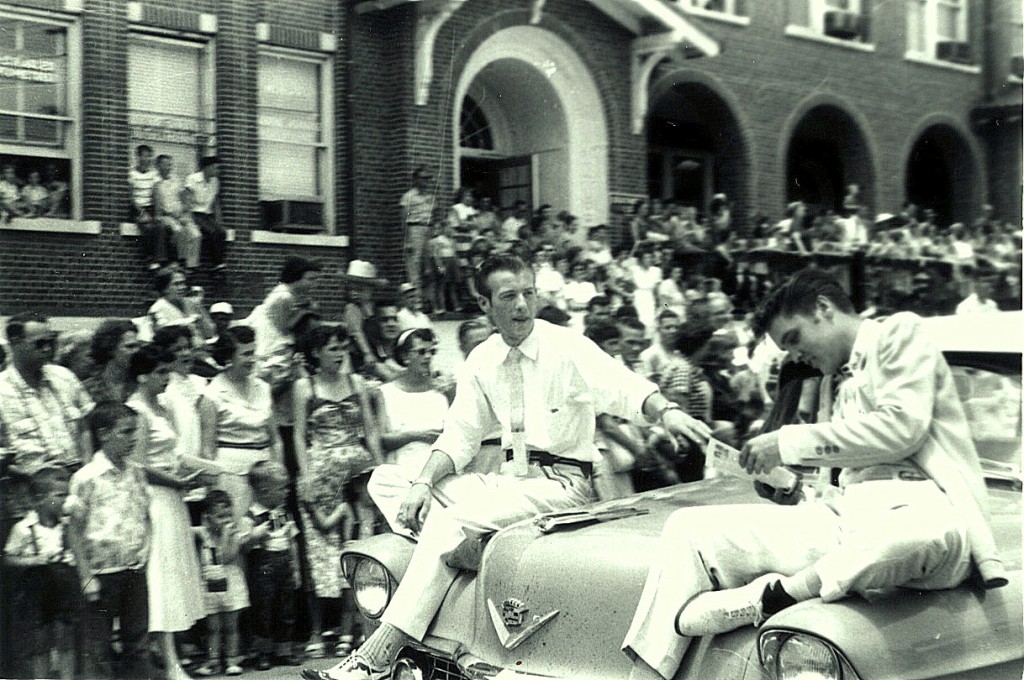
The other photo, below, shows Elvis with Bill Black and Jimmy Snow on the same Cadillac.

Nobody I know in Meridian has developed any oral history about this or any clearcut description of the event.
Here’s an interesting wrinkle: a Wikipedia article on Elvis gives a different time frame …
“The audience response at Presley’s live shows became increasingly fevered. Moore recalled, “He’d start out, ‘You ain’t nothin’ but a Hound Dog,’ and they’d just go to pieces. They’d always react the same way. There’d be a riot every time.” At the two concerts he performed in September at the Mississippi-Alabama Fair and Dairy Show, 50 National Guardsmen were added to the police security to prevent crowd trouble.”
According to the article, this was in 1956, after Presley had appeared on both Milton Berle’s and Ed Sullivan’s tv shows and created a national sensation. Of course, the reference to the Mississippi-Alabama State Fair and Dairy Show is Meridian’s own and was back then. Not enough info for me to resolve the discrepancy in dates beyond doubt. My best guess is that the source for the Wikipedia info, who was part of Elvis’s entourage back then, may be a little confused as to the timing. I would go with the dates of the photos for two reasons: first, that the dates of the pictures are part of their provenance; and second, after the national tv appearances, the crowd in the parade picture would have been far more focused on Elvis.
Steve Labiche did a little more research and found that the Cadillac had been purchased by Presley in Florida, and he had the dealer paint “ELVIS” on the door.
NOTE: the mystery of the building above with the three arches is solved here.
It’s an interesting little tidbit of Meridian history.
FAMILY LAW IN THE FAST LANE
October 29, 2010 § Leave a comment
This article is copied from the Washington Post online edition. After you read it, you may have an unsettling sense of unreality. Lawyers charging $850 an hour for a divorce? Billing for more than 7 hours a day, 365 days a year? Billing for as many as 71 hours in a day? $624,000 in fees for a divorce trial? I am not making this up.
High-priced lawyer sues former client, then agrees to pay him $102,000
By Tom Jackman
Washington Post Staff Writer
Saturday, September 25, 2010; 6:29 PM
Glenn C. Lewis is an acknowledged titan of the D.C. area divorce bar, a former president of the Virginia Bar Association who boasts that he is the most expensive lawyer in the region: $850 an hour. He has an impressive office in the District and an array of high-profile clients.
So it fascinated the Fairfax County courthouse when Lewis sued one of his former clients for an additional $500,000 in fees and interest, although he’d already been paid $378,000.
The fascinating part was that the client, a lawyer himself, fired back. He hired another former state bar president, Bernard J. DiMuro, who dug through Lewis’s billing records and hired two more divorce bar giants – including another former state bar president – as his experts. The experts said Lewis had done a poor job and didn’t deserve nearly $900,000 for his work.
In Fairfax Circuit Court on Friday, Lewis capitulated. He agreed to pay his former client more than $102,000, including $25,000 in sanctions imposed on Lewis’s lawyers for defying pretrial orders. Lewis even failed to show up for his own deposition.
Lewis, who for years hosted his own cable access television show, and who was given a lifetime achievement award from the Virginia State Bar’s family law section, remains unrepentant. His final bill for the divorce of Steve Firestone was $627,000, and he sought another $253,000 in interest for the case, which ended in 2004 without a trial less than a year from the time it was filed.
“He owed us more than that,” Lewis said in an interview last week. “We earned more than that. I feel as strongly today as I did the day we filed [suit], that Mr. Firestone owed every penny of it.”
Firestone said, “I thought that what I paid was egregiously high,” and he stopped paying shortly before his divorce was finalized. Then he received the lawsuit seeking another $500,000 five years later.
“I was shocked,” Firestone said. “If he won, we were going to be out on the street.”
Firestone hired DiMuro, who doesn’t do divorce law. But DiMuro obtained Lewis’s billing records and the records of the divorce, which he then handed over to Joseph Condo and Robert Shoun, two longtime family law practitioners.
Their conclusion: Not only were Lewis’s bills “flagrantly disproportionate to the value of the dispute,” DiMuro said, but Lewis’s settlement was a lousy deal. Firestone, through DiMuro, pursued Lewis for legal malpractice.
Firestone’s ex-wife had used Fairfax attorney David L. Duff for the divorce. Duff’s total bill: $73,000.
DiMuro noted that three lawyers from Lewis’s firm worked on Firestone’s case, and two lawyers often appeared at meetings or depositions that would normally be handled by one lawyer. In 2003, Lewis was only billing $575 an hour, while two young associates billed at rates closer to $250 an hour.
Lewis said Firestone was a difficult client, presenting numerous problems, and that comparing one side’s legal bills with the other’s is unfair. Firestone had tax problems, problems with his law practice, bookkeeping difficulties, suffered from depression and was intent on revenge against his wife, Lewis said.
But DiMuro said, “This was a garden-variety divorce with a modest estate for this area. No child custody issues. Their incomes were modest.” Besides their house in Fairfax County, the Firestones owned a small office condo and a few other assets. Firestone also had a $1.1 million inheritance from his parents, DiMuro said, which Lewis successfully kept separate from the marital estate.
Lewis said that’s a simplistic analysis. “This case presented so many more issues that were bigger than getting unmarried,” he said. “I had the high maintenance client.” He said Firestone signed a contract acknowledging that multiple lawyers might work on his case and that he had 30 days to challenge a bill, which he never did.
One of Firestone’s quirks was his heated denial that his wife had cancer, Lewis claimed. Lewis said he never really pursued the issue, and the case ended in July 2004. But several years later, in a casual conversation with Duff, he learned that Beverly Firestone had died of cancer not long after the divorce.
“My head exploded,” Lewis said. “I was sickened by that. I was horrified to think the case accelerated that. Nothing is more stressful than a divorce case. Stress kills.”
So, he sued Steve Firestone in October 2009.
Firestone said he never told Lewis his wife didn’t have cancer. “I told him I wondered if it was a ploy to increase my alimony exposure,” Firestone said.
In pretrial discovery, DiMuro obtained billing records for all of Lewis’s cases, not just the Firestone case. He found examples of days where Lewis billed for 39 hours; 31 hours; 40 hours; 71 hours.
Lewis said that was the result of “block billing,” in which he entered the time for many days all at once.
In a 16-month period in 2003 and 2004, DiMuro calculated in court records, Lewis billed his clients for 3,620 hours, or an average of 226 hours per month, or 7.4 hours per day, 365 days per year.
Lewis said he worked nights and weekends, in addition to his bar duties and television hosting.
As the suit progressed in Fairfax Circuit Court, Lewis’s lawyers angered Fairfax judges by failing to respond to basic requests and orders. The judges started slapping Lewis’s lawyers with financial sanctions. First $2,000. Then another $2,000. Then $5,000, $7,500 and finally a $10,515 hit after Lewis failed to appear for his deposition last month.
Lewis said his lawyer, Michael P. Freije, had released him from appearing, although he had been subpoenaed. Freije told Judge David S. Schell there had been a misunderstanding, but Schell was clearly upset and ordered Lewis to appear in DiMuro’s office the following week as well as pay the highly unusual fifth court-imposed sanction.
Lewis said he couldn’t be there, because of family obligations. Rather than defy the court, he said, he agreed to pay Firestone and settled the case.
“QUOTE UNQUOTE”
October 29, 2010 § Leave a comment
“Have you ever noticed? Anybody going slower than you is an idiot, and anyone going faster than you is a maniac.” — George Carlin
“Half our life is spent trying to find something to do with the time we have rushed through life trying to save.” — Will Rogers
“A traveling salesman, seeing a farmer holding a large pig up to an apple tree to feed him an apple, stopped and asked, ‘Wouldn’t it save a lot of time just to pick the apple and give it to the pig?’ Replied the farmer: ‘What’s time to a pig?'” — Old joke

EXEMPT PROPERTY AND ESTATES
October 28, 2010 § 14 Comments
You’re handling an estate of a decedent whose spouse predeceased him. The decedent was a man of modest means with a two-bedroom home in town, some furniture and appliances, an older car, some savings and $6,000 in a 401(k) account. There’s not enough cash to pay all the creditors’ claims. The surviving children and grandchildren want you to close the estate as soon as possible. Do you advise them to sell the furniture at an estate sale to muster up enough cash to satisfy the creditors? Or should you get court approval to sell the house, pay the debts, and distribute what’s left?
Not so fast. All that property may not even belong in the estate in the first place. It may not be subject to the creditors’ claims at all.
MCA § 91-1-19 provides in part:
The property, real and personal, exempted by law from sale under execution or attachment shall, on the death of the husband or wife owning it, descend to the survivor of them and the children and grandchildren of the decedent, as tenants in common, grandchildren inheriting their deceased parent’s share; and if there be no children or grandchildren of the decedent, to the surviving wife or husband; and if there be no such survivor, to the children and grandchildren of the deceased owner.”
What this language means is that the property that is exempted by Mississippi law from sale under execution or attachment descends automatically, not through any estate, as stated in the statute. You would be shortchanging the statutory survivors considerably by not pursuing the exemptions.
It’s important to know what are the exemptions. MCA § 85-3-1 sets out the personal property and financial assets that are exempt:
(a) Tangible personal property of the following kinds selected by the debtor, not exceeding Ten Thousand Dollars ($10,000.00) in cumulative value:
(i) Household goods, wearing apparel, books, animals or crops;
(ii) Motor vehicles;
(iii) Implements, professional books or tools of the trade;
(iv) Cash on hand;
(v) Professionally prescribed health aids;
(vi) Any items of tangible personal property worth less than Two Hundred Dollars ($200.00) each.
Household goods, as used in this paragraph (a), means clothing, furniture, appliances, one (1) radio and one (1) television, one (1) firearm, one (1) lawnmower, linens, china, crockery, kitchenware, and personal effects (including wedding rings) of the debtor and his dependents; however, works of art, electronic entertainment equipment (except one (1) television and one (1) radio), jewelry (other than wedding rings), and items acquired as antiques are not included within the scope of the term “household goods.” This paragraph (a) shall not apply to distress warrants issued for collection of taxes due the state or to wages described in Section 85-3-4.
(b)(i) The proceeds of insurance on property, real and personal, exempt from execution or attachment, and the proceeds of the sale of such property.
(ii) Income from disability insurance.
(c) All property in this state, real, personal and mixed, for the satisfaction of a judgment or claim in favor of another state or political subdivision of another state for failure to pay that state’s or that political subdivision’s income tax on benefits received from a pension or other retirement plan. As used in this paragraph (c), “pension or other retirement plan” includes:
(i) An annuity, pension, or profit-sharing or stock bonus or similar plan established to provide retirement benefits for an officer or employee of a public or private employer or for a self-employed individual;
(ii) An annuity, pension, or military retirement pay plan or other retirement plan administered by the United States; and
(iii) An individual retirement account.
(d) One (1) mobile home, trailer, manufactured housing, or similar type dwelling owned and occupied as the primary residence by the debtor, not exceeding a value of Thirty Thousand Dollars ($30,000.00); in determining this value, existing encumbrances on the dwelling, including taxes and all other liens, shall first be deducted from the actual value of the dwelling. A debtor is not entitled to the exemption of a mobile home as personal property who claims a homestead exemption under Section 85-3-21, and the exemption shall not apply to collection of delinquent taxes under Sections 27-41-101 through 27-41-109.
(e) Assets held in, or monies payable to the participant or beneficiary from, whether vested or not, (i) a pension, profit-sharing, stock bonus or similar plan or contract established to provide retirement benefits for the participant or beneficiary and qualified under Section 401(a), 403(a), or 403(b) of the Internal Revenue Code (or corresponding provisions of any successor law), including a retirement plan for self-employed individuals qualified under one of such enumerated sections, (ii) an eligible deferred compensation plan described in Section 457(b) of the Internal Revenue Code (or corresponding provisions of any successor law), or (iii) an individual retirement account or an individual retirement annuity within the meaning of Section 408 of the Internal Revenue Code (or corresponding provisions of any successor law), including a simplified employee pension plan.
(f) Monies paid into or, to the extent payments out are applied to tuition or other qualified higher education expenses at eligible educational institutions, as defined in Section 529 of the Internal Revenue Code or corresponding provisions of any successor law, monies paid out of the assets of and the income from any validly existing qualified tuition program authorized under Section 529 of the Internal Revenue Code or corresponding provisions of any successor law, including, but not limited to, the Mississippi Prepaid Affordable College Tuition (MPACT) Program established under Sections 37-155-1 through 37-155-27 and the Mississippi Affordable College Savings (MACS) Program established under Sections 37-155-101 through 37-155-125.
(g) The assets of a health savings account, including any interest accrued thereon, established pursuant to a health savings account program as provided in the Health Savings Accounts Act (Sections 83-62-1 through 83-62-9).
(h) In addition to all other exemptions listed in this section, there shall be an additional exemption of property having a value of Fifty Thousand Dollars ($50,000.00) of whatever type, whether real, personal or mixed, tangible or intangible, including deposits of money, available to any Mississippi resident who is seventy (70) years of age or older.
(i) An amount not to exceed Five Thousand Dollars ($5,000.00) of earned income tax credit proceeds.
(j) An amount not to exceed Five Thousand Dollars ($5,000.00) of federal tax refund proceeds.
(k) An amount not to exceed Five Thousand Dollars ($5,000.00) of state tax refund proceeds.
(l) Nothing in this section shall in any way affect the rights or remedies of the holder or owner of a statutory lien or voluntary security interest.
MCA § 85-3-21 establishes the homestead exemption.
There are other exemptions that are set out in the cross-references to the code sections cited.
MCA § 91-7-117 requires the appraisers to set apart the exempt property.
As attorney for the estate, you have a duty to determine what assets need to be declared exempt and not included in it. In moderate estates it could mean the difference between survivors getting nothing and the survivors getting something.
Now re-read the first paragraph above. Do you see it differently?
 The Better Chancery Practice Blog