THE “INABILITY TO PAY” DEFENSE
August 4, 2011 § Leave a comment
We talked about the US Supreme Court’s decision in Turner v. Rogers here. In essence, the case mandates in a contempt proceeding that the defendant or respondent be advised that ability to pay is a critical issue in the case, that he or she may use a form (e.g., 8.05 financial statement) to submit the proof, that he or she be afforded the opportunity to offer testimony and responses about ability to pay, and a finding by the court of ability to pay as a prerequisite to finding contempt.
So what exactly is it that a defendant has to show to establish inability to pay?
In Seghini v. Seghini, 42 So.3d 635, 643 (Miss. App. 2010), the court state the outline of the rule:
The court’s power to imprison a person until he complies with the terms of a decree depends on that person’s present ability to comply with the decree. Wilborn v. Wilborn, 258 So.2d 804, 805 (Miss.1972). “Where the contemnor is unable to pay, even if that present inability is due to his misconduct, imprisonment cannot accomplish the purpose of a civil contempt decree, which is to compel obedience.” Jones v. Hargrove, 516 So.2d 1354, 1358 (Miss.1987) (citing Miss. Const. art. 3, § 30). But the defendant has the burden of proving his inability to pay and must make such showing with particularity and not in general terms. Clements v. Young, 481 So.2d 263, 271 (Miss.1985).
In Seghini, the court rejected the claim of inability to pay on the basis that there was no independent corroboration. The defendant had prepared both the business ledger and the tax return upon which he based his defense (Note: I have posted here previously about the ineffectiveness of self-corroboration). Moreover, the proof showed that the defendant was often paid in cash, and that he had successfully paid a significant sum under the temporary judgment, his alleged inability having arisen only after the divorce judgment.
In Clements v. Young, cited above, the defendant offered no proof at all of inability to pay. In fact, his lawyer conceded on the record that his client had an ability to pay.
In Woodfin v. Woodfin, 26 So.3d 389, 393 (Miss. App. 2010), the court upheld a chancellor’s rejection of the defense on the basis that the defendant had failed to provide “particular evidence” of inability to pay. The decision states that it was his burden to prove inability to pay by clear and convincing evidence. The court went on to find affirmatively that he did have the ability to pay, based on his Rule 8.05 financial statement.
Inability to pay must be shown in particular terms. McIntosh v. DHS, 886 So.2d 721, 725 (Miss. 2004), Howard v. Howard, 913 So.2d 1030, 1036 (Miss. App. 2005)
In Howard, the court pointed out that when the defendant discovers his inability to comply with the court order, he must file a petition to modify immediately, and it is not appropriate to find him in contempt after he does so. See also, Setser v. Piazza, 644 So.2d 1211, 1216 (Miss. 1994). The prompt filing of a modification action, however, only precludes a finding of contempt, and does not excuse any arrearage. Thurman v. Thurman, 559 So.2d 1014, 1016-71 (Miss. 1990); Cumberland v. Cumberland, 564 So.2d 839, 847 (Miss. 1990).
What constitutes particular proof of inability to pay will obviously depend on the facts of the case at hand. Assets available for liquidation should be taken in consideration. See, Doyle v. Doyle, 55 So.3d 1097, 1111-1112 (Miss. App. 2010). The fact that another resident of the household, such as a new spouse, is helping pay household expenses, would be a factor. And evidence that the defendant enjoys a standard of living inconsistent with inability to pay is persuasive.
THE POT OF GOLD AT THE END OF THE RAINBOW
August 3, 2011 § 8 Comments
You have tried a simply sterling case, and now you are ready to cash in on the pot at the end of the rainbow: an award of attorney’s fees against the opposing party. But the judge says, “no attorney’s fees for you.” Where did you go wrong?
I’ve talked about the best ways to approach attorney’s fees here and here. And fees in an estate matter are covered here and here.
In the case of Evans v. Evans, handed down by the COA on April 26, 2011, you can find a pretty concise statement of the law that you need to know when pursuing a claim for attorney’s fees. The decision is unpublished, and can not be cited itself for authority, but Judge Maxwell did such a good job writing an exposition on the subject that I wanted to bring it to your attention. Here are some excerpts from the opinion, paraphrased and supplemented with a couple of notes of mine:
The matter of awarding attorney’s fees is largely entrusted to the sound discretion of the chancellor. McKee v. McKee, 418 So.2d 764, 767 (Miss. 1982). The appellate courts are reluctant to disturb a chancellor’s discretionary determination whether to award attorney’s fees or the amount of any award. Smith v. Smith, 614 So.2d 394, 398 (Miss. 1993). Except in contempt actions, attorney’s fees may only be awarded to a party who has shown an inability to pay his or her own fees. Voda v. Voda, 731 So.2d 1152, 1157 (Miss. 1999); Pacheco v. Pacheco, 770 So.2d 1007, 1012 (Miss. App. 2000).
When awarding attorney’s fees, chancellors must make specific findings regarding the recipient’s ability to pay. Hankins v. Hankins, 729 So.2d 1283, 1286 (Miss. 1999). And chancellors should apply the McKee factors in determining the proper amount of the award:
(1) A sum sufficient to secure a competent attorney; (2) the skill and standing of the attorney employed; (3) the nature of the case and novelty and difficulty of the questions at issue; (4) the degree of responsibility involved in the management of the cause; (5) the time and labor required; (6) the usual and customary charge in the community; (7) and the preclusion of other employment by the attorney due to the acceptance of the case. McKee, 418 So.2d at 767 (internal citation omitted).
Our supreme court has held that “[a] trial court abuses its discretion by awarding attorney’s fees without first finding that the party is unable to pay the fees.” Hankins, 729 So.2d at 1286.
The chancellor must also consider the paying party’s financial situation. Where neither party is able to pay more than his or her own fees, an award of attorney’s fees is inappropriate. Sarver v. Sarver, 687 So.2d 749, 755 (Miss. 1997), overruled on other grounds by Pearson v. Pearson, 761 So.2d 157 (Miss. 2000); see also Bell, at § 12.01[6] [b] (explaining that the chancellor should consider the parties’ financial disparity).
In addition, an award of attorney’s fees must be supported by sufficient evidence for an accurate assessment of fees. See McKee, 418 So.2d at 767 (reversing and remanding award based on insufficient evidence); Powell v. Powell, 644 So.2d 269, 276 (Miss.1994) (same). An itemized bill is not always required. Estimates may support an award in some circumstances if the estimates clearly explain “the method used in approximating the hours consumed on a case.” McKee, 418 So.2d at 767; see also Watkins v. Watkins, 748 So.2d 808, 813 (Miss. App. 1999). A chancellor’s failure to apply the McKee factors is not necessarily itself reversible error, see Miley v. Daniel, 37 So.3d 84, 87 (Miss. App. 2009), the proof must at least support an accurate assessment of fees under the McKee criteria. Bumgarner v. Bumgarner, 475 So.2d 455, 456 (Miss. 1985).
Attorney’s fees are properly assessed against a party found to be in contempt. Mount v. Mount, 624 So.2d 1001, 1005 (Miss. 1993). A finding of inability to pay is not necessary to an award of attorney’s fees in a contempt action. Bounds v. Bounds, 935 So.2d 407, 411 (Miss. App. 2006).
As for parentage cases, MCA § 93-9-45 provides that the “cost of the legal services of the attorney representing the petitioner … shall be taxed against the defendant.”
If you expect to be successful on a claim for attorney’s fees, you have to prove:
- That your client is entitled to an award. In contempt and parentage cases, the adjuducation of contempt or parentage will do the trick. In all other cases, you will have to show inability of your client to pay;
- Each of the McKee factors;
- Quantification of the fees by showing the time and effort expended;
- That the party you want to pay has the ability to pay.
Too many times I see attorneys put on a mere modicum of proof on the issue of getting paid. That’s a shame. Your client would appreciate it to no end if you found your pot of gold at the end of the other party’s rainbow.
THE INTERNET AND THE UNAUTHORIZED PRACTICE OF LAW, CHAPTER TWO
August 2, 2011 § Leave a comment
Only yesterday morning, I posted here about the internet and the unauthorized practice of law, taking the position that internet legal-forms dealers are practicing law without a license and raising the question “I wonder what the state bar and the district attorneys are doing to rein this in?”
Well, ask and ye shall receive.
Yesterday afternoon I received an email from the state bar announcing that it filed a petition with the Supreme Court last Friday to amend the appellate rules and the rules of professional conduct to define more clearly the practice of law and to spell out sanctions available to the courts for those who are found to be engaged in unauthorized practice.
You can read the proposed rules here.
Apropos of what I said in my post yesterday is a provision making it clear that drafting legal documents and pleadings is in itself practicing law. There are many other provisions in what amounts to a sweeping and all-encompassing statement of what constitutes the practice of law.
I urge you to read these proposed changes and I encourage you to comment on them if comments are called for. If the Supreme Court accepts these, they will likely be sent to the Rules Committee, of which I am a member. If it comes to that, I will welcome any input.
As I said in my prior post, this is not about the legal profession or convenience for judges. It is about protecting the public. I commend the bar for addressing this problem.
THE INTERNET AND THE UNAUTHORIZED PRACTICE OF LAW
August 1, 2011 § 3 Comments
It’s no secret that I am at least dubious about the efficacy and advisibility of lay persons representing themselves in court. My distaste for the practice rests primarily on the fact that most often it results in self-inflicted harm. Secondarily, I am concerned that lay litigants are unencumbered by any ethical or professional obligation of candor to the court and fair dealing with the other party.
Many lay-lawyers download forms from online vendors. The purveyors of these forms claim that they enable lay people to handle their own routine legal matters for less money than it would cost them to pay a lawyer.
My problem with that approach is two-fold:
First, how does a layperson decide that a legal matter is routine without some advice? How does a layperson know what the hidden pitfalls are if she has no one but a form to ask? Sure, she can check box A on the computer-downloaded form, but would box B be far more advantageous?
Second, is not the providing of legal forms in itself providing legal representation? The Mississippi Supreme Court answered the question in the case of Mississippi Commission on Judicial Performance v. Jenkins, 725 So.2d 162, 167 (Miss. 1998), in which the court stated:
” This Court defined the practice of law to include ‘… the drafting or selection of documents, the giving of advice in regard to them, and the using of an informed or trained discretion in the drafting of documents to meet the needs of the person being served. So any exercise of intelligent choice in advising another of his legal rights and duties brings the activity within the practice of the legal profession. Oregon State Bar v. Security Escrows, Inc., 233 Or. 80, 377 P.2d 334 (1962).’ Darby v. Mississippi State Bd. of Bar Admissions, 185 So.2d 684, 687 (Miss.1966).”
There is a class action lawsuit pending in Missouri raising the issue of unauthorized and inadequate practice of law by Legal Zoom, an online seller of legal advice via forms. The thrust of that lawsuit is that the company’s activities are inherently harmful to consumers because they violate the state’s public policy against unauthorized practice of law, which protects consumers. The trial judge has already overruled the company’s motion for summary judgment, and the company is mounting an ad campaign in the state to scare people into believing that their right of self-representation is under threat, and that lawyers are out to get their money.
We have seen our share of Legal Zoom-type documents and other internet lawyers in this district, but that’s not by any means all. We have shadowy individuals in the area who sell “secretarial services” in the form of complaints for irreconcilable differences divorces, PSA’s and judgments. Those clerk-typists are beyond a reasonable doubt unqualified to give legal advice. So what possibly qualifies them to prescribe the forms appropriate for a person’s legal problems, and to determine the appropriate content?
Caveat emptor, you might say. I answer: bull. Neither the legal profession nor the courts should countenance unqualified persons preying on unsuspecting laypeople. I wonder what the state bar and the district attorneys are doing to rein this in? After all, there is a state law making it a crime to practice law without a license.
As I have said before, I am all for self-representation. But I hate to see self-destruction. And I hate even more to see someone on the path to self destruction believing that they are protected by a piece of paper they bought off the internet or from a “secretarial service” with no legal advice to back it up.
This is not all about protecting lawyers or making it easier on the judges. This is all about making sure that the legal process produces as fair a result as possible, and that all who are involved in it deal with each other and the court with integrity and are fully informed of their rights and the ramifications of their actions.
BOOKS WITHOUT BATTERIES
July 29, 2011 § 5 Comments
To Kindle or not to Kindle. That is the question.
On the one hand, books have played a significant role in my life. I love them. I love their heft, their solid feel, the way the pages riffle as you fan them. I love the aroma of a good book, the enticing allure of the dust jacket, the texture of the pages, the quality of the binding. I love to see the words in print, to savor the typography, to marvel at never-before-seen illustrations. I love to find a nugget of the author’s personal story on the inside sleeve. I could never opt for an electronic book reader if it meant the extinction of books with real paper pages and bindings.
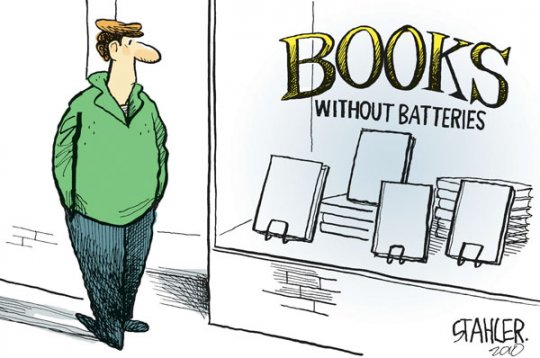 On the other hand, I have hundreds of books, and an electronic book would help reduce the numbers I have to deal with. Too, with an e-reader, you can literally carry an entire library onto a plane or across town. It’s like having a Bookmobile in your hand.
But what is the effect of e-readers on the availability of book stores? I would be lost without access to a good book seller who is local, knows what I want, and offers a stock of tomes that appeal to my sensibilities. Book shops are one of the great pleasures in my life. I remember spending youthful hours in the Sans Souci Bookstore in Lafayette, LA., a modest shop with books filling every space in abundance, something a small-town boy could barely imagine. Over the years I have spent countless hours browsing in book shops. I have gone out of my way to find book sellers in Paris, London, Munich, Rome, New York, Boston, San Francisco and God knows how many other locales. Each local shop offers a different stock in trade to please the palate of its local clientelle. What a pleasure to see the parcels of books ordered awaiting pickup, and to hear the familiarity between seller and reader inquiring about a title or just exchanging pleasantries.
Over the years the book-selling trade has been taken over increasingly by chains and e-tailers like Barnes & Noble, Amazon, Books-A-Million and (now almost extinct) Borders. They were preceded by the Walden Books and Brentano’s chains, who now are past. Chains are giant corporations that make deals with publishers to hype certain books, for which the chains make millions, pushing many deserving authors to the back shelves or out of the store entirely. Of course, any bookseller in a way dictates the readers’ choices by what is in stock, but the big chains go for the big bucks. Regional writers get lost in the shuffle. I wonder whether you would find Eudora Welty, Larry Brown, Ernest Hemingway or Will Faulkner on the bookshelves of the big chains today if those magnificent authors were unknown and just starting out.
Right here in Mississippi we have three phenomenal independent booksellers: Square Books in Oxford; Lemuria in Jackson; and Turnrow in Greenwood. These three stores are as good as any independent shops you will find anywhere. They offer books that the local owners know will interest their readers. Your book choices are not dictated out of corporate headquarters in a skyscraper in a big city up north. The shelves are not stocked by a corporate drone with eye fixed solely on the bottom line. The owners stock titles they know will enrich their patrons and the community as a whole. The local bookseller looks you in the eye and says, “Here is an author that will interest you” or “Have you read this?” They listen to what interests you and respond. The local readers and local sellers become an organic unit.
So that is my dilemma. I am not adverse to supplementing my love of books with an e-reader if … (1) it does not make books any less available … and … (2) it does not adversely impact the availability of independent booksellers.
In the midst of my dithering over this dilemma, I received the Square Books Dear Reader Newsletter that included the following:
KINDLE = Amazon only. ALL OTHER DEVICES = Square Books. Want Choice? Don’t get left to their devices. Google e-books are available at coompetitive prices from www.squarebooks.com and are compatible with any device (smartphones, laptops, tablets and e-reading devices including the Nook and the Sony Reader), except the Kindle. Those who surrender to Amazon’s monopoly reduce local economics, diminish their consumer power, and imperil freedom of choice!
Voila. An answer to my quandary. I can buy a Kindle and work against my interests, or I can acquire another e-reader that uses Google e-books and protect my interests.
I am not particularly fond of the idea of battery-powered books, but I recognize the advantages. I just might pick up one of those new-fangled gadgets after all, but there’s no way that it will take the place of my need for books without batteries.
WHEN IT COMES TIME TO BAIL OUT
July 28, 2011 § 5 Comments
Sometimes it happens that you find it necessary to withdraw from representing a client. Maybe an ethical dilemma has reared its head. Or perhaps you and your client have developed irreconcilable differences. Or it could be that your client has not met the terms of the employment contract as to cooperation or payment or in some other way.
Once you have entered an appearance in a case, you are in it until the court lets you out. You may not avoid responsibility simply by not participating further. So when the need arises, how can you make an effective exit?
Uniform Chancery Court Rule (UCCR) 1.08 provides: “When an attorney makes an appearance for any party in an action, the attorney will not be allowed to withdraw as counsel for the party except upon written motion and after reasonable notice to the client and opposing counsel.”
In other words, it’s not good enough to get an agreed order signed by counsel opposite and present it to the judge. Nor is it adequate to get your client to sign off on an order.
Here is what you have to do, step by step:
- File a motion to withdraw. Set out a general statement of your reason without compromising the interest of your client in the litigation.
- File the motion and send a copy of it with certificate of service to opposing counsel and the client.
- Notice the motion for hearing.
- If your client and opposing counsel will sign an agreed order allowing you to withdraw, present it to the court for entry.
- If either your client or opposing counsel, or both, object, hold a hearing and ask the court to rule on your motion.
Several caveats:
- If the case is set for trial, most chancellors will allow you to withdraw only in the most urgent and exigent circumstances.
- No chancellor will allow you to withdraw if to do so will seriously prejudice your client.
- You may not withdraw in any probate matter unless there is an attorney who will substitute for you. UCCR 6.01 requires that the fiduciary retain an attorney, unless the fiduciary is a licensed attorney.
- Be general in stating a reason. Okay: “The undersigned attorney and the plaintiff have differences of opinion about handling this case that can not be resolved.” Not okay: “My client has filed three bar complaints against me and has retained counsel to sue me for malpractice, and I have reason to believe he is concealing assets from the court.”
- Don’t include any language in your order that absolves you of any responsibility for anything you did in the case, or approves everything you did; that’s overreaching. You may state that you are relieved of all further responsibility from and after the date of the order allowing withdrawal.
- Many chancellors will not permit you to withdraw if the only basis is non-payment of fees. Their rationale is that you took on a professional duty to represent the client when you entered an appearance, and that duty is higher than your desire to be paid.
A MINI-GLOSSARY OF PROBATE TERMS
July 27, 2011 § Leave a comment
Administration. Supervision of an intestate estate under the auspices of a court exercising jurisdiction.
Administrator. (f: Administratrix) One appointed by the court to take responsibility for an administration. Also used with certain modifying terms to designate a person appointed to replace an executor named in a will.
Administrator with the Will Annexed. (Administrator cum testamento annexo, or CTA) When the will names no executor, or where the nominated executor is unable or unwilling to serve, the court will appoint an administrator CTA (literally with the will in hand) to do the job.
Administrator de Bonis Non. (Administrator DBN) The original term was “Administrator de bonis non administratis,” which literally means administrator of the goods not [already] administered. The administrator DBN is appointed to administer the effects of a decedent that were not administered or omitted in a previous administration.
Administrator DBN CTA. An administrator appointed to replace an executor who had died or must otherwise be replaced before completing administration of the estate.
Administrator de Son Tort. One who, without any authority in a will or court order, assumes to act as executor or administrator of an estate, disposing of its goods and meddling in its affairs. Literally “Administrator in his own wrong.”
Beneficiary. One named in a will to receive a bequest, legacy or devise, or in a trust to receive the trust proceeds. Note that not all heirs are beneficiaries.
Bequest. Disposition of personal property by will.
Codicil. Written supplement to or addition to a will.
Decedent. The person whose death has occasioned the opening of an estate.
Devastavit. Literally “he or she has wasted.” An action against an executor or administrator charging him or her with mismanagement or neglect of duty that has caused loss and which obligates the fiduciary to the heirs, creditors or beneficiaries.
Devisavit vel non. The ancient name given to a proceeding in chancery court to determine whether or not the testator did devise, and whether the document presented was his will. Literally “Did he devise or not?”
Devise. Disposition of real property by will.
Devisee. Person to whom property is devised.
Executor. (f: Executrix) One appointed by the court to take responsibility for probate of a testate estate.
Fiduciary. Term embracing administrators, conservators, executors, guardians, trustees and others who have a special duty of good faith and responsibility to the court and interested parties in relation to the matters entrusted to him or her.
Heir. One who is designated under the laws of descent and distribution to receive the estate of a decedent not disposed of in a will. Although an heir may be a beneficiary, all beneficiaries are not necessarily heirs.
Holographic will. A will written entirely in the handwriting of the decedent.
Intestate. The state of not having written a will; also refers to the individual himself or herself.
Legacy. Same as bequest.
Legatee. One to whom a legacy or bequest is made.
Nuncupative will. An oral will knowingly made in extremis before the required number of witnesses.
Probate. The procedure to prove a will. Also, the collective term used for estates, administrations, guardianships, conservatorships and judicially-administered trusts, the common characteristic of which is appointment of a fiduciary to be responsible to the court and interested parties.
Probate in Common Form. Admission of a will to probate ex parte, without formalities.
Probate in Solemn Form. Admission of a will to probate after notice to all interested parties and a court hearing.
Residuary Estate. All that remains of an estate after the expenses of administration, debts, legacies and devises have been satisfied.
Settlor. One who creates a trust.
Testate. The state of having written a will; also refers to the individual himself or herself.
Testator. (f: Testatrix) The maker of a will, and one who dies leaving a will.
Trustor. Same as settlor.
Wrongful Death Beneficiaries. Statutory designation of persons who are entitled to a distribution of damages for another’s injury and death. Heirs and wrongful death beneficiaries are not necessarily the same persons. See MCA § 11-7-13.
PLEADING THAT WHICH MUST BE PLED
July 26, 2011 § 2 Comments
If you will read the statutes that apply in your case, you will find exactly the language you need to plead a proper claim and lay out jurisdiction and venue. It’s right there in the code. The closer you adhere to the statutory language, the more likely it is that your complaint will withstand an MRCP 12(b)(6) motion.
For example, in a divorce case, you must plead all of the following: either one or more grounds set out in MCA §93-5-1, and/or irreconcilable differences as in MCA § 93-5-2; and proper venue as in MCA § 93-5-11; and that one of the parties meets the residence requirement of MCA § 93-5-5. All of the language you need to do that is right there in the statutes for your penalty-free plagiarization.
As a side note, many older chancellors through the years required the complaint to quote the language of the residency statute for divorce that, ” … [plaintiff] has been an actual bona fide resident within this state for six (6) months next preceding the commencement of this suit.” If you varied by a single word, you had pled yourself out of court. There may still be chancellors adhering to that practice. Whether your chancellor does or not, you can’t go wrong tracking the language of the statute.
Some lawyers copy other lawyers’ pleadings. That’s fine as long as the copied pleadings are adequate. Several years ago a few new lawyers used pleadings filed by a weathered, older lawyer as their template. You could tell because they slavishly replicated the older lawyer’s misstatement that “Plaintiff is entitled to a divorce from the defendant on the ground of habitual cruel and inhuman treatment as codiciled in Section 93-5-1, MCA.” If you’re going to copy, at least put some thought into what you’re doing.
The MRCP offer another source of pleading material. For instance, if you will read Rule 57, you will find every word you need to plead to obtain a declaratory judgment. Same with Rule 56 summary judgment. Same with Rule 65 for temporary restraining orders, temporary injunctions, and preliminary and permanent injunctions.
In modification of custody cases, you will be out of court on your ear unless you plead specifically in your petition that (1) there has been a material change in circumstances that (2) is having or has had an adverse effect on the minor child(ren), and (3) that it is in the best interest of the child(ren) to change custody to your client. McMurry v. Sadler, 846 So.2d 240, 243-4 (Miss. App. 2002). Note that in McMurry, the petitioner had pled only a material change justifying modification. The respondent moved to dismiss for failure to state a claim at the outset of trial, and the judge even prompted counsel that the word “adverse” was absent. The judge dismissed the pleading with leave to amend, and counsel for petitioner moved ore tenus to amend to add the language that an adverse effect would occur if modification were not granted. At that point, the chancellor found the pleadings insufficient as a matter of law and dismissed with prejudice. The COA affirmed.
As McMurry illustrates, faulty pleading will cause nothing but trouble. And it can be fatal. Look what happened there: the judge granted leave to amend as is prescribed in MRCP 12(b), but when counsel failed to fix the problem by amendment, the judge took the case off of the respirator and it died.
What if counsel for the respondent had said nothing about the adequacy of the pleadings before trial, but then had objected to every question about any adverse effect on the basis that it had not been pled? I saw that on more than one occasion when I was in practice, and the judge always sustained the objections, effectively gutting the petitioner’s case, or, more accurately, letting it gut itself. If you’re in that situation and you’re not too discombulated to think clearly, you might try making a Rule 15 motion for leave to amend. Maybe the judge will let you off the hook. At least you will have it in the record.
THE AFFIDAVIT OF “REASONABLY DILIGENT INQUIRY” FOR CLAIMS AGAINST THE ESTATE
July 25, 2011 § 11 Comments
MCA § 91-7-145(1) requires the estate fiduciary to make “reasonably diligent inquiry” to identify persons who have claims against the estate, and to notify them by mail at their last known address that failure to probate a claim within the statutorily-prescribed time will bar their claims.
MCA § 91-7-145(2) provides that:
“The executor or administrator shall file with the clerk of the court an affidavit stating that such executor or administrator has made reasonably diligent efforts to identify persons having claims against the estate and has given notice by mail … to all persons so identified. Upon filing such affidavit, it shall be the duty of the executor or administrator to publish in some newspaper in the county a notice requiring all persons having claims against the estate to have same probated and registered by the cleerk of the court granting the letters, which notice shall state the time when the letters were granted and that a failure to probate and register within ninety (90) days after the first publication of such notice will bar the claim … ” [Emphasis added]
Most lawyers refer to this as the “Affidavit of Creditors.”
Clearly, then, the statute requires these measures, in this order:
- First, identify those having a claim against the estate;
- Send them notice conforming to the statute;
- File an affidavit with the clerk stating compliance with the statute;
- Publish notice to creditors.
Skip a step and you will have to start over. Go out of order and you will have to start over. Notice the language of the statute: it says that publication is undertaken “[u]pon filing such affidavit …” That clearly requires that you may not publish until after the affidavit has been filed. And, of course, the affidavit can not be filed until after you have made diligent inquiry and mailed your notices, if any.
In the case of In re Estate of Petrick, 635 So.2d 1389 (Miss. 1994), the untimely claim of a creditor was allowed because the administratrix published without notifying a creditor whom the court found was “reasonably ascertainable.” The court added that notice may be published only after the affidavit has been filed (at 1394).
In Houston v. Ladner, 911 So.2d 673 (Miss. App. 2005), the COA found the chancellor in error for finding a probated claim time-barred without first finding that the creditor was a reasonably ascertainable creditor. The creditor had not been sent notice by mail, and the COA pointed out that publication notice was not a substitute for mail notice; it was required in addition to mail notice.
Here are a couple of practice tips to help you comply with the statute:
- Always question your fiduciary about bills of the decedent. It will be hard to argue that BOA Visa was not a “reasonably ascertainable” creditor when your fiduciary had been paying the bill herself for three months after the decedent died and before the estate was opened. It will be harder still to argue that the attending physician at the time of death was not “reasonably ascertainable.”
- Why not include the required affidavit in your petition to open the estate, or in the fiduciary’s oath, whichever is the appropriate point for you? Maybe by eliminating one extra piece of paper you will be more likely to do it right.
Reminder: MCA § 93-13-38 makes the foregoing provisions applicable to guardianships and conservatorships, as well as estates.
The statutory requirements are technical and mandatory. Read the code and do what it says. Doing so can save you considerable grief down the road.
“QUOTE UNQUOTE”
July 22, 2011 § Leave a comment
 “By means of all created things, without exception, the divine assails us, penetrates us, and molds us. We imagined it as distant and inaccessible, whereas in fact we live steeped in its burning layers.” — Pierre Teilhard de Chardin
“Sometimes I think that just not thinking of oneself is a form of prayer.” — Barbara Grizutti Harrison
“God answers all our prayers. Sometimes the answer is yes. Sometimes the answer is no. Sometimes the answer is “You’ve got to be kidding.” — Jimmy Carter
 The Better Chancery Practice Blog