MORE HISTORY OF THE LAUDERDALE COUNTY COURT HOUSE
October 21, 2011 § Leave a comment
I posted here about the evolution of the Lauderdale County Court House, which included various historical photos of the building.
Below is a photo of Meridian looking east-southeast, obviously from a vantage point in the Threefoot Building, Meridian’s 16-story Art Deco icon, which had been built in 1929. The Lauderdale County Court House is the domed, Beaux-Arts-style building in the right center. The photo had to have been taken before 1939, because that is the year when the WPA work removed the dome, replaced it with a squarish jail, and transformed the façade from Beaux Arts to Art Deco. The photo, then, had to have been taken between 1929 and 1939.
If you compare this photo to some in the prior post, you will notice that the statues that originally adorned the court house roof above the west-facing columned entrance are removed. The Confederate memorial has been installed on the northwest corner of the lawn.
In other details of the photo, look to the right of the court house, east of and about a block from the Lamar Hotel building, and you will see the old jail that predated the one installed atop the court house during the WPA renovation.
You will also notice the residential neighborhoods to the east that extend in this photo within a block of the court building. I imagine some of the more everyday lawyers strolled to work from home in those neighborhoods back when this photo was taken. The more prosperous barristers lived in the mansions along Eighth Street, or around Highland Park, or in the ample residences on Twenth-Third and Twenty-Fourth Avenues.

Here is a post-card photo of the jail building. Notice the Soulé foundry building to the left (east) of the jail. Its location will give you a clue as to the site of the old jail.

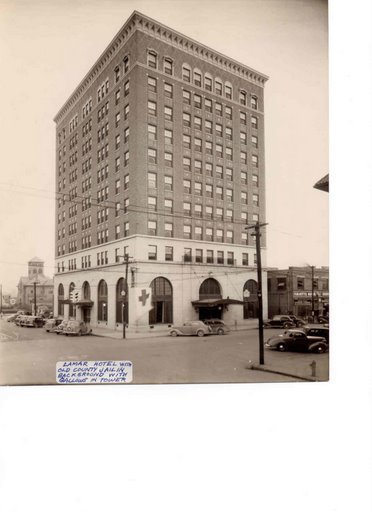
And below is a photo of the Lamar Hotel looking southeast, with the jail to the left, or east. Notice the caption, “Lamar Hotel with old County Jail in background with gallows in tower.” Before the state employed a travelling electric chair, executions for capital offenses were carried out in the various counties by hanging. Meridian, in forward-looking fashion, had a permanent gallows for the purpose, rather than having to go to the expense of constructing an ad-hoc apparatus as the need arose. Even back in those days, Lauderdale County had innovative leadership.
Q & A WITH JUDGE GRANT
October 20, 2011 § 1 Comment
Chancellor John Grant is one of two chancery judges serving in the Twentieth District (Rankin County). Here is a Q & A he provided for 12 CCDM:
Q: Tell us some of your personal preferences that lawyers from outside your district need to know before they come before you.
A: Lawyers should be properly attired, punctual and bring with them a working knowledge of the law and procedure with regard to the issue before the court.
Q: What are the three attributes that you would consider to set the good lawyers apart from the bad ones?
A: Good lawyers are always well organized and prepared.
Good lawyers are dignified and extend civility to fellow members of the bar and to the court.
Good lawyers are expedient in their presentations. (They don’t have to ask the same question three times. They make their point and move on.)
Q: What is the main thing lawyers should know to avoid doing in your court room during a trial?
A: They should avoid being disruptive or discourteous, whether it be in the questioning of a witness or in making argument before the court.
Q: What part of your job do you enjoy the most?
A: I probably most enjoy being able to participate in the adoption of a child by worthy parents. At other times, it is knowing that an important and difficult decision that I had to make was the right one.
Q: What part of your job do you enjoy the least?
A: Having to remove children from a parent who that child loves first comes to mind. Having to sanction a member of the bar for misbehavior is another in the “least” category.
Q: What is your pet peeve as a judge?
A: A lawyer will act with restraint and will not be allowed to transition a court case into a dramatic performance for the benefit of onlookers or client.
Q: Tell us a funny story about something that happened in your court room.
A: We had a very contentious domestic case one day involving a female pro se litigant and her ex-husband. Prior to the beginning of trial she could only write down her request for a continuance because she could not speak due to some type of throat condition. She professed an inability to properly present her case due to this malady. Her request was denied.
Within 5 minutes of beginning trial the lady’s voice mysteriously returned.
Epilogue: She lost the case.
Q: Cell phone ringing during a trial: death penalty, stern look, dismay, or no reaction?
A: Stern look only. (After all it has happened to me – accidentally, of course!)
Q: Lawyer tells you, “That’s not how we do it back in ________ County.” Discuss.
A: This comes up from time to time and I usually respond using the great Judge Cortwright’s classic line, “Mr. Jones, are you in Hinds County?”
Q: Who do you model yourself after as a judge?
A: I hope I have some of the qualities of three of my favorite mentors: Ed Cortwright, Sebe Dale and Mike Carr.
Q: Who do you consider to be the best chancellor you ever appeared before, and what set that chancellor apart?
A: Probably Judge Ed Cortwright. He possesses great character and integrity, much like other fine judges I have known. What set him apart, however, was his brilliant legal mind.
Q: Share your innermost thoughts and feelings about MRCP 81.
A: Many have expressed hate for this rule. However, once one is around it constantly for an extended period of time and gets to really understand its application, it reveals itself as probably one of the best protectors of due process for litigants. After all, what’s not to like about a type of process that informs a litigant of when and where to appear for trial?
Q: What do you do to try and get control of your probate docket?
A: We require annual accountings, the timeliness of which are monitored by computer program. We also have certain days allocated during the year to deal with delinquent accountings and other fiduciary related matters.
Q: Should chancery and circuit court systems be merged?
A: No.
Q: There are 19 appellate judges. What would be the ideal number of former chancellors serving on the two appellate courts?
A: About 19.
Q: Tell us your favorite quote.
A: ”When I was 14, my old man was so stupid I could hardly stand to have him around the house. However, when I became 21, I was astonished at what my father had learned in 7 short years.” (sic) Abraham Lincoln
Q: Tell us your favorite court room movie.
A: My Cousin Vinnie (“Mr. Gambini, are you on drugs?”)
SCRUGGS-PETERS-DELAUGHTER CONNECT-THE-DOTS GAME
October 19, 2011 § 2 Comments
Of all the sad aspects of the Scruggs saga, the one that most troubles me is the chain of events that led to the downfall of Circuit Judge Bobby DeLaughter. Up to now, what we have known of his culpability could be gleaned from his own guilty plea and from reading between the lines of other disclosures. Ed Peters’ involvement, and how he interacted with DeLaughter, has been left mostly to conjecture and street gossip.
Thanks to motions filed by Scruggs in federal court, however, Peters’ grand jury testimony, or a portion of it, has been unsealed, and you can read for yourself the sordid details. Tom Freeland has summarized it, and has another post about it. You can read Peters’ testimony for yourself here and here. Freeland followed up with another couple of posts that you can find on his blog.
Philip Thomas has a post questioning why Peters has never been prosecuted in state court.
Some had considered DeLaughter a sort of wunderkind of the bench. They expected special things of him after he stepped out of the role as prosecutor of Byron De la Beckwith into a circuit judgeship. But he was a long-time associate of Ed Peters, the Hinds County DA, and he allowed himself to be in a position to be influenced by Peters. Peters took advantage of the cozy relationship to demand hefty fees from clients who expected him to influence the circuit judge. Peters’ testimony reveals how they did it.
It still turns my stomach to read this stuff, but it’s important for us to know and understand how this unfolded so that we can take measures to ensure that it will never happen again.
WHAT IS THE EXTENT OF THE DISABILITIES OF MINORITY?
October 17, 2011 § 3 Comments
Minors can not act for themselves. We call this the “disability of minority,” and the chancery court is charged with protecting their rights. Alack vs. Phelps, 230 So. 2d 789, 793 (Miss. 1970).
The principle of minority disability is in keeping with the ancient maxim of equity that “When parties are disabled equity will act for them.” Griffith, Mississippi Chancery Practice, Section 34, page 37 (1950 ed.). More than 130 years ago, in the case of Price vs. Crone, 1871 WL 8417, at 3 (1870), the Mississippi Supreme Court stated:
“Nothing is taken as confessed or waived by the minor or her guardian. The court must look to the record and all its parts, to see that a case is made which will warrant a decree to bind and conclude [the minor’s] interest, and of its own motion, give the minor the benefit of all objections and exceptions, as fully as if specially made in pleading … There being no power in the infant to waive anything, a valid decree could not be made against her, unless there has been substantial compliance with the requirements of the law, in the essential matters.” [Emphasis added]
Thus, the chancery court can and should act on its own initiative to protect and defend the minor’s interest.
In the case of Khoury vs. Saik, 203 Miss. 155, 33 So.2d 616, 618 (Miss. 1948), the supreme court held that, “Minors can waive nothing. In the law they are helpless, so much so that their representatives can waive nothing for them …” This is so even where the minor has pled, appeared in court, and even testified.” Parker vs. Smith, et al., 150 Miss. 849, 117 So. 249, 250 (Miss. 1928).
Our modern MRCP 4(e) embodies these concepts wherein it specifically states that, “Any party … who is not an unmarried minor … may … waive service of process or enter his or her appearance … in any action, with the same effect as if he or she had been duly served with process, in the manner required by law on the day of the ate thereof.” There is no provision in MRCP 4 that permits a minor to join in an action on his or her own initiative, or to waive process; in fact, the express language of Rule 4 makes it clear that such is not permitted.
It is a long-held fundamental of Mississippi law that process must be had on infants in the form and manner require by law, and a decree rendered against minors without service in the form and manner required by law is void as to them, as they can not waive process. Carter vs. Graves, 230 Miss. 463, 470, 93 So.2d 177, 180 (Miss. 1957).
The purpose of the protective posture of the law is clear: “Minors are considered incapable of making such decisions because of their lack of emotional and intellectual maturity.” Dissent of Presiding Justice McRae in J.M.M. vs. New Beginnings of Tupelo, 796 So.2d 975, 984 (Miss. 2001). During the formative adolescent years, minors often lack the experience, perspective and judgment required to recognize and avoid choices that are not in their best interest. Belotti vs. Baird, 443 U.S. 622, 634, 99 S.Ct. 3035, 3043 (1979).
In the case of In the Matter of R.B., a Minor, by and through Her Next Friend, V.D. vs. State of Mississippi, 790 So.2d 830 (Miss. 2001), R.B., an unmarried, seventeen-year-old minor, became pregnant and sought chancery court approval of an abortion, pursuant to MCA § 41-41-55(4). The decision described her as, ” … of limited education, having attended school through the eighth grade,” and largely ignorant of the medical and legal implications of her request. Id., at 831. The decision reveals that the chancellor went to great pains to develop the record that the young girl had not been informed of the possible complications of the surgical procedure, that she was emotionally fragile and susceptible to mental harm, that there were services available to the youngster of which she was unaware, and other pertinent factors. Id., at 834. The supreme court upheld the decision of the chancellor, saying,
“R.B. has failed to persuade us that she is mature enough to handle the decision (for an abortion) on her own. The record does not indicate that the minor is capable of reasoned decision-making and that she has considered her various options. Rather the decision shows that R.B.’s decision is the product of impulse.” Id., at 834.
It has long been the law in Mississippi that all who deal with minors deal with them at their peril, since the law will take extraordinary measures to guard them against their own incapacity.
The principle of minority disability is ingrained in many facets of Mississippi law:
- Minors may not vote. Article 12, Section 241, Mississippi Constitution.
- Minors may not waive process. MRCP 4(e).
- Minors may not select their own domicile, but must have that of the parents. Boyle vs. Griffin, , 84 Miss.41, 36 So. 141, 142 (Miss. 1904); In re Guardianship of Watson, , 317 So.2d 30, 32 (Miss. 1975); MississippiBand of Choctaw Indians vs. Holyfield, 490 U.S. 30, 40; 109 S.Ct. 1597, 1603 (1989).
- Minors may not enter into binding contracts regarding personal property or sue or be sued in their own right in regard to contracts into which they have entered. MCA § 93-19-13.
- Minors may not have an interest in an estate without having a guardian appointed for them. MCA § 93-13-13.
- Minors may not purchase or sell real property, or mortgage it, or lease it, or make deeds of trust or contracts with respect to it, or make promissory notes with respect to interests in real property without first having his or her disabilities of minority removed. MCA § 93-19-1.
- Minors may not be bound by contracts for the sale of land, and may void them at their option.Edmunds vs. Mister, 58 Miss. 765 (1881).
- Minors may not choose the parent with whom they shall live in a divorce or modification; although they may state a preference, their choice is not binding on the chancellor. MCA § 93-11-65; Westbrook vs Oglesbee,606 So.2d 1142, 1146 (Miss. 1992); Bell vs. Bell, 572 So.2d 841, 846 (Miss. 1990). Minors may not after emancipation be bound by or enforce contracts entered into during minority except by following certain statutory procedures. MCA § 15-3-11.
- Minors may not legally consent to have sexual intercourse. MCA § 97-3-65(b).
- Minors may not legally consent to be fondled. MCA § 97-5-23(1).
- Minors are protected by an extended statute of limitations. MCA § 15-1-59.
It’s important to be aware of the legal status of the persons with whom you are dealing in land transactions, estates, contracts, and many other legal matters. In Mississippi, minors have many legal protections and disabilities that the courts will zealously guard.
“QUOTE UNQUOTE”
October 14, 2011 § 1 Comment
Lawyer and Chancellor Sir Thomas More
“About half the practice of a decent lawyer consists of telling would-be clients that they are damned fools and should stop.” — Elihu Root
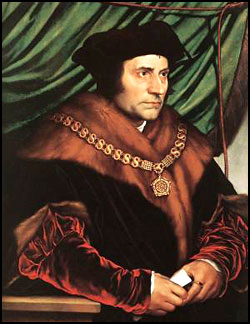
“They have no lawyers among them, for they consider them as a sort of people whose profession it is to disguise matters.” — Sir Thomas More, in Utopia
“An incompetent attorney can delay a trial for years or months. A competent attorney can delay one even longer.” — Evelle J. Younger
Q & A WITH JUDGE CLARK
October 13, 2011 § Leave a comment
Chancellor H. David Clark, II, sole chancery judge of the Second Chancery District (Jasper, Newton and Scott) shared some of his thoughts on chancery court practice with 12 CCDM.
Q: Tell us some of your personal preferences that lawyers from outside your district need to know before they come before you.
A: Based on my observations both as an attorney and as a Chancellor, litigation, especially divorce, custody and child support, is not only expensive and time consuming, it is extremely stressful on the parties as well as their children. The sooner the litigation is completed the sooner the litigants, and the children can put the matter behind them and move forward with their lives. I use our computer program [Court Clerk] to monitor cases and move them along toward completion in a reasonable manner and within a reasonable time. Thus, attorneys should be prepared to present and conclude matters within the suggested time standards contained in Administrative Order 2001-00001 entered by the Supreme Court on November 15, 2001.
All cases that are set for trial in the Second Chancery Court District are also set for Settlement Conference prior to the trial date. As the name suggest, the purpose of these conferences is to attempt to resolve the issues between the parties [i.e.: settle the case]. If the matter cannot be fully resolved, these conferences are used to dispose of any outstanding motions or issues and to narrow the issues so that there will be no impediment to completion of the matter on the date it is set for trial. Thus, it is vitally important that all parties and their counsels appear at these Settlement Conferences.
Some trials cannot be complete in one day. In that event, be prepared to return and complete the matter the next day. Personally, I do not like to try cases piecemeal over 3, 4 or 6 months. Let the Judge know how long you anticipate the matter will take to complete, and be prepared to try the case to completion.
Q: What are the three attributes that you would consider to set the good lawyers apart from the bad ones?
A: A “good” lawyer:
✓ Is always prepared and knowledgeable of the issues, the facts and the law and can support her/his positions with applicable legal authority;
✓ Takes care of her/his client’s business [“TCB”] in a timely manner and at a reasonable cost;
✓ Communicates regularly with her/his client to keep them apprised of the status of the case and with counsel opposite regarding scheduling and resolution of issues.
A “bad” lawyer:
✓ Is seldom prepared to discuss the issues, facts or the law. They are more prone to just “Shoot from the hip.” Research is what they do when they have lost their car keys;
✓ Accept employment in more cases than she/he is able and/or willing to work on and complete. “Bad” lawyers delay litigation in an effort to “milk” every case for all they can get and are never interested in streamlining procedures, narrowing issues or resolving matters.
✓ Can never be found by his/her client, by counsel opposite or by the Court. A “bad” lawyer seldom returns telephone calls, emails or letters. A “bad” lawyer is “AWOL” most of the time.
Q: What is the main thing lawyers should know to avoid doing in your court room during a trial?
✓ Don’t begin a trial unless you are ready. Always be prepared!
✓ Never walk in to a courtroom with only one copy of documents or exhibits. You should have sufficient copies of every document for all counsels and for the Court. It does no good to hand the witness a document and begin questioning the witness regarding the contents of that document if the Chancellor, the trier-of-fact, does not have a copy to view and understand.
✓ Never submit to the Court an 8.05 you are not throughly familiar with. If you have not reviewed it and do not understand it, the Court will not understand it either, and you will be dealing with one frustrated Judge.
✓ Oh, and while we are talking about things not to do, never ask a Chancery Court to approve a wrongful death claim for adult heirs-at law. The Court’s only concern is with estates and minors. We have no control over how adults settle their claims.
Q: There are 19 appellate judges. What would be the ideal number of former chancellors serving on the two appellate courts?
A: 19!
Seriously, if you have a Chancery Court background, and if you regularly read cases rendered by the Supreme Court and the Court of Appeals, you know that there exist a serious dearth of Chancery perspective on both courts. I won’t go into that here, but would strongly encourage a change in the present demographics. [Circuit vs Chancery vs academic vs practitioner vs other] Think about it.
YET MORE ON POST-TRIAL MOTIONS AND APPEALS
October 12, 2011 § 3 Comments
I posted here, here and here about the COA and post-trial motions.
On October 11, 2011, the COA in Aspired Custom Homes, LLC v. Todd and Tina Melton, there is this language by Judge Carlton, at ¶ 11:
While Aspired appeals the judgment of the chancery court questioning the judgment’s substance, we acknowledge the record reflects the chancellor denied a timely filed post-trial motion brought by Aspired pursuant to Rule 59(e) — a motion to alter or amend judgment. See M.R.C.P. 59. Aspired filed a motion pursuant to Rule 59(e) and raised four issues before the chancellor. However, a party is not required to file a post-trial motion in chancery court in order to appeal the chancery court’s judgment. We therefore address the merits of the appeal before us, questioning the substance of the chancellor’s judgment. [Emphasis added]
In a footnote to that paragraph, the opinion stated:
If a party’s motion for reconsideration is served within ten days of the rendition of judgment, the motion falls under Rule 59(e) of the Mississippi Rules of Civil Procedure. Carlisle v. Allen, 40 So. 3d 1252, 1260 (¶33) (Miss. 2010) (citing Cannon v. Cannon, 571 So. 2d 976, 978 (Miss. 1990)). The Mississippi Supreme Court has established that to succeed on a Rule 59(e) motion, “the movant must show: (i) an intervening change in controlling law, (ii) availability of new evidence not previously available, or (iii) need to correct a clear error of law or to prevent manifest injustice.” Brooks v. Roberts, 882 So. 2d 229, 233 (¶15) (Miss. 2004). Case law has also provided that “[a]n appeal from a denial of a Rule 59 motion may address the merits of the entire underlying proceeding, and review of a trial judge’s denial of a Rule 59 motion is limited to abuse of discretion.” Perkins v. Perkins, 787 So. 2d 1256, 1261 (¶9) (Miss. 2001). In this case, the notice of appeal reflects only an appeal by Aspired from the judgment of the chancellor, with no reference to the unsuccessful post-trial motion.
That, in my opinion, is an accurate statement of what Mississippi law has been in chancery bench trials, and I’m glad to see it clearly stated.
So, based on the language above, a post-trial motion is not a prerequisite to an appeal from a chancery bench trial. But the question remains whether a post-trial motion is necessary to preserve particular issues for appeal, as the COA case cited in the prior post would indicate. Here’s some language that may remove all doubt:
“It is clearly the better practice to include all potential assignments of error in a motion for new trial. However, this approach is not always practical. Because a trial transcript is rarely available within the time frame for filing post-trial motions, the most prudent attorney cannot be expected to pinpoint every objection raised and ruling made during the course of the trial. Thus, when the assignment of error is based on an issue which has been decided by the trial court and duly recorded in the court reporter’s transcript, such as the admission or omission of evidence, we may consider it regardless of whether it was raised in the motion for new trial. [Emphasis added] Kiddy v. Lipscomb, 628 So. 2d 1355, 1359 (Miss. 1993).
_____________________
Thanks to Thus Blogged Anderson for the Kiddy v. Lipscomb cite .
ADOPTION DECREE DO’S AND DON’TS
October 11, 2011 § 1 Comment
Before you draft your adoption final decree, be sure to read MCA §§ 93-17-13 and 29. There are some critical provisions in those statutes that you need to address.
Here are the highlights of 93-17-13:
- DO include in your judgment a six-month interlocutory period unless the child to be adopted is the stepchild of a petitioner or is related to a petitioner by blood within the third degree, unless the chancellor has determined that the interlocutory period is not necessary for the benefit of the court; if the judge does waive the interlocutory period, DO include language in your final judgment that the interlocutory period is waived and the reason why.
- If the chancellor shortens the interlocutory period by the length of time that the child has lived with the adoptive parent in their residence, DO include that explanation in your judgment.
- DO include in your judgment that that the child shall (a) inherit from and through the adoptive parents and siblings as would a child of the full blood. The language of the statute is explicit, and you should track it verbatim.
- DO specify in your judgment that the child, adoptive parent(s) and kin are all vested with all of the rights and responsibilities as if the child had been born to the adoptive parents as their natural child. Again, the language of the statute is explicit, and you would do well to copy it verbatim into your judgment.
- DO adjudicate in the body of the decree that the name of the child is changed, if desired.
And here are the highlights of 93-17-29:
- DON’T state the name of the natural parent or parents in the style of the case or where they can be spread on the minutes of the court.
- DON’T state the name of the natural parent or parents in your final decree.
- DON’T state the original name of the child or children in the style of the case. Use “the child named herein,” or “a minor child,” or words to that effect.
- DON’T state the original name of the child or children in the decree unless the name of the child will be unchanged.
Section 29 addresses confidentiality issues. Use your common sense. Any confidential information that you add to the style of your case will find its way into the docket entry and even into a publication notice. “Confidential information” in the sense of adoption embraces any information that will identify the child by original name, or that identifies either or both of the natural parents. I have seen publication notices that are blatant violations of this code section. Once that kind of improper publication is made, confidentiality for all intents and purposes is eliminated. If you have any doubts about how to style your case to avoid these problems, sit down with your chancellor and hash it out before you file your pleadings.
Some lawyers ask how to accomplish an adjudication of termination of parental rights without naming the terminated parent(s) in the final decree. Two methods come to mind: (1) enter a separate judgment specifically terminating the parental rights and reference that judgment in your final decree with language like “The parental rights of the natural parents were terminated by separate judgment in this action rendered March 16, 2011, which is incorporated herein by reference for all purposes;” or (2) in the final decree, simply state that the rights of the natural parents identified in the Complaint for Adoption are hereby terminated, etc.
I heard a report from another district that the State Board of Health is requiring that the name of the parent or parents whose rights are terminated must be included in the decree. If so, that agency is requiring by its directives a violation of the statute. Based on my training, background and experience, I take the position that the statutory law of Mississippi trumps agency directives every time.
THE YOKE OF PROBATE
October 10, 2011 § 1 Comment
It looks like easy money. Grandma is sitting in your office with a fistful of greenbacks, asking you to open a guardianship so that she can get grandson into the county school. Momma is agreeable, daddy is in prison and will sign whatever you send him, and the child needs to get into school.
Before you file those papers and track down your chancellor, consider:
- When you enter your appearance, you are responsible as attorney for the guardianship forever, or until the judge lets you out, or until the guardianship is closed, whichever occurs first.
- There will be an accounting, or at least a reporting, requirement, for which you as counsel will be held responsible.
- Your compensation will be fixed by the chancellor, and it may not be as much as you would like to charge.
- You will be responsible to report to the court any misfeasance, malfeasance or neglect of duty by the fiduciary.
I encourage you to read UCCR 6.01 and 6.02 before you file that petition to open the guardianship. Your duty and liability as an attorney in a simple guardianship of the person is every bit as great as it is in a guardianship where the ward has thousands of dollars in the bank.
We regularly send out orders for lawyers to bring their accounts current in all probate matters, including guardianships of the person only. In guardianships of the person, we require a report at least every other year that (a) the guardianship continues to be necessary due to the age or circumstance of the ward, and (b) that no assets have come to the ward since the last report. It is not uncommon for lawyers to call and have some problem with that requirement. Some customary complaints:
- “I wasn’t paid enough to continue to do work in this case.” UCCR 6.01 expressly states that “When an attorney has once appeared for a fiduciary, in any respect, he may withdraw only with the consent of the Chancellor, after notice to the Chancellor, after notice to the client.” That rule also requires the fiduciary to be represented by a lawyer at all times. This means that once you appear, you are in it until someone takes your place or the matter is finally closed.
- “I can’t find my fiduciary.” You are responsible to keep up with the guardian and his or her activities so as to advise the court as required by UCCR 6.02. You have some liability to the ward if the fiduciary receives assets of the ward and squanders them.
- “This was only a guardianship for school purposes; why do we have to jump through all these hoops?” Because the law does not lower the protective bar for benefit of a ward “merely” because this is a guardianship of the person, and you, as attorney for the fiduciary, have a professional, legal, ethical and equitable duty to the ficuciary, the court and the ward.
I am not suggesting that you not file that guardianship action. I am suggesting that you read the rules and understand exactly what you and your client are taking on when you shoulder the yoke of probate.

