THE GREAT RESERVOIR OF EQUITABLE POWER
January 24, 2013 § Leave a comment
We talked here about the COA decision in Brown v. Weatherspoon, handed down November 6, 2012. That earlier post dealt with attorney’s fees.
There is another aspect of the case that warrants your attention. It has to do with MRCP 60(b)(6).
In the case at the trial level, Kenyader Weatherspoon had agreed to a court order, entered in 2002, adjudicating him to be the father of a child born to Serhonda Brown. In 2008, the opinion tells us, Weatherspoon agreed to DNA testing to determine parentage (the opinion is silent as to who prompted the testing, and why he agreed to it). The test results came in showing zero probability that he was the father, and five months later he filed a pleading seeking to set aside the prior judgment under MRCP 60(b)(6), which allows a court to relieve a party from a judgment for “any other reason justifying relief from judgment.” The chancellor set aside the judgment, and Brown appealed.
Judge Roberts’ opinion succinctly states the law that applies in this instance:
¶12. The chancellor granted Weatherspoon’s motion under Rule 60(b)(6). “Relief under Rule 60(b)(6) is reserved for extraordinary and compelling circumstances.” [MAS v. Miss. DHS, 842 So.2d 527.] at 530 (¶12). Rule 60(b)(6) has also been described as “grand reservoir of equitable power to do justice in a particular case.” Id. But it “is not an escape hatch for litigants who had procedural opportunities afforded under other rules and who without cause failed to pursue those procedural remedies.” Id.
¶13. In M.A.S., a man had consented to paternity of a child, but through DNA testing he later learned that he was not the child’s biological father. M.A.S., 842 So. 2d at 528 (¶1). M.A.S. successfully moved to set aside the prior order of filiation. Id. at 529 (¶5). The Mississippi Supreme Court affirmed the decision to set aside an order of filiation and stated that M.A.S. was “the archetype for the application of Rule 60(b)(6).” Id. at (¶18). Despite the fact that the movant in M.A.S. had paid child support for ten years, the supreme court held that he had filed his Rule 60(b) motion within a reasonable time after he learned that he was not the child’s father. Id. at 530 (¶15). Brown notes that the movant in M.A.S. was seventeen years old when he signed a stipulated paternity agreement. Id. at 528 (¶3). Brown argues that this case is distinguished from M.A.S. because Weatherspoon was twenty-four when he signed the stipulated paternity agreement. But the M.A.S. court did not base any part of its rationale on the movant’s age.
¶14. Brown also claims Weatherspoon’s motion was untimely. A Rule 60(b)(6) motion is timely if it is filed “within a reasonable time.” M.R.C.P. 60(b)(6). “What constitutes reasonable time must of necessity depend upon the facts in each individual case.” M.A.S., 842 So. 2d at 530 (¶14) (citation omitted). Relevant factors include whether the movant’s delay prejudiced the nonmoving party and whether there is a good reason for the movant’s delay. Id. According to Brown, Weatherspoon’s Rule 60(b)(6) motion was untimely because he filed it more than six years after he signed the stipulated paternity order. But the supreme court has held that the movant in M.A.S. timely filed his Rule 60(b)(6) motion even though he did so approximately nine years after he signed a stipulated paternity order. Id. at (¶13).
¶15. Weatherspoon did not definitively learn that M.B. was not his child until shortly after DNA testing was completed on March 19, 2008. The record does not indicate that Weatherspoon had earlier opportunities to seek DNA testing. He filed his Rule 60(b)(6) motion approximately five months later. Under the circumstances, the chancellor did not abuse her discretion when she implicitly found good cause for Weatherspoon’s delay. Moreover, Brown was not prejudiced by Weatherspoon’s delay. Although he had accrued unpaid child support, Weatherspoon paid Brown a significant amount of child support for a child who was not his.
¶16. “Consideration of a Rule 60(b) motion does require that a balance be struck between granting a litigant a hearing on the merits with the need and desire to achieve finality.” M.A.S., 842 So. 2d at 531 (¶17) (citation and internal quotation omitted). Weatherspoon has been obligated to pay and has paid child support for someone else’s child. As the supreme court stated in M.A.S., “finality should yield to fairness here.” Id. Following M.A.S., we find that the chancellor did not abuse her discretion when she granted Weatherspoon’s Rule 60(b) motion. There is no merit to this issue.
“Finality should yield to fairness here.” Indeed.
When no other avenue for relief appears viable, consider Rule 60. There might just be a way to get what your client wants by using that rule, particularly (b)(6).
Remember, though, that the motion must be filed within a reasonable time, and it will not work where your client esszentially slept on his or her rights. You can read a dramatic example at this previous post, which did not involve Rule 60 per se, but which illustrates the ruinous effect of slumbering on one’s rights.
A COMPASS HEADING FOR DIVISION OF THE MARITAL ESTATE
January 23, 2013 § 4 Comments
In an equitable distribution case where there was a temporary order that provided for no support, is the date of that temporary order the demarcation line for purposes of classifying and valuing marital property?
Before we talk about how to answer the question, let me remind you that the the so-called demarcation line is important to delineate in an equitable distribution case. Depending on where the line is drawn, assets can increase or decrease by tens of thousands of dollars, or even lose value altogether, and your client who purchased a new pickup after the separation may be terribly chagrined to learn that his philandering estranged wife owns a part of it.
The line of demarcation is something we’ve talked about before here and here.
The general rule, in essence, is that marriage is deemed over for the purpose of classifying or valuing assets on entry of the final judgment, and any property or value acquired before that date is marital, unless there was a temporary order, in which event the date of the temporary order becomes the demarcation line. There are some exceptions in case law, but this is the general rule.
So, to get back to the original question, the COA confronted this very issue in the case of Mauldin v. Mauldin, decided January 15, 2013. In this case, Jim and Donna Mauldin found themselves in equitable distribution. Jim had bought some assets after a temporary order was entered, and the judge nonetheless included them among the marital assets subject to division. The COA opinion, by Judge Irving, stated:
¶13. Although the divorce decree did not specifically state the date that the marriage ended for purposes of classifying marital and separate property, it is clear that the chancery court used the date of divorce rather than the date of the temporary order. As previously stated, absent the entry of a separate-maintenance or temporary-support order, marital property continues to accumulate until the date of divorce. Although the chancery court entered a temporary order in this case, the order did not provide for temporary support. Therefore, Jim and Donna’s marital assets continued to accumulate until the date of their divorce. Accordingly, even though Jim purchased his motorcycle and his truck after his separation from Donna, the chancery court properly classified these assets as marital property. Additionally, the increase in Jim’s retirement account since his separation from Donna is marital property because the increase occurred during the marriage. This issue is without merit. [Emphasis added]
This case underscores what I have pointed out before, that it can be a two-edged sword when you don’t get a temporary support order entered. Yes, your client gets to dodge the bullet of any temporary support, but the asset values, as well as the inventory of marital assets, continue to change, often not in your client’s favor.
Put some thought in the strategy and tactics you should best employ for the benefit of your client in these cases. What is best for one client will not be the same for another. Knowing the rule, you will be in a position to plot the best course.
HOW WOULD YOU OVERHAUL MRCP 81?
January 22, 2013 § 6 Comments
Everyone who has had some experience with MRCP 81 has an opinion about it.
Most chancery lawyers and judges have come to grips with it over the years and have found ways to make it work. Some, however, have grown to hate it. Changing or eliminating the rule is a topic touched on and even seriously discussed at judges’ meetings.
If you could change Rule 81, would you? And, if so, how would you change it?
Every time I ask an opponent of the rule to catalog the objections and outline how it should be changed, I get fulmination, not recommendation. What I want to know is:
- what do you perceive to be the problems with the rule?
- what about it has caused you problems?
- if it is not working in a particular district, why do you think that is?
- if we were to eliminate the rule, how should we deal with short-notice matters like temporary hearings and the like?
- does chancery court need its own, unique procedural rules?
There are other questions, I am sure, but those are a start.
I invite any lawyers or judges to comment on this, or, if you prefer, email me at primeauxl@yahoo.com.
This is not an idle exercise. I am on the Supreme Court Advisory Committee on Rules, and I am hearing rumblings that this is a matter that will come up for discussion soon. I would appreciate as much input as I can get. Many of you tell me you read but don’t comment. This is a time for you to have your say.
“QUOTE UNQUOTE”
January 18, 2013 § 2 Comments
“It is the greatest of all mistakes to do nothing because you can only do a little.” — Sydney Smith
“Our salvation is in striving to achieve what we know we’ll never achieve.” — Ryszard Kapuscinski
“You can’t leave footprints in the sands of time if you’re sitting on your butt — and who wants to leave butt prints in the sands of time?” — Bob Moawad

RECUSAL MERRY-GO-ROUND
January 17, 2013 § Leave a comment
I started to do a post to call your attention to the entertaining COA decision in the case of Boatwright v. Boatwright, but Lost Gap does such a good job expounding on it that I will simply defer and let you read about it there in a post titled, “MRCP 63 – Have you ever wondered what happens when a judge recuses after judgment but before ruling on post-trial motions?”
Enjoy.
FINALITY OF JUDGMENTS AND THE OPINION
January 16, 2013 § Leave a comment
Can a chancellor order alimony in an opinion to take effect before entry of the judgment?
That was the question in McCarrell v. McCarrell, 19 So.3d 168, 171 (Miss.App. 2009). In that divorce case, the chancellor had rendered a written opinion on December 20, 2007, concluding that Billy McCarrell should pay Janie McCarrell $1,800 a month in rehabilitative alimony, commencing January 5, 2008, and continuing for five years. The judgment corresponding to the court’s opinion was not filed and docketed by the clerk until January 18, 2008, thirteen days after the date of the first ordered payment. The judgment did incorporate the judge’s opinion.
Billy took the position that he was required only to comply with the final judgment, and not with the opinion. Since the final judgment was not entered until after the initial payment date was passed, he argued that the alimony obligation did not go into effect until after the date of the judgment.
On the face of it, Billy’s position makes some sense, because MRCP 58 states that “A judgment shall be effective only when entered as provided in MRCP 79(a),” and 79(a) defines entry as docketing on the General Docket showing the date of entry and a brief description, followed by filing in the court file.
What Billy overlooked, though, was the power of the chancellor to order interlocutory and temporary relief. The court said, beginning at ¶12:
… our jurisprudence recognizes that the chancellor possesses the statutory authority to order temporary alimony and make proper orders and judgments thereon. Miss.Code Ann. § 93-5-17(2) (Miss.2004). Moreover, courts are always deemed open for purposes of making and directing all interlocutory motions, orders, and rules. See also M.R.C.P. 77(a). * * *
¶ 14. Certainly, the chancellor possesses the authority to order temporary alimony and make all proper orders and judgments thereon. Miss.Code Ann. § 93-5-17(2); M.R.C.P. 77(a); see also Langdon v. Langdon, 854 So.2d 485, 496(¶ 44) (Miss.Ct.App.2003). The duty to pay temporary support terminates upon entry of the final judgment of divorce, but the judgment does not eliminate the obligation to pay temporary alimony arrearages which accrued before the entry of the final decree. Prescott v. Prescott, 736 So.2d 409, 416(¶ 35) (Miss.Ct.App.1999) (citing Lewis v. Lewis, 586 So.2d 740, 741 (Miss.1991)). Stated differently, a temporary order is not a final order; however, arrearages accrue on unpaid temporary support payments. Id. Further, temporary support orders are enforceable through contempt actions. [McCardle v.] McCardle, 862 So.2d at 1292(¶ 9); see also Bell on Mississippi Family Law § 9.01[5][c], at 236 (2005).
In this district, more often than not in more complicated cases I render a detailed opinion making findings of fact and conclusions of law, and I direct one of the attorneys to draft a judgment corresponding to the opinion, with instructions to present it to the court after it has been approved as to form by counsel opposite. Every now and then, a judgment will be delayed for one reason or another. McCarrell addresses what happens to the relief granted in that situation.
ATTORNEY’S FEES REVISITED
January 15, 2013 § Leave a comment
I sometimes quip that our body of case law is reaching biblical proportions, meaning that one can find authority to support opposite sides of most issues, and sometimes three or more sides.
Take the matter of attorney’s fees. It used to be fairly clear that in all but contempt you had to prove inability of the party to pay and the claim had to be proven reasonable via the McKee factors. In contempt actions proof of inability to pay is not relevant because the award is punitive.
Last September I posted here about the COA’s Bowen case, which reiterated the contempt rule, and remanded for proof of reasonableness under McKee. That post includes links to other posts on the subject of attorney’s fees.
In Brown v. Weatherspoon, decided by the COA on November 6, 2012, Kenyader Weatherspoon had produced DNA results proving conclusively that he was not the father of a child born to Serhonda Brown. Weatherspoon filed an MRCP 60(b) action seeking to set aside a prior judgment, to which he had agreed, establishing child support. Brown contested the 60(b) petition, and she persisted in a collection effort for unpaid child support. She also testified that she knew the identity of the natural father, and that she had no intention of suing him for child support. Based on Brown’s position, the chancellor assessed Brown $9,210 in attorney’s fees incurred by Weatherspoon in the case. Brown appealed.
In her appeal, Brown argued that she had the right to defend against the 60(b) action, and further that Weatherspoon would have incurred the fees anyway in the prosecution of his petition. She also argued that Weatherspoon failed to prove either inability to pay or the McKee factors.
Judge Roberts, writing for the COA, said:
¶22. The award of attorney’s fees is generally left to the discretion of the chancellor. Arthur v. Arthur, 691 So. 2d 997, 1004 (Miss. 1997) (citations omitted). “We are reluctant to disturb a chancellor’s discretionary determination whether or not to award attorney[’s] fees and of the amount of any award.” Id. (citation and internal quotation omitted). The chancellor based her decision to award Weatherspoon attorney’s fees on Brown’s vigorous insistence that Weatherspoon pay child support when, based on the DNA test results, Brown knew Weatherspoon was not M.B.’s father. The chancellor also noted that Brown knew the identity and whereabouts of the man she believes to be M.B.’s biological father, but she chose not to pursue paternity testing or child support from him. In her order, the chancellor referenced the fact that when Brown was asked why she had not sought child support from M.B.’s biological father, Brown responded that “she just did not want to.”
¶23. Furthermore, in McKee, the supreme court held that an award of attorney’s fees based on an estimated 850 hours worked on the case was too speculative to support the award. McKee, 418 So. 2d at 766-67. But when a chancellor bases an award of attorney’s fees on an itemized bill, there is substantial evidence to support the chancellor’s award. Dobbins v. Coleman, 930 So. 2d 1246, 1252 (¶27) (Miss. 2006). Weatherspoon submitted itemized bills from his attorney. The chancellor based her award on those itemized bills. Consequently, we do not find that the chancellor abused her discretion.
This was not an award of attorney’s fees based on contempt, so it is unclear why inability to pay was not a factor. The award was, however, in the nature of a sanction, since the chancellor was clearly punishing Sheronda for pursuing the futile action and thereby, I suppose, inflating both sides’ legal bills.
As for reasonableness, it would appear that either McKee proof or itemized bills will accomplish the same purpose. In other words, there must be something substantial in the record to support the chancellor’s finding that the fee award is reasonable. As I have said here before, my suggestion is that you put on proof of both the McKee factors and documentation of your time in the case, so that both are in the record if you need them.
THE QUIRKS OF RENUNCIATION
January 14, 2013 § 1 Comment
The COA case of Estate of Weill v. Weill, decided November 6, 2012, is a reminder of several quirks involved in renunciation of wills.
- MCA 91-5-27 provides that if the decedent made no provision for a surviving spouse, the survivor has a right to share in the estate of the decedent as in the case where there is an unsatisfactory provision (see below), and no formal act of renunciation is necessary. Tillman v. Williams, 403 SO.2d 880, 881 (Miss. 1981).
- In Weill, the decedent had left his surving spouse ” … my seven beloved dogs to care for. She is to be offered $25,000 from my assets to effect the transfer of my dogs to her home …” The chancellor and the COA rejected the appellant’s argument that the bequest was really for the benefit of the dogs, noting that the cash bequest was to her and not for benefit of the canines. Thus, since there was a bequest, she could not avail herself of MCA 91-5-27.
- MCA 91-5-25 provides that if the decedent ” … does not make satisfactory provision …” for the spouse (the statute uses the word “wife”), then the spouse may renounce the will by filing a formal notice to the effect of the language suggested in the statute, and the spouse will thereupon be entitled to share in the estate to the extent set out in the statute. The renunciation must be filed within 90 days of the date of the admission of the will to probate.
- In addressing one of the appellant’s arguments, the COA noted that a renunciation filed in the stautory form before probate of the will has been found to be adequate. Gettis v. McAllister, 411 So.2d 770 (Miss. 1982).
- In Weill, although the attorney for the widow had made it known to the court and counsel opposite that the widow intended to file a renunciation, no formal renunciation was filed within the 90 days. The chancellor and the COA rejected the claim that an oral statement of intent to renounce complied with the statute.
When it comes to probate matters, the bottom line is that the requirements are all statutory, which means that they must be strictly construed and followed. Do not expect a chancellor or appellate court to fudge requirements for you because you “came close.” The fact is that close gets you no cigar. You have to be right on target. What is required is right there in the law, in black and white. If you don’t read the law in advance, you have no one to blame but yourself when things go embarrassingly and expensively wrong.
PUTTING SLAVERY ON THE MAP
January 11, 2013 § 4 Comments
I ran across a most interesting map at the Library of Congress during the holidays. It depicts the percentage of slave population of the southern states, county by county, based on the 1860 census. You can click here or on the map to see it in zoomable form.
The picture below gives you an idea of the scope and distribution of slavery in the pre-civil-war south. The darker the color, the greater percentage of slave population in the county. Washington County in the Delta, for instance, had 92% slave population, while Jones County in the southeastern piney woods, had only 12%. Mississippi’s total population of nearly 800,000 was 55% slave, and only South Carolina, with 57%, had a greater percentage of slavery.
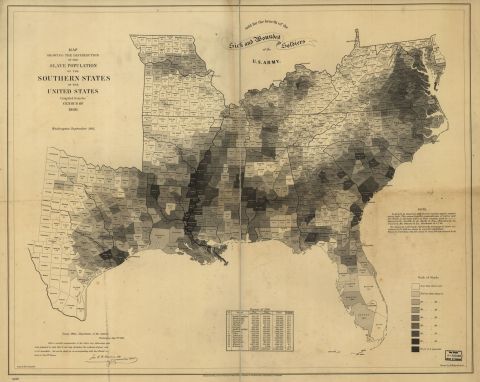
I hate to confess that I had no idea that slaves were as numerous as shown on the map. My ancestors in Vermilion Parish, LA, were poor, illiterate dirt farmers who could not afford slaves. Growing up we learned in school that the same was true of most folks in our area. Yet, when I look at the map, I am surprised that nearly a third of my Parish’s population at the time were slaves. It’s a sobering thought.

