Maxims: What Use Are They Today?
October 23, 2013 § 3 Comments
As we’ve seen over the past several weeks, the jurisprudence of equity developed radically apart from the law. It looked past forms to substance, beyond rigid concepts to a more fluid approach to affording relief. It sought to make whole those who were wronged.
Mississippi long adhered to the principle that the lines of demarcation between law and equity jurisdiction should be preserved. See, e.g., Cotton States Life Ins. Co. v. Cunningham, 141 Miss. 474, 482, 106 So. 766 (1926).
Those lines were kept clear and distinct from the earliest days of statehood through two, separate sets of procedures, one for chancery court and another for circuit court. Each set of procedures addressed the unique needs and approaches of the different courts.
Since the MRCP, however, our procedures have become more alike. In fact, except notice of R81 matters, practice is procedurally the same in both courts.
With the advent of the MRCP, in my opinion, the line of demarcation between the courts has become increasingly blurred. It seems that the concept that equity follows the law has been elevated to a principle that somehow equity is inferior to the law, or that it should be constrained by the same strict forms and conventions that limit the law courts.
That’s unfortunate because there is a need for flexibility and ability to do substantial justice in our court system, as equity has been doing for many centuries.
So the point I’m getting at is this: when you are pressing a point in chancery, don’t overlook using the maxims themselves as persuasive authority. They are a part of our law of equity just as is every MSSC and COA ruling arising from chancery appeals. They are good law.
Maybe if more lawyers would throw the maxims into their trial arguments and appellate briefs, it would reawaken an awareness of the great equity principles in our jurisprudence. And by doing so, perhaps we will return to the core idea of the great difference in approach between the two courts, and the validity of preserving the difference.
As Judge Griffith said:
… there is not to be forgotten the obligation of equity judges to firmly retain the jurisdiction which the court of chancery definitely possesses, not only because a vast experience has justified the propriety and better efficiency of it, but because of a reason already elsewhere touched upon; that two courts, one more largely of the people and the other solely of a judge, existing and in operation side by side, each within its own sphere, tend to keep the course of justice directed the more upon an even keel and better along a middle, a deeper and a truer channel. Griffith, § 26, p. 28.
What is the future of equity and chancery courts as we plunge deeper into the 21st century and move toward the second 100-years of our statehood? That’s a matter we’ll explore at a later date.
Maxims: The Legal Chance to be Heard
October 22, 2013 § 1 Comment
“No one should be condemned without a legal chance to be heard.”
This concept is so fundamental to our notions of due process that it almost goes without saying. Judge griffith expounded on it this way:
This maxim is so clearly founded in natural justice that even savages would understand it, and every decent modern government observes it as an indispensible principle of constitutional right. A decree rendered in its absence is utterly void, as it ought to be. A decree in personam cannot be rendered without a personal appearance or without personal notice sereved within the territorial limits of the state, and a decree bearing upon personal property situated within the state but owned by a non-resident is not valid unless by some reasonable method to be prescribed by law the defendant is given notice by constructive process, such as notice by publication. Griffith, § 48, p. 50.
The MRCP modified process to allow personal service outside the boundaries of the state.
The principle is found consistently in our jurisprudence. If there is no personal jurisdiction, if there is no notice, the court may not act.
The one exception is MRCP 65 pertaining to temporary restraining orders (TRO) without notice. These are not favored, however, unless the circumstances are of such an emergency and exigent nature that relief must be granted immediately. Even in such cases, however, the TRO may be dissolved upon motion of the enjoined party on only two days’ notice, and in no event may extend by the initial order for more than ten days.
Maxims: No Self-Dealing
October 21, 2013 § 4 Comments
“No person bound to act for another can act for himself.”
This maxim is the essence of the law of fiduciaries that binds executors, administrators, guardians, conservators, and all persons charged by the court to carry out some responsibility for the benefit of another. No self-dealing.
Here is how Judge Griffith said it (with paragraphing added):
This is a principle as old as the first among laws, and it has an especially wide application in the processes and proceedings in chancery as a court of conscience. Under it, for instance, no next friend, no guardian, no guardian ad litem, and no commissioner of the court can purchase at any sale wherein there is being sold any property of his ward or any of those for whom he has a duty to perform in the cause.
The disability and disqualification imposed by the maxim runs through all the procedure and includes trustees, fiduciaries, and in a large measure all those in confidential relations, so that no officer, agent or fiduciary shall be permitted in any respect to have such connection or acquire any such interest as may come in conflict with those for whom in any substantial respect he is or may be required to act as to any portion of the matter at hand. Griffith, ¶ 47, pp. 49-50.
The principle behind this maxim is so ingrained in the law of our state that it can be found in dozens of cases. Our law will not tolerate anyone in a fiduciary or confidential relationship profiting at the expense of the beneficiary.
A Loris is not a Lorax
October 18, 2013 § 2 Comments
The pop singer Rihanna recently stirred up a lot of commotion when she posed for this picture with a loris in Thailand …

The loris — more exactly, a “slow loris” — is the creature perched on the lady’s right shoulder. Rihanna, for those of you who, like I, are abysmally ignorant of pop culture, is the lady doing the self-pic with a creature perched on her right shoulder.
A loris is a primate — some species of which are threatened, and all are protected — that lives in the rain forests of Southeast Asia. Despite some of their less attractive attributes, which include having a venomous bite (the only primate with such a skill, except for some lawyers) and inability of the young to clean themselves of fecal and other noisome matter, the cuddly little critters are in high demand as “living toys” due to their slow, deliberate movements, expressive eyes, soft fur, and docile behavior when handled.
The only natural predators of lorises, other than snakes, orangutans, and some raptors, are humans who hunt them illegally for their pethood. Poachers snatch baby lorises from the wild, killing their mothers to take the young. The young lorises then have their teeth pulled out with pliers or other implements, not only to make them more appealing to pet owners, but also, and most importantly, less likely to deliver a poisonous bite. Infections from the pulled teeth kill many of the captive baby animals. Since the lorises are not able to breed in captivity, the poachers have to take the young creatures to meet demand, which is considerable.
There are all sorts of international treaties and laws and federal statutes that ban the importation of lorises and other animals into the US. But if, somehow, one found its way into the Magnolia State, what would its legal status be under state law? Mississippi is, after all, a fairly laissez faire jurisdiction when it comes to many of people’s personal preferences in such matters.
Well, turns out that Mississippi, like most states, does regulate some animals, primates included, as you can divine from this quasi-helpful map:
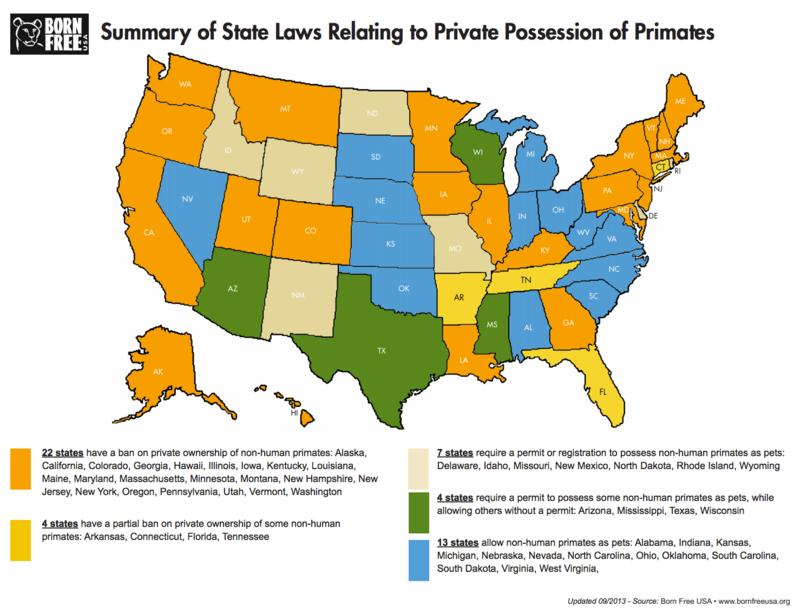
Mississippi regulates “Animals inherently dangerous to humans,” and makes it illegal to import, transfer, sell, purchase or possess them, except by permit or exception (e.g., zoos, transient circuses, research facilities, et al.). MCA 49-8-5, 49-8-7.
The loris, however, is not included among the proscribed creatures. Among the primates covered by Mississippi law are gibbons, orangutans, chimpanzees, siamangs, gorillas, macaques, mandrills, drills, baboons, and Gelada baboons. No loris. Not even a slow loris.
FYI, also restricted in our fair state are: wolves, jackals, dingoes, wolf-cross-breeds, maned wolves, red dogs, African hunting dogs, bears, wolverines, hyenas, lions, tigers, jaguars, leopards, snow leopards, cheetahs, cougars, elephants, hippopotami, and African buffalo.
Caveat: Do not confuse the loris with the lorax, although both creatures are closely related to environmental and conservational concerns. The lorax was exhaustively researched by Theodor Geisel, and was found to be benign, non-venomous (except perhaps to the logging industry), and free of disgusting habits. Oh, and the lorax is not an “animal inherently dangerous to humans” under Mississippi law.

Reprise: Some Frequently-Asked Questions About Chancery Practice
October 17, 2013 § 1 Comment
Reprise replays posts from the past that you might find useful today.
BETTER CHANCERY PRACTICE FAQ
October 8, 2010 § Leave a Comment
My 8.05 financial statements stink. How can I improve them?
Here are Ten Tips for More Effective Rule 8.05 Financial Statements.
Is my estate ready to close?
Check out this Checklist for Closing an Estate.
I think I need to file a habeas action. Any tips?
This Habeas Corpus Step by Step should help.
One more time: what are those child custody factors I need to prove at an upcoming trial?
The Albright factors are what you’re looking for.
Help! We need to sell some real property in an estate, and I don’t know where to start?
How to Sell Real Property in an Estate may be just what you need.
I’ve been asked to handle a minor’s settlement for a Jackson firm, and I’ve never done it before. What do I need to do?
This Outline for Handling a Minor’s Settlement will get you started.
My mail has an MRCP 41(d) notice in it this morning. I remember you said something about it, but I don’t have time to look for it. Can you remind me what I am supposed to do?
<Sigh> Here’s a post on what to do When Rule 41(d) Comes Knocking at Your Door.
I need to prove the tax effects of alimony, but my client can’t afford to hire a CPA to come testify. Any ideas on what I should do?
Try looking at Proving Tax Effects of Alimony.
My Chancery Judge is really nitpicky. How can I draft my adoption Complaint to satisfy him?
Are you talking about me? Whatever. Here is a post on pleading Jurisdiction for Adoption.
Every time I go to court in Jackson, the lawyers there snicker about my countryfied attire. Any suggestions? I cannot afford another $100 contempt citation for punching out a lawyer in the courtroom.
You probably need to be charging more so that you can afford either a better wardrobe or more contempt fines. Until you do, try reading “High Waters” and Burlap Suits. It won’t change anything, but it may help you to feel better.
A Rules Gap that Can be a Fool’s Trap
October 16, 2013 § 4 Comments
MRCP 32 (a)(3)(E) allows for the use of a deposition at trial of a medical doctor “for any purpose.” R32(a) says that the deposition may be used ” … so far as admissible under rules of evidence applied as though the witness were then present and testifying… ”
In practice, that language has been applied to excuse medical doctors from personal appearance at trial, allowing their testimony to be presented by video deposition, or by reading into the record in jury trials, or by introduction of the transcribed deposition in bench trials. The deposition of a medical doctor, then, per this rule, has been deemed admissible in evidence as though the doctor were present and testifying, simply because the witness is a medical doctor.
When this amendment to rule 32 was adopted. It was seen as a friendly gesture to the medical profession, a way to encourage testimony of doctors without unduly interfering with their schedules. All doctor testimony henceforth would be via deposition. It was a no-cost win-win.
But, as Lee Corso would say, not so fast my friend.
The deposition of the medical doctor is unquestionably a hearsay statement, so how does MRCP 32(a) mesh with MRE 804(a), which creates the hearsay exception for persons deemed unavailable to testify? If you will read MRE 804(a), it is clear that the mere status of medical-doctorhood does not automatically fit one into any of the six definitions of unavailability set out in subsection (a). Nor does that status automatically fit into any of the hearsay exceptions in subsection (b). It may be that the doctor’s statement could be qualified as an exception under subsection (b)(5), but that would require a finding by the court, after prior notice by the offering party to counsel opposite.
The answer is that the MRE controls. That’s what MRE 1003 states: “All evidentiary rules, whether provided by statute, court decision or court rule, which are inconsistent with the Mississippi Rules of Evidence are hereby repealed.”
This gap between the two rules caught a party unprepared in the case of Parmenter v. J & B Enterprises, Inc., 99 So.3d 207, 219 (Miss. App. 2012), in which the trial judge disallowed the expert testimony via deposition per MRCP 32(a) where there was no proof of unavaiability as defined in MRE 804. The appellant unsuccessfully argued that MRCP 32(a) allowed the introduction. The COA held, to the contrary, that the MRE provision controlled.
Don’t assume that, just because you have gotten that doctor’s deposition, it will automatically be admissible in lieu of the doctor’s personal testimony. To do that, you will still have to prove the doctor’s unavailability as defined in MRE 804. That may be something you can achieve via requests for admission, or by stipulation, or by making a record.
Oh, and don’t overlook (1) that you have to plant somewhere in the record enough proof to satisfy the judge of the doctor’s qualifications to testify as an expert in the first place, and (2) that MRCP 32(a) applies only to medical doctors, not to PhD clinical psychologists. Those were two stumbling blocks for the plaintiff in Parmenter.
Maxims: No Interference with Court Orders
October 15, 2013 § Leave a comment
“Courts of equity will not tolerate interference with their orders, nor with their officers in the enforcement thereof.”
This maxim was born in the earliest days of equity courts, when dissatisfied litigants sought to evade duties imposed by the chancellors through contrary orders from law courts. Those days are long past, and the Constitution and statutes determine jurisdiction in the modern era.
Here is what Judge Griffith said about it (with paragraphing added):
… it became in time the established rule that while the chancellors would of their own accord refrain absolutely from interfering with the orders of the law courts and their enforcement thereof, except upon an established equitable ground, yet when a dominant equity so required, all persons, other than the law judges themselves, would be enjoined to give obedience to the decrees in equity as to all the matter comprised therein. For instance, when a receiver is appointed in chancery and all the property has been taken in charge by the receiver, as the officer of the court it is punishable as a contempt for any person to attempt to interfere, although he may have a writ from some other court.
The rule is that if any person suffer by reason of any order in chancery, whatever it may be, he must apply to chancery for a revocation or modification of that order: a resort to some other court will not avail, save only in those cases wherein the order in chancery was absolutely void. Griffith, § 46, p. 48-49.
To put it in more succinct terms: When chancery court enters an order, you can obey it, or you can appeal it.
Today, the maxim underscores the chancery court’s considerable power to enforce its orders and to punish those who thwart them or the officers charged with carrying them out.
Trial Lawyer’s Prayer
October 11, 2013 § 2 Comments
Every lawyer, even the professed non-believer, invokes the power of prayer from time to time in the course of legal combat. Come on, admit it. I suppose one reason for the phenomenon is the old saw that “there are no atheists in the trenches.” And another is the realization that, how else but through divine intervention are we expected to be able to survive in the toxic fog of litigation war?
Here is an admittedly tongue-in-cheek trial lawyer’s prayer that illustrates my point …
Trial Lawyer’s Prayer, by Evan Schaeffer
Dear Lord: Here I am, back in Church. It’s been awhile, I freely admit, and I apologize for the long string of Sunday absences, but as you know, the demands of my busy practice often require me to work all weekend, Sundays included. That’s true even today, Lord, but today is a special Sunday. So special, in fact, that to skip Mass today would be malpractice, more or less, if you know what I mean, which, of course, you do.
Tomorrow is the big trial. Not only is it big, Lord, but as you know already, it’s huge, the most important trial of my career to date, the trial at which my client stands to collect millions of dollars, in addition to a sizable punitive damage award. With this in mind, Lord, I come to you today at Mass. And even though I may be preoccupied from time to time, which is understandable given the magnitude of my burden, I ask that you have mercy on your humble servant, and hear his prayer.
And so, I pray as follows:
First and foremost, Lord, let your light shine on my opponent, that he may come to me tomorrow morning before the trial begins with the news that he will accept my settlement demand, which as I recall is in the neighborhood of $7 million. Of course, you shouldn’t let your light shine too brightly on my opponent, if you know what I mean, which of course you do, but at least grant him the wisdom to look upon my settlement demand as worthy of his consideration, even if it isn’t, so that the trial won’t even be necessary, and I can begin working on my next big case.
On the other hand, Lord, if it be your plan that before I win, and cement my reputation as a trial lawyer of the first rank, my opponent and I will actually have to engage in courtroom battle, then as your humble servant I will accept your judgment. However, please keep in mind that an early settlement is certainly the better option, as it would immediately alleviate the stress on my heart, and allow me to get some much-needed sleep. You should also know, Lord, that an early settlement will free up my Sundays for at least the next month, making it no problem at all to drop by for the guitar Mass, which is my personal favorite, and which, as you know, always makes me tap my foot and occasionally, sing out loud.
But I digress. I fully understand, Lord, that speaking frankly, there is almost no chance of an early settlement, since in truth, my $7 million demand is outrageous, and my opponent would to be out of his mind to accept it. So I will assume, Lord, for purposes of this prayer only, that I am going to trial in the morning, despite the fact that it is likely to turn my hair prematurely gray, and is even now making my stomach queasy with worry and uncertainty.
And so, Lord, if we aren’t able to settle the case in the morning, and if the Judge doesn’t cancel the trial so that he can go fishing, which, as you know, he loves to do, and perhaps should be omnisciently compelled to do tomorrow, then I will stand before the jury and in my loudest voice, demand that they return a verdict of $7 million.
Be with me when I do that, Lord. It will take guts, and bravado, and a certain amount of recklessness on my part, especially considering the facts, which tend to favor my opponent on many points, including, as you know, all the important ones.
Be with me, Lord, not only when I attempt to use my powers of persuasion to sway the jury to an unreasonable verdict, but also during cross-examination, when I plan to make up the distance between what actually happened to my client, and what I will tell the jury actually happened. What I mean, Lord, is grant me the fortitude to be a good cross-examiner, such that I ferret out the truth when it helps my case, and skillfully conceal it when it doesn’t. Aid me in making it perfectly clear to the jury why I’m right, and why my opponent is wrong, even though, as I said, you should bless him too, but not excessively, and only at the conclusion of the entire case, including any appeal, which often takes months or years.
And finally, Lord, bless my witnesses, that they will remember to stick to the story that I have so carefully prepared for them, and avoid being caught in any damaging inconsistencies, and be spared the embarrassment of sweating profusely out of nervousness, or of losing their tempers when cross-examined by my opponent, or of exposing the bad sides of their characters, thereby alienating the jury, the members of which, by the way, you should also bless, but only once they’re firmly on my side.
It’s a long list, Lord, but it’s a big case. I hope you understand that, which, of course, you do. And now, Lord, I’m afraid it’s back to work.
Amen.
[Editor’s note … I am giving the author the benefit of the doubt that by ” … they will remember to stick to the story that I have so carefully prepared for them …” he means the trial preparation he has gone through to properly state the facts they observed, which is ethical, as opposed to a story he made up, which is completely unethical.]
 The Better Chancery Practice Blog