A few Comments about Comments
February 22, 2017 § 2 Comments
From time to time I have to reiterate a few points about comments …
- I welcome comments by lawyers and judges. I enjoy the input, even when it disagrees with or corrects what I post. I’m not infallible, and my point of view is not the only way to see things, so have at it. Add your own insight.
- Laypersons are free to read this blog, but I limit comments to lawyers and judges. That’s my policy, and I’m sticking to it. Many comments I get from laypeople ask for legal advice, or what to do because their lawyer is not doing a good job, or the judge is against them, or what if this and that. There are lots of blogs and listservs that perform that function. This is not one of them. Mississippi law prohibits me from giving legal advice.
- As always, all comments are moderated. If yours includes criticism of a sitting judge in a case, don’t expect it to be published.
- When I use the term “lawyer” here, I mean lawyers and their staffs.
How Many Attorneys Does it Take to …
February 21, 2017 § 3 Comments
… Okay, I’ll spare us all the rest of the joke. But the question does arise from time to time as to how many attorneys can be compensated in an award of attorney’s fees. The oft-heard formula is ” … a fee to compensate one competent attorney …” or words to that effect.
That was one issue in the recent case of Moore v. McDonald, et al., decided by the COA on February 7, 2017. The appellants argued that the chancellor erred by granting attorney’s fees for more than one attorney. The COA rejected the argument in an opinion by Judge Wilson:
¶7. The Moores next assert that the chancellor “erred by assessing attorneys’ fees . . . that cover the costs of more than one attorney.” The Moores argue that Mississippi Supreme Court precedent “clearly sets forth that . . . only a sufficient fee to secure one competent attorney may be granted.” In fact, however, our Supreme Court has rejected this very argument. Coleman & Coleman Enters. Inc. v. Waller Funeral Home, 106 So. 3d 309, 318 (¶27) (Miss. 2012) (“We do not interpret [McKee v. McKee, 418 So. 2d 764 (Miss. 1982),] as having held that attorneys’ fees in Mississippi are limited to the fees of only one lawyer.”); see also Upchurch Plumbing Inc.v. Greenwood Utils. Comm’n, 964 So. 2d 1100, 1116 (¶40) (Miss. 2007) (affirming an award of attorneys’ fees for the work of two attorneys); Mabus v. Mabus, 910 So. 2d 486, 490 (¶13) (Miss. 2005) (same). The Moores do not identify any duplicative time entries or excessive charges. They make only a broad argument that fees for the work of more than one attorney are not recoverable. This argument is contrary to Supreme Court precedent and thus without merit.
You may well question how the above squares with the express language of McKee, wherein the Supreme Court stated, “In determining an appropriate amount of attorneys fees, a sum sufficient to secure one competent attorney is the criterion by which we are directed. Rees v. Rees, 188 Miss. 256, 194 So. 750 (1940).” Well, if you read the Mabus case, cited above, you will see that the MSSC said that the “one competent attorney” language is more about non-duplication than about the number of attorneys involved to produce the result.
You are going to see more of this Moore case in some future posts. Not only is the fact situation interesting, but so are the observations of the chancellor and some of the other holdings.
Franklin Church
February 17, 2017 § 4 Comments
Franklin is a once-thriving community in Holmes County. Settlers, primarily from South Carolina and Virginia, arrived in the area in the early 1830’s, soon after it was ceded by the Choctaws. They developed cotton plantations worked by the slaves they had brought with them.
Still standing is the church built east of Franklin in 1841 with slave labor.

The church has two front doors, one of which is obscured by a tree in the picture above. Originally, one door was used by men, the other by women.
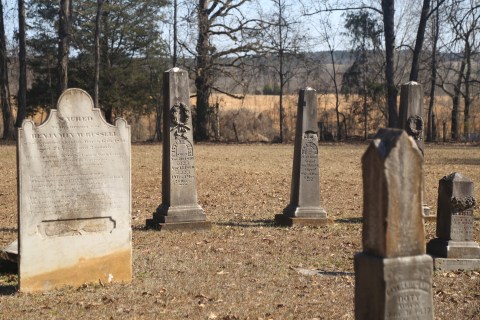
The cemetery behind the church is filled with graves of the early settlers, many of whom had been born in the 1700’s. Many of the tombstones remark that the decedent was from the Abbeville District in South Carolina.



The photo below shows the gravestone of Benjamin W. Russell, who immigrated to the area from North Carolina two years before his death in 1857 at only 21 years of age. The intriguing inscription recites his tragic history, which sounds like treachery in a business deal, and perhaps a duel: “Here lies entombed an honest man whose courage forced him from a distant land, by fortune’s wheel untimely thrown, this grave bespeaks his solemn moan. Let youth in future great caution take, and never join in business for fortune’s sake, for hearts today in manly friendship beat, tomorrow in a warlike attitude may meet.”
In the waning days of the Civil War, on January 2, 1865, only three months before Lee’s surrender at Appomattox, 1,100 Confederate Home Guards led by General Wirt Adams attacked a column of 3,300 mounted federal troops near the church. The union forces included some of the Second U.S. Colored Cavalry, which consisted of black men recruited from Mississippi, according to a nearby Historical Marker. The battle resulted in heavy Confederate losses, and many were taken prisoner. None of the soldiers who died there are buried in this cemetery; at least none is so noted. Some sources state that the church still bears bulletholes from the clash, but none were visible to us when we visited recently. The historical marker incorrectly states that the battle was part of Grierson’s Raid, but that action actually took place in 1863, and Grierson’s force, which numbered only 1,700 men, did not come near Franklin.
So, who were these people? Who were the farmers, the slaves, the shopkeepers, blacksmiths, homemakers, the soldiers, cavalrymen? What did they hold dear, and what did they care nothing about? What filled their days? What did they dream about? What were their stories? What did they leave behind to mark their time on earth other than tombstones?
There are many communities in Mississippi in decline and on the way to their own extinction. It’s hard to grasp how places that were once so vital, pulsing with the lives and endeavors of people, can simply wither away and return to wilderness, but they do. It’s a sort of cultural entropy. Franklin reminds us that what can seem so important and even critical to us today will be forgotten and faded to nothing over time. Sic transit gloria mundi.




Now This is the Way to Instruct a Jury
February 16, 2017 § 2 Comments
Justice can be pretty complicated today, what with mass torts, experts, voluminous discovery, digital information, and on and on. One of the banes of the judicial process is how to properly instruct the jury so as to avoid error and expensive reversal.
It wasn’t always this way. In a jury trial involving the death of a doctor’s horse in Butler County, Ohio, in 1905, Judge Squire Sprigg instructed the jury as follows:
Gentlemen of the Jury: This is a hoss case. We make quick work of hoss cases in this court. These people killed Doc’s old hoss; if Doc’s hoss was worth anything, then he is entitled to recover; if he wasn’t worth anything, then he ain’t. Some hosses are worth something and a good many more are worth nothing. So, it is for you to say, whether this hoss was worth anything or not. You are to be governed by the preponderance of testimony. Preponderance is a big word, which I must explain to you. It means this: If one side has fifty witnesses and you think they are all liars, and the other side has one witness, and you don’t think he is a liar, or at least as big a liar as the other fifty, then the testimony of the one will preponderate over that of the others, and will knock the socks off of the other fifty. Now, if by a preponderance of the testimony, as I have explained it to you, you think the Doc’s old hoss was worth anything, find what that is and give it to him; if you think he was worth nothing, why say so. Doc will think this is pretty hard on the medical profession, but he will have to take the medicine which the law prescribes. The law provides for just such cases; it calls this damnum absque injuria, which means, as I interpret it, that a man is usually hurt a damned sight less than he thinks he is.
Now, gentlemen, I believe I have covered the whole case. You have heard the evidence and the law as I have given it to you. Remember that you are under oath in this business and that the court expects quick verdicts, especially in hoss cases.
[Note: lest anyone get too bent out of shape, back then only men were allowed to serve on juries. That’s just the way it was.]
Doc won the case.
We don’t have many jury trials in chancery, but when we do, for some reason, the law has limited them to will contests, which can involve undue influence, competency, outright fraud, and other issues that can rank among the most complicated concepts in the law. So instructing the jury about those kinds of concepts can present quite a challenge.
I’m not advocating a return to a Judge Spriggs-esque form of jury instruction, but there is some charm in simplicity, isn’t there?
Thanks to Futility Closet.
Revenge of the Missing Link
February 14, 2017 § Leave a comment
“Heir property” is an often-heard term in Mississippi, used to describe the convoluted and sometimes impossibly complicated ownership of real property that has passed through several generations without administration of an estate or probate of a will.
Walter and Ressie Quinn inherited an interest in some property from Walter’s mother. Although most of the siblings quitclaimed their interests to the Quinns, one sibling quitclaimed her interest to Jessie and Arma Morton. The Quinns filed suit against Arma for partition of the property. They did not join Jessie.
When Arma filed her answer she did not include a defense of failure to join a necessary and indispensable party (R12(h)(2)).
The court ordered a sale of the property, which took place on the courthouse steps on September 29, 2014. When it came time to confirm the sale, Arma raised for the first time that the sale was invalid for failure to join Jessie as a party. So the Quinns filed an amended pleading adding Jessie as a party, and the Mortons waived process and filed an answer. At a final hearing, it was discussed that, although Jessie objected to a sale, he declined to testify.
Following court proceedings, the judge signed a judgment confirming the sale and finding that Jessie had failed to show that he had been prejudiced in any way by the sale. The judgment also found that Jessie had failed to show prejudice because Arma had failed to raise a R12(h)(2) defense. Arma and Jessie appealed.
In Morton v. Quinn, handed down December 13, 2016, the COA reversed and remanded. Judge James wrote for the majority:
¶10. Since the first issue is dispositive, we decline to address the other issue on appeal. “[T]he decision of a trial judge will stand ‘unless we conclude that the discretion was arbitrary and clearly erroneous, amounting to an abuse of discretion.’” Ashmore v. Miss. Auth. on Educ. Television, 148 So. 3d 977, 983 (¶17) (Miss. 2014) (quoting Miss. Transp. Comm’n v. McLemore, 863 So. 2d 31, 34 (¶4) (Miss. 2003)). After the amended petition was filed, adding Jessie as a respondent, the sale was not vacated, and Jessie was not given a chance to meaningfully participate in the disposition of his property. Jessie favored a partition in kind rather than a sale, yet he was not afforded the opportunity to respond to the Quinns’ request for a judicial sale.
¶11. Mississippi Code Annotated section 11-21-11 (Rev. 2004) permits a judicial partition by sale only where: “[A] sale of the lands, or any part thereof, will better promote the interest of all parties than a partition in kind, or if the court be satisfied that an equal division cannot be made.” At the hearing to confirm the judicial sale, the Quinns asserted that Jessie had to illustrate that the omission of his name as a respondent resulted in prejudice. The trial court afforded him with an opportunity to testify as to any prejudice that he may have incurred. Jessie declined to testify but asserted that he was prejudiced by the sale since he preferred a partition in kind. Moreover, the record shows that Jessie lived on the property, and that the sale would directly affect the location of his patio and other fixtures. Since the disposition of the land directly impacted Jessie’s rights to the subject property, the judicial sale should have been vacated.
¶12. In Shaw v. Shaw, 603 So. 2d 287, 294 (Miss. 1992), the Mississippi Supreme Court held, “While the question of joinder of an absent person generally must be timely raised in the trial court, an appellate court may consider the issue even though it was not initially raised below, and may do so sua sponte.” In the present case, the nonjoinder was raised, but it was not properly raised by the filing of a motion. However, Jessie did raise the matter at the hearing to confirm the sale, which sufficiently preserved the matter on appeal. “Rule 12(h)(2) of the Mississippi Rules of Civil Procedure requires [parties] to raise the issue of failure to join a necessary and indispensable party in the pleadings under [Mississippi ] Rule [of Civil Procedure] 7(a) or by motion for judgment on the pleadings or at the trial on the merits.” Marathon Asset Mgmt. LLC v. Otto, 977 So. 2d 1241, 1246 (¶14) (Miss. Ct. App. 2008).
¶13. The supreme court has noted that “parties whose rights are to be affected are entitled to be heard . . . . Furthermore, they must be notified in a manner and at a time that is meaningful.” Aldridge v. Aldridge, 527 So. 2d 96, 98 (Miss. 1988) (internal citations omitted). Jessie was not properly noticed or added as a respondent until a year after the matter was initiated. Once the Quinns filed their second amended petition for a judicial sale, naming Jessie as a respondent, the sale of the subject property should have been vacated and renoticed for a proper sale, involving all parties if Jessie’s in-kind partition did not materialize. Nevertheless, the court presumed that since Jessie and Arma were husband and wife, Jessie had knowledge of the actions regardless of his omission as a respondent in the matter. We find that presumption was in error.
Several lessons in this:
- The COA has made clear in many cases, including this one, that the mere fact that you know about litigation does not confer jurisdiction over you.
- When Jessie finally awoke and decided to participate, I guess he should have been more forceful in asserting his objection to the sale.
- I would have affirmed, because after the amended complaint was filed Jessie was given the opportunity to object and even to testify in opposition to the sale at the confirmation hearing, but he declined. As a trial judge, one often wonders how far we have to go to accommodate people who simply will not protect themselves even when they have the means to do so.
- When you have litigation involving “heir property,” jump through every hoop and go to extra trouble to discover and get process on everyone who has or claims to have an interest in the property. That extra attention may avoid big headaches later.
Lump Sum Alimony and Child Support
February 13, 2017 § Leave a comment
When Suzann and Greg Davis went to court on modification issues, the chancellor ruled that Suzann had to pay Greg a sum of child support. In calculating the amount, the chancellor included lump-sum alimony payments she was receiving as part of her adjusted gross income. Suzann appealed.
In the case of Davis v. Davis, decided January 24, 2017, the COA affirmed.
¶13. Suzann also argues that the chancellor erred in including lump-sum alimony as part of her income when calculating her child-support obligation, because lump-sum alimony is not the type of alimony contemplated in the statute. [Fn 1] She points to Neville v. Neville, 734 So. 2d 352 (Miss. Ct. App. 1999), and Dickerson v. Dickerson, 34 So. 3d 637 (Miss. Ct. App. 2010), to support her argument. In Neville, this Court held that lump-sum alimony payable in installments is not “‘alimony’ necessarily includable” when calculating a parent’s adjusted gross income. Neville, 734 So. 3d at 359 (¶31). In Dickerson, this Court simply detailed the connection between lump-sum alimony and the division of property. Dickerson, 34 So. 3d at 645 (¶32). Neither of these cases prohibits a chancellor from considering lump-sum alimony as income under section 43-19-101(3)(a). Thus, we find that a chancellor retains the discretion to classify lump-sum alimony as income when calculating child support. We find no abuse of discretion in the present case.
[Fn 1] Section 43-19-101(3)(a) provides that alimony is a potential source of income that may be considered when determining a parent’s adjusted gross income.
Not much to comment on. I thought this was something useful to have in your arsenal when you have a similar case.





Squatter’s Rights = No Rights
February 9, 2017 § Leave a comment
In February, 2009, Acey Huey deeded property he owned in a subdivision to his daughter, Fillisa.
On August 7, 2009, Acey signed off on a document entitled, “Repairing and Renting Agreement.” Acey and his brother Tom were named in the document as “Landlords,” and Tom’s daughter, Tommie, was denominated as “Tenant,” of the same property that had been conveyed to Fillisa. The agreement, which was prepared by Tommie’s godmother, provided in part: Tommie would pay rent of $150 per month and repair the property at her sole expense; the Landlords could not raise her rent or evict her without cause; if forced to leave for any reason she would be reimbursed for the labor and material she expended on the property, and for moving expenses and “pain and suffering.”
Filisa did not become aware of the agreement until 2012. In June of that year, she sent Tommie notice to pay rent or vacate, demanding $400 a month in rent, plus a $400 security deposit.
On July 25, 2012, Filisa conveyed the property to LeMorris Strong.
On July 27, 2012, the 2009 “Repairing and Renting Agreement” was filed in the county’s lis pendens records, attached to a “Notice of Subordination, Attornment and Non-Disturbance Agreement.”
On August 14, 2012 Strong recorded his deed from Filisa.
In November, 2012, Strong made written demand for Tommie to cancel the lis pendens notice, including a form to do so, as well as a copy of Mississippi’s Litigation Accountability Act (LAA), MCA 11-55-5.
In 2013, after Tommie had vacated the property, Strong filed suit to remove clouds from and quiet title to the property. Tommie counterclaimed. The chancellor granted Strong the relief he requested, and dismissed Tommie’s counterclaim. She also awarded Strong $3,917.14 in attorney’s fees and costs, ruling that the filing of the lis pendens notice and refusal to withdraw it constituted a violation of the LAA.
In Huey v. Strong, decided December 13, 2016, the COA affirmed with a unanimous opinion by Judge Fair, James not participating.
You can read the opinion for yourself. The point I want to make here is that you need to stop and think before you leap. I don’t know who filed that lis pendens notice for Tommie, but I hope it was the godmother who prepared the original agreement, and not an attorney. When you file a lis pendens notice you may be slandering title unless what you have filed is true, accurate, and has a basis in law. Tommie had a chance to withdraw it but did not, which ended up costing her nearly $4,000 she does not have, judging from the recitation of facts in this case. Here the COA holds that filing a false lis pendens notice can be a violation of the LAA. Damages were relatively small in this case, but they could have been huge.
Years ago, as a young lawyer (and before there was an LAA), a breathless client demanded that I file a mechanic’s lien notice against a subdivision developer only to learn soon after that the client had misrepresented the facts to me, and wanted it done as a vendetta because the developer had elected to begin using another contractor. I notified the client that I was withdrawing the lien and he could file one or anything else in his own right, but that I was not going to participate. My bad for leaping before looking and demanding some documentation or proof of the claim. Had that lien notice botched a sale, I might have been on the hook with my client for damages.
The Price of Breach of Trust
February 7, 2017 § Leave a comment
The law of trusts in Mississippi may be the least litigated area of our jurisprudence, judging from the paucity of reported cases on trust issues.
That’s why I was planning to do a post on the COA’s recent 30-page decision by Judge Barnes in Cassibry v. Cassibry, decided January 24, 2017. But Philip Thomas posted about the case on his excellent Mississippi Litigation Review and Commentary blog, so you can read his take at this link. At the trial level, the trustee was found to have violated the trust and was assessed a judgment in the amount of $144,865.86, plus post-judgment interest of eight percent per annum, and was ordered to pay $17,902 in costs and $28,500 in attorney’s fees. He was also ordered to transfer 7,757 shares of stock to the prevailing party. On appeal the COA affirmed but remanded for further proceedings on the issue of attorney’s fees, which the appellee conceded was not properly documented at trial.
One minor quibble with Mr. Thomas’s post: he refers to the trial court’s ruling as a “verdict,” but since it came from a chancellor and not a jury, it was a judgment. Not intended as a swipe at the knowledgeable Mr. Thomas. Just pointing this out for the young chancery lawyers and law students. Mr. Thomas will tell you that he spends most of his time in federal and circuit court, and not in chancery, so he can be forgiven the lapse into his more familiar verbiage.
Many trusts are extra-judicial, grant extremely broad discretion to the trustee, and waive accountings and other reporting. I guess that’s why relatively few are litigated. I had a case in my court years ago in which the beneficiary claimed a breach of trust because the trustee refused to disburse any money to him at all. The trust specifically gave the trustee unfettered discretion in that regard. The beneficiary also complained that the trustee had sold some of the assets of the trust; however, the trust gave him broad discretion in that area, also. The case fell to summary judgment and, to my knowledge was never appealed. It would have been interesting to litigate, since the were conflicting provisions as to which state’s laws controlled, and none of them were Mississippi.
An epic case in which the trustee was removed for non-monetary breach of duty to the beneficiaries is Wilbourn v. Wilbourn, decided April 24, 2012.
 The Better Chancery Practice Blog