SOMETHING TO BE PROUD OF IN QUITMAN
June 21, 2010 § 7 Comments
Court time in Clarke County is always enjoyable thanks to the friendly staff in the court house who go out of their way to be helpful and hospitable. As good as it is, though, that favorable atmosphere is about to improve.
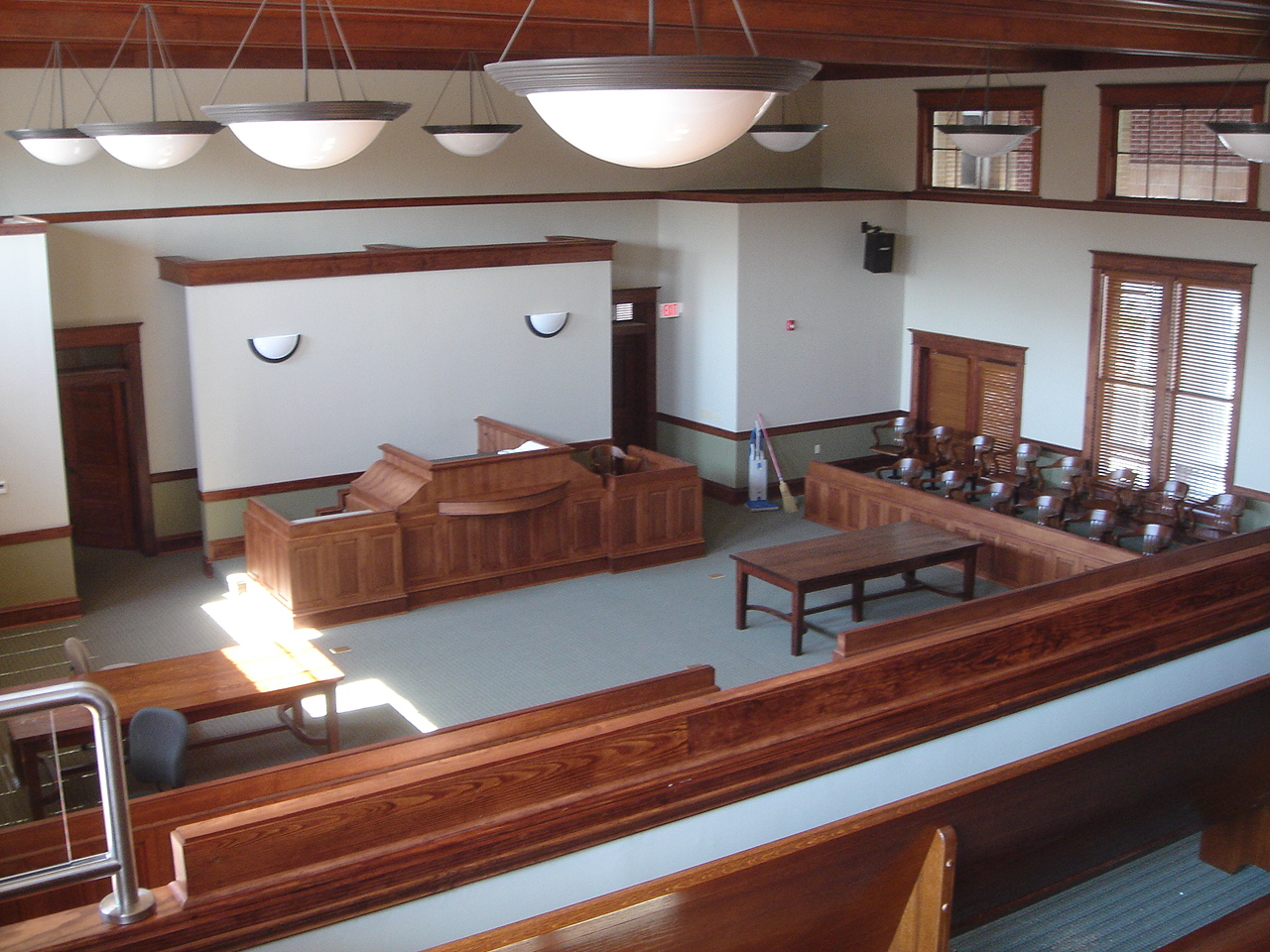
The new court room upstairs in the main building is near completion. The supervisors and the contractor are in the final phases, going over punch lists. When the work is finally accepted by the supervisors, Clarke County will have a shining jewel that every citizen can be proud of.

The new court room is airy and modern
It wasn’t too many years ago that the Clarke County Court House was shabby and inadequate. Cheap plywood panelling covered the walls and the windows in the court room — someone’s ineffective notion about how to keep out the roar of the big trucks passing on Hy 45 in front of the building. The balcony and vintage pressed-tin ceiling were concealed by a suspended celotex ceiling. The building had a shabby sense of decay that was heightened by its dusty, dirty state.
I tried many cases in that old court room. It was common to hear the cooing of pigeons nesting between the panelling while a witness droned on. Before the bypass took the heavy trucks out of town, one could hear the big windows shaking behind the panelling as they rumbled through the stoplight. I remember during one trial a thunderstorm raged outside and a water leak flooded counsel’s table. Sad to say, but the court house back then reflected what many people thought of Quitman and Clarke County: A community in decline, its better days in the past.

Looking from behind the bench toward the audience and balcony
All that changed in the late 90’s, when the Board of Supervisors took an interest in upgrading the court house. They added the new building with its new, modern court room and offices. The new building provided plenty of space for the courts, with meeting space for the Grand Jury and a D.A.’s office, as well as a library. With the new building came a renewed sense of pride, and the dust, dirt and grime were banished in both the new and old buildings. Floors were polished and windows cleaned. The court house staff was energized.

A treasure concealed for many years
Meanwhile, the lights were turned off in the old court room, which was left to languish. Before long, however, some Clarke Countians interested in preserving the best of the past were nosing around the old court room to see whether it could be restored to its pre-plywood-panelling days. They found the old, pressed-tin ceiling, an Edwardian architectural detail that can not be duplicated today. They also found behind the celotex a labyrinth of ventialtion ducts and utilities. Conventional wisdom would have dictated that it was simply too big a job for little Clarke County, with its shrunken tax base and many other priorities. It seemed too much to hope for that the court room could actually be restored.
To their credit, the supervisors stepped up and committed to the work. It has taken around 5 years, but the work is nearly completed now, and when the court room is furnished it will be ready for business.
Clarke County deserves praise for recognizing that a clean, orderly, businesslike court house with attractive court facilities is not only a service to its citizens, but also is a reflection on the community as a whole. Where Clarke County’s Court House used to send the message of a tired, dying community in decline, the new facilities speak loudly of a progressive community alive with potential and ready to roll up its sleeves and go to work.
Clarke County: Give yourselves a pat on the back.
Something to be proud of in Quitman
DISTRICT 12 LAW FIRM LINKS
June 20, 2010 § 6 Comments
Among the links on the right side of the page, you will see several for District 12 law firms. I am limiting the listings to law firms physically located in Lauderdale and Clarke Counties.
If your firm isn’t listed and you have a web site or blog, let me know, and I will add you to the list.
HAPPY FATHER’S DAY
June 20, 2010 § Leave a comment
Happy Father’s Day to all, but especially to all who manage to be good fathers and lawyers at the same time. My hat is off to you.
NOTORIETY IN THE BLOGOSPHERE
June 19, 2010 § Leave a comment
It surprised me to see that on the first day I publicized this blog, I had 144 views, and the next day 283! And that was even before I had let more than a couple of lawyers know it existed.
The answer is that when I commented on Philip Thomas’ amusing article on dressing for court (“HIGH WATERS” AND BURLAP SUITS), other bloggers picked it up and spread the word.
We were mentioned in NMissCommentor, Thus Blogged Anderson, Dr. X’s Free Associations, and The Mississippi Family Law Blog, and the views flooded in. There may be others, but those are the ones I am aware of. This internet is truly amazing. It affirms my belief that it’s a great medium to disseminate information. I hope all of the attorneys in D12 take advantage of this blog and contribute to it. And I hope that it helps those from out of district who do business in our court.
I mentioned NMissCommentor above. It’s the blog of Tom Freeland, a lawyer in Oxford whose posts I started reading and became addicted to during the Scruggs scandal. I read his blog every day and commend it to you as a great source of info about the law in general and Mississippi litigation in particular, as well as his interests, including Mississippi blues, local food, cooking, humor and esoterica.
I’ll be adding more suggested links to the panel on the right as soon as I get around to it.
ELVIS HAS LEFT THE BUILDING
June 18, 2010 § 2 Comments
But so what? You can still find out how you can be TCB* by clicking on the TCB tab up there on the right.
TCB is where you go to find out how we do most things in Place 2, D12. Click and check it out.
* “Taking Care of Business”
SO EXACTLY WHO ARE THE HEIRS IN ADMINISTRATIONS?
June 18, 2010 § 5 Comments
§ 91-7-293, MCA requires in part that “The executor or administrator shall file with his final account a written statement, under oath, of the names of the heirs or devisees and legatees of the estate, so far as known … the statement must aver that diligent inquiry has been made to learn the same without avail … ”
So how do you know who the real heirs are? There is a case in Clarke County where as far as the children knew the decedent had no other heirs, and the case proceeded on that basis until one fine day when a claimant popped up. That case has been pending a dozen years, with an appeal and remand, and a third generation of lawyers. The claimant says that the decedent fathered him while in the Air Force in California during the Korean conflict, and that he secretly stayed in touch with him through all the years. The point is that the children were never aware that there was anyone else claiming to be a child. The undeniable fact is that — especially in the case of a male decedent — we can never be entirely sure that the decedent did not have another child the family did not know about.
Whether to require publication to determine unknown heirs in administrations was a topic of discussion at the Chancery Judges’ winter study meeting in January. The consensus was that determination of unknown heirs should be required in all administrations, so you should be prepared to meet this requirement as you handle estate business around the state. FYI: in District 16 (Jackson, Greene and George Counties), you will be required to publish in both testate and intestate estates.
In sum, you must include an action to determine the unknown heirs of the decedent in all administration actions, with proper publication. Thirty days’ notice is required for the action to determine unknown heirs.
You will not be able to close the estate unless the action to determine unknown heirs is completed.
PUBLICATION PITFALL
June 17, 2010 § 7 Comments
So you dug and dug until by the hardest you found the defendant’s mailing address in Moosebreath, Idaho. Good for you. Pleadings all prepped and filed. Publication 3 consecutive weeks in the MERIDIAN STAR for that anticipated and fateful day. Notify client to be there. No answer filed. Case called in open court. Defendant called 3 times. Present judgment …
Judge shakes his head and says, “Sorry, no jurisdiction.”
What happened? How do you explain this to your client?
The answer is in Rule 4 (c) (4) (C), MRCP. That rule states: “Where the post office address of the absent defendant is stated, it shall be the duty of the clerk to send by mail (first class mail, postage prepaid) to the address of the defendant, at his post office, a copy of the summons and complaint and to note the fact of issuing the same and mailing the copy, on the general docket, and this shall be evidence of the summons having been mailed to the defendant” [Emhasis added].
Prectice tip: At the same time that you file your pleading, provide the clerk with an extra copy of the pleading and the summons and specifically request that it be mailed as set out in the rule, and that the facts of issuance of process and mailing be noted on the docket. Some lawyers, to add a measure of assurance, pay the postage for the clerk to mail it certified mail, return receipt requested, although that should not be strictly necessary if the facts of issuance and mailing are properly noted on the general docket.
MORE ON JURISDICTION FOR ADOPTION
June 16, 2010 § 5 Comments
I have already made the case for incorporating the adoption jurisdiction statute into your pleading forms here.
What I want to emphasize is that there is so much more to the jurisdictional statute than just a change from 90-day to six-month residency since its amendment in 2007 that you need to be aware of and address.
The statute is § 93-17-3, MCA. Pull out the statute and read it. This is important.
Subsection (1) sets out five different, basic scenarios for jurisdiction: (a) that the minor lived in Mississippi with a parent, guardian, prospective adoptive parent or other person acting as a parent for six months AND there is available in Mississippi “substantial evidence concerning the minor’s present or future care”; or (b) the prospective adoptive parent lived in the state for six months AND there is available in Mississippi “substantial evidence concerning the minor’s present or future care”; or (c) the agency that placed the child for adoption is licensed in Mississippi and it is in the child’s best interest to adopt because the minor’s parents or the minor and the adoptive parents have a significant connection with this state AND there is available in Mississippi “substantial evidence concerning the minor’s present or future care”; or (d) the minor and the prospective adoptive parent are physically present in Mississippi and the child has been abandoned or there is an emergency to protect the child from mistreatment or neglect; or (e) no other state would have jurisdiction under prerequisites as (a) through (d), or another state has declined jurisdiction, and it is in the best interest of the minor for Mississippi to take jurisdiction.
From the foregoing, it is clear that it is not sufficient to allege merely that the parties have been residents of Mississippi for six months. All of the applicable elements must be pled in order to invoke jurisdiction.
Subsections (2) and (3) prohibit Mississippi from taking jurisdiction where there is any action for custody of the minor pending in another state.
In order to avoid problems with Section (2) and (3), the best practice would be to add an affirmative provision to your pleading addressing the jurisdictional issues raised in them, and adding a complete UCCJEA pleading would be prudent.
Subsection (4) limits adoption to an unmarried adult or a married person whose spouse joins in the petition. Your pleading should make it clear what is the marital status of your adoptive parent(s).
Other provisions of Subsection (4): The petition must be sworn and ” … filed in the chancery court of the county in which the adopting petitioner or petitioners reside or in which the child to be adopted resides or was born, or was found when abandoned or deserted, or in which the home is located to which the child has been surrendered by a person authorized to so do.”
In my opinion, the pleading must set out one of the residency bases for jurisdiction, and it must be one that applies to the facts in your case.
The old requirements for a physician’s or nurse practitioner’s certificate and statement of property still continue in effect.
Subsection (4) also includes a requirement that the petitioner(s) must make an affidavit disclosing the amount of fees charged by adoption agencies or facilitators ” … and any other expenses paid by the petitioner or petitioners in the adoption process as of the time of filing the petition.”
In my opinion, the disclosure of fees and expenses requires a combination of any or as many of the following that apply: (a) a statement itemizing all such fees; (b) a statement that no fees have been incurred; (c) an itemization of “any other expenses.” I believe that the phrase “any other expenses” includes attorney’s fees.
Adoption is a purely statutory creature. Since it is in derogation of common law, the statute must be strictly construed and applied. If you do not properly invoke jurisdiction of the court in your pleadings, you are running the risk that at some later point someone will try to get the adoption decree set aside — most likely after a wrongful death suit has been filed — and you will be embarassed or worse.
Read the statute and plead it. The extra trouble will be worth it.
“HIGH WATERS” AND BURLAP SUITS
June 16, 2010 § 6 Comments
Philip Thomas, a lawyer in Jackson who publishes the MS Litigation Review & Commentary blog, has a clever piece about effective attire for the trial lawyer. You can read it here.
What interested me was the emphasis that jury-trial lawyers place on image and the subtle appearance clues that can influence jurors. Jurors have certain expectations bred from experience, years of watching dubious tv dramas about the law, and John Grisham novels. I remember years ago an expert at a seminar telling his audience in all sincerity that a lawyer should never wear green in the court room because it is an insincere color. If you want that billion-dollar verdict, you need to dress like a billion dollars. With so much at stake, who can blame a lawyer for striving to attend to even the smallest detail that could conceivably influence the outcome of a case?
Still, I almost laughed out loud at Mr. Thomas’ references to “high waters” and a burlap suit. My trial experience has been primarily in Chancery Court, where, of course, juries are empanelled as often as total solar eclipses. Chancellors are just not as susceptible as jurors to appearances, probably at least in part because Chancery Judges can’t afford to dress much better than the lawyers who appear before them. And anyway, Chancery Judges are mostly a jaded lot who have so many factors to weigh and consider in even the simplest case that we just don’t have the luxury of paying much attention to what the lawyers are wearing. Oh sure, a jacket and tie for males and “professional attire” for females in the court room are still de rigeur in Chancery. But that is required to preserve decorum, not to create a fashion show.
If it is true that “Clothes make the [man/woman],” I can say emphatically that in Chancery Court, clothes do not make the lawyer. In my many years of practicing and judging in mostly rural counties in Mississippi I have seen many a lawyer in “high waters” and burlap suits. I have worn them myself. I have seen lawyers in poplin suits, boiled white shirts with short sleeves, clip-on ties and galluses who were wizards in the court room. I have seen rumpled country lawyers in laughably poorly fitting suits send nattily dressed lawyers back to their sleek offices in the city rubbing equitable knots on their sore heads. I once tried a case in a country court room against a lawyer who had yet to remove the sewn-on tag from the sleeve of his sport coat, and I was glad to escape that trial with a squeaky victory.
Now, I am not trying to put down Mr. Thomas or other trial lawyers who navigate the rarified atmosphere of public interest and multi-district litigation, class actions, toxic torts and other legal train wrecks with billions on the line. You have to do what you have to do to make it work. I understand that. I just marvel at how sophisticated some of us have become over my nearly 40 years in bench and bar.
As I write this, I sit at my computer in my “professional golfer” attire (even though I don’t play golf). Nothing on the docket today, so I can relax and work on getting out an opinion that addresses five or six sets of those factors I mentioned above. Lawyers who pop in to open an estate are free to dress as they please as long as we remain in chambers and they don’t have a client tagging along. If we do have to head to the court room, I will be costumed in my robe, and the lawyers may feel free to wear their “high waters” or burlap suits.
And I’ll be thankful for our relaxed atmosphere where we can focus on the essentials.
ESSENTIAL INGREDIENTS FOR CHILD SUPPORT AND 8.06 PROVISIONS IN ID DIVORCES
June 15, 2010 § 2 Comments
The chancery judge in an irreconcilable differences (ID) divorce is required by law to make a determination about the sufficiency of the provision for support of the minor children. Different chancellors approach the task in different ways. Some judges require a complete Rule 8.05 financial statement from each party. Some judges take the word of the attorney or litigants.
In District 12, you are required to include some specific information about income of the paying parent. The property settlement agreement must include information showing gross income and deductions for taxes, Medicare and social security for year to date for the paying party, in the form of a pay stub attached to the agreement or a recitation of the actual figures, including monthly and year-to-date figures, in the body of the agreement; in the alternative, a statement satisfactory to the court as to why such information is not available. If the pay stub is attached, the agreement itself must include a provision that both parties have seen and are satisfied with the accuracy of the document. If the required information is not included, the agreement will not be approved.
As for Rule 8.06 disclosures, all current required information for both parties must be set out in the body of the agreement or in any attached visitation schedule. So the property settlement agreement must include the current names, addresses and telephone numbers of both parents and include the standard language informing the parties of their continuing duty of disclosure.
Practice Tip: Change your property settlement agreement forms to include the required language.

