HELLHOUND ON HIS TRAIL
July 11, 2010 § 2 Comments
1968 was a hellish year on many counts for our nation. It was the year that Bobby Kennedy was gunned down at a primary night victory celebration in California. The Vietnam War continued its grip on the nation and claimed Lyndon Johnson’s presidential career among its 50,000-plus casualties. The Democratic convention in Chicago was beset by violent demonstrations and police reaction that were broadcast live on television to the shock of millions. The heady “Prague Spring” came to a stunning and abrupt end when Soviet tanks rumbled into Czechoslovakia and crushed the fresh democracy that had sprung up, raising new fears of an east-west confrontation and adding to the chilly pall that the cold war had cast over our lives for more than twenty years.
But no event in the tumult of 1968 had more powerful repercussions than the assasination of Rev. Martin Luther King, Jr., on April 4, in Memphis.
Hampton Sides’ book, HELLHOUND ON HIS TRAIL is the meticulously researched and spellbinding retelling of how the drifter James Earl Ray stalked King, planned the murder, and carried it out, and the story of how the FBI, Royal Canadian Mounted Police and Scotland Yard painstakingly unravelled the knot of aliases and false trails that Ray threw in their path until his arrest at a London airport two months after the assasination. 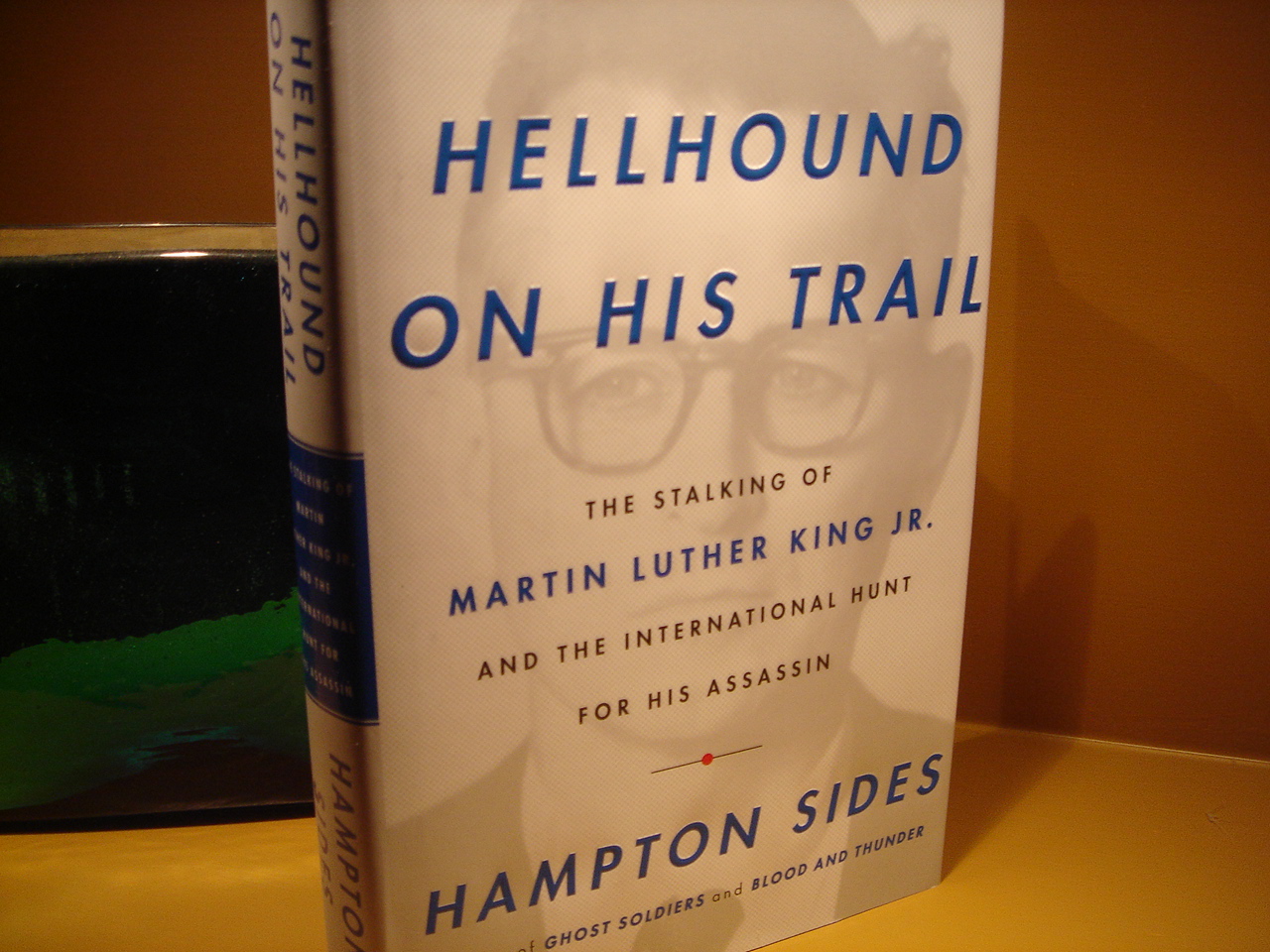
There is nothing really new here: no startling bombshell revelation of a conspiracy that has long been whispered about; no new eyewitness or piece of hitherto undiscovered shard of evidence; no new insight into the enigmatic Ray.
What is here in this book, and what makes it such a compelling read is how Sides lays it out like a detective novel, unfolding developments and clues in tantalizing morsels that whet the reader’s appetite and keep the pages turning for more. Sides draws on the many reams of investigative material, research, scholarly papers and personal interviews that rose out of this dark event and applies his considerable writing skill to craft a narrative that is hard to put down.
The characters are all here in bold relief: King himself, struggling to re-establish himself and non-violence as pre-eminent in the civil rights movement, against the rising tide of calls to racial violence; Ray, the murderous escaped con who swore he would kill the man he considered the leader of the race he hated; Ralph David Abernathy, King’s loyal friend and aide, but ultimately unequal to the task of being his successor; Coretta, the stoic widow; J. Edgar Hoover, who hated King and resisted taking over the murder investigation until he was ordered to do so by US Attorney General Ramsey Clark; Jesse Jackson, who would lie to try to claim the mantle of King’s successor; the FBI agents who undertook a seemingly impossible task and did a remarkable job of tracking down the killer in the largest manhunt in history; and the cast of casual bystanders who were caught up in the events. And, yes, there are some tawdry details about King’s personal life; those are an undeniable part of the true story.
Hampton Sides is a native Memphian with a good feel for the south. Despite the fact that he was only six years old when King was murdered, Sides is able to paint the landscape of racism and insensitivity to poverty that permeated the region in those days without resorting to the stereotypes and generalizations on which writers unfamiliar with southern folkways of the 1960’s so often fall back. His depiction of the south of 1968 is factual and stark. We thought we had come so far back then, but in retrospect some of the images are painful. There were Cal Alley’s racist and patronizing cartoons that I recall reading in the Memphis Commercial Appeal in those days. There is the depiction of the regal Cotton Carnival and its opulence set against the desparate poverty of the Memphis sanitation workers. There is the fact that racist groups raised hundreds of thousands of dollars for Ray’s defense and hailed him as a hero, a sobering reminder of a seamy underside of American society.
Reading this book will bring into focus how much America and the south have changed in 42 years. African-Americans are more incorporated into the mainstream now, in jobs, neighborhoods, schools and elected positions that were unimaginable in 1968. African-Americans are a growing segment of the middle class. It is not uncommon to see whites and blacks socializing together, something so innocuous today that would have raised eyebrows back then. Racial reconciliation is not an accomplished fact, but we have made a start thanks to the life and sacrifice of a man whose life was cut short by the very violence he repudiated.
TRIAL BY CHECKLIST: ATTORNEY’S FEES
July 9, 2010 § 20 Comments
A practice tip about trial factors is here.
If you are expecting an award of attorney’s fees in your case, you must put on proof of the quantity of work that was done to earn the fees, as well as the amount of the fees. In the case of McKee v. McKee, 418 So.2d 764, 767 (Miss. 1982), the Mississippi Supreme Court set out the following factors that must be considered by the court in determining the proper amount of attorney’s fees to be awarded:
- The parties’ relative financial ability;
- The skill and standing of the attorney;
- The novelty and difficulty of the issues;
- The degree of responsibility involved in management of the case;
- Time and labor;
- The usual and customary charge in the community;
- Preclusion of other employment as a result of accepting the case.
If McKee factor evidence is not submitted, the court may deny your prayer for attorney’s fee, and if the trial court does award it, it may be thrown out on appeal.
In a divorce case, an award of an attorney’s fee is properly made only to a party who proves inability to pay and there is proof of the McKee factors. In Turner v. Turner, 744 So.2d 332, 338 (Miss. App. 1999), the trial court’s award of attorney’s fees was reversed where no itemized account was introduced into evidence, and the only testimony of fees was that the fee charged was $1,500 and that the party seeking the award was unable to pay it.
In other cases, an award of attorney’s fees may be made regardless of ability to pay where the party is found in contempt, or is found guilty of dilatory behavior or behavior that causes the other party undue expense, or for frivolous litigation, or for unfounded allegations of domestic abuse. In such cases, the proof of attorney’s fees should be supported by proof of the McKee factors.
“QUOTE UNQUOTE”
July 8, 2010 § Leave a comment
“Everybody thinks of changing humanity, and nobody thinks of changing himself.” — Tolstoy
“‘Be yourself’ is just about the worst advice you can give some people.” — Tom Masson

Margaret Atwood
“You refuse to own yourself; you permit others to do it for you.” — Margaret Atwood
CHANGING LANDSCAPE IN CHANCERY COURT STATEWIDE
July 7, 2010 § Leave a comment
Lawyers from Meridian and Quitman often travel out of district to conduct business and try cases in other Chancery Courts. When they do in the coming year, they’ll have to adjust to some newcomers. Six Chancery Court Districts have contested races this judicial election year, and no matter who wins, several will result in new faces on the bench.
Nearby, in District 6, we have already bade farewell to Judge J. Max Kilpatrick, who retired effective June 30, and have welcomed new Chancellor D. Joseph “Joey” Kilgore, who was appointed by Governor Barbour to fill the post. Judge Kilgore had already qualified to run without opposition.
All of the other races across the state to replace retiring Chancellors,or, in one case, to fill a newly-created seat, are contested.
In District 7 (Tunica, Quitman, Coahoma, Tallahatchie and Leflore Counties), Place 1, Catherine Farris-Carter of Shaw and Tom T. Ross, Jr., of Clarksdale are vying to replace the retiring Judge William Willard.
Also in District 7, Place 3, W. M. Sanders of Greenwood and Jimmy Miller of Marks are facing off for a newly-created seat.
District 8 (Hancock, Harrison and Stone Counties) has six contestants to take the place of retiring Chancellor Margaret Alfonso. Qualified and running are: D. Scott Gibson, Jennifer Schloegel and Dara Skinner, all of Gulfport; and Robert G. Harenski, William E. Tisdale and Fran Yeatts, all of Biloxi.
In District 1o (Forrest, Lamar, Pearl River and Perry Counties), there are three candidates for Place 2, from which Judge Sebe Dale, dean of Chancellors, is retiring after a long and illustrious career. The candidates are Dawn H. Beam of Sumrall, Scott Phillips of Columbia, and Aaron L. Russell of Carriere.
There are only two incumbents facing opposition.
Chancery Judge Larry Buffington of Collins faces two opponents in District 13 (Covington, Jefferson Davis, lawrence, Simpson, and Smith Counties): Douglas MacArthur Magee of Mendenhall; and David Shoemake of Collins.
Chancery Judge Edwin H. Roberts, Jr. in District 18 (Benton, Calhoun, Lafayette, Marshall and Tippah Counties) is opposed by Helen Kennedy Robinson of Oxford.
TRIAL BY CHECKLIST
July 5, 2010 § 23 Comments
Some years ago an old Chancellor complained to me that we were being reduced to “trial by checklist,” what with all the cases being handed down that spelled out factors that the trial court must address in adjudicating certain issues. Over the years, those so-called checklists have multiplied, so that Chancellors are required to consider and address factors in determining:
- Child custody
- Equitable distribution
- Periodic and rehabilitative alimony
- Lump sum alimony
- Grandparent visitation
- Separate maintenance
- Modification of child support
- Adverse possession
- Attorney’s fees
Over time, I will be posting these factor “checklists” for your use.
Remember that these factors are the ones that must be decided by the judge in order to decide your case. In essence, the factors are the elements of the case that will determine its outcome. If you are not putting on proof as to each factor that applies in your case, you are running the risk that the Chancellor will find that there is not enough evidence to rule in your favor.
Practice Tip: When trying a case involving any of the foregoing issues, have a list of the factors applicable your case at hand, and methodically cover them in your questions for the witnesses. Give some thought to questions that will best develop evidence that will support a finding in your client’s favor for as many factors as possible, and how to minimize the impact of factors that are not in your favor.
July 4, 2010 § Leave a comment
We hold these truths to be self-evident, that all men are created equal, that they are endowed by their Creator with certain unalienable Rights, that among these are Life, Liberty and the pursuit of Happiness.

“QUOTE UNQUOTE”
July 2, 2010 § 2 Comments

Yes, this is she
“I would not live forever because we should not live forever, because if we were supposed to live forever then we would live forever, but we cannot live forever, which is why I would not live forever.” — Miss Alabama 1994
“The graveyards are full of indispensable men.” — Charles DeGaulle
“Death is the sound of distant thunder at a picnic.” — W.H. Auden
THE MARK OF THE BEAST
July 1, 2010 § 12 Comments
And he causeth all, both small and great, rich and poor, free and bond, to receive a mark in their right hand, or in their foreheads; And that no man might buy or sell, save he that had the mark, or the name of the beast, or the number of his name. Here is wisdom. Let him that hath understanding count the number of the beast: for it is the number of a man; and his number is Six hundred threescore and six. Revelations 13:16-18.
666. The number of the mark of the beast.
Irony of ironies, that is the section of the federal criminal code under which Dickie Scruggs and his cohorts were indicted for the crime of corruptly influencing a public official. 18 U.S.C. §666.
And so it was that Dickie Scruggs and his minions, bearing the mark, bought and sold justice in Mississippi.
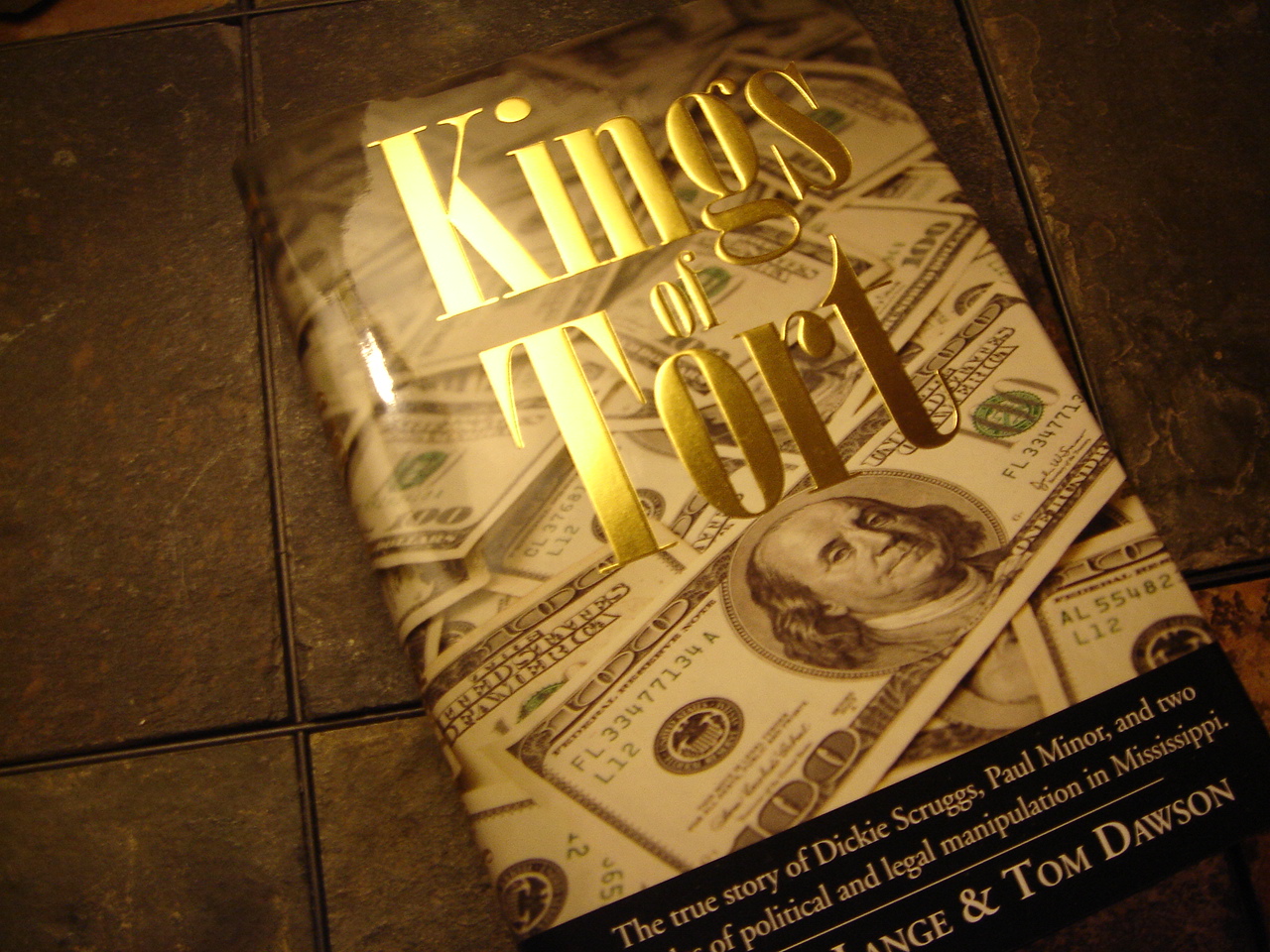
I have read KINGS OF TORT by Alan Lange and Tom Dawson, the enthralling story of how Dickie Scruggs and Paul Minor, in league with others, corrupted our legal system. The story is stomach-turning and fascinating at the same time, in the same way that one is revolted by seeing a person leap to his death from a tall building, yet can not look away. It is a story that will repel and anger honest lawyers and judges, and yet it is one that they must know. I feel strongly that it is a must-read for anyone who has practiced law or sat the bench in Mississippi, as well as anyone else who is interested in our state legal system.
KINGS OF TORT is the story of the rise and fall of some of the richest and most powerful lawyers ever known in Mississippi, and indeed in our republic, along with the judges they corruptly influenced. They are all here: Dickie Scruggs, Zach Scruggs, Paul Minor, Bobby DeLaughter, Joey Langston, Sid Backstrom, Tim Balducci, John Whitfield, Wes Teel, Ed Peters, Steve Patterson and others who, for money, or out of lust for power and control, or for sheer egotism, stole from one another and tried to manipulate and corrupt the legal system to achieve their ends. It’s all too unfortunately true, and it happened here in our state during our careers as we went about our quotidian legal tasks, unmindful of the cesspool growing only a few miles down the road that would engulf so many.
Authors Alan Lange and Tom Dawson each had a favored vantage point from which to view this Greek tragedy, act by act. Lange amassed literally tons of information on the various scandals by his untiring reporting on his blog, Y’all Politics. Dawson was one of the lead prosecutors in the Oxford U.S. Attorney’s office who helped design the strategy that brought down the Scruggs house of cards, from coordinating FBI investigation and search warrants to drafting the indictments and preparing for trial.
The downfall of Dickie Scruggs was a national story, reported as it unfolded in the New York Times and Wall Street Journal. Several Mississippi-based blogs followed the story closely and actually served as sources for the national press. Lange’s own Y’all Politics was a major player in revealing much information. Folo, now in hiatus, was energetic in pursuing the story, often breaking news that others missed, and one of its most astute contributors, NMC (who is Oxford atty Tom Freeland), continues with his own blog, NMissCommentor.
The improbable hero of this sordid saga is District 3 Circuit Judge Henry Lackey of Calhoun City, who toppled the kings of tort from their thrones by going to the U.S. Attorney and reporting that they were attempting to bribe him. He then wore a wire and captured the crucial evidence that first snared Balducci, and then took down Scruggs, Backstrom, Patterson and Langston. Judge Lackey is an engaging and self-effacing man with a wry humor. When the prosecutors warned him of the stress that his role as undercover witness would place on him and his heart problems, he smiled and said with country assurance, “Boys, don’t mind the mule, just load the wagon.” He would be the first to disclaim the hero label, pointing out that he only did what his oath and judicial ethics expected of him.
Most readers will find the writing in large part clear and easy to read. The authors do a good job of explaining complicated legal proceedings and concepts in a way that non-lawyers can easily grasp. What is unfortunately lacking in a book such as this with national exposure, however, is decent editing. It is bothersome that the writers appear not to know the difference between “affect” and “effect,” or that the correct pronoun to refer to a person is “who” rather than “that” (e.g., “He is the person that who loaned the money”), or that “tortuous” does not mean the same thing as “tortious,” or that the word “divulge” does not mean “deprive,” or that proper usage is “between him and … ” and not “between he and … “, or that the court room of the Calhoun County Court House is in Pittsboro and not Calhoun City, and that some of the clauses within clauses will make your head spin. Good editing would have cured those defects. Warts and all, though, it’s still a worthwhile and even essential read for Mississippi lawyers.
Buy this book and keep it in your law office library. Keep it handy. When you feel an itch to stretch ethical limits, even ever so slightly, to score big in a case, or to gain an upperhand, or you feel the temptation to shaft another lawyer who has been loyal and helpful to you, pull this book off the shelf and hold it. Remember those lawyers and judges marked with the number of the beast and ask yourself: “Do I really want to be like them?”
PROBATE OF WILL IN COMMON FORM
June 30, 2010 § 2 Comments
[This outline is based on the 15th Chancery Court District Newsletter published by Chancellor Ed Patten]
Admission of will to probate:
- Original will must be presented and filed, if available.
- Petition must have copy of the will attached. Uniform Chancery Court Rule 6.15.
- Will must be proven by at least one subscribing witness, usually through affidavit attached to self-proving will, or by proof of will executed later. §91-7-7, MCA.
Caveat:
- Will may not be probated in common form if there is a previously-filed written objection to probate. §91-7-21, MCA.
Executor appointed and Letters Testamentary Granted:
- Court appoints executor named in the will, if appropriate.
- Executor must be over 18 years of age, of sound mind, and not a convict of felony.
- If no person qualifies or agrees to act as executor, court may appoint one. §§91-7-35 and 91-7-39.
Oath and Bond:
- At the time that Letters Testamentary are granted, executor must take and subscribe the oath set out in §91-7-41, MCA.
- At the time that the executor takes the oath, the executor must also post bond equal to the full value of the estate, unless bond is waived by the terms of the will. Even so, the court has authority to require a bond. §91-7-41, MCA.
Notice to Creditors:
Executor has the responsibility to give notice to creditors in the prescribed form and in the proper order set out in §91-7-145, MCA, as follows:
- Executor to make reasonable effort to identify creditors having a claim against the estate and to mail them actual notice of the 90-day time period in which to file a claim.
- Executor must file an affidavit of known creditors and attest to having served actual notice on them.
- Executor must publish notice in newspaper publsihed in the county informing creditors that they have 90 days in which to file a claim against the estate; publication to run 3 times, once per week for 3 consecutive weeks.
- Executor is required to file proof of newspaper publication in the court file.
- Publication may be waived by the court in very small estates having value not more than $500.
Inventory and Appraisal:
- If not specifically waived in the will, the executor is required to complete and file inventory and appraisal within 90 days from the grant of Letters Testamentary. §91-7-45, MCA.
- The court may require inventory and appraisal eben if waived in the will.
Interim Hearings:
- Held as necessary to resolve interlocutory conflicts between the parties.
Accountings:
- Accountings are required annually and upon closing the estate.
- All parties may agree to waive final accounting, and by custom also annual accountings.
Petition to Close Estate and Discharge Executor:
- Final account must be filed with petition to close unless excused by the court.
- All parties in interest must be summoned to hearing on final account and petition to close. §91-7-295, MCA.
- Any party may enter an appearance by consent and waiver.
- If approved, the court enters its final judgment for final distribution of any property remaining in the executor’s care. §91-7-297, MCA.
CHANCERY COURT IN DAYS OF YORE, PART ONE
June 29, 2010 § 3 Comments
Last week in Clarke County I took the bench one day in a dark suit and dispatched the day’s business in that attire because my robe was in chambers with a Circuit Judge whom I did not wish to bother. The Chancery Clerk pointed out later that the younger lawyers were abuzz about it. They had never seen such a thing. Imagine — a judge adjudicating sans black robe.
Down through the decades it was a hallmark of our courts that the Chancery Judge did not wear a robe. The Chancellor presided in his (yes, in those days there were few female Chancery Judges) dark suit, dispensing equity like an ancient Titan loosing thunderbolts.
Long after Circuit Judges donned the robe, Chancellors continued unrobed. It was not until the late 80’s, as far as I recall, that Chancellors donned robes in our part of the state, and then not every Chancellor did. Judge John Clark Love in District Six never wore a robe until the day he retired in 2005. Neither did his counterpart, Judge Ed Prisock.
The philosophy behind the robe is that it instantly lends authority and recognition of office to the wearer, but Chancellors in those pre-robe days didn’t really need a cloak to lend them weight. Authority emanated from them like deadly radiation from a chunk of uranium. For those of us who practiced before some of the really great old lions of the Chancery bench, there was no question of authority. A wilting glance or stabbing remark could inflict a wound in one’s case that would bleed to a fateful conclusion. Heaven help the unprepared lawyer.
Billy Neville of Meridian was the commander of his court room. He sat on the bench, pipe jutting MacArthur-like out of his face, whittling on a cedar plug until he carved an eye-shaped piece — rounded in the middle and sharp on each end — whence he would start another. A lying witness never escaped his ire. “Suh!” he would thunder, “Do you expect me to believe that?” You knew that was coming because only a few questions before he had begin running his hand across his forehead and then over his scalp as first his cheeks and then his temples and then his forehead changed hues from peach to crimson to scarlet. “Mr. Bailiff, suh! Take this man upstairs!”
Judge Neville was also a master at communicating subtly to the attorney the futility of one’s case. “Yes, suh, I will sustain the objection because this has nothing to do with the case, and even if it did there is no law in Mississippi that would permit me to do what the Complainant has prayed for. Now you may proceed, suh.” Okay, how do you frame the next question when the judge has just let all the air out of your case?
Judge Ed Cortright of Yazoo City was a gentleman of the first order and a scholar of note in his long career on the bench. He was reversed on appeal only once that I know of, and that by Frank Coleman, now County Judge Coleman, of Meridian. As gentlemanly as he was, there was a steely side to Judge Cortright, and he could communicate his displeasure at a lawyerly gaffe in no uncertain terms. His disdain for the illogical argument or a position unsupported by the law was unmistakable.
Judge Mike Sullivan of Columbia was so revered and respected that he was elevated to the Supreme Court, where he made his mark as a voice for Chancery Court in the appellate court. His calm demeanor and measured speech left no doubt who was in control of his court room.
Judge John Clark Love of Kosciusko had a way of eviscerating lawyers who wandered ill-prepared into his lair.
Judge Ray Montgomery of Canton could shrink your head two to three sizes from his tirade if you wound up on his wrong side or if your case did not impress him.
There were many robeless Chancellors, too many to mention, some great and some forgettable. We sometimes quaked in their presence, but in the crucible of their courtrooms we were molded into better lawyers.

