PROBATE IN SOLEMN FORM
August 30, 2010 § Leave a comment
[This outline is based on the 15th Chancery Court District Newsletter published by Chancellor Ed Patten]
Petition filed to probate will in solemn form.
- Notice to all interested persons. § 91-7-19, MCA.
- Process is issued under Rule 81, MRCP.
- At the petition of either party, the issue of devisavit vel non — whether the will is the valid last will and testament of the decedent — may be tried.
Hearing.
- Either party may request a jury trial. § 91-7-19, MCA.
- Burden of proof is by a preponderance of the evidence.
- If the will has already been admitted to probate in common form, the prima facie burden of proof has been met, and the burden of proof shifts to the contestants to overcome thr proponent’s prima facie proof as to the will’s validity. § 91-7-27, MCA.
- Tactical advantage if the will has already been admitted to probate in common form. § 91-7-29, MCA.
Adjudication.
- Binding on those made parties to the proceeding.
FIVE YEARS AFTER
August 29, 2010 § Leave a comment
It was five years ago today — August 29, 2005 — that Hurricane Katrina brought death and devastation to New Orleans, the Mississippi Gulf Coast and south-central Mississippi.
The news this weekend cast the familiar images of flooded homes in the Lower Ninth Ward, Bay St. Louis reduced to piles of debris, the Superdome, victims clamoring for help, and on and on.
The storm was still powerful when it crossed east Mississippi near Newton, bringing 85-mile-per-hour winds with gusts to 105 here in Meridian. More than one thousand homes in Meridian suffered serious damage. It took nearly two weeks to restore electric service throughout the city and county, and the damage to structures took years to repair. The devastation was astonishing considering that Meridian is nearly 200 miles inland.
In the years since Katrina the Mississippi Gulf Coast has rebounded well. Rebuilding is a continuing process, and there are ongoing battles between property owners and insurers, but the resilience of the Coast makes all Mississippians proud.
 New Orleans, on the other hand, has struggled. The dysfunctional near-anarchy of the Big Easy that has always been one of its most endearing features as an entertainment center has not served it well in its efforts to recover. The city’s population is significantly reduced (the poverty-plagued Lower Ninth Ward had 18,000 residents before the storm and now has around 1,800), and many damaged neighborhoods, particularly in the east, remain mostly boarded up and abandoned. There are still 50,000 abandoned homes in the city. Convention business and tourism, the lifeblood of the city, are greatly diminished. New Orleans is down, for sure, but not out. New Orleans is now the fastest-growing city in the US. The New York Times has an interesting article, with video, showing evolution of two streets near the Industrial Canal in the Lower Ninth both before and since Katrina [Thanks to nmisscommentor for letting us know about it]. There is a University of Southern California study of damage in the area, with video, here.
Today, three tropical cylones are churning across the Atlantic, with yet another tropical wave trailing them out of Africa. Is our next Katrina among them? We pray not.
THE LAST BATTLE OF THE CIVIL WAR
August 28, 2010 § 2 Comments
Through the spring and summer most of my reading has been books dealing with the South in general and Mississippi in particular in the last half of the twentieth century, the era of the struggle for civil rights I still have a few more to read on the topic before I move on to other interests.
One of the seminal events of the civil rights era was the admission of James Meredith as a student at the University of Mississippi in 1962. The confrontation at Ole Miss between the determined Meredith, backed by the power of the federal government, and Mississippi’s segregationist state government culminated in a bloody battle that resulted in two deaths and a shattering blow to the strategies of “massive resistance,” “interposition,” and “states rights” that had been employed to stymie the rights of black citizens in our state.
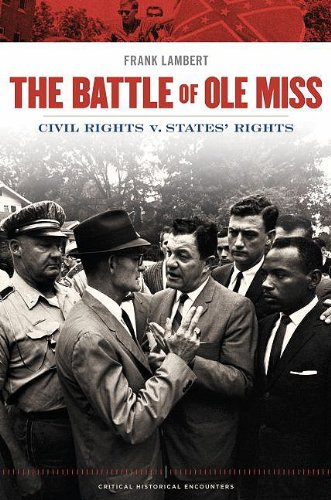 Frank Lambert has authored a gem of a book in THE BATTLE OF OLE MISS: Civil Rights v. States Rights, published this year by the Oxford University Press. If you have any interest in reading about that that troublesome time, you should make this book a starting point.
Lambert, who is a professor of history at Purdue University, not only was a student at Ole Miss in 1962 and an eye-witness to many of the events, he was also a member of the undefeated football team at the time, and his recollection of the chilling address delivered by Governor Ross Barnett at the half-time of the Ole Miss-Kentucky football game on the eve of the battle is a must-read.
This is a small book, only 193 pages including footnotes and index, but it is meticulously researched. As a native Mississippian and eyewitness, Lambert is able not only to relate the historical events, he also is able to describe the context in which they happened.
The book lays out the social milieu that led to the ultimate confrontation. There is a chapter on Growing Up Black in Mississippi, as well as Growing up White in Mississippi. Lambert describes how the black veterans of World War II and the Korean conflict had experienced cultures where they were not repressed because of their race, and they made up their minds that they would challenge American apartheid when they returned home. Meredith was one of those veterans, and he set his sights on attending no less than the state’s flagship university because, as he saw it, a degree from Ole Miss was the key to achievement in the larger society. He also realized that if he could breach the ramparts at Ole Miss, so much more would come tumbling down.
The barriers put up against Meredith because of his race were formidable. He was aware of the case of Clyde Kennard, another black veteran who had tried to enroll at what is now the University of Southern Mississippi, but was framed with trumped-up charges of stolen fertilizer and sentenced to Parchman, eventually dying at age 36. And surely he knew of Clennon King, another black who had managed to enroll at Ole Miss only to be committed to a mental institution for his trouble. Even among civil rights leadrs, Meredith met resistance. He was discouraged by Medgar and Charles Evers, who were designing their own strategy to desegregate Ole Miss, and felt that Meridith did not have the mettle to pull it off. Against all of these obstacles, and in defiance of a society intent on destroying him, Meredith pushed and strove until at last he triumphed.
But his triumph was not without cost. Armed racists from throughout Mississippi, Alabama and other parts of the South streamed to Oxford in response Barnett’s rallying cry for resistance. The governor’s public rabble-rousing was cynically at odds with his private negotiations with President John Kennedy and US Attorney General Bobby Kennedy, with whom he sought to negotiate a face-saving way out. The ensuing battle claimed two lives, injured 160 national guardsmen and US marshals, resulted in great property damage, sullied the reputation of the university, tarred the State of Mississippi in the eyes of the world, led to armed occupation of Lafayette County by more than 10,000 federal troops, and forever doomed segregation. Ironically, the cataclysmic confrontation that Barnett and his ilk intended to be the decisive battle that would turn back the tide of civil rights was instead the catalyst by which Ole Miss became Mississippi’s first integrated state university. It was in essence the final battle of the Civil War, the coup de grace to much of what had motivated that conflict in the first place and had never been finally resolved.
As for Meredith, the personal cost to him was enormous. He was subjected to taunts and derision, as well as daily threats of violence and even death. He found himself isolated on campus, and did not even have a roommate until the year he graduated, when the second black student, Cleveland Donald, was admitted. Meredith described himself in 1963 as “The most segregated Negro in the world.”
The admission of James Meredith to Ole Miss not only opened the doors of Mississippi’s universities to blacks, it also helped begin the process in which Mississippians of both races had to confront and come to terms with each other as the barriers fell one by one. As former mayor Richard Howorth of Oxford recently told a reporter: ” … other Americans have the luxury of a sense of security that Mississippi is so much worse than their community. That gives them a sense of adequacy about their racial views and deprives them of the opportunity we’ve had to confront these issues and genuinely understand our history.”
Meredith’s legacy is perhaps best summed up in the fact that, forty years after his struggle, his own son graduated from the University of Mississippi as the Outstanding Doctoral Student in the School of Business, an event that Meredith said, ” … vindicates my entire life.” His son’s achievement is the culmination of Meredith’s singular sacrifice. What Meredith accomplished for his son has accrued to the benefit of blacks and whites alike in Mississippi, and has helped our state begin to unshackle itself from its slavery to racism.
“QUOTE UNQUOTE”
August 27, 2010 § Leave a comment
“In the name of God, stop a moment, cease your work, look around you.” — Leo Tolstoy
“Two men came to a hole in the sky.
One asked the other to lift him up…
But so beautiful was it in heaven that
the man who looked in over the edge
forgot everything, forgot his companion
whom he had promised to help up
and simply ran off into all the
splendor of heaven.”
— Igliuk Inuit poem

Kurt Vonnegut
“I want to stay as close to the edge as I can without going over. Out on the edge you see all kinds of things you can’t see from the center.” — Kurt Vonnegut
TRIAL BY CHECKLIST: PERIODIC AND REHABILITATIVE ALIMONY
August 27, 2010 § 19 Comments
A practice tip about trial factors is here.
Armstrong vs. Armstrong, 618 So.2d 1278, 1280 (Miss. 1993), sets out the factors that the trial court must consider and address in making a determination about whether to award periodic and/or rehabilitative alimony. They are:
- The income and expenses of the parties.
- The health and earning capacities of the parties.
- The needs of each party.
- The obligations and assets of each party.
- The length of the marriage.
- The presence or absence of minor children in the home, which may require that one or both parties either pay, or personally provide, child care.
- The age of the parties.
- The standard of living of the parties, both during the marriage and at the time of the support determination.
- The tax consequences of the spousal support order.
- Fault or misconduct.
- Wasteful dissipation of assets by either party.
- Any other factor deemed by the Court to be “just and equitable” in connection with the setting of spousal support.
Before the court can reach the issue of alimony, the court must first adjudicate equitable distribution and determine whether any need for alimony can be alleviated by a greater share of equitable distribution. This means that the factors for equitable distribution (Ferguson factors) must be presented in alimony cases. If, after equitable distribution, the court finds that the needs of both parties are met and there is no disparity, the court does not consider alimony.
Professor Deborah Bell in her MISSISSIPPI FAMILY LAW treatise and her annual seminars has done some important research into how length of marriage and relative income affect awards of periodic, rehabilitative and lump-sum alimony. You should become very familiar with her work if you are going to take on an alimony case.
Caveat: This is an area of the law in flux, and the cases are significantly fact-driven. You should do some research for authority supporting your position pro or con before going to trial. There is plenty of case law on both sides of the issue.
WHO RETAINS THE ORIGINAL OF A PROBATED WILL?
August 26, 2010 § 13 Comments
Twice this summer, the deputy Chancery Clerks in Lauderdale County have been confronted by lawyers wanting to probate original wills and demanding to retain the original. One was from another district with large cities to our west, and the other was, I am sad to report, from closer to home. The clerks, I am glad to report, stood their ground and demanded the original for filing. Both lawyers condescendingly made it clear that our clerks are backward ignoramuses, and one went so far as to say that ours is the only district that makes the ridiculous demand for the original will. Which is where I was called in — apparently it is the Chancellor’s role to determine as between eminent lawyers and lowly clerks just who is the backward ignoramus.
Now, in all my years in the law, I had never heard of a lawyer in Mississippi retaining an original will after its admission to probate. But then again, we are more or less country peasants in this part of the state, and some things do pass us by. As is my anachronistic, unsophisticated practice, I sought for the answer in that arcane repository of gnostic mysteries of the law that remain so seemingly inaccessible to most practicing attorneys: The Mississippi Code.
It only took me a few minutes to leaf directly to Section 91-7-31, MCA, which states:
All original wills, after probate thereof, shall be recorded and remain in the office of the clerk of the court where they were proved, except during the time thay may be removed to any other court under process, from which they shall be duly returned to the proper office. Authenticated copies of such wills may be recorded in any county in this state.
So there you have it. The statute unambiguously requires that the original must be surrendered to the clerk of the court where the will is probated, and the clerk is responsible to record it and keep it.
Even though the truth revealed in the statute would seem to be clear, I realize that I do learn something new each day, and I posited to myself that there might be some angle to this issue that was known only to these superior attorneys that neither I, nor the state legislature, nor nearly 200 years of Mississippi jurisprudence had taken into account. Accordingly, I raised the question at the Chancery Judges’ study meeting last weekend whether any judges were aware of any districts where the statute was not being followed, or of any exception to the rule, and the unanimous response was no.
In our own, primitive way here in the hinterland, we try to follow the law, and when we do so, we will look first to the Mississippi Code and the Chancery Court Rules and not to the lawyer’s interpretation. We know that is a backwards and so 20th-century approach, but that is the old-fashioned way we still do it. We apologize if that offends your more cosmopolitan sensibilities that may not allow you time between workouts at the gym to look up the law. If our humble practice is too “slow lane” for you, perhaps you should pass that estate off to a local lawyer who is more accustomed to our rustic ways.
Practice Tip: (1) Read and know the law. (2) Apply Practice Tip (1) before acting like a jerk toward the Chancery Clerks. Oh, and while you’re at it, refresh yourself on the Mississippi Lawyer’s Creed, especially that part that reads: “To the courts, and other tribunals, and to those who assist them, I offer respect, candor, and courtesy. I will strive to do honor to the search for justice.”
IS THIS THE SOLUTION TO PRO SE LITIGATION?
August 25, 2010 § 7 Comments
A post about proposed changes to the pro bono rules for lawyers is here. There is a thoughtful comment to that post that highlights some dimensions of the situation.
It’s no secret that pro se litigants are appearing more and more frequently in Chancery Court. Whenever I ask a self-represented litigant why he or she did not hire an attorney, cost is always the response.
In our district, it’s not uncommon for a simple, irreconcilable differences (ID) divorce to cost upward of $1,500 to $2,500, plus court costs, although I have heard of some lawyers charging as little as $250 plus costs for an ID divorce with no children.
Self-representation, however, is not limited to routine, uncomplicated matters like ID divorces involving no children, no property, no joint debts and no other problems. I see pro se litigants in all kinds of matters. I presided over a termination of parental rights case not too long ago where the father represented himself and lost. I have seen pro se litigants in an adverse possession case, contempts, paternity, and even in a partition suit where, believe it or not, both sides were pro se. I can say unequivocally that I have never seen a party who proceeded pro se in a contested case leave the courtroom in better shape legally or equitably than he or she was when they walked in.
Although most all say that they choose to proceed pro se due to the rising cost of legal fees, I find in the course of things that others simply underestimate the complexity of the issues involved and think that legal matters are little more than filling out a few sheets of paper and filing with the court. Still others are lured by the siren-song of the internet sites that push cheap fill-in-the-blank do-it-yourself legal proceedings. The common denominator among all of these is that they are looking for a cheap, one-size-fits-all, easy solution to what may be a complicated situation.
These are the people who wind up in court pro se. In many cases, those pro se parties are getting simple ID divorces using kits they purchased on-line. Some are getting pleadings prepared by “secretarial services,” in violation of state law prohibiting practice of law without a license. The simple cases with no children do not usually give rise to later litigation. Pro se litigants with children, however, are a recurring problem.
Problems with child support provisions, joint and sole custody provisions, division of property, and allocation of debts are all common problems in these do-it-yourself cases. I have one pair of parties in Clarke County that I have sent back to the drawing board four times, and, although they are my most extreme case, they are by no means the only case that I have had to treat that way. I have just about decided that, if there are children, I will require the parties either to have an attorney or I will appoint a guardian ad litem at their expense.
The self-represented parties seldom understand why they can’t simply have their papers signed, and they are invariably frustrated when I tell them that I can not advise them how to draft an acceptable child support provision, or why that waiver filed a week before the complaint won’t cut it, or why they need a property settlement agreement when they don’t have any property.
How do we make legal services more affordable, thus reducing the pool of pro se litigants? Some claim that “limited scope representation,” also known as “unbundling” is the answer to lower legal fees. In essence, it is a representation arrangement in which the respnsibility of the lawyer is limited and the fee is resultingly lower. The attorney may, for instance, agree only to advise one of the parties about the language of the property settlement and child support agreement, or simply to prepare pleadings. The clients buy only as much legal service as they feel they need.
The Supreme Court’s Commission on Access to Justice proposed an amendment to Rule 1.2 of the Rules of Professional Conduct to allow for limited-scope representation. They met on Monday, August 23, and since the comment period has expired, I assume they will pass the rule on to the Supreme Court for adoption. I am all for it.
Although the proposed rule approves and encourages the practice, it does not address how a representation agreement would read so as to cover all of the ethical concerns that might arise. There is information available online, however, that may provide a starting point for lawyers. The LAWYERS USA website offers some information. The ABA has some info. The Civil Justice Network also has some info. A paper presenting the pros and cons of the practice is here.
Whether limited scope representation is the answer to the growing numbers of pro se litigants, I have no way of knowing. I do believe that it has the potential to help dramatically because it will decrease the amount of time judges will need to devote to scrutinizing pro se litigants’ pleadings and paperwork.
One caveat: I will not approve a limited-scope representation arrangement in any probate matter. Rule 6.1 of the Uniform Chancery Court Rules requires that every fiduciary retain an attorney, and you will be expected to continue in your role as counsel once you are in until you find substitute counsel. I will not allow the operation of the new rule (if it is enacted) to create an end-run around Rule 6.1.
An approach to the pro se phenomenon that I can not endorse is continued encouragement of laypeople to tackle more of their own legal matters. I saw a bar-produced video of smiling legal professionals encouraging people to handle their own “routine” legal matters, and making it sound as easy as folding a paper airplane. I don’t understand this approach. The American Medical Association does not promote do-it-yourself tonsillectomies, but then medical ethics includes the fundamental proscription, “Do no harm.” To me, the solution is not to encourage people to do their own legal surgery. The answer is to make it more likely that they will have a competent surgeon.
I am not a fan of pro se litigation. Even seemingly simple, routine matters may have serious implications for the parties, and I assure you that they have absolutely no clue about those ramifications. Self-represented litigants seldom have a grasp of the ramifications and complexities of equitable distribution, the various forms of child custody, or joint debt, to name but a few of the many legal snares that await the unwary. Also, the parties are under no duty to be honest and forthright with the court, leaving open the very real possibility of fraud or worse. Without legal advice and the check that an ethical attorney provides, the parties’ paperwork can create more problems than it solves, and even in the absence of lawyers it is clearly not the duty of the judge to advise them about the possible mess they may be creating. Yet, every day, inexorably, we see more and more self-represented litigants.
I am a firm believer in access to justice, but in our commendable haste to discover a way to do that, let us not lose sight of what it is we are trying to achieve: access to justice. Not access to disaster. Limited scope representation may be a good first step toward alleviating this problem.
PROPOSED CHANGES TO RULE 8.05
August 24, 2010 § Leave a comment
The Supreme Court has posted proposed revisions to Uniform Chancery Court Rule 8.05 and your comments are invited.
There is, arguably, no Uniform Chancery Court Rule that affects Chancery practitioners more strongly than 8.05. If you have a position on this proposal, you need to make it known before final action. The deadline is September 20, 2010.
” ‘TIL DEATH DO US PART” — OR MAYBE NOT
August 24, 2010 § Leave a comment
Charles Allen and Janet Allen were divorced in 2002, but they continued a relationship and even resumed wearing their wedding rings. They opened a joint checking account and made plans to move in together. They spent every weekend together, and Charles even had a private line installed in Janet’s residence so that they could talk with one another whenever they wished. Janet said “It was like we were never divorced.” Eventually, they saw where the relationship was headed and decided to set aside the divorce so they could get back together.
On May 17, 2006, they filed a joint petition in the Chancery Court of Pearl River County to revoke the divorce as provided in § 93-5-31, MCA. So far, so good. Only problem is that Charles died June 16, 2006, before the court could hear any testimony on the petition.
The specific code section invoked by the joint petition reads as follows:
The judgment of divorce from the bonds of matrimony may be revoked at any time by the court which granted it, under such regulations and restrictions as it may deem proper to impose, upon the joint application of the parties, and upon the production of satisfactory evidence of their reconciliation.
The Chancellor quashed the petition nearly a year later on condition that he would allow Janet to file a timely request for reconsideration if she could show sufficient facts of reconciliation.
Janet did file for reconsideration, and the Chancellor found after hearing that she had presented proof sufficient to satisfy the criteria for revocation of the divorce. He entered a judgment revoking the divorce, and the Administrator of Charles’s estate appealed.
In Carlisle v. Allen, 2009 WL 1758864 (Miss.Ct.App. June 23, 2009), a case of first impression, the Court of Appeals reversed, holding that, although Janet had produced sufficient evidence to support a finding of reconciliation, the trial court has no authority to reinstate the marriage because of Charles’s death. The court reasoned that since death of a party to a divorce ends the status of marriage and would even have the effect of nullifying a divorce action, the purpose of the statute, which the court found was “to reunite two formerly married persons as a married couple,” would be thwarted because there “is no status of marriage upon which to operate.”
Janet filed a petition for certiorari, which was granted.
On cert, the Supreme Court reversed the Court of Appeals and reinstated the Chancellor’s decision. In Carlisle, Adm’r of the Estate of Allen v. Allen, No. 2007-CT-02047-SCT, the court held that Janet had met all of the criteria of the statute, had presented satisfactory evidence in support of it, and that it was not error for the Chancellor to grant the revocation in such a situation, regardless of Charles’s intervening death. The opinion pointed out that there is nothing in the statute that required both parties to be alive when the revocation is ordered, and that it was error for the Court of Appeals to analogize the action to a divorce action, where the applicable law is not necessarily the same.
There are some procedural disagreements between the majority and the dissenters that hinge on the timeliness of the motion to reconsider and the trial court’s jurisdiction as a result. That is an issue for another post.
As a practical matter, this case is mostly of academic interest since petitions for revocation are pretty rare. I only presented two in 33 years of practice and have had none come before me on the bench. Interestingly, I did have a case where my client died before the divorce judgment could be signed by the Chancellor, but after the Chancellor had rendered his opinion from the bench. In that case, White v. Smith, 645 So,2d 875 (Miss. 1994), the Supreme Court upheld Chancellor Shannon Clark’s entry of a Judgment of Divorce nunc pro tunc after the death.
This Allen case raises what I consider to be a couple of valid questions: Why do we need this statute? Would we not be better off if it were repealed?
The first question is based on the simple fact that the parties are free to remarry at any time with little bureaucracy, which is in my opinion the preferable manner to effect their reunion. Why would they prefer to hire an attorney, draft pleadings, set a court date, appear and testify, and await the judge’s ruling? I am speculating here, but I believe it is reasonable to assume that this statute is an adjunct to the Chancellor’s power to forbid the remarriage of the parties due to adultery (still in the code at § 93-5-25, MCA), and perhaps this statute was a way for parties to get around that injunction. In any event, I am not aware of any case in my career in practice or on the bench where a Chancellor has entered such an injunction, and certainly not in the 21st century. What other reason is there for this law to continue in effect?
My second question stems from the fact that since this statute was enacted, the landmark Ferguson case and its offspring have taken root in our jurisprudence, giving rise to many questions about the accumulation of marital assets between the time that the divorce judgment is entered and the date it is revoked. Consider, for example, that the husband got title to the former marital residence in the divorce and has made all mortgage payments in the interim. Is the residence restored to its status as marital property (notwithstanding title)? And what are the parties’ respective equitable interests in it? Remarriage would set a clear demarcation as opposed to revocation, which raises more questions than it answers.
Something to think about.
WHEN IS MODIFICATION OF CHILD SUPPORT EFFECTIVE?
August 23, 2010 § Leave a comment
A judgment modifying child support upward may be effective on the date that the petition is filed, or on a later date “within the sound discretion of the trial court.” Lawrence v. Lawrence, 574 So.2d 1376, 1384 (Miss. 1991). In Frazier v. Burnett, 767 So.2d 263, 268 (Miss. App. 2000), the court stated that the “best practice” is to make the modification retroactive to the date of filing.
A judgment modifying child support downward or terminating it may not be retroactive because each child support payment vests when and as due, and may not be forgiven. Cumberland v. Cumberland, 564 So.2d 839, 847 (Miss. 1990).
§ 43-19-35 (4), MCA, effective July 1, 2010, and repealed automatically July 1, 2011, includes the following curious language:
(4) “Any order for support of minor children … shall not be subject to a downward retroactive modification. An upward retroactive mofidication may be ordered back to the date of the event justifying the upward modification.” [Emphasis added]
What exactly is the date of the event that would justify the upward change is not defined, nor have there been any cases construing the statute.
The question arises from time to time whether the court may order retroactivity without a request therefor in the pleading. Chancellors in my experience are split, some taking the position that it must be pled, some saying that it need not be since it is in the discretion of the trial judge. My own position is that it is a simple Fifth Amendment due process matter. You are trying to take someone else’s money, and because you are, you are required to put that person on notice and afford the opportunity to defend. In my opinion, the opposing party needs to be put on notice of whatever relief you are seeking, including retroactive modification, and that without that notice, the court can not grant your client that relief.
Clearly the safest position is to include a prayer for retroactive relief in every petition to modify child support. Get in your computers and add that language to your petition for modification of child support.

