CALCULATING CHILD SUPPORT FOR OUTSIDE CHILDREN
November 8, 2011 § Leave a comment
MCA § 43-19-101 is the statute that prescribes the formula for calculating child support. I’ll leave it to you to re-read it (or to actually read it for the first time, if you’ve never bothered). I do suggest you read it, because from the questions I get about the statute, it’s clear that not all of you have done so.
There are two provisions in the statute that deal with how to consider child support for the payor’s other children:
- § 43-19-101 (3)(c) provides that any amounts due for prior court-ordered child-support for other children must first be deducted.
- § 43-19-101 (3)(d) provides that if the payor is parent of other children who live with him, and there is no other court order for the other children who live with him, the chancellor may deduct an amount “appropriate to account for the needs” of the other children who live with him.
The statute does not address the situation that arises when the payor has other children who do not live with him, and for whom there is no court-ordered child support. That was the situation that presented itself in Knighten v. Hooper, handed down by the COA on September 6, 2011.
Hooper and Knighten lived together for a brief time, and their relationship produced a son, CJ. After CJ was born, Knighten had relationships with two different women that resulted in three children.
Hooper sued Knighten for for child support for CJ. After a hearing on the matter, the chancellor ruled that neither party had overcome the presumption that the statutory child support guidelines were applicable. She calculated that guideline child support for CJ should be 14% of Knighten’s adjusted gross income, or $526.21. The chancellor went on to say that, ” [t]he court does consider that Mr. Knighten has three other minor children that he has to provide for … The court further considers all other factors and finds that it is reasonable for Mr. Knighten to pay … $400 per month.”
Knighten appealed, complaining that the chancellor had failed to make findings of fact sufficient to support the reduction of child support. Reading between the lines, it appears that he felt that the reduction for the outside children should have been greater than the 24% of adjusted gross income that the chancellor allowed.
The COA found no error in the chancellor’s approach. The court noted that the two statutory deductions for other children did not apply, and then stated, beginning at ¶ 11:
“Although the deductions did not apply, the chancellor decided that it was equitable to consider Knighten’s other children. Chancellors may deviate from the child-support guidelines if they determine, in writing, that application of the guidelines would be unjust or inappropriate in the particular case. Miss. Code Ann. § 43-19-101(2). When deciding whether a deviation is appropriate, chancellors may take into account, among other things: “[a]ny . . . adjustment which is needed to achieve an equitable result which may include, but not be limited to, a reasonable and necessary existing expense or debt.” Miss. Code Ann. § 43-19-103(i) (Rev. 2009).
¶12. Here, the chancellor wrote that “[t]he Court does consider that Mr. Knighten has three other minor children that he has to provide for . . . . The Court further considers all other factors and finds that it is reasonable for Mr. Knighten to pay . . . . $400 per month.” Thus, the chancellor determined, in writing, that a deviation from the guidelines was appropriate based on a reasonable and necessary existing expense – namely, Knighten’s obligation to support his other children.
¶13. Knighten correctly argues that the chancellor did not explain in detail how she settled on the precise amount of $400. However, he cites no authority that supports his proposition that such a detailed explanation was required. The chancellor was faced with great uncertainty in this case. Given the informal arrangement Knighten had with the mothers of his other children, it was unclear exactly how much Knighten paid to support the children. When there is no court-ordered child support for the other children, there will inevitably be uncertainty in this regard. In light of that uncertainty, chancellors must be afforded flexibility and discretion so that they may do equity under the circumstances.
¶14. The chancellor, in her discretion, determined that a downward deviation in the amount of $126.12 per month was appropriate and equitable in light of Knighten’s obligations to his other children. We find that the chancellor’s decision was within her discretion. This issue is without merit.”
In a footnote, the court declined to consider whether later-born children are entitled to any consideration in calculation of child support for earlier born children. Some jurisdictions take the position that payors should not be allowed to place the first-born children at a financial disadvantage by continuing to procreate.
The opinion seems to imply that it was doubtful whether Knighten was actually paying any support for the three after-born children. In that situation, any reduction would be a direct benefit to him and not to the children. The chancellor was obviously conflicted about what the COA described as this “uncertain” situation. The COA afforded her the flexibility and discretion she needed to address it.
JUDGE MAXWELL’S PRIMER ON HCIT
November 7, 2011 § 8 Comments
Habitual Cruel and Inhuman Treatment (HCIT) as a ground for divorce can be an elusive concept. It’s almost seems to be an “eye of the beholder” phenomenon.
In the case of Smith v. Smith, rendered November 1, 2011, by the COA, Judge Maxwell penned about as concise an exposition on the legal basis of the ground as you will find. Here is an excerpt from the opinion:
In Mississippi, one of the twelve fault-based grounds for divorce is habitual cruel and inhuman treatment. Miss. Code Ann. § 93-5-1 (Supp. 2011). To obtain a divorce on this ground, the plaintiff must show conduct that either:
(1) endangers life, limb, or health, or creates a reasonable apprehension of such danger, rendering the relationship unsafe for the party seeking relief, or (2) is so unnatural and infamous as to make the marriage revolting to the non-offending spouse and render it impossible for that spouse to discharge the duties of marriage, thus destroying the basis for its continuance.
Richard v. Richard, 711 So. 2d 884, 889 (¶22) (Miss. 1998). The plaintiff must prove one of these two prongs by a preponderance of the credible evidence. Shavers v. Shavers, 982 So. 2d 397, 403 (¶35) (Miss. 2008).
¶11. In reviewing a divorce based on cruelty, “[t]here is a dual focus on the conduct of the offending spouse and the impact of that conduct on the offended spouse.” Bodne v. King, 835 So. 2d 52, 59 (¶24) (Miss. 2003). Evaluating the impact on the offended spouse is a subjective inquiry. The focus is on the effect the conduct has on the particular spouse, not its effect on an ordinary, reasonable person. Faries v. Faries, 607 So. 2d 1204, 1209 (Miss. 1992). The plaintiff must show a casual connection between the defendant’s conduct and the impact on the plaintiff. Id. And the defendant’s cruelty must not be too temporally remote from the separation. See Richard, 711 So. 2d at 890 (¶23) (finding a divorce may be granted based on “habitual or continuous behavior over a period of time, close in proximity to the separation, or continuing after a separation occurs[.]”); see also Deborah H. Bell, Bell on Mississippi Family Law § 4.02[8][b]-[c] (2005) (explaining that a strict causal connection between the conduct and the separation is no longer a required element of proof).
¶12. Generally, the party alleging habitual cruelty must corroborate his or her own testimony. Shavers, 982 So. 2d at 403 (¶35). An exception is made in cases where corroboration is not reasonably possible because of the nature of the accusation. Bell § 4.02[8][d]; see also Jones v. Jones, 43 So. 3d 465, 478 (¶30) (Miss. Ct. App. 2009). “‘[C]orroborating evidence need not be sufficient in itself to establish [habitual cruelty],’ but rather ‘need only provide enough supporting facts for a court to conclude that the plaintiff’s testimony is true.’” Jones, 43 So. 3d at 478 (¶30) (quoting Bell § 4.02[8][d]).
¶13. To prove habitual cruelty, the plaintiff must show more than mere unkindness, rudeness, or incompatibility. Robison v. Robison, 722 So. 2d 601, 603 (¶5) (Miss. 1998). Although in cases of violence a single incident may be sufficient for a divorce, generally the plaintiff must show a pattern of conduct. See Curtis v. Curtis, 796 So. 2d 1044, 1047 (¶8) (Miss. Ct. App. 2001). When there is no violent conduct involved, we review the facts on a case-by-case basis, taking into account the frequency and severity of the conduct, as well as the impact on the plaintiff. See Bell § 4.02[9][b]. “There are many kinds of acts such as wilful failure to support, verbal abuse, neglect, and the like which, if taken alone will not constitute cruelty, but when taken together will manifest a course of conduct as a whole which may amount to cruelty.” Jackson v. Jackson, 922 So. 2d 53, 57 (¶8) (Miss. Ct. App. 2006).”
* * *
“Our supreme court has observed “[t]he words ‘unnatural and infamous’ have not been precisely defined by precedent because the plain meanings of those words are sufficient.” To determine the plain meaning of words, we look to their dictionary definition. Gilmer v. State, 955 So. 2d 829, 834 (¶13) (Miss. 2007). The American Heritage Dictionary 1956 (3ded. 1992) defines “unnatural” as “[d]eviating from a behavioral or social norm[.]” “Infamous” means “[c]ausing or deserving infamy; heinous[.]” Id. at 924.
¶16. In McIntosh v. McIntosh, 977 So. 2d 1257, 1267 (¶¶37-38) (Miss. Ct. App. 2008), this court found a wife’s conduct relating to the parties’ finances amounted to habitual cruelty under the “unnatural and infamous” prong. The wife in McIntosh forged her husband’s name to savings bonds, cashed them without notifying him, and pretended to help him look for them afterward. We found: “Such acts certainly qualify as conduct that could have rendered the marriage revolting . . . and could have made it impossible . . . to discharge the duties of marriage.” Id. at 1267 (¶38). In Jones, 43 So. 3d at 471-72 (¶10), 473-74 (¶¶15-16), 477-78 (¶¶26, 29), we found a husband’s substantial gambling losses—when combined with his verbal abuse and sexual demands—rose to the level of habitual cruel and inhuman treatment. Though proof of the gambling losses was limited, the wife testified the losses were $100,000. Id. at 471 (¶10).”
* * *
“¶22. Habitual cruelty may be found from a series of acts, ‘such as wilful failure to support, verbal abuse, neglect, and the like which, if taken alone will not constitute cruelty, but when taken together will manifest a course of conduct as a whole which may amount to cruelty.'” Jackson, 922 So. 2d at 57 (¶8).
DICTA
November 4, 2011 § Leave a comment
- What Mississippi crimes will cost you your voting privilege if you’re convicted? Tom Freeland has an enlightening post about the confusing state of Mississippi’s disenfranchisement law.
- It’s up for a vote on Nov. 8. The NYT weighs in on Mississippi’s proposed “personhood amendment.“
- And, another NYT article, this on the decline of manners in the south.
- Locked out of your house, computer, wifi or garage? Lifehack offers top 10 ways to unlock the unlockable.
- Brian Palmer at Slate on why you should be drinking cheap wine. Like less than $5.00 a bottle.
- An elegy to handwriting by Ann Wroe at More Intelligent Life.
- Quite possibly the silliest opinion ever from the Mississippi Supreme Court. Thus Blogged Anderson revisits Justice Roberston’s embarassingly bombastic opinion in Dycus v. Sillers, 557 So. 2d 486 (Miss. 1990).
- SF Chronicle: A record 49% of all Americans live in a family where at least one member receives some type of government benefits. 63% of all federal spending is checks to individuals for which the government receives no services.

BACK IN THE DAY WHEN LAW SCHOOL WAS REALLY TOUGH
November 3, 2011 § 2 Comments
Law school ground you down, eh? Con Law especially rugged? Took you a while to get back on your feet?
Well, you only thought you had it tough. Take a look at this sad tale of an overzealous law student from the Chicago Tribune’s June 8, 1900, edition.
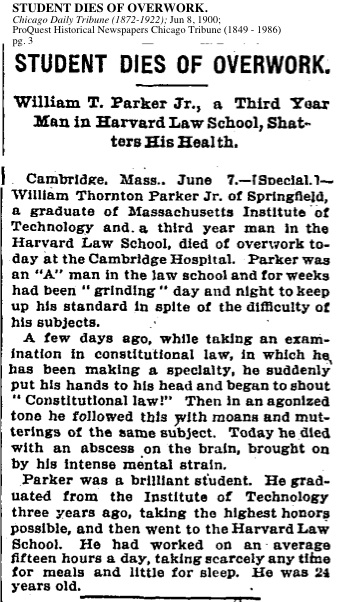
“CONSTITUTIONAL LAW!” he shouted. Indeed. If that had been me, I would have yelled “REAL PROPERTY” and swooned dead away.
___________________________________________________________
Thanks to The Law Life.
4 WAYS TO LOSE THE NATURAL PARENT PRESUMPTION
November 2, 2011 § 3 Comments
It’s an axiom of Mississippi law that the natural parents, if fit, are presumed to have the first right against everyone else in the world to have custody of their children. K.D.F. v. J.L.H., 933 So.2d 971, 980 (Miss. 2006). This means that, if the natural parent is challenged for custody by a non-parent, there must be a showing of unfitness that will trigger an Albright analysis to determine the best interest of the children.
That presumption, however, can be lost. Here are the 4 ways:
- Voluntary Court Order. If the parent voluntarily relinquishes custody and there is a court order to that effect, the presumption is lost, and the party to whom custody is relinquished gets custody until there can be shown to be a material change in that person’s household that is having an adverse effect on the children, and it is in the best interest of the children to change custody. Grant v. Martin, 757 So.2d 264 (Miss. 2000). In Grant, the MSSC held that the natural mother who had agreed by court order giving her parents custody had given up the natural parent presumption, with the effect that she had to prove material change-adverse effect-best interest to regain custody. Under Grant, it is immaterial whether the natural parent is unfit or has abandoned or deserted the children; the operative fact is the agreement memorialized by a court order. Note that the court has declined to extend Grant to include temporary orders. Vaughn v. Davis, 36 So.3d 1261, 1266 (Miss. 2010).
- Abandonment. A parent who is shown by “clear proof” to have abandoned the children has lost the presumption. McKee v. Flynt, 630 So.2d 44, 47 (Miss. 1993). Abandonment is ” … any conduct on the part of the parent which evinces a settled purpose to forego all duties and relinquish all parental claims to the child …” In re Leverock and Hamby, 23 So.3d 424, 429 (Miss. 2009), citing Ainsworth v. Natural Father, 414 So.2d 417, 419-20 (Miss. 1982), which defined abandonment as including both active relinquishment and avoidance of duty.
- Desertion. Inaction or avoidance of duty toward the children. Requires clear and convincing evidence. In Leverock, at 33, the Court found that a father had deserted his son by completely avoiding both his moral and legal duties and obligations as a father for more than two years, during which time he had showed a complete disregard for the welfare of his son. The court said that the father had chosen “ ‘to take an extended holiday from the responsibilities of parenthood’ and we find that he should not now be able to claim the benefit of his status as a natural parent….” Once the finding of desertion is made based on clear and convincing evidence, the court must embark on an Albright analysis.
- Adjudication of Unfitness. When the court awards custody to a third party based on the natural parent’s unfitness, the presumption no longer applies, and the material change-adverse effect-best interest standard applies. Adams v. Johnson, 33 So.3d 551, 555 (Miss. App. 2010).
PLEADINGS AND THE PROOF
November 1, 2011 § 2 Comments
“It is the pleading that makes the case for adjudication, and it is the evidence that sustains or defeats it upon the final hearing.” Terry v. Jones, 44 Miss. 540, 1871 WL 8413 (1871).
Voilà! After 140 years and a sea-change in the rules of Mississippi pleading, that ancient formula holds oh-so true in our courts. The pleadings frame the issues; the evidence admitted at trial determines the outcome.
Put another way: THE PLEADINGS ARE NOT EVIDENCE.
This immutable principle has not only for ages been a bedrock of procedure in Mississippi courts, it has also been the rock that has dashed the case of many an unseasoned or unwary practitioner.
Don’t ever assume because you have pled something that the court will take it as true. On the contrary, without actual evidence in the record, the court can not take it as true, whether it wants to or not.
I have seen lawyers leave key elements of their cases lying on the court room floor simply because they neglected to offer proof thereof. This is a chronic problem when it comes to claims for attorney’s fees, but the problem is not limited to that issue. I see Rule 59 motions more frequently than I’d like where the motion claims I “overlooked” a point, but the attorney concedes that the witness never testified about the matter. I should grant the motion, the lawyer pleads, because it was, after all, in the pleadings.
Here’s the deal: If you don’t include a properly-pled issue in your pleadings, the court can not consider it. BUT, just because it is in your pleadings does not mean it is established; you still have to put on evidence in support of it.
THE LAW OF INTENDED CONSEQUENCES
October 31, 2011 § Leave a comment
Who owns a joint savings account? If your answer is that each person named on the joint account owns 100% and is entitled to withdraw and spend all of it, step right up here with us other average intellects.
If, on the other hand, your answer was to the effect that “It depends on what the parties intended,” then take your gold star and step over there with all the other geniuses.
Here is a scenario to illustrate:
Marie, Edward, Josie and Bennie are siblings. Together they open two savings accounts and a CD for the benefit of their elderly parents.
Each account requires the signature of two of the four parties to make a withdrawal.
The mother died, and after her death Marie and Edward unilaterally withdrew some of the money and put it in a “safe place” to be used to do some repairs on property owned by the dad in which the four siblings had an ownership interest. The father then died.
It is undisputed that the siblings had agreed when they opened the accounts that, upon death of the parents, any money remining was to be divided equally among all four siblings.
Josie and Bennie took exception to the withdrawal and filed suit in circuit court for charging Marie and Edward with the tort of conversion. Marie and Edward took the position that each sibling possessed an equal ownership interest in the accounts, and that they had legal authority to make the withdrawals. They denied that there was any conversion as a matter of law, because they had absolute authority to withdraw the funds. Josie and Bennie took the position that the withdrawal violated the parties’ agreement, and that the funds were being unlawfully withheld.
The circuit judge granted summary judgment in favor of Josie and Bennie, and Marie and Edward appealed.
In the case of Stevens and Bohannon v. Smith and Bohannon, decided October 4, 2011, by the COA, the court affirmed the circuit court.
The decision recited the familiar rule of joint accounts:
Regarding joint accounts, it is well settled in Mississippi that joint-account holders have given each other absolute authority over an account “and the unconditional power to withdraw all or any part of the account.” Triplett v. Brunt-Ward Chevrolet, Oldsmobile, Pontiac, Buick, Cadillac, GMC Trucks, Inc., 812 So. 2d 1061, 1066 (¶9) (Miss. Ct. App. 2001) (citing Deposit Guar. Nat’l Bank v. Pete, 583 So. 2d 180, 184 (Miss. 1991)).
Although Marie and Edward had the unqualified right to withdraw the funds, they did not have the right to deprive Josie and Bennie of their right to an equal interest in the funds. The court said at ¶ 12, Citing Drummonds v. Drummonds, 248 Miss. 25, 31, 156 So.2d 819, 821 (1963), that ” … joint accounts are presumed to be vested in the names of the account depositors as equal contributors and owners in the absence of evidence to the contrary; however, intent of the parties is the controlling factor.” And:
The peculiar features of a joint and several bank account make it difficult, if not impossible, in most cases, to determine what portion of the account belongs to each depositor. A long series of deposits which cannot be traced to their source, and a similar series of withdrawals which cannot be traced to their destination, are normally involved. This defect is inherent in the severalty feature of such bank accounts wherein each depositor is allowed to treat joint property as if it were entirely his own. A joint bank account of this kind is generally a creature of contract between parties avowedly indifferent to the exact percentage of ownership between themselves. It is said that the law should take them at their word and give effect to their contract without making detailed evidentiary inquiries to establish factual ownership. The prevailing view seems to be, however, that while joint accounts are presumed to be vested in the names as given in the deposit as equal contributors and owners in the absence of evidence to the contrary, the intention of the parties is the controlling factor, and where a controversy arises as to the ownership thereof evidence is admissible to show the true situation.” [Emphasis in bold added]
Since the undisputed proof in this case was that the parties had agreed to a joint ownership arrangement for the funds remaining after the parents’ death that were not needed for their care, it was conversion for Marie and Edward to deprive Josie and Bennie of their share of the funds.
The decision does not mention the parol evidence rule. It seems to me that there are parol evidence considerations in that the agreement to deposit the money into a joint account is a contract evidenced by the signature card and the bank regulations that are usually printed on it. Doesn’t this case in essence say that the agreement between the parties can be varied by parol evidence even when the agreement is not shown to be ambiguous?
So what are the ramifications of this case for family law practitioners? In my opinion, this rationale opens another line of attack in the situation where one spouse has withdrawn money from a joint account in anticipation of divorce. I say “another line of attack” because claiming the money is subject to equitable distribution is the usual, obvious course. But what if, for instance, it is undisputed that the parties had agreed that the proceeds from sale of husband’s separately-owned horses that were deposited into a joint account were to be used specifically to pay for the college education of his child by a previous marriage instead of being divided? Or what if it had been agreed that the joint income tax refund that was deposited in a joint account was to be used 100% to pay off husband’s credit card debts that had been incurred for the household? In either case where you represented the husband, it would clearly be in his interest to look to the intent of the parties rather than to equitable distribution.
“QUOTE UNQUOTE”
October 28, 2011 § 2 Comments

San hunters of the Kalahari
“Among the San Bushmen of South Africa … the hunt for game with poison-tipped arrows depends on moving rapidly across the veld. … When men become too old to participate in the hunt, they become makers of arrows — and tradition ascribes to the arrow maker the primary credit for the kill. … Similarly, only when women are too old for childbearing are they permitted to become shamanic healers, a translation of the love and care they have given their children to the health of the wider community. In both cases, an appropriately limited effort is recognized as having a profound value.” — Mary Catherine Bateson
“The great thing about getting older is that you don’t lose all the other ages you’ve been.” — Madeleine L’Engle
“When I was young, I was amazed at Plutarch’s statement that the elder Cato began at the age of eighty to learn Greek. I am amazed no longer. Old age is ready to undertake tasks that youth shirked because they would take too long.” — W. Somerset Maugham
ANYWAY
October 27, 2011 § Leave a comment
People are often unreasonable, irrational, and self-centered. Forgive them anyway.
If you are kind, people may accuse you of selfish, ulterior motives. Be kind anyway.
If you are successful, you will win some unfaithful friends and some genuine enemies. Succeed anyway.
If you are honest and sincere people may deceive you. Be honest and sincere anyway.
What you spend years creating, others could destroy overnight. Create anyway.
If you find serenity and happiness, some may be jealous. Be happy anyway.
The good you do today, will often be forgotten. Do good anyway.
Give the best you have, and it will never be enough. Give your best anyway.
In the final analysis, it is between you and God. It was never between you and them anyway.
_______________________________
Credited to various sources, but it doesn’t matter who came up with it; it’s a way to live as a lawyer.
WHAT PRICE JUSTICE?
October 26, 2011 § 2 Comments
There were lawyers ‘way back in 1960. You youngsters will have to take my word for that. Heck, I will even have to take my word for that, because I was a mere 11 years old at the time.
Those 1960’s lawyers had the ingenious idea that bar-mandated fee schedules would accomplish some good things, such as providing some protection for clients against unconscionable fees, giving lawyers a framework for determining what would be reasonable, and would give the courts a measuring device.
I remember when I was admitted to the Mississippi bar, all of us received a navy binder with ethical rules, useful telephone numbers and mailing addresses, and fee schedules. Later, as a young lawyer in Memphis in 1974, I received my copy of the Memphis and Shelby County bar’s fee schedule.
We lawyers all regarded fee schedules as a benign thing.
Then the US Supreme Court saw a bugbear lurking among that legal finery, and declared fee schedules unacceptable. Legal fees were free to float through the ceiling, and, indeed, the roof; clients be danged. Freed of gravity, legal fees have done what all things do when unfettered by an earthward pull.
Meridian lawyer Dan Self brought me a fascinating document published May 2, 1960, by the Mississippi State Bar. It’s entitled Fee Computation and Law Office Management. It offers a look at how law practice has changed, as well as how it hasn’t changed, in the intervening 51 years. I won’t bore you with the rusty nuts and bolts of law office management, but I am sure you will find some of the fee schedule entertaining. Consider:
- Advice and consultation by telephone or in office … $5.00
- Advice and consultation out of lawyer’s office … $10.00
- Preparation of Articles of Partnership with capital less than $5,000 … $150.00
- Incorporation (obtaining charter, drafting by-laws, conducting first meeting of stockholders and directors and preparing minutes thereof, and reporting organization to the Secretary of State) … $250.00
- Will or codicil for estate with value less than $2,500 … $15.00
- Will or codicil for estate with value greater than $2,500 … $25.00
- Certficate of title for 32-year chain of title … $50
- Complaint for divorce, custody or separate maintenance, uncontested … $100.00
- Complaint for divorce, custody or separate maintenance, contested … $150.00, plus time for trial
- Chancery court trials: Preparation of pleadings … $100; Court appearances per day … $150
I can testify that these fees were aspirational by the time I spent any time in Mississippi court rooms. Around 1981, I tried a three-day trial before then-Chancellor Howard Pigford. Since I prevailed, he awarded my client a “reasonable attorney’s fee” in the princely sum of $150. That was $50 a day for some heavy lifting.
 The Better Chancery Practice Blog