2012 LAWS THAT MAY AFFECT YOUR CHANCERY PRACTICE
May 9, 2012 § Leave a comment
Here is the final list of 2011-2012 legislative session bills that passed both houses. Some of these are awaiting the governor’s signature.
HB 159. Revises confidentiality in domestic abuse cases. Although this statute is among the criminal procedure laws, it offers some guidance for the chancery/county court practitioner who handles domestic violence cases about who is entitled to confidentiality in such cases, what information should be treated as confidential, and some means to accomplish it. Signed by the Governor. Effective July 1, 2012.
HB 484. Judicial pay raise. Discussed here before. Signed by the governor.
HB 780. Revises jurisdiction in domestic violence cases. This bill makes several significant changes. Venue is in the county where the alleged abuse occurred, and if the case is filed in the wrong county the judge “shall transfer” the action to the appropriate venue. A chancellor presented with a petition for emergency relief may refuse to consider it, but not for the sole reason that it should have been filed in justice or county court instead. The obvious problem with requests for emergency relief in chancery is that they can be used to “poison the well,” so to speak, or to prejudice the chancellor for or against a party in a pending divorce case. This bill makes many other changes to the law that you need to be aware of if you do any domestic violence practice. It has been signed into law by the governor, and takes effect July 1, 2012.
HB 1157. Conforms DHS child support enforcement to federal requirements. A few minor tweaks to the law, passed in conference, not yet signed by the governor.
HB 1268. Revises various statutes pertaining to adoption. If you do any adoptions at all, you must get familiar with this bill. It amends MCA 93-17-3 to add the requirement that a home study be done in all adoptions, and to provide that no out-of-state residents may adopt unless they have first complied with the Interstate Compact for Placement of Children, and adds some post-placement reporting requirements. It requires that the Indian Child Welfare Act be complied with as a prerequisite to adoption in appropriate cases. It amends MCA 93-17-6 to require DNA testing when the father appears or contests, and, most importantly, clarifies the publication requirements for an unknown father. It adds an interesting qualifier to the provision that the parental rights of a father who has not “met his full responsibilities of parenthood” be terminated by tacking on the phrase “and is unwilling to do so,” changing, in my opinion, the emphasis from past non-performance to past non-performance coupled with future unwillingness. The bill passed conference and is awaiting the governor’s signature.
HB 1588. Appropriations for the judicial branch.
HB 2256. Prohibits sex offender access to MYCIDS, beaches and campgrounds. This bill adds more proscriptions against sex offender activity where they may come into contact with children, prohibiting them from beaches and camp grounds where children gather. They are also prohibited from accessing the youth court MYCIDS data base. The bill also permits youth court referral to drug courts. Signed by the governor. Effective in part on passage, and in part on July 1, 2012.
HB 2367. Clarifies the definition of abuse and neglect of vulnerable adults. Amends MCA 43-47-5 and other statutes to clarify the definition of abuse and neglect as it relates to vulnerable adults. Signed by the governor. Effective July 1, 2012.
Click on this link to view a list, with links, of all the legislation affecting courts that passed during this session.
MORE ABC’S OF GRANDPARENT VISITATION
May 8, 2012 § Leave a comment
We’ve talked here and here about who are the necessary parties in a grandparent-visitation case under MCA 93-16-3. Here is a link to a post on the ins and outs of grandparent visitation.
After the petitioner has established entitlement to grandparent visitation under the statute, the chancellor must apply the factors set out in Martin v. Coop, 693 So.2d 912, 916 (Miss. 1997). The Martin v. Coop factors are here, in checklist form.
In the recent COA case of Bolivar v. Waltman, decided April 3, 2012, Judge Maxwell outlined the decision-making process:
Once the statutory criteria are established, the chancellor must apply the following Martin factors to determine appropriate visitation:
1. The amount of disruption that extensive visitation will have on the child’s life. This includes disruption of school activities, summer activities, as well as any disruption that might take place between the natural parent and the child as a result of the child being away from home for extensive lengths of time.
2. The suitability of the grandparents’ home with respect to the amount of supervision received by the child.
3. The age of the child.
4. The age, and physical and mental health of the grandparents.
5. The emotional ties between the grandparents and the grandchild.
6. The moral fitness of the grandparents.
7. The distance of the grandparents’ home from the child’s home.
8. Any undermining of the parent’s general discipline of the child.
9. Employment of the grandparents and the responsibilities associated with that employment.
10. The willingness of the grandparents to accept that the rearing of the child is the responsibility of the parent, and that the parent’s manner of child rearing is not to be interfered with by the grandparents.
Townes v. Manyfield, 883 So. 2d 93, 95-96 (¶17) (Miss. 2004) (quoting Martin, 693 So. 2d at 916). The Mississippi Supreme Court has explained that “making findings of fact under the Martin factors is an integral part of a determination of what is in the best interest of a child.” Id. at 97 (¶29) (quoting T.T.W. v. C.C., 839 So. 2d 501, 505 (¶12) (Miss. 2003)). Because of the “integral” nature of these findings, our supreme court specifically instructs that “the Martin factors are to be applied and discussed in every case in which grandparent visitation is an issue.” Id. (emphasis added).
¶11. There is additional general guidance regarding the amount of visitation that should be awarded. “The visitation granted to a grandparent should be less than that which would be awarded to a non-custodial parent, unless the circumstances overwhelming[ly] dictate that that amount of visitation is in the best interest of the child, and it would be harmful to the child not to grant it.” Id. at 96 (¶21). And in cases where “a chancellor finds . . . a grandparent should be awarded equivalent visitation to that of a parent, those findings must be fully discussed on the record.” Id. at 97 (¶29).
¶12. Further, we note that the grandparent-visitation statute and the Martin factors apply whether the grandparent is seeking visitation from a natural or adoptive parent. T.T.W., 839 So. 2d at 503-06 (¶¶1-2, 7, 10, 17) (finding grandparent-visitation statute and Martin factors applicable where maternal grandparents adopted children, and paternal grandmother sought visitation); see also Woodell v. Parker, 860 So. 2d 781, 785-86 (¶15), 789-90 (¶29) (Miss. 2003). Thus, we find it logical that both the grandparent-visitation statute and the Martin factors should similarly apply to the present situation where a grandparent is seeking visitation rights from the children’s legal guardians. See Townes, 883 So. 2d at 97 (¶29) (instructing that Martin factors must always be applied where grandparent visitation is at issue).
¶13. Because chancellors are required to make specific findings on the Martin factors in every case involving grandparent visitation, the supreme court has vacated grandparent visitation awards unsupported by such findings. Townes, 883 So. 2d at 97-98 (¶30); T.T.W., 839 So. 2d at 506 (¶17); Morgan v. West, 812 So. 2d 987, 992 (¶14), 997 (¶38) (Miss. 2002).
On remand, the chancellor should fully discuss his findings concerning the grandparent visitation statute and Martin factors. Failure to do so may amount to reversible error. See Townes, 883 So. 2d at 97-98 (¶¶28-30).
If your opinion or judgment does not include findings on the Martin factors, file a timely MRCP 59 motion asking the court to make such findings. That assumes, of course, that you put on enough evidence for the court to make such findings. As Judge Maxwell so clearly states, every grandparent vissitation case pivots on the Martin factors. They are vital to your case. Question the witnesses using them. Make your record, and make sure the chancellor addresses them in the ruling.
Only last week the MSSC unanimously upheld the constitutionality of Mississippi’s grandparent visitation statute and application of the Martin factors. We’ll talk about that later.
GETTING THE THIRD DEGREE
May 7, 2012 § 2 Comments
Every now and then you run into a statute that requires you to join a relative “within the third degree.” MCA § 93-19-3, for removal of disabilities of minority, requires that, if the parents are not living, you must join as defendants ” … two of his adult kin within the third degree, computed according to the civil law …” A similar provision is in MCA § 93-13-281, dealing with suits involving wards.
So who exactly are the kin within the third degree? Parent, child, brother, sister, grandparent, grandchild, aunt, uncle, niece, nephew, great-grandparent and great-grandchild.
That’s what the Nolan Chart of Relationships and Degrees of Kindred According to the Civil Law tells us. You can find it reproduced in the Alabama case of Owen v. State, 255 Ala. 354, 355, 51 So.2d 541, 542 (1951). It has been cited in Mississippi appellate cases, such as Matter of Estate of Ford, 552 So.2d 1065, 1066-67 (Miss.1989).
You’ll find the Nolan Chart useful in many ways. When you are trying to determine heirs in an estate, it helps you to translate “She was my grandmother’s sister’s daughter’s third child” into a relationship that even a judge could understand.
An added bonus of the chart is that it will help you understand, once and for all, that your first cousin’s children are not your second cousins. Check out the chart for yourself and you’ll see.


CARROLLTON
May 5, 2012 § Leave a comment
 Carrollton, population 400, County Seat of Carroll County, population 10,500, a hillcountry county for the most part, falling off into the Delta along its western edge. The Carroll County Picture Show in Bobbie Gentry’s Ode to Billy Joe was here. The movie version of Faulkner’s The Reivers, starring Paul Newman, was filmed in Carrolton. The extinct hamlet of Avalon, in northwest Carroll County, was the birthplace of bluesman Mississippi John Hurt.
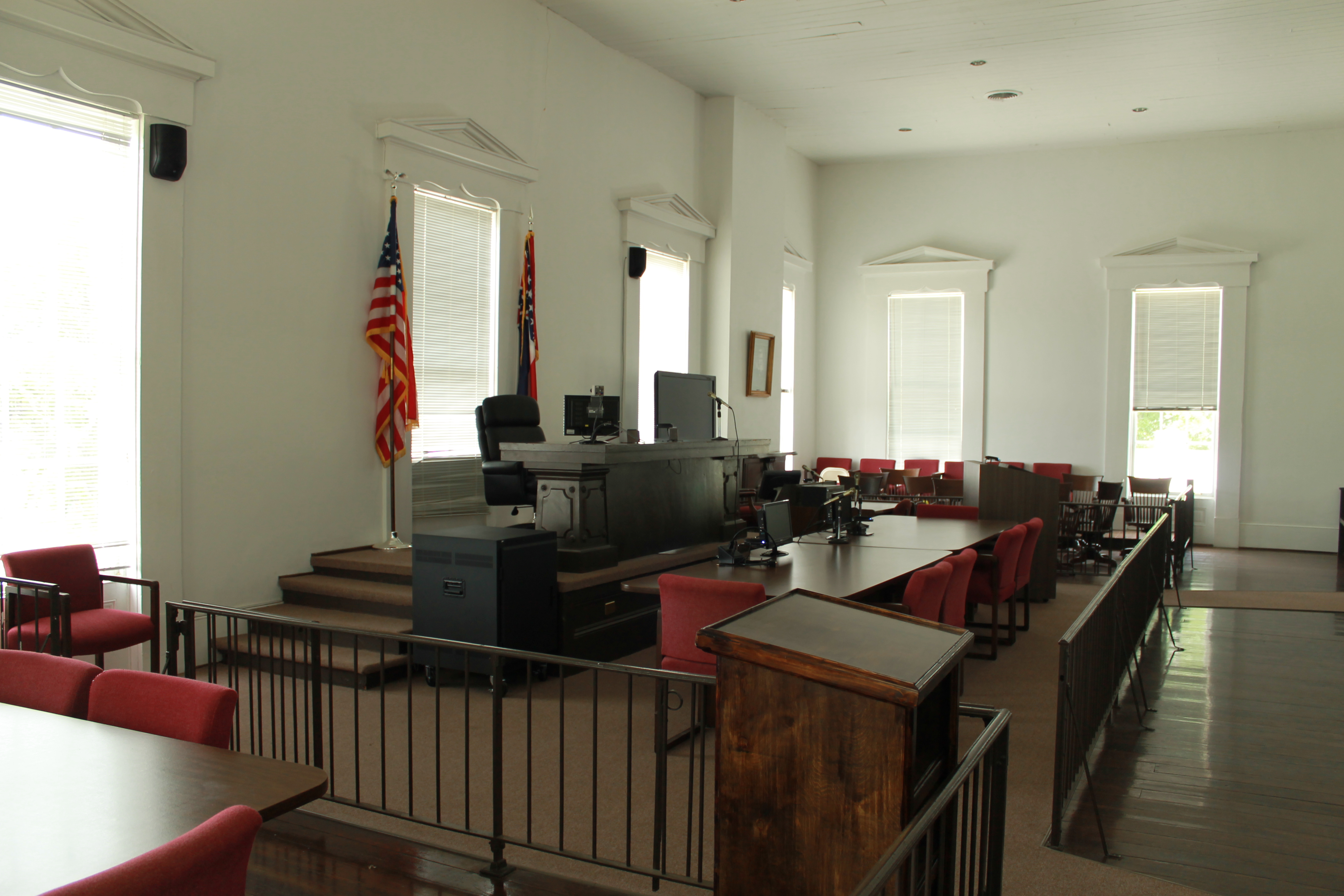
The courthouse in Carrollton was built around 1870 and features breezeway halls that cross perpendicularly. The halls are cool in the summer and cold in winter. A dog was enjoying the cool of the concrete floor on the warm afternoon when we dropped in. Upstairs is the old court room, its electronic trial gadgets adding a discordant punctuation to the plain, stately setting.
The day we visited, jail trustees had just finished moving all of the Justice Court records out of the old courthouse to the newer, storefront version in Vaiden, in the southern part of the county. Vaiden is the largest town in mostly rural Carroll County, and is the seat of the County’s other judicial district. Carroll is one of around 10 Mississippi Counties that have 2 judicial districts, making them for court purposes like two separate, distinct counties. It’s an archaic concept, but unlikely to be undone any time soon, since Carrollton and Vaiden are unfriendly rivals.
Across from the courthouse to the north is the white frame building that was the 19th-century law office of James Zachariah George, a formidable figure in Mississippi history. You can see it in street scene photo below. J.Z. George was a native of Georgia who moved to Mississippi. He fought with Jefferson Davis in the Mexican-American War and later became a lawyer. He was a reporter for the Mississippi Supreme Court, and signer of Mississippi’s Ordinance of Secession. He was an officer in the Civil War, and was taken prisoner twice. After the war, he served as Chief Justice of the Mississippi Supreme Court, and later as US Senator. His statue is Mississippi’s offering in Statuary Hall in the US Capitol.
Carrolton is a sleepy town that seems to cling tightly to its past, as the photos suggest. There are old homes and old churches, the flag of a defeated cause, and a patina of faded glory.











TOP TEN TIPS TO IMPRESS A CHANCELLOR AT TRIAL: #9
May 3, 2012 § 4 Comments
This is the second in a series counting down 10 common-sense practice tips to improve your chancery court trial performance. If you’re a long-time reader of this blog, some of these will be familiar. That’s okay. They bear repeating because they are inside tips on how to impress your chancellor, or at least how to present your case in a way that will help her or him decide in your favor.
TOP TEN TIP #9 …
Make sure your witnesses are prepared.
I am regularly astonished at how unprepared and consequently inept some witnesses are at trial. Some examples:
-
The party who testifies to her 8.05 as if it were a runic stone tablet that fell to earth from the planet Uranus instead of as if it were a document she herself helped to originate.
-
The lawyer who slams his head repeatedly against objections for leading because he can’t come up with any other way to clue his witness in to what he expects the testimony to be.
-
The client who probably presented herself as a roaring lion in the intial interview, and is now a mewing pussycat, much to the obvious chagrin and buffaloment of her attorney.
These and many, many other unpleasant witness experiences can be avoided, or at least ameliorated, through the simple expedient of trial preparation in which the lawyer familiarizes the witnesses with what is headed down the tracks right at them. It’s what your client paid you for.
Prepare your witnesses for trial. Go through their testimony. Test their recollection.
Go over that 8.05 with your client. Remember that although it’s not the first one you’ve ever seen, it probably is the first one your client has. Clients have no concept how important and even crucial the financial form is to their case. Consequently, they are haphazard and careless in prepping them, omitting important items, overstating (often absurdly) some expenses, while drastically understating others. Challenge your client’s memory as to what was included in each category and how the figures were determined. Make her defend her figures. If she can not, suggest she reconsider and adjust as necessary to make it true. Is each and every asset listed, and are the values realistic? Ten tips for more effective financial statements are here. And five more are here.
Explain for your client what the trial factors are that will apply in your case, and what the important facts are that you need to get into the record. For instance, if you have a child custody modification case, explain material change, plus adverse effect, plus best interest, Albright factors, and how his or her testimony fits into the picture. Go over some expected questions and critique your client’s answers.
Weed out self-destructive language. It’s not ethical to tell a witness what to say, but it’s perfectly ethical to tell the witness how to say what they have to say. In other words, you can’t change the facts, but you can help the witness select a better, truthful way to state those facts.
Encourage your witness never to volunteer or guess. “I don’t know” is a better answer than “Well, you didn’t ask me, but I guess I was at fault, if you think I am.”
Train your witness to paint a word picture of what happened instead of just babbling a bunch of labels. “The windows were all busted out of the house, the wallpaper was ripped down, there was a puddle of blood on the floor as big as a sow pig, and there was a fire burning in the kitchen trash can making a scorched spot on the ceiling,” is a lot more effective than “The house was tore slam up.”
And while you’re at it, teach your witness some points of court room etiquette: don’t speak over the lawyers or judge; speak loudly and clearly; don’t chew gum or chewing tobacco in court; stand when directed by the bailiff. Every judge has his or her own preferences and quirks. Any lawyer who has spent even a short time in my court can tell you, for example, that I can’t abide witnesses and lawyers speaking over each other. That’s a quirk of mine that you should warn your witnesses about. Your judge has similar idiosyncracies. I practiced before a chancellor decades ago who could not stand to see women in short or low-cut dresses. I know it’s so un-twenty-first-century, but if you find yourself in a similar throwback situation, prudence would suggest that you warn your client in advance so that she could adjust her trial-day wardrobe accordingly.
Warn your client not to get argumentative or sarcastic with opposing counsel no matter how big a jerk he acts like he is.
Tell the witness how the proceedings will go and what to expect. Most people headed to court only have tv as a frame of reference for what to expect. Tell them how the case will proceed and who all the people will be in the court room.
Explain that it’s a lot less damaging to be hurt by the truth than to be caught in a lie.
If you take your client’s money and don’t prepare him or her for trial, you are taking money under false pretenses. And if you think you will slide it by an oblivious judge, think again. The unprepared witness is usually the second-most embarassingly conspicuous aspect of a trial, right after the unprepared lawyer.
A 54(b) HICCUP
May 2, 2012 § 4 Comments
MRCP 54(b) provides that, when a case involves multiple claims for relief, or multiple parties, the court may enter a final, appealable judgment as to fewer than all of the issues, or as to only certain parties, upon a determination that there is no just reason for delay, and at the trial court’s expressed direction for entry of the judgment. We have referred to it here as “Rule 54(b) certification.” Without such certification, the court’s ruling is not appealable, does not terminate the action, and is subject to revision at any time before entry of a final judgment disposing of all claims against all parties. It’s a subject we’ve dealt with here repeatedly: here, here, here, here and here.
In Wilton Acquisitions Corp. v. First Methodist Church of Biloxi, decided by the COA April 3, 2012, the chancellor dismissed Wilton’s pleadings for discovery violations and took under advisement the plaintiff’s claim for attorney’s fees in the case ” … until the Defendant submits sufficient information on which the Court can base its decision …” The judgment also recited “Ordered and Adjudged that this is a final judgment under Rule 54(b) as to all matters addressed herein.” The judge went on to explain that the court needed further information upon which to base its decision on attorney’s fees, and that ” … there is no just reason for delay and that judgment shall be final pursuant to [Rule] 54(b) as to all claims in the matter with the exception of the amount of expenses and attorney’s fees to be awarded, if any.”
Wilton appealed, complaining about the merits of the dismissal.
The COA, however, sidestepped the merits, finding that the chancellor had abused his discretion in ruling that the judgment was final and appealable under MRCP 54(b). The court noted at ¶8 that 54(b) judgments are reviewed under an abuse-of-discretion standard.
Citing Myatt v. Peco Foods, 22 So.3d 334, 340 (Miss. App. 2009), the court pointed out that Rule 54(b) is an attempt to strike a balance between the undesirability of piecemeal appeals and “the need to review a case at a time that best serves the needs of the parties.”
At ¶13, the opinion states that “We find the record unclear as to why the chancellor certified this judgment as final under Rule 54(b) when an item of requested relief, First Methodist’s request for attorney’s fees, was still pending. We find no apparent reason, from the record to review a partial judgment; therefore, we must dismiss this appeal.” [Emphasis added] Thus, the COA concluded that the chancellor had abused his discretion in certifying the case as a final, appealable judgment.
What you need to take away from this case is that if you want the partial judgment to be properly certified under 54(b), make sure that it includes the reasons why a review of the case on appeal before disposition of fewer than all of the issues will best serve the needs of the parties. In this particular case, perhaps an immediate review was necessary in order to prevent prejudice in related litigation, or a statute of limitations is ticking perilously away on a claim that might arise out of the outcome of the case. We really have no idea because the judge did not tell us. The COA is telling us that it is not sufficient merely to quote the language of the rule that “there is no just reason for delay;” you have to be sure that the judgment recites why, and why the best interest of the parties will be served thereby.
As a practice matter, if you intend to appeal, make sure you get that 54(b) judgment to recite what it needs to recite to pass muster under Wilton. If you are not allowed to draft the judgment yourself, or to have input into its language, file a timely MRCP 59 motion and ask the judge to add the specific wording you need. Otherwise, you may have the unpalatable choice of filing that appeal just in case, with full knowledge that it may well be a wasted effort.
DEAN ROSENBLATT RESPONDS
May 1, 2012 § 3 Comments
I posted here on April 12, 2012, about what, to me, was the startling discovery that Evidence is no longer a required course at either MCLaw or Ole Miss Law. The post prompted quite a response. Ole Miss Dean Richard Gershon submitted a brief reply here.
On April 24, 2012, I received this response from MCLaw Dean Jim Rosenblatt …
Judge Primeaux (Your Honor)
I appreciate the opportunity to provide follow-up information regarding your blog posting regarding the teaching of Evidence courses in Mississippi’s law schools.
At Mississippi College School of Law (MC Law), we share your commitment to prepare our students for the courtroom. We take the view that if a law student is confident in the courtroom, that student confidence will carry over to non-courtroom aspects of a legal practice.
I took some time to review the records of our MC Law graduates from May 2008 through May 2012. For this most recent 5-year period, 819 of our 833 graduates took Evidence (98.3% of our graduates). We offer 4 sections of Evidence each year to afford all our students an opportunity to fit this important course into their schedule.
During this period Evidence was not generally a required course in our catalog, but was a required prerequisite course in order to take Trial Practice—one of our most popular elective courses which we offer 8-9 times a year with a class size of 12-16 students. Each student in our Trial Practice course is required to demonstrate throughout the course an understanding of the elements of a trial and the evidentiary principles involved. At the end of the course each student serves as counsel for a full trial as a capstone experience. A thorough knowledge of evidence is essential to be successful in this course. In addition to our tenured faculty members who teach Evidence, we are fortunate to have Presiding Justice Jess Dickinson from the Mississippi Supreme Court and Judge Kenny Griffis from the Mississippi Court of Appeals who teach Evidence at MC Law (Justice Dickinson was voted by our students as Adjunct Professor of the Year, so he must be doing all right with his Evidence teaching).
Many of these law students go on to compete in one of the 26 regional and national trial or appellate moot court competitions in which our law school participates. In addition we offer school-based competitions in the trial arena such as our Opening Argument Competition (1L), Closing Argument Competition (1L), and Top Gun Competition (upper level) for our future litigators. The Mississippi bench and bar are tremendously supportive of these competitions and assist as coaches, advisers, practice round judges, or competition judges. I am grateful to you and your fellow members of the bench for your involvement in legal education.
Some years ago (before my time), our Faculty made the policy decision to mandate curriculum only for the first year. The exception to this policy was requiring Appellate Advocacy (taught in the fall semester of the second year), Professional Responsibility/Ethics (a course required by the standards of the American Bar Association), and a writing requirement course or seminar. Constitutional Law was formerly a required course in the first-year curriculum and kept that status when it was moved to the upper level.
Recently, we instituted a “Guided Curriculum” for our students who have a grade point average of less than a 2.5 at the end of the first year. Evidence is one of the five courses that these students are required to take in their upper level curriculum.
There is an additional factor that motivates our students to take Evidence in such large measure–the subject is tested on the bar examination. Evidence is routinely tested on the Multistate Bar Exam (MBE) and the Multistate Essay Exam (MEE) and is potentially testable on the Mississippi Essay Exam. This fact is not lost on our students, which is another reason for the robust enrollment rate for our Evidence courses.
I am confident that our policies, curricular offerings, and programs emphasize the importance of Evidence as a subject and that our students emerge from their legal education with a theoretical and practical understanding of this subject so crucial to the practice of law. I appreciate the opportunity you have afforded me to respond and thank you for allowing discussions such as this on your blog.
Please also allow me to share with you a resource that may be of benefit to you and your blog readers. We have created the Judicial Data Project–a data base on our Law Library web site at http://judicial.mc.edu/ that is available free of charge to members of the legal community or to the public. One can watch videos of oral arguments at our appellate courts, view briefs filed in the cases, and search the statistical data base using a whole host of parameters. For example, one could type in the name of a trial judge and see how many cases of that judge went up on appeal. One can also search by type of case, party name, attorney name, date, jurisdiction, and many other data items either singularly or by using a combination of these parameters to narrow a search. I would appreciate you examining this web site and sharing with your readers information about the Judicial Data Project and how it can be used by judges and practitioners.
I hope you are finding your copies of the Mississippi Rules Annotated to be of use to you on the bench. We are pleased to furnish complimentary copies to Mississippi judges.
I am grateful for your judicial service on behalf of the citizens of Mississippi. Warm regards.
Jim Rosenblatt
Dean and Professor of Law, Mississippi College School of Law (MC Law)
“Let Justice Roll”
 The Better Chancery Practice Blog