Connected to the Court
March 28, 2014 § 4 Comments
Lauderdale County Chancery Court implemented electronic filing this year, and it became mandatory March 1. I have informally polled lawyers about their experience with and views of the system. Here is the feedback from my random, unscientific survey:
“I hate it.”
“I’m having trouble signing on, but once I get that straightened out, it should be no problem because I use PACER and file electronically in Alabama.”
“I am still trying to learn it, but so far I don’t care for it.”
“My secretary does it; I haven’t heard anything negative from her.”
“It’s okay.”
“I think it will be fine once I learn how to do it.”
“The categories for pleadings don’t fit.”
“No big deal. It’s the same as federal court.”
“Maybe when I get used to it, it will be good.”
“It’s an improvement.”
“It makes it easier for me to stay on top of my cases.”
“I had to update my computers and internet connection, so that was probably good. I’m getting the hang of it.”
Stay tuned for further developments over here in the far east.
Inter Vivos Gifts Between Spouses — the Next Step
March 27, 2014 § 4 Comments
It’s been a little more than two years since we last visited the saga of the litigation between the estate of Patricia Langston and her surviving spouse, Mansfield Langston. You can detour and refresh your recollection at this link. The facts that led to the litigation between Patricia’s estate and her surviving husband and joint owner, Mansfield, are in that earlier post.
In that last report, the COA had reversed and rendered, concluding that there was no undue influence by Mansfield that would justify setting aside a deed and CD that Patricia had placed into their joint ownership during her lifetime.
Following that COA ruling, however, the MSSC ordered that the case be remanded to give the estate an opportunity to prove undue influence. In its opinion, finding the issue to be one of first impression, the MSSC formulated a new rule in Mississippi law, that “[a] confidential relationship between spouses does not create a presumption that one spouse used undue influence over the other to obtain an inter vivos gift.”
The high court’s ruling as to spouses is in contrast with the general rule of inter vivos gifts, which is that, if you can establish a confidential relationship, a presumption arises that there was undue influence, which must be overcome by evidence of good faith.
On remand in this case the chancellor found no undue influence after applying the new rule. The estate appealed.
In Estate of Langston: Williams v. Langston, handed down March 18, 2014, the COA affirmed the chancellor.
The case is fact-intensive, and the chancellor resolved conflicting testimony in her findings. You can read the decision for yourself to see how any case you have might compare with the facts in this one. Suffice it to say that when you are striving to set aside spousal inter vivos gifts you have no presumption to aid you in scaling what is a rather steep jurisprudential cliff.
That would seem to me to be the end of the road for the Langston litigation. The MSSC had already clarified the law, and all that remained was for the chancellor to make her findings of fact and conclusions of law, which she did in due course. Now that the COA has blessed her ruling, I don’t see the MSSC taking it up again.
I think it’s a sound rule that a presumption does not arise out of the confidential relationship between spouses, because, after all, it’s the rare marriage that does not involve some degree of confidential relationship. Married couples make all sorts of decisions about joint ownership and exchanges of title based on what they judge to be in their mutual best interest. If all of those could be deemed presumptively questionable, we would see much more litigation, not much of which would benefit many folks.
The Limits of Limited Scope Representation
March 26, 2014 § Leave a comment
The traditional default setting for representation of a client in a legal proceeding is that, once you enter an appearance, you are in the case until the judge lets you out.
There was a change in the Mississippi Rules of Profesional Conduct (MRPC) 1.2(c), which now provides that: “A lawyer may limit the objectives or scope of representation if the limitation is reasonable under the circumstances and the client gives informed consent.” The comment to the rule provides some helpful insight [Note that the comment in the West version of the rules is more detailed and to the point than the one posted online at the MSSC web site. I don’t know what causes the discrepancy].
With MRPC 1.2 in mind, then, how do you go about accomplishing limited scope representation in chancery court? There are no guidelines that I know of, and there is no Mississippi case law on point to my knowldge, so I am offering my opinion as to how you should handle limited-scope representation so that your obligation to the court and the client is, indeed limited:
- First, and most importantly, have your client sign a contract or representation agreement that specifically spells out exactly what you are agreeing to do, where your representation begins and ends, and includes the acknowledgment by the client that he or she had been fully informed about it and agrees that it is reasonable under the circumstances. The written agreement is critical, because you don’t want it to have to come down to a credibility contest between you and your client; you might just get caught in that default setting mentioned above.
- If the scope of representation involves filing pleadings, include in your filing some language informing the court of the limited scope, and include in the request for relief a prayer to be released from further representation after an order or judgment is entered. And, just to be certain, have your client sign off on the pleading. Then make sure your order or judgment specifies that you are released, and a better practice is to have your client sign off on it.
- If the scope of representation involves personally appearing before the court for a limited purpose (e.g., solely to obtain a continuance for the client), before you appear in court file an entry of appearance with the clerk spelling out your limited representation. Then make sure the resulting order lets you out. Just because you have an agreement with your client that does not mean you do no have continuing responsibility to the court.
- Remember, if the court does not let you out of the case by a specific order doing so, you are in it until the court does let you out.
- Limited scope representation does not work in probate matters. Once you enter an appearance in most districts you are in it until the judge approves a replacement.
Unless and until you inject into the record that your scope of representation is limited, the court should assume that it is not.
The enforceability of a limited scope representation agreement is contingent upon the resonableness in the circumstances of limiting representation and the client’s informed consent. I think this means that a chancellor may, at any time that you try to invoke such an agreement, inquire into both prongs. My intuition is that most chancellors will enforce the limitation of representation where the client does not object. But where the client objects, and where there is no written agreement, you are in a case-by-case situation.
I have said before that I wish the bar would give lawyers more guidance about the practicalities and the ethics of limited scope representation. Even sample agreements that have worked in other jurisdictions would be helpful. Those kinds of things would be a benefit not only to lawyers, but also to clients with limited funds who could pay a lawyer to do some work in the case without shouldering the full burden of attorney’s fees, rather than going pro se all the way. Win-win.
No Appeal from an “Interim” Judgment
March 25, 2014 § Leave a comment
Frank Lewis is a name you might recall from a previous post. I posted about his case in a post entitled Guardian or Conservator?, back in 2011. Mr. Lewis was the indoividual for whom an adult guardianship was established in chancery court, and the COA reversed for failure to comply in all respects with the statute vis a vis joinder of relatives. The case was remanded for further proceedings to cure the defects and then to determine the need for a guardianship.
Mr. Lewis died, however, during the pendency of the appeal, which was not taken into account by the COA opinion, although a suggestion of death had been filed. His death, however, did not end the family- controversy-riddled matter.
The executor of Lewis’s estate filed a petition with the trial court to recover all of the attorney’s fees that had been paid out by the guardianship, totalling some $15,000, since the guardianship had been reversed on appeal. The attorneys against whom the petition was filed responded with a counterclaim under the Litigation Accountability Act (LAA) asking for attorney’s fees incurred in defending the executor’s action.
The chancellor ruled that the guardianship had, indeed, been necessary to tend to Mr. Lewis’s business. All parties then agreed that the court’s ruling rendered the executor’s claim for recovery of attorney’s fees moot.
That left the LAA counterclaim. The chancellor deferred a decision on the LAA to determine whether the executor’s action had been frivolous, and to consider proof of the actual damages incurred in defending it. He set the hearing for a future date.
The executor asked for an interlocutory appeal, and the court granted a recess to allow the parties to discuss it, without any result of record.
Several days later, the chancellor entered a two-page judgment entitled “Interim Judgment,” adjudicating the necessity of the guardianship and ruling the executor’s claims moot, but not adjudicating the LAA counterclaim. On the face of the Interim Judgment, the words “THIS IS A FINAL JUDGMENT” had been stricken through in ink [Note: The court in that district requires the stricken language to appear on the face of all final judgments].
The executor (referred to by the COA as “Junior”) appealed. In the case of Estate of Frank Lewis: Lewis v. Harvey and Logan, handed down March 18, 2014, the COA found that it lacked jurisdiction on familiar grounds. Judge Maxwell wrote for the court:
¶13. We employ a de novo standard in reviewing jurisdictional issues. R.A.S. v. S.S., 66 So. 3d 1257, 1259 (¶10) (Miss. Ct. App. 2011) (citing Calvert v. Griggs, 992 So. 2d 627, 631 (¶9) (Miss. 2008)). Although not raised by either party, we must examine the finality of a judgment on our own initiative. Id. (citing M.W.F. v. D.D.F., 926 So. 2d 897, 899 (¶4) (Miss. 2006)).
¶14. “As a general rule, only final judgments are appealable.” Maurer v. Boyd, 111 So. 3d 690, 693 (¶11) (Miss. Ct. App. 2013). See also Miss. Code Ann. § 9-3-9 (Rev. 2002); Miss. Code Ann. § 11-51-3 (Rev. 2012); M.R.A.P. 5. “A final, appealable judgment is one that ‘adjudicates the merits of the controversy [and] settles all issues as to all the parties’ and requires no further action by the trial court.” Maurer, 111 So. 3d at 693 (¶11) (quoting Walters v. Walters, 956 So. 2d 1050, 1053 (¶8) (Miss. Ct. App. 2007)). “When all the issues in a case or claims against all the parties are not resolved in a judgment, no appeal of right can be taken.” Thompson v. True Temper Sports, Inc., 74 So. 3d 936, 938 (¶6) (Miss. Ct. App. 2011) (quoting Williams v. Bud Wilson’s Mobile Home Serv., 887 So. 2d 830, 832 (¶5) (Miss. Ct. App. 2004)).
¶15. It really cannot be argued that an order labeled “Interim Judgment” is a final, appealable judgment—particularly when the language “THIS IS A FINAL JUDGMENT” has been scratched out and initialed by the judge, and the judge has apparently not ruled on a pending issue. While there are exceptions to the final-judgment rule—including obtaining permission to pursue an interlocutory appeal under Mississippi Rule of Appellate Procedure 5 or appealing from a Mississippi Rule of Civil Procedure 54(b)-certified final judgment—none are applicable here. [Foontnote omitted]
¶16. Because there is no record evidence that the issue of attorneys’ fees incurred defending Junior’s allegedly frivolous petition was ever resolved, the “Interim Judgment” is not final and appealable. So we must dismiss for lack of jurisdiction.
Nothing really earth-shattering here. It’s just a different spin on a theme we’ve visited fairly frequently over the past couple of years: that a judgment disposing of fewer than all of the issues is not a final, appealable judgment.
Nobody asked me, but I’m going to offer my view that if the document had been styled merely “Judgment,” and the words “THIS IS A FINAL JUDGMENT” had not been stricken, the same result would apply. And that’s so even if the chancellor had given the green light for an interlocutory appeal. All of that is so because the order entered disposed of fewer than all of the pending issues, and the court did not make any specific findings as to why there was no just reason for delay in entry of a judgment, as required by R54(b). You might see it differently.
SOL No Bar in an Egregious Undue Influence and Fraud Case
March 24, 2014 § Leave a comment
We talked here recently about the statute of limitations (SOL) applicable in an action to recover land procured by fraud. A 2002 MSSC case sheds further light on when that statute begins to run, and some other related aspects.
In 1979, 24-year-old Michael Cupit appeared uninvited at the home of Mary Lea Reid, a 78-year-old widow living in Liberty, MS. Cupit, who lived some 40-miles distant in Brookhaven, attributed the visit to his interest in antebellum homes and that some of his relatives had sharecropped on Reid’s land decades earlier. From that visit, Cupit contiinued to visit Reid, and he developed a strong relationship with her, despite his departure to commence law school that fall.
The relationship became intimate, according to witnesses and letters exchanged between the two, although Cupit contended that it was a mother-son relationship.
Cupit testified that he had had conversations with fellow law students about how to obtain Reid’s property.
In 1982, Cupit took Reid to a Brookhaven law firm with the intention of being adopted by Reid so as to cut off claims of any of her heirs. After the lawyer met with Reid, he suggested that an adoption was not necessary. Cupit then asked the lawyer to prepare a deed by which Reid conveyed her real property to Cupit reserving a life estate, which was done, and the deed was recorded.
The next day, Cupit assisted Reid in preparing a holographic will devising all of her property to him. As of the date when this was done, apparently, Cupit had been admitted to the bar. The chancellor found that Cupit, not Reid, was the client of the Brookhaven attorney, and that Reid was Cupit’s client.
In 1983, Reid again visited the Brookhaven law firm accompanied by Cupit, this time meeting with a different attorney. The attorney met separately with Reid and took steps to satisfy himself of her independent will and competence. The product of this meeting was a will essentially identical in substance to the holographic will.
In 1986, Reid adopted Cupit.
In 1995, Cupit had Reid’s power of attorney transferred to himself.
Through the years, Cupit alienated Reid from her family and friends, and restricted their access to her.
Reid died in 1997, and Thomas Pluskat filed for administration of the estate. He was appointed administrator, and initiated an action to set aside the will, the deed, adoption, and power of attorney.
At trial, the chancellor found that Cupit had exercised undue influence over Reid, and that the will, deed, adoption and power of attorney should all be set aside. His opinion stated:
The Court finds that the evidence regarding Michael Cupit’s efforts to exclude most, if not all of the family members and some long-time friends of Mary Reid from her, together with Mary Reid’s strong desire to have a child which she had never had, coupled with the engaging and unique personality and tendencies of Michael Cupit, as observed by the court in the evidence as well as personal observations of Mr. Cupit throughout the course of the trial, combined so as to put Mr. Cupit in a position with Mary Reid that Mr. Cupit could and did over-reach and influence Mary Reid to his advantage and her ultimate disadvantage. Mr. Cupit’s influence, subtle and undetected by some of Mary Reid’s friends, was used in order to gain advantage of Mary Reid and to obtain her property consisting of approximately 205 acres of land, an antebellum home that had been in her family for about 140 or so years and substantial and unique family heirlooms located within the home as well as significant amounts of money from the time of Mr. Cupit’s law school days through the time of Mary Reid’s death. During a portion of this time, subsequent to Mr. Cupit’s beginning of the practice of law, he occupied a dual fiduciary role in that he was her attorney and counselor at law.
* * *
The Court finds as a matter of fact and law that the deed, will, adoption, and subsequent power of attorney granted by Mary Reid and /or pursued by Mary Reid and Michael Cupit were the direct result of Mr. Cupit’s efforts to obtain the property of Mary Reid to his own advantage and to her ultimate harm and disadvantage. Therefore, the Court finds that the deed and will were procured as a result of undue influence, overreaching, breach of a fiduciary relationship, breach of an attorney-client relationship, breach of a position of trust that Michael Cupit had gained with and over Mary Reid notwithstanding the fact that she was “strong-willed.”
Michael appealed.
His first issue on appeal was whether the administrator’s action to set aside the deed was barred by the SOL. In its decision in the case of Estate of Mary L. Reid: Cupit v. Pluskat, handed down May 30, 2002, The MSSC addressed it this way:
¶17. This Court has held that statutes of limitation in actions to recover land begin to run as soon as a cause of action exists. Aultman v. Kelly, 236 Miss. 1, 5, 109 So.2d 344, 346 (1959). However, § 15-1-7 has been construed to require possession by the defendants claiming its protection. Greenlee v. Mitchell, 607 So.2d 97,110 (Miss. 1992); Bowen v. Bianchi, 359 So.2d 758, 760 (Miss.1978); Trigg v. Trigg, 233 Miss. 84, 99, 101 So.2d 507, 514 (1958).
¶18. In Greenlee this Court held that the ten-year statute of limitations on action to recover land did not commence to run as soon as a cause of action existed, upon execution of deed pursuant to undue influence, but only when plaintiffs, the grantor’s heirs, had notice of the existence of an attempted deed, where the defendants had not taken possession in the interim. 607 So.2d at 110.
¶19. Here Cupit did not gain possession with the recording of the 1982 deed. Reid retained a life estate and remained in possession until her death. The only person who could have contested the deed during this period was Reid herself, who was in possession. Therefore, the statute of limitations did not begin to run against Thomas Pluskat until 1997 when Reid died.
¶20. As this suit was commenced well within ten years after Reid died and the defendant was not in possession during her lifetime, Cupit’s claim that the statute had run is without merit.
Cupit also argued that Pluskat had no standing to challenge the adoption, but the MSSC rejected that argument on the basis that it was a fraud on the court, and was part of a long-term scheme by Cupit to take advantage of Reid by fraud and overreaching. The court did conclude, however, that its findings as to the adoption “are specific to the facts of this case.”
Both the will and the deed were found by the chancellor to have been products of undue influence. The MSSC affirmed, saying:
¶25. Cupit argues that the chancellor erred in finding that Reid’s will is void because Reid was competent to make a will and there was no confidential relationship between the two of them.
¶26. As previously discussed, the chancellor found that a confidential relationship and an attorney/client or fiduciary relationship existed between Reid and Cupit. This finding is based on substantial evidence.
¶27. Once a confidential relationship is found, the beneficiary must disprove the presumption of undue influence by clear and convincing evidence. In re Estate of Dabney, 740 So.2d at 921; In re Estate of Smith, 543 So.2d 1155, 1161 (Miss. 1989).
¶28. To overcome the presumption of undue influence, the proponents must show (a) good faith on the part of the beneficiary, (b) the grantor’s full knowledge and deliberation of the consequences of her actions, and (c) the grantor’s independent consent and action. Mullins [v. Ratcliff], 515 So.2d [1183,] at 1193.
¶29. For many of the same reasons he found that the deed was a product of undue influence, the chancellor also found that Reid’s will was a product of undue influence. The attested will was an almost exact copy of the holographic will which Cupit helped Reid prepare. As discussed previously, the chancellor found that Cupit did not act in good faith in any part of his dealings with Reid. The chancellor also found that Reid did not receive independent counsel in the making of her will. We find that the attorney who prepared the will acted as a mere scrivener and that Reid did not receive independent counsel concerning her will. In re Estate of Moses, 227 So. 2d 829, 833 (Miss. 1969). We affirm the chancellor’s decision to set aside the will.
I commend the decision to your reading both as an object lesson in unethical, dishonest and rapacious conduct by an attorney, and as an exposition on the particular points of law in this case.
An interesting sidelight: two of the attorneys in the case have judicial experience. Current District 14 Circuit Court Judge Mike Taylor was one of the attorneys representing Pluskat. Former Mississippi Supreme Court Justice James Robertson was one of the attorneys representing Cupit.
Boler’s Inn
March 22, 2014 § 1 Comment
On September 27, 1830, the Treaty of Dancing Rabbit Creek was signed, putting into motion the first great removal of Native Americans under recently-enacted federal laws. The treaty ceded around 11 million acres of Choctaw lands in a wide swath across Mississippi from the Mississippi River, southeasterly across the Delta, and encompassing all of east-central Mississippi. In exchange, the tribe acquired lands in what is now Oklahoma, and the treaty granted US citizenship to any Choctaws who chose to remain peacefully in their former territory.
The treaty was made public some five months later, and white settlers began to move into the length and breadth of the area affected by the treaty.
In 1833, in the area of East Mississippi ceded by the Choctaws, Neshoba County was formed, consisting of what is now Neshoba and Newton Counties. The county seat was established near the center of the new county, a few miles east of what is now the town of Union. The Montgomery-to-Jackson Stagecoach Road, a major thoroughfare, passed through the settlement.
In 1834, Wesley Boler sold his land in Hinds County and purchased land on the stagecoach road in an area known as New Ireland. Boler’s property encompassed what eventually became the entire town of Union.
In 1836, Neshoba County was divided into its present arrangement: Neshoba County to the north, with its county seat in Philadelphia, and Newton County to the south, with its county seat at Decatur. The town of Union grew up near the old county seat at the Neshoba-Newton County line.
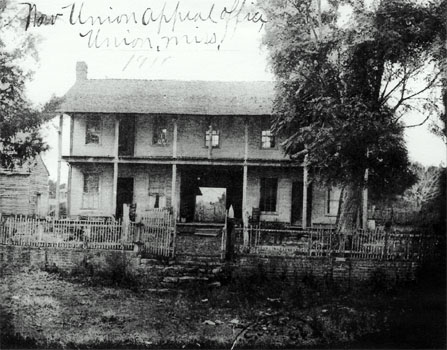
In 1856, Boler built a two-story dogtrot home on the stagecoach road at the edge of the village of Union. Here is how the property appeared in 1907, in its earliest known photograph:
Only a few years later the Civil War had engulfed the nation, and in another couple of years it reached Newton County. Grierson’s Raid in 1863 resulted in armed clashes near Philadelphia and at the railroad station at Newton (loosely depicted in the 1959 John Wayne movie The Horse Soldiers). Sherman in 1864 marched a force of 20,000 through Newton County en route to his destruction of Meridian, burning the Decatur courthouse and tearing up miles of railroad on his way. On his return from Meridian to Canton, Sherman took over and spent the night in Boler’s home on February 21, 1864.
There is a local legend that Sherman declined to burn Boler’s home because he mistakenly believed or was falsely led to believe that the name “Union” had come about because Wesley Boler was in the Union army. Boler was, however, enrolled in the Confederate army. There is nothing in Sherman’s journals of the Meridian campaign to support the local account, although he does use quotation marks with the name “Union.” Was that an ironic wink at the inaptly-named town? He did not offer us an explanation.
We know from Sherman’s records that he had tarried at Meridian awaiting reinforcements of 7,000 cavalry from Memphis that never arrived, and, having completed the razing of Meridian and the destruction of all railroad lines and facilities in the surrounding area, Sherman determined to return to the main body of Union forces to the west. The journal of one of Sherman’s officers indicates that the force had marched 21 miles west from the burning of Meridian in haste to get to Canton the following day, and was in need of rest when it found Boler’s place to be the only suitable one in the area, which probably explains why the invaders did not take the time for destruction.
It is unclear when Boler’s home made the transition from private residence to Stagecoach Inn. It is reasonable to surmise that Boler himself may have taken in boarders soon after the home was built, given the location of the home on the heavily-travelled road, the lack of rail transportation in the area until later, and the configuration of the home that would enable the family to live comfortably downstairs with guests upstairs. Boler sold the building after the Civil War to a gentleman who did operate it as an inn and tavern.
Some claim that both Jefferson Davis and Stonewall Jackson were among the lodgers at Boler’s. It is quite possible that Davis stayed there, since his route eastward from his plantation near Natchez would have taken him through the area. If Jackson was ever a guest, that would help establish that Boler’s was an inn before the Civil War, since Jackson did not survive the conflict.
The property fell into disrepair through the years until a foundation took on its restoration. Today, it is restored and houses a museum. It is located in sight of Union’s downtown, in an area with some grand, old homes.
Carolshouse is one web site with historical notes and photographs of Boler’s Inn. The Newton County historical and Genealogical Society maintains another web site with a narrative history of the inn.

Joint Custody and the Consent Divorce, and a Maxim Bonus
March 20, 2014 § 1 Comment
The COA decision in Keyes v. Keyes, handed down March 11, 2014, is noteworthy for a couple of points.
Melanie and Dustin Keyes entered into a consent for an irreconcilable differences divorce, leaving custody of their two children to the judge to decide. After a hearing, the chancellor awarded the parties joint physical and legal custody.
Melanie appealed, raising two issues: (1) the chancellor erred in failing to determine whether the parties could cooperate, which is a prerequisite to joint custody; and (2) the chancellor’s decision violated the maxim of equity that “equity delights to do complete justice, and not by halves.”
The COA affirmed. Judge Carlton wrote the opinion for a unanimous court (James not participating). Here’s her take on the first issue:
¶13. [MCA] Section 93-5-24(2) provides that in an irreconcilable-differences divorce the chancellor may, at her discretion, award joint custody “upon application of both parents.” In Crider [v. Crider], the parties filed a written consent to an irreconcilable-differences divorce and asked the chancellor to decide the issues of primary custody, property settlement, and support. Crider, 904 So. 2d at 143 [(Miss. 2005)] (¶3). The supreme court held “that when parties consent in writing to the court’s determination of custody, they are consenting and agreeing to that determination.” Id. at 148 (¶15). The supreme court further stated:
It is logical and reasonable that “application of both parties” exists when both parties consent to allowing the court to determine custody. The fact that the parties request that the court determine which parent is to receive “primary custody” does not alter this. The parties are allowing the court to determine what form of custody is in the best interest of the child. If joint custody is determined to be in the best interest of the child using court-specified factors, i.e., the Albright factors, the parties should not be able to prohibit this by the wording of the consent. . . . To be sure, unless the parents are capable of sharing joint custody cooperatively, it is incumbent upon a chancellor not to award joint custody. This is for the chancellor to determine as he or she is in the best position to evaluate the credibility, sincerity, capabilities[,] and intentions of the parties.
Id. at 147 (¶¶12-13). “The Crider court held that it is logical that when both parties consent for the court to determine custody, they fulfill the ‘application of both parents’ requirement of section 93-5-24(2).” Phillips, 45 So. 3d at 695 (¶33) (citation omitted).
¶14. In the present case, the parties do not dispute that they both consented to the chancellor’s determination of custody and that the “application of both parents” requirement discussed in Crider was met. Therefore, we turn our focus to whether the chancellor erred in awarding joint custody because of the parents’ inability to “shar[e] joint custody cooperatively.” Crider, 904 So. 2d at 147 (¶13). The supreme court has concluded that section 93-5-24(2) “should be interpreted to allow the chancellor to award joint custody in an irreconcilable[-]differences divorce if it is in the best interest of the child.” Phillips, 45 So. 3d at 695 (¶33) (citing Crider, 904 So. 2d at 148 (¶16)).
The decision goes on to find that the chancellor did, in her analysis of the facts, adequately weigh the parties’ ability to cooperate, and that she was in the best position as the trier of fact to determine how to resolve conflicting evidence at trial for the best interest of the minor children. The court concluded that this issue lacked merit.
As for the maxim argument, Judge Carlton addressed it as follows:
¶18. Melanie next argues that the award of joint custody essentially ensures future litigation; therefore, the chancellor violated the maxim that “[e]quity delights to do complete justice, and not by halves.” Melanie asserts that future litigation is likely because the chancellor failed to determine in which county the children should reside or where they should reside once they begin kindergarten. Melanie and Dustin reside in different counties, and Melanie contends that the children will be put “in the unenviable position of shifting back and forth from home to home during the school year.”
¶19. In support of her argument, Melanie relies on this Court’s decision in Daniel v. Daniel, 770 So. 2d 562 (Miss. Ct. App. 2000). The chancellor in Daniel awarded both parents joint legal custody of their minor child, with custody alternating every two weeks. Id. at 563 (¶2). This arrangement was to continue until the child turned five and entered kindergarten, at which time the father would receive physical custody. Id. In affirming the chancellor’s determination of the custody arrangement, we stated:
We are aware of the fact that a practice of constantly alternating a child back and forth to each parent is not a habit that should be encouraged. The Mississippi Supreme Court has spoken on this issue on more than one occasion, ruling that it is not in the best interest of a small child to be shifted from parent to parent. However, in this case, we are mindful that the child is nearing the age of five[-]year[-]old kindergarten and has been subjected to the rotating custody order since the chancellor’s judgment was handed down on December 15, 1998. We therefore can see no reason why what has become the child’s regular routine should be interrupted. Nonetheless, we agree with the chancellor that at such time as the child begins kindergarten, it will be necessary for the child to maintain the stability that is crucial at the beginning stages of her education.
Id. at 567 (¶15) (internal citations and quotation marks omitted).
¶20. In the present case, Melanie argues that the parties’ two minor children need the same stability given to the minor child in Daniel. She asserts that the parties’ children should reside with her in Warren County, where they currently attend daycare. In light of the Court’s decision in Daniel, and to provide the parties’ children with the stability that is crucial at the beginning stages of education, Melanie asks that the case be remanded with instructions for the chancellor to determine which parent should be the primary physical custodian.
¶21. As previously discussed, the decision to award the parties joint legal and physical custody was within the chancellor’s discretion since the parties agreed to submit this issue to her for determination. Bearing in mind our limited scope of review on appeal, we find that the chancellor did not commit manifest error in awarding joint custody. Therefore, this issue also lacks merit.
Bravo to Melanie’s appellate counsel for making the maxim argument. I thought it was apropos. Don’t let the fact that the COA didn’t buy the argument in this case discourage you from asserting claims based on the maxims in other cases. I’ve stressed here before that the maxims underly all actions in and relief granted by chancery courts, so they are always a legitimate basis for advocating for your client’s position.
No Great-Grandparent Visitation
March 19, 2014 § Leave a comment
Grandparent visitation is a legislative creation that first made its appearance in Mississippi in 1983, and it is now codified at MCA 93-16-1. The concept was unknown to the common law.
We posted here before that there is no right of sibling or step-parent visitation.
But what about great-grandparents? They are, after all, grandparents themselves.
That was the question squarely before the COA in the case of Lott v. Alexander, handed down March 11, 2014.
The Alexanders are the great-grandparents of the children with whom visitation was sought. Lott, the children’s mother, is the Alexanders’ granddaughter. It appears from the record that, for whatever reason, the Alexanders have stood in the shoes of their own daugher, who is or was the grandmother of the children with whom visitation was requested. Based on that relationship, and on the judge’s findings that they met the criteria for grandparent visitation, the chancellor found that they were entitled to grandparent visitation. Lott appealed.
Judge Fair, for the majority, wrote that the statute, which is plain and unambiguous, does not include or even define great-grandparent status. The courts have no authority to expand or add to the scope of an unambiguous statute, so great-grandparent visitation is not available in Mississippi.
Judge Fair’s analysis is detailed and comprehensive. I commend it to your reading.
The outcome in this case should be no surprise. The statute is in derogation of common law, and, therefore, must be strictly construed. There is no room for the courts to add great-grandparents, siblings, step-parents, or any other categories of relatives whatsoever. That’s up to the legislature.
How Not to Propound Discovery Requests via Email
March 18, 2014 § 5 Comments
If you’re like me, this entry among the MSSC hand-downs last Thursday had you scratching your head:
EN BANC
2013-IA-01784-SCT
Amber Olsen Johnson v. Walter Thomas Johnson; Madison Chancery Court; LC Case #: 2012-0921; Ruling Date: 10/14/2013; Ruling Judge: Janace Goree; Disposition: The Petition for Interlocutory Appeal filed by Petitioner is granted. This matter is remanded to the Madison County Chancery Court for entry of an order denying Respondent’s Motion to Compel in cause no. 2012-0921. The notice of appeal having been deemed filed, the filing fee is due and payable to the Clerk of this Court. The Respondent is taxed with all costs of this appeal. To Grant and Render: Waller, C.J., Dickinson and Randolph, P.JJ., Lamar, Kitchens, Chandler, Pierce and King, JJ. To Grant: Coleman, J.; Randolph, P.J., for the Court. Order entered.
An interlocutory appeal is granted and the chancellor is ordered to enter a discovery order. What exactly is going on here?
After I read Jane’s and Anderson’s blog posts on the ruling, it was much clearer.
It seems that the trial court had granted a motion to compel based on a R34 request for production of documents (bank records) that was directed via email to an employee of opposing counsel, and not to opposing counsel herself. Petition was filed for an interlocutory appeal from the order. The MSSC accepted the appeal, dispensed with briefing, and ruled that an email request made by counsel for one party to an employee of counsel for the other party does not meet the notice requirements of MRCP 5 and 34.
Jane includes the transcript of the trial-court proceedings, in which counsel for the party seeking discovery argues that an email request, no matter how informal, complies with the requirements of R34, which only requires a writing. The MSSC did not directly address this particular point.
The two points to take away from this are:
- Sometimes we get accustomed to dealing with a particular paralegal or other staff in opposing counsel’s office. Notice to that staff member will not suffice as notice to the attorney under R5 or R34. Here, the missing component was either an automatic electronic acknowledgment of receipt from the attorney, or the attorney’s separate acknowledgment, either of which is required in R5. The acknowledgment of a staff member does not satisfy the express requirement of R5 that it be made by the attorney.
- If you find yourself scratching your head over some hand-down of the appellate courts, it might pay you to take an extra three minutes to look up the order behind it. If you don’t, you might miss something that could impact a future case of yours.
Thanks to both Jane and Anderson for posting on this, and to Beverly Kraft for calling it to my attention.
 The Better Chancery Practice Blog