Your Client’s Financial Well-Being
November 20, 2014 § 4 Comments
In family law, we see the intimate details of people’s financial pictures every day. So I’m always interested in how developments in the national economy affect people we see in our courts.
Looking at the Federal Reserve Board’s triennial 2013 Survey of Consumer Finances, I found these conclusions revealing:
- Mean family income rose 4% between 2010 and 2013, after adjustment for inflation, but median income fell 5%. In my experience, incomes around here have been flat, except in high-paying jobs, which have increased in pay. Since the mean is usually skewed by outlying figures, and the median tends not to be, I would trust the median in this case to be closer to accurate. Also, that adjustment for inflation is misleading. The experts use prices of certain commodities to gauge inflation, and inflation has been fairly non-existent (ask anyone who lived through the 80’s). There is a hidden price creep, though. For instance, the price of a bag of coffee has remained fairly constant over the past several years, but the bag has shrunk from 16 oz to 12 oz, a reduction of 25%. You need to spend 25% more to buy same amount of coffee beans, but the shelf price for a bag has not gone up. An 18 oz box of cereal is now 14 oz, but at the same price it was when it was 18 oz. So you need to spend 22% more to buy the same amount of Froot Loops you did a while ago. I could go on and on, but you get the picture. When I pointed this phenomenon out to a grocer not too long ago, he said he had done his own calculations and concluded that shrinkage is averaging closer to 30%. So your paycheck is buying 30% or so less, but the government happily tells us that inflation is near zero.
- Debt obligations fell during the three-year period. Many people retrenched during the recession, shedding debt as best they could, but the 8.05’s I see still have breathtaking amounts of debt, particularly consumer debt.
- Fewer families had debt secured by a primary residence, and those who did have home-secured debt owed less. I would be absolutely surprised if that held true in our little corner of the republic. From what I see, many middle-income folks refinanced when rates were low, and used the refi to tap into equity, increasing debt.
- Education debt increased, both in terms of the numbers of people with such debt, as well as the average value of the debt. College education has increased by a stunning amount. We all know about how professional school expenses have escalated. Some people who think they can not afford or can not get into a legitimate academic institution turn to commercial operations that hold themselves out as “colleges” or “universities” but have no more valid academic credentials than a pool hall. In one case in my court, a young lady had spent $17,000 toward a “degree” as a lab tech from one of those diploma mills, only to learn that they had changed the requirements for that degree so that she would have to spend another $10,000 to complete it. She dropped out because she could not afford it, but she still has to pay the $17,000 in student loan debt. I pointed out to her that the “university” is bound by the catalog when she was admitted, and she should see a lawyer. That drew a blank stare. I wonder whether any laboratory worth its salt would consider a graduate of one of those places to be even minimally qualified.
From where I sit, I see life in the middle class as tough and getting tougher, from a financial standpoint. The financial statements I see show people with not a lot of income, but expanding expenses.
It’s important to be aware of how the changing financial environment is affecting your clients. What made sense to demand 10 years ago simply will not work today.
Justices Kagan and Scalia at OM Law School
November 19, 2014 § 4 Comments
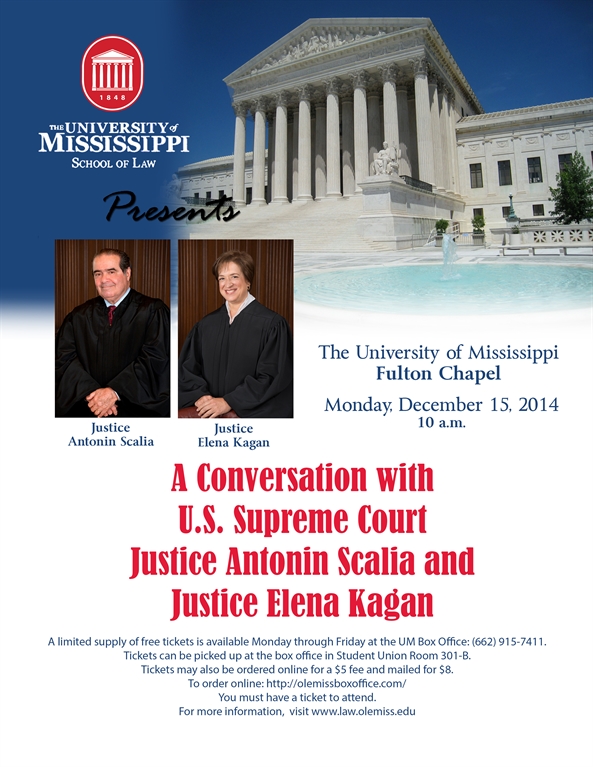
USSC Justices Elena Kagan and Antonin Scalia will be guests of the Ole Miss Law School on December 15, 2014. Here’s the graphic from Ole Miss:
Non-marital Children, Estates, and the Statute of Limitations
November 18, 2014 § 4 Comments
Boyce Elmore died in 2000. His widow, Kathleen, opened an administration and was appointed administrator in 2002.
In 2010, more than ten years after Boyce Elmore died, Cedric Williams filed a paternity action in an effort to establish a claim to recover from Boyce’s estate.
The version of MCA 91-1-15(3)(c) in effect at the time provided that a non-marital child might file an action to establish paternity ” … within one (1) year of the death of the intestate or within ninety (90) days after the first publication of notice to creditors to present their claims, whichever is less …” Since Boyce’s estate had not been opened in the first year following his death, the publication provision was inapplicable.
Faced with the issue of Cedric’s timeliness, the chancellor ruled that, because Kathleen had failed to give Cedric notice of the estate, the statute of limitations had been tolled, and his action was timely.
The COA reversed the chancellor’s decision that failure to give Cedric notice tolled the statute of limitations, but would not apply the one-year statute because the appellant had failed to raise the issue on appeal.
MSSC granted cert.
In In the Matter of the Estate of Elmore: Jamison v. Williams, handed down November 6, 2014, the court affirmed the COA’s decision, but held that the appellant had “squarely presented” the issue before the chancellor on appeal and at trial by raising the issue of application of SOL under 91-1-15, so that the one-year statute did apply, and barred Cedric’s suit.
Based on all of this, I believe it is fair to say that failure to give notice to a purported non-marital heir will not toll the statute under the language in effect before 2005. The Mississippi legislature resolved the question in 2005 by adding language to MCA 91-1-15 that ” … this one-year limitation shall be self-executing, and may not be tolled for any reason, including lack of notice.”
A Rule More Observed in the Breach
November 17, 2014 § 6 Comments
Just a friendly reminder that MRAP 25(b) states in part:
“In all cases a copy of any brief on the merits shall be served on the judge who presided at the trial …”
Update on the Sixteenth District Race
November 14, 2014 § 2 Comments
Certified yesterday. D. Neil Harris (incumbent) defeated Paula S. Yancey by 18 votes.

What it Means When You Sign a Pleading
November 13, 2014 § Leave a comment
We talked Monday about what can happen when one knowingly files a false pleading.
Aside from the fact that it’s patently unethical to do so, there is a specific requirement in the MRCP about a lawyer’s representations to the court via her pleadings. It’s in R11(a), which states in part:
Every pleading or motion of a party represented by an attorney shall be signed by at least one attorney of record … The signature of an attorney shall constitute a certificate that the attorney has read the pleading or motion; that to the best of the attorney’s knowledge, information, and belief there is good ground to support it; and that it is not interposed for delay …
That’s pretty straightforward. You have to have read the pleading, and if you fail to do that, you are still responsible for its contents since you certified to the court that you are aware of what is in it. You have to do more than take your client’s word for it that there is good ground to support the claims, because you are certifying to the court that you have made sufficient inquiry to determine that it is, indeed, a meritorious claim. And you can never file an unmeritorious pleading just to hold things up while your client makes good his escape or otherwise arranges his affairs to his advantage.
If the court finds that you have not signed pleadings or signed them with intent to defeat the purpose of the rule, you are subject to the sanctions in R11(b), including discipline, reasonable expenses and attorney’s fees. The sanctions extend both to the client and to the lawyer.
Carelessness is no excuse. The rule requires that you put some thought and attention into the pleadings that you file.
Can the Children of a Mississippi Marriage Have a Cause of Action for Alienation of Affection?
November 12, 2014 § 1 Comment
No, says the MSSC in Brent v. Mathis on November 6, 2014.
A Case for Sanctions
November 10, 2014 § 3 Comments
Louis Pannagl had made a will in 2001. In April, 2011, he contacted Kellems, a lawyer, about changes he wanted to be made in his will. He sent Kellems handwritten notes with the changes, including a document that included the language, “The Will of April 23rd 2011 … has been destroyed and March 23, 1993 [sic].” It is undisputed that the notes were in Louis’s handwriting.
Louis died on June 8, 2011, and Louis’s widow, Donis, contacted one of Louis’s lawyers, who sent her the notes described above. Donis gave the notes to her son, David Lambert, Louis’s step-son, who read them and passed them on to Holmes, an attorney he had hired to open Louis’s estate. On August 19, 2011, a sworn petition was filed, with Louis’s will attached, alleging that the original had been lost and that the will had not been destroyed by Louis with intent to revoke it. The handwritten notes were not attached to the petition.
Both of Louis’s biological son, Curt, and daughter, Sammi, filed contests to probate of the will. It was not until around a year after the petition had been filed that they found out, in the course of discovery, about the handwritten notes revoking the prior will(s). Sammi filed for summary judgment and sanctions under MRCP 11 and the Litigation Accountability Act. The chancellor granted summary judgment, but declined to impose sanctions.
Sammi and Curt appealed the denial of sanctions.
In the case of Estate of Pannagl: Pannagl and Spence v. Lambert and Holmes, the COA on November 4, 2014, reversed. Since this case makes some important points about sanctionable behavior and the applicable law, I am quoting at length:
¶7. In this appeal, Curt contends that Lambert’s failure to include the document in this petition constituted fraud; thus, the chancellor erred in failing to award sanctions. Curt argues that Lambert, having read the handwritten document prior to filing his petition, knew the will had been destroyed with an intent to revoke it and, therefore, had no hope of success. According to Curt, the action was frivolous and constituted a fraud on the court because Lambert withheld the document and filed a sworn petition alleging that the original will was lost and not destroyed by Louis with the intent to revoke it.
¶8. Mississippi Rule of Civil Procedure 11(b) states, in pertinent part:
If any party files a motion or pleading which, in the opinion of the court, is frivolous or is filed for the purpose of harassment or delay, the court may order such a party, or his attorney, or both, to pay to the opposing party or parties the reasonable expenses incurred by such other parties and by their attorneys, including reasonable attorneys’ fees.
M.R.C.P. 11(b). The Litigation Accountability Act states, in pertinent part:
Except as otherwise provided in this chapter, in any civil action commenced or appealed in any court of record in this state, the court shall award, as part of its judgment and in addition to any other costs otherwise assessed, reasonable attorney’s fees and costs against any party or attorney if the court, upon the motion of any party or on its own motion, finds that an attorney or party brought an action, or asserted any claim or defense, that is without substantial justification . . . .
Miss. Code Ann. § 11-55-5(1) (Rev. 2012). The phrase “without substantial justification” is defined by the Act as a filing that is “frivolous, groundless in fact or in law, or vexatious, as determined by the court.” Miss. Code Ann. § 11-55-3(a) (Rev. 2012). “The term ‘frivolous’ as used in this section takes the same definition as it does under Rule 11: a claim or defense made ‘without hope of success.’” In re Spencer, 985 So. 2d at 338 (¶26) (quotations omitted). “A plaintiff’s belief alone will not garner a ‘hope of success’ where a claim has no basis in fact.” Foster v. Ross, 804 So. 2d 1018, 1024 (¶21) (Miss. 2002) (quotations omitted). Whether a party has any “hope of success” is an objective standard to be analyzed from the vantage point of a reasonable plaintiff at the time the complaint was filed. Tricon Metals & Servs. Inc. v. Topp, 537 So. 2d 1331, 1335 (Miss. 1989).
¶9. The chancellor found the following: (1) it was unclear whether the will had been revoked or if Louis merely contemplated doing so; (2) more information was required to determine Louis’s intent; (3) the handwritten document was insufficient to put a proponent of a will having minor children as beneficiaries on notice that it had been revoked; (4) the handwritten document was not subscribed, but merely signed at the top, and the various copies of the document contained different-color ink; and (5) tendering a copy of Louis’s will was not so egregious as to warrant the imposition of sanctions against Lambert and Holmes.
¶10. The Mississippi Supreme Court has found that a misrepresentation of pertinent facts to a chancellor, who entered an order based on the misrepresentations, was a violation of the Litigation Accountability Act and Rule 11 of the Mississippi Rules of Civil Procedure and warranted sanctions. In re Estate of Ladner, 909 So. 2d 1051, 1056 (¶17) (Miss. 2004). In that case, an executor and his attorney failed to inform the court of the testator’s brother’s claim to ownership of cattle located on the brother’s land prior to obtaining a court order to seize the cattle. Id. at 1055-56 (¶¶15-16). In addition, this Court has found that a verified creditor’s notice of claim, filed by the counsel of a creditor of potential heirs of a decedent’s estate and containing a misrepresentation of pertinent facts, was frivolous. In re Necaise, 126 So. 3d 49, 57 (¶30) (Miss. App. Ct. 2013). This Court found that the misrepresentation caused the estate to incur unnecessary attorney’s fees in having to respond to those filings and thus warranted sanctions under Rule 11 and the Litigation Accountability Act. Id.
¶11. In this case, Lambert failed to disclose the existence of the handwritten document when he filed his petition. A reasonable person in Lambert’s position, with Lambert’s knowledge, would have no hope of success in rebutting the presumption that Louis’s will had been lost and not destroyed. Lambert admitted that, when he filed his petition, he had received and read the documents attached to Carrigee’s letter, which included the handwritten document. This letter, with attachments, was later given to Holmes prior to filing this action. In that document, Louis listed a myriad of changes he wanted to make to his will. At the bottom of the first column of the two-column document, he wrote: “The will of April 23rd 2001 Brookhaven/Brady Kellems has been destroyed.” The words “and March 23, 1993,” were written in a different-color ink on Kellems’s copy. The document was signed by Louis, and Donis testified that the document was in his handwriting. Lambert searched for a will, but could not find one. The file folder in Louis’s office entitled “will” was empty.
¶12. From this document, it is clear that Louis wanted to make changes to his will and that he intended to revoke all prior wills. Even though Louis signed this document at the top of the page, Donis testified that it was his handwriting. When taken in context, the statement that: “The will of April 23rd 2001 Brookhaven/Brady Kellems has been destroyed,” effectively put Lambert and his attorney on notice that Louis destroyed his will with the intent to revoke it. This is evidenced by Lambert’s attempt to convert the proceedings to that of intestate succession. On the same day that the court ruled on a motion to compel Kellems to give his deposition, and prior to any other depositions being taken, Lambert filed a motion to amend his petition. He sought a declaration that Louis had died intestate and asked the court to appoint Donis the administrator. The handwritten document had not yet come to light, and judging from the timing of the motion’s filing, Holmes knew that once it did, there would be no hope of success in overcoming the presumption. In the hearing on the motion for summary judgment, Holmes admitted that he filed that motion because he did not think he could overcome the presumption that Louis’s will had been lost and not destroyed.
¶13. The chancellor did not consider the fact of nondisclosure to be important when making her decision about whether to award sanctions. But the fact remains that the nondisclosure was a misrepresentation, making the petition to probate the will frivolous in light of the evidence. The chancellor abused her discretion in not considering Lambert’s nondisclosure in determining the frivolity of the action. Curt incurred unnecessary expense in contesting the probate of this will, only to uncover a document that Lambert withheld for almost a year and a half and that would later serve as the basis for summary judgment.
¶14. Finding that the chancellor abused her discretion in deciding not to award sanctions pursuant to Rule 11 and the Litigation Accountability Act, we reverse and remand for a determination of attorney’s fees and costs.
So the shortcoming here was the failure to disclose the handwritten notes. Hindsight, which is always high-def, tells us that the better practice would have been to disclose the notes and leave it up to the chancellor, as finder of fact, to interpret them. By not disclosing the notes, Lambert and counsel gave the reasonable impression that they were trying to hide something to change a possible adverse outcome. That’s always a recipe for sanctions and even discipline.

