Who Gets to Decide Fair Market Value?
May 19, 2015 § 2 Comments
Gary Marter and his wife Celeste were divorced, and Gary appealed complaining that the chancellor erred when he assigned a value of $110,000 to 120 acres of jointly-owned real property. The COA found that the chancellor had not adequately explained how he arrived at the figure, and so remanded the case in Marter v. Marter, 95 So.3d 733 (Miss. App. 2012).
On remand the chancellor conducted a hearing, and both sides had the opportunity to present evidence. The court heard from two appraisers hired by Gary, and from both of the parties. The chancellor then rendered an opinion concluding that the property was worth $110,000. Gary appealed again.
In Marter v. Marter, handed down by the COA May 12, 2015, the COA, by Judge Fair, affirmed. The main issue I want to address is what the chancellor is to do when confronted by conflicting and inconclusive proof of fair market value. Here’s what Judge Lee said in his opinion:
¶12. Gary first argues that the chancellor erred in valuing the 120 acres at $110,000 because neither party placed that specific value on the property . But he presents no authority supporting this proposition. Instead, the chancellor is the ultimate finder of fact, and as the finder of fact he is entitled to accept or reject the testimony of witnesses, in whole or in part, and to give the various testimony the weight it deserves; the chancellor’s findings can be disturbed only if clearly wrong or derived from the application of an erroneous legal standard. Mize v. Westbrook Constr. Co. of Oxford LLC, 146 So. 3d 344, 348 (¶6) (Miss. 2014). Our courts have repeatedly recognized that the chancellor is entitled to make an independent judgment of a property’s value, especially where the estimates of the parties vary widely. In McKnight v. McKnight, 951 So. 2d 594, 596 (¶¶7, 10) (Miss. Ct. App. 2007), this Court affirmed a valuation where the chancellor had apparently just averaged the two proposed values, because the evidence in the record supported the conclusion that the low estimates were too low and the high estimates were too high. We reached the same result in Williams v. Williams, 129 So. 3d 233, 241 (¶32) (Miss. Ct. App. 2013). “If the court finds all of the competing values to be inaccurate, it may make its own independent valuation.” Brett R. Turner, 2 Equitable Distribution of Property § 7:12 (3d ed. 2005).
¶13. Gary next contends that the chancellor erred in considering the tax assessor’s appraisal of the property, which was noted to be approximately $49,000. The chancellor took notice of the tax appraiser’s valuation on his own initiative, but without objection from either party. Gary cites to Watson v. Watson, 882 So. 2d 95, 106-07 (¶¶55-57) (Miss. 2004), where the supreme court reversed a valuation determined by simply adding 15% to the tax roll assessment. The chancellor derived this formula from his own experience, and he applied it despite all the other evidence in the record supporting a higher value. But, in today’s case, the chancellor did not apply a rigid formula; he merely noted that he had found the value of the 120 acres to be significantly in excess of the tax assessment. The chancellor’s observation does not demonstrate a defect in his reasoning.
¶14. Finally, Gary argues that the chancellor committed reversible error when he failed to consider the value of the timber separately from the land. In the judgment on remand, the chancellor expressly noted that there was timber on the property, but he treated it as a fixture of the land and did not assign it a separate value. Gary offers no authority requiring land and timber to be valued separately; he only supports this claim by saying that “[Celeste] has never presented any evidence to contradict [his] contention.” Gary suggests that the chancellor could not disregard the testimony of Gary’s timber appraiser, but that appraisal was done years after the divorce, and there was greatly varying testimony as to the value of the timber. Celeste and the tax assessor valued the land, including the trees, at approximately $50,000. Gary points out that both of these valuations have their flaws, which the chancellor was very much aware of. But Gary himself originally valued the land at $55,000 plus the unspecified value of 28 acres of trees. The timber appraisal he now relies upon was conducted several years after the divorce and valued 108 acres of timber. “Expert opinions are not obligatory or binding on triers of fact but are advisory in nature.” Downs v. Ackerman, 115 So. 3d 785, 791 (¶18) (Miss. 2013). In situations like this, “where there is reason to doubt the trustworthiness of the appraisal,” the “chancellor is justified in rejecting the values an appraiser places.” A & L Inc. v. Grantham, 747 So. 2d 832, 842 (¶44) (Miss. 1999).
* * *
¶15. The chancellor has twice found himself in circumstances such as those described by this Court in the oft-cited case of Dunaway v. Dunaway, 749 So. 2d 1112, 1121 (¶28) (Miss. Ct. App. 1999), in which this Court said:
It is our conclusion that the chancellor, faced with proof from both parties that was something less than ideal, made valuation judgments that find some evidentiary support in the record. To the extent that the evidence on which the chancellor based his opinion was less informative than it could have been, we lay that at the feet of the litigants and not the chancellor.
¶16. We conclude that, as in Dunaway, the chancellor did the best he could with the evidence presented to him. Id. at 118 (¶14). As this Court will not disturb a chancellor’s findings unless manifestly wrong or clearly erroneous, our standard of review requires that the judgment be affirmed. Johnson v. Johnson, 650 So. 2d 1281, 1285 (Miss. 1994) (citation omitted).
There’s really nothing more to add to that.
A Willful, Wanton or Reckless Disregard
May 18, 2015 § 2 Comments
It doesn’t come up very often in chancery court, but from time to time a party will ask a chancellor to impose punitive damages.
Not surprisingly, the latest reported case involved parties contending over an easement. I think most experienced chancery practitioners would nod in agreement that easement and property line disputes can quite often eclipse even bitter divorces for malicious, vicious, destructive behavior.
In the case of Muirhead v. Cogan, decided March 10, 2015, siblings Steve Muirhead and Lula Cogan, along with some other siblings, inherited some land near Vicksburg. A private easement, called “Muirhead Road,” gave both Steve and Lula access to their portions of the property. Steve’s son Ronnie built a home near Steve’s, and after he began using the road also, Steve augmented the hardpan dirt surface with gravel.
The gravel washed out in heavy rains, and Steve wanted Lula to contribute $3,000 to help maintain the easement. Lula, however, was not convinced. She had the road inspected by Pete B. (described in the COA opinion as “a construction worker who owns a construction business”), who opined that it did not need any maintenance.
That’s where things took a detour:
¶6. In 2006, Ronnie built a road that intersected Muirhead Road. After the new road was built, both Steve and Ronnie abandoned the easement and began using the newly built road to access their houses. Ronnie also installed a culvert near the intersection. The culvert directed water away from the newly built road and onto the easement. Also in 2006, after the new road was built, most of the gravel was mysteriously removed from the easement. At some point after the gravel was removed, dirt from the center of the easement was pushed up onto the sides of the easement. After that, a large v-shaped ditch was dug across the easement, preventing vehicular use of the easement.
¶7. In 2007, Lula hired Pete to perform conservation work on her property. To access Lula’s property, Pete and his employees had to use the easement. To make the easement usable, Pete instructed one of his employees, Marcus Clark, to fill the v-shaped ditch with dirt. Marcus complied. However, shortly thereafter, a trench, which was approximately four feet deep and five feet wide, was dug in the center of the easement. As a result, water settled in the center of the easement, causing severe erosion. By 2008, the easement had almost completely eroded.
Lula sued, and one of her claims was for punitive damages. The COA opinion is enlightening about what law the chancellor is required to apply in making a determination whether to assess punitive damages. Judge Irving, for the court:
¶25. Steve argues that the chancery court erred by awarding punitive damages after: (1) applying an improper legal standard and (2) failing to hold an evidentiary hearing on the issue of punitive damages. Second, Steve argues that the chancery court erred by finding that the erroneous award of punitive damages was a proper basis for the award of attorney’s fees. Finally, Steve argues that the chancery court erred by finding James’s testimony credible because James relied on notes prepared by Lula. On the other hand, Lula asserts that a careful reading of the final judgment reveals that the chancery court utilized the clear-and convincing standard in finding that Steve’s actions were malicious.
¶26. In [Jones v. Music, 2 F.Supp.2d 880 (SD Miss. 1988)], which the chancery court relied on in assessing punitive damages, the United States District Court for the Southern District of Mississippi indicated that the standard to be applied during a court’s assessment of punitive damages is a preponderance-of-the-evidence standard. Jones, 2 F. Supp. 2d at 884 (finding that “[p]unitive damages may be awarded only when the trier of fact is persuaded by a preponderance of the evidence that defendant’s actions were wanton, malicious[,] or fraudulent in nature.”) Likewise, in its final judgment, the chancery court found that “[p]unitive damages may be awarded only when the trier of fact is persuaded by a preponderance of the evidence that [the] defendant’s actions were wanton, malicious[,] or fraudulent in nature.” The chancery court further found
that [Steve’s] conduct was malicious, intentional[,] and outrageous. The court finds that removing the gravel that he bought and put on the easement, and cutting a vee down the easement, was spiteful. However, after the easement was made usable following these acts, regardless of who deepened the ditches (which the court believes was an act of [Steve]), digging the trench down the middle of the easement under the guise of saving his fence[] was clearly malicious, intentional[,] and outrageous. [Steve], as a farmer[] who retired from the construction business[,] knew that this action would destroy the easement (and having destroyed the easement, [Steve] now seeks to abandon it). He knew that he could take other, less invasive, remedial actions. He never discussed the fence situation with [Lula] to ascertain the best remedial action; therefore, he was not interested in finding the best solution or in saving the easement. Obviously, he wanted to prevent [Lula] from using the easement regardless of her right to use the easement. Through this aggressive action, which he even admits was wrong, [Steve] showed an intentional[,] wanton disregard for the rights of [Lula], and Lula is entitled to punitive damages in the amount of $10,000.
¶27. We find that the standard enunciated in Jones is in clear conflict with Mississippi statutory law. Mississippi Code Annotated section 11-1-65 (Rev. 2014) provides, in relevant part, as follows:
(1) In any action in which punitive damages are sought:
(a) Punitive damages may not be awarded if the claimant does not prove by clear and convincing evidence that the defendant against whom punitive damages are sought acted with actual malice, gross negligence which evidences a willful, wanton or reckless disregard for the safety of others, or committed actual fraud.
****
(c) If, but only if, an award of compensatory damages has been made against a party, the court shall promptly commence an evidentiary hearing to determine whether punitive damages may be considered by the same trier of fact.
****
(f)(i) Before entering judgment for an award of punitive damages the trial court shall ascertain that the award is reasonable in its amount and rationally related to the purpose to punish what occurred giving rise to the award and to deter its repetition by the defendant and others.
(ii) In determining whether the award is excessive, the court shall take into consideration the following factors:
1. Whether there is a reasonable relationship between the punitive[-]damage award and the harm likely to result from the defendant’s conduct as well as the harm that actually occurred;
2. The degree of reprehensibility of the defendant’s conduct, the duration of that conduct, the defendant’s awareness, any concealment, and the existence and frequency of similar past conduct;
3. The financial condition and net worth of the defendant; and
4. In mitigation, the imposition of criminal sanctions on the defendant for its conduct and the existence of other civil awards against the defendant for the same conduct.
¶28. Despite Lula’s argument to the contrary, it is unclear whether the chancery court required Lula to prove by clear and convincing evidence that Steve’s actions were malicious. However, the chancery court’s reliance on Jones suggests that the court applied the lesser standard. Additionally, the record does not reveal that the chancery court conducted an evidentiary hearing on the issue of punitive damages, or that the chancery court ascertained that the punitive-damages award was reasonable in its amount and rationally related to the purpose of deterrence. Furthermore, the chancery court failed to consider the factors enumerated in section 11-1-65(f)(ii). Therefore, we find that the chancery court erred by awarding punitive damages in this case. Consequently, we reverse and remand for an evidentiary hearing wherein the chancery court must determine by clear and convincing evidence whether Steve’s actions were willful, wanton, and malicious. If, on remand, the chancery court finds that punitive damages are warranted, then the chancery court must consider the factors enumerated in section 11-1-65(f)(ii) in determining the amount of punitive damages to be awarded.
The court went on to reverse the award of attorney’s fees in the case because the judge had not enunciated any basis other than punitive damages for the attorney fee award.





Electronic Service of Process
May 14, 2015 § 7 Comments
An attorney recently asked me whether he could effect service of process via email. It seems that the proposed defendant would communicate with the attorney’s client by email, but kept his address and whereabouts to himself.
My response was that there is no provision in MRCP 4 for electronic process, and until there is, he and his client should make diligent inquiry to ascertain the same, and obtain process by publication.
Later I stumbled across MEC rule § 3.F.3:
A party may not electronically serve a summons and complaint, but must perfect service according to M.R.C.P. 4 or 81, as applicable.
That covers that.
Also, MEC rule § 6.A.2 requires summonses and complaints to be issued by conventional means.
At first blush, electronic summonses and subpoenas would appear to be the next electronic innovation, since email is so ubiquitous. The flaw in it, however, is that there is no guarantee that the recipient of the email is actually the person who owns the email account. Due process requires that a person have actual notice of the filing of the suit, and an opportunity to be heard. Personal service fulfills those requirements, and publication constructively does it. Email leaves open the possibility that a judgment could be set aside because the recipient was not the addressee. Until that possibility is eliminated somehow by the technical folks, we will have to stay our current course.
Valuation Date Makes all the Difference
May 13, 2015 § 4 Comments
Two things are true when it comes to valuation of the marital estate in equitable distribution: (1) The date selected for valuation can be critical; and (2) Selection of the date of valuation is in the discretion of the chancellor.
The recent COA decision in McKissack v. McKissack, handed down May 5, 2015, illustrated both points.
Billy Stephen McKissack and Terri McKissack had consented to a divorce on the sole ground of irreconcilable differences, and left equitable distribution up to the chancellor. The judge entered a divorce judgment in November, 2008, ruling that some $542,000 in CD’s in Billy Stephen’s name were marital property. Billy Stephen appealed, and the COA reversed and remanded on October 12, 2010, holding that the CD’s were separate property. The chancellor was charged to reconfigure the equitable distribution based on the COA ruling.
On remand, the chancellor did adjust the equitable distribution to accommodate the COA ruling. He found that the financial disparity created by the half-million-dollar separate estate could not be made up by allocating assets, and so ordered Billy Stephen to pay Terri lump-sum alimony to make up the difference. He also left the original asset allocation for the most part intact. In making his ruling, the chancellor used the date of the original divorce judgment as the valuation date, and he relied on his previous ruling to Billy Stephen again appealed, complaining that the chancellor used the original divorce-hearing date for valuation, instead of a post-appeal, later date.
The reason Billy Stephen urged the later date is that he had acquired new debt since the date of the original divorce, the largest of which was a debt he had co-signed with his paramour for an apartment complex that had subsequently been destroyed in a fire.
In the case of McKissack v. McKissack, decided May 5, 2015, the COA affirmed. Here’s how Judge Maxwell, writing for the majority, addressed Billy Stephen’s arguments:
¶9. As Steve sees it, the chancellor’s distribution of marital assets was “unfair” because he gave too little weight to Steve’s newly acquired debt from the apartment fire. He also insists the chancellor should have conducted a Ferguson analysis anew on remand and improperly skimped on the Cheatham factors. After review, we find no error in the chancellor’s methodology.
I. Equitable Distribution After Remand
¶10. There are three general tasks required of a chancellor’s division of marital assets in divorce cases. The chancellor must “(1) classify the parties’ assets as marital or separate, (2) determine the value of those assets, and (3) divide the marital estate equitably based upon the factors set forth in Ferguson.” Rhodes v. Rhodes, 52 So. 3d 430, 436 (¶18) (Miss. Ct. App. 2011) (citation omitted) (citing Ferguson v. Ferguson, 639 So. 2d 921, 928-29 (Miss. 1994)) [Footnote omitted]. We review a chancellor’s equitable division under the familiar manifest-error standard of review. Vaughn v. Vaughn, 56 So. 3d 1283, 1288 (¶17) (Miss. Ct. App. 2011).
A. Newly Acquired Debt
¶11. To Steve, his losses from the apartment fire were reason enough to not have to pay additional lump-sum alimony. And he argues it was wrong for the chancellor not to have re-valued the marital estate, giving more weight to his newly acquired, non-marital debt from the apartment fire.
¶12. But on remand, the chancellor opted to use the property values already “in evidence at the trial on the merits”—rightly noting that the “date of valuation is discretionary with the court.” Because he had already valued the property as of the divorce hearing date when making his findings, he found “any accumulation of additional assets or the appreciation of awarded assets should be classified as separate property[.]” Steve urges it was wrong for the chancellor to use the divorce hearing date as the “point of demarcation for valuation.”
B. Valuation Date
¶13. Steve’s argument is blunted by the fact that chancellors are given deference in setting the valuation date for equitable distribution of marital property. Holdeman v. Holdeman, 34 So. 3d 650, 654 (¶13) (Miss. Ct. App. 2010). Often chancellors deem the date of the divorce hearing or judgment as the line of demarcation. See Wheat v. Wheat, 37 So. 3d 632, 637 (¶15) (Miss. 2010). The date of entry of a separate maintenance order or temporary support order may also serve as the valuation date. Id. (citing Godwin v. Godwin, 758 So. 2d 384, 386 (¶7) (Miss. 1999)). But this deference is measured against the general notion that “assets should be valued as close to the trial date as feasible.” Debbie Bell, Mississippi Family Law § 6.07[3] (2005).
¶14. The trial-date approach is the route the chancellor took here. He made a common-sense decision that the date of the divorce hearing would be the cut-off point. He held any later-accumulated assets or appreciation of already-awarded assets would be separate property. See Henderson v. Henderson, 757 So. 2d 285, 293 (¶37) (Miss. 2000) (On remand, the supreme court held a husband’s one-half interest in the marital home should be valued from the divorce date—not several years after the case had been appealed and retried, during which time the wife had been paying the mortgage on an appreciating asset). The chancellor was, however, aware of authority that post-divorce passive appreciation of asset values could be included [Footnote omitted]. But he found no proof of passive appreciation here.
¶15. What Steve largely overlooks is that his preferred valuation date cuts both ways. It is true the chancellor gave little weight to Steve’s newly acquired debt for valuation purposes. But he also refrained from tampering with Steve’s possibly new assets—though he perceived Steve’s income was greater and his expenses lower than when the couple divorced. Also, the chancellor highlighted that the resulting debt from the apartment fire was not from Terri’s wrongdoing or fault. The apartment was Steve’s separate property. And it was Steve who chose to sign as guarantor for his claimed paramour Millie’s debt in the complex. For these reasons, and those we explain below, we cannot say the chancellor erred in relying more on his initial valuations than Steve’s new debt.
The court went on to uphold the chancellor’s decision to rely on his original Ferguson analysis.
One thing that Billy Stephen apparently did was to put on proof of his preferred valuation date and the reasons supporting it. I have held forth here before about that failure of many attorneys in equitable distribution cases to put on any proof whatsoever in trials of the client’s position on what valuation date is selected. When you do that you are: (a) leaving it entirely in the judge’s unfettered discretion; and (b) depriving your client of a basis in the record to complain about it on appeal.
Every calculation involved in equitable distribution revolves around the valuation date. Remember that.
Playing with Dynamite
May 12, 2015 § 2 Comments
If a husband and wife came into your office and wanted you to represent them both in an ID divorce, what would you say? I think, and would hope, that the vast majority of us would decline on ethical grounds and offer to represent only one, not both.
How would it work, anyway, to represent both parties? You could put them in separate rooms and shuttle between. You could run to one room and advise the husband against agreeing to pay any alimony, and then run to another room and advise the wife to hold out until the husband agrees to alimony. Absurd? I’ll say.
Mississippi Rule of Professional Conduct (MRPC) 1.7 precludes representation of opposing parties in litigation unless certain conditions are met. Ethics Opinion number 80 of the Bar issued March 25, 1983, makes it clear that joint representation in an irreconcilable differences divorce is unethical:
The Committee is, therefore, of the opinion that the representation of both parties to a no-fault divorce violates the Rule 1.7, MRPC, and that it is, therefore, unethical for a lawyer to undertake such multiple representation.
How to handle it is set out in this language of the Opinion:
There is nothing wrong at all with one of the parties to a No-Fault Divorce being without an attorney, so long as that party, either H or W is properly informed by the spouse’s attorney that (1) that party is not represented by the spouse’s attorney, (2) the spouse’s attorney will not undertake to advise that party on any aspect of the case as to his or her rights, and (3) that party has a right to obtain an attorney to advise him or her and to review any of the agreements, pleadings or decrees which will be prepared. See Rule 4.3, MRPC.
A recent COA case involved dual representation and a challenged outcome. Leta Collins and Kenneth Collins were divorced from each other in 2011. They had filed a joint complaint for divorce on the sole ground of irreconcilable differences. The pleading stated that “The parties together have been represented by [Name of the Attorney], and was signed by that attorney as “Counsel for Leta D. Collins and Kenneth J. Collins.” In the PSA, which was approved by the court, Leta relinquished all interest in Kenneth’s financial assets and retirement.
More than a year later, Leta discovered that she had not known of more than $500,000 in financial assets that Kenneth had at the time of the divorce. She filed a R60 motion, but she did not allege that a fraud had been committed. The chancellor denied the motion, and Leta appealed.
In the case of Collins v. Collins, decided May 5, 2015, the COA affirmed. Judge Fair wrote this for the court:
¶24. Leta argues that the marital property was not equitably distributed because she and Kenneth were represented by the same attorney during the divorce. She alleges that her lack of independent advice and counsel led her to sign the unfair PSA.
¶25. The joint complaint for divorce states “[t]he parties together have been represented by M. Chadwick Smith,” and it was signed by Smith as “attorney for” both parties. Leta testified she and Kenneth believed they were represented by the same attorney. Leta argues this was a direct violation of Mississippi Rule of Professional Conduct 1.7(a), which prohibits representation of “a client if the representation of that client will be directly adverse to another client,” unless certain conditions are met.
¶26. The chancellor addressed this issue in her findings from the bench, stating that
when Mr. Chadwick Smith came in with his document, the final decree, I inquired of him who he represented because the divorce had the words that Ms. Collins’[s] counsel very ably draws to attention, that he represented both. And he stated, “I only prepared the paperwork, Judge. That’s what it says on there, ‘Prepared by.’” Only after the assurances of Mr. Chad Smith did I accept the parties’ divorce, and I signed the same on the 8th day of June 2011. Thus the allegations that Ms. Collins seeks to present that Mr. Collins committed a fraud on this court are fundamentally vested against Mr. Chad Smith.
¶27. Leta testified that she was the one who had actually prepared the PSA, based on her prior divorce papers, with some contributions from Kenneth. Kenneth likewise testified that Smith did not make any decisions for them. As the chancellor found, if Smith violated the Rules of Professional Conduct by engaging in dual representation, it was not a sufficient basis to modify the divorce decree. This issue is without merit.
What saved the attorney here apparently was that the parties had specifically waived financial disclosures, and it was Leta, and not the lawyer, who prepared the PSA. Both parties acknowledged that the lawyer gave them no advice at all. It did not help Leta’s cause, if you read the rest of the opinion, that it took her a year and some months to seek the court’s assistance.
A few thoughts:
- Don’t let anything about the peculiar facts in this case mislead you into believing it’s ever okay to represent both parties in an ID divorce. It’s not. Ever. It’s unethical. And if it’s unethical, it can cost you professionally. Don’t do it. Ever.
- Any lawyer who states on a joint complaint for divorce that he represents both parties is asking for trouble. That in and of itself is a statement admitting an ethical violation.
- I must be getting old (and I admit I am), but I am seeing more and more of people with JD after their names taking the position that “I only drafted papers for the parties,” or “I simply typed and submitted what they gave me,” or “this is what the client insists on doing.” Whatever happened to lawyers (JD’s) as counselors at law? Have lawyers gone from being legal advisors and guides to being high-priced clerk-typists? What is the point of having a lawyer when anyone with a word-processing program and a laptop can produce pleadings and an agreement? What is the point of having a lawyer if it is not to obtain legal advice? This trend, particularly among young people with JD after their names troubles me greatly. Notice that I said “JD after their names” and not lawyers. Just because you have JD after your name does not make you a lawyer. What makes you a lawyer is representing, protecting, and looking after the legal interests of a client. If all you’re doing is being a paying customer’s stooge, or acting as their clerk-typist, all you are is a JD, not a lawyer.
- In this case, the parties themselves acquiesced in this awkward arrangement, which created an excuse for it under MRPC. Had they not, I think Ms. Collins had a legitimate beef, and maybe a viable lawsuit against their joint lawyer. But although it gets the lawyer out of this particular bind, I don’t think that the parties’ acquiescence can excuse this ethical breach. The lawyer, not the parties. has the higher duty and is ethically bound.
- If you ever draft a joint complaint, make doubly, triply sure that you make it clear which party you represent, and that you have not, and will not provide the unrepresented party with any legal advice, and that she has the right to have attorney advise him or her and to review any of the agreements, pleadings or decrees which will be prepared.
- Better yet: never, ever, ever, ever file a joint complaint for divorce on the ground of irreconcilable differences.
- And, for Pete’s sake, be an attorney and advise your client. That’s what you went to law school for.
- Play fast and loose with the ethical rules and you are playing with dynamite.
That Sinking Feeling
May 11, 2015 § 2 Comments
Most old adages stick around for centuries because they have at their heart a kernel of truth. Sayings like “You can’t tell a book by its cover,” and “The early bird gets the worm” ring true because they are true. Trite and true.
Another old saying is, “A boat owner’s two happiest days are (1) the day he buys the boat, and (2) the day he sells it.”
We can now add a corollary to (1) above: “the day he buys the boat … unless the Mississippi Department of Revenue (MDOR) demands payment of use tax.”
Vincent Castigliola, Jr., a Pascagoula lawyer, thought he had had his happiest day when he bought a yacht in Florida from Mark Fallon, an Ohio individual who was not engaged in the boat trade, but who had marketed the boat through a boat marketing service. Vincent undoubtedly was happy until the killjoys from the MDOR showed up and demanded that he fork over another $7,588 in use taxes for the transaction. This, I am sure, made Vincent unhappy, boat and all.
Use taxes, as I am sure you know, are paid on purchases of personal property from a dealer in another state when that personal property is used in Mississippi. A boat bought from a dealer in Florida and brought to Mississippi incurs a use tax. A computer bought from Best Buy in Baton Rouge and brought to Mississippi incurs a use tax. And so on. The rule is that if the transaction would have borne sales tax in Mississippi if it occurred here, it incurs use tax if it took place in another state. Casual sales between individuals not operating as dealers, incur neither sales nor use tax.
Vincent exhausted his administrative remedies and appealed to chancery court. MDOR filed for summary judgment claiming that Vincent could not meet his burden of proof that he was entitled to the exemption, and that the transaction was between a dealer and Vincent.
The chancellor granted summary judgment in favor of MDOR, and Vincent appealed.
In the case of Castigliola v. Mississippi Dept. of Revenue, the MSSC reversed and rendered, the opinion by Chief Justice Waller holding that it was the MDOR’s burden to prove that the transaction was subject to the casual-sale exemption, and that the purchase was not subject to Mississippi use tax. The decision was unanimous, with Justice Randolph not participating.
You can read the opinion for yourself. There is an interesting discussion of the distinction between exclusions and exemptions. In all, it’s an interesting read.
And it’s a victory of sorts for taxpayers, not to mention attorneys who aim to be happy boat owners.
Courthouses of Mississippi
May 8, 2015 § 1 Comment
More for you … send me yours.

Yalobusha at Coffeeville

Covngton – Kathy Wilkinson

Quitman – LP

Union – Bob Cornelius
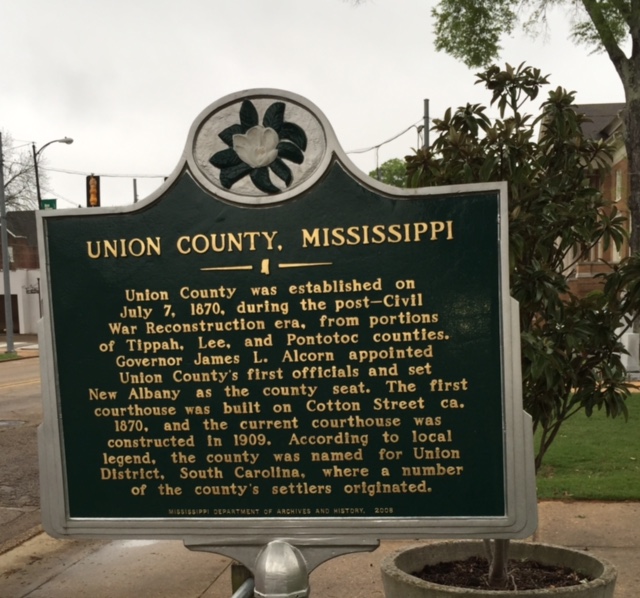
Union – Bob Cornelius

Lafayette – Scott Yoste
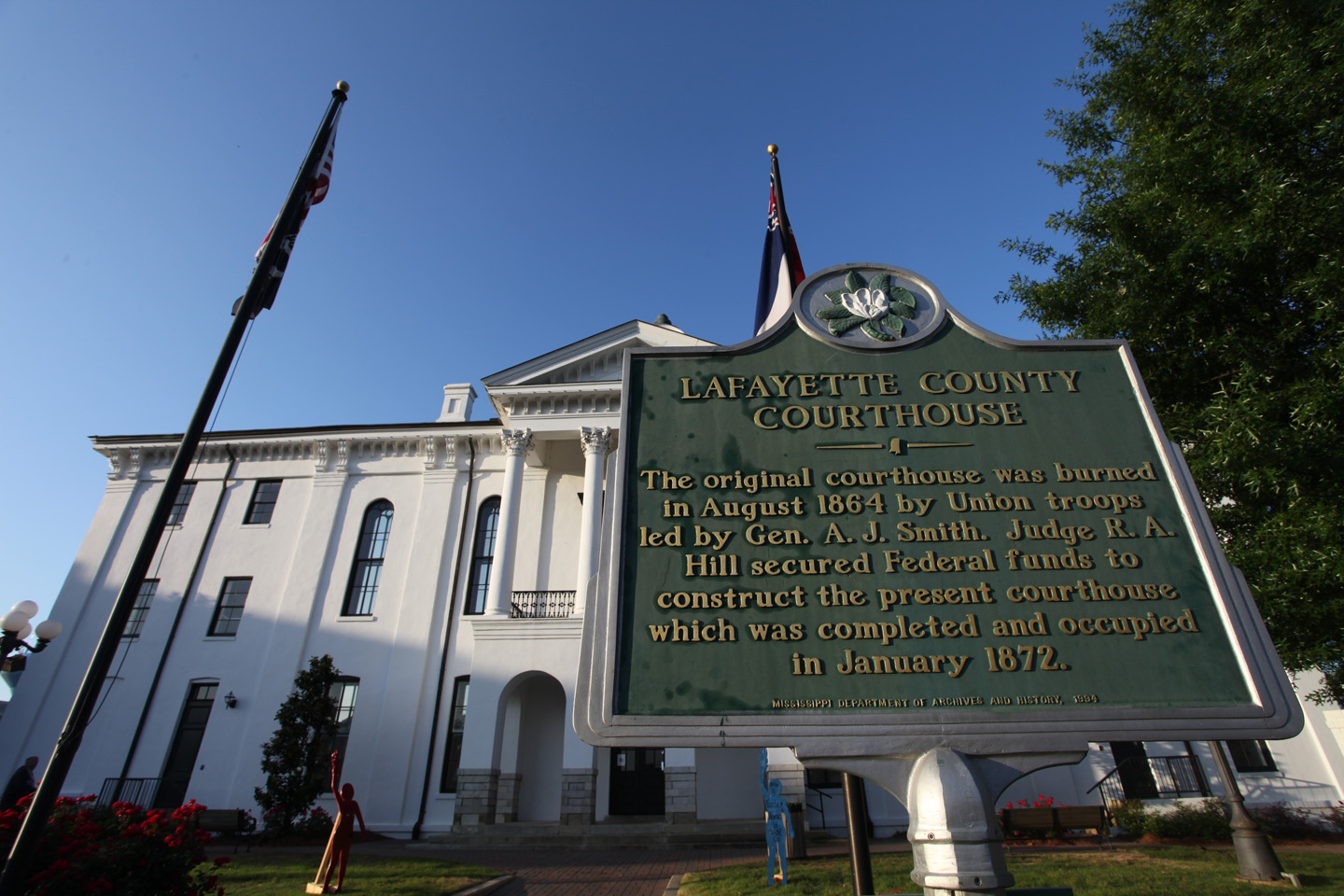
Lafayette – Paul Rogers

Harrison at Gulfport – Kathy Wilkinson

Panola – Lacy Hollins

Calhoun (demolished) – LP
So You Want to be a Judge
May 7, 2015 § 4 Comments
There are vacant chancery judge posts scattered around the state, and lawyers are vying to fill them. If you’re thinking about becoming a chancellor, you might want to give some thought not only to what are the duties of the job, but also what are some of the nuances.
Here are some of my personal, random thoughts on the role of a chancery court judge:
- The judge’s first duty is to the law. The judge has to be blind to who the parties are, and to who represents them, and let the facts lead him to a decision consistent with the applicable law. That sounds obvious, but it can be difficult to do.
- The judge has to be dispassionate, but understanding of the foibles of human nature. A wrathful judge who hurls moralistic thunderbolts at the parties is, in my opinion, an ineffective judge. It’s better to craft an effective solution to a problem than to dispense punishment with judgmental platitudes. People come to court hoping for a pragmatic, wise solution, not another layer of problems laid on by the court.
- What lawyers and the public want most is a judge who is fair and follows the law. Fail on either count, and you fail as a judge. A chancellor can never pick a side or a conclusion and reason back through the facts and law to get to that preconceived notion. The facts and law of the case dictate a ruling, not vice versa.
- It takes a sure, confident, competent command of the rules of evidence to be a judge. If you have tried enough cases, you know what I mean. In fact, if you have little or no trial experience, I really don’t see how you could pull off being a chancellor. Lack of evidentiary skills will show in the work product. A judge who is usually wrong in evidentiary rulings or who waffles on every ruling will lose respect of the lawyers, and probably develop a history of reversals.
- Speaking of reversals, two things apply. One is that a consistent history of reversals is a symptom of not following the law and/or not paying attention to the facts. Two is that the chancellor must rule based on what the facts and law dictate, and never with a concern to avoid reversal. Those two may sound inconsistent, but the common thread is to follow the law and to apply it appropriately to the facts in evidence.
- The judge must always be vigilant to see that justice is done. That may require a sua sponte appointment of a GAL, or inquiring behind a PSA, or scrutinizing actions of executors, guardians, conservators, and lawyers.
- The judge must make sure that probate matters are being handled diligently, and free of any misconduct.
- The chancellor must not let lawyers, particularly old lions, push him around. The judge controls the conduct of the case, and absolutely controls the courtroom. That does not mean that the judge is a tyrant, but firm, assertive behavior is required, and when the lawyers get accustomed to it, respect ensues.
- Ethics are critically important. Even the appearance of impropriety is forbidden. It requires a thorough knowledge and observance of the Canons of Judicial Conduct to be a successful judge.
- One of the side-effects of ethical behavior is isolation. The old comraderie with lawyers comes to an end.
- A crucial thing to remember is that demeanor is vitally important. A judge should be rational, wise, kind, understanding, respectful, and even-handed. A judge should try never to be impatient, rude, sarcastic, or erratic. Lawyers who appear before you are still your colleagues who deserve your respect. The lawyer you mistreat and humiliate in the courtroom may likely be your next opponent.
- Another reason that demeanor is important is that people in the courtroom are observing you closely. There is not a judge’s frown, grimace, smile, nod, sigh, or rolling of the eyes that someone does not note.
- One of the hardest things to do consistently is to be patient. That is not easy when a lawyer is stumbling and fumbling through some routine matter, or must be shown the proper way to handle estate matters time and again.
- Dishonesty can never be tolerated, and must be dealt with swiftly and decisively.
Other judges may have a different take.
Before You Draft that PSA …
May 6, 2015 § 4 Comments
Suzie drops by, writes you a check for your retainer and court costs, and fills you in on the terms of the parties’ agreement to get an irreconcilable differences divorce. She hands you a folded sheet of notebook paper with bullet points that read like, ” … Joe will get his truck and pay for it, and I will get my car and pay for it,” and ” … Joe will pay me $5,000 from his retirement account,” and “Suzie will get 1/2 of Joe’s retirement with Ajax Lightning Rod Corp.”
So, what do you do next?
If your answer was to hand the paper to your secretary to start working on a draft, you are wrong. As in deeply, malpracticedly wrong.
The correct answer is that you need a LOT more information before you commence that draft. Consider:
- What kind of retirement account is the $5,000 going to come from, and when it is it to be paid? If the account is a defined contribution plan, such as IRA or 401(k), a lump sum can be paid if done properly. If, on the other hand, it is a defined benefit plan, such as most pension plans, she could only get the money in the form of an income stream at the time of Joe’s eligibility for retirement.
- If that retirement plan that is going to fund the lump-sum payment is PERS or military retirement, you can’t dip into it to withdraw cash. The only way to access PERS benefits is to retire and begin drawing a monthly benefit, or to leave employment and get a cash payout.
- What are the actual names of the retirement accounts? You are asking for trouble if you don’t use the exact name of the accounts, such as “Ajax Lightning Rod Corp. Employee Benefit Program 51-014,” or “Joe Blow IRA Account no. 700-092108, Skinflint Bank & Trust, Lucedale, MS.” Why? Because people have a tendency years after the fact to lose their memory of exactly what it was they agreed to do, and that detail nails down exactly what that agreement was. Not only that, but later when you draft any necessary QDRO, you will need that exact information.
- Do not lift a finger to draft that PSA until you hold in your hand the most recent statements from all of the retirement accounts. Just because someone tells you they can do something does not mean they can. Also, those statements will have most, if not all, of the information you will need to draft the retirement provisions of the PSA.
- Make sure you specify the exact date of division. For example, “Suzie shall receive an amount equal to one-half of the account balance as of January 15, 2015 …” The date by which the division is to be accomplished is also critical.
- Spell out who has the responsibility to do what. If Joe is to accomplish all of this, make sure the agreement says that. If someone is going to hire a financial advisor or lawyer to draft a QDRO, who will pay the expense? Some plans actually charge fees — as much as several hundred dollars — to process divisions. Who will pay?
- Address who will bear the tax responsibility for his or her share of the division. Remember that IRA and 401(k) divisions are taxed as income, plus a 10% penalty. If that $5,000 payment is made, will Suzie’s share be reduced by 38%, or will Joe bear that burden? Remember that Suzie can avoid any taxes by rolling the money over into her own qualified account.
The most recent object lesson in how not to handle a retirement division is in the case of Miles v. Miles, about which I posted at the link. You don’t want that to happen to you. As I said before, you need to educate yourself about retirement accounts and put some thought into the most effective way to draft a provision that will protect your client and successfully accomplish what she wants to do.
Some of the information in this post is derived from a presentation by Michael D. James of Legacy Wealth Management Group, Hattiesburg, to the Conference of Chancery Judges in April.

