Playing with Dynamite
May 12, 2015 § 2 Comments
If a husband and wife came into your office and wanted you to represent them both in an ID divorce, what would you say? I think, and would hope, that the vast majority of us would decline on ethical grounds and offer to represent only one, not both.
How would it work, anyway, to represent both parties? You could put them in separate rooms and shuttle between. You could run to one room and advise the husband against agreeing to pay any alimony, and then run to another room and advise the wife to hold out until the husband agrees to alimony. Absurd? I’ll say.
Mississippi Rule of Professional Conduct (MRPC) 1.7 precludes representation of opposing parties in litigation unless certain conditions are met. Ethics Opinion number 80 of the Bar issued March 25, 1983, makes it clear that joint representation in an irreconcilable differences divorce is unethical:
The Committee is, therefore, of the opinion that the representation of both parties to a no-fault divorce violates the Rule 1.7, MRPC, and that it is, therefore, unethical for a lawyer to undertake such multiple representation.
How to handle it is set out in this language of the Opinion:
There is nothing wrong at all with one of the parties to a No-Fault Divorce being without an attorney, so long as that party, either H or W is properly informed by the spouse’s attorney that (1) that party is not represented by the spouse’s attorney, (2) the spouse’s attorney will not undertake to advise that party on any aspect of the case as to his or her rights, and (3) that party has a right to obtain an attorney to advise him or her and to review any of the agreements, pleadings or decrees which will be prepared. See Rule 4.3, MRPC.
A recent COA case involved dual representation and a challenged outcome. Leta Collins and Kenneth Collins were divorced from each other in 2011. They had filed a joint complaint for divorce on the sole ground of irreconcilable differences. The pleading stated that “The parties together have been represented by [Name of the Attorney], and was signed by that attorney as “Counsel for Leta D. Collins and Kenneth J. Collins.” In the PSA, which was approved by the court, Leta relinquished all interest in Kenneth’s financial assets and retirement.
More than a year later, Leta discovered that she had not known of more than $500,000 in financial assets that Kenneth had at the time of the divorce. She filed a R60 motion, but she did not allege that a fraud had been committed. The chancellor denied the motion, and Leta appealed.
In the case of Collins v. Collins, decided May 5, 2015, the COA affirmed. Judge Fair wrote this for the court:
¶24. Leta argues that the marital property was not equitably distributed because she and Kenneth were represented by the same attorney during the divorce. She alleges that her lack of independent advice and counsel led her to sign the unfair PSA.
¶25. The joint complaint for divorce states “[t]he parties together have been represented by M. Chadwick Smith,” and it was signed by Smith as “attorney for” both parties. Leta testified she and Kenneth believed they were represented by the same attorney. Leta argues this was a direct violation of Mississippi Rule of Professional Conduct 1.7(a), which prohibits representation of “a client if the representation of that client will be directly adverse to another client,” unless certain conditions are met.
¶26. The chancellor addressed this issue in her findings from the bench, stating that
when Mr. Chadwick Smith came in with his document, the final decree, I inquired of him who he represented because the divorce had the words that Ms. Collins’[s] counsel very ably draws to attention, that he represented both. And he stated, “I only prepared the paperwork, Judge. That’s what it says on there, ‘Prepared by.’” Only after the assurances of Mr. Chad Smith did I accept the parties’ divorce, and I signed the same on the 8th day of June 2011. Thus the allegations that Ms. Collins seeks to present that Mr. Collins committed a fraud on this court are fundamentally vested against Mr. Chad Smith.
¶27. Leta testified that she was the one who had actually prepared the PSA, based on her prior divorce papers, with some contributions from Kenneth. Kenneth likewise testified that Smith did not make any decisions for them. As the chancellor found, if Smith violated the Rules of Professional Conduct by engaging in dual representation, it was not a sufficient basis to modify the divorce decree. This issue is without merit.
What saved the attorney here apparently was that the parties had specifically waived financial disclosures, and it was Leta, and not the lawyer, who prepared the PSA. Both parties acknowledged that the lawyer gave them no advice at all. It did not help Leta’s cause, if you read the rest of the opinion, that it took her a year and some months to seek the court’s assistance.
A few thoughts:
- Don’t let anything about the peculiar facts in this case mislead you into believing it’s ever okay to represent both parties in an ID divorce. It’s not. Ever. It’s unethical. And if it’s unethical, it can cost you professionally. Don’t do it. Ever.
- Any lawyer who states on a joint complaint for divorce that he represents both parties is asking for trouble. That in and of itself is a statement admitting an ethical violation.
- I must be getting old (and I admit I am), but I am seeing more and more of people with JD after their names taking the position that “I only drafted papers for the parties,” or “I simply typed and submitted what they gave me,” or “this is what the client insists on doing.” Whatever happened to lawyers (JD’s) as counselors at law? Have lawyers gone from being legal advisors and guides to being high-priced clerk-typists? What is the point of having a lawyer when anyone with a word-processing program and a laptop can produce pleadings and an agreement? What is the point of having a lawyer if it is not to obtain legal advice? This trend, particularly among young people with JD after their names troubles me greatly. Notice that I said “JD after their names” and not lawyers. Just because you have JD after your name does not make you a lawyer. What makes you a lawyer is representing, protecting, and looking after the legal interests of a client. If all you’re doing is being a paying customer’s stooge, or acting as their clerk-typist, all you are is a JD, not a lawyer.
- In this case, the parties themselves acquiesced in this awkward arrangement, which created an excuse for it under MRPC. Had they not, I think Ms. Collins had a legitimate beef, and maybe a viable lawsuit against their joint lawyer. But although it gets the lawyer out of this particular bind, I don’t think that the parties’ acquiescence can excuse this ethical breach. The lawyer, not the parties. has the higher duty and is ethically bound.
- If you ever draft a joint complaint, make doubly, triply sure that you make it clear which party you represent, and that you have not, and will not provide the unrepresented party with any legal advice, and that she has the right to have attorney advise him or her and to review any of the agreements, pleadings or decrees which will be prepared.
- Better yet: never, ever, ever, ever file a joint complaint for divorce on the ground of irreconcilable differences.
- And, for Pete’s sake, be an attorney and advise your client. That’s what you went to law school for.
- Play fast and loose with the ethical rules and you are playing with dynamite.
That Sinking Feeling
May 11, 2015 § 2 Comments
Most old adages stick around for centuries because they have at their heart a kernel of truth. Sayings like “You can’t tell a book by its cover,” and “The early bird gets the worm” ring true because they are true. Trite and true.
Another old saying is, “A boat owner’s two happiest days are (1) the day he buys the boat, and (2) the day he sells it.”
We can now add a corollary to (1) above: “the day he buys the boat … unless the Mississippi Department of Revenue (MDOR) demands payment of use tax.”
Vincent Castigliola, Jr., a Pascagoula lawyer, thought he had had his happiest day when he bought a yacht in Florida from Mark Fallon, an Ohio individual who was not engaged in the boat trade, but who had marketed the boat through a boat marketing service. Vincent undoubtedly was happy until the killjoys from the MDOR showed up and demanded that he fork over another $7,588 in use taxes for the transaction. This, I am sure, made Vincent unhappy, boat and all.
Use taxes, as I am sure you know, are paid on purchases of personal property from a dealer in another state when that personal property is used in Mississippi. A boat bought from a dealer in Florida and brought to Mississippi incurs a use tax. A computer bought from Best Buy in Baton Rouge and brought to Mississippi incurs a use tax. And so on. The rule is that if the transaction would have borne sales tax in Mississippi if it occurred here, it incurs use tax if it took place in another state. Casual sales between individuals not operating as dealers, incur neither sales nor use tax.
Vincent exhausted his administrative remedies and appealed to chancery court. MDOR filed for summary judgment claiming that Vincent could not meet his burden of proof that he was entitled to the exemption, and that the transaction was between a dealer and Vincent.
The chancellor granted summary judgment in favor of MDOR, and Vincent appealed.
In the case of Castigliola v. Mississippi Dept. of Revenue, the MSSC reversed and rendered, the opinion by Chief Justice Waller holding that it was the MDOR’s burden to prove that the transaction was subject to the casual-sale exemption, and that the purchase was not subject to Mississippi use tax. The decision was unanimous, with Justice Randolph not participating.
You can read the opinion for yourself. There is an interesting discussion of the distinction between exclusions and exemptions. In all, it’s an interesting read.
And it’s a victory of sorts for taxpayers, not to mention attorneys who aim to be happy boat owners.
Courthouses of Mississippi
May 8, 2015 § 1 Comment
More for you … send me yours.

Yalobusha at Coffeeville

Covngton – Kathy Wilkinson

Quitman – LP

Union – Bob Cornelius

Union – Bob Cornelius

Lafayette – Scott Yoste
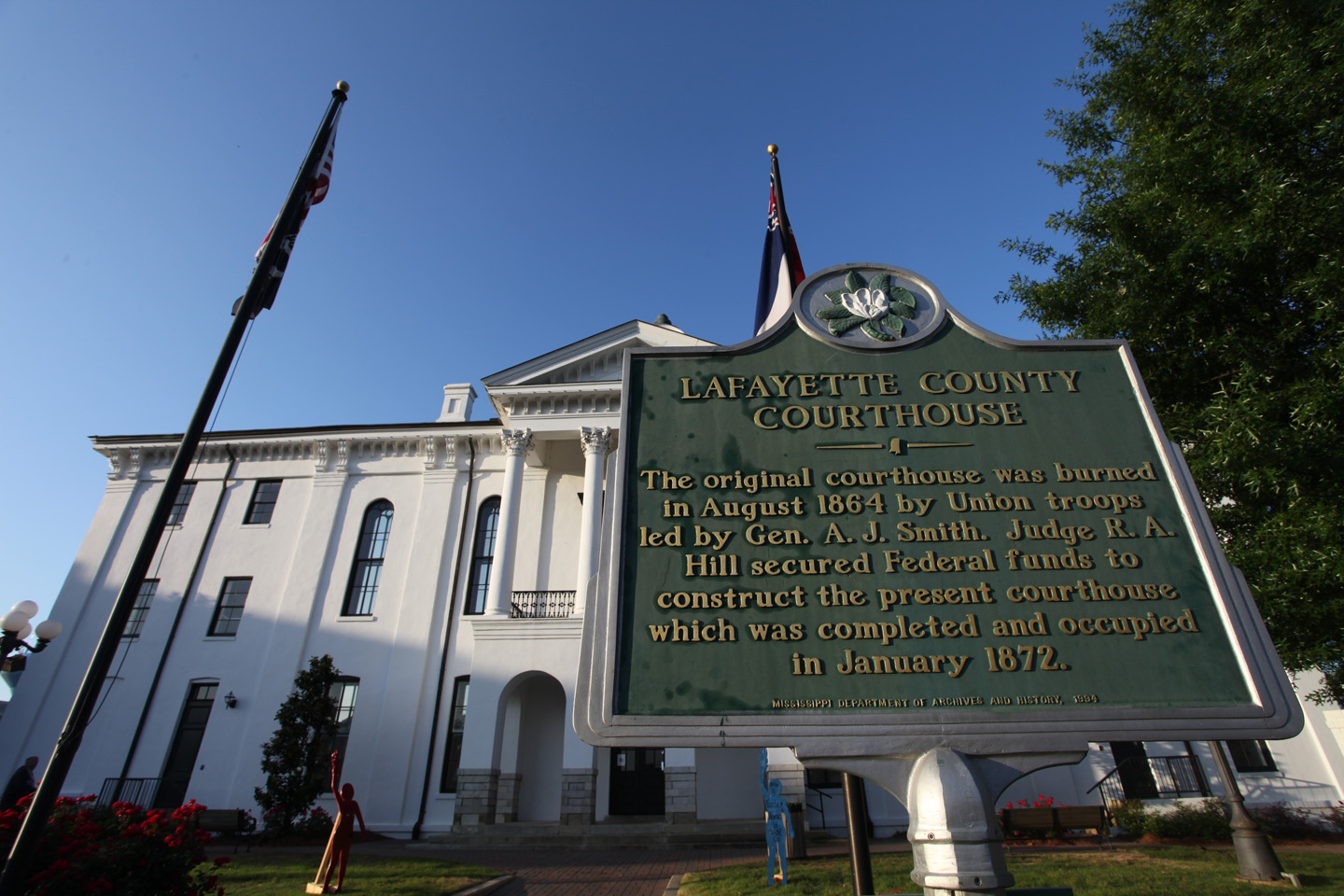
Lafayette – Paul Rogers

Harrison at Gulfport – Kathy Wilkinson

Panola – Lacy Hollins

Calhoun (demolished) – LP
So You Want to be a Judge
May 7, 2015 § 4 Comments
There are vacant chancery judge posts scattered around the state, and lawyers are vying to fill them. If you’re thinking about becoming a chancellor, you might want to give some thought not only to what are the duties of the job, but also what are some of the nuances.
Here are some of my personal, random thoughts on the role of a chancery court judge:
- The judge’s first duty is to the law. The judge has to be blind to who the parties are, and to who represents them, and let the facts lead him to a decision consistent with the applicable law. That sounds obvious, but it can be difficult to do.
- The judge has to be dispassionate, but understanding of the foibles of human nature. A wrathful judge who hurls moralistic thunderbolts at the parties is, in my opinion, an ineffective judge. It’s better to craft an effective solution to a problem than to dispense punishment with judgmental platitudes. People come to court hoping for a pragmatic, wise solution, not another layer of problems laid on by the court.
- What lawyers and the public want most is a judge who is fair and follows the law. Fail on either count, and you fail as a judge. A chancellor can never pick a side or a conclusion and reason back through the facts and law to get to that preconceived notion. The facts and law of the case dictate a ruling, not vice versa.
- It takes a sure, confident, competent command of the rules of evidence to be a judge. If you have tried enough cases, you know what I mean. In fact, if you have little or no trial experience, I really don’t see how you could pull off being a chancellor. Lack of evidentiary skills will show in the work product. A judge who is usually wrong in evidentiary rulings or who waffles on every ruling will lose respect of the lawyers, and probably develop a history of reversals.
- Speaking of reversals, two things apply. One is that a consistent history of reversals is a symptom of not following the law and/or not paying attention to the facts. Two is that the chancellor must rule based on what the facts and law dictate, and never with a concern to avoid reversal. Those two may sound inconsistent, but the common thread is to follow the law and to apply it appropriately to the facts in evidence.
- The judge must always be vigilant to see that justice is done. That may require a sua sponte appointment of a GAL, or inquiring behind a PSA, or scrutinizing actions of executors, guardians, conservators, and lawyers.
- The judge must make sure that probate matters are being handled diligently, and free of any misconduct.
- The chancellor must not let lawyers, particularly old lions, push him around. The judge controls the conduct of the case, and absolutely controls the courtroom. That does not mean that the judge is a tyrant, but firm, assertive behavior is required, and when the lawyers get accustomed to it, respect ensues.
- Ethics are critically important. Even the appearance of impropriety is forbidden. It requires a thorough knowledge and observance of the Canons of Judicial Conduct to be a successful judge.
- One of the side-effects of ethical behavior is isolation. The old comraderie with lawyers comes to an end.
- A crucial thing to remember is that demeanor is vitally important. A judge should be rational, wise, kind, understanding, respectful, and even-handed. A judge should try never to be impatient, rude, sarcastic, or erratic. Lawyers who appear before you are still your colleagues who deserve your respect. The lawyer you mistreat and humiliate in the courtroom may likely be your next opponent.
- Another reason that demeanor is important is that people in the courtroom are observing you closely. There is not a judge’s frown, grimace, smile, nod, sigh, or rolling of the eyes that someone does not note.
- One of the hardest things to do consistently is to be patient. That is not easy when a lawyer is stumbling and fumbling through some routine matter, or must be shown the proper way to handle estate matters time and again.
- Dishonesty can never be tolerated, and must be dealt with swiftly and decisively.
Other judges may have a different take.
Before You Draft that PSA …
May 6, 2015 § 4 Comments
Suzie drops by, writes you a check for your retainer and court costs, and fills you in on the terms of the parties’ agreement to get an irreconcilable differences divorce. She hands you a folded sheet of notebook paper with bullet points that read like, ” … Joe will get his truck and pay for it, and I will get my car and pay for it,” and ” … Joe will pay me $5,000 from his retirement account,” and “Suzie will get 1/2 of Joe’s retirement with Ajax Lightning Rod Corp.”
So, what do you do next?
If your answer was to hand the paper to your secretary to start working on a draft, you are wrong. As in deeply, malpracticedly wrong.
The correct answer is that you need a LOT more information before you commence that draft. Consider:
- What kind of retirement account is the $5,000 going to come from, and when it is it to be paid? If the account is a defined contribution plan, such as IRA or 401(k), a lump sum can be paid if done properly. If, on the other hand, it is a defined benefit plan, such as most pension plans, she could only get the money in the form of an income stream at the time of Joe’s eligibility for retirement.
- If that retirement plan that is going to fund the lump-sum payment is PERS or military retirement, you can’t dip into it to withdraw cash. The only way to access PERS benefits is to retire and begin drawing a monthly benefit, or to leave employment and get a cash payout.
- What are the actual names of the retirement accounts? You are asking for trouble if you don’t use the exact name of the accounts, such as “Ajax Lightning Rod Corp. Employee Benefit Program 51-014,” or “Joe Blow IRA Account no. 700-092108, Skinflint Bank & Trust, Lucedale, MS.” Why? Because people have a tendency years after the fact to lose their memory of exactly what it was they agreed to do, and that detail nails down exactly what that agreement was. Not only that, but later when you draft any necessary QDRO, you will need that exact information.
- Do not lift a finger to draft that PSA until you hold in your hand the most recent statements from all of the retirement accounts. Just because someone tells you they can do something does not mean they can. Also, those statements will have most, if not all, of the information you will need to draft the retirement provisions of the PSA.
- Make sure you specify the exact date of division. For example, “Suzie shall receive an amount equal to one-half of the account balance as of January 15, 2015 …” The date by which the division is to be accomplished is also critical.
- Spell out who has the responsibility to do what. If Joe is to accomplish all of this, make sure the agreement says that. If someone is going to hire a financial advisor or lawyer to draft a QDRO, who will pay the expense? Some plans actually charge fees — as much as several hundred dollars — to process divisions. Who will pay?
- Address who will bear the tax responsibility for his or her share of the division. Remember that IRA and 401(k) divisions are taxed as income, plus a 10% penalty. If that $5,000 payment is made, will Suzie’s share be reduced by 38%, or will Joe bear that burden? Remember that Suzie can avoid any taxes by rolling the money over into her own qualified account.
The most recent object lesson in how not to handle a retirement division is in the case of Miles v. Miles, about which I posted at the link. You don’t want that to happen to you. As I said before, you need to educate yourself about retirement accounts and put some thought into the most effective way to draft a provision that will protect your client and successfully accomplish what she wants to do.
Some of the information in this post is derived from a presentation by Michael D. James of Legacy Wealth Management Group, Hattiesburg, to the Conference of Chancery Judges in April.
New Laws that may Impact Your Chancery Practice
May 5, 2015 § Leave a comment
The legislature enacted some laws in the recently-completed session that might affect your practice in chancery court. I may have comments on some of them later, but for now here is the list:
- HB 153: “MS Uniform Statutory Rule Against Perpetuities.” create. 03/23 Approved by Governor.
- HB 177: Courts; prohibit from applying foreign law under certain circumstances. Approved by Governor.
- HB 272: Bad checks; include electronically converted checks and electronic commercial debits. Approved by Governor.
- HB 405: Commercial Real Estate Broker Lien Act; clarify definition of “commercial real estate” under. Approved by Governor.
- HB 556: Domestic violence; revise procedures related to. Approved by Governor.
- HB 692: Emergency Response and Overdose Prevention Act; create. Approved by Governor.
- HB 700: Estate bond requirement; authorize court or chancellor to waive. Approved by Governor.
- HB 703: Judicial redistricting; revise. Approved by Governor.
- HB 711: Landlord-tenant; provide for disposition of personal property remaining on the premises after removal of the tenant. Approved by Governor.
- HB 959: Minors; clarify appointment of guardian ad litem, enact protections for child witnesses. Approved by Governor
- HB1049: Court reporters; increase salary for those in circuit, chancery and county courts. Approved by Governor.
- SB2105: Children in custody of DHS; require notification of parents of child’s siblings in conformity with federal law. Approved by Governor.
- SB2301: Uniform Interstate Family Support Act; create (corrected). 03/17 Approved by Governor.
- SB2310: Mississippi Uniform Limited Partnership Act; revise and expand. Approved by Governor.
- SB2364: Real property liens; clarify Notice of Contest of Lien form. Approved by Governor.
- SB2390: Service of process; sheriff may retain fee for attempt to serve. Approved by Governor.
Please don’t ask me to comment on these yet. In most cases, I know as much about them as you do. I’ll post on some of them later after I have had an opportunity to read and digest them.
The Expectation of Privacy
May 4, 2015 § 4 Comments
The MSSC last Thursday published a new MRCP 5.1 that imposes some important privacy protections to all filings in chancery court — both electronic and paper. Here is the new rule, which went into effect April 30, 2015:
RULE 5.1. PRIVACY PROTECTION FOR FILINGS MADE WITH THE COURT
(a) Redacted Filings. Unless the court orders otherwise, in an electronic or paper filing with the court that contains an individual’s social-security number, taxpayer-identification number, or birth date, the name of an individual known to be a minor, or a financial-account number, a party or nonparty making the filing may include only:
(1) the last four digits of the social-security number and taxpayer-identification number;
(2) the year of the individual’s birth;
(3) the minor’s initials; and
(4) the last four digits of the financial-account number.
(b) Exemptions from the Redaction Requirement. The redaction requirement does not apply to the following:
(1) a financial-account number that identifies the property allegedly subject to forfeiture in a forfeiture proceeding;
(2) the record of an administrative or agency proceeding; and
(3) the record of a court or tribunal, if that record was not subject to the redaction requirement when originally filed.
(c) Filings Made Under Seal. The court may order that a filing be made under seal without redaction. The court may later unseal the filing or order the person who made the filing to file a redacted version for the public record.
(d) Protective Orders. For good cause, the court may by order in a case:
(1) require redaction of additional information; or
(2) limit or prohibit a nonparty’s remote electronic access to a document filed with the court.
(e) Option for Additional Unredacted Filing Under Seal. A person making a redacted filing may also file an unredacted copy under seal. The court must retain the unredacted copy as part of the record.
(f) Option for Filing a Reference List. A filing that contains redacted information may be filed together with a reference list that identifies each item of redacted information and specifies an appropriate identifier that uniquely corresponds to each item listed. The list must be filed under seal and may be amended as of right. Any reference in the case to a listed identifier will be construed to refer to the corresponding item of information.
(g) Waiver of Protection of Identifiers. A person waives the protection of Rule 5.1(a) as to the person’s own information by filing it without redaction and not under seal.
These same restrictions, in slightly different form, are in Section 9 of the Electronic Courts Administrative Procedures. This amendment to the MRCP extends the existing electronic filing privacy protections to paper, or conventional, filings.
From a practice standpoint:
- Tax returns need to be scrutinized carefully. It’s not enough to redact the taxpayers’ SSN’s at the top of the returns. The children’s names and SSN’s are also on the return. Schedule C may include a taxpayer ID number.
- On 8.05’s, use the initials of the children and their ages rather than their full names and birth dates. As for the parties, again, use their ages and not birthdates. For financial accounts, use only the last four digits. Do not include taxpayer ID numbers anywhere.
- If you slip up and include any of the proscribed information, you will be deemed to have waived the protection of the rule for your client. If that results in any damage due to identity theft or other misuse, you could be called to account.
The obvious purpose of this amendment is to prevent identity thieves from trolling for SSN’s and birthdates. Keeping the children’s names out protects them from predators.
This rule is in effect right now. School your staff in its requirements and begin observing them yourself. Discovery, particularly voluminous discovery, is typically chock full of this kind of private information. You need to be diligent to protect the interest of your clients.
“Quote Unquote”
May 1, 2015 § 1 Comment
“Too often we underestimate the power of a touch, a smile, a kind word, a listening ear, an honest compliment, or the smallest act of caring, all of which have the potential to turn a life around.” — Leo Buscaglia
“This is my simple religion. There is no need for temples; no need for complicated philosophy. Our own brain, our own heart is our temple; the philosophy is kindness.” — Tenzin Gyatso, 14th Dalai Lama
“Deeds of kindness are equal in weight to all the commandments.” — Talmud

Reprise: Better Chancery Practice FAQ
April 30, 2015 § 4 Comments
Reprise replays posts from the past that you may find useful today.
BETTER CHANCERY PRACTICE FAQ
October 8, 2010 § 1 Comment
My 8.05 financial statements stink. How can I improve them?
Here are Ten Tips for More Effective Rule 8.05 Financial Statements.
Is my estate ready to close?
Check out this Checklist for Closing an Estate.
I think I need to file a habeas action. Any tips?
This Habeas Corpus Step by Step should help.
One more time: what are those child custody factors I need to prove at an upcoming trial?
The Albright factors are what you’re looking for.
Help! We need to sell some real property in an estate, and I don’t know where to start?
How to Sell Real Property in an Estate may be just what you need.
I’ve been asked to handle a minor’s settlement for a Jackson firm, and I’ve never done it before. What do I need to do?
This Outline for Handling a Minor’s Settlement will get you started.
My mail has an MRCP 41(d) notice in it this morning. I remember you said something about it, but I don’t have time to look for it. Can you remind me what I am supposed to do?
<Sigh> Here’s a post on what to do When Rule 41(d) Comes Knocking at Your Door.
I need to prove the tax effects of alimony, but my client can’t afford to hire a CPA to come testify. Any ideas on what I should do?
Try looking at Proving Tax Effects of Alimony.
My Chancery Judge is really nitpicky. How can I draft my adoption Complaint to satisfy him?
Are you talking about me? Whatever. Here is a post on pleading Jurisdiction for Adoption.
Every time I go to court in Jackson, the lawyers there snicker about my countryfied attire. Any suggestions? I cannot afford another $100 contempt citation for punching out a lawyer in the courtroom.
You probably need to be charging more so that you can afford either a better wardrobe or more contempt fines. Until you do, try reading “High Waters” and Burlap Suits. It won’t change anything, but it may help you to feel better.
Garbage in, Garbage out
April 29, 2015 § 4 Comments
Output often bears a marked resemblance to input.
One cannot expect to emulate the deep luster and luxe of mahogany with coarse plywood. Nor does ground round yield an acceptable chateaubriand. In either case, the product will look shabbily like the original material.
So why should we expect that the cultural garbage that we daily consume in the form of trash novels (for the few of us who still read), situation comedies, reality dance and bachelor shows, alarmist “news” programs, and television “dramas,” will produce from us any more refined output than the quality of what we have consumed?
What do these rubbish add to our store of wisdom, or our deeper understanding of human nature, or our grasp of how other cultures view the world, or how we can make things better?
This is not to suggest that one should not add a little cultural cotton candy, or broadcast Ben & Jerry’s, or reading Reese’s peanut butter cups to one’s life every now and then. No. What I am saying is that a steady diet of that stuff will transform you from a lithe, supple thinker into a bloated, lazy advocacy short-cutter.
Before I entered law school, a wise judge told me that the more exposure one is able get to the great ideas, to the history behind the way things are, to the principles that influence people in their daily lives, the better one can understand how to use the tools of the legal profession for the benefit of one’s clients. That process takes place over a lifetime, and it does not end when one graduates from law school.
We learn much of what we come to know from our experiences. You decide what you are learning by the experiences you choose.
Anderson made a similar point recently on his blog with reference to writing: the best way to learn the art of persuasive writing is to read persuasive writers.
The quality of what you produce depends on the quality of the raw materials used.
 The Better Chancery Practice Blog