FREEDOM TRAIL
October 5, 2012 § Leave a comment
Last week marked the fiftieth anniversary of James Meredith’s enrollment at Ole Miss. The tumult and combat that surrounded the diminutive Meredith’s entrance to the university has often been characterized as “the last battle of the Civil War.” It’s an event we have talked about here before.
But as much as Meredith did to bring down the oppressive reign of white supremacy, there was much struggle to come after. The bloody summer of 1964 — “Freedom Summer” — was especially noteworthy, because its murders sent a shiver of revulsion through the collective conscience of the nation that directly gave rise to the 1964 federal Civil Rights Act. Gradually, with the weight of the federal government behind it, the civil rights movement demolished barrier after barrier.
And so, as the weeks click by, we will be clicking off fiftieth anniversary after fiftieth anniversary of milestones in the Civil Rights Era.
I saw that one of the events to commemorate Meredith’s feat was the unveiling of a marker on the Mississippi Freedom Trail at Ole Miss. To date, the Freedom Trail has markers at Bryant’s Grocery in Money, Medgar Evers’ home in Jackson, The Greyhound Bus Station in Jackson, Jackson State University, and Mississippi State Penitentiary at Parchman.
A list of the sites planned for the first 30 markers is here.
It’s a bit of a surprise to me that there is no marker slated for Meridian, which: had the biggest COFO operation and Freedom School in the state in 1964; was the base of operations for Schwerner, Goodman and Chaney, who were murdered in nearby Philadelphia; and was the site of the state’s Freedom School Convention in 1964.
There is a group in Meridian that has secured ownership of the old Fielder & Brooks drug store, which housed the COFO headquarters. They plan to restore it and create an educational center there. As always, funding is the main obstacle.
Knowing and understanding our history is vitally important. We have to comprehend the forces that have shaped us, our ethos and the place where we live in order to be able to see clearly where we can and should go from here. The history of racial conflict and gradual reconciliation is so deeply ingrained in our culture that we must know and understand it so that we can know and understand ourselves.
No place on earth is better equipped by experience to show and tell the way out of racial oppression than Mississippi. Others can talk about it, but we are living it, day by day, increment by increment. To bear that witness, however, we must be able to tell our history.
James Meredith bravely blazed a trail to freedom in 1962. Many others, in ways large and small, blazed similar courageous paths. Mississippi’s Freedom Trail will help us remember.
DATELINE’S SELF-PORTRAIT OF 1965 GREENWOOD
July 16, 2012 § 2 Comments
If you missed Dateline NBC’s piece last night on Greenwood in 1965 studying white citizens’ racial attitudes, here is a link that will take you not only to the original 1965 report, but also to last night’s that focused on Booker Wright, a black waiter at the then-segregated Lusco’s restaurant, who spoke from his heart about the humiliation of segregation, a statement that cost him his job and other indignities.
For those of us who lived through it, the 1965 report is a disturbing reminder of the way things were, and how desperately unequal were our two ways of life — black and white.
For those of you too young to have experienced it, I urge you to see this to help understand where we were, and to help you evaluate where we are.
Ray DeFelitta, the son of the photojournalist who filmed the 1965 study, has a post on his blog about the Dateline segment. Ray is working on a documentary showcasing his father Frank’s work on Mr. Wright, along with Mr. Wright’s granddaughter, Yvette Johnson.
I recommend you take some time to view these.
FREEDOM SUMMER IN MERIDIAN
May 23, 2011 § 17 Comments
This year marks the 50th anniversary of the Freedom Riders’ attempts at integration of transportation and amenities across the south. The arrival of the Freedom Riders in May, 1961 was met with mob violence and police brutality, but it did not end segregation in Mississippi. The Freedom Riders did, however, pique public awareness across the nation of the inequalities in the south and the need to address them.
In 1962, representatives of four civil rights organizations — SNCC (Student Non-violent Coordinating Committee), CORE (Congress of Racial Equality), NAACP and SCLC (Southern Christian Leadership Conference) — met at Clarksdale and formed a new organization designed to coordinate their efforts and resources in Mississippi. They called the organization COFO (Congress of Federated Organizations).
The primary concern was to register black voters in Mississippi. At the time, Mississippi at less than 7% had the lowest percentage of black voter registration in the nation. Blacks seeking to register to vote were subjected to poll taxes, examinations that they had to pass to become enfranchised, and, when that was not enough, violence and even death.
It was decided that COFO would spearhead a massive, concentrated voter registration and desegregation effort in Mississippi in the summer of 1964. Volunteers were enlisted from across the country, primarily from the northeast and midwest, many of whom were college students willing to devote a summer to the cause. The effort came to be known as “Freedom Summer.”
In January, 1964, Michael Schwerner came to Mississippi and opened a COFO office in Meridian at 2505 1/2 Fifth Street. Schwerner was a member of CORE, and was a native of New York. He and his wife, Rita, lived in a Meridian apartment, and engaged in various community organizing activities. The COFO office was the headquarters of the Freedom Summer operation in Lauderdale County.
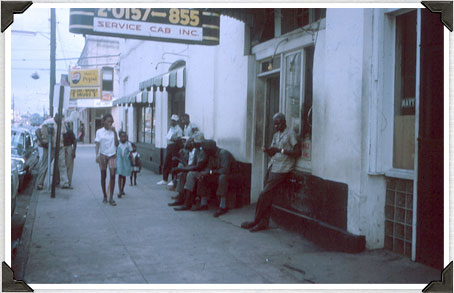
COFO HQ in Meridian
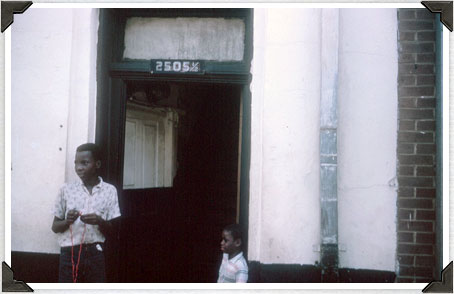
2505-1/2 Fifth Street
The headquarters occupied the second floor of the Fielder & Brooks Drug Store, an established and respected black business.
The Schwerners opened a COFO-sponsored community center where black children could gather and play games, socialize and access a lending library.
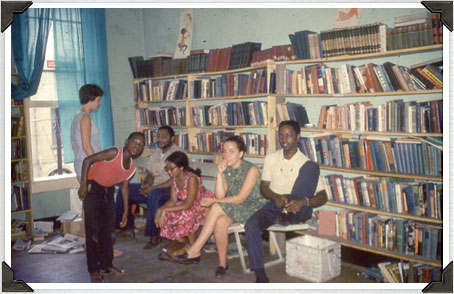
Reading Room
COFO in Meridian also operated one of the several dozen Freedom Schools that were opened across Mississippi that summer. The Freedom Schools taught citizenship, black history, constitutional rights, political processes, and basic academics. More than 3,500 students attended the Freedom Schools. Meridian’s Freedom School was at the old black Baptist Seminary.
Here is the text of a 1964 COFO memo describing the Meridian operation:
Meridian is a city of 50,000, the second largest in the state. It is the seat of Lauderdale county. It is in the eastern part of the state, near the Alabama border, and has a history of moderation on the racial issue. At the present time, the only Republican in the State Legislature is from Meridian. Registration is as easy as anywhere in the state, and there is an informal (and inactive) “biracial committee”, which, if it qualifies, is the only one in the state.
Voter registration work in Meridian began in the summer of 1963 (for COFO staff people, that is), and by autumn, when Aaron Henry ran in the Freedom Vote for Governor campaign, there was a permanent staff of two people in the city. In January, 1964, Mike and Rita Schwerner, a married couple from New York City, started a community center. In Meridian’s mild political climate, the community center there has functioned more smoothly than either of the two community centers which COFO has organized in tougher areas. The center has recreation programs for children and teenagers, a sewing class and citizenship classes. It also has a library of slightly over 10,000 volumes, and ambitious plans for expansion if more staff were available. The COFO staff in Meridian uses Meridian as a base for working six other adjoining counties.
The Freedom School planned for Meridian will have a fairly large facility, in contrast to most places in the state. The Baptist Seminary is a large, 3-story building with classroom capacity for 100 students and sleeping accommodations for staff up to about 20. Besides this, there is a ballpark available for recreation. The school has running water, blackboards and a telephone. The center has a movie projector and screen which it probably would lend. The library lends books to anyone for two-week periods. The question of rent has not been decided for the school. Even if there is no rent, however, we can count on a budget of around $1300, for food for students, utilities, telephone and supplies.
One of the COFO volunteers was Mark Levy, who came to Meridian with his wife, Betty, from Queens College in New York. He chronicled his sojourn in Meridian with his camera, and his impressive collection of photographs is in the Queens College archives, where you can view it online.
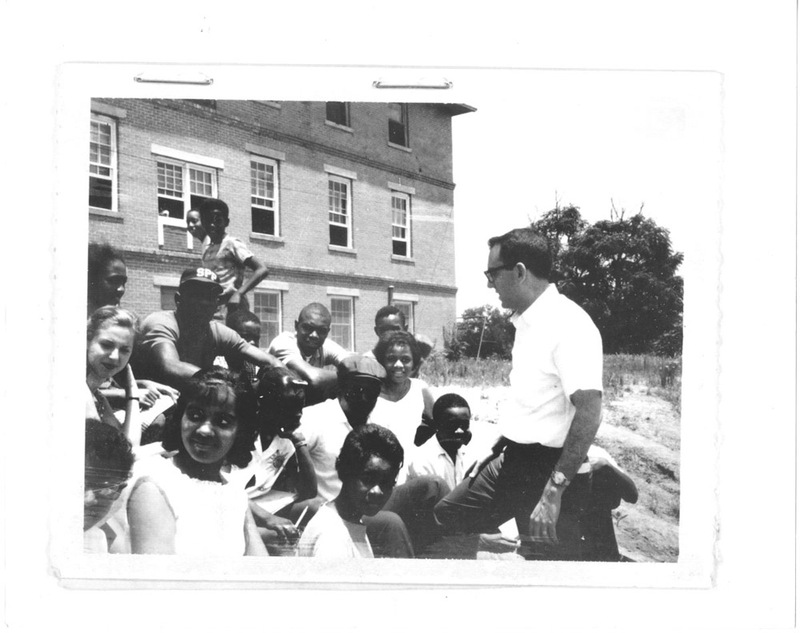
Mark and Betty Levy with students at the Freedom School
A remarkable fact documented by Levy is that the famed folk/protest singer Pete Seeger visited Meridian and played at the old Mt. Olive Baptist Church during Freedom Summer.
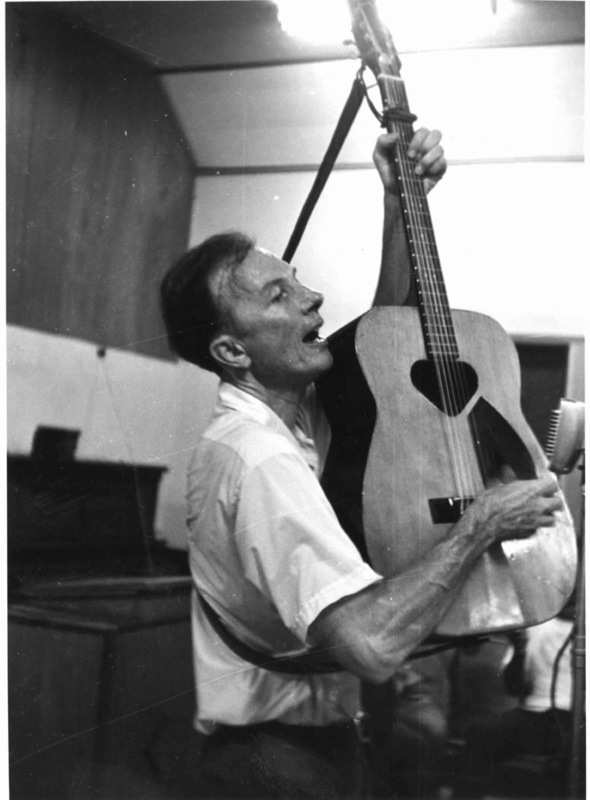
Seeger plays for the COFO workers
He performed for the COFO volunteers. The next photo shows COFO workers and others joining hands to sing along with Seeger. The young woman at the right with the flowered dress is COFO volunteer Patti Miller of Iowa, who pinpoints the date of Seeger’s performance as August 4, 1964.
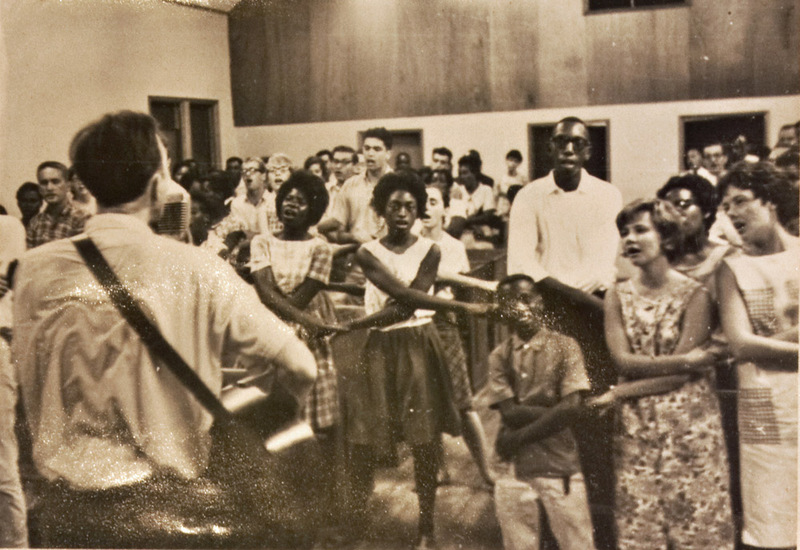
Shortly after he arrived, Schwerner was joined by an eager young Meridianite volunteer named James Chaney. As the summer drew near, other volunteers began to arrive from other places, among them Andrew Goodman of New York.
Despite its moderate reputation on racial issues, there was a dark underside to Meridian and the surrounding area. The Klan was active, with members in law enforcement and in influential positions. The Klan had its eye on COFO, and on Schwerner in particular. They gave him the derisive nickname “Goatee,” for his beatnik-style beard, and spread rumors that he was having an affair with a black woman.
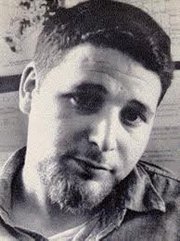
Michael "Goatee" Schwerner
Mississippi’s political leadership provoked the citizenry with accusations that the COFO workers were communists who had trained in Cuba. FBI Director J. Edgar Hoover made the statement that “We will not wet-nurse troublemakers,” insinuating that anyone who took matters into their own hands would not be bothered by the feds.
On June 21, 1964, Schwerner, Goodman and Chaney had returned from a training session in Oxford, Ohio, to learn that the Mt. Zion Methodist Church in Neshoba County had been burned by the Klan and some of its members beaten in retribution for allowing a Freedom School to operate there. The three travelled from Meridian to Neshoba and met with the leaders of the church. As they made their way back to Meridian, the three were stopped by a Neshoba County Deputy Sheriff and taken into custody on the pretext of a speeding charge. After they were released from jail in Philadelphia, they were stopped again on Highway 19 South by the Sheriff, who allowed a group of Klansmen to take them to Rock Cut Road, between House and Bethsaida, where all three were murdered by gunfire. An historical marker is set on the junction of Highway 19 and the road where they were killed.
When the trio did not return to Meridian as scheduled, their disappearance was reported and a manhunt ensued. Hundreds of naval personnel participated. President Johnson ordered Hoover to mobilize the FBI, and the agency began investigating, increasing the number of agents in the state from 15 to more than 150. Posters went up.
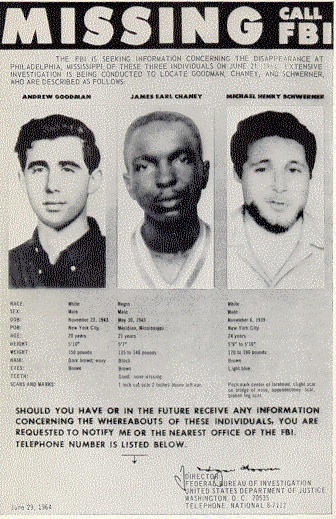
The Mississippi Sovereignty Commission investigated and its reports took the prevailing view that the disappearance was a publicity stunt designed to stir up public opinion. Governor Paul B. Johnson quipped that “Those boys are in Cuba.”
Before long, the searches turned up the CORE station wagon that the men had driven from Meridian. It had been taken to the Pearl River swamps north of Philadelphia east of Stallo off of Highway 21, where it was burned.
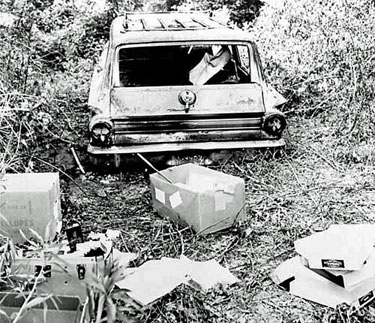
The discovery of the car did not quell the public belief that the disappearance had been staged, but the denial, speculation and ridicule abruptly ended when the three bodies were discovered by the FBI in a dam being built not far from the Neshoba County fairgrounds. It was conclusive proof of the atrocity.

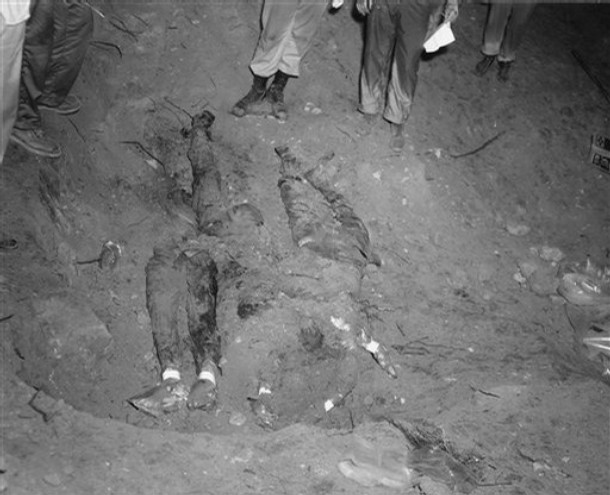
The FBI autopsy revealed that all three young men had died of gunshot wounds. The families were not convinced, however, and they demanded and got a second autopsy which revealed that Schwerner and Goodman had indeed been shot and killed. Chaney, though, had been brutally beaten before being fatally shot. The doctor who performed the autopsy said that he had never seen such extensive, catastrophic injuries, including smashed bones and damaged internal organs, not even in car or plane wreck victims.
Patti Miller remembers that that the bodies were found on August 4, 1964. She remembers that date because it was Seeger himself who announced it that night to the COFO workers during his appearance at Mt Olive.
Nineteen men, many of whom were from Meridian, were arrested and charged with the killings, but state charges were soon dropped. The federal government prosecuted them for violation of Schwerner’s, Goodman’s and Chaney’s civil rights, and seven were sentenced to varying terms up to ten years. It took until 2005 for one of the defendants, Edgar Ray Killen, to be brought to justice in a Mississippi court. He was convicted of manslaughter in Neshoba County Circuit Court.
Long before the legal proceedings, though, the families had to bury the dead as a prologue to getting on with their shattered lives. Schwerner and Goodman were taken back to their homes far away in New York.
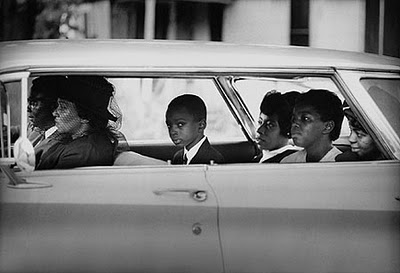
James Chaney's family on the day of the funeral
Chaney’s funeral was held in Meridian. Mourners included his collegues, the COFO workers. The funeral services took place at four different churches, culminating at First Union Baptist Church on 36th Avenue.
As for Freedom Summer, the results were mixed. Some voter registration was accomplished in the face of resistance. People were beaten and killed. Churches were burned. Violence across Mississippi escalated. By any of those measures, it was at least a borderline failure. But the deaths of Schwerner, Goodman and Chaney galvanized public opinion. The 1,000 or so COFO workers returned home from Mississippi with eyewitness testimony about the severity of the situation, many of them with scars to corroborate their stories. The nation realized that the full weight of the law and the federal government would be needed to end the systemic injustice that fostered violence and hatred and shielded murderers. The political pressure became irresistable, and the 1964 Civil Rights Act passed Congress and was promptly signed into law by President Johnson.
Freedom Summer was not the end of apartheid in Mississippi, but it did help deal it a mortal blow.
___________________________________
Thanks to Dr. Bill Scaggs for the info about Pete Seeger, Mark Levy and the Freedom School.
Patti Miller, the COFO volunteer mentioned above, has a Keeping History Alive site where I found several Freedom School photos.
EVER IS A LITTLE OVER A DOZEN YEARS
September 12, 2010 § Leave a comment
 W. Ralph Eubanks is publishing editor at the Library of Congress and a native of Covington County, Mississippi. His book, EVER IS A LONG TIME, is a thought-provoking exploration of Mississippi in the 1960’s, 70’s, and the present, from the perspective of a black child who grew up in segregation and experienced integration, and that of a young black man who earned a degree from Ole Miss, left Mississippi vowing never to return, achieved in his profession, established a family, and eventually found a way to reconcile himself to the land of his birth.
It was his children’s inquiries about their father’s childhood that led Eubanks to begin to explore the history of the dark era of his childhood. In his quest for a way to help them understand the complex contradictions of that era, he came across the files of the Mississippi Sovereignty Commission and found his parents’ names among those who had been investigated, and he became intrigued to learn more about the state that had spied on its own citizens.
Eubanks’ search led him to Jackson, where he viewed the actual files and their contents and explored the scope of the commission’s activities. He had decided to write a book on the subject, and his research would require trips to Mississippi. It was on these trips that he renewed his acquaintance with the idyllic rural setting of his childhood and the small town of Mount Olive, where, in the middle of his eighth-grade school year, integration came to his school.
There are three remarkable encounters in the book. The author’s meetings with a surviving member of the Sovereignty Commission, a former klansman, and with Ed King, a white Methodist minister who was active in the civil rights movement, are fascinating reading.
The satisfying dénouement of the book is Eubanks’ journey to Mississippi with his two young sons in which he finds reconciliation with his home state and its hostile past.
If there is a flaw in this book, it is a lack of focus and detail. The focus shifts dizzyingly from the Sovereignty Commission, to his relationship with his parents, to his rural boyhood, to life in segregation, to his own children, to his problematic and ultimately healed relatiosnhip with Mississippi. Any one or two of these themes would have been meat enough for one work. As for detail, the reader is left wishing there were more. Eubanks points out that his own experience of segregation was muted because he lived a sheltered country existence, and his memories of integrated schooling are a blur. For such a gifted writer whose pen commands the reader’s attention, it is hard to understand why he did not take a less personal approach and expand the recollections of that era perhaps to include those of his sisters, or other African-Americans contemporaries, or even the white friends he had.
This is an entertaining and thought-provoking book, even with its drawbacks. I would recommend it for anyone who is exploring Mississippi’s metamorphosis from apartheid to open society.
The title of this book has its own interesting history. In June of 1957, Mississippi Governor J. P. Coleman appeared on MEET THE PRESS. He was asked if the public schools in Mississippi would ever be integrated. “Well, ever is a long time,” he replied, ” [but] I would say that a baby born in Mississippi today will never live long enough to see an integrated school.”
In January of 1970, only twelve-and-a-half years after the “ever is a long time” statement, Mississippi public schools were finally integrated by order of the Fifth Circuit Court of Appeals, a member of which, ironically, was Justice J. P. Coleman, former governor of Mississippi.

Eubanks
THE LAST BATTLE OF THE CIVIL WAR
August 28, 2010 § 2 Comments
Through the spring and summer most of my reading has been books dealing with the South in general and Mississippi in particular in the last half of the twentieth century, the era of the struggle for civil rights I still have a few more to read on the topic before I move on to other interests.
One of the seminal events of the civil rights era was the admission of James Meredith as a student at the University of Mississippi in 1962. The confrontation at Ole Miss between the determined Meredith, backed by the power of the federal government, and Mississippi’s segregationist state government culminated in a bloody battle that resulted in two deaths and a shattering blow to the strategies of “massive resistance,” “interposition,” and “states rights” that had been employed to stymie the rights of black citizens in our state.
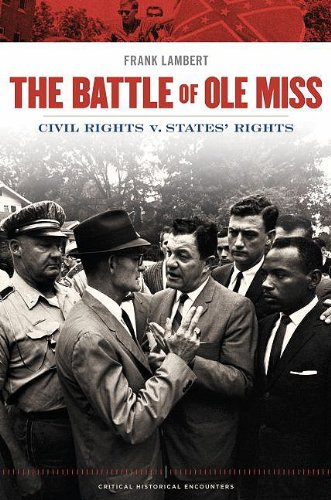 Frank Lambert has authored a gem of a book in THE BATTLE OF OLE MISS: Civil Rights v. States Rights, published this year by the Oxford University Press. If you have any interest in reading about that that troublesome time, you should make this book a starting point.
Lambert, who is a professor of history at Purdue University, not only was a student at Ole Miss in 1962 and an eye-witness to many of the events, he was also a member of the undefeated football team at the time, and his recollection of the chilling address delivered by Governor Ross Barnett at the half-time of the Ole Miss-Kentucky football game on the eve of the battle is a must-read.
This is a small book, only 193 pages including footnotes and index, but it is meticulously researched. As a native Mississippian and eyewitness, Lambert is able not only to relate the historical events, he also is able to describe the context in which they happened.
The book lays out the social milieu that led to the ultimate confrontation. There is a chapter on Growing Up Black in Mississippi, as well as Growing up White in Mississippi. Lambert describes how the black veterans of World War II and the Korean conflict had experienced cultures where they were not repressed because of their race, and they made up their minds that they would challenge American apartheid when they returned home. Meredith was one of those veterans, and he set his sights on attending no less than the state’s flagship university because, as he saw it, a degree from Ole Miss was the key to achievement in the larger society. He also realized that if he could breach the ramparts at Ole Miss, so much more would come tumbling down.
The barriers put up against Meredith because of his race were formidable. He was aware of the case of Clyde Kennard, another black veteran who had tried to enroll at what is now the University of Southern Mississippi, but was framed with trumped-up charges of stolen fertilizer and sentenced to Parchman, eventually dying at age 36. And surely he knew of Clennon King, another black who had managed to enroll at Ole Miss only to be committed to a mental institution for his trouble. Even among civil rights leadrs, Meredith met resistance. He was discouraged by Medgar and Charles Evers, who were designing their own strategy to desegregate Ole Miss, and felt that Meridith did not have the mettle to pull it off. Against all of these obstacles, and in defiance of a society intent on destroying him, Meredith pushed and strove until at last he triumphed.
But his triumph was not without cost. Armed racists from throughout Mississippi, Alabama and other parts of the South streamed to Oxford in response Barnett’s rallying cry for resistance. The governor’s public rabble-rousing was cynically at odds with his private negotiations with President John Kennedy and US Attorney General Bobby Kennedy, with whom he sought to negotiate a face-saving way out. The ensuing battle claimed two lives, injured 160 national guardsmen and US marshals, resulted in great property damage, sullied the reputation of the university, tarred the State of Mississippi in the eyes of the world, led to armed occupation of Lafayette County by more than 10,000 federal troops, and forever doomed segregation. Ironically, the cataclysmic confrontation that Barnett and his ilk intended to be the decisive battle that would turn back the tide of civil rights was instead the catalyst by which Ole Miss became Mississippi’s first integrated state university. It was in essence the final battle of the Civil War, the coup de grace to much of what had motivated that conflict in the first place and had never been finally resolved.
As for Meredith, the personal cost to him was enormous. He was subjected to taunts and derision, as well as daily threats of violence and even death. He found himself isolated on campus, and did not even have a roommate until the year he graduated, when the second black student, Cleveland Donald, was admitted. Meredith described himself in 1963 as “The most segregated Negro in the world.”
The admission of James Meredith to Ole Miss not only opened the doors of Mississippi’s universities to blacks, it also helped begin the process in which Mississippians of both races had to confront and come to terms with each other as the barriers fell one by one. As former mayor Richard Howorth of Oxford recently told a reporter: ” … other Americans have the luxury of a sense of security that Mississippi is so much worse than their community. That gives them a sense of adequacy about their racial views and deprives them of the opportunity we’ve had to confront these issues and genuinely understand our history.”
Meredith’s legacy is perhaps best summed up in the fact that, forty years after his struggle, his own son graduated from the University of Mississippi as the Outstanding Doctoral Student in the School of Business, an event that Meredith said, ” … vindicates my entire life.” His son’s achievement is the culmination of Meredith’s singular sacrifice. What Meredith accomplished for his son has accrued to the benefit of blacks and whites alike in Mississippi, and has helped our state begin to unshackle itself from its slavery to racism.
ATTICUS FINCH FIFTY YEARS LATER
July 15, 2010 § 1 Comment
He had an unremarkable law practice in the backwater town of Maycomb, Alabama, in the 1930’s. He was a widower with two small children to raise, an earnest son named Jem and a tomboyish daughter named Scout. In one steaming southern summer his bravery and devotion to the rule of law elevated him into one of the most towering exemplars of integrity and the best of the legal profession. And yet, he never existed in real life. His name is Atticus Finch, hero of Harper Lee’s Pulitzer Prize-winning novel, To Kill a Mockingbird, which observes the 50th anniversary of its publication this week.
The book is a powerful evocation of small-town life in the south in the sleepy, destitute era long before the civil rights awakening of the 1960’s. Rosa Parks had not yet sat in the front of a bus in Montgomery. There were no freedom riders then. No protest marches with German Shepherds and fire hoses. In the time of the story there is no political movement bearing the characters forward; there is only a black man wrongly accused and this small-time lawyer in a “tired, old” Alabama town doing what his profession and his own personal convictions demanded of him, and doing it with honor, courage and single-minded devotion to the interest of his client, heedless of the personal danger that his unpopular actions brought him. And through it all Atticus Finch the lawyer was a wise, attentive and devoted father and rock for his children.
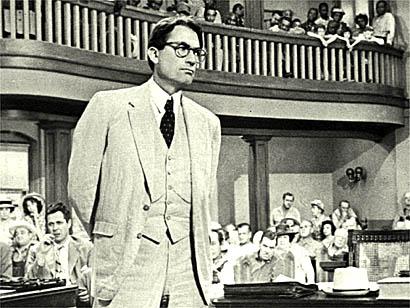 To many of us, Atticus Finch is inescapably Gregory Peck, who played the role in the 1962 film and won an Oscar as best actor. The movie won three Academy Awards out of eight nominations, and today is considered one of the great American classics. Its black-and-white images remain etched in our minds. I am sure that I am not the only southern teenager who saw the movie in those days and was inspired to be a lawyer just like Atticus some day.
Half a century after he appeared, Atticus Finch remains a model and a contemporary inspiration. In a recent poll practicing lawyers voted him an influence on their careers; strong stuff for a fictional character.
Here is Atticus Finch in his own words:
- “Mockingbirds don’t do one thing but make music for us to enjoy… but sing their hearts out for us. That’s why it’s a sin to kill a mockingbird.”
- “The one place where a man ought to get a square deal is in a courtroom, be he any color of the rainbow, but people have a way of carrying their resentments right into a jury box.”
- “You never really understand a person until you consider things from his point of view – until you climb into his skin and walk around in it.”
- “The one thing that doesn’t abide by majority rule is a person’s conscience.”
- “There’s a lot of ugly things in this world, son. I wish I could keep ’em all away from you. That’s never possible.”
- “Courage is not a man with a gun in his hand. It’s knowing you’re licked before you begin but you begin anyway and you see it through no matter what. You rarely win, but sometimes you do.”
- “When a child asks you something, answer him, for goodness sake. But don’t make a production of it. Children are children, but they can spot an evasion faster than adults, and evasion simply muddles ’em.”
- “Bad language is a stage all children go through, and it dies with time when they learn they’re not attracting attention with it.”
- “Best way to clear the air is to have it all out in the open.”
HELLHOUND ON HIS TRAIL
July 11, 2010 § 2 Comments
1968 was a hellish year on many counts for our nation. It was the year that Bobby Kennedy was gunned down at a primary night victory celebration in California. The Vietnam War continued its grip on the nation and claimed Lyndon Johnson’s presidential career among its 50,000-plus casualties. The Democratic convention in Chicago was beset by violent demonstrations and police reaction that were broadcast live on television to the shock of millions. The heady “Prague Spring” came to a stunning and abrupt end when Soviet tanks rumbled into Czechoslovakia and crushed the fresh democracy that had sprung up, raising new fears of an east-west confrontation and adding to the chilly pall that the cold war had cast over our lives for more than twenty years.
But no event in the tumult of 1968 had more powerful repercussions than the assasination of Rev. Martin Luther King, Jr., on April 4, in Memphis.
Hampton Sides’ book, HELLHOUND ON HIS TRAIL is the meticulously researched and spellbinding retelling of how the drifter James Earl Ray stalked King, planned the murder, and carried it out, and the story of how the FBI, Royal Canadian Mounted Police and Scotland Yard painstakingly unravelled the knot of aliases and false trails that Ray threw in their path until his arrest at a London airport two months after the assasination. 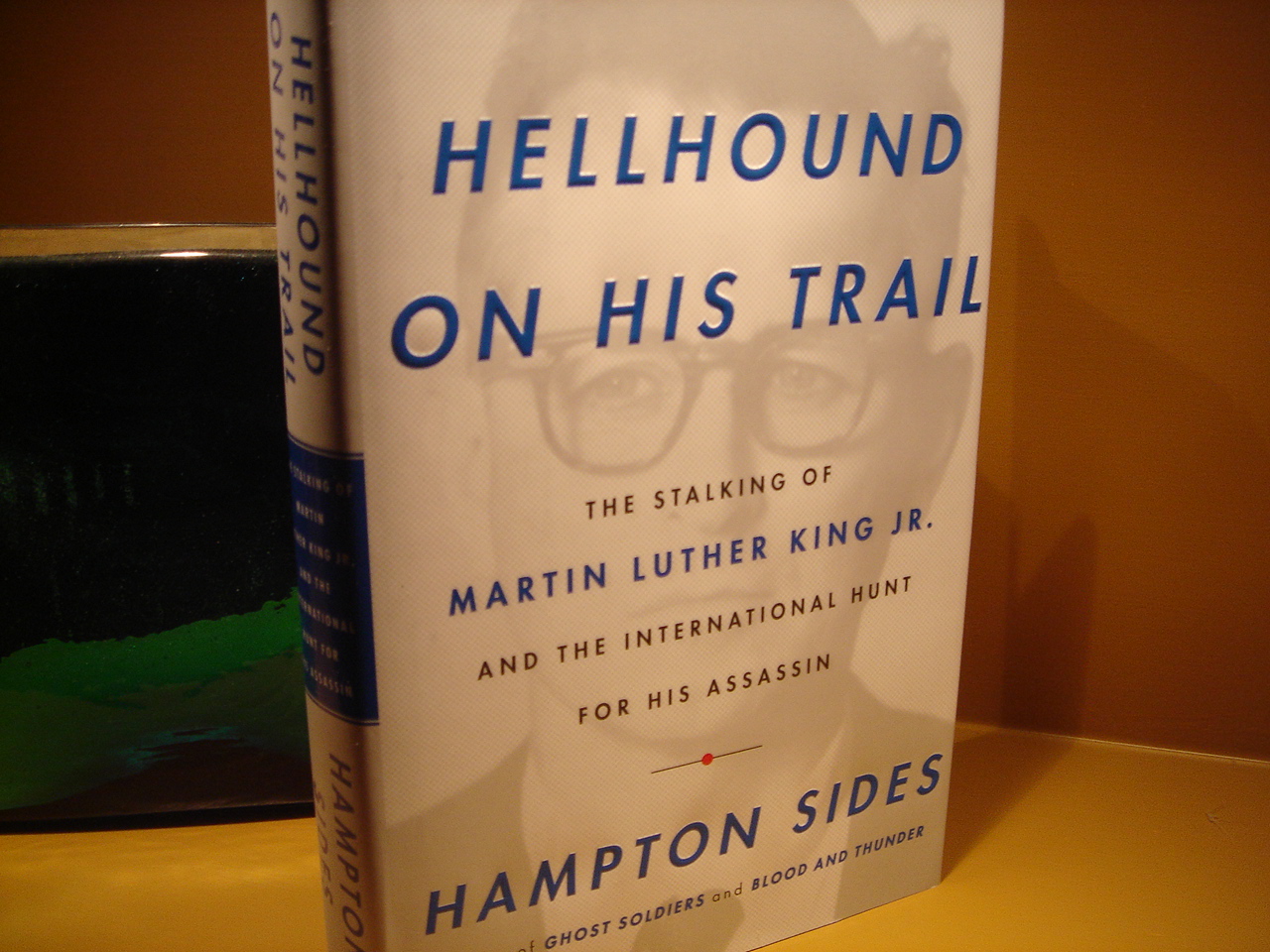
There is nothing really new here: no startling bombshell revelation of a conspiracy that has long been whispered about; no new eyewitness or piece of hitherto undiscovered shard of evidence; no new insight into the enigmatic Ray.
What is here in this book, and what makes it such a compelling read is how Sides lays it out like a detective novel, unfolding developments and clues in tantalizing morsels that whet the reader’s appetite and keep the pages turning for more. Sides draws on the many reams of investigative material, research, scholarly papers and personal interviews that rose out of this dark event and applies his considerable writing skill to craft a narrative that is hard to put down.
The characters are all here in bold relief: King himself, struggling to re-establish himself and non-violence as pre-eminent in the civil rights movement, against the rising tide of calls to racial violence; Ray, the murderous escaped con who swore he would kill the man he considered the leader of the race he hated; Ralph David Abernathy, King’s loyal friend and aide, but ultimately unequal to the task of being his successor; Coretta, the stoic widow; J. Edgar Hoover, who hated King and resisted taking over the murder investigation until he was ordered to do so by US Attorney General Ramsey Clark; Jesse Jackson, who would lie to try to claim the mantle of King’s successor; the FBI agents who undertook a seemingly impossible task and did a remarkable job of tracking down the killer in the largest manhunt in history; and the cast of casual bystanders who were caught up in the events. And, yes, there are some tawdry details about King’s personal life; those are an undeniable part of the true story.
Hampton Sides is a native Memphian with a good feel for the south. Despite the fact that he was only six years old when King was murdered, Sides is able to paint the landscape of racism and insensitivity to poverty that permeated the region in those days without resorting to the stereotypes and generalizations on which writers unfamiliar with southern folkways of the 1960’s so often fall back. His depiction of the south of 1968 is factual and stark. We thought we had come so far back then, but in retrospect some of the images are painful. There were Cal Alley’s racist and patronizing cartoons that I recall reading in the Memphis Commercial Appeal in those days. There is the depiction of the regal Cotton Carnival and its opulence set against the desparate poverty of the Memphis sanitation workers. There is the fact that racist groups raised hundreds of thousands of dollars for Ray’s defense and hailed him as a hero, a sobering reminder of a seamy underside of American society.
Reading this book will bring into focus how much America and the south have changed in 42 years. African-Americans are more incorporated into the mainstream now, in jobs, neighborhoods, schools and elected positions that were unimaginable in 1968. African-Americans are a growing segment of the middle class. It is not uncommon to see whites and blacks socializing together, something so innocuous today that would have raised eyebrows back then. Racial reconciliation is not an accomplished fact, but we have made a start thanks to the life and sacrifice of a man whose life was cut short by the very violence he repudiated.
 The Better Chancery Practice Blog
