IS THIS THE SOLUTION TO PRO SE LITIGATION?
August 25, 2010 § 7 Comments
A post about proposed changes to the pro bono rules for lawyers is here. There is a thoughtful comment to that post that highlights some dimensions of the situation.
It’s no secret that pro se litigants are appearing more and more frequently in Chancery Court. Whenever I ask a self-represented litigant why he or she did not hire an attorney, cost is always the response.
In our district, it’s not uncommon for a simple, irreconcilable differences (ID) divorce to cost upward of $1,500 to $2,500, plus court costs, although I have heard of some lawyers charging as little as $250 plus costs for an ID divorce with no children.
Self-representation, however, is not limited to routine, uncomplicated matters like ID divorces involving no children, no property, no joint debts and no other problems. I see pro se litigants in all kinds of matters. I presided over a termination of parental rights case not too long ago where the father represented himself and lost. I have seen pro se litigants in an adverse possession case, contempts, paternity, and even in a partition suit where, believe it or not, both sides were pro se. I can say unequivocally that I have never seen a party who proceeded pro se in a contested case leave the courtroom in better shape legally or equitably than he or she was when they walked in.
Although most all say that they choose to proceed pro se due to the rising cost of legal fees, I find in the course of things that others simply underestimate the complexity of the issues involved and think that legal matters are little more than filling out a few sheets of paper and filing with the court. Still others are lured by the siren-song of the internet sites that push cheap fill-in-the-blank do-it-yourself legal proceedings. The common denominator among all of these is that they are looking for a cheap, one-size-fits-all, easy solution to what may be a complicated situation.
These are the people who wind up in court pro se. In many cases, those pro se parties are getting simple ID divorces using kits they purchased on-line. Some are getting pleadings prepared by “secretarial services,” in violation of state law prohibiting practice of law without a license. The simple cases with no children do not usually give rise to later litigation. Pro se litigants with children, however, are a recurring problem.
Problems with child support provisions, joint and sole custody provisions, division of property, and allocation of debts are all common problems in these do-it-yourself cases. I have one pair of parties in Clarke County that I have sent back to the drawing board four times, and, although they are my most extreme case, they are by no means the only case that I have had to treat that way. I have just about decided that, if there are children, I will require the parties either to have an attorney or I will appoint a guardian ad litem at their expense.
The self-represented parties seldom understand why they can’t simply have their papers signed, and they are invariably frustrated when I tell them that I can not advise them how to draft an acceptable child support provision, or why that waiver filed a week before the complaint won’t cut it, or why they need a property settlement agreement when they don’t have any property.
How do we make legal services more affordable, thus reducing the pool of pro se litigants? Some claim that “limited scope representation,” also known as “unbundling” is the answer to lower legal fees. In essence, it is a representation arrangement in which the respnsibility of the lawyer is limited and the fee is resultingly lower. The attorney may, for instance, agree only to advise one of the parties about the language of the property settlement and child support agreement, or simply to prepare pleadings. The clients buy only as much legal service as they feel they need.
The Supreme Court’s Commission on Access to Justice proposed an amendment to Rule 1.2 of the Rules of Professional Conduct to allow for limited-scope representation. They met on Monday, August 23, and since the comment period has expired, I assume they will pass the rule on to the Supreme Court for adoption. I am all for it.
Although the proposed rule approves and encourages the practice, it does not address how a representation agreement would read so as to cover all of the ethical concerns that might arise. There is information available online, however, that may provide a starting point for lawyers. The LAWYERS USA website offers some information. The ABA has some info. The Civil Justice Network also has some info. A paper presenting the pros and cons of the practice is here.
Whether limited scope representation is the answer to the growing numbers of pro se litigants, I have no way of knowing. I do believe that it has the potential to help dramatically because it will decrease the amount of time judges will need to devote to scrutinizing pro se litigants’ pleadings and paperwork.
One caveat: I will not approve a limited-scope representation arrangement in any probate matter. Rule 6.1 of the Uniform Chancery Court Rules requires that every fiduciary retain an attorney, and you will be expected to continue in your role as counsel once you are in until you find substitute counsel. I will not allow the operation of the new rule (if it is enacted) to create an end-run around Rule 6.1.
An approach to the pro se phenomenon that I can not endorse is continued encouragement of laypeople to tackle more of their own legal matters. I saw a bar-produced video of smiling legal professionals encouraging people to handle their own “routine” legal matters, and making it sound as easy as folding a paper airplane. I don’t understand this approach. The American Medical Association does not promote do-it-yourself tonsillectomies, but then medical ethics includes the fundamental proscription, “Do no harm.” To me, the solution is not to encourage people to do their own legal surgery. The answer is to make it more likely that they will have a competent surgeon.
I am not a fan of pro se litigation. Even seemingly simple, routine matters may have serious implications for the parties, and I assure you that they have absolutely no clue about those ramifications. Self-represented litigants seldom have a grasp of the ramifications and complexities of equitable distribution, the various forms of child custody, or joint debt, to name but a few of the many legal snares that await the unwary. Also, the parties are under no duty to be honest and forthright with the court, leaving open the very real possibility of fraud or worse. Without legal advice and the check that an ethical attorney provides, the parties’ paperwork can create more problems than it solves, and even in the absence of lawyers it is clearly not the duty of the judge to advise them about the possible mess they may be creating. Yet, every day, inexorably, we see more and more self-represented litigants.
I am a firm believer in access to justice, but in our commendable haste to discover a way to do that, let us not lose sight of what it is we are trying to achieve: access to justice. Not access to disaster. Limited scope representation may be a good first step toward alleviating this problem.
PROPOSED CHANGES TO RULE 8.05
August 24, 2010 § Leave a comment
The Supreme Court has posted proposed revisions to Uniform Chancery Court Rule 8.05 and your comments are invited.
There is, arguably, no Uniform Chancery Court Rule that affects Chancery practitioners more strongly than 8.05. If you have a position on this proposal, you need to make it known before final action. The deadline is September 20, 2010.
” ‘TIL DEATH DO US PART” — OR MAYBE NOT
August 24, 2010 § Leave a comment
Charles Allen and Janet Allen were divorced in 2002, but they continued a relationship and even resumed wearing their wedding rings. They opened a joint checking account and made plans to move in together. They spent every weekend together, and Charles even had a private line installed in Janet’s residence so that they could talk with one another whenever they wished. Janet said “It was like we were never divorced.” Eventually, they saw where the relationship was headed and decided to set aside the divorce so they could get back together.
On May 17, 2006, they filed a joint petition in the Chancery Court of Pearl River County to revoke the divorce as provided in § 93-5-31, MCA. So far, so good. Only problem is that Charles died June 16, 2006, before the court could hear any testimony on the petition.
The specific code section invoked by the joint petition reads as follows:
The judgment of divorce from the bonds of matrimony may be revoked at any time by the court which granted it, under such regulations and restrictions as it may deem proper to impose, upon the joint application of the parties, and upon the production of satisfactory evidence of their reconciliation.
The Chancellor quashed the petition nearly a year later on condition that he would allow Janet to file a timely request for reconsideration if she could show sufficient facts of reconciliation.
Janet did file for reconsideration, and the Chancellor found after hearing that she had presented proof sufficient to satisfy the criteria for revocation of the divorce. He entered a judgment revoking the divorce, and the Administrator of Charles’s estate appealed.
In Carlisle v. Allen, 2009 WL 1758864 (Miss.Ct.App. June 23, 2009), a case of first impression, the Court of Appeals reversed, holding that, although Janet had produced sufficient evidence to support a finding of reconciliation, the trial court has no authority to reinstate the marriage because of Charles’s death. The court reasoned that since death of a party to a divorce ends the status of marriage and would even have the effect of nullifying a divorce action, the purpose of the statute, which the court found was “to reunite two formerly married persons as a married couple,” would be thwarted because there “is no status of marriage upon which to operate.”
Janet filed a petition for certiorari, which was granted.
On cert, the Supreme Court reversed the Court of Appeals and reinstated the Chancellor’s decision. In Carlisle, Adm’r of the Estate of Allen v. Allen, No. 2007-CT-02047-SCT, the court held that Janet had met all of the criteria of the statute, had presented satisfactory evidence in support of it, and that it was not error for the Chancellor to grant the revocation in such a situation, regardless of Charles’s intervening death. The opinion pointed out that there is nothing in the statute that required both parties to be alive when the revocation is ordered, and that it was error for the Court of Appeals to analogize the action to a divorce action, where the applicable law is not necessarily the same.
There are some procedural disagreements between the majority and the dissenters that hinge on the timeliness of the motion to reconsider and the trial court’s jurisdiction as a result. That is an issue for another post.
As a practical matter, this case is mostly of academic interest since petitions for revocation are pretty rare. I only presented two in 33 years of practice and have had none come before me on the bench. Interestingly, I did have a case where my client died before the divorce judgment could be signed by the Chancellor, but after the Chancellor had rendered his opinion from the bench. In that case, White v. Smith, 645 So,2d 875 (Miss. 1994), the Supreme Court upheld Chancellor Shannon Clark’s entry of a Judgment of Divorce nunc pro tunc after the death.
This Allen case raises what I consider to be a couple of valid questions: Why do we need this statute? Would we not be better off if it were repealed?
The first question is based on the simple fact that the parties are free to remarry at any time with little bureaucracy, which is in my opinion the preferable manner to effect their reunion. Why would they prefer to hire an attorney, draft pleadings, set a court date, appear and testify, and await the judge’s ruling? I am speculating here, but I believe it is reasonable to assume that this statute is an adjunct to the Chancellor’s power to forbid the remarriage of the parties due to adultery (still in the code at § 93-5-25, MCA), and perhaps this statute was a way for parties to get around that injunction. In any event, I am not aware of any case in my career in practice or on the bench where a Chancellor has entered such an injunction, and certainly not in the 21st century. What other reason is there for this law to continue in effect?
My second question stems from the fact that since this statute was enacted, the landmark Ferguson case and its offspring have taken root in our jurisprudence, giving rise to many questions about the accumulation of marital assets between the time that the divorce judgment is entered and the date it is revoked. Consider, for example, that the husband got title to the former marital residence in the divorce and has made all mortgage payments in the interim. Is the residence restored to its status as marital property (notwithstanding title)? And what are the parties’ respective equitable interests in it? Remarriage would set a clear demarcation as opposed to revocation, which raises more questions than it answers.
Something to think about.
WHEN IS MODIFICATION OF CHILD SUPPORT EFFECTIVE?
August 23, 2010 § Leave a comment
A judgment modifying child support upward may be effective on the date that the petition is filed, or on a later date “within the sound discretion of the trial court.” Lawrence v. Lawrence, 574 So.2d 1376, 1384 (Miss. 1991). In Frazier v. Burnett, 767 So.2d 263, 268 (Miss. App. 2000), the court stated that the “best practice” is to make the modification retroactive to the date of filing.
A judgment modifying child support downward or terminating it may not be retroactive because each child support payment vests when and as due, and may not be forgiven. Cumberland v. Cumberland, 564 So.2d 839, 847 (Miss. 1990).
§ 43-19-35 (4), MCA, effective July 1, 2010, and repealed automatically July 1, 2011, includes the following curious language:
(4) “Any order for support of minor children … shall not be subject to a downward retroactive modification. An upward retroactive mofidication may be ordered back to the date of the event justifying the upward modification.” [Emphasis added]
What exactly is the date of the event that would justify the upward change is not defined, nor have there been any cases construing the statute.
The question arises from time to time whether the court may order retroactivity without a request therefor in the pleading. Chancellors in my experience are split, some taking the position that it must be pled, some saying that it need not be since it is in the discretion of the trial judge. My own position is that it is a simple Fifth Amendment due process matter. You are trying to take someone else’s money, and because you are, you are required to put that person on notice and afford the opportunity to defend. In my opinion, the opposing party needs to be put on notice of whatever relief you are seeking, including retroactive modification, and that without that notice, the court can not grant your client that relief.
Clearly the safest position is to include a prayer for retroactive relief in every petition to modify child support. Get in your computers and add that language to your petition for modification of child support.
RECEPTION FOR DEAN GERSHON
August 23, 2010 § Leave a comment
There will be a reception for new Ole Miss Law School Dean Richard Gershon at the offices of Hammack, Barry, Thaggard & May on Thursday, August 26, 2010, at 5:00, p.m. All members of the bar are invited to visit with and meet Dean Gershon, whose tenure as Dean began on July 1, 2010.
JAMES O. DUKES PROFESSIONALISM PROGRAM
August 20, 2010 § Leave a comment
I participated yesterday in the James O. Dukes Professionalism Program at the Ole Miss Law School. The program is part of the orientation for new law school students and is offered at both Ole Miss and Mississippi College.
Lawyers and judges volunteer to serve as facilitators for discussions involving situations that commonly confront legal practitioners with ethical questions. The facilitators this year included Supreme Court Justices, Court of Appeals Justices, Chancery Judges, Circuit Judges, County Judges and lawyers. Judge Bailey, Bill Hammack and I were there from Meridian.
This was my first year to participate. In years past, it seems I always had a conflict with trial settings that took precedence.
The program opened in the Ford Center with an introduction by the new Law School Dean, Richard Gershon, followed with remarks by Nina Stubblefield Tollison, President of the Mississippi Bar, who introduced the keynote speaker, Chief Justice William Waller, Jr.
Justice Waller’s address focused on three lawyers, L.Q.C. Lamar, Thurgood Marshall, and Evelyn Gandy, and their contributions to society in their day.
Following the opening program, the 200 or so entering freshmen and facilitators crossed the bridge over the Hilgard Cut and went to the Law School, where we participated in breakout sessions in which facilitators were assigned to different groups of students. Each freshman law student receives a set of hypotheticals; the facilitators receive the hypos and some guidance material such as the applicable professional rules.
Going in, I wondered whether incoming law students would “get it” when trying to tackle legal ethics questions. After all, what do these young people with no legal training know about legal ethics? I shouldn’t have been concerned.

Our group
Our group of eleven students were from Mississippi, Tennessee, Kentucky, Ohio and maybe some other places I don’t recall now. At least one had a master’s degree. All were sharp and articulate, and without exception showed a quick grasp of the rights and wrongs and do’s and don’ts, even when thrown curveball questions to test their understanding.

David Mockbee holds forth

David Mockbee of Jackson and Stacie Zorn of Pascagoula were my fellow facilitators, and they did a super job of leading their parts of the discussion and keeping things interesting and interactive.
Lunch followed the breakout session, and I was fortunate to sit with some of the new students who had been in our group. I enjoyed my visit with them, and I have the feeling they will all be successful.
I came away feeling refreshed, like I had gotten back in touch with something basic. I was encouraged at the intelligence and energy of these young people. In a few years they will be the next infusion of fresh blood that invigorates our profession every year. I am looking forward to see them step onto the legal stage.
I encourage you to consider volunteering for this worthwhile program in the future, either at Ole Miss or Mississippi College. It will give you a break in your routine, and it may just be the boost you need.
ANSWERS TO WICKED MISSISSIPPI TRIVIA
August 20, 2010 § Leave a comment
1. Which Mississippi county changed its name in 1865 to Davis County in honor of Jefferson Davis and the name of its county seat to Leesburg, in honor of Robert E. Lee? What was the name of the original county seat? (Note: the names were restored to their originals in 1869).
It was Jones County. Ellisville was the original county seat, because Laurel, which is now one of the two county seats, was not founded until 1882.
2. What is the present-day name of the Mississippi county that was established in 1871 as Colfax County?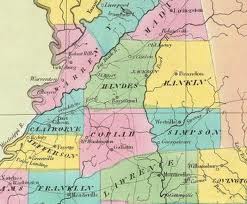
Clay. Colfax County was created in 1871 from parts of Chickasaw, Lowndes, Oktibbeha and Monroe. It changed its name in 1876 to honor Henry Clay.
3. From which present-day county did Bainbridge County separate in1823, only to merge back into its original county in 1824?
Covington. There is no record of the reason for the establishment of Bainbridge county, or for its dissolution, nor is there any identfication of the person or place for whom the county was named in the act establishing it.
4. What is the present-day name of the Mississippi county that was established in 1874 as Sumner County?
Webster. The county was renamed in honor of Daniel Webster in 1882.
5. In 1918 , the last county to be established in Mississippi was formed. What is its name?
Humphreys. Named for Benjamin Humphreys, 26th governor of Mississippi.
6. What present-day county seat was founded in 1832 as the Town of Jefferson? (Note: no relation to the Faulkner’s fictional town of the same name).
Hernando.
7. John L. Sullivan defeated Jake Kilrain in 1889 in the last official bare-knuckled bout in what was then Perry County. In which present-day county is the site located?
Forrest. Forrest County was carved out of the western part of Perry County in 1908.
8. President James K. Polk owned a 1,120-acre estate in the Troy community of which present-day county from 1835-1849?
Grenada.
9. Which Mississippi county seat was the home of thirteen generals of the Confederacy?
Holly Springs. The original name of the town was “Suavatooky,” which would have been a nightmare for today’s image-conscious tourism promoters.
10. Which Mississippi town was named after a newspaper published in another state?
Picayune. Eliza Jane Nicholson, a famed poet and resident of Pearl River County, was editor of the New Orleans Picayune, now the Times-Picayune, and the town was named in honor of her achievements.
11. In which Mississippi county did Teddy Roosevelt’s famous bear hunt take place in 1902 in the community of Smedes?
Sharkey. Smedes was the name of the train landing at Onward Plantation in Sharkey County. Onward, which is the surviving community in the vicinity of the plantation, is usually given as the locale, since the train landing has long since disappeared. You can read the fascinating story how African-American Holt Collier, legendary bear hunter, former slave, Confederate soldier and Texas cowboy, guided Roosevelt on his hunt here.
12. In which Mississippi county does the “Southern cross the Dog?”
Sunflower. At Moorhead, where a line of the Southern Railway crossed the Yazoo and Delta (YD=Yellow Dog, or “Dog”) at a 90-degree angle, reputedly the only place in the western hemisphere where two rail lines cross at a perpindicular. The junction is mentioned in blues recordings, notably by W.C. Handy and Bessie Smith.
13. Which Mississippi county’s name is derived from an Indian name meaning “tadpole place?”
Yalobusha. Some other unusual names: Pontotoc means “weed prairie” or “land of hanging grapes”; Noxubee means “stinking water,” and Oktibbeha means “bloody water”; and Attala was named after the heroine of an 1801 novella by Franois-Rene de Chateaubriand, spelled Atala in his work.
24 HOURS LEFT FOR TRIVIA
August 19, 2010 § Leave a comment
The answers to Wicked Mississippi Trivia will be revealed in 24 hours. How many have you figured out? I know one person who has them all but a couple.
There are a couple of lifelines if you need them.
Post your best guesses as a comment to Wicked Mississippi Trivia, if you dare.
NEW RIGHTS OF PARENTS ON ACTIVE MILITARY DUTY
August 19, 2010 § Leave a comment
Section 93-5-34, MCA, which sets out certain custodial and visitation rights of parents who are called to active military duty, has been amended to add some new wrinkles. It is one of several new laws that affect your Chancery practice, most of which went into effect July 1, 2010, and are listed here.
The amended statute now applies also to persons related by blood or marriage to a deployed military parent, and may include, step-parents, grandparents, aunts, uncles, adult siblings and others.
It adds the requirement that any order entered affecting custody of or visitation with a parent called to active duty shall require:
- that the non-deployed parent shall make the child or children reasonably available to the deployed parent when he or she is on leave.
- that the non-deployed parent shall facilitate opportunities for telephonic, webcam and e-mail contact between the deployed parent and the child or children during deployment, and that
- the deployed parent shall provide timely information regarding his or her leave schedule to the non-deployed parent.
TRIVIA HELP
August 18, 2010 § 1 Comment
The answers to Wicked Mississippi Trivia will be posted Friday.
If you haven’t yet given up completely, you may find some help here, and you definitely will find some answers here.
Happy hunting.
 The Better Chancery Practice Blog