The Equitable Power of the Circuit Court
June 5, 2019 § 1 Comment
When Trustmark Bank foreclosed on Odell and Renodda Dorman’s property, it was discovered that the property description of the Dorman’s 6-acre residence was not included. With that discovery, the Dormans moved back home. The bank filed suit in circuit court for a deficiency judgment, and the Dormans counterclaimed for wrongful foreclosure on their residence. In turn, the bank moved to amend to plead mutual mistake, which the court granted. The bank moved for summary judgment, in the course of which the bank somehow requested reformation of the deed for mutual mistake. The court ordered reformation of the deed and granted summary judgment. The Dormans appealed.
Before we go to the next step, the point needs to be made that reformation of an instrument is a quintessentially equitable process. If you were going to file an original action for reformation, you would file it in chancery court. So was the circuit judge in error by granting equitable relief in this case? The argument that the Dormans made before the COA was that the circuit court lacked subject matter jurisdiction, and so the judgment was void.
In Dorman v. Trustmark, decided May 7, 2019, the COA affirmed on the issue of subject matter jurisdiction. Chief Judge Barnes wrote for the unanimous court:
¶9. Before addressing the substantive issues raised on appeal, we first consider the Dormans’ claim that the circuit court lacked subject-matter jurisdiction. Trustmark’s complaint requested recovery of a deficiency judgment on a loan, which the Dormans acknowledge was properly before the circuit court as a matter of law. However, the circuit court allowed Trustmark to amend its answer to the Dormans’ counterclaim to assert reformation and mutual mistake as a defense. At the motions hearing, the circuit judge questioned whether he had the power to reform the deed, noting: “It’s just I think that the place for that correction is in front of a chancellor.” After briefing by the parties on the issue, the court determined in its final judgment that it had subject-matter jurisdiction over the claims. The Dormans now argue that Trustmark tried to “back door” the issue of reformation by filing the complaint for the deficiency judgment and that the bank “should have sought reformation in chancery court.”
¶10. “To determine whether a court has subject[-]matter jurisdiction, we look to the face of the complaint, examining the nature of the controversy and the relief sought.” RAS Family Partners LP v. Onnam Biloxi LLC, 968 So. 2d 926, 928 (¶11) (Miss. 2007) (emphasis added). “If the complaint seeks legal relief, even in combination with equitable relief, the circuit court can have proper subject[-]matter jurisdiction.” Id. “[E]quitable claims are more appropriately brought before a circuit court when they are connected to a contractual relationship or other claims tied to questions of law.” Era Franchise Sys. Inc. v. Mathis, 931 So. 2d 1278, 1283 (¶14) (Miss. 2006).
¶11. As the court noted, Trustmark’s complaint asserted a legal claim for a deficiency judgment; the issue of mutual mistake later arose as an affirmative defense to the counterclaim. The Mississippi Supreme Court has held that once a circuit court acquires subject-matter jurisdiction of an action at law, “it may hear and adjudicate in that action all claims, including those with an equitable smell, arising out of the same transaction and occurrence as the principal claim.” Hall v. Corbin, 478 So. 2d 253, 255 (Miss. 1985). This includes “other claims (whether asserted by the one or more of the original parties or by new or intervening parties), ancillary or pendent to the original claim,” even if those claims “standing alone may have been beyond the court’s jurisdiction.” Id. Because Trustmark’s equitable claim was raised as a defense to the Dormans’ counterclaim, we find no error in the circuit court’s determination that it had subject-matter jurisdiction of Trustmark’s claim for reformation of the DOT.
The COA reversed the grant of summary judgment because there was a fact issue of mutual mistake and remanded for further proceedings.
Some years ago an attorney told me that he wanted to file a 2-count complaint: Count I for alienation of affection against the defendant and his paramour; and Count II for divorce against the defendant for divorce and related relief. I told him that, if he did I would transfer the case to circuit court; our law is that once a case is transferred it can not be transferred back to the transferring court. We had a good laugh over that. The idea of a circuit judge (and possibly a jury) having to grope their way through a divorce was rife with comedic possibilities. When I mentioned it to a circuit judge, though, he simply smiled and said, “No problem; I would just appoint you as special master to hear the divorce.” That put an end to that.
Medical Bills and Minor’s Settlements
June 4, 2019 § Leave a comment
Stacy, age 8, is injured in an automobile accident. Her medical bills are $17,000 for the hospital, $800 for ambulance and EMT, and $1,200 for miscellaneous doctors and other medical. Total is $19,000.
Whom should the judge order to pay the bills? Stacy? Her parents? Leave them unpaid? The questions seem almost absurd. Sould an 8-year-old child be expected to pay her own medical bills? Aren’t medical bills the kind of thing that parents provide for their children? But what if the parents don’t have the ability to pay? And if we leave the bills unpaid, what impact will that have on the ability of the parents to access medical care for Stacy in the future?
All of those questions are what the judge needs answered in the course of a minor’s settlement. But often those kinds of questions are left unasked. Worse … when I try to ask the petitioners (usually parents) why they want the bills to be paid out of the proceeds of a minor’s settlement, they have no clue about what I am asking. It’s obvious that the issue has never been discussed between attorney and client.
It’s been the expectation for a long time that medical bills for the child will be paid out of the child’s settlement proceeds. But that came into question after Gulfport Memorial Hospital v. Proulx, which you can read about at this link, which held essentially that medical providers do not have a statutory lien against settlement proceeds, and, therefore, they do not have the right to collect from them.
So when you ask the court to pay medical bills out of the minor’s settlement proceeds, you are asking the court to order the minor (or her guardian) to pay her own expenses. To accomplish that you have to put some evidence in the record that it is in the child’s best interest to order that. My suggestion is that you offer proof that: (1) the parents do not have the financial ability to pay; (2) ordering the parents to pay will impose undue financial hardship on the family; (3) the bills can not be left unpaid because those medical providers may refuse service in the future because of the unpaid balances.
I usually ask questions to elicit that information if the lawyers do not because I want justification in the record. Instead, what I get is blank stares. It doesn’t have to be that way. Prepare your witness. Be ready to put justification in the record for ordering the child to pay her own expenses.
Rule 8.05 and Intentional Infliction of Emotional Distress
June 3, 2019 § 1 Comment
UCCR 8.05 should make everyone’s job in chancery court a lot easier. But lawyers, in their eternal ingenuity for contriving ways to complicate nearly all of creation, turn them into an implement of torture that they inflict on the court.
Chancellor Haydn Roberts of Rankin County presented this material at the Bar’s Family Law Section Hot Tips Seminar recently:
How to Confuse, Frustrate and/or Anger a Judge with an 8.05
Seriously, it happens often!
Don’t Prepare an an 8.05
Rule 8.05 states: “Unless excused by Order of the Court for good cause shown, each party in every domestic case involving economic issues and/or property division shall provide the opposite party or counsel, if known, an 8.05 in compliance with subparts (a) and (b) of the rule
Speights v. Speights, 2016-CA-01691-COA
Prepare your client’s 8.05 in the lobby, hallway or parking lot immediately preceding trial
Most of us Judges aren’t stupid and can tell when an 8.05 is prepared in this fashion
Common errors when this happens include unsigned 8.05s, incomplete property asset listing, incomplete debt listing and amounts, confusing expenses, pages
missing,
AND MY FAVORITE – misspelled children’s names and inaccurate birthdays
Don’t Bring Copies
You need a minimum of 5 copies (6 with a GAL)
Your copy
Counsel opposite
The Court
Evidence
Copy for the witness
GAL copy
Deflate Income
Gross income – “total income from all sources before deductions, exemptions or other tax deductions
Includes wages, investment income, gifts from friends, rentals, social security, pension, child support, etc…
Overtime hours count
Be careful as the Judge may ask for a recent loan application from your client, wherein he/she must report his/her income
See, 2017-CA-1476 SCT; Tracy Marie Miles Williams v. Brent Reid Williams; affirmed 01/17/19; and Trim v. Trim 33 So.3d 471 (Miss. 2010)
Inflate Expenses
If your client’s expenses far exceed his/her income, and he/she doesn’t have much debt…SOMETHING ISN’T CORRECT
Single person in an apartment shouldn’t incur $1200/month in food and household items BUT single person raising multiple children will incur at least that much
Most client’s don’t have much “household maintenance”
Pet expenses, yard expenses, miscellaneous, entertainment should be ACTUAL and know what those items entail
Double-dip Expenses
Some insurance is listed as a deduction
Don’t use health insurance as a mandatory deduction and then also an “insurance expense”
Same with life insurance, property insurance, rental insurance, automobile insurance, personal property insurance, umbrellas
Intermingle Expenses
Use columns
Expenses could be current, past, future
Expenses could be single, family/household, and/or spouse + child(ren)
Keep it realistic even if speculative
Fail to Update
Time Lapse between temporary hearing and final may mean different information
When you update an 8.05 tell the Court
Witness/Client should know the differences and WHY there are differences
If Client has new employment, attach new pay stub
Mislabel property
Make sure personal property matches
“Grandma’s antique roll top desk” on wife’s 8.05 is the same as “desk in bedroom” on husband’s 8.05
2012 Accord on wife’s 8.05 is the Blue Honda on husband’s 8.05
Watch the models, years, makes, account numbers, bank names, creditors’ names
Mark property value/equity as “unknown”
If you list an asset or debt as “unknown” and the opposite party has a value, the Judge will likely use that value
Be prepared to give a value even if it’s an educated guess
Be prepared to discuss the other party’s value(s) and why it/they are wrong
REMEMBER – asset value as to “stuff” is garage sale value, not brand spanking new
Who Needs Statements? [i.e., Documentation]
Debts should be corroborated by statements
Helps if they are at or near date of demarcation you are requesting
Retirement accounts
Bank accounts with substantial balances
Other accounts
Church Donations
This not a way to equalize income to expenses
If client makes church donations during a court matter, they should KNOW the following:
Church’s name
Church’s location
What service time they attend
Preacher’s name
Some previous posts on how to improve your 8.05’s are here, here, and here. Or type “8.05” in the search box to access a plethora of posts on financial proof and 8.05’s.
A Valuable Resource is Coming Your Way
May 31, 2019 § Leave a comment
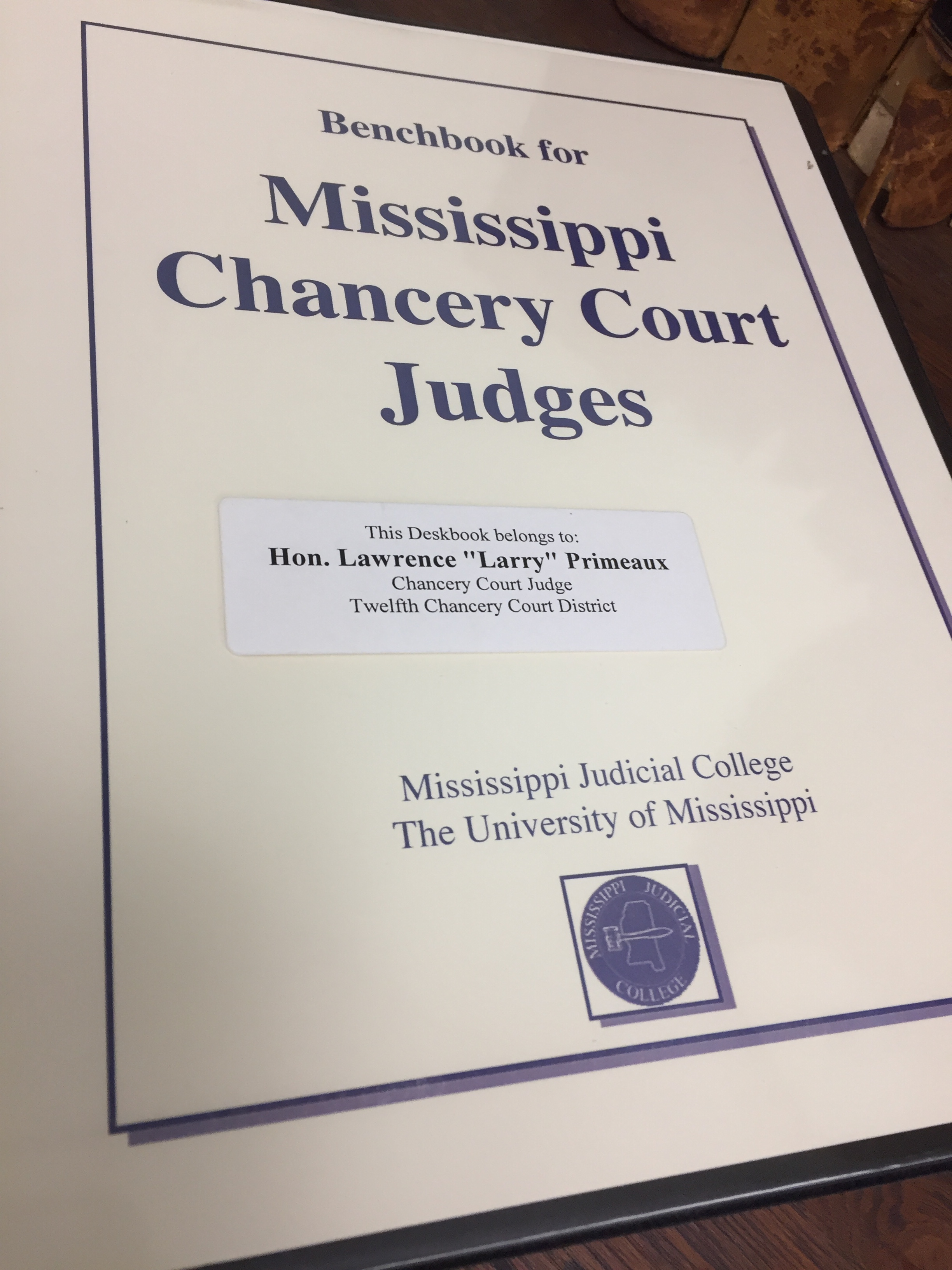
Chancery judges have long had a resource not available to practitioners: The Benchbook for Mississippi Chancery Court Judges.
The last printed edition I have consists of 31 chapters on topics ranging from divorce, alimony, probate, property, restraining orders and injunctions, recusal, and everything in between. There are case citations, tables of authority, statutes, and other helpful material. It is updated periodically by the Mississippi Judicial College’s (MJC’s) excellent staff attorneys.
In the past few years the Benchbook has been accessible behind a password-wall at MJC’s web site, rather than in printed form.
The good news for you is that, effective July 1, 2019, the password will no longer be required, and attorneys and others will be able to access this valuable resource. You will have at your fingertips some of the best research you could hope for ready to use in any chancery proceeding.
You will find the Benchbook at the MJC web site under the ‘Publications” tab, or at this link.
PS … there are benchbooks for circuit and county court judges, and even for justice court judges.
Ins and Outs of Recusal
May 29, 2019 § Leave a comment
There comes a time in every lawyer’s life when you have no choice but to file a motion for the judge to recuse.
Most recusal situations are pretty clear, but not all are. It’s awkward at best to suggest that the judge should not be hearing your case, particularly where you are insinuating that ethical challenges may be involved. So you want to do it right if you’re going to do it at all. Here is some information that might help you get it right.
There are two categories of situations giving rise to consideration of recusal.
The first category consists of situations where the judge is per se disqualified and recusal is required unless waived by the parties. The bases for disqualification per se are set out in the Mississippi Constitution and the Mississippi Code.
The second category consists of situations in which grounds for disqualification per se are not present, but the judge’s impartiality might be questioned by a reasonable person knowing all of the pertinent facts. These are spelled out in Miss. Code of Judicial Conduct, Canon 3E.
Category One: Per Se Disqualification
Mississippi Constitution Article 6, § 165 states: “No judge of any court shall preside on the trial of any cause, where the parties or either of them, shall be connected with him by affinity or consanguinity, or where he may be interested in the same, except by the consent of the judge and of the parties.”
Mississippi Code Ann. § 9-1-11 sets forth the same bases for recusal as provided in the constitution and adds the ground that the judge was previously counsel in the same proceeding.
The key to category one is that the judge is actually disqualified from sitting in the case. Recusal is mandatory unless the parties and the judge agree otherwise, or, as some people put it, they agree to waive the disqualification.
Category Two: Discretionary Recusal
The second category of recusal matters is found in the Mississippi Code of Judicial Conduct in Canon 3. In contrast with the Constitution and statutory mandatory recusal, all of the Mississippi Code of Judicial Conduct bases for recusal are hortatory; the Code recites that the judge “should” recuse in the listed circumstances if they apply.
Canon 3E(1) states the general principle: “Judges should disqualify themselves in proceedings in which their impartiality might be questioned by a reasonable person knowing all the circumstances or for other grounds provided in the Code of Judicial Conduct or otherwise as provided by law, including but not limited to instances where … ” The provision continues with several specific categories of situations that may require recusal. This is the general principle behind all recusal motions. Note the word should above. Again, in these situations recusal is discretionary and is reviewed on appeal for abuse of discretion.
The specific situations spelled out to complete the above provision are:
3E(1)(a). The judge has a personal bias toward a party or has personal knowledge of disputed evidentiary facts.
The Mississippi Supreme Court has stated that, “In the absence of a judge expressing a bias or prejudice toward a party or proof in the record of such bias or prejudice, a judge should not recuse himself.” Bateman v. Gray, 963 So.2d 1284, 1291 (Miss. 2007). The burden, which is a heavy one, is on the movant to prove facts sufficient to establish disqualifying bias or prejudice.” Hodnett v. State, 787 So.2d 670 (Miss. Ct. App. 2001).
What about a bad outcome? Some clients thing the judge is prejudiced against them because of an adverse ruling. Our appellate courts have recognized that “[O]ne party’s irritation at the trial judge’s ruling against him is not grounds to force the judge to recuse himself.” Clay v. State, 829 So.2d 676, 687 (Miss. Ct. App. 2002). “Prior rulings by a judge in the proceeding will almost never be sufficient to justify recusal.” Campbell and Jackson, Commentary on Judicial Ethics in Mississippi, § 6: 9 (2010). The United States Supreme Court addressed the principle in the case of Liteky v. U.S., 510 U.S. 540, 555 (1994):
“ … opinions formed by the judge on the basis of facts introduced or events occurring in the course of the current proceedings , or of prior proceedings, do not constitute a basis for a bias or partiality motion unless they display a deep-seated favoritism or antagonism that would make fair judgment impossible. Thus, judicial remarks during the course of a trial that are critical or disapproving of, or even hostile to, counsel, the parties, or their cases, ordinarily do not support a bias or partiality challenge. They may do so if they reveal an opinion that derives from an extrajudicial source; and they will do so if they reveal such a high degree of favoritism or antagonism as to make fair judgment impossible.”
In Rogers v. Morin, 791 So. 2d 815, 821 (¶13) (Miss. 2001), the court held that a chancellor was not required to recuse after he remarked in a hearing that he believed that the appellant had no credibility. Weighing credibility is, after all, what chancellors do. If we were required to recuse every time we made that determination, there would be chaos.
3E(1)(a). The judge or a lawyer with whom she previously practiced served as a lawyer or is a witness in the matter in controversy, or .
3E(1)(b). A lawyer as attorney or witness in the case is a former law partner or associate and served in the case while the judge was with the firm.
3E(1)(c). The judge or a member of his household has a pecuniary interest.
3E(1)(d). The judge or a member of his family is a party or is an officer, will be a witness.
You should read the Canons themselves for the exact language. A link to them is here.
There is a presumption that all judges sworn to administer impartial justice are qualified and unbiased. Wal-Mart Stores, Inc. v. Frierson, 818 So.2d 1135, 1141-42 (Miss. 2002); Miss. Code Judicial Conduct Canon 3E commentary. The burden is on the party seeking recusal to file a motion detailing the factual basis relied on, and to create a reasonable doubt about the presumption of impartiality. Taylor v. State, 789 So.2d 787 (Miss. 2001); Copeland v. Copeland, 904 So.2d 1066, 1071 (Miss. 2004). There must be a reasonable basis to form a conclusion that there was a question of impartiality. Faerber v. Faerber, 13 So.3d 853, 865-66 (Miss. Ct. App. 2009). Mere speculation is not enough. Pearson v. Browning, 200 So.3d 1080, 1085 (Miss. Ct. App. 2016), citing Dillard’s, Inc. v. Scott, 908 So.2d 93, 98 (Miss. 2005) (quoting Code of Judicial Conduct, Canon 3(E)(1)).
Rule 59 and the Court of Equity
May 28, 2019 § Leave a comment
Sometimes you want or need to argue that you should be granted R59 relief because this is a court of equity, and a new trial or rehearing, or new judgment are needed to do equity. The other side argues the rigid language of R59 and says the court can’t go beyond that.
In the case of Pevey v. Pevey, 2017-CA-01144-COA, 2018 WL 4089685 (August 28, 2018), an opinion yet unpublished in the Southern Reporter, Judge Fair (a former chancellor) of the COA wrote this in the unanimous opinion:
¶5. The chancery court’s authority to modify the final judgment is “limited” by Rule 59, and it is a “higher” standard than under Rule 54(b), which allows a trial court to set aside interlocutory decisions for any reason it sees just. [ Maness v. K & A Enters. of Miss. LLC, No. 2017-CA-00173, ––– So.3d ––––, ––––, 2018 WL 3791250, at *12 (¶ 68) (Miss. Aug. 9, 2018) Id. at –––– (¶¶ 69, 71), 2018 WL 3791250, at *13 (¶¶ 69, 71). Still, Rule 59 permits a chancery court substantial discretion to reconsider its decisions—either on the motion of a party, or sua sponte “for any reason for which it might have granted a new trial on motion of a party.” See M.R.C.P. 59(d). When a case has been tried to the court, Rule 59(a) expressly provides that a new trial may be granted “for any of the reasons for which rehearings have heretofore been granted in suits in equity in the courts of Mississippi.” “The ground rules [for a Rule 59 motion in chancery court] include those that preexisted the Civil Rules regarding the grant or denial of trial court rehearings.” Mayoza v. Mayoza, 526 So.2d 547, 549-50 (Miss. 1988). In In re Enlargement of Corporate Limits of Hattiesburg, 588 So.2d 814, 828 (Miss.1991), the supreme court explained that “[i]n equity, the chancellor has always had entire control of his orders and decrees and authority to modify or vacate any of them on motion of any party, or on his own, prior to final judgment.” While the chancellor’s order may have been styled a final judgment, it was rendered non-final by Dallas’s filing of the motion to reconsider. See Wilson v. Mallett, 28 So.3d 669, 670 (¶ 3) (Miss. Ct. App. 2009). “It is long-settled that when a final judgment is reopened [under Rule 59,] the judgment remains subject to the control of the court until the motion is disposed of and, until that time, does not become final.” E.E.O.C. v. United Ass’n of Journeymen & Apprentices of the Plumbing & Pipefitting Indus. of the U.S. & Canada, Local No. 120, 235 F.3d 244, 250 (6th Cir. 2000).
¶6. To grant the motion under Rule 59, the chancery court need only be “convinced that a mistake of law or fact has been made, or that injustice would attend allowing the judgment to stand.” See Maness, ––– So.3d at –––– (¶ 69), 2018 WL 3791250, at *13 (¶ 69) (Maxwell, J., specially concurring) (quoting McNeese v. McNeese, 119 So.3d 264, 272 (¶ 20) (Miss. 2013) ). This is an independent basis for granting the motion, distinct from the court’s authority to order a new trial on the presentation of newly discovered evidence. Id. “When hearing a motion under Rule 59(e), a trial court proceeds de novo, if not ab initio. Recognizing that to err is human, Rule 59(e) provides the trial court the proverbial chance to correct its own error to the end that we may pretermit the occasion for a less than divine appellate reaction.” Bruce v. Bruce, 587 So.2d 898, 904 (Miss. 1991). A Rule 59 motion is the “functional equivalent” of a motion for rehearing on appeal. King v. King, 556 So.2d 716, 722 (Miss. 1990).
¶7. Although Rule 59(a) refers to a “new trial,” when a case was tried to the court, the formality of a full retrial is not required. Under Rule 59(a), the chancellor “may open the judgment if one has been entered, take additional testimony, amend findings of fact and conclusions of law or make new findings and conclusions, and direct the entry of a new judgment.” Id.
¶ 8. Motions under Rule 59 should be distinguished from motions under Rule 60(b), which seek “extraordinary relief” from a judgment that is truly final. Rule 60(b) motions are for “extraordinary and compelling circumstances” and “should be denied when they are merely an attempt to relitigate the case.” S. Healthcare Servs. Inc. v. Lloyd’s of London, 110 So.3d 735, 742 (¶ 14) (Miss. 2013). “[T]he trial court has considerably broader discretionary authority under Rule 59(e) to grant relief than it does under Rule 60(b).” King, 556 So.2d at 722.
A previous post with a citation to Pevey is at this link. The Warner v. Thomas case at that link actually cites Pevey, despite the fact that it is unpublished in the Southern Reporter. I think the best practice is always to point out that the case you are citing is unpublished in the Southern Reporter, but you can also point out that it has been cited in other published decisions if it has. Another strategy is simply to use the authority cited in the unpublished case.
I think that a regrettable by-product of the MRCP has been a pharisaical tendency toward rigid application of the rules in chancery, losing sight that chancellors bring knowledge, wisdom, judgment, and a sense of fairness to bear. When you take that away from the judge and pen her in a rule cage with no room to maneuver, you might as well do away with the judge and simply look in the rule book for the answer.
Bell Seminars
May 24, 2019 § 1 Comment
As I have often said here, one of the best ways to stay current in family law is to attend Professor Debbie Bell’s seminars.
The schedule this year is
- Jackson. Friday, July 12, 2019. Jackson Marriott.
- Oxford. Friday, July 19, 2019. Oxford Conference Center.
- Gulf Coast. Friday, July 26, 2019. Imperial Palace Biloxi.
Registration is $235 in advance, $260 at the door on a space-available basis.
You can register online at msfamilylaw.com.
The Burden to Rebut the Presumption of Undue Influence
May 22, 2019 § Leave a comment
Marquan Stover filed a contest to probate of his great aunt’s second codicil to her will, claiming that it was the product of undue influence. Following a hearing, the chancellor found no undue influence and dismissed his contest. Stover appealed, and the COA affirmed on May 8, 2018. He filed a petition for cert, which was granted.
In Stover v. Davis, handed down April 25, 2019, the MSSC reversed and remanded, holding that the chancellor had applied the wrong legal standard. Justice Beam wrote the opinion:
¶11. “The sole issue in a will contest is devisavit vel non, [Fn 3] or will or no will.” Trotter v. Trotter, 490 So. 2d 827, 833 (Miss. 1986). The proponent of the will has the burden of proof of the will’s validity, and this burden of proof stays with the proponent throughout the trial. Harris v. Sellers, 446 So. 2d 1012, 1014 (Miss. 1984). The proponent makes a prima facie case of validity when the will and record of probate are admitted into evidence. Id. At that point, the burden shifts to the contestant to produce evidence challenging the will’s validity. Clardy v. Nat’l Bank of Commerce of Miss., 555 So. 2d 64, 66 (Miss. 1989).
¶12. The contestant raises a presumption of undue influence by showing the existence of a confidential relationship between the testator and a beneficiary under the will, along with suspicious circumstances. Croft v. Alder, 237 Miss. 713, 723, 115 So. 2d 683, 686 (1959). Suspicious circumstances may include the testator’s mental infirmity or direct involvement of the beneficiary in the confidential relationship in preparing or executing the will. Id. at 686. When a presumption of undue influence arises, then the proponent of the will bears the burden to rebut the presumption with clear and convincing evidence that the will was not the result of undue influence. In re Estate of Dabney, 740 So. 2d 915, 921 (Miss. 1999) (citing Croft v. Alder, 237 Miss. 713, 115 So. 2d 683, 686 (1959)). To rebut the presumption, the proponent must show three things: “(a) good faith on the part of the beneficiary, (b) the testatrix’s full knowledge and deliberation of the consequences of her actions, and (c) the testatrix received the advice of a competent person disconnected from the beneficiary and devoted wholly to him.” Id. at 921 (citing Murray v. Laird, 446 So. 2d 575, 578 (Miss. 1984)).
[Fn 3] Devisavit vel non means “he (or she) devises or not.” Devisavit vel non, Black’s Law Dictionary (10th ed. 2014). “An issue directed from a chancery court to a court of law to determine the validity of a will that has been contested, as by an allegation of fraud or testamentary incapacity. Id.
¶13. As the Court of Appeals recognized, the chancellor made no findings on whether a confidential relationship had existed between Robinson and Davis or whether a presumption of undue influence arose. Stover, 2018 WL 2110017, at *24. Yet the Court of Appeals held that, even if a presumption of undue influence had arisen, Davis rebutted it, because clear and convincing evidence existed in the record to satisfy the three-prong test. Stover, 2018 WL 2110017, at *27. We disagree. The record shows that the chancellor found that Davis had made a prima facie case of the will’s validity and that Stover had not met his burden to show that the second codicil was the product of undue influence. The chancellor misstated the burden of proof as preponderance of the evidence when the burden for a presumption of undue influence is clear and convincing. See In re Estate of Dabney, 740 So. 2d at 921 (citing Croft, 115 So. 2d at 686). Further, the record does not show the burden-shifting scheme set forth above. If a presumption of undue influence had, in fact, arisen, then Stover did meet his burden, and Davis, the proponent of the will and codicils, bore the burden to rebut the presumption with clear and convincing evidence.
¶14. As the chancellor rightly found, Davis’s submission of the will and the record of probate and its receipt into evidence established a prima facie case of the will’s validity. But Stover’s proof raised a presumption of undue influence, because he showed that Davis was in a confidential relationship with Robinson when the second codicil was executed and that the second codicil had been executed under suspicious circumstances.
¶15. Because Davis was Robinson’s duly appointed conservator, a confidential relationship was established. We have held that “[a] conservator stands in the position of a trustee, has a fiduciary relationship with the ward and is charged with a duty of loyalty toward the ward.” Bryan v. Holzer, 589 So. 2d 648, 657 (Miss. 1991). While the existence of a conservatorship alone is not immediate grounds for undue influence, the courts should not take lightly the role, power, trust, and influence of the conservatorship relationship between the person or ward and his or her conservator. Wards deserve the most meticulous judicial scrutiny in situations such as this to ensure the ward’s protection. When a confidential relationship exists, coupled with suspicious circumstances, the proponent of the will bears the burden of rebutting the presumption by clear and convincing evidence.
¶16. Suspicious circumstances were shown by the undisputed evidence that Robinson suffered from dementia. A conservatorship had been established for Robinson in 2006, and Davis, who stepped into the role of conservator after Myers died, was directly involved in the preparation of the will. Davis testified that she discussed the will with Robinson. Davis reminded Robinson of the deaths of a named beneficiary and the executrix, and the changes made in the codicil were both to Davis’s benefit. Davis called Attorney Moss on her own cell phone to initiate the process of procuring the second codicil. Given that these facts were uncontested, the burden shifted to Davis to prove, by clear and convincing evidence, “(a) good faith on the part of the beneficiary, (b) the testatrix’s full knowledge and deliberation of the consequences of her actions, and (c) [that] the testatrix received the advice of a competent person disconnected from the beneficiary and devoted wholly to him.” In re Estate of Dabney, 740 So. 2d at 921(citing Murray, 446 So. 2d at 578).
¶17. Because the chancellor erroneously did not recognize that a presumption of undue influence had arisen, the chancellor made no findings of fact on the three-part test for determining whether Davis had rebutted the presumption by clear and convincing evidence. Instead, the chancellor found that Stover had not met his burden. But Stover had, in fact, met his burden of production, resulting in the burden’s shifting to Davis to rebut the presumption with clear and convincing evidence. Because the evidence was such that the chancellor reasonably could have found either that Davis had rebutted the presumption or that she had not, we reverse the decisions of both courts and remand to the chancery court for factfinding on whether Davis rebutted the presumption by clear and convincing evidence.
The Limits of In Terrorem
May 21, 2019 § 1 Comment
Back in 2014, the MSSC tacked on a good faith exception to in terrorem clauses in wills and trusts. The case was Parker v. Benoist, and you can read a post about it at this link.
Fast forward to 2019, and the in terrorem issue was once again before the appellate courts, this time the COA, and this time with a peculiar set of facts.
Joan Roosa, widow of Colonel Stuart Roosa, an astronaut on the Apollo 14 moon mission, executed her will in 2002. She followed with two codicils in 2004 and 2007. The 2002 will bequeathed her estate among all of her children and grand children. The 2007 codicil left everything to her daughter Rosemary. The 2002 will included an in terrorem clause.
The original will was admitted to probate, and shortly after Rosemary submitted the two codicils. The other children and grandchildren (led by Joan’s son Christopher) contested the validity of the second codicil charging that Rosemary had exercised undue influence. They also contended that Rosemary had triggered the forfeiture provision of the in terrorem clause.
A jury was empaneled to consider the issue of devisavit vel non as to the second codicil. It returned a verdict finding it not to be valid.
On the issue of forfeiture, the chancellor ruled that Rosemary had acted in good faith and denied the request that she be deemed to have forfeited her bequest under the will.
Christopher appealed on several issues, but for our purposes we will focus on the chancellor’s ruling on the forfeiture.
The COA affirmed in Estate of Roosa: Roosa v. Roosa, decided April 23, 2019. Judge McCarty wrote the opinion for the court:
¶8. The chancery court found that Rosemary should not forfeit her share of her mother’s estate due to attempting to probate the second codicil. Christopher argues that the forfeiture provision should be enforced against Rosemary because she did not act in good faith when submitting the second codicil for probate. In response, Rosemary argues that submitting a codicil for probate is not contesting the will, so the forfeiture provision is not triggered at all. Alternatively, Rosemary contends that the forfeiture provision is not applicable since she submitted the second codicil in good faith.
¶9. An in terrorem clause in a will acts to frighten a beneficiary that any benefit they might receive will be forfeited if they contest or otherwise dispute the validity of the will. See Taylor v. Rapp, 124 S.E.2d 271, 272 (Ga. 1962). Joan’s will contained just such a forfeiture provision. It read in relevant part:
If any beneficiary hereunder shall contest the probate or validity of this Will or any provision thereof, or shall institute or join in (except as a party defendant) any proceeding to contest the validity of this Will or to prevent any provision thereof from being carried out in accordance with its terms (regardless of whether or not such proceedings are instituted in good faith and with probable cause), than all benefits provided for such beneficiary are revoked and such benefits shall pass to the residuary beneficiaries of this Will (other than such beneficiary) in the proportion that the share of each such residuary beneficiary bears to the aggregate of the effective shares of the residuary.
¶10. The forfeiture clause explicitly states that “regardless” of whether a beneficiary starts proceedings “in good faith and with probable cause” that they will be forfeited from benefitting under the estate. During the life of the litigation, the Mississippi Supreme Court declared forfeiture provisions like this unenforceable as a matter of law. See Parker v. Benoist, 160 So. 3d 198, 205 (¶15) (Miss. 2015). The Court held that “[a] strict interpretation of no-contest provisions in wills would hamper courts’ goal of determining what is, once and for all, the will of the testator,” and that “[a] bona fide inquiry into the validity of the will should not be defeated by language contained in the will itself.” Id. at 206. As a result, if a will contained a forfeiture provision, it also had to have a requirement that it would only be enforced if it had a good faith exception. Id.
¶11. Rosemary’s will contained the exact same forfeiture provision that the Supreme Court held unenforceable in Parker. Id. at 203 (¶9). As a result, the chancery court found that “as a matter of law the [forfeiture] clause in this case is unenforceable because it fails to contain a good faith exception.” This does not delete the forfeiture provision but instead reforms it to include an exception for good faith actions by beneficiaries. Id. at 205-06 (¶¶12-15).
¶12. The first question we must resolve is whether the forfeiture clause even applies to Rosemary. Her argument on appeal is that it cannot be applied since she did not contest the will per se but instead only submitted the second codicil for probate. However, the plain language of Joan’s will captures more conduct than simply contesting the will. The forfeiture clause applies when any beneficiary tries to “prevent any provision [of the will] from being carried out in accordance with its terms . . . .” The second codicil Rosemary submitted to probate dramatically changed the amounts her siblings would take under their mother’s will (among other significant changes). Under the express language of the forfeiture provision in Joan’s will and the specific nature of the second codicil, we find that the forfeiture provision is applicable to Rosemary.
¶13. This does not end the inquiry, as we must determine whether Rosemary acted in good faith in submitting the second codicil for probate. In Parker, our Supreme Court noted that the evidence was sufficient for it to determine good faith and probable cause, rather than remand for the chancery court to conduct an inquiry. Id. at 206-07 (¶16). Likewise, we will determine if sufficient evidence supports Rosemary’s claim that she submitted the second codicil in good faith and based on probable cause. In the context of a will contest, “[p]robable cause exists when, at the time of instituting the proceeding, there was evidence that would lead a reasonable person, properly informed and advised, to conclude that there was a substantial likelihood that the challenge would be successful.” Id. at 206 (¶15) (quoting Restatement (Third) of Property: Wills and Other Donative Transfers § 8.5 cmt. c. (2003)). “The determination of good faith and probable cause should be inferred from the totality of the circumstances.” Id.
The court went on to analyze the facts and concluded that Rosemary had acted in good faith, affirming the chancellor.
This case is a reminder of two points: (1) that an in terrorem clause is enforceable if it includes a good faith provision; and (2) that if an in terrorem clause does not include good faith language the court will reform it to include a good-faith exception.
 The Better Chancery Practice Blog