SCENE IN MISSISSIPPI
August 3, 2012 § 9 Comments
Where in Mississippi is this?

And a close-up …

[Thanks to atty Marcus Evans]
SETTING ASIDE A DEFAULT JUDGMENT
August 2, 2012 § Leave a comment
MRCP 55(c) allows the trial judge to set aside a default judgment “for good cause shown.” MRCP 60(b) authorizes the judge to set aside a default for “mistake, newly discovered evidence, fraud, void judgment, satisfaction, or other reasons the court finds to justify setting it aside.”
In the case of American States Insurance Co. v. Rogilio, 10 So.3d 463, 467 (Miss. 2009), the court established a three-prong test for trial courts to apply in determining whether to set aside a judgment:
(1) the nature and legitimacy of a defendant’s reasons for default (i.e., whether a defendant has good cause for default), (2) whether the defendant has a colorable defense to the merits of the claim, and (3) the nature and extent of prejudice that a plaintiff would suffer if default is set aside.
In the COA case of Olive v. Malouf, decided July 24, 2012, the trial judge had denied Olive’s motion to set aside the default judgment entered against him. Judge Roberts, writing for the COA, addressed each of the American Standard elements:
- The nature and legitimacy of a defendant’s reasons for default. In support of his motion, Olive argued only that he did not know where to file or send a copy of a responsive pleading, despite the fact that the name and address of opposing counsel was clearly stated on the complaint. Olive offered nothing else to explain his failure to file an answer. “¶11. The Mississippi Supreme Court has declined to set aside a default judgment where ‘[n]othing in the record suggests that [a defendant] was confused about the meaning and effect of the papers served upon him,’ and there was no indication that the defendant was ‘confused about the fact that he had been sued and should respond.’ Guar. Nat’l Ins. Co. v. Pittman, 501 So. 2d 377, 388 (Miss. 1987).”
- Whether the defendant has a colorable defense to the merits of the claim. Olive presented nothing by way of affidavit or other sworn form of evidence that he had any meritorious defense. A party does not meet the burden of MRCP 60(b) by relying on unsubstantiated allegations that a meritorious defense exists. American Cable Corp. v. Trilogy Communications, Inc., 754 So.2d 545, 554 (Miss.App. 2000). “Despite the general preference that litigants have a trial on the merits, a defendant must still ‘set forth[,] in affidavit form[,] the nature and substance of [his] defense.” Olive at ¶14, citing H & W Transfer & Cartage Service v. Griffin, 511 So.2d 895, 899 (Miss. 1987). This is the prong that the appellate courts have held to carry the most weight.
- The nature and extent of prejudice that a plaintiff would suffer if default is set aside. Olive presented nothing in support of this element, and the court found that Malouf would suffer prejuddice, especially considering that he had prevailed on the other two prongs.
To prevail on a Rule 55(c) or 60(b) argument, then, you will have to do some groundwork to support your claim. Mere allegations will not carry the day. You will have to file affidavits and address each prong of the American Standard test. If you fail to do so, you won’t prevail on appeal.
DEFINING THE SCOPE OF TRIM
August 1, 2012 § 2 Comments
You’ve read here before about the case of Trim v. Trim and its ramifications for family law practitioners. Trim is the MSSC case holding that intentional filing of a substantially false UCCR 8.05 financial statement constitutes a fraud on the court, so that any judgment based on it is vulnerable to being set aside any time.
In the case of Rogers v. Rogers, decided July 24, 2012, the COA confronted the question of intentionality and exactly how substantial the falsehood needs to be to warrant setting aside the prior judgment.
At trial in 2009, Charles Rogers submitted a financial statement that showed his monthly adjusted gross income as $4,651.71. The court awarded child support and alimony based on that figure.
Later, in a 2010 contempt proceeding brought by his ex-wife Julianne, Charles disclosed in discovery that his gross income was in excess of $88,000 a year, which would produce considerably greater adjusted gross income.
The chancellor found that the discrepancy was “proof of a gross misrepresentation and fraud” upon the court, and revised the final judgment of divorce to increase both the child support and alimony.
On appeal, the COA noted that in his 2009 trial testimony Charles had expressly testified that his yearly gross income was $88,000, that the $4,400 figure represented two weeks’ pay, and he had been asked about it in detail both on direct and under cross examination. At the contempt trial, Charles steadfastly stood by his position that he had not intentionally failed to disclose or falsified the financial information.
Judge Carlton recited the well-known Mississippi rule on establishing the elements of fraud:
¶18. The general rule is well settled that fraud will not be presumed but must be affirmatively proven. Taft v. Taft, 252 Miss. 204, 213, 172 So. 2d 403, 407 (Miss. 1965). The Mississippi Supreme Court has held that in order to establish fraud, the burden is on the proponent to prove the following elements:
(1) a representation, (2) its falsity, (3) its materiality, (4) the speaker’s knowledge of its falsity or ignorance of its truth, (5) his intent that it should be acted on by the hearer and in the manner reasonably contemplated, (6) the hearer’s ignorance of its falsity, (7) his reliance on its truth, (8) his right to rely thereon, and (9) his consequent and proximate injury.
Koury v. Ready, 911 So. 2d 441, 445 (¶13) (Miss. 2005) (citing Mabus v. St. James Episcopal Church, 884 So. 2d 747, 762 (¶32) (Miss. 2004)). Additionally, “fraud . . . must be proved with clear and convincing evidence.” Hamilton v. McGill, 352 So. 2d 825, 831 (Miss. 1977). We have recognized that “[c]lear and convincing evidence is such a high standard that even the overwhelming weight of the evidence does not rise to the same level.” Moran v. Fairley, 919 So. 2d 969, 975 (¶24) (Miss. Ct. App. 2005) (citation omitted).
¶19. To vacate a decree due to fraud, the supreme court, in Manning v. Tanner, 594 So. 2d 1164, 1167 (Miss. 1992), listed the four necessary requirements that must be met:
(1) that the facts constituting the fraud, accident, mistake[,] or surprise must have been the controlling factors in the effectuation of the original decree, without which the decree would not have been made as it was made; (2) the facts justifying the relief must be clearly and positively alleged as facts and must be clearly and convincingly proved; (3) the facts must not have been known to the injured party at the time of the original decree, and (4) the ignorance thereof at the time must not have been the result of the want of reasonable care and diligence.
Applying the law of fraud to the case at hand, Judge Carlton concluded that the elements of fraud had not been proven, and that the chancellor’s judgment essentially setting aside the original judgment was, therefore, in error. Her opinion distinguished Trim in this way:
¶24. Julianne cites Trim v. Trim, 33 So. 3d 471 (Miss. 2010), in support of her argument that Charles’s inaccurate Rule 8.05 statement perpetrated a fraud upon the court. In Trim, George Trim submitted his Rule 8.05 statement listing the value of his company’s stock at $100,000. Id. at 473 (¶4). George and his ex-wife, Lisa, entered into a property-settlement agreement, which the chancellor later ratified, based on their assets and liabilities disclosed in their Rule 8.05 statements. Id. Lisa later discovered that George had misrepresented his stock value in his Rule 8.05 statement, and filed suit against him for fraudulent misrepresentation. Lisa’s expert valued George’s stock at $694,000 at the time of George and Lisa’s divorce. Id. at 474 (¶4). On appeal, the Trim court held that George’s intentional filing of a substantially false Rule 8.05 statement constitutes a fraud on the court, noting the chancellor’s finding that George’s Rule 8.05 statement drastically undervalued a major marital asset. Id. at 478 (¶17).
¶25. The case before us differs from Trim in that the record shows that Charles testified during trial and explained that his Rule 8.05 submission reflected a two-week pay period. In applying the standard for proving fraud to the facts and record before us, we cannot agree that Julianne met her burden of proving fraud by clear and convincing evidence. See Hamilton, 352 So. 2d at 831. Although Charles’s Rule 8.05 statement incorrectly reflected his monthly salary, the record shows that he explained the discrepancy several times in his trial testimony. As a result, we find that the chancellor erred in considering Charles’s Rule 8.05 statement only, and not also his trial testimony, in determining that Charles’s misrepresentation of his income rose to the level of fraud. In her July 6, 2010 judgment, the chancellor erroneously found that Julianne proved by clear and convincing evidence that Charles perpetrated a fraud upon the court. Therefore, the chancellor erred in vacating the prior decree and revising the final divorce decree by increasing the alimony award. Accordingly, we reverse and set aside the revised final judgment and reinstate the original divorce decree. We also reverse and render the increased award of $1,000 in rehabilitative alimony for thirty-six months, which was based upon the erroneous finding of fraud on the court. Since the record does not support a finding of fraud by clear and convincing evidence, we reinstate the chancellor’s original divorce decree. See Manning, 594 So. 2d at 1167; Shaeffer v. Shaeffer, 370 So. 2d 240, 242 (Miss. 1979).
So, unless and until the MSSC chooses to clarify the matter further, you will have to prove all of the elements of fraud by clear and convincing evidence in order to invoke Trim relief. Proof of discrepancies and oversights in 8.05 statements will not be enough to do the job.
CHOOSING NOT TO PLAY CATCH-UP
July 31, 2012 § 6 Comments
This is not a political post, I swear. You who have read this blog for any length of time should be aware that I eschew politics here.
But this is a post about a subject that has reverberated in Mississippi politics for quite some time.
The issue is education, and, specifically, early childhood education, as in pre-k.
TIME magazine on July 27, 2012, published an article online entitled “Mississipi Learning: Why the State’s Students Start Behind — and Stay Behind.” I encourage you to read it.
Some of the article’s major points:
- Mississippi has the highest rate of childhood poverty in the country and test scores that are consistently among the nation’s worst.
- Neighboring states have made great strides in early education, but Mississippi remains the only state in the South — and just one of 11 in the country — that doesn’t fund any pre-k programs.
- Researchers have found that high-quality pre-k programs can improve long-term outcomes for low-income children and help close an achievement gap for minorities that tends to worsen over time. Being able to stand in line, listen to directions or make eye contact with the teacher play in an important role when it comes time to try to teach kids how to read and write.
- Failure to prepare children for kindergarten or first grade costs the state a lot of money. One of every 14 kindergarteners and one of every 15 first-graders in Mississippi repeated the school year in 2008, the most recent year for which statistics are available. From 1999 to 2008, the state spent $383 million on children who had to repeat kindergarten or first grade, according to the Southern Education Foundation. who repeat one or more grades are much more likely than their classmates to drop out of school, decades of research have shown.
- The state’s academic results, which trail other states’ significantly, don’t improve as the children grow older. In 2011, the state’s fourth-graders were outperformed on the reading portion of the National Assessment of Educational Progress by their peers in 44 states. In math, they finished second to last in the nation, ahead only of fourth-graders in the District of Columbia.
- Just 61 percent of Mississippi’s students graduate from high school on time — more than 10 percentage points below the national average.
- More than 75 percent of young Mississippi residents are ineligible to join the military because, among other reasons, they failed to graduate from high school on time.
Whether to fund early-childhood education in Mississippi is an issue wrapped up in budgetary, educational, political, and socio-economic considerations. Some legislators believe the state can not bear the cost. Some are not persuaded by the data that it would be beneficial. Some are motivated negatively by the political repercussions they believe they would feel back home. A few are motivated by lack of interest in any further funding for public education.
As a chancellor, with Youth Court responsibilities in Clarke County, I see the crippling cycle of poverty and poor education that keeps an underclass trapped in a perpetual dead end. We who are more fortunate tend to look down our noses and sniff that “those people” can lift themselves up by their bootstraps if they will only try. But a child who shows up for the first day of kindergarten not knowing her colors, or his street address, or his letters, or how to interact in a disciplined fashion with other children, has miles to go before ever reaching the starting line. And quite often those children come from homes in which there is a heritage of generation after generation in the same circumstances.
The results I see in my court include chronic unemployment and underemployment, malnourished and neglected children, reliance on costly government programs that often have dubious success, inability to pay child support, rampant teen pregnancy and the resulting reliance on the dole, school dropouts, child abuse, domestic violence, substance abuse, shattered family structure, subhuman living conditions, and on and on in a panoply of human misery. As chancellor charged with the responsibility as superior guardian of children and incompetents, I can not overlook what I see.
I am not saying that throwing more money at this problem would fix it. I am saying that the overwhelming evidence from other states is that early childhood education pays dividends. Until we get moving, we will fall further and further behind.
A society is only as strong as its weakest members. When we reach out and give a hand up, we all benefit.
INVESTMENT RESPONSIBILITIES OF FIDUCIARIES
July 30, 2012 § 4 Comments
Executors, administrators, guardians and conservators have a fiduciary duty to the beneficiaries or wards (trustees have their own, separate body of law, although they are fiduciaries also). The fiduciary’s duty (in the absence of explicit directions in a will) …
” … is to provide honest, intelligent management … [h]owever it might be more accurate to think of the [fiduciary] as a co-manager (and perhaps a junior co-manager at that) with the court being the other manager. The [fiduciary] can do very little without the prior approval of the court. The [fiduciary’s] responsibility is to be knowledgeable about the estate, to anticipate problems and dangers, as well as opportunities, to decide upon the intelligent and prudent thing to do, and then to go to the Chancellor to try to get the authority to do it.” Weems, Wills and Administration of Estates in Mississippi, 3rd Ed., §2.34, p. 65.
Absent directions in a will or court authorization, or specific authority by statute, the fiduciary has no authority to: bind the estate by contract such as a lease or note; purchase or sell real estate or any other asset; warrant title on behalf of the estate; borrow money for the estate; mortgage property of the estate; or even to continue a decedent’s business except to wind it up or as provided in MCA 91-7-173.
MCA §93-13-38 requires the guardian or conservator to improve the estate of the ward, and to “apply so much of the income, profit or body thereof as may be necessary for the comfortable maintenance and support of the ward and his family, if he have any, after obtaining an order of the court fixing the amount.” The duty of the fiduciary is to employ the funds in their hands profitably, and they may be liable on their bonds for failure to improve the estate.
Does that duty to improve the estate mean that there is a duty to invest?
The answer to that question, of course, is that every case is different, and several factors come into play, including:
- Whether the the amount of funds in excess of those needed in the immediate future to pay claims and administration expenses, and in the case of wards, the necessary, authorized expenses, make investment practical;
- The economic conditions in the markeplace;
- Whether in the case of a decedent’s estate that it will be open for a length of time that would make investment practical.
In the case of McNeil v. Hester, 753 So.2d 1075 (Miss. 2000), the court held that the fiduciary has no duty to invest because MCA 91-13-3 because that statute uses the permissive may rather than the mandatory shall.
But simply because there is no explicit statutory duty does not mean that not investing would be prudent. The fiduciary is under a duty to deal prudently with the estate, and in a given circumstance non-investment may be judged imprudent. MCA 91-13-3 says that the ” … fiduciary shall exercise the judgment and care under the circumstances then prevailing which men of prudence, discretion, and intelligence exercise in the management of their own affairs, not in regard to speculation, but in regard to the permanent disposition of their funds, considering the probable income as well as the probable safety of the capital.”
MCA 91-13-3 and -5 allow certain investments to be made without specific authority of the court, giving the fiduciary some flexibility to park funds until a more prudent investment, if any, can be made. Those investments, unless prohibited by court order, include: time certificates of deposit; savings or other interest-bearing accounts of any state or national bank whose main office is located in Mississippi, and whose deposits are FDIC-insured; any state or federal savings and loan association whose main office is located in Mississippi, and the deposits of which are FSLIC-insured. Not included are credit union accounts, online banks, e-trade, Schwab or Fidelity, or the mayonnaise jar buried in the back yard.
Whether a given investment is prudent was the issue in the COA case of In re Estate of McGee, 982 So.2d 428 (Miss.App. 2007), in which the court held that, where the decedent had invested in the stock market for many years and the fiduciary had received his portfolio, which he put in the control of a reputable broker pursuant to court order, the fiduciary was not liable to the heirs when the portfolio declined in value after 9-11-01. The court pointed out that “administrators are not insurers or guarantors of the estate’s assets.” Citing Harper v. Harper, 491 So.2d 189, 198 (Miss. 1986).
So what exactly is and is not prudent? For guidance in addition to particular case law you might want to look at the Mississippi Uniform Prudent Investor Act, MCA 91-9-601- et seq., which actually applies to trustees, but would certainly be persuasive authority for any court to consider in weighing the prudence of any other fiduciary. Section 603 sets out factors for the court to consider as a standard of care. Other sections in the law address the duties of diversification, loyalty, impartiality, reasonability of cost, and care in delegation of management responsibility.
The attorney representing a fiduciary has a duty to advise him or her of the responsibilities involved, and to make sure that the fiduciary is acting prudently and in compliance with the law. The subject is more complex than the scope of this post, so consider this an introduction and prompt to study it in adequate depth to be of service to your clients.
[Much of the information here is derived from a presentation by Bob Williford, Esq. to the chancery judges last April]
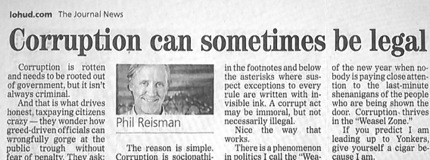
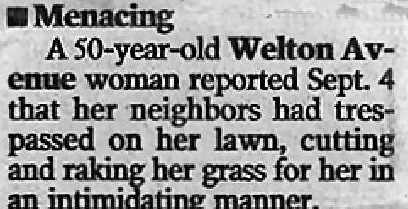
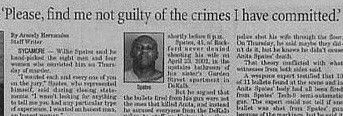
MORE SIGNS OF APOCALYPSE NOW*
July 27, 2012 § Leave a comment
*Might as well admit that it’s no longer impending.


DEVIOUS SEARCH AND INQUIRY
July 26, 2012 § 3 Comments
It avails one naught to get a judgment when all the proper parties have not been given notice and an opportunity to defend.
In 2007, Lottie Woods brought an action for adverse possession of family property. She claimed in her complaint that she was the sole and only heir of her uncle Cornelius, and she published process for him, his unknown heirs, and any other person claiming an interest in the property.
It should have been a clue of problems to come when Corenelius, Jr. showed up at the appointed time and produced a birth certificate showing he was Cornelius’s son. But it all seemed to work out because Lottie and Jr. settled the dispute between them, dividing the property.
The only problem with all of the foregoing is that Lottie neglected to make it known that she had four other siblings who could claim an interest in the property. In other words, as Jr.’s appearance foretold, she could hardly be said to be the “sole and only” heir. Her brother Samson and the other siblings filed an objection and separate litigation to correct the matter.
The COA case of Byrd v. Woods, et al., decided June 19, 2012, is where this particular drama was played out. The case goes off on several other points of law, but the one that I want to focus on here is what happens when a party does not comply with MRCP 4’s requirement that there be diligent search and inquiry before process by publication. Here is what Judge Fair had to say about it, commencing at ¶14:
Mississippi Rule of Civil Procedure 4(c)(4) states that if a defendant cannot be found after diligent search and inquiry, shown by sworn complaint or filed affidavit, he may be made a party by publication. In the 2007 adverse possession action, Lottie filed an affidavit of diligent search and inquiry to obtain a publication summons. However, she must have known that her brother (and her other siblings) would have an interest in the “family land” she sought to adversely possess. They were both potential heirs of Cornelius and believed the property belonged to their family. Further, Lottie and Samson were not estranged, so it is unlikely she could not find him after diligent search and inquiry. But Lottie did not serve Samson personally, nor did she mention or serve her other three siblings.
“The rules on service of process are to be strictly construed. If they have not been complied with, the court is without jurisdiction unless the defendant appears of his own volition.” Kolikas v. Kolikas, 821 So. 2d 874, 878 (¶16) (Miss. Ct. App. 2002). In Caldwell v. Caldwell, 533 So. 2d 413 (Miss. 1988), the supreme court stated “if at any stage of the proceedings it appears that . . . the affidavit was not made in good faith after diligent inquiry, under the facts of the particular case, the process should be quashed by the court . . . .” Id. at 416.
Therefore, Lottie did not obtain service of process on Samson by publication because her affidavit was not made in good faith after diligent inquiry. Neither he nor Lottie’s other siblings are bound by the 2007 judgment.
The lesson here is that when your client avers that he or she has made “diligent inquiry,” or, using the traditional phrase still used by many lawyers, “diligent search and inquiry,” you had better make darned sure that there was indeed a search and inquiry, and that it was in fact diligent. It’s a subject we’ve talked about here before.
Expect the chancellor to inquire behind the affidavit before granting any relief. I always do, and I do not accept a shrug of the shoulders or a couple of half-hearted attempts. In one case before me the woman claimed that the last she knew of her husband he was hanging out at a bar in Wayne County. I asked whether she had gone there to inquire about him. When she said “no,” I ordered her to go to the bar and ask the bartender and some of the habitués whether they knew his whereabouts. Wonder of wonders, she found him and he was personally served.
In the case of Lottie Woods, based solely on what I read in the COA opinion, I would have found that her claim in a pleading intended to influence a judge that she was the sole and only heir when she had living siblings in the area and Cornelius’s son was still alive to have been a fraud on the court. As it was, her “oversight” has cost all of these parties more than five years of wasted time in litigation, and they are returning to the starting line, probably poorer for the trial and appeal attorney fees, and surely not thrilled with the legal process. If only Lottie had sworn truthfully …
“YOUNG KIDS TAKE EVERYTHING PERSONALLY”
July 25, 2012 § 1 Comment
I found a link to this remarkable article by psychologist Marie Hartwell-Walker on Jake Adams’ blog, and I decided that it was so insightful and important that I should reproduce it here.
If you handle divorces involving children, or custody cases of any stripe, I wish you would make a copy of this and give it to your clients. I might even give it to warring litigants in my court. I see so much cruelty and inhumanity in custody battles where the children are treated like instruments of war. Anything to alleviate or put a stop to that is worthwhile. And attorneys are in a unique position to do some good on this point.
Here’s the article …
TOP 5 KID CONCERNS WHEN PARENTS DIVORCE
If you are divorced or in the process of a divorce, you’re probably wondering what the kids are thinking. Oh, some of them will tell you — loud and clear. But kids also have a way of protecting their parents. Their security depends on the big folks so they often pull their punches. They know that the situation is already upsetting. They don’t want to make things worse.
In a support group for kids or in the therapy room, kids can sometimes feel safe enough to tell us what they really think. Here are the five issues I’ve found concern young kids the most. (Teen issues are a bit different so I’ll leave that for another time.) For kids under 10, then, these concerns top the list:
1. “I just want the fighting to stop!” A little fighting actually helps kids make sense of why their parents can’t stay together. Some of the kids I’ve seen who’ve had the hardest adjustment are those who thought that everything was fine. But when parents continue to fight in almost every contact or when they regularly say bad things about each other, the kids feel torn in half. Kids usually love and want to continue to love both parents. Often they want to comfort their folks. They want them to be okay. They don’t want to take sides (see #2).
2. “I hate being in the middle.” Although it seems that every divorcing or divorced parent I’ve talked to in therapy seems to know it’s a bad idea to put kids in the middle, some can’t seem to help themselves. They make disparaging remarks about the other parent in the kids’ presence. They roll their eyes or sigh when they talk about their ex. They ask the kids to take messages to the other parent instead of dealing with them directly. (For example, “You tell you mother that when she sends you over here, she’d better send more than 1 set of clothes.” “You tell your father to be on time or we won’t be here waiting for him.”) It’s important to remember that kids are intensely loyal to both their parents. Each parent can go about the business of parenting without making negative comments about the other.
3. “I feel like it’s all my fault.” When parents break up, it’s unsettling enough. Harder still is when the kids feel they are somehow to blame. They take it to heart when one or the other parent says things like: “Everything was fine until we had kids!,” or “We had kids too young,” or “I never had a turn to be a teenager cuz I had a baby.” Each of those things may be true. But it’s only part of a much larger truth that made it impossible for the parents to stay together. The kids don’t understand that. When they overhear such things, they feel like they’re not loved and maybe were never wanted.
4. “Will my mother/father divorce me too?” Young kids take everything personally. Yes, it may be that the only job available to one or the other parent is 100 miles or more away. Yes, it might be for the best to move in with the grandparents who live in the next state. Or maybe visitations don’t work out because the boss offers an extra shift or the financial situation means needing two jobs to stay afloat. Whatever the reason, if the kids don’t get time with a parent, they often feel rejected. It’s understandable. Deep inside, every kid has a tiny (or not so tiny) voice that says, “If my parents can divorce each other, maybe they can divorce me too.” They need regular reassurance that it’s the situation causing the reduced contact, not the parent’s feelings about them.
5. “I wish everything could go back to the way it was before.” However difficult family life was before the decision to divorce, it’s still what the kids know. To them, the way they’ve lived is their “normal”. They’ve learned how each parent operates, who to go to for what, and how to get what they need. Parents lose sight of the fact that adults have a broader perspective. Adults have a basis for comparing the relationship they have to the one they want. Kids don’t. It’s understandable that the kids want things to get back to “normal”. Even if it was uncomfortable, even dangerous, they knew what to expect.
Parents need to be mindful that whatever they say in the kids’ earshot has a huge impact. Kids are not little adults. Kids don’t have adult perspective or experience. What may seem obvious and sensible to their parents doesn’t always occur to the kids. One serious talk to explain things doesn’t do it. Kids need ongoing reassurance, conversation, love, and attention as they settle in to a new normal.
Follow Marie Hartwell-Walker, Ed.D. on Twitter: http://www.twitter.com/MHartwellWalker
FIVE MORE MISTAKES THAT FIDUCIARIES MAKE
July 24, 2012 § 3 Comments
We talked here about some mistakes that fiduciaries make. Continuing the hit parade, here are five more:
- Failure to account timely and properly. All expenses and receipts must be accounted for annualy or more frequently if ordered by the court. UCCR 6.03-6.06 detail the voucher requirement. There’s a right way and a wrong way to file an accounting. There is a checklist for doing an accounting here. You can read more about accounting and vouchers here.
- Failure to seek and heed legal advice.The UCCR impose a heavy duty on attorneys to advise and supervise the client-fiduciary in probate matters. The burden can be so onerous that I call it the “yoke of probate.” You can not blithely turn your fiduciary loose to figure it out for himself or herself. You have a duty to the court and the beneficiaries. A case showing how severely the Supreme Court views the joint duty of the attorney and fiduciary-client, read this post on the case of Matthews v. Williams. And a case showing the disastrous consequences of an attorney’s complicity in the fiduciary’s malfeasance, check out this post on the ongoing Hinds county trainwreck involving (soon-to-be-former) attorney Michael J. Brown. Make sure your fiduciary knows what the do’s and don’ts are. Put together an instruction sheet and have your client sign a copy to keep in your file for your protection. There is a reason that UCCR 6.01 requires every fiduciary to have an attorney. It’s because the attorney is the arm of the court who is responsible to supervise the fiduciary and make sure everything is being done properly. As I have said many times before, if that is an unpalatable concept for you, simply refuse to handle probate matters.
- Failure to get authority for investment of the ward’s estate.Your fiduciary is obligated to increase the ward’s estate, if possible. The courts apply the prudent investor standard, which can be second-guessed. There are a few ultra-safe investments that the fiduciary may make without prior approval, per MCA 91-13-3, including time CD’s, savings accounts, and most FDIC- and FSLIC-insured accounts (Note: to my knowledge, credit union accounts do not qualify). Only problem is that in this era, those accounts produce interest rates closer to zero than anything that would actually increase the ward’s estate. So the prudent investor has to look to more speculative investments, which are allowed under MCA 91-13-3 and -5. You should have your investment plan approved in advance by the court, with adequate supporting documentation so that anyone looking at it later will be able to see that the court had a valid basis for its order. Again, one of the transgressions in Matthews v. Williams was the fiduciary’s helter-skelter, unapproved investment scheme.
- Failure to give proper notice to close.MCA 93-13-77 requires that the final account in a conservatorship or guardianship must be on file for 30 days, and the ward must have have 30-days notice and an opportunity to inspect it and file any objection. A ward who is a competent adult may waive the notice and accounting. A ward under 21, however, must be served with process and may waive nothing. In estates, every beneficiary or heir must either join in the accounting, or waive process, or be served with process and given an opportunity to be heard.
- Failure to keep the attorney and court informed of contact information. Make sure your fiduciary knows and understands that you need to notified immediately of any change of address, telephone number and other contact information. It’s a good idea to get the names and telephone numbers of a couple of local relatives and/or long-standing friends who can help you locate a fiduciary who has wandered off.
There are some simple strategies to avoid these missteps. Here is a link to Five Tips to Improve Your Probate Practice that outlines some things you can do. The primary attribute you need, though, is vigilance. Set up procedures in your office to get the information you need, to instruct and advise your fiduciary, and to keep in touch. It could keep you out of some costly trouble.
BEST INTEREST IN A PARENT – NON-PARENT CUSTODY DISPUTE
July 23, 2012 § Leave a comment
Is it necessary for the chancellor to analyze the proof in light of the Albright factors in a case where the grandparents are seeking to take custody from the natural father, the sole surviving parent, based on a finding of unfitness?
That Albright analysis question was an issue before the COA in the case of Lucas v. Hendrix, decided by the COA July 17, 2012. At trial, the chancellor had found that the father, Adam Lucas, was unfit, and awarded custody of the two minors, Tyler and Cody, to the maternal grandarents, Jeannie and John Hendrix, without any Albright analysis. Here is how Judge Roberts’ opinion addressed it, beginning at ¶16:
In his first issue, Lucas asserts that the chancellor used an incorrect legal standard by failing to apply an Albright analysis before granting the Hendrixes custody of Tyler and Cody …
¶17. In Albright v. Albright, 437 So. 2d 1003, 1005 (Miss. 1983), the Mississippi Supreme Court outlined multiple factors to be considered when determining which natural parent should receive custody of the child, with the polestar consideration being the best interest of the child. The supreme court and this Court have repeatedly stated that a different analysis must be applied when adjudicating custody between a natural parent and a third party, such as in this case. In custody cases involving a natural parent and a third party, a presumption exists that the natural parent is the best custodian for his child. McKee v. Flynt, 630 So. 2d 44, 47 (Miss. 1993). However, this natural-parent presumption may be overcome by clear and convincing evidence “that the parent has (1) abandoned the child[;] or (2) the conduct of the parent is so immoral as to be detrimental to the child[;] or (3) the parent is unfit mentally or otherwise to have the custody of his or her child.” Id. (quoting White v. Thompson, 569 So. 2d 1181, 1183-84 (Miss. 1990)); see also McCraw v. Buchanan, 10 So.3d 979, 984 (¶15) (Miss. Ct. App. 2009). Additionally, pursuant to Mississippi Code Annotated section 93-5-24(1)(e) (Rev. 2004):
Upon a finding by the [chancery] court that both parents of the child have abandoned or deserted such child or that both such parents are mentally, morally or otherwise unfit to rear and train the child[,] the [chancery] court may award physical and legal custody to:
(i) The person in whose home the child has been living in a wholesome and stable environment; or
(ii) . . . any other person deemed by the [chancery] court to be suitable and able to provide adequate and proper care and guidance for the child.
In the current case, the chancellor relied on this statute because Moore, the boys’ natural mother, was deceased; therefore, Lucas was the sole remaining natural parent. If a chancellor finds the remaining natural parent to be unfit, as she did in this case, then the statute gives the chancellor the authority to grant custody to a third party.
¶18. We do not read Mississippi Code Annotated section 93-5-24 or the majority of prior case law to require an Albright analysis if the chancellor finds the sole, natural parent has abandoned or deserted the child or is unfit to raise the child …
The decision went on to distinguish this case from In re Dissolution of the Marriage of Leverock and Hamby, 23 So.3d 424 (Miss. 2009). The primary point of departure between the two cases was that the chancellor made a finding of unfitness in the Lucas case, but there was no such finding in Leverock.
The important feature of the Lucas case is that no Albright analysis is necessary in a contest netween a natural parent and third parties once the chancellor has found unfitness. That finding alone is sufficient to trigger the change and opens the door to either class of custodians set out in the statute, without a best-interest Albright analysis.
Adam argued also that the chancellor erred by not expressly finding by clear and convincing evidence that he was unfit. Without saying it in so many words, however, the COA held the chancellor’s findings to be so detailed and supported by proof that they were tantamount to a finding by clear and convincing evidence, and so brushed aside this contention.
So does this mean you should not bother with proof of the Albright factors when you try a case of this type? I guess, strictly speaking, the answer would be in the affirmative. But why take the chance? Even if the chancellor does not use that evidence, you have it in the record if you need it.
 The Better Chancery Practice Blog