Reprise: That Checklist Thing
February 6, 2014 § 2 Comments
Reprise replays posts from the past that you may find useful today.
UPDATED CHECKLIST OF CHECKLISTS
May 27, 2011 § 2 Comments
Proving your case by proving certain factors is a fact of legal life in Mississippi. I’ve referred to it as trial by checklist. If you’re not putting on proof of the factors when they apply in your case, you are wasting your and the court’s time, as well as your client’s money, and you are committing malpractice to boot.
Many lawyers have told me that they print out these checklists and use them at trial. I encourage you to copy these checklists and use them in your trial notebooks. And while you’re at it, you’re free to copy any post for your own personal use, but not for commercial use. Lawyers have told me that they are building notebooks tabbed with various subjects and inserting copies of my posts (along with other useful material, I imagine). Good. If it improves practice and makes your (and my) job easier and more effective, I’m all for it.
Here is an updated list of links to the checklists I’ve posted:
Doing an accounting in a probate matter.
Income tax dependency exemption.
Modification of child support.
This Week: Snow Daze-d … and Another Icon Passes
January 31, 2014 § Leave a comment
As I write this, we are in the midst of an unheard-of three-day shutdown of our courthouses in Lauderdale and Clarke Counties for, of all things, ice.
That’s right — ice. As in ice on the roads and bridges that makes it hazardous for people not on the main thoroughfares to travel to the courthouse to conduct their business.
I don’t know about you, but I don’t recall ever ice and snow sticking around more than 24 hours after its appearance in these parts. You know how it usually goes: snow all night and next morning, and then all gone by afternoon or next morning at the latest. And that only happens once every five years or so. But here we are on Thursday with Monday’s snow still on the ground, and the temperatures expected — finally — to struggle above freezing today for the first time since the beginning of the week.
The most tiresome thing about this whole ordeal, in a way, was listening to the smiling faces on tv drone on about how unprepared we in the southland were for the snow and ice, as if this thought had only now occurred to them for the first time in some miraculous medla revelation.
Actually, we were unprepared, in the same sense that Minnesota is unprepared for a hurricane. When one experiences a particular calamity only once or so a century, one does not prudently invest money, peoplepower, infrastructure, and planning for such that could be devoted to the more reasonably-anticipated and frequently occurring disasters that usually befall us, like hurricanes, tornadoes, grass fires, hazardous spills on the interstate, and crumbling county roads and bridges.
Any Mississippi supervisor who spent funds on snowplows, sand, sand trucks, salt, salt trucks, snow shovels, and other winter storm equipment sufficient to cover his or her county, or even beat, would likely be investigated by the state auditor and indicted by a federal grand jury — or should be.
Well, this will all be history by the weekend, we expect, when temperatures will percolate back up into the mid-60’s — as they should in any self-respecting winter.
————–
As the snow fell on Mississippi Monday, Pete Seeger slipped quietly out of this life. He was 94 years old.
If you grew up in the 50’s and 60’s you will remember that Seeger was an important figure in folk music, which was the sound of that era. He was a member of The Weavers, a quite popular folk group that rivalled other performers like the Kingston Trio, the Limelighters, and the Brothers Four for popularity. Even as mainline folk wained in the public eye, and its music fell out of favor, its influence persisted. It morphed into folk rock and crossover country, and never completely disappeared. Dylan, Simon & Garfunkel, the Byrds, The Mammas & the Pappas, and many others, carried folk DNA in their music.
Seeger was not known only for his music. His activism for civil rights, workers rights, and anti-war and environmental issues was legendary.
I’ve posted here before that Seeger came to Meridian to perform for and sing with the Freedom Summer volunteers on August 4, 1964. It was he who broke the tragic news to them that the bodies of Mickey Schwerner, James Chaney, and Andy Goodman had been discovered in a dam that very day in Neshoba County.
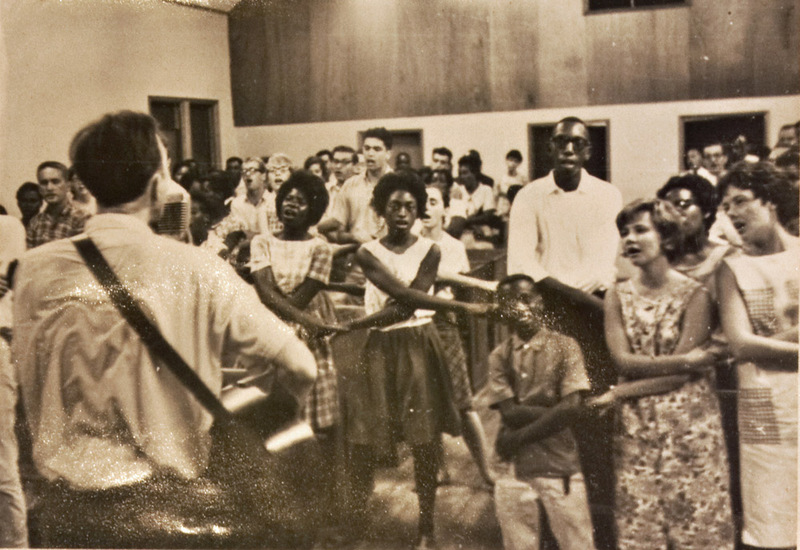
Pete Seeger will live on in his music. Songs like “Where have all the Flowers Gone,” Turn, Turn, Turn,” and “If I had a Hammer,” are part of our musical heritage.
Seeger’s politics made him anathema to some. He was a communist in his earlier years, a position he later rejected and even said he regretted. That coupled with his refusal to testify before the HUAC, on the ground of free speech, earned him blacklisting with many media outlets and broadcasting networks. But his steadfast defense of and unwavering advocacy for the poor, the underpaid, the dispossessed, and the downtrodden will be his legacy.
Law Like Love
January 17, 2014 § Leave a comment
by W.H. Auden
Law, say the gardeners, is the sun,
Law is the one
All gardeners obey
To-morrow, yesterday, to-day.
Law is the wisdom of the old,
The impotent grandfathers feebly scold;
The grandchildren put out a treble tongue,
Law is the senses of the young.
Law, says the priest with a priestly look,
Expounding to an unpriestly people,
Law is the words in my priestly book,
Law is my pulpit and my steeple.
Law, says the judge as he looks down his nose,
Speaking clearly and most severely,
Law is as I’ve told you before,
Law is as you know I suppose,
Law is but let me explain it once more,
Law is The Law.
Yet law-abiding scholars write:
Law is neither wrong nor right,
Law is only crimes
Punished by places and by times,
Law is the clothes men wear
Anytime, anywhere,
Law is Good morning and Good night.
Others say, Law is our Fate;
Others say, Law is our State;
Others say, others say
Law is no more,
Law has gone away.
And always the loud angry crowd,
Very angry and very loud,
Law is We,
And always the soft idiot softly Me.
If we, dear, know we know no more
Than they about the Law,
If I no more than you
Know what we should and should not do
Except that all agree
Gladly or miserably
That the Law is
And that all know this
If therefore thinking it absurd
To identify Law with some other word,
Unlike so many men
I cannot say Law is again,
No more than they can we suppress
The universal wish to guess
Or slip out of our own position
Into an unconcerned condition.
Although I can at least confine
Your vanity and mine
To stating timidly
A timid similarity,
We shall boast anyway:
Like love I say.
Like love we don’t know where or why,
Like love we can’t compel or fly,
Like love we often weep,
Like love we seldom keep.
Reprise: Pleadings are Not Evidence
January 9, 2014 § 6 Comments
Reprise replays posts from the past that you may find useful today.
PLEADINGS AND THE PROOF
November 1, 2011 § 1 Comment
“It is the pleading that makes the case for adjudication, and it is the evidence that sustains or defeats it upon the final hearing.” Terry v. Jones, 44 Miss. 540, 1871 WL 8413 (1871).
Voilà! After 140 years and a sea-change in the rules of Mississippi pleading, that ancient formula holds oh-so true in our courts. The pleadings frame the issues; the evidence admitted at trial determines the outcome.
Put another way: THE PLEADINGS ARE NOT EVIDENCE.
This immutable principle has not only for ages been a bedrock of procedure in Mississippi courts, it has also been the rock that has dashed the case of many an unseasoned or unwary practitioner.
Don’t ever assume because you have pled something that the court will take it as true. On the contrary, without actual evidence in the record, the court can not take it as true, whether it wants to or not.
I have seen lawyers leave key elements of their cases lying on the court room floor simply because they neglected to offer proof thereof. This is a chronic problem when it comes to claims for attorney’s fees, but the problem is not limited to that issue. I see Rule 59 motions more frequently than I’d like where the motion claims I “overlooked” a point, but the attorney concedes that the witness never testified about the matter. I should grant the motion, the lawyer pleads, because it was, after all, in the pleadings.
Here’s the deal: If you don’t include a properly-pled issue in your pleadings, the court can not consider it. BUT, just because it is in your pleadings does not mean it is established; you still have to put on evidence in support of it.
 The Better Chancery Practice Blog