Reprise: Common Mistakes of Fiduciaries (and their Attorneys)
December 22, 2014 § Leave a comment
FIVE MISTAKES THAT FIDUCIARIES MAKE
July 18, 2012 § 4 Comments
- Failure to file an inventory. In every type of probate matter, it is required that an inventory be filed, usually within 90 days of appointment of the fiduciary. Often the will waives inventory, but the better attorneys I know always file an inventory, whether waived or not. Why? Because the inventory (a) sets a base line for later accountings, and (b) covers the lawyer’s rear from later claims by other heirs or beneficiaries that items are missing. Better to get those matters out up front where they can be dealt with than to let it hold up closing the estate. MCA 93-13-33 provides that an inventory must be filed within three months of appointment in a guardianship or conservatorship, and even requires an annual inventory. A guardian who fails to do so may be removed and be liable on his or her bond.
- Failure to publish notice to creditors. This requirement is mostly overlooked in guardianships and conservatorships. MCA 93-13-38(1) expressly states that “All the provisions of the law on the subject of executors and administrators, relating to settlement or disposition of property limitations, notice to creditors, probate and registration of claims, proceedings to insolvency and distribution of assets of insolvent estates, shall, insofar as applicable and not otherwise provided, be observed and enforced in all guardianships.” And remember that the statutory affidavit of creditors must be filed before publication of the notice to creditors. MCA 91-7-145(2) says that “Upon filing such affidavit …” it shall be the duty of the fiduciary to publish. An affidavit filed after the publication is a nullity.
- Failure to get authority of the court for expenditures. Perhaps the most pervasive error of fiduciaries. MCA 93-13-38 requires the conservator to improve the estate of the ward, and to “apply so much of the income, profit or body thereof as may be necessary for the comfortable maintenance and support of the ward and his family, if he have any, after obtaining an order of the court fixing the amount” [emphasis added]. Every expenditure must be approved in advance. Emergency expenditures may be ratified, but only if properly proven to be for the ward’s benefit, and properly supported by vouchers. Caution: as set out below, self-dealing expenses may be neither approved or ratified.
- Failure to keep the ward’s estate separate and to avoid self-dealing. It often happens that a son or daughter is appointed to serve as conservator of momma’s or daddy’s estate. The child simply adds his or her name to the parent’s account and proceeds from there. This complicates matters because that joint account belongs 100% to each person whose name is on the account, and becomes the property of the survivor on death. That is certainly not an appropriate or even legal arrangement for a guardian or conservator. The fiduciary in every kind of probate matter needs to open a separate estate, guardiandhip or conservatorship bank account, and make all financial transactions through it and through it alone. MCA 91-7-253 prohibits the fiduciary from paying herself any money from the ward’s estate without prior court approval, and loans to the fiduciary and family members are prohibited also. The statute says that the court can not ratify or approve such payments. If the fiduciary has some expense that needs to be reimbursed, make sure the fiduciary has proper documentation and petition the court for authority. Don’t expect a cash payment or check made out to cash to be approved without abundant supporting documentation.
- Failure to get court permission to move the ward to another county. It’s prohibited to relocate the ward to a county other than the one in which the fiduciary was appointed, unless approved in advance by the court. MCA 93-13-61.
R.I.P. Chancellor Ray H. Montgomery
December 15, 2014 § 6 Comments
Retired Chancellor Ray H. Montgomery died Sunday, December 14, 2014.
“Quote Unquote”
December 5, 2014 § 1 Comment
“God is striving with us. God is present, whether you just lost your mother to pancreatic cancer or your country just killed people at a wedding party in Yemen. God went to the camps, and God was lynched and shot and tortured. And God is still loving. It’s not our job to read Isaiah and then go sit at Starbucks and talk about what a sad place the world is. It is our job to collaborate with each other and activate that love.” — Rev. Lynice Pinkard
“Remember as you go about your day that you may be the only Jesus some of your friends, neighbors, and family will ever see.” — Wanda Brunstetter
“Do all the good you can, by all the means you can. In all the ways you can. In all the places you can. At all the times you can. To all the people you can. As long as you ever can.” — John Wesley

Reprise: Exempt Property and Estates
November 26, 2014 § Leave a comment
Reprise replays posts from the past that you might find useful today.
EXEMPT PROPERTY AND ESTATES
October 28, 2010 § 11 Comments
You’re handling an estate of a decedent whose spouse predeceased him. The decedent was a man of modest means with a two-bedroom home in town, some furniture and appliances, an older car, some savings and $6,000 in a 401(k) account. There’s not enough cash to pay all the creditors’ claims. The surviving children and grandchildren want you to close the estate as soon as possible. Do you advise them to sell the furniture at an estate sale to muster up enough cash to satisfy the creditors? Or should you get court approval to sell the house, pay the debts, and distribute what’s left?
Not so fast. All that property may not even belong in the estate in the first place. It may not be subject to the creditors’ claims at all.
MCA § 91-1-19 provides in part:
The property, real and personal, exempted by law from sale under execution or attachment shall, on the death of the husband or wife owning it, descend to the survivor of them and the children and grandchildren of the decedent, as tenants in common, grandchildren inheriting their deceased parent’s share; and if there be no children or grandchildren of the decedent, to the surviving wife or husband; and if there be no such survivor, to the children and grandchildren of the deceased owner.”
What this language means is that the property that is exempted by Mississippi law from sale under execution or attachment descends automatically, not through any estate, as stated in the statute. You would be shortchanging the statutory survivors considerably by not pursuing the exemptions.
It’s important to know what are the exemptions. MCA § 85-3-1 sets out the personal property and financial assets that are exempt:
(a) Tangible personal property of the following kinds selected by the debtor, not exceeding Ten Thousand Dollars ($10,000.00) in cumulative value:
(i) Household goods, wearing apparel, books, animals or crops;
(ii) Motor vehicles;
(iii) Implements, professional books or tools of the trade;
(iv) Cash on hand;
(v) Professionally prescribed health aids;
(vi) Any items of tangible personal property worth less than Two Hundred Dollars ($200.00) each.
Household goods, as used in this paragraph (a), means clothing, furniture, appliances, one (1) radio and one (1) television, one (1) firearm, one (1) lawnmower, linens, china, crockery, kitchenware, and personal effects (including wedding rings) of the debtor and his dependents; however, works of art, electronic entertainment equipment (except one (1) television and one (1) radio), jewelry (other than wedding rings), and items acquired as antiques are not included within the scope of the term “household goods.” This paragraph (a) shall not apply to distress warrants issued for collection of taxes due the state or to wages described in Section 85-3-4.
(b)(i) The proceeds of insurance on property, real and personal, exempt from execution or attachment, and the proceeds of the sale of such property.
(ii) Income from disability insurance.
(c) All property in this state, real, personal and mixed, for the satisfaction of a judgment or claim in favor of another state or political subdivision of another state for failure to pay that state’s or that political subdivision’s income tax on benefits received from a pension or other retirement plan. As used in this paragraph (c), “pension or other retirement plan” includes:
(i) An annuity, pension, or profit-sharing or stock bonus or similar plan established to provide retirement benefits for an officer or employee of a public or private employer or for a self-employed individual;
(ii) An annuity, pension, or military retirement pay plan or other retirement plan administered by the United States; and
(iii) An individual retirement account.
(d) One (1) mobile home, trailer, manufactured housing, or similar type dwelling owned and occupied as the primary residence by the debtor, not exceeding a value of Thirty Thousand Dollars ($30,000.00); in determining this value, existing encumbrances on the dwelling, including taxes and all other liens, shall first be deducted from the actual value of the dwelling. A debtor is not entitled to the exemption of a mobile home as personal property who claims a homestead exemption under Section 85-3-21, and the exemption shall not apply to collection of delinquent taxes under Sections 27-41-101 through 27-41-109.
(e) Assets held in, or monies payable to the participant or beneficiary from, whether vested or not, (i) a pension, profit-sharing, stock bonus or similar plan or contract established to provide retirement benefits for the participant or beneficiary and qualified under Section 401(a), 403(a), or 403(b) of the Internal Revenue Code (or corresponding provisions of any successor law), including a retirement plan for self-employed individuals qualified under one of such enumerated sections, (ii) an eligible deferred compensation plan described in Section 457(b) of the Internal Revenue Code (or corresponding provisions of any successor law), or (iii) an individual retirement account or an individual retirement annuity within the meaning of Section 408 of the Internal Revenue Code (or corresponding provisions of any successor law), including a simplified employee pension plan.
(f) Monies paid into or, to the extent payments out are applied to tuition or other qualified higher education expenses at eligible educational institutions, as defined in Section 529 of the Internal Revenue Code or corresponding provisions of any successor law, monies paid out of the assets of and the income from any validly existing qualified tuition program authorized under Section 529 of the Internal Revenue Code or corresponding provisions of any successor law, including, but not limited to, the Mississippi Prepaid Affordable College Tuition (MPACT) Program established under Sections 37-155-1 through 37-155-27 and the Mississippi Affordable College Savings (MACS) Program established under Sections 37-155-101 through 37-155-125.
(g) The assets of a health savings account, including any interest accrued thereon, established pursuant to a health savings account program as provided in the Health Savings Accounts Act (Sections 83-62-1 through 83-62-9).
(h) In addition to all other exemptions listed in this section, there shall be an additional exemption of property having a value of Fifty Thousand Dollars ($50,000.00) of whatever type, whether real, personal or mixed, tangible or intangible, including deposits of money, available to any Mississippi resident who is seventy (70) years of age or older.
(i) An amount not to exceed Five Thousand Dollars ($5,000.00) of earned income tax credit proceeds.
(j) An amount not to exceed Five Thousand Dollars ($5,000.00) of federal tax refund proceeds.
(k) An amount not to exceed Five Thousand Dollars ($5,000.00) of state tax refund proceeds.
(l) Nothing in this section shall in any way affect the rights or remedies of the holder or owner of a statutory lien or voluntary security interest.
MCA § 85-3-21 establishes the homestead exemption.
There are other exemptions that are set out in the cross-references to the code sections cited.
MCA § 91-7-117 requires the appraisers to set apart the exempt property.
As attorney for the estate, you have a duty to determine what assets need to be declared exempt and not included in it. In moderate estates it could mean the difference between survivors getting nothing and the survivors getting something.
Now re-read the first paragraph above. Do you see it differently?
Sounds of Space
November 21, 2014 § 1 Comment
There is no audible sound in space, due to its vacuum.
NASA, however, found a way to record electromagnetic impulses emitted by planets, using a plasma wave antenna to record vibrations within 20 to 20,000 hertz, the range of human hearing. (Sorry for the ad).
Justices Kagan and Scalia at OM Law School
November 19, 2014 § 4 Comments
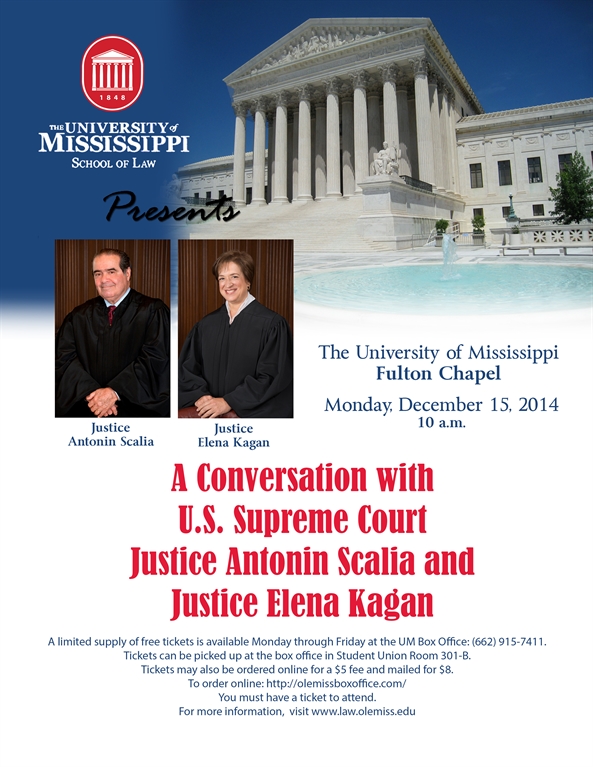
USSC Justices Elena Kagan and Antonin Scalia will be guests of the Ole Miss Law School on December 15, 2014. Here’s the graphic from Ole Miss:
Update on the Sixteenth District Race
November 14, 2014 § 2 Comments
Certified yesterday. D. Neil Harris (incumbent) defeated Paula S. Yancey by 18 votes.
Can the Children of a Mississippi Marriage Have a Cause of Action for Alienation of Affection?
November 12, 2014 § 1 Comment
No, says the MSSC in Brent v. Mathis on November 6, 2014.

