LINCOLN’S NOTES ON THE PRACTICE OF LAW
February 18, 2011 § 4 Comments
 Among the many facets of his notable life, often overlooked, is Abraham Lincoln’s career as a lawyer. It’s not hard to imagine the rough-hewn Lincoln in country courthouses questioning witnesses, holding forth to the court, and regaling juries. Even though he achieved respect of his peers and some wealth in his practice in his representation of a railroad, he retained his homespun country lawyer patina.
These notes are some he roughed out for a speech on the practice of law that he never delivered. Despite the fact that they were never refined to the point of oratory, they reflect the philosophy of an everyday lawyer that we can appreciate nearly 150 years later.
I am not an accomplished lawyer. I find quite as much material for a lecture in those points wherein I have failed, as in those wherein I have been moderately successful. The leading rule for the lawyer, as for the man of every other calling, is diligence. Leave nothing for to-morrow which can be done to-day. Never let your correspondence fall behind. Whatever piece of business you have in hand, before stopping, do all the labor pertaining to it which can then be done. When you bring a common-law suit, if you have the facts for doing so, write the declaration at once. If a law point be involved, examine the books, and note the authority you rely on upon the declaration itself, where you are sure to find it when wanted. The same of defenses and pleas. In business not likely to be litigated, — ordinary collection cases, foreclosures, partitions, and the like, — make all examinations of titles, and note them, and even draft orders and decrees in advance. This course has a triple advantage; it avoids omissions and neglect, saves your labor when once done, performs the labor out of court when you have leisure, rather than in court when you have not.
Extemporaneous speaking should be practised and cultivated. It is the lawyer’s avenue to the public. However able and faithful he may be in other respects, people are slow to bring him business if he cannot make a speech. And yet there is not a more fatal error to young lawyers than relying too much on speech-making. If any one, upon his rare powers of speaking, shall claim an exemption from the drudgery of the law, his case is a failure in advance.
There is a vague popular belief that lawyers are necessarily dishonest. I say vague, because when we consider to what extent confidence and honors are reposed in and conferred upon lawyers by the people, it appears improbable that their impression of dishonesty is very distinct and vivid. Yet the impression is common, almost universal. Let no young man choosing the law for a calling for a moment yield to the popular belief — resolve to be honest at all events; and if in your own judgment you cannot be an honest lawyer, resolve to be honest without being a lawyer. Choose some other occupation, rather than one in the choosing of which you do, in advance, consent to be a knave.
Discourage litigation. Persuade your neighbors to compromise whenever you can. Point out to them how the nominal winner is often a real loser — in fees, expenses, and waste of time. As a peacemaker the lawyer has a superior opportunity of being a good man. There will still be business enough.
Never stir up litigation. A worse man can scarcely be found than one who does this. Who can be more nearly a fiend than he who habitually overhauls the register of deeds in search of defects in titles, whereon to stir up strife, and put money in his pocket? A moral tone ought to be infused into the profession which should drive such men out of it.
The matter of fees is important, far beyond the mere question of bread and butter involved. Properly attended to, fuller justice is done to both lawyer and client. An exorbitant fee should never be claimed. As a general rule never take your whole fee in advance, nor any more than a small retainer. When fully paid beforehand, you are more than a common mortal if you can feel the same interest in the case, as if something was still in prospect for you, as well as for your client. And when you lack interest in the case the job will very likely lack skill and diligence in the performance. Settle the amount of fee and take a note in advance. Then you will feel that you are working for something, and you are sure to do your work faithfully and well. Never sell a fee note — at least not before the consideration service is performed. It leads to negligence and dishonesty — negligence by losing interest in the case, and dishonesty in refusing to refund when you have allowed the consideration to fail.
Thanks to Legal Ethics Blog.
“QUOTE UNQUOTE”
February 18, 2011 § 1 Comment
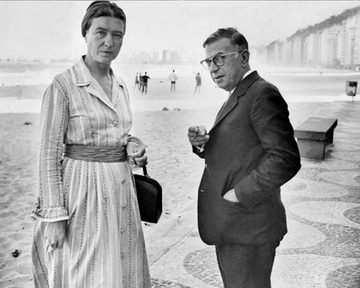
Sartre with Simone de Beauvoir
“Words are loaded pistols.” — Jean-Paul Sartre
“Mind your thoughts, for they become words. Mind your words, for they become actions. Mind your actions, for they become habits. Mind your habits, for they become character. Mind your character, for it becomes your destiny.” — Old saying
“A kind word is like a spring day.” — Russian Proverb
“QUOTE UNQUOTE”
January 21, 2011 § Leave a comment

Ibsen
“‘Your money or your life.’ We know what to do when a burglar makes this demand of us, but not when God does.” — Mignon McLaughlin
“Money may be the husk of many things, but not the kernel. It brings you food, but not appetite; medicine, but not health; acquaintances, but not friends; servants, but not loyalty; days of joy, but not peace or happiness.” — Henrik Ibsen
“”When we truly discover love, capitalism will not be possible and Marxism will not be necessary.” — Will O’Brien
LOSING: NOT THE NEXT BEST THING TO WINNING
December 28, 2010 § 1 Comment
This from Philip Thomas’s excellent blog Mississippi Litigation Review & Commentary. If these thoughts do not resonate with with your experience as a litigator, you might consider some tamer undertaking …
Losing Sucks
Posted on March 3, 2010 by Philip Thomas
You heard me. Losing a trial sucks. On multiple levels. Sorry if you don’t like my vocabulary.
Even worse, a win does not even out a loss. Tennis great Andre Agassi described it as well as anyone that I’ve heard even though he was talking about tennis and not trials:
Now that I’ve won a slam, I know something that very few people on earth are permitted to know. A win doesn’t feel as good as a loss feels bad, and the good feeling doesn’t last as long as the bad. Not even close.
Shortly after I started my first job as a lawyer I heard veteran trial lawyer Natie Caraway say basically the same thing. It took personal experience winning and losing trials to understand it.
For me a loss on appeal does not feel bad as a loss at a trial. And the loss of a bench trial does not feel as bad as the loss of a jury trial. The loss of a jury trial feels the worst because you hang it all on the line for twelve people who you don’t know and you are shattered when you find out that you could not convince them. And if you believe in your clients case–and most lawyers do–you think that the jury got it wrong. That makes it worse.
I have no answer for the best way to deal with a loss. But I agree with Chicago lawyer John Tucker on this point:
Courtroom lawyers and people who play sports are engaged in an endeavor where there is a winner and loser of every contest, and no matter how good they are, sometimes they lose.In fact, in both endeavors it is often true that the better they are the harder their contests and the more often they will lose. You don’t have to like it-in fact, you had better not-but you won’t last long if you don’t learn to get over it, or at least put it far enough behind you to go on to the next case.
Some lawyers lose a big trial and never recover. They are habitually afraid to re-enter the courtroom for fear of losing again. The best lawyers get over it and seek the adrenalin rush of going back in and putting it all on the line again.
“QUOTE UNQUOTE”
December 17, 2010 § Leave a comment

Viktor Frankl
“What is to give light must endure burning.” — Viktor Frankl
“When a true genius appears in the world, you may know him by this sign: that all the dunces are in confederacy against him. — Jonathan Swift
“The only kinds of fights worth fighting are those you’re going to lose, because somebody has to fight them and lose and lose and lose until someday, somebody who believes as you do wins. — I.F. Stone
“QUOTE UNQUOTE”
November 19, 2010 § Leave a comment

Dave Barry
“If a woman has to choose between catching a fly ball and saving an infant’s life, she will choose to save the infant’s life without even considering if there are men on base.” — Dave Barry
“There’s so much comedy on television. Does that cause comedy in the streets?” — Dick Cavett
“I am not a vegetarian because I love animals; I am a vegetarian because I hate plants.” — A. Whitney Brown
“QUOTE UNQUOTE”
October 29, 2010 § Leave a comment
“Have you ever noticed? Anybody going slower than you is an idiot, and anyone going faster than you is a maniac.” — George Carlin
“Half our life is spent trying to find something to do with the time we have rushed through life trying to save.” — Will Rogers
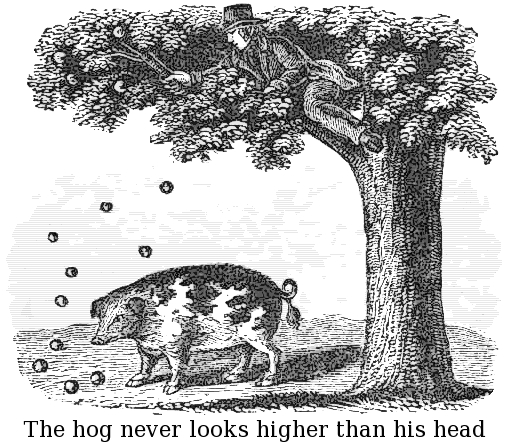
“A traveling salesman, seeing a farmer holding a large pig up to an apple tree to feed him an apple, stopped and asked, ‘Wouldn’t it save a lot of time just to pick the apple and give it to the pig?’ Replied the farmer: ‘What’s time to a pig?'” — Old joke
“QUOTE UNQUOTE”
October 8, 2010 § Leave a comment

Mignon McLaughlin
“Every day of our lives we are on the verge of making those slight changes that would make all the difference.” — Mignon McLaughlin
“Do not let the fact that things were not made for you, that conditions are not as they should be, stop you. Go on anyway. Everything depends on those who go on anyway.” — Robert Henri
“Do not be too timid and squeamish about your actions. All life is an experiment. The more experiments you make the better. What if they are a little coarse, and you get your coat soiled or torn? What if you do fail, and get fairly rolled in the dirt once or twice? Up again, you shall never be so afraid of a tumble.” — Ralph Waldo Emerson
“QUOTE UNQUOTE”
September 23, 2010 § Leave a comment

Lao Tzu
“No one can get inner peace by pouncing on it.” — Harry Emerson Fosdick
“It is an ironic habit of human beings to run faster when we have lost our way.” — Rollo May
“Nature does not hurry, yet everything is accomplished.” — Lao Tzu
“QUOTE UNQUOTE”
September 16, 2010 § Leave a comment
 “Blessed is the man who, having nothing to say, abstains from giving us wordy evidence of the fact.” — Elbert Hubbard
“Silence is not a thing we make; it is something into which we enter. It is always there. … all we can make is noise.” — Mother Maribel of Wantage
“Ask me about my vow of silence” — Bumper sticker
 The Better Chancery Practice Blog