FAMILY LAW IN THE FAST LANE
October 29, 2010 § Leave a comment
This article is copied from the Washington Post online edition. After you read it, you may have an unsettling sense of unreality. Lawyers charging $850 an hour for a divorce? Billing for more than 7 hours a day, 365 days a year? Billing for as many as 71 hours in a day? $624,000 in fees for a divorce trial? I am not making this up.
High-priced lawyer sues former client, then agrees to pay him $102,000
By Tom Jackman
Washington Post Staff Writer
Saturday, September 25, 2010; 6:29 PM
Glenn C. Lewis is an acknowledged titan of the D.C. area divorce bar, a former president of the Virginia Bar Association who boasts that he is the most expensive lawyer in the region: $850 an hour. He has an impressive office in the District and an array of high-profile clients.
So it fascinated the Fairfax County courthouse when Lewis sued one of his former clients for an additional $500,000 in fees and interest, although he’d already been paid $378,000.
The fascinating part was that the client, a lawyer himself, fired back. He hired another former state bar president, Bernard J. DiMuro, who dug through Lewis’s billing records and hired two more divorce bar giants – including another former state bar president – as his experts. The experts said Lewis had done a poor job and didn’t deserve nearly $900,000 for his work.
In Fairfax Circuit Court on Friday, Lewis capitulated. He agreed to pay his former client more than $102,000, including $25,000 in sanctions imposed on Lewis’s lawyers for defying pretrial orders. Lewis even failed to show up for his own deposition.
Lewis, who for years hosted his own cable access television show, and who was given a lifetime achievement award from the Virginia State Bar’s family law section, remains unrepentant. His final bill for the divorce of Steve Firestone was $627,000, and he sought another $253,000 in interest for the case, which ended in 2004 without a trial less than a year from the time it was filed.
“He owed us more than that,” Lewis said in an interview last week. “We earned more than that. I feel as strongly today as I did the day we filed [suit], that Mr. Firestone owed every penny of it.”
Firestone said, “I thought that what I paid was egregiously high,” and he stopped paying shortly before his divorce was finalized. Then he received the lawsuit seeking another $500,000 five years later.
“I was shocked,” Firestone said. “If he won, we were going to be out on the street.”
Firestone hired DiMuro, who doesn’t do divorce law. But DiMuro obtained Lewis’s billing records and the records of the divorce, which he then handed over to Joseph Condo and Robert Shoun, two longtime family law practitioners.
Their conclusion: Not only were Lewis’s bills “flagrantly disproportionate to the value of the dispute,” DiMuro said, but Lewis’s settlement was a lousy deal. Firestone, through DiMuro, pursued Lewis for legal malpractice.
Firestone’s ex-wife had used Fairfax attorney David L. Duff for the divorce. Duff’s total bill: $73,000.
DiMuro noted that three lawyers from Lewis’s firm worked on Firestone’s case, and two lawyers often appeared at meetings or depositions that would normally be handled by one lawyer. In 2003, Lewis was only billing $575 an hour, while two young associates billed at rates closer to $250 an hour.
Lewis said Firestone was a difficult client, presenting numerous problems, and that comparing one side’s legal bills with the other’s is unfair. Firestone had tax problems, problems with his law practice, bookkeeping difficulties, suffered from depression and was intent on revenge against his wife, Lewis said.
But DiMuro said, “This was a garden-variety divorce with a modest estate for this area. No child custody issues. Their incomes were modest.” Besides their house in Fairfax County, the Firestones owned a small office condo and a few other assets. Firestone also had a $1.1 million inheritance from his parents, DiMuro said, which Lewis successfully kept separate from the marital estate.
Lewis said that’s a simplistic analysis. “This case presented so many more issues that were bigger than getting unmarried,” he said. “I had the high maintenance client.” He said Firestone signed a contract acknowledging that multiple lawyers might work on his case and that he had 30 days to challenge a bill, which he never did.
One of Firestone’s quirks was his heated denial that his wife had cancer, Lewis claimed. Lewis said he never really pursued the issue, and the case ended in July 2004. But several years later, in a casual conversation with Duff, he learned that Beverly Firestone had died of cancer not long after the divorce.
“My head exploded,” Lewis said. “I was sickened by that. I was horrified to think the case accelerated that. Nothing is more stressful than a divorce case. Stress kills.”
So, he sued Steve Firestone in October 2009.
Firestone said he never told Lewis his wife didn’t have cancer. “I told him I wondered if it was a ploy to increase my alimony exposure,” Firestone said.
In pretrial discovery, DiMuro obtained billing records for all of Lewis’s cases, not just the Firestone case. He found examples of days where Lewis billed for 39 hours; 31 hours; 40 hours; 71 hours.
Lewis said that was the result of “block billing,” in which he entered the time for many days all at once.
In a 16-month period in 2003 and 2004, DiMuro calculated in court records, Lewis billed his clients for 3,620 hours, or an average of 226 hours per month, or 7.4 hours per day, 365 days per year.
Lewis said he worked nights and weekends, in addition to his bar duties and television hosting.
As the suit progressed in Fairfax Circuit Court, Lewis’s lawyers angered Fairfax judges by failing to respond to basic requests and orders. The judges started slapping Lewis’s lawyers with financial sanctions. First $2,000. Then another $2,000. Then $5,000, $7,500 and finally a $10,515 hit after Lewis failed to appear for his deposition last month.
Lewis said his lawyer, Michael P. Freije, had released him from appearing, although he had been subpoenaed. Freije told Judge David S. Schell there had been a misunderstanding, but Schell was clearly upset and ordered Lewis to appear in DiMuro’s office the following week as well as pay the highly unusual fifth court-imposed sanction.
Lewis said he couldn’t be there, because of family obligations. Rather than defy the court, he said, he agreed to pay Firestone and settled the case.
JUDGE LACKEY RETIRES
October 5, 2010 § Leave a comment
This from Tom Freeland’s NMissCommentor Blog …
Judge Lackey Retirement Dinner, & request for donations
A retirement party for Hon. Henry Lackey, Circuit Judge of the Third Circuit Court District is being held by the Third Circuit Bar in Oxford on November 4th at the Oxford Conference Center. I’m one of the lawyers collecting contributions toward this dinner, which will also include a retirement gift to Judge Lackey.
Please send any contributions you are willing to make with the check made out to:
Judge Lackey Retirement Party Fund
Send them to me at:
Box 269
Oxford, MS 38655If you send a check, it would be useful to my effort to keep track of donations if you sent me an email telling me you did and how much it was. Send the email to tom (at) freelandlawfirm.com
Invitations to this event will be sent out later this month to members of the Third Circuit Bar and to judges all over the state; if you wish to attend the event and aren’t in the counties of the Third Circuit, send me an email to the address just mentioned and I will see that the information gets to the appropriate person.
Thanks!
[Tom Freeland]
I don’t know how many Twelfth District lawyers have had the privilege to know or practice before Judge Lackey. If you do know him or tried cases in his court, you may want to try to make the event or send a contribution.
I met Judge Lackey back in the 1980’s at a CLE program in New Orleans during Mardi Gras. I had recently finished trying a case before Chancellor Woodrow Brand, sitting as Special Chancellor in Meridian in a trial involving lots of money and a world-renowned manufacturer. At the conclusion of the trial Judge Brand complimented the attorneys on a job well done and took the case under advisement. When he heard that, Judge Lackey raised his bushy eyebrows and remarked with humor and some irony that that sort of compliment was something that lawyers in Judge Brand’s district were simply not accustomed to. We laughed together and swapped tales about practice in our different parts of the state. He knew some Meridian lawyers and judges and asked about them. He was kind, soft-spoken, attentive and humorous, and I enjoyed the little time I spent with him — so much so that I remembered it down through the years.
I ran into Judge Lackey last year at a Judges’ meeting in Tunica, and he remembered the New Orleans seminar and was kind enough to say that he did remember sitting next to me and visiting. He reminded me that there had been an ice storm that Sunday that closed the bridges out of the city so that he and his wife were stranded there an extra day. I had forgotten that. My wife and I had made it out of the city an hour before the bridges were closed.
If Judge Lackey’s long service as a lawyer and as a Circuit Judge were all he accomplished in his career, he would be remembered as a successful public servant. His role in the Scruggs scandal, however, in which he hewed strictly to judicial and legal ethics, and would not deviate an inch from the proper path, elevates him to a higher level of esteem. Not because he did what professional standards required of him, but because of his courage in facing down the beast and bringing it to destruction.
Judge Lackey is a beacon of right shining through the ashy pall that Scruggs and his minions cast over the legal profession and the judiciary. For that let us ever remember him and esteem his memory.
God bless you in your retirement, Judge Lackey.
THE BALDUCCI FILES
October 4, 2010 § 1 Comment
If you’re familiar with the story of Dickie Scruggs’ downfall, you know that the final, climactic act in his Greek tragedy began in the Calhoun City offices of Circuit Judge Henry Lackey, who met with Scruggs operative Tim Balducci and recorded Balducci’s offer to bribe him.
Patsy Brumfield of the Tupelo Daily Journal, has obtained copies of the FBI recordings and has posted them online here. There are four video and three audio recordings. Six are in Lackey’s office, and one is in Scruggs’ office after Balducci has been arrested and has agreed to cooperate with he FBI.
What is most remarkable about them is the prosaic, almost ho-hum nature of the conversations. The tone is business as usual, which is chilling, considering how far-flung were Scruggs’ conflicts with other lawyers similar to the one that led to the Lackey bribe attempt.
Another compelling feature of the recordings is how they show the banal nature of evil. It seldom manifests itself with the dramatic flair we see on tv and in the cinema. It is a handshake, a wink and a nod, an exchange of consideration.
Thanks to Tom Freeland at NMissCommentor for posting about this.
Tom also has a great post today about whether Curtis Wilkie’s upcoming book, FALL OF THE HOUSE OF ZEUS answers some questions about the handling of the Scruggs trial.
ONLY 3 MORE DAYS TO COMMENT ON MANDATORY PRO BONO
September 28, 2010 § Leave a comment
From the Mississippi Bar’s BAR BRIEFS …
October 1 Is Deadline to Submit Comments on Proposed Mandatory Pro Bono Rule
The Mississippi Supreme Court Rules Committee on the Legal Profession seeks comments on two proposed rule changes. The first proposed change would amend Rule 6.1 of the Mississippi Rules of Professional Conduct. As proposed the change would make pro bono service mandatory, and would increase the fee to be submitted in lieu of performance from $200 to $500. The second proposed rule change is to Rule 46 of the Mississippi Rules of Appellate Procedure. The proposed change would increase pro hac vice admissions fees from $200 to $500. These proposed rule changes may be found on the Supreme Court website at http://www.mssc.state.ms.us/rules/rulesforcomment/rulesforcomment.html . The deadline for filing comments is October 1, 2010. Comments are encouraged and should be filed with the Clerk of the Supreme Court, Gartin Justice Building, P. O. Box 249, Jackson, MS 39205-0249.
* * * * * *
I have read reports that only around 100 lawyers, out of 5,000 or so members of the Mississippi Bar have submitted comments. That’s pretty pathetic … and apathetic. This is a proposal that will impact your practice. At the risk of being boringly repetitious, I beg you to submit your comments. Just click on the link and fire away. You don’t even need to spend a postage stamp.
YET MORE ON MANDATORY PRO BONO
September 27, 2010 § 3 Comments
The only thing I am hearing on mandatory pro bono (MPB) from lawyers in east Mississippi is stony silence. You would think that a measure with so many ramifications for lawyers, particularly small-town lawyers of which we have many, would provoke a major reaction.
Meanwhile, down the board, you will find an earlier post and some insightful comments from lawyers in other parts of the state on the subject, the latest from John Gillis in Water Valley, who makes some points that deserve your consideration.
Although I think Mr. Gillis and others make some valid and even persuasive points, I do disagree with their argument that MPB constitutes a form of involuntary servitude. In my opinion, that argument is is based on a business-model view of the legal profession, a view that is incomplete and incorrect. The law is a profession and not a business. Lawyers have a duty to the administration of justice.
The Preamble to the Rules of Professional Conduct states: “A lawyer is a representative of clients, an officer of the legal system and a public citizen having special responsibility for the quality of justice.” [Emphasis added] It goes on to say: “As a public citizen, a lawyer should seek improvement of the law, access to the legal system, the administration of justice and the quality of service rendered by the legal profession … A lawyer should be mindful of deficiencies in the administration of justice and the fact that the poor, and sometimes persons who are not poor, cannot afford adequate legal assistance. Therefore all lawyers should devote professional time and resources and use civil influence to ensure equal access to our system of justice for all who, because of economic or social barriers, cannot afford or secure adequate legal counsel.” [Emphasis added]
Mr. Gillis is perhaps too young to remember the days when all lawyers were subject to that infamous telephone call from the Circuit Judge to come defend an indigent prisoner. That practice persisted until counties began hiring public defenders to do the job. Back then I did not know a single attorney who refused the judge on the ground that the requirement was a form of Marxism (as Mr. Gillis characterizes it). Those of us who were fairly competent accepted the burden as an obligation of the profession, not always gladly I assure you, but always with the understanding that it was our professional responsibility.
I also do not understand the significance of the point that no other state has MPB. How does that matter?
As for the other arguments, I think they are sound and need to be considered. I am not sold on the idea of MPB, although I do lean toward it as a solution to a major problem facing the courts and the bar.
It does seem to me that two things are necessary before a final decision is made on MPB: First, much more study needs to be done; and second, many more lawyers’ voices’ need to be heard. The silence on the subject is baffling to me.
WHAT DO PROSPECTIVE CLIENTS WANT TO KNOW?
September 24, 2010 § Leave a comment
Not a knock on anybody’s web site or advertising strategy, but I thought this clever venn diagram pointed out a weakness in many law office marketing strategies: lawyers don’t really know what information prospective clients are really wanting to know as they make a lawyer selection decision.
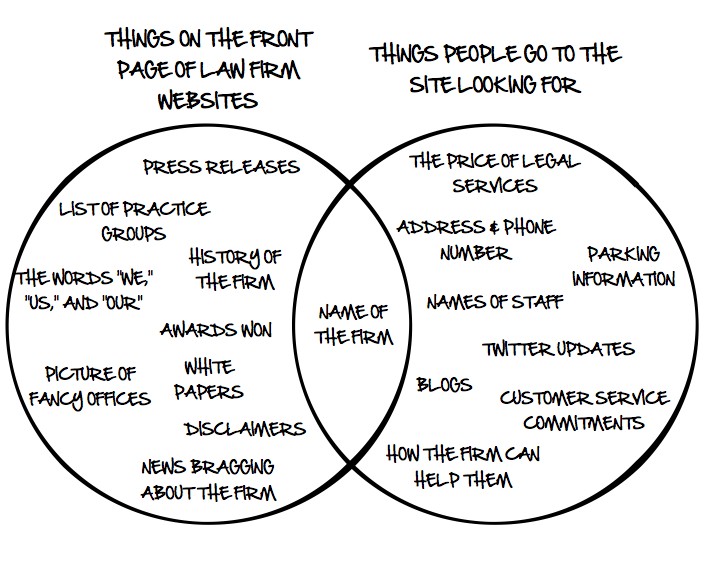 I found this and some other pretty interesting professional marketing ideas at the[non]billablehour blog. You might find it useful, too.
A GRAVE DISCOURTESY
September 3, 2010 § 2 Comments
You get 10 points if you can answer this question:
In our law and rules there are transgressions that can be treated as contempt, and there are some that can be sanctioned by removal or disqualification of the attorney.
What action or or omission of an attorney ” … will be considered a grave discourtesy?”
MORE ON MANDATORY PRO BONO
August 31, 2010 § 1 Comment
Philip W. Thomas of Jackson publishes the Mississippi Litigation Review & Commentary blog, and you can find a link to it on the right of this page. If you don’t view it regularly, you’re doing yourself a disservice.
Thomas turned his attention yesterday to the proposed rule change to the Rule 6.1 of the Rules of Professional Conduct that would make pro bono mandatory in our state. His post, Mandatory Pro Bono Coming to Mississippi? is linked for you to read.
I already commented on the proposed rule here, and my views are contrary to Mr. Thomas’s. There is a comment to my post taking issue with my position, and you should read it.
My suggestion is that you study the proposed rule, read over these posts and any other material on the subject that you can find, and submit your comment to the Supreme Court. Whatever your position, this will affect you and your practice, and you need to make your voice heard. You can read a copy of the proposed rule here.
WHO RETAINS THE ORIGINAL OF A PROBATED WILL?
August 26, 2010 § 13 Comments
Twice this summer, the deputy Chancery Clerks in Lauderdale County have been confronted by lawyers wanting to probate original wills and demanding to retain the original. One was from another district with large cities to our west, and the other was, I am sad to report, from closer to home. The clerks, I am glad to report, stood their ground and demanded the original for filing. Both lawyers condescendingly made it clear that our clerks are backward ignoramuses, and one went so far as to say that ours is the only district that makes the ridiculous demand for the original will. Which is where I was called in — apparently it is the Chancellor’s role to determine as between eminent lawyers and lowly clerks just who is the backward ignoramus.
Now, in all my years in the law, I had never heard of a lawyer in Mississippi retaining an original will after its admission to probate. But then again, we are more or less country peasants in this part of the state, and some things do pass us by. As is my anachronistic, unsophisticated practice, I sought for the answer in that arcane repository of gnostic mysteries of the law that remain so seemingly inaccessible to most practicing attorneys: The Mississippi Code.
It only took me a few minutes to leaf directly to Section 91-7-31, MCA, which states:
All original wills, after probate thereof, shall be recorded and remain in the office of the clerk of the court where they were proved, except during the time thay may be removed to any other court under process, from which they shall be duly returned to the proper office. Authenticated copies of such wills may be recorded in any county in this state.
So there you have it. The statute unambiguously requires that the original must be surrendered to the clerk of the court where the will is probated, and the clerk is responsible to record it and keep it.
Even though the truth revealed in the statute would seem to be clear, I realize that I do learn something new each day, and I posited to myself that there might be some angle to this issue that was known only to these superior attorneys that neither I, nor the state legislature, nor nearly 200 years of Mississippi jurisprudence had taken into account. Accordingly, I raised the question at the Chancery Judges’ study meeting last weekend whether any judges were aware of any districts where the statute was not being followed, or of any exception to the rule, and the unanimous response was no.
In our own, primitive way here in the hinterland, we try to follow the law, and when we do so, we will look first to the Mississippi Code and the Chancery Court Rules and not to the lawyer’s interpretation. We know that is a backwards and so 20th-century approach, but that is the old-fashioned way we still do it. We apologize if that offends your more cosmopolitan sensibilities that may not allow you time between workouts at the gym to look up the law. If our humble practice is too “slow lane” for you, perhaps you should pass that estate off to a local lawyer who is more accustomed to our rustic ways.
Practice Tip: (1) Read and know the law. (2) Apply Practice Tip (1) before acting like a jerk toward the Chancery Clerks. Oh, and while you’re at it, refresh yourself on the Mississippi Lawyer’s Creed, especially that part that reads: “To the courts, and other tribunals, and to those who assist them, I offer respect, candor, and courtesy. I will strive to do honor to the search for justice.”
 The Better Chancery Practice Blog