THE MORNING AFTER
November 9, 2011 § Leave a comment
As is always the case the morning after an election, I awake to discover that I won some and lost some. I”m sure your experience is pretty much the same.
Overall, though, I’m pleased that we once again came together in this ancient civic ritual of our republic and peaceably renewed our government through the ballot, resolving our differences via democracy.
Cynics will argue that I am wrong, that special interests, plutocrats and autocrats actually govern, and that electoral democracy is a chimera designed to placate the masses. As with all overstatements, there is a kernel of unfortunate truth in that, but even the most hardshell cynic can not deny that we did get to vote, and our votes counted.
Some years ago when I campaigned for the judgeship I now hold, I was astonished at the number of people who told me that they would be happy to vote for me if they were registered to vote, but they weren’t registered because they did not want to bother with jury duty.
Think about it. They are shirking the two core privileges/responsibilities of a citizen in a democracy: the right to vote, and the right to a jury of one’s peers. This is mind-boggling to me. Some of these are the very same people who wave the flag, act like patriots, and criticize politics and politicians with whom they disagree. These are some of the same people who welcome back our troops from conflicts afar and forward partisan emails about supporting our troops.
I don’t know about you, but I don’t think of those people as fellow citizens. They are, I hope, fellow taxpayers, and they are fellow occupants of space on this continent, but citizens? No. They are not supporters of our military. They are parasites sponging off of the blood and sacrifice of all who truly valued our freedom and sacrificed their lives, their fortunes and their sacred honor to preserve it.
Lawyers have traditionally had a special role to play as guardians of our democratic ways. They have been looked to as leaders, policy makers, defenders of those whose rights are threatened, and active in the political arena. That role has been blunted, in my opinion, over the past 25 or so years by one party that has vilified lawyers and cynically attacked their legitimate role in society, as well as by lawyers themselves, who have increasingly become shopkeepers interested more in a safe profile and the bottom line. That’s a pity — if my opinion is accurate. If you disagree, feel free to comment.
So to those of you who exercised the grandest privilege of your liberty yesterday and voted, I tip my hat to you and embrace you as my fellow citizen. We may not have voted the same way, but we made our voices — however small — heard.
And to those of you lawyers who are hunkered down with your bottom line, I urge you to do yourselves and your embattled profession a favor by sticking your head up out of the trenches, look about you at the surrounding landscape, roll up your sleeves, and lead. Critics be damned.
ANYWAY
October 27, 2011 § Leave a comment
People are often unreasonable, irrational, and self-centered. Forgive them anyway.
If you are kind, people may accuse you of selfish, ulterior motives. Be kind anyway.
If you are successful, you will win some unfaithful friends and some genuine enemies. Succeed anyway.
If you are honest and sincere people may deceive you. Be honest and sincere anyway.
What you spend years creating, others could destroy overnight. Create anyway.
If you find serenity and happiness, some may be jealous. Be happy anyway.
The good you do today, will often be forgotten. Do good anyway.
Give the best you have, and it will never be enough. Give your best anyway.
In the final analysis, it is between you and God. It was never between you and them anyway.
_______________________________
Credited to various sources, but it doesn’t matter who came up with it; it’s a way to live as a lawyer.
SCRUGGS-PETERS-DELAUGHTER CONNECT-THE-DOTS GAME
October 19, 2011 § 2 Comments
Of all the sad aspects of the Scruggs saga, the one that most troubles me is the chain of events that led to the downfall of Circuit Judge Bobby DeLaughter. Up to now, what we have known of his culpability could be gleaned from his own guilty plea and from reading between the lines of other disclosures. Ed Peters’ involvement, and how he interacted with DeLaughter, has been left mostly to conjecture and street gossip.
Thanks to motions filed by Scruggs in federal court, however, Peters’ grand jury testimony, or a portion of it, has been unsealed, and you can read for yourself the sordid details. Tom Freeland has summarized it, and has another post about it. You can read Peters’ testimony for yourself here and here. Freeland followed up with another couple of posts that you can find on his blog.
Philip Thomas has a post questioning why Peters has never been prosecuted in state court.
Some had considered DeLaughter a sort of wunderkind of the bench. They expected special things of him after he stepped out of the role as prosecutor of Byron De la Beckwith into a circuit judgeship. But he was a long-time associate of Ed Peters, the Hinds County DA, and he allowed himself to be in a position to be influenced by Peters. Peters took advantage of the cozy relationship to demand hefty fees from clients who expected him to influence the circuit judge. Peters’ testimony reveals how they did it.
It still turns my stomach to read this stuff, but it’s important for us to know and understand how this unfolded so that we can take measures to ensure that it will never happen again.
THE YOKE OF PROBATE
October 10, 2011 § 1 Comment
It looks like easy money. Grandma is sitting in your office with a fistful of greenbacks, asking you to open a guardianship so that she can get grandson into the county school. Momma is agreeable, daddy is in prison and will sign whatever you send him, and the child needs to get into school.
Before you file those papers and track down your chancellor, consider:
- When you enter your appearance, you are responsible as attorney for the guardianship forever, or until the judge lets you out, or until the guardianship is closed, whichever occurs first.
- There will be an accounting, or at least a reporting, requirement, for which you as counsel will be held responsible.
- Your compensation will be fixed by the chancellor, and it may not be as much as you would like to charge.
- You will be responsible to report to the court any misfeasance, malfeasance or neglect of duty by the fiduciary.
I encourage you to read UCCR 6.01 and 6.02 before you file that petition to open the guardianship. Your duty and liability as an attorney in a simple guardianship of the person is every bit as great as it is in a guardianship where the ward has thousands of dollars in the bank.
We regularly send out orders for lawyers to bring their accounts current in all probate matters, including guardianships of the person only. In guardianships of the person, we require a report at least every other year that (a) the guardianship continues to be necessary due to the age or circumstance of the ward, and (b) that no assets have come to the ward since the last report. It is not uncommon for lawyers to call and have some problem with that requirement. Some customary complaints:
- “I wasn’t paid enough to continue to do work in this case.” UCCR 6.01 expressly states that “When an attorney has once appeared for a fiduciary, in any respect, he may withdraw only with the consent of the Chancellor, after notice to the Chancellor, after notice to the client.” That rule also requires the fiduciary to be represented by a lawyer at all times. This means that once you appear, you are in it until someone takes your place or the matter is finally closed.
- “I can’t find my fiduciary.” You are responsible to keep up with the guardian and his or her activities so as to advise the court as required by UCCR 6.02. You have some liability to the ward if the fiduciary receives assets of the ward and squanders them.
- “This was only a guardianship for school purposes; why do we have to jump through all these hoops?” Because the law does not lower the protective bar for benefit of a ward “merely” because this is a guardianship of the person, and you, as attorney for the fiduciary, have a professional, legal, ethical and equitable duty to the ficuciary, the court and the ward.
I am not suggesting that you not file that guardianship action. I am suggesting that you read the rules and understand exactly what you and your client are taking on when you shoulder the yoke of probate.
KICKING THE CAN DOWN THE ROAD
October 3, 2011 § 1 Comment
What you thought would be a simple irreconcilable differences divorce has proven to be anything but. You’re bone-weary of your client’s whining. The other party is an intransigent j*ck*$$ over every minor detail. Counsel opposite has been an uncommunicative pain and no help at all with his client. Getting all the issues nailed down has taken a monumental effort. And now, with the final draft of the property settlement agreement nearing the finish line, all that remains is to settle the personal property.
But, that is where the parties are stuck. Husband wants this and that. Wife wants this and that. Counsel opposite is no help at all. You could spend some more time insisting that the parties resolve the personal property issues, but you don’t want to make the effort, especially without any help from the other attorney.
So you say to yourself, “What the heck; let someone else deal with it,” and you draft some language to fill in that pothole in the agreement. Parties sign and judge signs the judgment.
Deal done. Case closed. For now.
Only problem is, the parties will likely be back in court sooner or later battling over that pothole.
I call that “kicking the can down the road (KCDTR).” You do enough to get by, but in the process you draft a ticket back to court for your clients. You kick the can down the road where the next person coming along will have to pick it up and deal with it.
Of course, case weariness is only one source of the KCDTR phenomenon. Some lawyers KCDTR out of sheer laziness, others out of lack of drafting skills, others from haste, and others from oversight or lack of care.
Consider a recent case I had in which the property division read, “Husband shall have ownership of the former marital residence, and wife shall have ownership of the furnishing [sic].”
Wife moved and took with her all of the furniture and her personal effects. She also took the light fixtures and window blinds, along with a barbecue grill, a fountain (she left the base), a yard sweeper implement and various other items in the yard. Husband punched his ticket back to court.
After three days of trial (there were other issues involved), it was left to me to determine whether all the stuff that wife took was “furnishing.”
No need to go into detail about my ruling. You can probably guess how it came out. My point here is that if the drafting lawyer had said, “No, I am not going to put this PSA in final form unless and until you can give me a list of all the items that you two agree that wife will remove,” we would have avoided having to try that issue later.
Incidentally, the COA case of Aegler v. Gambrell, decided April 26, 2011, offers an insight into what exactly are considered “furnishings,” “personal things,” and fixtures.
Some other KCDTR examples:
- “The former marital residence shall be sold at a price to be agreed between the parties.” What if the parties can’t agree?
- “Husband shall be responsible for one-half of the school expenses.” Husband thinks this means he will pay for daughter’s cheerleading expenses. Wife thinks it means that husband will pay one-half of the private school tuition and assessments.
- “Husband and wife shall each pay one-half of the child’s extra-curricular activities.” What activities are included, and who decides?
I could go on and on, but I hope you get my point. A lawyer is paid to draft an agreement that will avoid future problems. If you are not accomplishing that in the instruments you draft, you are taking your clients’ money and not delivering what was paid for.
FYI … you can read some tips for PSA drafting here and here. A post on some hidden dangers in some commonly-used PSA language is here. A post on the hidden costs of divorce is here. An object lesson in the ramifications of drafting is here. A few tips from Ernest Hemingway that may help improve your legal writing are here.
Draftsmanship is one of the hallmarks of a good lawyer. The good ones draft PSA’s that are clear and unambiguous, address all that needs to be addressed without unnecessary prolixity and fluff, and are not only enforceable on their own terms, but also are stout enough to withstand attack.
Good lawyering = good draftsmanship. Not-so-good lawyering = KCDTR.
YEAH, BUT THEY’RE APPOINTED FOR LIFE
August 31, 2011 § 8 Comments
Federal judges have it made.
They can say what’s really on their minds without fear of an inflamed bar, or elective repercussions, or the judicial performance commission.
As Exhibit A, I offer this court order from a Texas federal district court in a discovery dispute:
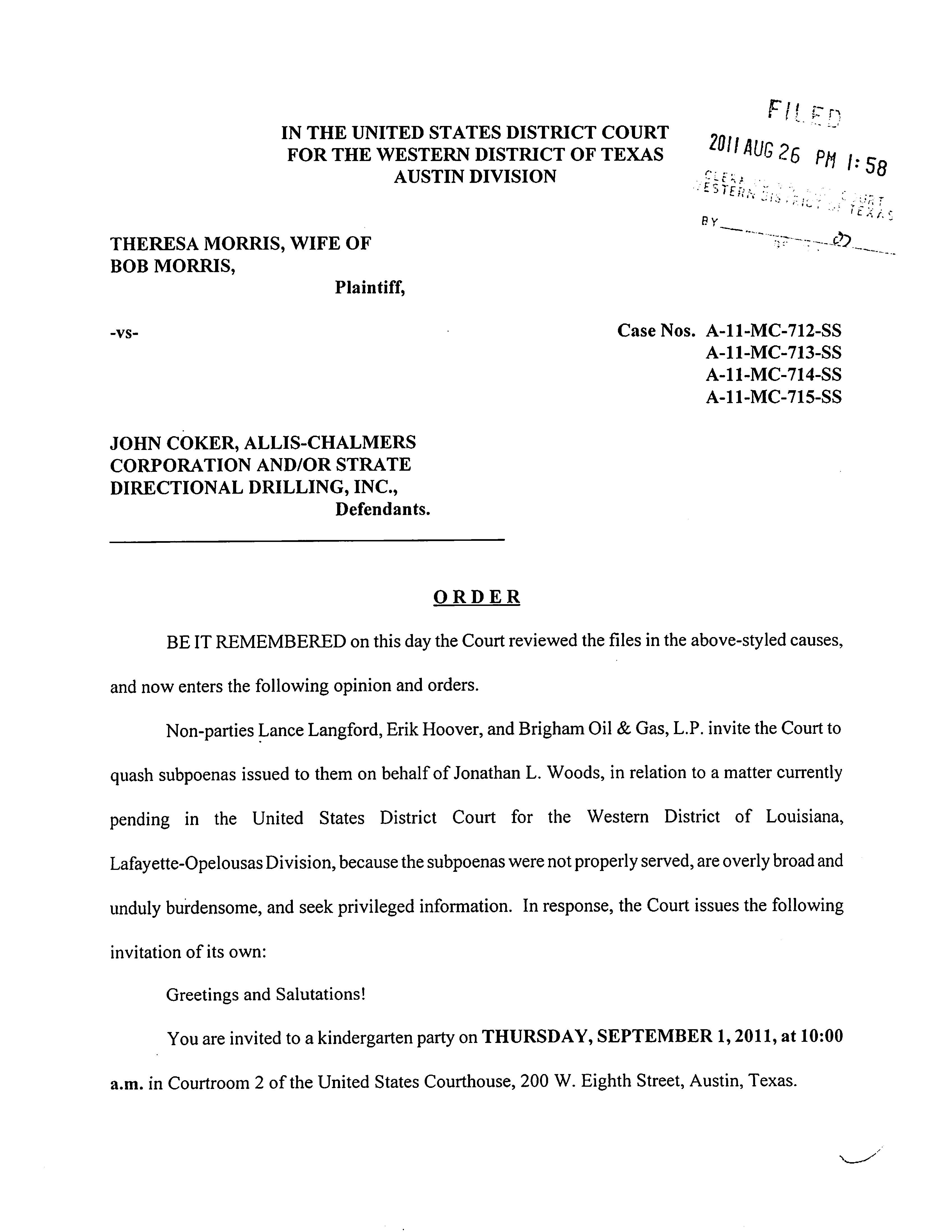
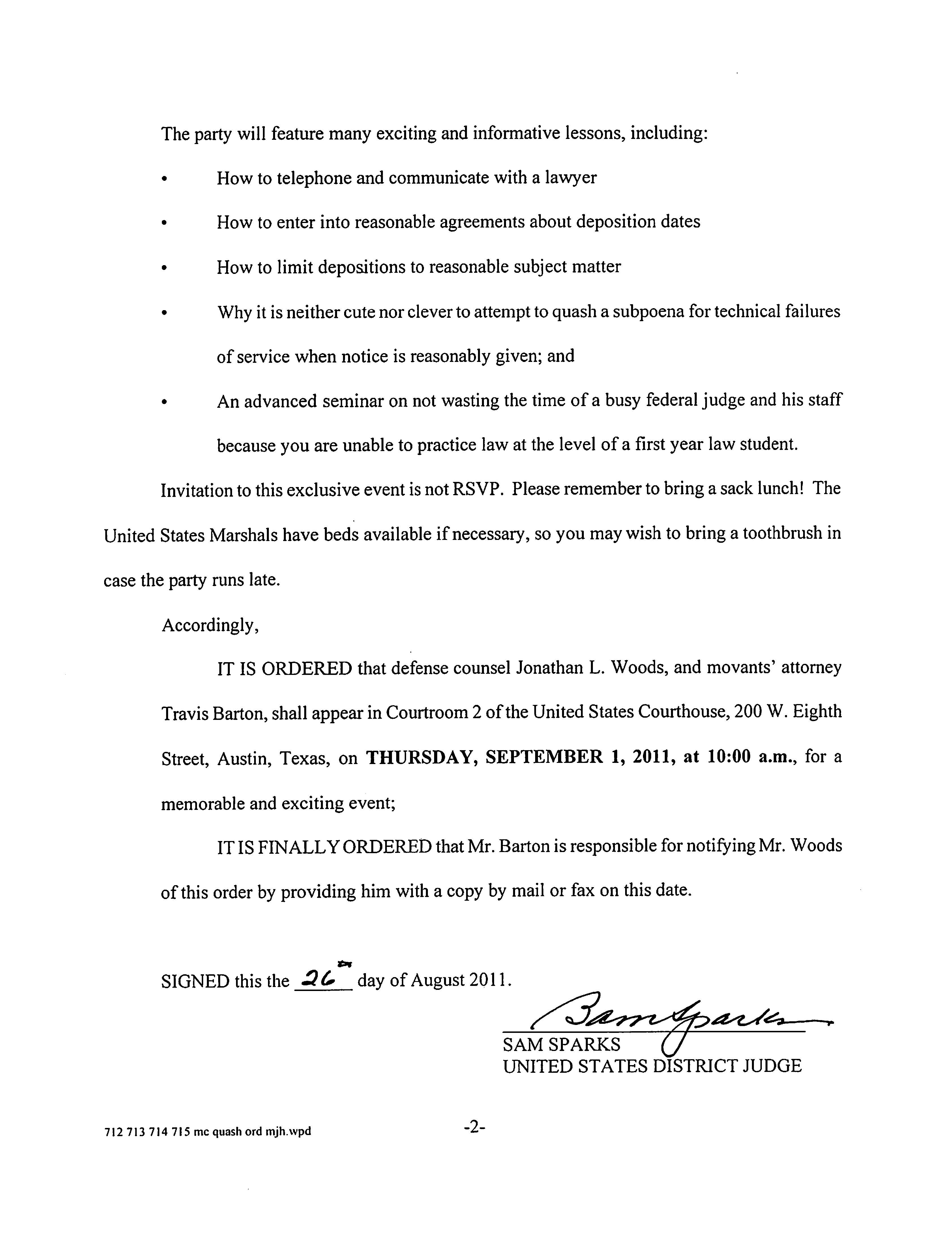
As I’ve said here before, some judges have no patience for discovery disputes.
Thanks to Attorney Marcus Evans
NEW DISCIPLINARY AND LJA RULES FOR COMMENT
August 30, 2011 § Leave a comment
The MSB is asking for comments on some fairly sweeping proposed changes to the disciplinary rules. You can click on this link to comment.
Unfortunately, you will need to read paragraph by paragraph, comparing your current rules, because there is no redline/italicized version. For that reason, I haven’t had the time to go through the changes and digest them for us here.
The Bar is also asking for your comments on a proposed rule setting up a separate Lawyers and Judges Assistance (LJA) committee. You can click on this link to get to it. This change is part of an ongoing effort to differentiate and separate the LJA function from the disciplinary function. Historically, some lawyers have been reluctant to submit to LJA intervention because it was linked to the disciplinary process, and they were concerned that they were placing their license in jeopardy. The new arrangement focuses on help to resolve self-destructive behaviors.
As always, I encourage you to offer your constructive comments. It’s your profession.
BULLETPROOFING YOUR WITNESSES
August 9, 2011 § 5 Comments
If you have never had a witness implode on the stand, this post is not for you.
If, on the other hand, you have struggled inwardly to maintain your composure as your witness apparently has forgotten everything he ever knew about the case, or he has abandoned all common sense, or she blurts out all manner of facts she never revealed to you before and is laying waste to her own case as effectively as if she were her own opposing counsel, then this post may help.
An important part of trial preparation — you do prepare for trial, I hope — is preparing your witnesses. Uh — you do prepare your witnesses, I hope.
It’s pretty clear when a witness is prepared. The witness and the lawyer work almost in tandem. The witness seems to understand where the lawyer is going with the questions and goes along easily, without a lot of leading and prodding. The witness’s testimony is clear. The witness knows how to say what needs to be said, and handles himself well on cross examination.
In other words, the witness is coated in teflon and swathed in kevlar. Non-stick and bullet-proof.
It doesn’t take a lot of time and effort to prep your witness if you focus in on what needs to be addressed. Here are a few helpful tips. Take them as a starting point and fill in with as many others as you can come up with.
- Take a few mintues to explain to your client what it is you have to prove to have a successful day in court. For instance, if modification of child custody is in issue, explain material change, adverse effect and best interest.
- Go over some questions and elicit your client’s answers. Suggest more effective ways to say what the witness is going to testify to. It is entirely ethical to suggest more effective ways to state the facts; of course it is unethical to change the facts or tell the witness to testify to something the witness did not perceive. You can tell the witness how to say it, but you can not tell the witness what to say.
- Remind the witness to testify about facts, and not impressions. Tell what you saw with your own two eyes without using labels. “The windows were all broken out of the car, the side mirrors were broken off and hanging down, the headlights were smashed, and the tires were all flat” is a lot more powerful than “The car was busted up.”
- Tell the witness about courtroom etiquette. Don’t chew gum or chewing tobacco, speak up loud and clear, be respectful of the court and other attorney, wait until the question is finished before answering, don’t interrupt any other speaker, dress conservatively, and avoid confrontation with the other party. If you want to bring something to your lawyer’s attention, write it down and pass a note; the lawyer has enough on her plate without having to deal with interruptions.
- If an 8.05 statement will be used, go over it with the witness. Test memory about figures and identify any trouble spots. Tips for more effective financial statements and financial testimony are here and here.
- Prepare the witness for cross examination. Explain how it works and confront the witness with the most obvious weak points. Suggest ways for the witness to deal with it. Caution the witness about the other lawyer’s typical bag of tricks on cross and offer some strategies to deal with them.
- Explain to the witness that he will be nervous when he takes the stand, but so is everyone else who has to get up there.
- Explain how hearsay works, and that just about every answer that begins, “He said …,” or “I heard her say …” or “The teacher told me that …”, etc. will elicit a reflexive objection. Recommend ways around hearsay.
A few pointers for more effective chancery trials are here.
There are two kinds of witnesses: the kinds who help your case; and the kinds who hurt it. You want every witness called by you to be in the former category. Witness prep will go a long way toward that end.
THE INTERNET AND THE UNAUTHORIZED PRACTICE OF LAW, CHAPTER TWO
August 2, 2011 § Leave a comment
Only yesterday morning, I posted here about the internet and the unauthorized practice of law, taking the position that internet legal-forms dealers are practicing law without a license and raising the question “I wonder what the state bar and the district attorneys are doing to rein this in?”
Well, ask and ye shall receive.
Yesterday afternoon I received an email from the state bar announcing that it filed a petition with the Supreme Court last Friday to amend the appellate rules and the rules of professional conduct to define more clearly the practice of law and to spell out sanctions available to the courts for those who are found to be engaged in unauthorized practice.
You can read the proposed rules here.
Apropos of what I said in my post yesterday is a provision making it clear that drafting legal documents and pleadings is in itself practicing law. There are many other provisions in what amounts to a sweeping and all-encompassing statement of what constitutes the practice of law.
I urge you to read these proposed changes and I encourage you to comment on them if comments are called for. If the Supreme Court accepts these, they will likely be sent to the Rules Committee, of which I am a member. If it comes to that, I will welcome any input.
As I said in my prior post, this is not about the legal profession or convenience for judges. It is about protecting the public. I commend the bar for addressing this problem.
THE INTERNET AND THE UNAUTHORIZED PRACTICE OF LAW
August 1, 2011 § 3 Comments
It’s no secret that I am at least dubious about the efficacy and advisibility of lay persons representing themselves in court. My distaste for the practice rests primarily on the fact that most often it results in self-inflicted harm. Secondarily, I am concerned that lay litigants are unencumbered by any ethical or professional obligation of candor to the court and fair dealing with the other party.
Many lay-lawyers download forms from online vendors. The purveyors of these forms claim that they enable lay people to handle their own routine legal matters for less money than it would cost them to pay a lawyer.
My problem with that approach is two-fold:
First, how does a layperson decide that a legal matter is routine without some advice? How does a layperson know what the hidden pitfalls are if she has no one but a form to ask? Sure, she can check box A on the computer-downloaded form, but would box B be far more advantageous?
Second, is not the providing of legal forms in itself providing legal representation? The Mississippi Supreme Court answered the question in the case of Mississippi Commission on Judicial Performance v. Jenkins, 725 So.2d 162, 167 (Miss. 1998), in which the court stated:
” This Court defined the practice of law to include ‘… the drafting or selection of documents, the giving of advice in regard to them, and the using of an informed or trained discretion in the drafting of documents to meet the needs of the person being served. So any exercise of intelligent choice in advising another of his legal rights and duties brings the activity within the practice of the legal profession. Oregon State Bar v. Security Escrows, Inc., 233 Or. 80, 377 P.2d 334 (1962).’ Darby v. Mississippi State Bd. of Bar Admissions, 185 So.2d 684, 687 (Miss.1966).”
There is a class action lawsuit pending in Missouri raising the issue of unauthorized and inadequate practice of law by Legal Zoom, an online seller of legal advice via forms. The thrust of that lawsuit is that the company’s activities are inherently harmful to consumers because they violate the state’s public policy against unauthorized practice of law, which protects consumers. The trial judge has already overruled the company’s motion for summary judgment, and the company is mounting an ad campaign in the state to scare people into believing that their right of self-representation is under threat, and that lawyers are out to get their money.
We have seen our share of Legal Zoom-type documents and other internet lawyers in this district, but that’s not by any means all. We have shadowy individuals in the area who sell “secretarial services” in the form of complaints for irreconcilable differences divorces, PSA’s and judgments. Those clerk-typists are beyond a reasonable doubt unqualified to give legal advice. So what possibly qualifies them to prescribe the forms appropriate for a person’s legal problems, and to determine the appropriate content?
Caveat emptor, you might say. I answer: bull. Neither the legal profession nor the courts should countenance unqualified persons preying on unsuspecting laypeople. I wonder what the state bar and the district attorneys are doing to rein this in? After all, there is a state law making it a crime to practice law without a license.
As I have said before, I am all for self-representation. But I hate to see self-destruction. And I hate even more to see someone on the path to self destruction believing that they are protected by a piece of paper they bought off the internet or from a “secretarial service” with no legal advice to back it up.
This is not all about protecting lawyers or making it easier on the judges. This is all about making sure that the legal process produces as fair a result as possible, and that all who are involved in it deal with each other and the court with integrity and are fully informed of their rights and the ramifications of their actions.
 The Better Chancery Practice Blog