
FREEDOM TRAIL
October 5, 2012 § Leave a comment
Last week marked the fiftieth anniversary of James Meredith’s enrollment at Ole Miss. The tumult and combat that surrounded the diminutive Meredith’s entrance to the university has often been characterized as “the last battle of the Civil War.” It’s an event we have talked about here before.
But as much as Meredith did to bring down the oppressive reign of white supremacy, there was much struggle to come after. The bloody summer of 1964 — “Freedom Summer” — was especially noteworthy, because its murders sent a shiver of revulsion through the collective conscience of the nation that directly gave rise to the 1964 federal Civil Rights Act. Gradually, with the weight of the federal government behind it, the civil rights movement demolished barrier after barrier.
And so, as the weeks click by, we will be clicking off fiftieth anniversary after fiftieth anniversary of milestones in the Civil Rights Era.
I saw that one of the events to commemorate Meredith’s feat was the unveiling of a marker on the Mississippi Freedom Trail at Ole Miss. To date, the Freedom Trail has markers at Bryant’s Grocery in Money, Medgar Evers’ home in Jackson, The Greyhound Bus Station in Jackson, Jackson State University, and Mississippi State Penitentiary at Parchman.
A list of the sites planned for the first 30 markers is here.
It’s a bit of a surprise to me that there is no marker slated for Meridian, which: had the biggest COFO operation and Freedom School in the state in 1964; was the base of operations for Schwerner, Goodman and Chaney, who were murdered in nearby Philadelphia; and was the site of the state’s Freedom School Convention in 1964.
There is a group in Meridian that has secured ownership of the old Fielder & Brooks drug store, which housed the COFO headquarters. They plan to restore it and create an educational center there. As always, funding is the main obstacle.
Knowing and understanding our history is vitally important. We have to comprehend the forces that have shaped us, our ethos and the place where we live in order to be able to see clearly where we can and should go from here. The history of racial conflict and gradual reconciliation is so deeply ingrained in our culture that we must know and understand it so that we can know and understand ourselves.
No place on earth is better equipped by experience to show and tell the way out of racial oppression than Mississippi. Others can talk about it, but we are living it, day by day, increment by increment. To bear that witness, however, we must be able to tell our history.
James Meredith bravely blazed a trail to freedom in 1962. Many others, in ways large and small, blazed similar courageous paths. Mississippi’s Freedom Trail will help us remember.
CHOOSING NOT TO PLAY CATCH-UP
July 31, 2012 § 6 Comments
This is not a political post, I swear. You who have read this blog for any length of time should be aware that I eschew politics here.
But this is a post about a subject that has reverberated in Mississippi politics for quite some time.
The issue is education, and, specifically, early childhood education, as in pre-k.
TIME magazine on July 27, 2012, published an article online entitled “Mississipi Learning: Why the State’s Students Start Behind — and Stay Behind.” I encourage you to read it.
Some of the article’s major points:
- Mississippi has the highest rate of childhood poverty in the country and test scores that are consistently among the nation’s worst.
- Neighboring states have made great strides in early education, but Mississippi remains the only state in the South — and just one of 11 in the country — that doesn’t fund any pre-k programs.
- Researchers have found that high-quality pre-k programs can improve long-term outcomes for low-income children and help close an achievement gap for minorities that tends to worsen over time. Being able to stand in line, listen to directions or make eye contact with the teacher play in an important role when it comes time to try to teach kids how to read and write.
- Failure to prepare children for kindergarten or first grade costs the state a lot of money. One of every 14 kindergarteners and one of every 15 first-graders in Mississippi repeated the school year in 2008, the most recent year for which statistics are available. From 1999 to 2008, the state spent $383 million on children who had to repeat kindergarten or first grade, according to the Southern Education Foundation. who repeat one or more grades are much more likely than their classmates to drop out of school, decades of research have shown.
- The state’s academic results, which trail other states’ significantly, don’t improve as the children grow older. In 2011, the state’s fourth-graders were outperformed on the reading portion of the National Assessment of Educational Progress by their peers in 44 states. In math, they finished second to last in the nation, ahead only of fourth-graders in the District of Columbia.
- Just 61 percent of Mississippi’s students graduate from high school on time — more than 10 percentage points below the national average.
- More than 75 percent of young Mississippi residents are ineligible to join the military because, among other reasons, they failed to graduate from high school on time.
Whether to fund early-childhood education in Mississippi is an issue wrapped up in budgetary, educational, political, and socio-economic considerations. Some legislators believe the state can not bear the cost. Some are not persuaded by the data that it would be beneficial. Some are motivated negatively by the political repercussions they believe they would feel back home. A few are motivated by lack of interest in any further funding for public education.
As a chancellor, with Youth Court responsibilities in Clarke County, I see the crippling cycle of poverty and poor education that keeps an underclass trapped in a perpetual dead end. We who are more fortunate tend to look down our noses and sniff that “those people” can lift themselves up by their bootstraps if they will only try. But a child who shows up for the first day of kindergarten not knowing her colors, or his street address, or his letters, or how to interact in a disciplined fashion with other children, has miles to go before ever reaching the starting line. And quite often those children come from homes in which there is a heritage of generation after generation in the same circumstances.
The results I see in my court include chronic unemployment and underemployment, malnourished and neglected children, reliance on costly government programs that often have dubious success, inability to pay child support, rampant teen pregnancy and the resulting reliance on the dole, school dropouts, child abuse, domestic violence, substance abuse, shattered family structure, subhuman living conditions, and on and on in a panoply of human misery. As chancellor charged with the responsibility as superior guardian of children and incompetents, I can not overlook what I see.
I am not saying that throwing more money at this problem would fix it. I am saying that the overwhelming evidence from other states is that early childhood education pays dividends. Until we get moving, we will fall further and further behind.
A society is only as strong as its weakest members. When we reach out and give a hand up, we all benefit.
DATELINE’S SELF-PORTRAIT OF 1965 GREENWOOD
July 16, 2012 § 2 Comments
If you missed Dateline NBC’s piece last night on Greenwood in 1965 studying white citizens’ racial attitudes, here is a link that will take you not only to the original 1965 report, but also to last night’s that focused on Booker Wright, a black waiter at the then-segregated Lusco’s restaurant, who spoke from his heart about the humiliation of segregation, a statement that cost him his job and other indignities.
For those of us who lived through it, the 1965 report is a disturbing reminder of the way things were, and how desperately unequal were our two ways of life — black and white.
For those of you too young to have experienced it, I urge you to see this to help understand where we were, and to help you evaluate where we are.
Ray DeFelitta, the son of the photojournalist who filmed the 1965 study, has a post on his blog about the Dateline segment. Ray is working on a documentary showcasing his father Frank’s work on Mr. Wright, along with Mr. Wright’s granddaughter, Yvette Johnson.
I recommend you take some time to view these.
CARROLLTON
May 5, 2012 § Leave a comment
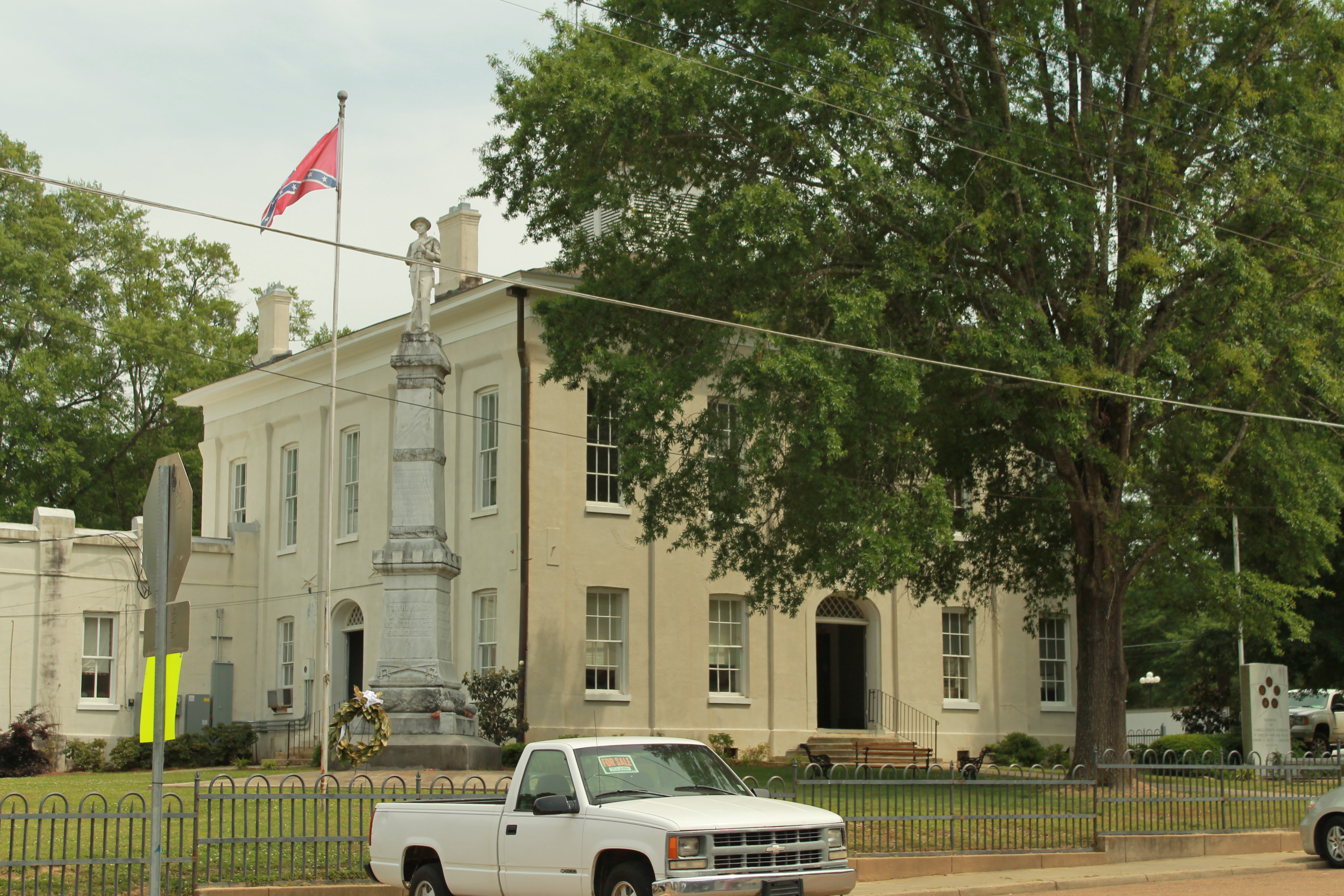
 Carrollton, population 400, County Seat of Carroll County, population 10,500, a hillcountry county for the most part, falling off into the Delta along its western edge. The Carroll County Picture Show in Bobbie Gentry’s Ode to Billy Joe was here. The movie version of Faulkner’s The Reivers, starring Paul Newman, was filmed in Carrolton. The extinct hamlet of Avalon, in northwest Carroll County, was the birthplace of bluesman Mississippi John Hurt.
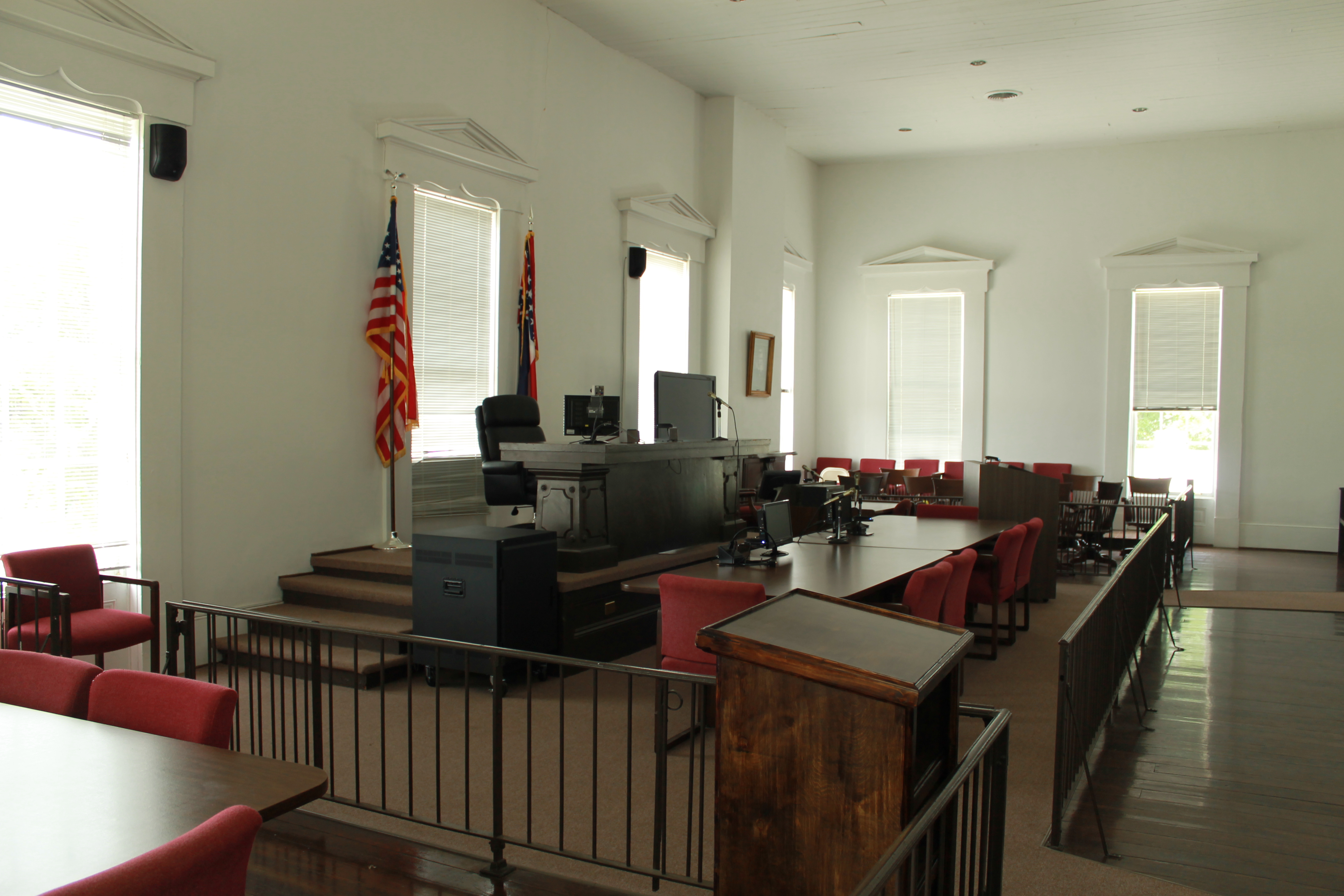
The courthouse in Carrollton was built around 1870 and features breezeway halls that cross perpendicularly. The halls are cool in the summer and cold in winter. A dog was enjoying the cool of the concrete floor on the warm afternoon when we dropped in. Upstairs is the old court room, its electronic trial gadgets adding a discordant punctuation to the plain, stately setting.
The day we visited, jail trustees had just finished moving all of the Justice Court records out of the old courthouse to the newer, storefront version in Vaiden, in the southern part of the county. Vaiden is the largest town in mostly rural Carroll County, and is the seat of the County’s other judicial district. Carroll is one of around 10 Mississippi Counties that have 2 judicial districts, making them for court purposes like two separate, distinct counties. It’s an archaic concept, but unlikely to be undone any time soon, since Carrollton and Vaiden are unfriendly rivals.
Across from the courthouse to the north is the white frame building that was the 19th-century law office of James Zachariah George, a formidable figure in Mississippi history. You can see it in street scene photo below. J.Z. George was a native of Georgia who moved to Mississippi. He fought with Jefferson Davis in the Mexican-American War and later became a lawyer. He was a reporter for the Mississippi Supreme Court, and signer of Mississippi’s Ordinance of Secession. He was an officer in the Civil War, and was taken prisoner twice. After the war, he served as Chief Justice of the Mississippi Supreme Court, and later as US Senator. His statue is Mississippi’s offering in Statuary Hall in the US Capitol.
Carrolton is a sleepy town that seems to cling tightly to its past, as the photos suggest. There are old homes and old churches, the flag of a defeated cause, and a patina of faded glory.









JUDICIAL PAY RAISE BILL SIGNED
April 16, 2012 § 2 Comments
HB 484 was signed into law Friday by Governor Bryant, putting into effect the first pay raise for Mississippi judges in nearly 10 years. The bill increases pay for appellate and trial judges in five increments over five years, beginning 2013. It is funded entirely by an increase in court filing fees that still leaves our state last in the southeast in the amount one has to pay to initiate a legal proceeding.
Many people helped get this done, and if I tried to name those who did, I would surely offend someone by omission, but this was a team effort by judges, legislators, leadership of the bar, lawyers, and laypeople who understand the importance of an independent, adequately-compensated judiciary.
The bill also establishes a group to study judicial compensation and make recommendations that would hopefully remove judges’ pay from the political-football status it has enjoyed hitherto. Maybe pay could be tied to a percentage of federal judges’ pay, or the southeastern average, or some other objective standard.
The entire budget for the judiciary in Mississippi is less than 1/2 of 1% of the state budget. Yes, less than 1/2 of 1%. The third, constitutionally co-equal branch of state government gets 1/2 of 1% of the entire state budget to fund its entire operation, which includes: salaries and state portion of benefits for 19 appellate judges and approximately 100 trial judges; salaries and state portion of benefits for staff attorneys and/or law clerks for judges who have them; an office expense allowance for each judge; the mini-bureaucracy in Jackson; in-state travel (some limited funds are available, rarely, to attend out-of-state conferences); and the judicial college in Oxford that provides much-needed training for judges. That’s a lot to squeeze into 1/2 of 1%.
A nearby legislator who voted against the bill was asked by an attorney why he voted against the bill. His response was, “They make enough.” I hope he gave the issue more thought than that. Even with the pay raise, Mississippi judges rank at or near the bottom of the southeastern average. As it stands now, it is a considerable sacrifice for most of us to take a job as a judge. What we give up financially is the possibility to earn more, the advantage of owning a business that can pay many expenses that judges have to shoulder personally, and the possibility of entering business ventures with others. But the limitations are not only financial. We have to submit to the code of judicial ethics, which limits us in many ways, and any judge who has done the job for even a short time can describe the feeling of isolation that comes with the wall of separation that is required to do it properly.
Despite the limitations, Mississippi has a remarkably talented, dedicated and competent judiciary. It struck me from the beginning as I saw judges at meetings and conferences how seriously they take their jobs. Judges work in our state, and they work hard, trying their best to follow the law and making difficult decisions.
Maybe our legislative leaders will find a new way in the future to give the judiciary adequate tools to do its job. Commerce depends on courts that are sound, consistent and clear in their rulings. Society depends on courts that are fair and equitable in resolving disputes among citizens, and sure and just in addressing criminal behavior. Government depends on the balance that the judicial branch provides.
It’s true that it all boils down to money, but we need to have the best government we can afford, not the cheapest we can get by with.
SCENE IN MISSISSIPPI
March 9, 2012 § 7 Comments
Where in Mississippi is this? (The tire-man sculpture is about 20 feet tall, btw; the horse is real).


THE LAWYER BUBBLE
January 10, 2012 § 4 Comments
Philip Thomas has a thoughtful post on his blog about the shrinking legal sector and its impact on the Mississippi legal profession. His post focuses on the big firms and their purges (i.e., layoffs) of numbers of attorneys. The post is worth a read; in fact, if Mr. Thomas’s blog is not on your regular reading list, it should be as a great way to keep up with developments in the law, courts and legal profession in our state.
One of the significant points of the article is that the slumping legal profession does not offer adequate opportunities for graduates who have accumulated massive law-school-tuition debt to retire that debt.
From where I sit, I will accept that premise insofar as it describes the big-firm experience. I wonder, though, whether it accurately describes the legal profession’s situation out here in the vast hinterland, as opposed to the Jackson metropolitan area where most of the big firms are concentrated. The great preponderance of legal work is done out here by lawyers from firms of 1-5, hardly “big” by any definition. Their work involves representing people — not corporations — in mundane matters involving estates, divorces, land matters, guardianships and conservatorships, commitments, Youth Court, felonies and misdemeanors, zoning, custody, child support, wills, and so on.
How are those small-firm lawyers doing? I don’t have any scientific data, and I haven’t done any real research, but I do have some anecdotal evidence and impressions.
My sense is that the small-firm lawyers are doing quite well, with a couple of caveats, and I base that statement on these observations:
- I do not see small law firms cutting associates loose or otherwise downsizing lawyer staff.
- Ordinarily, in a downturn, we see lawyers appearing in chancery court who ordinarily do not set foot there. I have seen a small handful of that happening, but nothing like what I have seen in the past in much less inhospitable economic periods.
- Pro se filings are on the rise. We are seeing people filing pro se pleadings even in relatively complex matters, which would seem for the most part to indicate that they do not have — or believe they do not have — enough money to hire a lawyer to do it for them. I view this development as a chipping away at the edge of legal business, not a hacking attack at the core. I believe that, although most lawyers would say they wish they could get those clients into their offices, the lawyers would find that these are the clients who would be slow- or no-pay. So, although on the surface it looks like a loss of business, it appears to me to be a loss of non-lucrative business.
- I ask lawyers all the time how business is doing, and almost without exception they say they have more work than they can handle. Their frequency in court confirms the fact. I am sure that there are some lawyers who are struggling, particularly with collections, but I believe for the most part that there is enough work representing people to go around to keep lawyers in business.
- Having made the previous point, I have noticed that some small-firm lawyers have eliminated secretarial positions. Where several years ago a theoretical sole practitioner had a receptionist/file clerk and two secretaries, that lawyer is now making do with one secretary.
- I have not heard any of the younger lawyers express any concern about paying their student loans, although I concede that is not necessarily the kind of thing they might share, much less with me. Still, a lawyer being sued for default would be the kind of news around small courthouses that one would expect to hear if it happened.
- Lawyer success in this tough economy rises out of one’s willingness to take on what people are willing to hire one to do, as well as achievement of a reputation for competence, reasonableness, efficiency and integration into the community.
Last year a law school professor asked me whether I knew of any firms in our area that were hiring, and pointed out that not a single graduate for that term had a job offer. That, my friends, is the “Lawyer Bubble” to which Mr. Thomas refers.
I do believe, however, that there is work enough for new and uprooted lawyers to plant and grow their own legal businesses out here in the small towns and cities of Mississippi where there are non-predatory lawyers who will work collegially with them to help them get established. After all, the legal profession is not a zero-sum game.
My conclusion is that there is indeed a lawyer bubble in the sense that law schools are continuing to pump out graduates at a rate greater than the big-firm legal industry can absorb them, but that there is a niche for lawyers who want to find a place in the legal profession representing people in the myriad of legal problems that confront them. No, that is not likely the path to great (or even near-great) riches, but there is a comfortable living and professional satisfaction for those who take that path.
Of course, my views are based on the geography I inhabit. The experience may be entirely different in other parts of the state, but I don’t know of a place that would be markedly different from our experience here in east Mississippi and the 12th District.
Your take may be different. I’d be interested in your comments.
RIP BILL WALLER
December 1, 2011 § Leave a comment
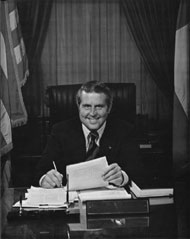
Gov. Waller at work
Former Mississippi governor (1972-1976) and distinguished member of the bar, William Lowe Waller, Sr., died November 30, 2011. He was 85.
He was a champion of the people, and was ahead of his time on civil rights issues. As a District Attorney, he unsuccessfully attempted to prosecute Byron De La Beckwith for the murder of Medgar Evers. He did away with the state’s spy agency, the infamous Sovereignty Commission, by vetoing its appropriations. He opened state government jobs to African Americans, appointing many to fill positions. His son, William L. Waller, Jr., is Chief Justice of the Mississippi Supreme Court.
Philip Thomas’s reminiscence of the governor as adverse counsel is worth a read.
 The Better Chancery Practice Blog