Jacinto Courthouse
November 4, 2013 § 6 Comments
Shortly after the Chickasaws sold their lands in north Mississippi in 1832 and moved west, settlers populated the area, established villages and towns, and set up local government.
In the northeast corner of the state, the County of Tishomingo was founded, comprised of what are now Prentiss, Alcorn, and Tishomingo Counties, and covering nearly 1,000 square miles.
The town of Jacinto was established in 1836 as the County Seat at the center of the large county, and it quickly became the commercial and governmental hub of the area. Named for the site of Sam Houston’s decisive victory in the Texas Revolution, the little town’s population grew, and it soon had boarding houses, a newspaper, taverns, inns, smithies, mercantile shops, and all of the other amenities one would expect in a prospering frontier town. At the height of its growth, the town had more than 6,600 residents. Its future appeared bright.
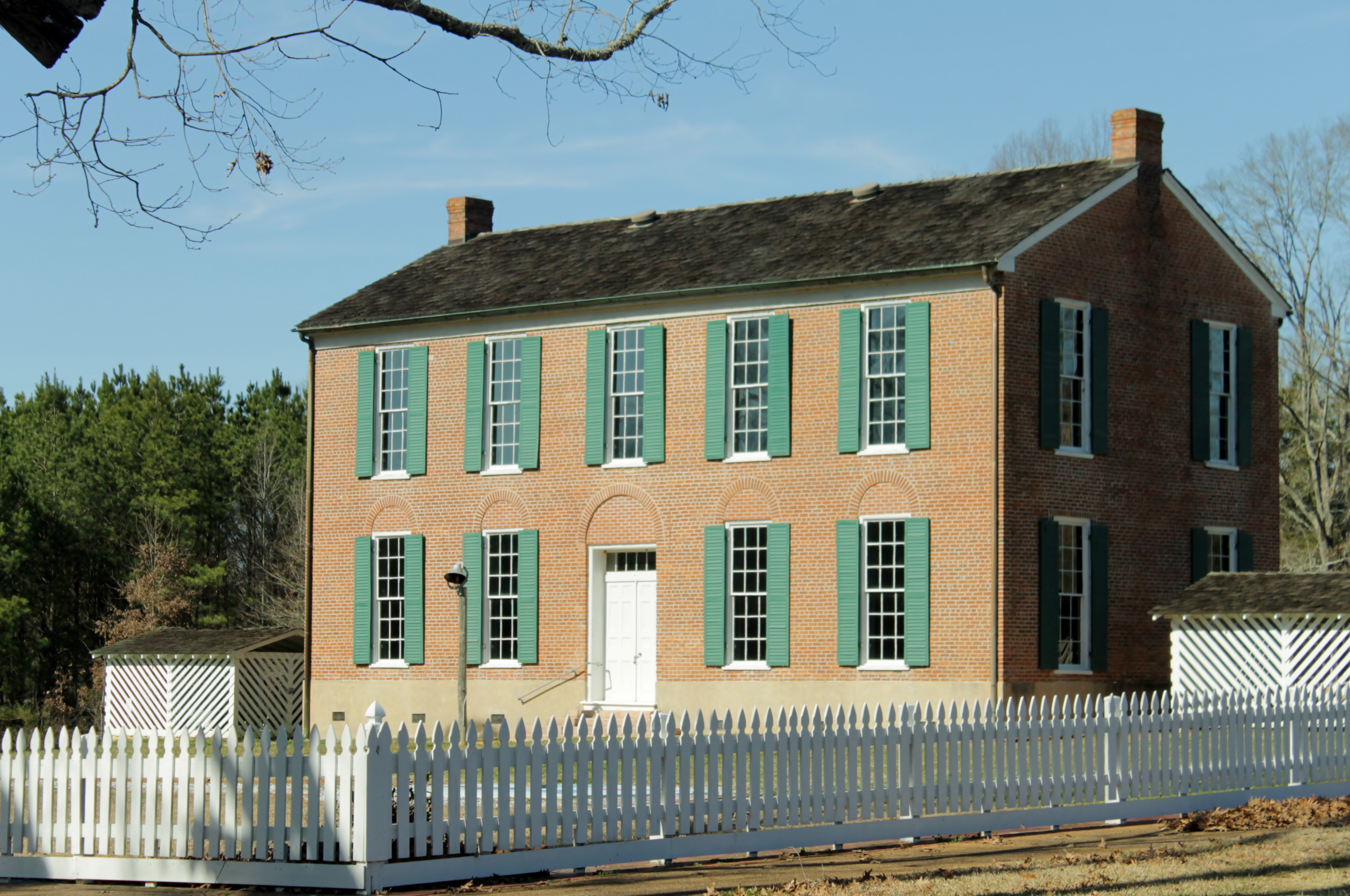
In keeping with its ambition to greatness, the county in 1859 constructed a fine courthouse in the federal style in the center of the town to replace the original log building.
Only a few years later, however, the Civil War raged through the area. Corinth, 15 miles north, was devastated by two major, bloody battles over its vital railroad junction, and Shiloh, only a few miles north of Corinth, was the site of two of the deadliest days of the entire conflict.
In 1870, the original Tishomingo County was split into its three present-day counties. Since Jacinto was not conveniently located, it was no longer suitable for a county seat.
The town’s once-promising future became doubtful when it lost the government business that came to the county seat, as well as the trade and traffic that came with it. To compound the problem, the town fathers had made a crucial strategic error when they voted not to allow the noisy, smoky, intrusive railroad to come through the town. Jacinto was further isolated when the telegraph companies refused to run lines into the town after local farmers kept chopping down the poles, blaming the telegraph for a disastrous drought.
The population dwindled until the thriving town was no more than a forgotten rural wayside, albeit a rural wayside with a lovely courthouse.
Through the years the grand old former courthouse served as a Methodist school and church. In the 1960’s the building was sold for salvage for $600. Local citizens became involved and persuaded the salvage company to sell it to them for $2,000. A doctor wrote the check, a foundation was set up, the group raised funds, and preservation of the courthouse was assured. The foundation saw to it that the building was restored faithfully to its original condition. Today, the Jacinto Courthouse is regarded as one of the finest examples of federal style architecture in the nation, and is listed on the National Register of Historic Places.
In 1972, the movie Tomorrow, starring Robert Duvall and Olga Bellin, was filmed in the area. Courtroom and courthouse scenes were filmed in Jacinto.
The courthouse is open to visitors. A caretaker will usher you through and tell you the stories of the town and the old courthouse. There is a rustic museum and there are some reconstructed outbuildings of interest.
Jacinto (the locals pronounce it JAY-sinna) is the site of a massive July 4 celebration each year that is renowned for its political speaking. Thousands of folks congregate for the holiday celebration, and the event is considered second only to the Neshoba County Fair in its attraction for statewide politicians.

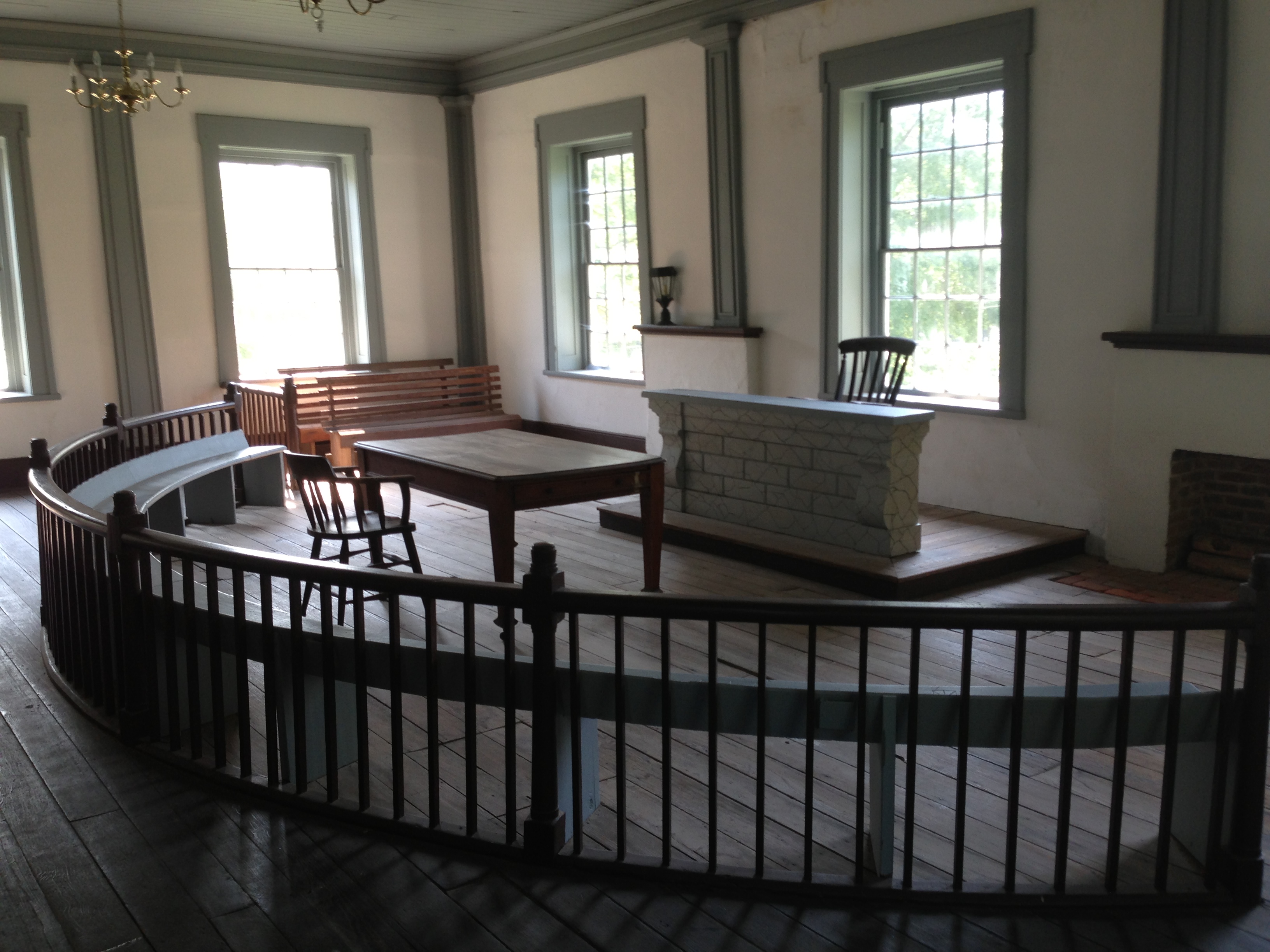
The court room, on the second floor, on the left side of the building in the photo above. Jurors sat on the semi-circular bench …

First-floor lobby. The floor is unglazed bricks set in sand. When the building was restored, the bricks were worn, so, in order to keep the original bricks, they were simply turned over in place. The tax collector’s office is the door to the right …

Judge’s chambers on the first floor …



Who was Judge Griffith?
September 18, 2013 § 8 Comments
We have been examining the Maxims of Equity in several posts, and will continue over the next few weeks. The source of much of the material has been Judge V. A. Griffith’s Mississippi Chancery Practice, first published in 1925, with a second edition in 1950.
Judge Griffith had an impact on the law, the legal profession, and the judiciary of Mississippi, and his story is worth knowing.
In his role as Mississippi Supreme Court Justice, he penned a blistering dissent in the torture-induced-confession case of Brown v. State, 173 Miss. 542, 161 So. 465 (1935), a miscarriage of justice by the court’s majority that was later reversed by the US Supreme Court. Here is his dissent, at length, but worth the read:
GRIFFITH, Justice (dissenting).
The crime with which these defendants, all ignorant negroes, are charged, was discovered about 1 o’clock p. m. on Friday, March 30, 1934. On that night one Dial, a deputy sheriff, accompanied by others, came to the home of Ellington, one of the defendants, and requested him to accompany them to the house of the deceased, and there a number of white men were gathered, who began to accuse the defendant of the crime. Upon his denial they seized him, and with the participation of the deputy they hanged him by a rope to the limb of a tree, and, having let him down, they hung him again, and when he was let down the second time, and he still protested his innocence, he was tied to a tree and whipped, and, still declining to accede to the demands that he confess, he was finally released, and he returned with some difficulty to his home, suffering intense pain and agony. The record of the testimony shows that the signs of the rope on his neck were plainly visible during the socalled trial. A day or two thereafter the said deputy, accompanied by another, returned to the home of the said defendant and arrested him, and departed with the prisoner towards the jail in an adjoining county, but went by a route which led into the state of Alabama; and while on the way, in that state, the deputy stopped and again severely whipped the defendant, declaring that he would continue the whipping until he confessed, and the defendant then agreed to confess to such a statement as the deputy would dictate, and he did so, after which he was delivered to jail.
The other two defendants, Ed Brown and Henry Shields, were also arrested and taken to the same jail. On Sunday night, April 1, 1934, the same deputy, accompanied by a number of white men, one of whom was also an officer, and by the jailer, came to the jail, and the two last named defendants were made to strip and they were laid over chairs and their backs were cut to pieces with a leather strap with buckles on it, and they were likewise made by the said deputy definitely to understand that the whipping would be continued unless and until they confessed, and not only confessed, but confessed, in every matter of detail as demanded by those present; and in this manner the defendants confessed the crime, and, as the whippings progressed and were repeated, they changed or adjusted their confession in all particulars of detail so as to conform to the demands of their torturers. When the confessions had been obtained in the exact form and contents as desired by the mob, they left with the parting admonition and warning that, if the defendants changed their story at any time in any respect from that last stated, the perpetrators of the outrage would administer the same or equally effective treatment.
Further details of the brutal treatment to which these helpless prisoners were subjected need not be pursued. It is sufficient to say that in pertinent respects the transcript reads more like pages torn from some mediaeval account than a record made within the confines of a modern civilization which aspires to an enlightened constitutional government.
All this having been accomplished, on the next day, that is, on Monday, April 2, when the defendants had been given time to recuperate somewhat from the tortures to which they had been subjected, the two sheriffs, one of the county where the crime was committed, and the other of the county of the jail in which the prisoners were confined, came to the jail, accompanied by eight other persons, some of them deputies, there to hear the free and voluntary confession of these miserable and abject defendants. The sheriff of the county of the crime admitted that he had heard of the whipping, but averred that he had no personal knowledge of it. He admitted that one of the defendants, when brought before him to confess, was limping and did not sit down, and that this particular defendant then and there stated that he had been strapped so severely that he could not sit down, and, as already stated, the signs of the rope on the neck of another of the defendants was plainly visible to all. Nevertheless the solemn farce of hearing the free and voluntary confessions was gone through with, and these two sheriffs and one other person then present were the three witnesses used in court to establish the so–called confessions, which were received by the court and admitted in evidence over the objections of the defendants duly entered of record as each of the said three witnesses delivered their alleged testimony. There was thus enough before the court when these confessions were first offered to make known to the court that they were not, beyond all reasonable doubt, free and voluntary; and the failure of the court then to exclude the confessions is sufficient to reverse the judgment, under every rule of procedure that has heretofore been prescribed, and hence it was not necessary subsequently to renew the objections by motion or otherwise.
The spurious confessions having been obtained—and the farce last mentioned having been gone through with on Monday, April 2d—the court, then in session, on the following day, Tuesday, April 3, 1934, ordered the grand jury to reassemble on the succeeding day, April 4, 1934, at 9 o’clock, and on the morning of the day last mentioned the grand jury returned an indictment against the defendants for murder. Late that afternoon the defendants were brought from the jail in the adjoining county and arraigned, when one or more of them offered to plead guilty, which the court declined to accept, and, upon inquiry whether they had or desired counsel, they stated that they had none, and did not suppose that counsel could be of any assistance to them. The court thereupon appointed counsel, and set the case for trial for the following morning at 9 o’clock, and the defendants were returned to the jail in the adjoining county about thirty miles away.
The defendants were brought to the courthouse of the county on the following morning, April 5th, and the so–called trial was opened, and was concluded on the next day, April 6, 1934, and resulted in a pretended conviction with death sentences. The evidence upon which the conviction was obtained was the so–called confessions. Without this evidence, a peremptory instruction to find for the defendants would have been inescapable. The defendants were put on the stand, and by their testimony the facts and the details thereof as to the manner by which the confessions were extorted from them was fully developed, and it is further disclosed by the record that the same deputy, Dial, under whose guiding hand and active participation the tortures to coerce the confessions were administered, was actively in the performance of the supposed duties of a court deputy in the courthouse and in the presence of the prisoners during what is denominated, in complimentary terms, the trial of these defendants. This deputy was put on the stand by the state in rebuttal, and admitted the whippings. It is interesting to note that in his testimony with reference to the whipping of the defendant Ellington, and in response to the inquiry as to how severely he was whipped, the deputy stated, “Not too much for a negro; not as much as I would have done if it were left to me.” Two others who had participated in these whippings were introduced and admitted it—not a single witness was introduced who denied it. The facts are not only undisputed, they are admitted, and admitted to have been done by officers of the state, in conjunction with other participants, and all this was definitely well known to everybody connected with the trial, and during the trial, including the state’s prosecuting attorney and the trial judge presiding.
We have already mentioned that counsel were appointed on the afternoon before the trial opened on the following morning, and that in the meantime the prisoners had been taken away to an adjoining county. Counsel were thus precipitated into the case and into the trial without opportunity of preparation either as to the facts or the law. Powell v. Alabama, 287 U. S. 45, 53 S. Ct. 55, 77 L. Ed. 158, 165, 84 A. L. R. 527. Without having had opportunity to prepare, they assumed—erroneously as the majority now say—that the objections interposed when the so–called confessions were being introduced in chief were technically sufficient, and did not later move to exclude them when, under the undisputed testimony and the admissions of the state itself, it was fully developed that the confessions had been coerced, and that they were not receivable as evidence; and now the case of Loftin v. State, 150 Miss. 228, 116 So. 435, is seized upon as a means of sanctioning the appalling violation of fundamental constitutional rights openly disclosed by this record, undisputed and admitted.
The case of Loftin v. State, when carefully examined, is not the case now before us, and ought not to be forced into service under the facts now being considered. No officer of the state had any part in the confessions in that case, the prosecuting officer of the state did not use the confession, knowing it was coerced, the weight of the testimony was that the confession was actually and in fact voluntary. The case now before us is thus separated from the Loftin Case, in vital principle, as far as the east from the west. The case which is applicable and ought to be controlling here is Fisher v. State, 145 Miss. 116, 110 So. 361, 365. There the alleged confession was obtained in the jail by torture in the presence of the sheriff. Defendant’s counsel did not object as he should have done under the rules of procedure when the confession was offered and admitted, but later and out of time moved to exclude. The conviction was sought to be maintained, as in the case now before us, on the ground that the defendant had not raised or interposed his objection to the alleged confession in the manner required by the procedural law. In reversing the sentence this court in banc said: “Coercing the supposed state’s criminals into confessions and using such confessions so coerced from them against them in trials has been the curse of all countries. It was the chief iniquity, the crowning infamy of the Star Chamber, and the Inquisition, and other similar institutions. The Constitution recognized the evils that lay behind these practices and prohibited them in this country. *** The duty of maintaining constitutional rights of a person on trial for his life rises above mere rules of procedure, and wherever the court is clearly satisfied that such violations exist, it will refuse to sanction such violations and will apply the corrective.” See, also, People v. Winchester, 352 Ill. 237, 245, 185 N. E. 580; State v. Griffin, 129 S. C. 200, 124 S. E. 81, 35 A. L. R. 1227; Williams v. U. S. (C. C. A.) 66 F.(2d) 868; Booth v. U. S. (C. C. A.) 57 F.(2d) 192, 197; Addis v. U. S. (C. C. A.) 62 F.(2d) 329; Commonwealth v. Belenski, 276 Mass. 35, 176 N. E. 501; Mack v. State, 203 Ind. 355, 180 N. E. 279, 83 A. L. R. 1349; Hagood v. Commonwealth, 157 Va. 918, 162 S. E. 10, 601; State v. Hester, 137 S. C. 145, 162, 134 S. E. 885; O’Steen v. State, 92 Fla. 1062, 1075, 111 So. 725; People v. Brott, 163 Mich. 150, 128 N. W. 236; People v. Bartley, 12 Cal. App. 773, 108 P. 868, 870; State v. Frost, 134 Wash. 48, 50, 234 P. 1021.
To my mind it would be as becoming a court to say that a lynching party has become legitimate and legal because the victim, while being hung by the mob, did not object in the proper form of words at precisely the proper stage of the proceedings. In my judgment there is no proper form of words, nor any proper stage of the proceedings in any such case as the record of the so–called trial now before us discloses; it was never a legitimate proceeding from beginning to end; it was never anything but a fictitious continuation of the mob which originally instituted and engaged in the admitted tortures. If this judgment be affirmed by the federal Supreme Court, it will be the first in the history of that court wherein there was allowed to stand a conviction based solely upon testimony coerced by the barbarities of executive officers of the state, known to the prosecuting officers of the state as having been so coerced, when the testimony was introduced, and fully shown in all its nakedness to the trial judge before he closed the case and submitted it to the jury, and when all this is not only undisputed, but is expressly and openly admitted. Cf. Mooney v. Holohan, 294 U. S. 103, 55 S. Ct. 340, 79 L. Ed. 791. The Scottsboro Cases [FN1] are models of correct constitutional procedure as compared with this now before the court. In fundamental respects, it is no better than the case reviewed in Moore v. Dempsey, 261 U. S. 86, 43 S. Ct. 265, 67 L. Ed. 543, wherein the formal court procedure was without defect, but the judgment was vitiated by the substance of what actually lay behind it.
FN1. See Patterson v. State, 224 Ala. 531, 141 So. 195; Powell v. State, 224 Ala. 540, 141 So. 201, Weems v. State, 224 Ala. 524, 141 So. 215, reversed Powell v. Alabama, 287 U. S. 45, 53 S. Ct. 55, 77 L. Ed. 158, 84 A. L. R. 527; Norris v. State (Ala. Sup.) 156 So. 556, reversed 55 S. Ct. 579, 79 L. Ed. 1074; Patterson v. State (Ala. Sup.) 156 So. 567, reversed 55 S. Ct. 575, 79 L. Ed. 1082.
It may be that in a rarely occasional case which arouses the flaming indignation of a whole community, as was the case here, we shall continue yet for a long time to have outbreaks of the mob or resorts to its methods. But, if mobs and mob methods must be, it would be better than their existence and their methods shall be kept wholly separate from the courts; that there shall be no blending of the devices of the mob and of the proceedings of the courts; that what the mob has so nearly completed let them finish; and that no court shall by adoption give legitimacy to any of the works of the mob, nor cover by the frills and furbelows of a pretended legal trial the body of that which in fact is the product of the mob, and then, by closing the eyes to actualities, complacently adjudicate that the law of the land has been observed and preserved.
[Note: the county where the crime was committed was Kemper; the adjoining county where the prisoners were jailed was Lauderdale]
Richard C. Cortner’s 2005 book, A “Scottsboro” Case in Mississippi: The Supreme Court and Brown v. Mississippi details the unfolding of the case from the arrests through two Mississippi appeals, and to the US Supreme Court.
Many credit Judge Griffith’s dissent — considered stunningly frank for 1930’s Mississippi — to have prompted the US Supreme Court to take the case and reverse it.
 So just who was this man?
Virgil Alexis Griffith was born August 10, 1874, in Silver Creek, Lawrence County, Mississippi, in modest circumstances.
He studied law at the University of Mississippi, and graduated in 1897. He first opened a law office in Biloxi, and then moved to Gulfport, where he became a member of the firm Bowers, Neville & Griffith.
On July 17, 1903, he married Florence Neville in Scooba, Kemper County. Florence Neville was the daughter of Judge James H. Neville. V.A. and Florence had three children: James Neville Griffith; Margaret Griffith; and Susan Hart Griffith.
In 1920, he was elected Judge of the Chancery Court of the 8th District, a position in which he served until 1928.
In 1924, Judge Griffith wrote a complete revision of the chancery court procedural laws of the state. The result, adopted by the legislature, was the Chancery Practice Act of 1924, which simplified chancery court procedures and made them more flexible. The changes, with few tweaks, remained the law of practice in the chancery courts until the MRCP took effect in 1982.
The first edition of his book, Mississippi Chancery Practice, was published in 1925 to elucidate the 1924 Chancery Practice Act for practitioners. The book was so influential and useful that it was regarded as the hornbook of Mississippi chancery practice for 57 years, until the MRCP went into effect.
In 1928, he was appointed to a commission with Charles Lee Crum and Morgan Stevens to compile and annotate a new code, to succeed Hemingway ‘s Annotated Mississippi Code. The new code was adopted by the legislature and published in 1930.
Also in 1928, Judge Griffith was elected an Associate Justice of the Supreme Court of Mississippi, in which post he served until 1948. Upon taking his position with the high court, he moved his family to Jackson, but retained his home in Gulfport, which he used as a retreat.
In 1948, he became Chief Justice. He retired January 1, 1949, and the second edition of his book was published on June 1, 1950. His wife, Florence, died in 1951. Judge Griffith died in 1953.
Judge Griffith’s son in law, Robert Gill Gillespie, was appointed justice of the Mississippi Supreme Court in 1954, and served as Chief Justice from 1971-1977. Justice Gillespie is noteworthy for having been one of the FBI agents earlier in his career who participated in the ambush and death of gangster John Dillinger in July, 1934.




ANSWERS TO WICKED MISSISSIPPI TRIVIA REDUX
March 22, 2013 § 4 Comments
Here are the answers …
1. McKinley Morganfield and Chester Burnett are two world-renowned Mississippians. What were they famous for, and by what names did we know them?
Answer: Blues musicians Muddy Waters (Morganfield) and Howlin’ Wolf (Burnett).
2. What was the name of US President James K. Polk’s plantation in what is now Grenada County?
Answer: Yalobusha.
3. What and where was the second oldest military academy (after West Point) in the US, and the first educational institution in the Mississippi Territory?
Answer: Jefferson College, near Washington, Mississippi, in Adams County. Jefferson Davis studied there, and John James Audubon was a professor there from 1822-23. Aaron Burr was arraigned there for treason. It ceased operation in 1964, and is now a state park site.
4. What now-nationwide organization was first established in 1909 in Crystal Springs?
Answer: The PTA.
5. The first franchised Holiday Inn was located in which Mississippi city?
Answer: Clarksdale.
6. Where does the “Southern cross the ‘Dog?” and what does that phrase mean?
Answer: In Moorhead, where the Southern RR was intersected at a 90-degree angle by the old Yazoo & Mississippi Valley RR (aka Yazoo & Delta, or YD = “Yellow Dog” or, simply ‘Dog), said to be the only 90-degree RR intersection in N. America. It’s mentioned in W.C. Handy’s “Yellow Dog Blues” and several other blues songs. Although the line is abandoned now, there is a monument at the site, and the crossed rails are preserved.
7. Casey Jones, a resident of Jackson, Tennessee, met his famous death in Vaughn, Mississippi. In what Mississippi town did he reside from 1893-1896?
Answer: Water Valley.
8. The adjoining towns of Pittsburgh and Tullahoma were consolidated on July 4, 1836, to form which Mississippi city?
Answer: Grenada.
9. Jesse James robbed a bank in which Mississippi city?
Answer: Corinth. On December 7, 1874, the Tishomingo Savings Bank was robbed, and witnesses attributed it to the James-Younger gang. Some witnesses claimed he was not with his gang when the robbery took place, and, indeed, he was seen in a train robbery in Kansas the following day.
10. A traditional belief of the Choctaw people is that they first appeared on earth when they emerged from a cave near the “Mother Mound” in Mississippi. What is the mound called, and where is it?
Answer: Nanih Waiya, about 15 mi. NE of Philadelphia.
11. Avalon, a defunct village in Carroll County, is the home town of which famous Mississipian?
Answer: Blues artist Mississippi John Hurt.
12. When he raided CSA President Jefferson Davis’s Brierfield plantation near Vicksburg, Ulysses Grant stole – or “confiscated” – one of Davis’s horses that the Union commander used through the rest of the Civil War. What did the General name his stolen horse?
Answer: “Jeff Davis.” Grant’s primary mount was “Cincinnatus,” but Jeff Davis the horse served as a replacement.
13. Name the community founded in the Mississippi Delta in 1887 by descendants of Davis Bend, a utopian slave community established by Joseph Davis, older brother of Jefferson Davis.
Answer: Mound Bayou.
14. What was the original name of the site that became Jackson before it was known as LeFleur’s Bluff?
Answer: Parkerville.
15. Which Laurel native became an internationally acclaimed soprano with the New York Metropolitan Opera?
Answer: Leontyne Price.
16. Which of Mississippi’s yacht clubs has the distinction of being only the second to be established in the U.S.?
Answer: Pass Christian Yacht Club, founded in 1849. The New York Yacht Club, founded in 1844, was the first.
17. Who is “The Sage of Tippo?”
Answer: Noted jazz musician Mose Allison, of Tippo, in Tallahatchie County.
18. Ronald Reagan launched his 1980 campaign for President as the Republican party nominee at what Mississippi event?
Answer: The Neshoba County Fair. He delivered a speech that drew criticism because he used the phrase “I believe in states’ rights” in the county where three civil rights workers had been murdered 16 years before. States’ rights had been considered by many to be a code phrase used in the 1950’s and 60’s for segregation.
19. On May 26, 1736, a combined force of 1,200 French and Choctaws, under command of Bienville, was defeated by Chickasaw defenders in the Battle of Akia, in what present-day Mississippi county?
Answer: Lee, about 3 mi. S of Tupelo. The name of the village is actually “Hikia” in Chickasaw, which means erected, or set up.
20. The fictional Dr. Leonard “Bones” McCoy, chief medical officer of the Starship Enterprise in the original Star Trek series, had a Mississippi connection. What was it?
Answer: He attended Ole Miss.
21. Just before the Civil War, 92.5% of this Mississippi county’s total population were slaves–the highest concentration of slaves in the United States.
Answer: Issaquena. The 1860 U.S. Census reported a total of 7,244 slaves held in Issaquena County, and of 115 slave owners, 39 held 77 or more slaves
22. What is the oldest newspaper published in Mississippi?
Answer: The Woodville Republican, since 1823.
23. At 86.5%, this Mississippi county has the highest percentage of African American population of any county in the United States. Which is it?
Answer: Jefferson.
24. What was the historic, now defunct, road that entered Mississippi from Alabama in what is now Lowndes County, crossed Noxubee, Kemper, Newton, Jasper, Jones, Marion, and Pearl River Counties before crossing into Louisiana at the Pearl River twenty miles west of Poplarville, Mississippi?
Answer: The Jackson Military Road, established at the insistence of General Andrew Jackson to facilitate the movement of forces south for defense of New Orleans. It was authorized by Congress in 1816, and was completed in 1820, under supervision of Jackson himself. Roads and streets with names such as “military road” and “Jackson Military Road” can still be found along the route.
25. Name the four official sites of the state capital through its history.
Answer: Natchez, Washington, Columbia and Jackson. After Jackson was occupied and burned in the Civil War, other provisional seats of government were Columbus, Macon, Enterprise and Meridian.
Bonus Question: What was the unusual object that fell from the sky in an 1887 hailstorm in Bovina?
Answer: A 6″ x 8″ gopher turtle encased entirely in ice.
 The Better Chancery Practice Blog