CHANCERY COURT IN DAYS OF YORE, PART DEUX
September 10, 2010 § 2 Comments
[Chancery Court in Days of Yore, Part One and “High Waters” and Burlap Suits are two older posts that touch on some of these same themes]
Recently in a ramble through the Uniform Chancery Court Rules (UCCR) I stumbled on a couple of curious throwbacks to pre-MRCP practice. You can read and scratch your head over these historical anomalies in Chapter 2 of the rules, dealing with pleadings. I won’t repeat them here, but they include references to bills of complaint, cross-bills and demurrers, as in “Trial not Delayed Because Demurrer Overruled.”
The references to those ancient and outmoded engines of the law got me thinking about that pre-MRCP era when the practice of law was, well, quainter than it is today. So travel back in time with me to 1979, when the “new rules” were not even yet a rumor, being two years away from adoption and four years from going into effect. Things were different then. Or maybe they were really the same, in a different way.
In 1979, Judge Neville ruled his courtroom like a Teutonic prince. He was sovereign, dictator, despot and all-wise, solomonic adjudicator. There were no “factors” for the Chancellor to consider. The Supreme Court understood the role of the Chancellor as finder of fact in complex human relationships and respected him as such. That was back in the day when most appellate judges had trial court experience, including Chancery experience, and the Court of Appeals had not yet been invented.
It’s trial day in a divorce you filed for a friend’s sister. Counsel opposite, a grizzled veteran, has filed a demurrer attacking your Bill of Complaint for Divorce, and the demurrer will be taken up in chambers before the trial. Whether the demurrer is granted in whole or in part, the trial will follow as night follows day because, “Trial not Delayed Because Demurrer Overruled.” The judge could grant a postponement if your case is gutted by the demurrer, but you know Judge Neville isn’t likely to do so, and your client wants this over with anyway.
You settle your client into the courtroom (now Judge Mason’s courtroom) for the duration. You’ve already explained to her that the judge may strike out part of the pleadings you filed on her behalf, but that you’re confident everything will be fine. That’s what you told her, not what you really feel. What you really feel is a knot in your stomach the size of Mount Rushmore.
You gather your file and leave your client in the dark-panelled court room, where dour portraits of previous Chancellors who practiced their alchemy in that chamber, their medieval visages glowering down disdainfully as if they sniff disagreeably the fetid aroma of the weaknesses in your case, stare balefully down on your misery.
In Judge Neville’s dim chambers (Cindy James’ office today), you wait while he relieves himself in the facilities. The air is redolent with fragrance of his ever-present pipe. There are wisps of smoke clinging to the ceiling like disembodied spirits. On the dark-panelled wall is a plaque that reads:
“If you are well, you have nothing to worry about; If you are sick, you have two things to worry about: whether you will live or whether you will die; If you live you have nothing to worry about; If ou die, you have only two things to worry about: whether you will go to heaven or whether you will go to hell; If you go to heaven you have nothing to worry about; If you go to hell, you’ll be so busy greeting your old friends that you won’t have time to worry!”
Before long, your older and more experienced opponent, wielding his superior knowledge of the byzantine rules of pleading, has prevailed, and the negative pregnants and other flaws in your pleading have been lopped away like infected warts. Before you know it, the 36-page Bill of Complaint for Divorce that you proudly filed has been whittled town to a dozen miserable pages.
Before turning you loose for the court room, the judge takes the opportunity to use his best cajolery skills to try to settle the case, telling you how he would rule on this issue and that, and even cussing you good for wasting the court’s precious time. He runs his hand over his balding head, adjusts his glasses, and you can see the trademark red flush spreading up his cheeks toward his forehead, but you stand your ground because you’ve already tried to no avail to talk your clint into a reasonable settlement.
You emerge into the comparatively brightly-lit court room and flash a brave smile at your client. Her attempt at looking brave looks more like crestfallen to you.
The floor is cork, scarred from years of cigarette burns. Brass spitoons, polished and emptied weekly by a jail trusty, are set on each side of the court room, one for the complainant and one for the defendant. In a corner plainly visible to the lawyers is a Coca-Cola clock; the art deco clock built into another wall stopped years ago at 10:05.
In the court room, the old lawyer has taken his place. He is chain smoking cigarettes. As he finishes one, he drops it on the floor and grinds it out under the sole of his two-tone wing-tips on the cork floor. He lights another and removes his linen jacket, revealing his short-sleeve shirt. He is wearing a cheap clip-on tie with Weidmann’s soup stains. His polyester slacks are held up by suspenders. His greased head gleams in the court room light. He is no fashion plate, but he is a dangerous adversary who only a few minutes ago gutted your case. He will smoke like that through the trial, his jacket hanging limply on his chair as he carves up your witnesses.
Your office file has only a few papers in it. There is no voluminous discovery, because you don’t get to propound interrogatories and requests for production. The only discovery is to ask for a Bill of Particulars. The rules of pleading are so arcane and complex that a misplaced adjective just might doom an essential element of your case. The older lawyers have mastered the strange warcraft of pleading and gleefully ambush you from the legal thickets, catching you unawares and pillaging the smoking ruins of your lawsuit.
As the older lawyer tends to other preparatory business, he lays his cigarette on the edge of the table, and the burning end inflicts yet another scar into counsel’s table, adding one more to the many other burn marks. He sticks the cigarette back into his mouth and approaches you to show you some document, wreathing your face in a fog of smoke and raining ashes on the natty pin-striped suit you bought from Harry Mayer (the elder) only last week.
Judge Neville takes the bench, his smoking pipe emitting inscrutable signals, clad in his customary dark suit. Chancellors did not wear a black robe back then, but he is wearing his black suit today, probably in mourning for my case, you muse. Your voice quavers as you read your pleadings into the record for the court, followed by the older lawyer. While you are struggling through the reading, Judge Neville is puffing pensively on his pipe and whittling strenuously on a cedar plug. Shavings curl slowly at first, and then furiously, as the pleadings pour from your mouth into the record for God and all the world to hear, the flaws and weaknesses drawing into clear focus with every heretofore and to-wit, and your spirits sag at the prospect of sour defeat.
By agreement the grounds for divorce are presented first, and the judge will rule whether a divorce will be granted. You call the opposing party first and he denies everything. Your client then testifies unconvincingly about her husband’s mistreatment. Her performance on cross is frightful. The corroborating witness might as well have been in Peru when the offending conduct is alleged to have occurred. Judge Neville ponders and whittles, maufacturing acrid clouds from his pipe. Tension builds until the judge intones his opinion that, “The grounds for divorce are not strong, but the court finds that these parties need to be divorced, and so I will grant the Complainant a divorce.” Whew. It was fairly common for Chancellors to do that back then, but it’s still a relief to get over that hump.
You rise to call your first witness on the remaining issues, but Judge Neville interrupts you in his stentorian tone, “Suh, I will see the lawyuhs in chambuhs,” and he leaps to his feet and bounds out of the court room and into his office, his pipe jutting decisively out of his face. You know what is coming. It’s the arm-twisting conference where the Judge, now that he’s granted the divorce, will bring all of his considerable persuasive power and intimidation to bear. In chambers he wheedles, threatens, sweet-talks, cajoles, cusses and pounds his desk, demanding that you settle, or else.
You confer with your client who is now more amenable to a settlement, having been tenderized by opposing counsel. A few more sessions with the Chancellor and the case is settled.
Somehow you paint the best face on your performance for your client. She’s not thrilled with the settlement, but it’s not really bad for those days: She gets her divorce and custody of the baby; her ex-husband will have to pay a respectable $35 a week for child support (her best friend got a divorce last month and got only $60 a month; after all, there were no statutory child support guidelines then); her ex gets the house because it is titled only in his name (no equitable distribution then; title controlled); she gets the 1971 Dodge, and he will pay the $65 monthly note; she will have to pay the $120 McRae’s bill; she will get the living room and bedroom suites, baby furniture and the 19-inch RCA black-and-white television, and he will get the 19-inch Westinghouse color tv. She’s not terribly happy, but all in all, she’s fairly satisfied that she got good value for the $250 that she paid you to handle her contested divorce.
In the clerk’s office, you stop to visit with Mr. M.B. Cobb, the gentlemanly Chancery Clerk, and deputy clerk Joyce Smith, who try to console you about your misfire in court. That new young deputy clerk, Rubye Hayes, is disgruntled about something, so you try not to lay your already-bruised ego in her path.
Leaving the court house, you meander over to the Southern Kitchen where you find the company of jovial lawyers and even your older adversary scarfing down coffee and pie, as they do every day. You pull up a chair and order a comforting slice of lemon icebox pie, and before your first forkful, you are the butt of their ribbing about how you folded your hot hand when Neville called your bluff. You fight not to blush, but you can’t help but smile with the satisfaction of knowing that they only treat colleagues that way, and that much of their humor is part painful experience and part shared pain.
It’s nearly 10:30, and you head back to your office. You wonder whether you’ll get to finish reading that new John D. MacDonald detective novel or whether you’ll have some work to do.
Back at the office, you have two new clients awaiting, and you receipt them and open files in time for lunch. But before leaving, you ask your secretary to type up the pleadings, which will be on legal-sized paper, the original on bond, and the several copies made with carbon paper on onion-skin; you can’t yet afford the latest technological advance: an IBM memory typewriter. Word processors and computers are unknown. You prefer carbons to photocopies (all of which were called “xerox copies” back then) because your copier, like most, makes sepia-colored copies on slick, coated paper from a roll in the machine, and the copies are not favored by the judges because they tend to curl up and are hard to handle, but worst of all, they tend to turn dark or black over time and become illegible.
Ordinarily you would head over to Weidmann’s to sit at the lunch counter over a vegetable plate with cracklin bread and see many of the people you know, or to the Orange Bowl for a cheeseburger, but today you’ve decided to recover from your court room wounds by spending the afternoon on a friend’s lake, casting crickets on a quill with a fly rod for chinkapins and having a few cool ones. You stop at the bait shop next to Anderson Hospital and visit with James Elmer Smith while he scoops up your crickets. One great thing about being out on the lake: no one will bother you there because there were no cell phones then; in fact, many people still had dial telephones.
On your way out to the lake you think to yourself what a good life you have and how even a disappointing day in court is not so bad in the whole flow of things. And tomorrow is a whole, new day.
RECEPTION FOR DEAN GERSHON
August 23, 2010 § Leave a comment
There will be a reception for new Ole Miss Law School Dean Richard Gershon at the offices of Hammack, Barry, Thaggard & May on Thursday, August 26, 2010, at 5:00, p.m. All members of the bar are invited to visit with and meet Dean Gershon, whose tenure as Dean began on July 1, 2010.
PROPOSED RULE CHANGES THAT MAY AFFECT YOU
August 17, 2010 § 10 Comments
The Mississippi Supreme Court is considering two rule changes, one of which will definitely affect you, and the other might indirectly.
The first is a change to Rule 6.1 of the Rules of Professional Conduct that would make pro bono service mandatory and would increase the fee to be paid in lieu of doing pro bono work from $200 to $500.
The second is a change to the appellate rules to increase the pro hac vice admissions fees from $200 to $500.
Your comments are invited by the Supreme Court, and may be submitted via this link.
If you don’t care what I think about these measures, stop reading here.
My opinion is that it is a good thing to make some level of pro bono service a professional requirement. And no, I am not talking about the deadbeat clients who will not pay their fees and are losses on your books. I am talking about the deliberate decision to volunteer through the Mississippi Pro Bono Project or to give your services free to a needy litigant or non-profit who needs legal help and legitimately can not pay. The numbers of pro se litigants are growing every day; if you don’t believe me, ask any Chancery Clerk or judge. Every time I ask a pro se litigant why they did not get an attorney, the answer is the same: “I can’t afford a lawyer.” Mandatory pro bono attacks the problem at its source by providing access to a lawyer, which in turn means access to court, to people who otherwise would not have it. And I am not talking about taking on an anti-trust suit or the like. You can do a couple of simple no-fault divorces and do a lot of good, both for the client and for the court. (Side note … I have a blog post coming about the dimensions of the pro se problem and one approach to solving it).
As for the $500, I think the practical effect will be that a lot of solo and small-firm practitioners and small-town lawyers will end up doing pro bono work, and a lot of high-powered and big-city lawyers will buy their way out of their duty. On one level, I find it repulsive that it would work that way because it’s not fair to lawyers of modest means, and it’s repugnant to think that one can meet a professional and what I consider a moral obligation with filthy lucre. On another, more practical level, you have to admit that even if there were no “buyout” provison, and every lawyer were required to do pro bono, there would be lawyers of means who would shuffle their duty off on a subordinate. In that case, we might as well reap their money and do something worthwhile with it. And before you ask me, I do not know what the Supreme Court is doing with that money.
As for the fee for pro hac vice lawyers, I would not mind seeing it doubled, tripled or increased by ten or more. If there is litigation in Mississippi, out-of-state attorneys should have an incentive to turn it over to Mississippi lawyers. Too often the out-of-state lawyer pays the Mississippi attorney a pittance to be a figurehead, reaps the gold and scoots. I would like to see that pattern reversed.
JUDGE SWEAT TAKES A STAND
August 4, 2010 § 1 Comment
It was my good fortune to have Judge Noah S. “Soggy” Sweat as a Trial Practice professor at the Ole Miss Law School. He was in his 50’s by the time I encountered him, but he retained a jaunty air and wry sense of humor that captivated his students and others who came within his thrall. His classes were renowned for their humor, but there was some serious learning, too. Judge Sweat loved zipping around campus and Oxford in his sport car and dark-tinted aviator glasses. He was a notorious prankster who enjoyed imbibing with good company from time to time. On the serious side, he was a former Circuit Judge in Corinth, and was the moving force behind and founder of the Mississippi Judicial College. He died in 1996.
Judge Sweat’s high water mark, so to speak, came as a young state legislator in 1952, when the body was debating control of alcohol, as it did for many years until legalization in 1966. The debates were often fractious, and feelings ran strong.
If the legislature was a lion’s den for lawmakers who dared to take a stand on the controversial issue, Judge Sweat was its Daniel. On April 4, 1952, he delivered one of the most remarkable speeches in Mississippi history, and, indeed, in the history of American oratory. Some say it was delivered on the floor of the legislature, and some say it was at a banquet. No matter; it is genius of the first order. Here is his short, brilliant address:
My friends, I had not intended to discuss this controversial subject at this particular time. However, I want you to know that I do not shun controversy. On the contrary, I will take a stand on any issue at any time, regardless of how fraught with controversy it might be. You have asked me how I feel about whiskey. All right, here is how I feel about whiskey:
If when you say whiskey you mean the devil’s brew, the poison scourge, the bloody monster, that defiles innocence, dethrones reason, destroys the home, creates misery and poverty, yea, literally takes the bread from the mouths of little children; if you mean the evil drink that topples the Christian man and woman from the pinnacle of righteous, gracious living into the bottomless pit of degradation, and despair, and shame and helplessness, and hopelessness, then certainly I am against it.
But, if when you say whiskey you mean the oil of conversation, the philosophic wine, the ale that is consumed when good fellows get together, that puts a song in their hearts and laughter on their lips, and the warm glow of contentment in their eyes; if you mean Christmas cheer; if you mean the stimulating drink that puts the spring in the old gentleman’s step on a frosty, crispy morning; if you mean the drink which enables a man to magnify his joy, and his happiness, and to forget, if only for a little while, life’s great tragedies, and heartaches, and sorrows; if you mean that drink, the sale of which pours into our treasuries untold millions of dollars, which are used to provide tender care for our little crippled children, our blind, our deaf, our dumb, our pitiful aged and infirm; to build highways and hospitals and schools, then certainly I am for it.
This is my stand. I will not retreat from it. I will not compromise.
TWILIGHT OF THE GODS
July 25, 2010 § 2 Comments
 They were so powerful that they thought they were gods, immune from the misfortunes of mere mortals. They were Dickie Scruggs and all of his allies and fellow-travelers who rose to unparalleled power and wealth through bribery and corruption, until their un-god-like downfall. Their story is an epic Mississippi saga.
The next book on the grotesquerie of Dickie Scruggs and his ilk will be out soon. THE FALL OF THE HOUSE OF ZEUS, by Mississippian Curtis Wilkie, former BOSTON GLOBE foreign correspondent and current Ole Miss professor, is set to be released October 19, 2010, and the author will be at Square Books in Oxford that day to talk about his book and autograph copies.
Author Richard Ford made these comments about the book on the Square Books web site …
Addictive reading for anyone interested in greed, outrageous behavior, epic bad planning and character, lousy luck, and worst of all, comically bad manners. Wilkie knows precisely where the skeletons, the cash boxes and the daggers are buried along the Mississippi backroads. And he knows, ruefully — which is why this book demands a wide audience — that the south, no matter its looney sense of exceptionalism, is pretty much just like the rest of the planet.
I reviewed Alan Lange’s and Tom Dawson’s book on the Scruggs downfall here.
REFLECTIONS ON THE CULTIVATED LAWYER
July 22, 2010 § Leave a comment
Tuesday I posted Felix Frankfurter’s advice to a young man who expressed an interest in preparing for a legal career. What I find particularly interesting about it is the esteemed Justice’s view of what it takes to be a good lawyer.
Here is what he said, paraphrased:
No one can be a truly competent lawyer without being a cultivated person.
A good lawyer is a well-read person because that is the only way to acquire the capacity to use the English language on paper and in speech and with the habits of clear thinking, skills that only a truly liberal education can give.
No less important for a lawyer is the cultivation of the imaginative faculties by reading poetry, seeing great art and listening to great music.
The truly competent lawyer stocks his or her mind with the deposit of much good reading, and widens and deepens his or her feelings by experiencing vicariously as much as possible the wonderful mysteries of the universe.
Early in my college career in Louisiana I announced my intention to go on to law school, and my father made an appointment for me to meet with a justice of that state’s Supreme Court for advice about the best course of study to prepare myself. The judge’s counsel was to get the broadest liberal arts education I could get, and to take courses that required writing and expressing my thoughts. He pointed out that the more exposure one is able get to the great ideas, to the history behind the way things are, to the principles that influence people in their daily lives, the better one can understand how to use the tools of the legal profession for the benefit of one’s clients.
The law is a great profession, but it requires not only a knowledge of and skill in its practice; it requires that lawyers use it ethically to influence and hopefully improve the lives of clients, whom they must represent “zealously within the bounds of the law,” and the larger society. The lawyer who is well read and cultivated — to use Justice Frankfurter’s term — is the lawyer who is best equipped to meet the demands of the profession.
ADVICE TO A YOUNG PERSON INTERESTED IN A CAREER IN THE LAW
July 20, 2010 § 1 Comment
In May 1954, M. Paul Claussen, Jr., a 12-year-old boy living in Alexandria, Virginia, sent a letter to Mr. Justice Felix Frankfurter in which he wrote that he was interested in “going into the law as a career” and requested advice as to “some ways to start preparing myself while still in junior high school.” This is the reply he received:
My Dear Paul:
No one can be a truly competent lawyer unless he is a cultivated man. If I were you I would forget about any technical preparation for the law. The best way to prepare for the law is to be a well-read person. Thus alone can one acquire the capacity to use the English language on paper and in speech and with the habits of clear thinking which only a truly liberal education can give. No less important for a lawyer is the cultivation of the imaginative faculties by reading poetry, seeing great paintings, in the original or in easily available reproductions, and listening to great music. Stock your mind with the deposit of much good reading, and widen and deepen your feelings by experiencing vicariously as much as possible the wonderful mysteries of the universe, and forget about your future career.
With good wishes,
Sincerely yours,
[signed] Felix Frankfurter
From THE LAW AS LITERATURE, ed. by Ephraim London, Simon and Schuster, 1960.
ONE MORE THING ON THE MATTER OF ATTORNEY’S FEES
July 16, 2010 § Leave a comment
A man phones a lawyer and asks, “How much would you charge for just answering three simple questions?”
The lawyer replies, “A thousand dollars.”
“A thousand dollars!” exclaims the man. “That’s very expensive isn’t it?”
“It certainly is,” says the lawyer. “Now, what’s your third question?”
ATTICUS FINCH FIFTY YEARS LATER
July 15, 2010 § 1 Comment
He had an unremarkable law practice in the backwater town of Maycomb, Alabama, in the 1930’s. He was a widower with two small children to raise, an earnest son named Jem and a tomboyish daughter named Scout. In one steaming southern summer his bravery and devotion to the rule of law elevated him into one of the most towering exemplars of integrity and the best of the legal profession. And yet, he never existed in real life. His name is Atticus Finch, hero of Harper Lee’s Pulitzer Prize-winning novel, To Kill a Mockingbird, which observes the 50th anniversary of its publication this week.
The book is a powerful evocation of small-town life in the south in the sleepy, destitute era long before the civil rights awakening of the 1960’s. Rosa Parks had not yet sat in the front of a bus in Montgomery. There were no freedom riders then. No protest marches with German Shepherds and fire hoses. In the time of the story there is no political movement bearing the characters forward; there is only a black man wrongly accused and this small-time lawyer in a “tired, old” Alabama town doing what his profession and his own personal convictions demanded of him, and doing it with honor, courage and single-minded devotion to the interest of his client, heedless of the personal danger that his unpopular actions brought him. And through it all Atticus Finch the lawyer was a wise, attentive and devoted father and rock for his children.
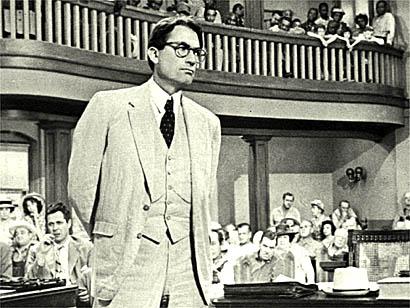 To many of us, Atticus Finch is inescapably Gregory Peck, who played the role in the 1962 film and won an Oscar as best actor. The movie won three Academy Awards out of eight nominations, and today is considered one of the great American classics. Its black-and-white images remain etched in our minds. I am sure that I am not the only southern teenager who saw the movie in those days and was inspired to be a lawyer just like Atticus some day.
Half a century after he appeared, Atticus Finch remains a model and a contemporary inspiration. In a recent poll practicing lawyers voted him an influence on their careers; strong stuff for a fictional character.
Here is Atticus Finch in his own words:
- “Mockingbirds don’t do one thing but make music for us to enjoy… but sing their hearts out for us. That’s why it’s a sin to kill a mockingbird.”
- “The one place where a man ought to get a square deal is in a courtroom, be he any color of the rainbow, but people have a way of carrying their resentments right into a jury box.”
- “You never really understand a person until you consider things from his point of view – until you climb into his skin and walk around in it.”
- “The one thing that doesn’t abide by majority rule is a person’s conscience.”
- “There’s a lot of ugly things in this world, son. I wish I could keep ’em all away from you. That’s never possible.”
- “Courage is not a man with a gun in his hand. It’s knowing you’re licked before you begin but you begin anyway and you see it through no matter what. You rarely win, but sometimes you do.”
- “When a child asks you something, answer him, for goodness sake. But don’t make a production of it. Children are children, but they can spot an evasion faster than adults, and evasion simply muddles ’em.”
- “Bad language is a stage all children go through, and it dies with time when they learn they’re not attracting attention with it.”
- “Best way to clear the air is to have it all out in the open.”
THE MARK OF THE BEAST
July 1, 2010 § 12 Comments
And he causeth all, both small and great, rich and poor, free and bond, to receive a mark in their right hand, or in their foreheads; And that no man might buy or sell, save he that had the mark, or the name of the beast, or the number of his name. Here is wisdom. Let him that hath understanding count the number of the beast: for it is the number of a man; and his number is Six hundred threescore and six. Revelations 13:16-18.
666. The number of the mark of the beast.
Irony of ironies, that is the section of the federal criminal code under which Dickie Scruggs and his cohorts were indicted for the crime of corruptly influencing a public official. 18 U.S.C. §666.
And so it was that Dickie Scruggs and his minions, bearing the mark, bought and sold justice in Mississippi.

I have read KINGS OF TORT by Alan Lange and Tom Dawson, the enthralling story of how Dickie Scruggs and Paul Minor, in league with others, corrupted our legal system. The story is stomach-turning and fascinating at the same time, in the same way that one is revolted by seeing a person leap to his death from a tall building, yet can not look away. It is a story that will repel and anger honest lawyers and judges, and yet it is one that they must know. I feel strongly that it is a must-read for anyone who has practiced law or sat the bench in Mississippi, as well as anyone else who is interested in our state legal system.
KINGS OF TORT is the story of the rise and fall of some of the richest and most powerful lawyers ever known in Mississippi, and indeed in our republic, along with the judges they corruptly influenced. They are all here: Dickie Scruggs, Zach Scruggs, Paul Minor, Bobby DeLaughter, Joey Langston, Sid Backstrom, Tim Balducci, John Whitfield, Wes Teel, Ed Peters, Steve Patterson and others who, for money, or out of lust for power and control, or for sheer egotism, stole from one another and tried to manipulate and corrupt the legal system to achieve their ends. It’s all too unfortunately true, and it happened here in our state during our careers as we went about our quotidian legal tasks, unmindful of the cesspool growing only a few miles down the road that would engulf so many.
Authors Alan Lange and Tom Dawson each had a favored vantage point from which to view this Greek tragedy, act by act. Lange amassed literally tons of information on the various scandals by his untiring reporting on his blog, Y’all Politics. Dawson was one of the lead prosecutors in the Oxford U.S. Attorney’s office who helped design the strategy that brought down the Scruggs house of cards, from coordinating FBI investigation and search warrants to drafting the indictments and preparing for trial.
The downfall of Dickie Scruggs was a national story, reported as it unfolded in the New York Times and Wall Street Journal. Several Mississippi-based blogs followed the story closely and actually served as sources for the national press. Lange’s own Y’all Politics was a major player in revealing much information. Folo, now in hiatus, was energetic in pursuing the story, often breaking news that others missed, and one of its most astute contributors, NMC (who is Oxford atty Tom Freeland), continues with his own blog, NMissCommentor.
The improbable hero of this sordid saga is District 3 Circuit Judge Henry Lackey of Calhoun City, who toppled the kings of tort from their thrones by going to the U.S. Attorney and reporting that they were attempting to bribe him. He then wore a wire and captured the crucial evidence that first snared Balducci, and then took down Scruggs, Backstrom, Patterson and Langston. Judge Lackey is an engaging and self-effacing man with a wry humor. When the prosecutors warned him of the stress that his role as undercover witness would place on him and his heart problems, he smiled and said with country assurance, “Boys, don’t mind the mule, just load the wagon.” He would be the first to disclaim the hero label, pointing out that he only did what his oath and judicial ethics expected of him.
Most readers will find the writing in large part clear and easy to read. The authors do a good job of explaining complicated legal proceedings and concepts in a way that non-lawyers can easily grasp. What is unfortunately lacking in a book such as this with national exposure, however, is decent editing. It is bothersome that the writers appear not to know the difference between “affect” and “effect,” or that the correct pronoun to refer to a person is “who” rather than “that” (e.g., “He is the person that who loaned the money”), or that “tortuous” does not mean the same thing as “tortious,” or that the word “divulge” does not mean “deprive,” or that proper usage is “between him and … ” and not “between he and … “, or that the court room of the Calhoun County Court House is in Pittsboro and not Calhoun City, and that some of the clauses within clauses will make your head spin. Good editing would have cured those defects. Warts and all, though, it’s still a worthwhile and even essential read for Mississippi lawyers.
Buy this book and keep it in your law office library. Keep it handy. When you feel an itch to stretch ethical limits, even ever so slightly, to score big in a case, or to gain an upperhand, or you feel the temptation to shaft another lawyer who has been loyal and helpful to you, pull this book off the shelf and hold it. Remember those lawyers and judges marked with the number of the beast and ask yourself: “Do I really want to be like them?”
 The Better Chancery Practice Blog