EVOLUTION OF THE LAUDERDALE COUNTY COURTHOUSE
July 30, 2010 § 2 Comments
When Lauderdale County was established in 1833 out of Choctaw lands ceded in 1830 at Dancing Rabbit Creek, there was already a settlement at Marion, named for the famous South Carolina “Swamp Fox” of Revolutionary War fame. Since the community was located near the center of the new county, it was the logical place to name as county seat.
Meridian was incorporated in 1860, and, except for a setback in 1864 thanks to General Sherman, grew rapidly. In 1870, as a result of a public referendum, the county seat was relocated to Meridian, a few miles to the southwest of Marion.
The county’s first courthouse was built in 1890 at the present site, where it stood until 1903, when it was destroyed by fire. If there is a photograph of that first building, I have been unable to locate it, even after checking with the Lauderdale County Archives.
In 1904-1905, a new courthouse was built on the original site. It was in the Beaux Arts style in fashion at the time, and featured a dome with cupola and sculpted figures.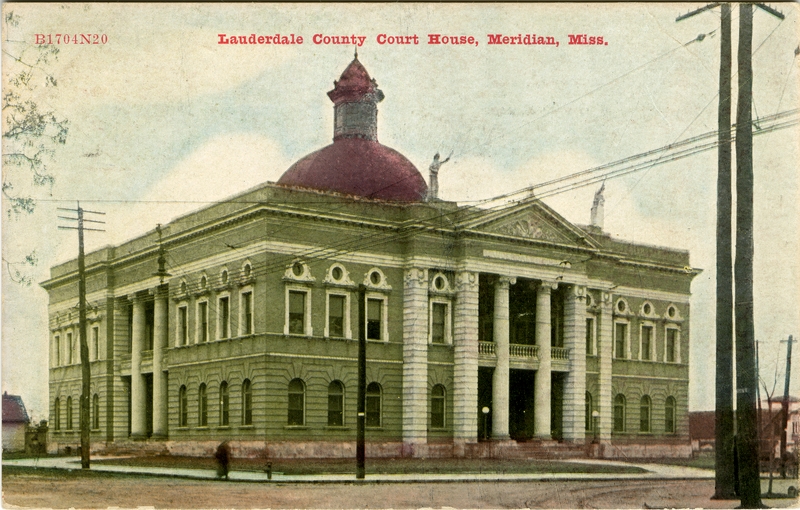
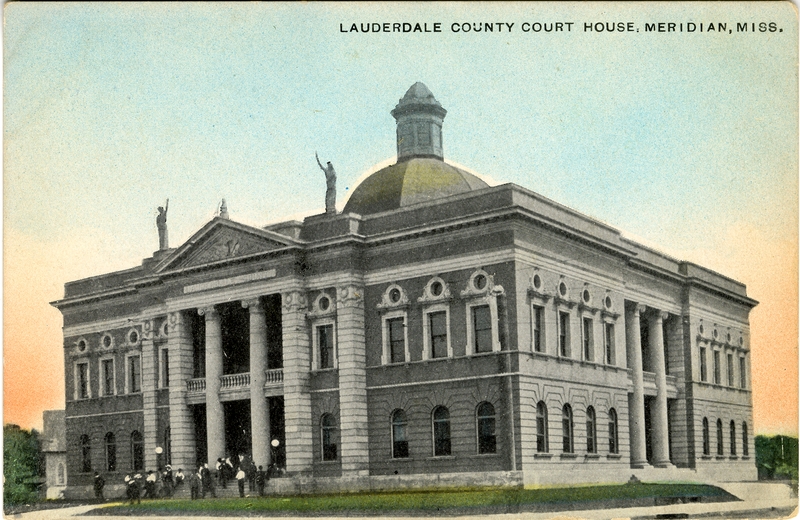
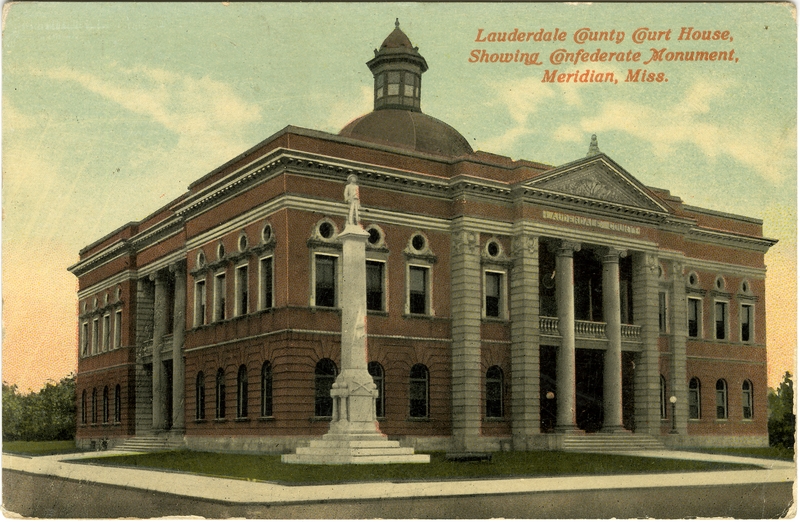
Some time later, the statues were removed, and even later, probably in the 1920’s, a Confederate memorial was erected on the northwest corner of the site. You can click on the photos for larger, more detailed view.
In 1939, the building was enlarged and extensively remodeled in Art Deco style. A jail was added on the top floor. The work was part of President Roosevelt’s federal works projects aimed at creating jobs to get the country out of the Great Depression.
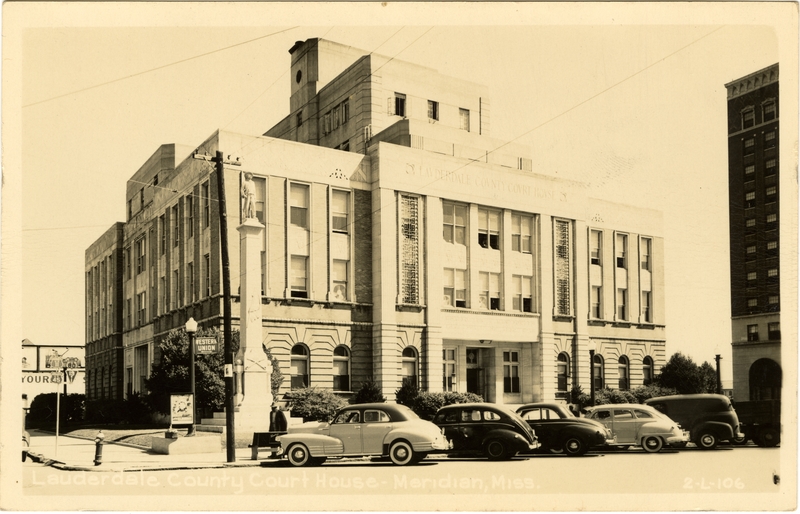 The building has remained essentially unchanged in appearance since the 1939 renovation. The photo to the left shows the west entrance in the early 1950’s.
In the 1970’s, a ramp was built at the west entrance for handicap accessibility. The ramp originally bore the inscription LAUDERDALE COUNTY COURTHOUSE, but the lettering was replaced in the 1980’s by a marble memorial honoring and naming the military of Lauderdale County who were killed in war.
A porch with benches was added at the south entrance in the 1980’s.
In the late 1990’s, before the new jail on Fifth Street could be built, a metal fire escape enclosed by chain-link fencing was constructed on the east side, giving jail inmates an escape onto Nineteenth Avenue into a chain-link enclosure in case of fire. The fire-escape apparatus was removed after the new jail was completed and put into operation.
The courthouse was designated a Mississippi Landmark on April 6, 1999, and is listed on the National Register of Historic Places as a contributing element of the Meridian Downtown Historic District.
The photos above, along with around 4,600 others showing scenes from all around Mississippi during the period from 1892 to the 1940’s, are available at the Mississippi Department of Archives and History’s website here.
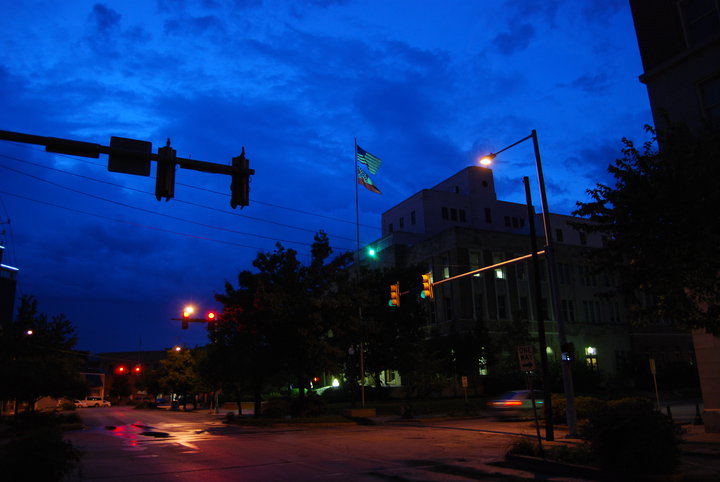 Above is a view of the courthouse as it appears today. It shows the DA’s office lit up in trial preparation on a rainy evening. This unusual photo was taken by Meridianite Ken Flynt, and is used with his permission.
ADVICE TO A YOUNG PERSON INTERESTED IN A CAREER IN THE LAW
July 20, 2010 § 1 Comment
In May 1954, M. Paul Claussen, Jr., a 12-year-old boy living in Alexandria, Virginia, sent a letter to Mr. Justice Felix Frankfurter in which he wrote that he was interested in “going into the law as a career” and requested advice as to “some ways to start preparing myself while still in junior high school.” This is the reply he received:
My Dear Paul:
No one can be a truly competent lawyer unless he is a cultivated man. If I were you I would forget about any technical preparation for the law. The best way to prepare for the law is to be a well-read person. Thus alone can one acquire the capacity to use the English language on paper and in speech and with the habits of clear thinking which only a truly liberal education can give. No less important for a lawyer is the cultivation of the imaginative faculties by reading poetry, seeing great paintings, in the original or in easily available reproductions, and listening to great music. Stock your mind with the deposit of much good reading, and widen and deepen your feelings by experiencing vicariously as much as possible the wonderful mysteries of the universe, and forget about your future career.
With good wishes,
Sincerely yours,
[signed] Felix Frankfurter
From THE LAW AS LITERATURE, ed. by Ephraim London, Simon and Schuster, 1960.
CHANCERY COURT IN DAYS OF YORE, PART ONE
June 29, 2010 § 3 Comments
Last week in Clarke County I took the bench one day in a dark suit and dispatched the day’s business in that attire because my robe was in chambers with a Circuit Judge whom I did not wish to bother. The Chancery Clerk pointed out later that the younger lawyers were abuzz about it. They had never seen such a thing. Imagine — a judge adjudicating sans black robe.
Down through the decades it was a hallmark of our courts that the Chancery Judge did not wear a robe. The Chancellor presided in his (yes, in those days there were few female Chancery Judges) dark suit, dispensing equity like an ancient Titan loosing thunderbolts.
Long after Circuit Judges donned the robe, Chancellors continued unrobed. It was not until the late 80’s, as far as I recall, that Chancellors donned robes in our part of the state, and then not every Chancellor did. Judge John Clark Love in District Six never wore a robe until the day he retired in 2005. Neither did his counterpart, Judge Ed Prisock.
The philosophy behind the robe is that it instantly lends authority and recognition of office to the wearer, but Chancellors in those pre-robe days didn’t really need a cloak to lend them weight. Authority emanated from them like deadly radiation from a chunk of uranium. For those of us who practiced before some of the really great old lions of the Chancery bench, there was no question of authority. A wilting glance or stabbing remark could inflict a wound in one’s case that would bleed to a fateful conclusion. Heaven help the unprepared lawyer.
Billy Neville of Meridian was the commander of his court room. He sat on the bench, pipe jutting MacArthur-like out of his face, whittling on a cedar plug until he carved an eye-shaped piece — rounded in the middle and sharp on each end — whence he would start another. A lying witness never escaped his ire. “Suh!” he would thunder, “Do you expect me to believe that?” You knew that was coming because only a few questions before he had begin running his hand across his forehead and then over his scalp as first his cheeks and then his temples and then his forehead changed hues from peach to crimson to scarlet. “Mr. Bailiff, suh! Take this man upstairs!”
Judge Neville was also a master at communicating subtly to the attorney the futility of one’s case. “Yes, suh, I will sustain the objection because this has nothing to do with the case, and even if it did there is no law in Mississippi that would permit me to do what the Complainant has prayed for. Now you may proceed, suh.” Okay, how do you frame the next question when the judge has just let all the air out of your case?
Judge Ed Cortright of Yazoo City was a gentleman of the first order and a scholar of note in his long career on the bench. He was reversed on appeal only once that I know of, and that by Frank Coleman, now County Judge Coleman, of Meridian. As gentlemanly as he was, there was a steely side to Judge Cortright, and he could communicate his displeasure at a lawyerly gaffe in no uncertain terms. His disdain for the illogical argument or a position unsupported by the law was unmistakable.
Judge Mike Sullivan of Columbia was so revered and respected that he was elevated to the Supreme Court, where he made his mark as a voice for Chancery Court in the appellate court. His calm demeanor and measured speech left no doubt who was in control of his court room.
Judge John Clark Love of Kosciusko had a way of eviscerating lawyers who wandered ill-prepared into his lair.
Judge Ray Montgomery of Canton could shrink your head two to three sizes from his tirade if you wound up on his wrong side or if your case did not impress him.
There were many robeless Chancellors, too many to mention, some great and some forgettable. We sometimes quaked in their presence, but in the crucible of their courtrooms we were molded into better lawyers.
CLARKE COUNTY’S OLD COURT HOUSE
June 28, 2010 § 3 Comments
I ran across these two old post cards depicting the Clarke County Court House that preceded today’s building. You can click on the pictures to see a larger version with more detail. My guess is that the pictures were taken in the 1890’s to early 1900’s, judging from the buggies parked around the building. The current court house does not have a cornerstone that I could find in a very brief saunter around the outside last week, but it does have the names of the Board of Supervisors 1912-1916, which would indicate to me that the building was built during their term. 
I showed these to Gilford Dabbs, and he told me that he had heard that the old court house was located on what is now a vacant lot next to First Baptist Church in Quitman. By the way, Gilford is old, but he’s not old enough to remember this old building himself.
Does anyone know why this court house was replaced? Was there a fire like there had been in Meridian that precipitated the building of the new version? Does anyone have any other pics of it, inside or out? Does anyone know what happened to the eagle?

That object dangling in front of the building in the bottom picture is a street light suspended on wires.
These photos, along with around 4,600 others showing scenes from all around Mississippi during the period from 1892 to the 1940’s, are available at the Mississippi Department of Archives and History’s website here.
 The Better Chancery Practice Blog