SYMPATHY FOR THE DEVIL
December 12, 2010 § 8 Comments
 Curtis Wilkie’s THE FALL OF THE HOUSE OF ZEUS is the story of the rise and fall of powerful trial lawyer Dickie Scruggs. It is entertainingly well written, as one would expect of an author with Wilkie’s gift for the word, and microscopically researched. Wilkie’s book complements KINGS OF TORT, Alan Lange’s and Tom Dawson’s treatment of Scruggs’ downfall from the prosecution point of view. Those of you who savor Wilkie’s keen writing and incisive journalism will not be disappointed by this book. The subject matter is a must-know for all Mississippi lawyers and jurists, and citizens as well. I recommend that you buy and read this book.
Although I commend Wilkies’s book to you, I do find it troubling that it is unabashedly sympathetic to Scruggs. Wilkie finally acknowledges their friendship at page 371, the third-to-last page of the book.
As a member of the legal profession for nearly four decades and a member of the judicial branch, I can find no sympathy whatsoever for Scruggs at this stage of his life. His flirtations with unethical conduct and illegality are legion. Even his acolyte (Stewart Parrish’s excellent descriptive), Tim Balducci, said in a candid moment that his approach to corruptly influence judge Lackey was not his “first rodeo” with Scruggs, and that he knew “where all the bodies are buried.” Big talk? Perhaps. But to me it eloquently bespeaks Scruggs’ history: His involvement at the shadowy edges of Paul Minor’s illegal dealings with Judges Wes Teel and John Whitfield; his use of stolen documents in the tobacco litigation; his use of questionably acquired documents in the State Farm litigation; and the hiring of Ed Peters to influence Judge Bobby Delaughter. Are there more?
Wilkie suggests that Scruggs’ increasing dependence on pain-killer medication led him to fall carelessly into a trap laid for him and Balducci by a scheming Judge Lackey, who had it in for Scruggs because of Scruggs’ political attacks on Lackey’s friend George Dale. He posits that Lackey created the crime, and that Scruggs had set out initially “only” to improperly influence Lackey.
The pain killers may be a contributing reason, but even a first-year law student knows that is not an excuse.
What about the idea of a trap? I leave it to lawyers far better versed in criminal law and procedure to address that. To me, the issue is finally resolved in this sentence on page 337: “But Scruggs had acknowledged, ‘I joined the conspiracy later in the game.'” Case closed as far as I am concerned. Moreover, Scruggs was not an unsophisticated convenience store owner charged with food stamp fraud. He was a sophisticated, powerful lawyer skilled in manipulating the levers of legal machinery. He was not a gullible rube who did not grasp the significance of his actions or their consequences. He was a lawyer and as such was held to the highest standard of propriety vis a vis the judiciary, a standard he trod into the mud.
As for Judge Lackey, the author skillfully excerpts quotes from the judge’s testimony to support his charge that Lackey had an animus against Wilkie’s friend, in particular the judge’s use of the term “scum” to describe Scruggs. From my perspective, I can understand how someone in Lackey’s position would view the arrogant and powerful lawyer as scum when he saw how Scruggs had seduced the star-struck young Balducci, whom Lackey liked, into impropriety and, indeed, illegality. Some of Dickie’s and Curtis’ influential and powerful friends in Oxford may buy Wilkie’s and Scruggs’ attempt to tar Judge Lackey, but I do not. Judge Lackey chose to stay on the side of right and Scruggs chose the other side. The point goes to the judge.
Scruggs’ plaint that he only intended to commit an unethical act, not a crime — in other words that the consequences were unintended — is a familiar theme in history. Henry II of England griped to his knights that he was irked by that troublesome bishop, Thomas Becket. The knights, knowing from experience how far they could go before incurring the wrath of their king, promptly rode to Canterbury and rid their sovereign of that meddlesome priest, killing him at the altar. Likewise, Scruggs’ knights, Balducci, Patterson, Langston, Backstrom and the others, knew the ballpark Scruggs was accustomed to playing in, and they set out with his money and influence to promote his (and their) interests in the accustomed manner of doing business.
Henry II did penance for the rest of his life for what he saw as the unintended consequences of his actions. Will Scruggs try to redeem himself for the damage he did to the legal profession and the legal system? Time will tell. When he is released from prison, he could find ways to devote some of his hundreds of millions of dollars to improving the courts and the legal profession and restoring integrity to the profession that made him rich. In the final decades of his lfe, he could become known as a philanthropist who advanced the law and the legal profession, with his past a footnote. I hope that is what he does.
Read this book and judge it yourself. You may see it differently than I. The story, though, and its lessons, are important for Mississippians to know and understand.
TRIBUTE TO JUDGE LACKEY
November 21, 2010 § Leave a comment
It was Judge Henry Lackey of Calhoun City whose refusal to be corrupted and courageous cooperation with law enforcement brought to justice some of the most powerful trial lawyers in this country.
This tribute from the Calhoun County Journal:
Judge Lackey is truly one-of-a-kind
“There are two things you need to be a judge,” Judge Henry Lackey said. “A lot of gray hair to look distinguished and hemorrhoids to look concerned.”
Judge Lackey was speaking to a large gathering at the Oxford Convention Center that turned out to honor him upon his upcoming retirement after 17 years as circuit court judge and even longer as public servant.
Judge Lackey is less than two months away from entering retirement, but one look at this week’s Journal and you would see he’s busier than ever.
He was “roasted and toasted” at the Oxford Convention Center last week shortly after being honored by the Mississippi Supreme Court for his years of service on the bench.
Another reception is planned for Dec. 10 at First Baptist Church in Calhoun City.
This Thursday, Judge Lackey will once again be auctioning off Christmas items at the City Sidewalks Celebration at the Methodist Corner on the Calhoun City Square. Saturday night he is the featured entertainment at the Vardaman Sweet Potato Festival Banquet.
In between all of this he is still managing his day job as Circuit Court Judge for District Three. He’s spent all of this week holding court in Holly Springs.
The honors for 75-year-old Judge Lackey continue to pour in due in part to his role in one of the biggest legal crackdowns in recent history – the downfall of famed trial lawyer Dickie Scruggs and several of his colleagues.
“I’ve received praise and accolades that I don’t deserve,” Judge Lackey told me a few months back. “It’s like praising the sheriff for not stealing. It’s your job.”
Judge Lackey’s “integrity and intrepidness” in the case are well documented in Curtis Wilkie’s new book “The Fall of the House of Zeus” – a must-read according to my wife Lisa.
But as all the attention still pours in, and rightfully so, Judge Lackey still thinks of himself as the simple, “country lawyer” who still lives “within 300 yards of where he discovered America,” and that’s why he is so treasured here in Calhoun County.
A visit with him and you hear no mention of Dickie Scruggs. He talks of his “wonderful upbringing” in Calhoun City, working at his family’s business – the Ben Franklin 5 and 10 Cent store on the Calhoun City Square – and the endless list of fascinating people he grew up with such as Clarence “Dummy” Martin, Ray “Funnyman” Tolley, John Pittman, Mr. Mac, Monk and Big Dog.
I’ll never forget sitting in his office and him telling me of his experience when Robert Wardlaw, the world’s tallest man at 8’9″, visited Calhoun City.
One of the best story tellers I’ve every known, Judge Lackey is always worth the price of admission at any event he’s attending. I certainly wouldn’t let an opportunity to enjoy his tales or company pass me by.
The homespun Judge Lackey deserves our accolades. As it is with Judge Lackey, I hope it will be said of all of us at the end of our careers that we adhered to the highest ethical principles and upheld the honor and dignity of the law.
Thanks to Tom Freeland for the link to this tribute.
IF BUSINESS IS SLACK, YOU MIGHT TRY CHANNELING
November 19, 2010 § Leave a comment
Channeling is communication with spirits. Some people claim to be able to communicate with the dead or others in the spirit realm, and share the communications with those here on the terrestrial plane.
That’s what an Arizona lawyer did. She convinced at least one client that she could “channel” messages from his dead spouse in the deceased spouse’s estate. She told the client that she was receiving communications from the deceased directing them to take this action and that, and she was so convincing that she continued to represent the client for three years.
Things got a little more complicated after she persuaded her client that his deceased spouse wanted the attorney and client to have sex, and they did. The client filed a bar complaint charging that the lawyer was exercising undue influence.
You can read what the Arizona courts did discipline-wise here.
Now, I am not suggesting you carry channeling beyond the bounds of propriety, assuming that channeling is itself, after all, within the bounds of proriety.
I am merely mentioning another possible career enhancement, not too far removed from the common practice of Mississippi lawyers to try to predict what the chancellor will do by hitting the ouija board with their clients. Uh, most of you still do that, right?
If you are going to get into the channeling business, please try to make it obvious to the court that your behavior is channeling and not imbibing.
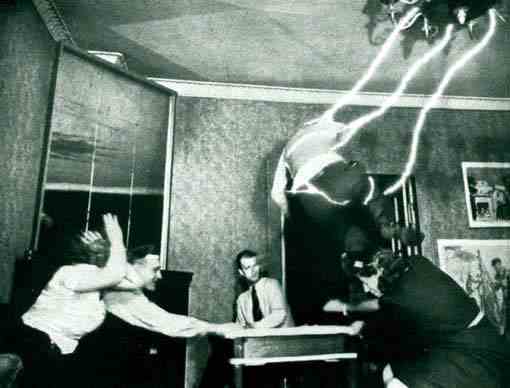
And another thing you need to keep in mind: there are risks involved in channeling. There is always the danger of out-of-control séances:
FAMILY LAW IN THE FAST LANE
October 29, 2010 § Leave a comment
This article is copied from the Washington Post online edition. After you read it, you may have an unsettling sense of unreality. Lawyers charging $850 an hour for a divorce? Billing for more than 7 hours a day, 365 days a year? Billing for as many as 71 hours in a day? $624,000 in fees for a divorce trial? I am not making this up.
High-priced lawyer sues former client, then agrees to pay him $102,000
By Tom Jackman
Washington Post Staff Writer
Saturday, September 25, 2010; 6:29 PM
Glenn C. Lewis is an acknowledged titan of the D.C. area divorce bar, a former president of the Virginia Bar Association who boasts that he is the most expensive lawyer in the region: $850 an hour. He has an impressive office in the District and an array of high-profile clients.
So it fascinated the Fairfax County courthouse when Lewis sued one of his former clients for an additional $500,000 in fees and interest, although he’d already been paid $378,000.
The fascinating part was that the client, a lawyer himself, fired back. He hired another former state bar president, Bernard J. DiMuro, who dug through Lewis’s billing records and hired two more divorce bar giants – including another former state bar president – as his experts. The experts said Lewis had done a poor job and didn’t deserve nearly $900,000 for his work.
In Fairfax Circuit Court on Friday, Lewis capitulated. He agreed to pay his former client more than $102,000, including $25,000 in sanctions imposed on Lewis’s lawyers for defying pretrial orders. Lewis even failed to show up for his own deposition.
Lewis, who for years hosted his own cable access television show, and who was given a lifetime achievement award from the Virginia State Bar’s family law section, remains unrepentant. His final bill for the divorce of Steve Firestone was $627,000, and he sought another $253,000 in interest for the case, which ended in 2004 without a trial less than a year from the time it was filed.
“He owed us more than that,” Lewis said in an interview last week. “We earned more than that. I feel as strongly today as I did the day we filed [suit], that Mr. Firestone owed every penny of it.”
Firestone said, “I thought that what I paid was egregiously high,” and he stopped paying shortly before his divorce was finalized. Then he received the lawsuit seeking another $500,000 five years later.
“I was shocked,” Firestone said. “If he won, we were going to be out on the street.”
Firestone hired DiMuro, who doesn’t do divorce law. But DiMuro obtained Lewis’s billing records and the records of the divorce, which he then handed over to Joseph Condo and Robert Shoun, two longtime family law practitioners.
Their conclusion: Not only were Lewis’s bills “flagrantly disproportionate to the value of the dispute,” DiMuro said, but Lewis’s settlement was a lousy deal. Firestone, through DiMuro, pursued Lewis for legal malpractice.
Firestone’s ex-wife had used Fairfax attorney David L. Duff for the divorce. Duff’s total bill: $73,000.
DiMuro noted that three lawyers from Lewis’s firm worked on Firestone’s case, and two lawyers often appeared at meetings or depositions that would normally be handled by one lawyer. In 2003, Lewis was only billing $575 an hour, while two young associates billed at rates closer to $250 an hour.
Lewis said Firestone was a difficult client, presenting numerous problems, and that comparing one side’s legal bills with the other’s is unfair. Firestone had tax problems, problems with his law practice, bookkeeping difficulties, suffered from depression and was intent on revenge against his wife, Lewis said.
But DiMuro said, “This was a garden-variety divorce with a modest estate for this area. No child custody issues. Their incomes were modest.” Besides their house in Fairfax County, the Firestones owned a small office condo and a few other assets. Firestone also had a $1.1 million inheritance from his parents, DiMuro said, which Lewis successfully kept separate from the marital estate.
Lewis said that’s a simplistic analysis. “This case presented so many more issues that were bigger than getting unmarried,” he said. “I had the high maintenance client.” He said Firestone signed a contract acknowledging that multiple lawyers might work on his case and that he had 30 days to challenge a bill, which he never did.
One of Firestone’s quirks was his heated denial that his wife had cancer, Lewis claimed. Lewis said he never really pursued the issue, and the case ended in July 2004. But several years later, in a casual conversation with Duff, he learned that Beverly Firestone had died of cancer not long after the divorce.
“My head exploded,” Lewis said. “I was sickened by that. I was horrified to think the case accelerated that. Nothing is more stressful than a divorce case. Stress kills.”
So, he sued Steve Firestone in October 2009.
Firestone said he never told Lewis his wife didn’t have cancer. “I told him I wondered if it was a ploy to increase my alimony exposure,” Firestone said.
In pretrial discovery, DiMuro obtained billing records for all of Lewis’s cases, not just the Firestone case. He found examples of days where Lewis billed for 39 hours; 31 hours; 40 hours; 71 hours.
Lewis said that was the result of “block billing,” in which he entered the time for many days all at once.
In a 16-month period in 2003 and 2004, DiMuro calculated in court records, Lewis billed his clients for 3,620 hours, or an average of 226 hours per month, or 7.4 hours per day, 365 days per year.
Lewis said he worked nights and weekends, in addition to his bar duties and television hosting.
As the suit progressed in Fairfax Circuit Court, Lewis’s lawyers angered Fairfax judges by failing to respond to basic requests and orders. The judges started slapping Lewis’s lawyers with financial sanctions. First $2,000. Then another $2,000. Then $5,000, $7,500 and finally a $10,515 hit after Lewis failed to appear for his deposition last month.
Lewis said his lawyer, Michael P. Freije, had released him from appearing, although he had been subpoenaed. Freije told Judge David S. Schell there had been a misunderstanding, but Schell was clearly upset and ordered Lewis to appear in DiMuro’s office the following week as well as pay the highly unusual fifth court-imposed sanction.
Lewis said he couldn’t be there, because of family obligations. Rather than defy the court, he said, he agreed to pay Firestone and settled the case.
JUDGE LACKEY RETIRES
October 5, 2010 § Leave a comment
This from Tom Freeland’s NMissCommentor Blog …
Judge Lackey Retirement Dinner, & request for donations
A retirement party for Hon. Henry Lackey, Circuit Judge of the Third Circuit Court District is being held by the Third Circuit Bar in Oxford on November 4th at the Oxford Conference Center. I’m one of the lawyers collecting contributions toward this dinner, which will also include a retirement gift to Judge Lackey.
Please send any contributions you are willing to make with the check made out to:
Judge Lackey Retirement Party Fund
Send them to me at:
Box 269
Oxford, MS 38655If you send a check, it would be useful to my effort to keep track of donations if you sent me an email telling me you did and how much it was. Send the email to tom (at) freelandlawfirm.com
Invitations to this event will be sent out later this month to members of the Third Circuit Bar and to judges all over the state; if you wish to attend the event and aren’t in the counties of the Third Circuit, send me an email to the address just mentioned and I will see that the information gets to the appropriate person.
Thanks!
[Tom Freeland]
I don’t know how many Twelfth District lawyers have had the privilege to know or practice before Judge Lackey. If you do know him or tried cases in his court, you may want to try to make the event or send a contribution.
I met Judge Lackey back in the 1980’s at a CLE program in New Orleans during Mardi Gras. I had recently finished trying a case before Chancellor Woodrow Brand, sitting as Special Chancellor in Meridian in a trial involving lots of money and a world-renowned manufacturer. At the conclusion of the trial Judge Brand complimented the attorneys on a job well done and took the case under advisement. When he heard that, Judge Lackey raised his bushy eyebrows and remarked with humor and some irony that that sort of compliment was something that lawyers in Judge Brand’s district were simply not accustomed to. We laughed together and swapped tales about practice in our different parts of the state. He knew some Meridian lawyers and judges and asked about them. He was kind, soft-spoken, attentive and humorous, and I enjoyed the little time I spent with him — so much so that I remembered it down through the years.
I ran into Judge Lackey last year at a Judges’ meeting in Tunica, and he remembered the New Orleans seminar and was kind enough to say that he did remember sitting next to me and visiting. He reminded me that there had been an ice storm that Sunday that closed the bridges out of the city so that he and his wife were stranded there an extra day. I had forgotten that. My wife and I had made it out of the city an hour before the bridges were closed.
If Judge Lackey’s long service as a lawyer and as a Circuit Judge were all he accomplished in his career, he would be remembered as a successful public servant. His role in the Scruggs scandal, however, in which he hewed strictly to judicial and legal ethics, and would not deviate an inch from the proper path, elevates him to a higher level of esteem. Not because he did what professional standards required of him, but because of his courage in facing down the beast and bringing it to destruction.
Judge Lackey is a beacon of right shining through the ashy pall that Scruggs and his minions cast over the legal profession and the judiciary. For that let us ever remember him and esteem his memory.
God bless you in your retirement, Judge Lackey.
THE BALDUCCI FILES
October 4, 2010 § 1 Comment
If you’re familiar with the story of Dickie Scruggs’ downfall, you know that the final, climactic act in his Greek tragedy began in the Calhoun City offices of Circuit Judge Henry Lackey, who met with Scruggs operative Tim Balducci and recorded Balducci’s offer to bribe him.
Patsy Brumfield of the Tupelo Daily Journal, has obtained copies of the FBI recordings and has posted them online here. There are four video and three audio recordings. Six are in Lackey’s office, and one is in Scruggs’ office after Balducci has been arrested and has agreed to cooperate with he FBI.
What is most remarkable about them is the prosaic, almost ho-hum nature of the conversations. The tone is business as usual, which is chilling, considering how far-flung were Scruggs’ conflicts with other lawyers similar to the one that led to the Lackey bribe attempt.
Another compelling feature of the recordings is how they show the banal nature of evil. It seldom manifests itself with the dramatic flair we see on tv and in the cinema. It is a handshake, a wink and a nod, an exchange of consideration.
Thanks to Tom Freeland at NMissCommentor for posting about this.
Tom also has a great post today about whether Curtis Wilkie’s upcoming book, FALL OF THE HOUSE OF ZEUS answers some questions about the handling of the Scruggs trial.
ATTACK OF THE KILLER EARWIGS
September 1, 2010 § 1 Comment

Bedbugs
The latest fad in the anxiety/nightmare industry is bedbugs. Seems like every media outlet has close-up photos of the little beasts the size of shetland ponies roaming mattresses across the country in cornucopious profusion awaiting fleshy morsels to chomp off of unwary humans.
In Chancery Court our “bedbug” is the dreaded earwig.
Uniform Chancery Court Rule 3.10, entitled EARWIGGING THE CHANCELLOR PROHIBITED, provides in part:
“No person shall undertake to discuss with or in the presence or hearing of the Chancellor the law or the facts or alleged facts of any litigated action then pending in the Court or likely to be instituted therein, except in the orderly progress of the trial, and arguments or briefs connected therewith. No attempt in any manner, except as above stated, to influence the Chancellor’s decision shall be made. No person shall send any written communication to the Chancellor concerning a pending action in the Court without delivering or mailing a copy of that communication to the opposing party …”
The language about written communication and copy to the opposing side has given rise to a curious practice among some attorneys that can be illustrated in the following scenario:
Lawyer A sends a letter to the Chancery Judge describing the scurrilous actions of the opposing party, including pillage, wantonness and rapine. There in the lower left-hand corner of the letter is the notation “cc: counsel opposite.”
When the judge questions the propriety of the letter, Lawyer A responds innocently that he complied with the rule because he sent a copy to opposing counsel.
With all due respect, if any is due, that practice is undoubtedly in violation of the rule and is, without question, earwigging.

Potential earwigs
The provision for copy of written communication to opposing counsel includes no exception to the preceding two sentences prohibiting communications about the merits of the case. It simply means that, if communication by letter is proper, as where it is necessary to transmit a copy of an agreed order, then a copy of the proper communication must be sent to opposing counsel.
By the time that opposing counsel has received a copy of the ex parte correspondence, the damage has already been done. The bell cannot be unrung, as the adage says. The judge has heard one side alone on the matter, and the judge’s impartiality and independence is in question from then on out. If the judge rules for the side that sent the letter, was the judge unduly influenced? If the judge rules against the side that sent the letter, was the judge trying to lean the other way to prove impartiality? We can never know what might have been because the ex parte communication has called the judge’s impartiality into question.
In my court, if you have allegations to make on the merits, put them in the form of a pleading and set the matter for hearing, and I will make a judgment after hearing both sides. Don’t poison the well that both parties have to drink from.
If you introduce the dreaded earwig into Chancery Court, prepare to be fumigated.

Genuine earwig
Genuine Ear Wig
IS THIS THE SOLUTION TO PRO SE LITIGATION?
August 25, 2010 § 7 Comments
A post about proposed changes to the pro bono rules for lawyers is here. There is a thoughtful comment to that post that highlights some dimensions of the situation.
It’s no secret that pro se litigants are appearing more and more frequently in Chancery Court. Whenever I ask a self-represented litigant why he or she did not hire an attorney, cost is always the response.
In our district, it’s not uncommon for a simple, irreconcilable differences (ID) divorce to cost upward of $1,500 to $2,500, plus court costs, although I have heard of some lawyers charging as little as $250 plus costs for an ID divorce with no children.
Self-representation, however, is not limited to routine, uncomplicated matters like ID divorces involving no children, no property, no joint debts and no other problems. I see pro se litigants in all kinds of matters. I presided over a termination of parental rights case not too long ago where the father represented himself and lost. I have seen pro se litigants in an adverse possession case, contempts, paternity, and even in a partition suit where, believe it or not, both sides were pro se. I can say unequivocally that I have never seen a party who proceeded pro se in a contested case leave the courtroom in better shape legally or equitably than he or she was when they walked in.
Although most all say that they choose to proceed pro se due to the rising cost of legal fees, I find in the course of things that others simply underestimate the complexity of the issues involved and think that legal matters are little more than filling out a few sheets of paper and filing with the court. Still others are lured by the siren-song of the internet sites that push cheap fill-in-the-blank do-it-yourself legal proceedings. The common denominator among all of these is that they are looking for a cheap, one-size-fits-all, easy solution to what may be a complicated situation.
These are the people who wind up in court pro se. In many cases, those pro se parties are getting simple ID divorces using kits they purchased on-line. Some are getting pleadings prepared by “secretarial services,” in violation of state law prohibiting practice of law without a license. The simple cases with no children do not usually give rise to later litigation. Pro se litigants with children, however, are a recurring problem.
Problems with child support provisions, joint and sole custody provisions, division of property, and allocation of debts are all common problems in these do-it-yourself cases. I have one pair of parties in Clarke County that I have sent back to the drawing board four times, and, although they are my most extreme case, they are by no means the only case that I have had to treat that way. I have just about decided that, if there are children, I will require the parties either to have an attorney or I will appoint a guardian ad litem at their expense.
The self-represented parties seldom understand why they can’t simply have their papers signed, and they are invariably frustrated when I tell them that I can not advise them how to draft an acceptable child support provision, or why that waiver filed a week before the complaint won’t cut it, or why they need a property settlement agreement when they don’t have any property.
How do we make legal services more affordable, thus reducing the pool of pro se litigants? Some claim that “limited scope representation,” also known as “unbundling” is the answer to lower legal fees. In essence, it is a representation arrangement in which the respnsibility of the lawyer is limited and the fee is resultingly lower. The attorney may, for instance, agree only to advise one of the parties about the language of the property settlement and child support agreement, or simply to prepare pleadings. The clients buy only as much legal service as they feel they need.
The Supreme Court’s Commission on Access to Justice proposed an amendment to Rule 1.2 of the Rules of Professional Conduct to allow for limited-scope representation. They met on Monday, August 23, and since the comment period has expired, I assume they will pass the rule on to the Supreme Court for adoption. I am all for it.
Although the proposed rule approves and encourages the practice, it does not address how a representation agreement would read so as to cover all of the ethical concerns that might arise. There is information available online, however, that may provide a starting point for lawyers. The LAWYERS USA website offers some information. The ABA has some info. The Civil Justice Network also has some info. A paper presenting the pros and cons of the practice is here.
Whether limited scope representation is the answer to the growing numbers of pro se litigants, I have no way of knowing. I do believe that it has the potential to help dramatically because it will decrease the amount of time judges will need to devote to scrutinizing pro se litigants’ pleadings and paperwork.
One caveat: I will not approve a limited-scope representation arrangement in any probate matter. Rule 6.1 of the Uniform Chancery Court Rules requires that every fiduciary retain an attorney, and you will be expected to continue in your role as counsel once you are in until you find substitute counsel. I will not allow the operation of the new rule (if it is enacted) to create an end-run around Rule 6.1.
An approach to the pro se phenomenon that I can not endorse is continued encouragement of laypeople to tackle more of their own legal matters. I saw a bar-produced video of smiling legal professionals encouraging people to handle their own “routine” legal matters, and making it sound as easy as folding a paper airplane. I don’t understand this approach. The American Medical Association does not promote do-it-yourself tonsillectomies, but then medical ethics includes the fundamental proscription, “Do no harm.” To me, the solution is not to encourage people to do their own legal surgery. The answer is to make it more likely that they will have a competent surgeon.
I am not a fan of pro se litigation. Even seemingly simple, routine matters may have serious implications for the parties, and I assure you that they have absolutely no clue about those ramifications. Self-represented litigants seldom have a grasp of the ramifications and complexities of equitable distribution, the various forms of child custody, or joint debt, to name but a few of the many legal snares that await the unwary. Also, the parties are under no duty to be honest and forthright with the court, leaving open the very real possibility of fraud or worse. Without legal advice and the check that an ethical attorney provides, the parties’ paperwork can create more problems than it solves, and even in the absence of lawyers it is clearly not the duty of the judge to advise them about the possible mess they may be creating. Yet, every day, inexorably, we see more and more self-represented litigants.
I am a firm believer in access to justice, but in our commendable haste to discover a way to do that, let us not lose sight of what it is we are trying to achieve: access to justice. Not access to disaster. Limited scope representation may be a good first step toward alleviating this problem.
JAMES O. DUKES PROFESSIONALISM PROGRAM
August 20, 2010 § Leave a comment
I participated yesterday in the James O. Dukes Professionalism Program at the Ole Miss Law School. The program is part of the orientation for new law school students and is offered at both Ole Miss and Mississippi College.
Lawyers and judges volunteer to serve as facilitators for discussions involving situations that commonly confront legal practitioners with ethical questions. The facilitators this year included Supreme Court Justices, Court of Appeals Justices, Chancery Judges, Circuit Judges, County Judges and lawyers. Judge Bailey, Bill Hammack and I were there from Meridian.
This was my first year to participate. In years past, it seems I always had a conflict with trial settings that took precedence.
The program opened in the Ford Center with an introduction by the new Law School Dean, Richard Gershon, followed with remarks by Nina Stubblefield Tollison, President of the Mississippi Bar, who introduced the keynote speaker, Chief Justice William Waller, Jr.
Justice Waller’s address focused on three lawyers, L.Q.C. Lamar, Thurgood Marshall, and Evelyn Gandy, and their contributions to society in their day.
Following the opening program, the 200 or so entering freshmen and facilitators crossed the bridge over the Hilgard Cut and went to the Law School, where we participated in breakout sessions in which facilitators were assigned to different groups of students. Each freshman law student receives a set of hypotheticals; the facilitators receive the hypos and some guidance material such as the applicable professional rules.
Going in, I wondered whether incoming law students would “get it” when trying to tackle legal ethics questions. After all, what do these young people with no legal training know about legal ethics? I shouldn’t have been concerned.

Our group
Our group of eleven students were from Mississippi, Tennessee, Kentucky, Ohio and maybe some other places I don’t recall now. At least one had a master’s degree. All were sharp and articulate, and without exception showed a quick grasp of the rights and wrongs and do’s and don’ts, even when thrown curveball questions to test their understanding.

David Mockbee holds forth

David Mockbee of Jackson and Stacie Zorn of Pascagoula were my fellow facilitators, and they did a super job of leading their parts of the discussion and keeping things interesting and interactive.
Lunch followed the breakout session, and I was fortunate to sit with some of the new students who had been in our group. I enjoyed my visit with them, and I have the feeling they will all be successful.
I came away feeling refreshed, like I had gotten back in touch with something basic. I was encouraged at the intelligence and energy of these young people. In a few years they will be the next infusion of fresh blood that invigorates our profession every year. I am looking forward to see them step onto the legal stage.
I encourage you to consider volunteering for this worthwhile program in the future, either at Ole Miss or Mississippi College. It will give you a break in your routine, and it may just be the boost you need.
DUTIES OF THE ATTORNEY IN PROBATE MATTERS
August 9, 2010 § 2 Comments
Not too long ago, during a proceeding involving a minor’s settlement, the following exchange took place between a veteran lawyer (who practices primarily in Circuit Court) and me:
Judge: Your claim for attorney’s fees has to be supported as set out in Rule 6.11.
Lawyer: I am sorry, your honor, I was not aware of your local rules.
Judge: That is not a local rule; it is the Uniform Chancery Court Rule.
Lawyer: When were uniform chancery rules adopted?
If ignorance is bliss, that is one happy lawyer.
Sometimes I feel that even lawyers who are fully aware of the Uniform Chancery Court Rules (UCCR) have no idea what they include because they do not bother to read them. Take the requirements for lawyers in probate matters. From time to time, I have to remind lawyers of their duties, and when I do it often happens that they are surprised to learn of it. Could it be that lawyers nowadays are just too busy to familiarize themselves with the law? Now that’s a scary thought.
My best advice is to get out your rule book and read UCCR 6.01 – 6.17 right now.
Okay, I know you’re too busy to do it right now, so here is an overview:
- Rule 6.01 requires that every fiduciary must have an attorney unless the fiduciary is licensed to practice law. The attorney’s compensation will be fixed by the Chancellor, and the attorney may not withdraw unless permitted to do so by the Chancellor. As a practical matter, you will not be allowed to withdraw unless and until an attorney takes your place, so you need to think twice before entering an appearance in a probate matter.
- Rule 6.02 expressly states that “Every fiduciary and his attorney must be diligent in the performance of his duties. They must see to it that …” publication to creditors is promptly made, inventories and accounts are timely filed and presented, all other statutory requirements are timely and properly met, and that ” … estates of decedents are completed and assets distributed as speedily as may be reasonably possible.” In plain English, that means that the lawyer is every bit as responsible to the court as is the fiduciary. Your professional standing, reputation with the court, and even your license in some cases, are on the line. It also means that estates are not to be kept open for years while the attorney deals with other matters.
- Rule 6.02 also provides as to guardianships and conservatorships that the attorney shall report promptly to the court a guardian’s or conservator’s failure to perform his or her duties, and if the lawyer fails to do so, the lawyer may be held in contempt.
- Rule 6.03 requires that every accounting must include a statement of all assets of the estate. For money, bonds or securities, a computer printout is not adequate; the accounting must include a sworn certificate by an officer of the bank that the funds are actually on deposit in the amount claimed.
- Rule 6.04 is perhaps the most overlooked of all, but it is perhaps also the most crucial. It requires that every disbursement be accompanied by a voucher in the form required by §91-7-279 and 93-13-71, MCA. It is not enough to recite in the accounting, for example, that “The guardian spent $50 on clothes for the ward as authorized by the court in the last accounting.” The accounting must include vouchers documenting the expenditure. In reporting the expenditures, Rule 6.05 mandates that where the expenditures are spelled out in the accounting, the voucher number, date of the disbursement, name of the payee, purpose of the expenditure, and date of any court order authorizing the payment must be stated.
- Rule 6.06 spells out how to deal with lost vouchers.
- Rule 6.07 states that claims arising after death of the decedent such as for funeral bills, monuments and attorney’s fees, must be approved by the court before payment.
- Any request for funds for support of a ward must include the present amount of the estate, the amount of the ward’s income, and the amount of any previous allowance, according to Rule 6.08. Any request to expend funds for necessities that are the responsibility of the parent will not be approved unless the guardian justifies the request under oath.
- Rule 6.10 deals with settlement of wrongful death or injury claims. An outline for handling minor’s settlements is here.
- Rule 6.11 sets out the required information to support a claim of the fiduciary for a commission or extraordinary compensation, which includes the total amount of the estate handled, the total amount disbursed, the balance on hand, the nature and extent of services rendered, the expenses incurred by the fiduciary, and the total amount of any amount previously allowed. The rule also states that neither fees for fiduciaries nor for attorneys shall be based on the value of any real property.
- Rule 6.12 governs petitions for attorney’s fees. The attorney must support the request with the same information required of a fiduciary as in Rule 6.11, and an itemized statement of services rendered. There are separate requirements for recovering damages for wrognful death or personal injury, and where a contingent fee contract has been approved.
- Rule 6.13 requires that the fiduciary swear to and sign every pleading, accounting and report. It is not adequate, as sometimes happens, that the attorney sign the documents.
- Rule 6.14 provides that a copy of the will must be attached to the petition to open the estate. Recently a lawyer (from out of town) argued with the clerk that the rule means that only a copy needs to be submitted, and that he should retain the original. That is not the meaning of the rule, and it is not the law. § 91-7-31, MCA, requires that the original will, when admitted to probate, shall be recorded and retained by the clerk. The rule merely requires that a copy of it be attached to the petition for ready reference by the court and other interested parties, and so that the original can be secured.
- Finally rule 6.17 bears stating verbatim: “If, without cause, an attorney fails to file accountings or other matters in probate cases (estates, guardianships and conservatorships) after being so directed in writing by the Court, the Court may consider such misconduct contempt.” Misconduct; such a meaningful, menacing word fraught with professional peril.
Practice Tip: Quit relying on forms to do everything and start reading the rules. I repeat: Start Reading The Rules. You stake your career on your performance; start staking your performance on knowledge of what you are doing. You have a professional duty to your client to know the law, to inform, advise and guide your client, and to keep your client as well as yourself in compliance. As the attorney in a probate matter the rules make it clear that you will be held every bit as responsible as the fiduciary when things go wrong. The fiduciary, however, seldom has a law license and career on the line like you do.
 The Better Chancery Practice Blog