COURT IN OLDE CLARKE COUNTIE
September 21, 2011 § Leave a comment
 I’ve posted before here and here about the renovation of the upstairs court room in the Clarke County Court House in Quitman. The photo to the right shows the court room when the renovation had just begun. You can see the plywood panelling that sheathed the room, as well as the placement of the jury box at that time. Glory be for the renovation!
The court room was encased in plywood panelling in the 1970’s. Before then, there was a large, pot-bellied stove in front of what you see in this photo as the witness stand. The stove provided heat for the entire court room. In cold weather, lawyers would stand by the stove and warm their hands during trials as they questioned witnesses (who sat on the judge’s left-hand side in those pre-panelling days) or addressed the jury. When the panelling was added, the ceiling was lowered and central air and heating were installed in the balcony. The lowered ceiling concealed the machinery, pipes and conduits. The panelling also concealed all of the windows, so that the court room was a fluorescent-lit, windowless chamber.
In the court room today, you can observe two doors, one in the jury box and one in the rear of the court room, that open out onto the balcony. Until those doors were concealed behind the panelling, it was the practice when court was called into session for the bailiff to go out on the balcony and announce loudly to the bystanders in the streets below that court was in session, and inviting all who may have any business to come forward and be heard.
By the 1990’s, before the addition to the east side of the building, with its new court room, the court house had fallen into a sad state of disrepair. Some of the windows behind the panelling were broken, letting in rain and inviting birds to nest in the walls. It was not uncommon to hear cooing pigeons throughout a trial. Eighteen-wheelers lumbering in low gear along Archusa Avenue in front of the building made the windows rattle and shake to such an extent that it was often necessary to pause in questioning a witness until they passed. The disrepair was not limited to the windows. In one case I tried, my client and I had to move our table several feet when a sudden thunderstorm sent a stream of water from the ceiling right onto my case file.
It’s all better now, thanks to forward-looking Clarke County leadership.
____________________________________
Thanks to George Warner, former DA and Chancellor, for some of these recollections.
Photo courtesy of Jonathan Ivey
RECUSAL IS FOREVER
September 13, 2011 § Leave a comment
Here’s an important principle to bear in mind:
Once a chancellor has recused himself in a case, he is without further authority to act in that case, even in the most trivial procedural matters.
The case of Covington v. Montgomery, 43 So.3d 1193 (Miss. App. 2010) illustrates how and why that principle can be so important. Here’s what happened:
Covington, an attorney in Harrison County, filed a petition in chancery court seeking modification of custody from his ex-wife to himself. All four chancellors, including Judge Carter Bise, recused themselves because one of the parties was a practicing attorney in the district. Judge Frank McKenzie of Jones County was appointed to serve as special chancellor. He heard the case and denied the modification. Covington decided to appeal.
On the last day of the appeal deadline, Covington filed a motion to extend the appeal time, and got the signature of Judge Bise on the order. He subsequently filed his notice of appeal within the enlarged time.
The COA, on its own motion, raised the issue of its jurisdiction and held that Judge Bise’s order “had no effect” because Judge Bise had recused himself and had no further authority to act in the case. The opinion, written by Judge Roberts, pointed out that the duration of the special chancellor’s appointment is determined by the supreme court’s order appointing him, and there was nothing in it to indicate that his authority ended before the trial court’s jurisdiction terminated with the filing of the notice of appeal.
I have been approached by parties in cases where I have recused myself seeking procedural orders. Often the parties are there by agreement. In one case, I was asked to sign off on an agreed final judgment because the special chancellor was on vacation. I told them to wait. Once I got out I had no more authority. It’s a point to bear in mind.
YEAH, BUT THEY’RE APPOINTED FOR LIFE
August 31, 2011 § 8 Comments
Federal judges have it made.
They can say what’s really on their minds without fear of an inflamed bar, or elective repercussions, or the judicial performance commission.
As Exhibit A, I offer this court order from a Texas federal district court in a discovery dispute:
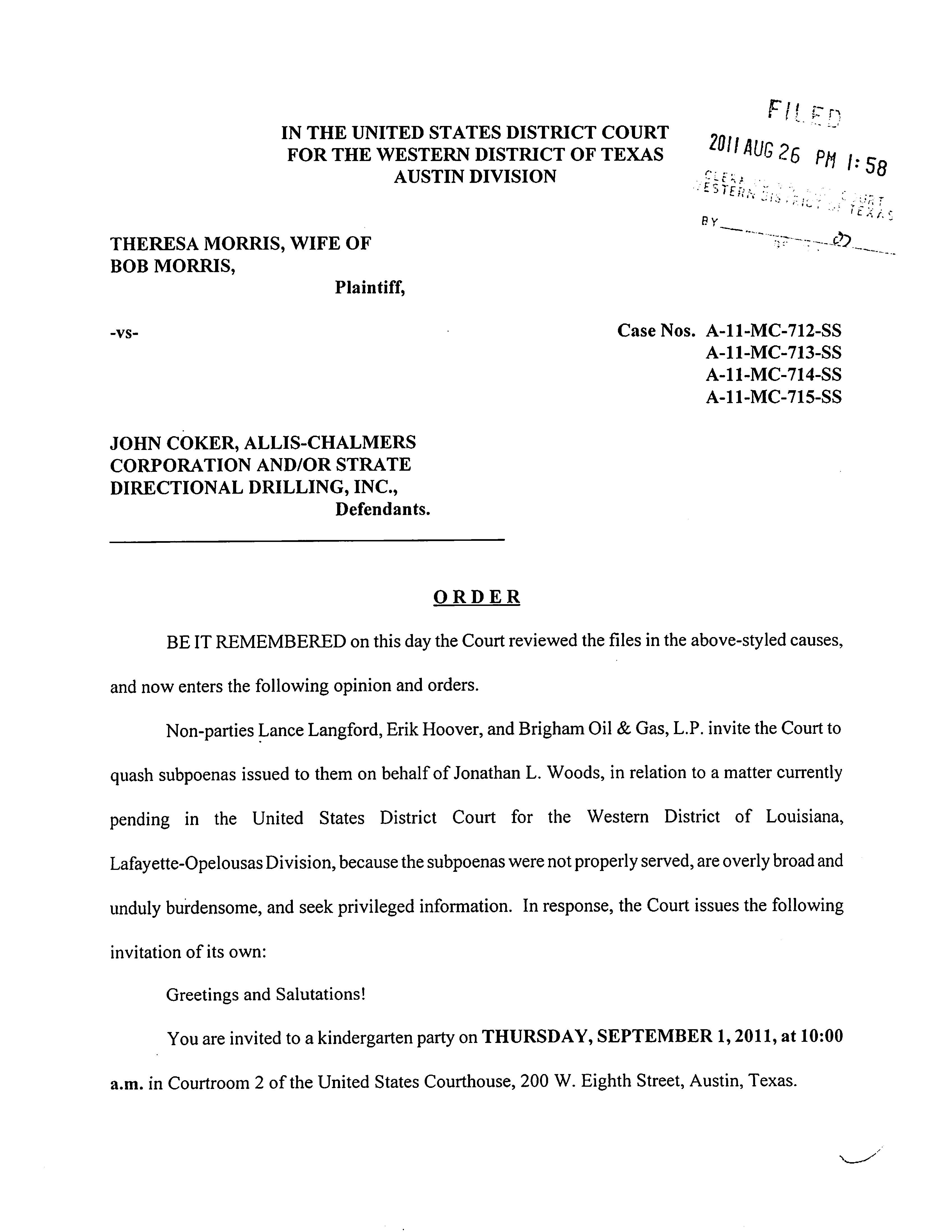
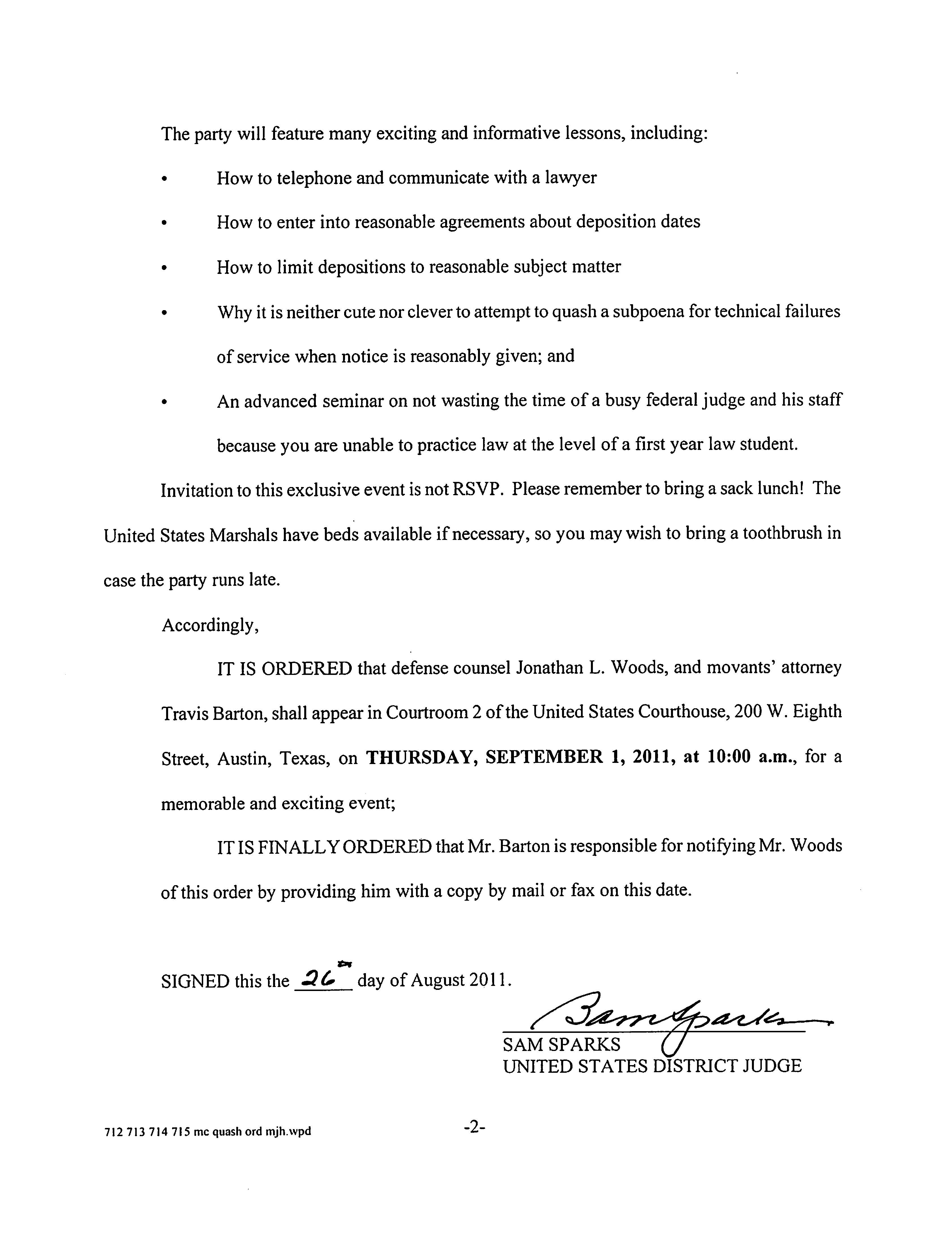
As I’ve said here before, some judges have no patience for discovery disputes.
Thanks to Attorney Marcus Evans
DECISIONS, DECISIONS, DECISIONS
August 25, 2011 § 1 Comment
It’s the end of a grueling three-day custody trial. The judge has recessed and will render a bench opinion at the end of the recess. You and opposing counsel are tired of the case, of fussing with each other, of the judge, of being out of the office, and of dealing with the clients. The judge gave the attorneys the option of a bench opinion or a written opinion later, and you and counsel opposite elected to end it right then and there.
Did you make the right choice? Maybe not.
The New York Times published a fascinating article on August 17, with the title, “Do You Suffer from Decision Fatigue?”
I encourage you to follow the link and print a copy. It is worth a read for every lawyer and judge to help understand how decison-making ability degrades with accumulation of decision-making, and how scheduling and trying matters may affect their outcome.
The study shows how the act of making decisions actually drains the brain of energy through the course of a day. Initially, the brain, full of energy and fresh, tackles decision-making with ease. The more decisions the brain is called on to make, however, the less energy it has available to devote to the task, and performance degrades. It’s like starting off on that jog through the park full of vigor and energy, and winding up panting and walking on jellyish legs to your car three miles later.
The study also says that blood glucose levels have an effect on decision making. The lower the blood sugar level of the decision maker, the more the decision maker suffers from decision fatigue. Decisions made after meals and snacks are, as a result, better reasoned and more true to the facts and law.
So what are the implications as you plod your way to the end of that stressful trial? Consider:
- It’s the judge’s job to make tough decisions every day, and quite often many times through the course of a day. Decison-making is not confined to the final outcome of the case. Decisions must be made objection-by-objection, and often in rapid-fire fashion. To top it off, good lawyers making strong legal arguments intensify the process.
- It’s true that judges are professionals, and that decision-making is part of the job, but judges are human, and are subject the to same fatigue factors as others.
- Keep in mind that the judge is not only depleting energy with decision-making while on the bench. The judge is paying attention, evaluating evidence and testimony and making notes, all of which in combination takes its own, separate toll.
- As an attorney, you can reduce wear and tear on your judge’s psyche by reducing the number of objections and preliminary matters you call on the judge to decide.
- If you anticipate that a witness will generate contentious argument and require rulings on admissibility, it’s probably best to tackle those early in the day before the judge has begun to wear down.
- You might want the judge to take the final decision under advisement, which allows the court to delay the decision to a time when the judge is more refreshed and capable of producing a better result.
I can tell you from experience that patience and insight both wane over the course of a taxing trial. I’ve remarked more than a few times to my wife after a trial that I was as worn out as if I had been one of the trial lawyers. You need to take that into consideration when you plan out your day in court.
THE INTERNET AND THE UNAUTHORIZED PRACTICE OF LAW, CHAPTER TWO
August 2, 2011 § Leave a comment
Only yesterday morning, I posted here about the internet and the unauthorized practice of law, taking the position that internet legal-forms dealers are practicing law without a license and raising the question “I wonder what the state bar and the district attorneys are doing to rein this in?”
Well, ask and ye shall receive.
Yesterday afternoon I received an email from the state bar announcing that it filed a petition with the Supreme Court last Friday to amend the appellate rules and the rules of professional conduct to define more clearly the practice of law and to spell out sanctions available to the courts for those who are found to be engaged in unauthorized practice.
You can read the proposed rules here.
Apropos of what I said in my post yesterday is a provision making it clear that drafting legal documents and pleadings is in itself practicing law. There are many other provisions in what amounts to a sweeping and all-encompassing statement of what constitutes the practice of law.
I urge you to read these proposed changes and I encourage you to comment on them if comments are called for. If the Supreme Court accepts these, they will likely be sent to the Rules Committee, of which I am a member. If it comes to that, I will welcome any input.
As I said in my prior post, this is not about the legal profession or convenience for judges. It is about protecting the public. I commend the bar for addressing this problem.
THE INTERNET AND THE UNAUTHORIZED PRACTICE OF LAW
August 1, 2011 § 3 Comments
It’s no secret that I am at least dubious about the efficacy and advisibility of lay persons representing themselves in court. My distaste for the practice rests primarily on the fact that most often it results in self-inflicted harm. Secondarily, I am concerned that lay litigants are unencumbered by any ethical or professional obligation of candor to the court and fair dealing with the other party.
Many lay-lawyers download forms from online vendors. The purveyors of these forms claim that they enable lay people to handle their own routine legal matters for less money than it would cost them to pay a lawyer.
My problem with that approach is two-fold:
First, how does a layperson decide that a legal matter is routine without some advice? How does a layperson know what the hidden pitfalls are if she has no one but a form to ask? Sure, she can check box A on the computer-downloaded form, but would box B be far more advantageous?
Second, is not the providing of legal forms in itself providing legal representation? The Mississippi Supreme Court answered the question in the case of Mississippi Commission on Judicial Performance v. Jenkins, 725 So.2d 162, 167 (Miss. 1998), in which the court stated:
” This Court defined the practice of law to include ‘… the drafting or selection of documents, the giving of advice in regard to them, and the using of an informed or trained discretion in the drafting of documents to meet the needs of the person being served. So any exercise of intelligent choice in advising another of his legal rights and duties brings the activity within the practice of the legal profession. Oregon State Bar v. Security Escrows, Inc., 233 Or. 80, 377 P.2d 334 (1962).’ Darby v. Mississippi State Bd. of Bar Admissions, 185 So.2d 684, 687 (Miss.1966).”
There is a class action lawsuit pending in Missouri raising the issue of unauthorized and inadequate practice of law by Legal Zoom, an online seller of legal advice via forms. The thrust of that lawsuit is that the company’s activities are inherently harmful to consumers because they violate the state’s public policy against unauthorized practice of law, which protects consumers. The trial judge has already overruled the company’s motion for summary judgment, and the company is mounting an ad campaign in the state to scare people into believing that their right of self-representation is under threat, and that lawyers are out to get their money.
We have seen our share of Legal Zoom-type documents and other internet lawyers in this district, but that’s not by any means all. We have shadowy individuals in the area who sell “secretarial services” in the form of complaints for irreconcilable differences divorces, PSA’s and judgments. Those clerk-typists are beyond a reasonable doubt unqualified to give legal advice. So what possibly qualifies them to prescribe the forms appropriate for a person’s legal problems, and to determine the appropriate content?
Caveat emptor, you might say. I answer: bull. Neither the legal profession nor the courts should countenance unqualified persons preying on unsuspecting laypeople. I wonder what the state bar and the district attorneys are doing to rein this in? After all, there is a state law making it a crime to practice law without a license.
As I have said before, I am all for self-representation. But I hate to see self-destruction. And I hate even more to see someone on the path to self destruction believing that they are protected by a piece of paper they bought off the internet or from a “secretarial service” with no legal advice to back it up.
This is not all about protecting lawyers or making it easier on the judges. This is all about making sure that the legal process produces as fair a result as possible, and that all who are involved in it deal with each other and the court with integrity and are fully informed of their rights and the ramifications of their actions.
WHEN IT COMES TIME TO BAIL OUT
July 28, 2011 § 5 Comments
Sometimes it happens that you find it necessary to withdraw from representing a client. Maybe an ethical dilemma has reared its head. Or perhaps you and your client have developed irreconcilable differences. Or it could be that your client has not met the terms of the employment contract as to cooperation or payment or in some other way.
Once you have entered an appearance in a case, you are in it until the court lets you out. You may not avoid responsibility simply by not participating further. So when the need arises, how can you make an effective exit?
Uniform Chancery Court Rule (UCCR) 1.08 provides: “When an attorney makes an appearance for any party in an action, the attorney will not be allowed to withdraw as counsel for the party except upon written motion and after reasonable notice to the client and opposing counsel.”
In other words, it’s not good enough to get an agreed order signed by counsel opposite and present it to the judge. Nor is it adequate to get your client to sign off on an order.
Here is what you have to do, step by step:
- File a motion to withdraw. Set out a general statement of your reason without compromising the interest of your client in the litigation.
- File the motion and send a copy of it with certificate of service to opposing counsel and the client.
- Notice the motion for hearing.
- If your client and opposing counsel will sign an agreed order allowing you to withdraw, present it to the court for entry.
- If either your client or opposing counsel, or both, object, hold a hearing and ask the court to rule on your motion.
Several caveats:
- If the case is set for trial, most chancellors will allow you to withdraw only in the most urgent and exigent circumstances.
- No chancellor will allow you to withdraw if to do so will seriously prejudice your client.
- You may not withdraw in any probate matter unless there is an attorney who will substitute for you. UCCR 6.01 requires that the fiduciary retain an attorney, unless the fiduciary is a licensed attorney.
- Be general in stating a reason. Okay: “The undersigned attorney and the plaintiff have differences of opinion about handling this case that can not be resolved.” Not okay: “My client has filed three bar complaints against me and has retained counsel to sue me for malpractice, and I have reason to believe he is concealing assets from the court.”
- Don’t include any language in your order that absolves you of any responsibility for anything you did in the case, or approves everything you did; that’s overreaching. You may state that you are relieved of all further responsibility from and after the date of the order allowing withdrawal.
- Many chancellors will not permit you to withdraw if the only basis is non-payment of fees. Their rationale is that you took on a professional duty to represent the client when you entered an appearance, and that duty is higher than your desire to be paid.
COA SINKS ANOTHER APPEAL FROM A LESS-THAN-FINAL JUDGMENT
July 20, 2011 § 4 Comments
It was only last month that the COA dispatched two appeals to dismissal-land because they were taken from less-than-final judgments. You can click the link to read about Jackson v. Lowe and S.E.B. v. R.E.B. The underlying principle is, you will recall, that an appeal only lies from a final judgment, and if any issues remain unadjudicated and not addressed as required in MRCP 54(b), your appeal will be dismissed.
The COA once again confronted the issue in R.A.S. Jr., K.S., A.S, V.S. and M.S. v. S.S., rendered July 19, 2011. In that case, the appellant, referred to as “Matt,” had filed a Chancery Court modification action seeking to reduce his $6,900 per month child support. His ex, “Anna,” responded by charging him with molesting one of their children. The charges were nol prossed, and Matt countered with a chancery motion for an accounting of the child support. Later, he filed an amended petition asking to “reform” original decree provisions for child support and custody.
The chancellor held a motion hearing and, without hearing any evidence, ruled from the bench that he was going to leave physical custody and legal custody as they were. He stated, “I’m not here today to decide [the modification issue] … I’m not going to address those motions stoday as to whether or not they meet the legal standard.” The judge later entered an order denying Matt’s request for an accounting, reserving ruling on the modification.
Matt filed a motion for a new trial (Note: in chancery this is a motion for rehearing, traditionally referred to as a motion for reconsideration), and Anna filed a motion for payment of certain expenses provided in the original judgment. The judge overruled Matt’s motion and denied Anna’s motion without addressing certain transportation expenses she had requested.
Matt complained on appeal that the chancellor refused to allow him to present evidence on his modification pleading, instead putting off a hearing so that Anna’s parenting could be monitored. A guardian ad litem had been appointed.
In every one of the chancellor’s rulings cited by the COA, it is clear that the judge was not making a final ruling. The COA said at ¶ 20 that
“The chancellor’s orders here were not final. We fully recognize that child-custody decisions are always subject to modification until the children’s emancipation. And no judgment entered is final in the sense of ending the case until that point. However, that the case involves custody modification does not eliminate the requirement that the chancellor enter a final, appealable judgment. Absent proper Rule 54(b) certification or the supreme court’s permission to proceed on an interlocutory appeal, which are both lacking here, piecemeal appeals are not allowed.
The chancellor clearly deferred ruling on contested issues, which he had not revisited when the parties appealed. Because we find the chancellor did not enter a final, appealable judgment, we dismiss this appeal for lack of jurisdiction.”
The court also pointed out that the supreme court has held in Michael v. Michael, 650 S0.2d 469, 471 (Miss. 1995), that parties may not appeal from a temporary order.
From Judge Maxwell’s opinion in this case, it appears that the record was somewhat confused. It may have been confusing to counsel as to exactly what matters were being addressed in which proceedings. I suggest you get a clear understanding with your chancellor either before hearing or when he casts the pleadings at the outset of trial as to what matters will be addressed. If you’re perplexed that the judge won’t address a certain issue at a certain time, try to pin him down on the record as to when, exactly, you can be heard on the issue.
In any event, the COA has once again sent an important message to trial and appellate counsel: If you don’t have a final, appealable judgment, your appeal will be dismissed.
NO WAY TO BREAK A DOG OF SUCKING EGGS
June 2, 2011 § Leave a comment
Oh, for the lost, effulgent epoch of mellifluous legal prose when only the most grandiloquent curlicues and glittering flourishes of the language graced the solomonic decrees of our learned justices.
Take this for example: “It is a fact of common knowledge that when a dog has once acquired the habit of egg-sucking there is no available way by which he may be broken of it, and that there is no calculable limit to his appetite in the indulgence of the habitual propensity.” How could this elemental principle underlying so much of our law be more succinctly and eloquently stated?
Thus Blogged Anderson offers his favorite from the 1900 MSSC decison in ICRR v. Johnson, which includes the memorable phrase: ” … the icecold law, from which no friction will excite sparks … “
And Tom Freeland, on NMisscommentor weighs in with his favorites, where you can find the cite to the egg-sucking-dog reference above, and the surprising identity of its author, as well as the case that includes the incisive and insightful quote: “It is not always conducive to domestic peace for a husband to contradict the statements of his wife … “
My bet is that the comments will produce at least a few more such gems. You should check them out.
JUDGE RUSSELL REPLACES JUDGE KING ON THE COA
May 25, 2011 § 3 Comments
Governor Barbour appointed Circuit Judge Ermea “E.J.” Russell of Hinds County, effective May 23, 2011, to fill the unexpired term on the COA formerly held by Judge Leslie King, who was earlier elevated to the Mississippi Supreme Court.
Judge Russell, who was Hinds County’s first black, female Circuit Judge, is the COA’s first black, female judge. She has been a member of the judiciary since her appointment by Governor Fordice in 1998.
The State Judiciary website press release on her swearing in is here.
The appointment continues the trend of excluding chancery judges from the appellate courts.
 The Better Chancery Practice Blog