CONSTITUTIONAL: MARTIN FACTORS AND GRANDPARENT VISITATION
May 21, 2012 § 3 Comments
Ever since grandparent visitation was enacted by our legislature in 1983, I have heard grumblings from some members of the bar that the statute is unconstitutional. The complaint chiefly is that it intrudes the state into the parent-child relationship and invades the province of parents’ decison-making, which should be beyond the state’s reach when the parents have not violated any laws or hurt their children.
The first test came in the case of Martin v. Coop, 693 So.2d 912 (Miss. 1997), in which the MSSC upheld the constitutionality of the statutes and established factors that trial courts were required to consider in adjudicating whether there should be grandparent visitation in a given case, and its terms.
The matter appeared to be settled until the US Supreme Court’s decision in Troxel v. Granville, 530 US 57 (2000), which held a visitation statute of the State of Washington to be unconstitutional. In Troxel the opponents saw another avenue of attack, and it was only a matter of time before the issue would percolate up from a trial court.
The first case in the aftermath of Troxel was Zeman v. Stanford, 789 So.2d 798 (Miss. 2001), in which the appellants questioned the constitutionality of MCA 93-16-3(1), which affords grandparental visitation when the parents are divorced and one parent has been awarded custody. The court in Zeman held that the constitutionality of that very statute had already been addressed and found constitutional in Martin v. Coop, and that Troxel added nothing new to the conversation.
The most recent iteration on the subject came in the case of Smith v. Wilson, an appeal from Chancellor Jim Davidson’s ruling in Lowndes County Chancery Court. In this case, the grandparents had sought visitation on the basis that their daughter, the child’s mother, had died. The judge granted the visitation in favor of the Wilsons, and the Smiths appealed, questioning the constitutionality of both MCA 93-16-3 and 93-16-5 in light of Troxel.
In its May 3, 2010, opinion authored by Justice King, the court first distinguished the statute deemed unconstitutional in Troxel. That Washington law provided:
Any person may petition the court for visitation rights at any time including, but not limited to, custody proceedings. The court may order visitation rights for any person when visitation may serve the best interest of the child whether or not there has been any change of circumstances.
The statute was too broad in scope, since it did not define any specific class of persons who would have standing to petition for visitation, and it did not protect the parent’s right to make decisions about rearing her children. As for other non-parental visitation statutes, the Supreme Court declined to go further, stating:
Because much state-court adjudication in this context occurs on a case-by-case basis, we would be hesitant to hold that specific non-parental visitation statutes violate the Due Process Clause as a per se matter.
Justice King pointed out that the Mississippi statute is not overly broad as was the statute in Troxel, and that both Martin and Zeman correctly dispose of the constitutionality argument through the application of the Martin factors, which protect the parents’ substantive due process rights. The court held that neither of the statutes nor the Martin factors violate the Constitution.
A couple of other points from the decision:
- The Smiths’ argument that the burden of proof should be by clear and convincing evidence, was rejected by the court, which found no authority for the proposition (¶¶ 26-27).
- The court found (¶30) no merit to the argument that chancellors should be required to defer to parents’ wishes. The court stated that “While a chancellor should accord special weight to a parent’s wishes, there is no automatic right to deference.
- Also rejected was the Smith’s argument that a parent must be found unfit before awarding grandparent visitation (¶¶31-32).
- The court held (¶¶33-35) that there is no requirement in the statute providing for visitation by the parents of a dead parent that there have been an unreasonable denial of visitation as a prerequisite.
The decision, joined in by all nine justices, affirmed Judge Davidson’s award of grandparent visitation.
So it would appear that the constitutionality of Mississippi’s grandparent visitation is laid to rest, at least for now. I do not know whether a petition for rehearing has been filed, but that would likely be a futile gesture considering the unanimity of the court. Maybe the appellants are maneuvering for a run at the US Supreme Court. We’ll see.
MORE ABC’S OF GRANDPARENT VISITATION
May 8, 2012 § Leave a comment
We’ve talked here and here about who are the necessary parties in a grandparent-visitation case under MCA 93-16-3. Here is a link to a post on the ins and outs of grandparent visitation.
After the petitioner has established entitlement to grandparent visitation under the statute, the chancellor must apply the factors set out in Martin v. Coop, 693 So.2d 912, 916 (Miss. 1997). The Martin v. Coop factors are here, in checklist form.
In the recent COA case of Bolivar v. Waltman, decided April 3, 2012, Judge Maxwell outlined the decision-making process:
Once the statutory criteria are established, the chancellor must apply the following Martin factors to determine appropriate visitation:
1. The amount of disruption that extensive visitation will have on the child’s life. This includes disruption of school activities, summer activities, as well as any disruption that might take place between the natural parent and the child as a result of the child being away from home for extensive lengths of time.
2. The suitability of the grandparents’ home with respect to the amount of supervision received by the child.
3. The age of the child.
4. The age, and physical and mental health of the grandparents.
5. The emotional ties between the grandparents and the grandchild.
6. The moral fitness of the grandparents.
7. The distance of the grandparents’ home from the child’s home.
8. Any undermining of the parent’s general discipline of the child.
9. Employment of the grandparents and the responsibilities associated with that employment.
10. The willingness of the grandparents to accept that the rearing of the child is the responsibility of the parent, and that the parent’s manner of child rearing is not to be interfered with by the grandparents.
Townes v. Manyfield, 883 So. 2d 93, 95-96 (¶17) (Miss. 2004) (quoting Martin, 693 So. 2d at 916). The Mississippi Supreme Court has explained that “making findings of fact under the Martin factors is an integral part of a determination of what is in the best interest of a child.” Id. at 97 (¶29) (quoting T.T.W. v. C.C., 839 So. 2d 501, 505 (¶12) (Miss. 2003)). Because of the “integral” nature of these findings, our supreme court specifically instructs that “the Martin factors are to be applied and discussed in every case in which grandparent visitation is an issue.” Id. (emphasis added).
¶11. There is additional general guidance regarding the amount of visitation that should be awarded. “The visitation granted to a grandparent should be less than that which would be awarded to a non-custodial parent, unless the circumstances overwhelming[ly] dictate that that amount of visitation is in the best interest of the child, and it would be harmful to the child not to grant it.” Id. at 96 (¶21). And in cases where “a chancellor finds . . . a grandparent should be awarded equivalent visitation to that of a parent, those findings must be fully discussed on the record.” Id. at 97 (¶29).
¶12. Further, we note that the grandparent-visitation statute and the Martin factors apply whether the grandparent is seeking visitation from a natural or adoptive parent. T.T.W., 839 So. 2d at 503-06 (¶¶1-2, 7, 10, 17) (finding grandparent-visitation statute and Martin factors applicable where maternal grandparents adopted children, and paternal grandmother sought visitation); see also Woodell v. Parker, 860 So. 2d 781, 785-86 (¶15), 789-90 (¶29) (Miss. 2003). Thus, we find it logical that both the grandparent-visitation statute and the Martin factors should similarly apply to the present situation where a grandparent is seeking visitation rights from the children’s legal guardians. See Townes, 883 So. 2d at 97 (¶29) (instructing that Martin factors must always be applied where grandparent visitation is at issue).
¶13. Because chancellors are required to make specific findings on the Martin factors in every case involving grandparent visitation, the supreme court has vacated grandparent visitation awards unsupported by such findings. Townes, 883 So. 2d at 97-98 (¶30); T.T.W., 839 So. 2d at 506 (¶17); Morgan v. West, 812 So. 2d 987, 992 (¶14), 997 (¶38) (Miss. 2002).
On remand, the chancellor should fully discuss his findings concerning the grandparent visitation statute and Martin factors. Failure to do so may amount to reversible error. See Townes, 883 So. 2d at 97-98 (¶¶28-30).
If your opinion or judgment does not include findings on the Martin factors, file a timely MRCP 59 motion asking the court to make such findings. That assumes, of course, that you put on enough evidence for the court to make such findings. As Judge Maxwell so clearly states, every grandparent vissitation case pivots on the Martin factors. They are vital to your case. Question the witnesses using them. Make your record, and make sure the chancellor addresses them in the ruling.
Only last week the MSSC unanimously upheld the constitutionality of Mississippi’s grandparent visitation statute and application of the Martin factors. We’ll talk about that later.
WHO ARE THE PARTIES IN A GRANDPARENT VISITATION CASE? PART TWO
April 18, 2012 § 1 Comment
In an earlier post we talked about how critical it is under the grandparent visitation statutes to join the natural parents.
The COA in Bolivar v. Waltman, decided April 3, 2012, raised the issue on its own and tossed out the appeal, vacating the trial court judgment in the process.
The natural parents of two minor children were divorced in 2006. The mother got custody and the father had visitation. In 2008, the Waltmans, who were maternal grandparents, got guardianship of the children due to both parents’ substance abuse. Initially the Waltmans afforded Bolivar, the paternal grandmother, the same every-other-weekend visitation that her son had enjoyed. Over time, however, the Waltmans began to curtail the time they allowed Bolivar, and she filed suit against the Waltmans in Jones County Chancery Court asking to be restored the full extent of her son’s visitation. The natural parents were not made parties.
Following a hearing the trial court granted Bolivar the same visitation that her son had under the original divorce judgment, and the Waltmans appealed.
In his opinion for the court, Judge Maxwell said:
¶6. Although neither party raises the issue of jurisdiction, we must do so on our own initiative. E.g., Michael v. Michael, 650 So. 2d 469, 471 (Miss. 1995) (citing Common Cause of Miss. v. Smith, 548 So. 2d 412, 414 (Miss. 1989); Cotton v. Veterans Cab Co., 344 So. 2d 730, 731 (Miss. 1977); Byrd v. Sinclair Oil & Refining Co., 240 So. 2d 623 (Miss. 1970)). Whether the chancery court had jurisdiction over a particular matter is a question of law, which the appellate court reviews de novo. In re Guardianship of Z.J., 804 So. 2d 1009, 1011 (¶9) (Miss. 2002) (citing Burch v. Land Partners, L.P., 784 So. 2d 925, 927 (¶7) (Miss. 2001)).
¶7. Mississippi Code Annotated section 93-16-5 establishes the necessary parties to a proceeding for grandparent visitation:
All persons required to be made parties in child custody proceedings or proceedings for the termination of parental rights shall be made parties to any proceeding in which a grandparent of a minor child or children seeks to obtain visitation rights with such minor child or children; and the court may, in its discretion, if it finds that such visitation rights would be in the best interest of the child, grant to a grandparent reasonable visitation rights with the child.
(Emphasis added). Section 93-15-107(1) lists as necessary parties in an action to terminate parental rights: “the mother of the child, the legal father of the child, and the putative father of the child, when known[.]” Miss. Code Ann. § 93-15-107(1) (Rev. 2004). Likewise, we find these same parties are also indispensable in a custody determination. See Miss. Code Ann. § 93-27-205 (Rev. 2004) (requiring service of process on “any parent whose parental rights have not been previously terminated” in interstate custody disputes); see also generally Deborah H. Bell, Bell on Mississippi Family Law § 19.01[3] (2005); cf. Smith v. Watson, 425 So. 2d 1030 (Miss. 1983) (finding a third-party with custody of a child is a proper party to a custody dispute between parents but not a necessary party).
¶8. We find section 93-16-5’s mandate clear and unambiguous that the natural parents whose parental rights have not been terminated must be parties to a grandparent-visitation proceeding. And we conclude that the requirement for the joinder of necessary parties in section 93-16-5 is jurisdictional. See Garrett v. Bohannon, 621 So. 2d 935, 937-38 (Miss. 1993) (holding similar mandatory “shall” language in Mississippi Code Annotated section 91-7-25 (Rev. 2004), which establishes necessary parties to will contest, is a jurisdictional requirement); In re Estate of McClerkin, 651 So. 2d 1052, 1058 (Miss. 1995) (holding trial court lacked jurisdiction over will contest because “necessary and proper parties were not before the court.”) (citations omitted). As the supreme court similarly found in Garrett, we find that to give validity and credence to the trial court’s judgment without joinder of necessary parties would undermine the legislative mandate in section 93-16-5. Garrett, 621 So. 2d at 937.
The court vacated the judgment and remanded the case to the chancery court for further proceedings.
Earlier this year, an astute lawyer raised the non-joinder of a natural parent as a defense in a grandparent visitation case and stopped a trial in my court dead in its tracks. To be honest, had he not raised the issue, I would have gone ahead with the trial simply because I had no reason to read the statute. If I had granted visitation, as the learned chancellor did in Bolivar, I guess it would have been reversible on the same ground.
As a practitioner, don’t rely on your rusty memory of the ins and outs of the code sections you are relying upon when you bring an action. Read the code. And, for Pete’s sake, don’t just blindly do a cut and paste job on the last similar set of pleadings you filed back in 2008. Code sections get amended. Case law changes things. Read the code. Stay current. Produce a quality product for your client that can’t be overturned.
NOT A MATHEMATICAL FORMULA
February 8, 2012 § Leave a comment
Some lawyers approach the Albright factors like some kind of score card. I remind you, however, that “The Albright factors are a guide. They are not the equivalent of a mathematical formula.” Lawrence v. Lawrence, 956 So.2d 251, 258 (Miss. App. 2006); Lee v. Lee, 798 So.2d 1284, 1288 (Miss. 2001).
In Divers v. Divers, 856 So.2d 370, 376 (Miss. App. 2003) the COA said:
In the difficult matter of determining child custody in divorce proceedings, the chancellor is necessarily vested with substantial discretion. Shepherd v. Shepherd, 769 So.2d 242, 245(¶ 11) (Miss.Ct.App.2000). In Hamilton v. Hamilton, this Court reviewed the record in that case and found that the chancellor should consider each Albright factor specifically in her decision for child custody. Id at (¶ 10). See also Hayes v. Rounds, 658 So.2d 863, 865 (Miss.1995). We found that it is not enough for the chancellor to simply state that she considered these factors. Hamilton, 755 So.2d at 530-31; Hayes, 658 So.2d at 865. If substantial evidence exists to support the chancellor’s finding of fact, broad discretion is afforded her determination. McEwen v. McEwen, 631 So.2d 821, 823 (Miss.1994).
In Johnson v. Gray, 859 So.2d 1006, 1013 (Miss. 2003), the supreme court said:
… a chancellor is never obliged to ignore a child’s best interest in weighing a custody change; in fact, a chancellor is bound to consider the child’s best interest above all else. ‘Above all, in ‘modification cases, as in original awards of custody,’ we never depart from our polestar consideration: the best interest and welfare of the child.’ ” Riley v. Doerner, 677 So.2d 740, 744 (Miss.1996) (quoting Ash v. Ash, 622 So.2d 1264, 1266 (Miss.1993)) (citing Marascalco, 445 So.2d at 1382). See also Albright v. Albright, 437 So.2d 1003, 1005 (Miss.1983). A modification of custody is warranted in the event that the moving parent successfully shows that an application of the Albright factors reveals that there had been a material change in those circumstances which has an adverse effect on the child and modification of custody would be in the child’s best interest. Sanford v. Arinder, 800 So.2d 1267, 1272 (Miss.Ct.App.2001).
Johnson also stands for the proposition that the chancellor must also take into account the credibility and demeanor of witnesses, and weight of the evidence.
In Weeks v. Weeks, 989 So.2d 408, 411 (Miss. App. 2008), the court affirmed the trial judge’s Abright findings even though the chancellor did not designate which party had “won” each factor. This is because Albright is not a scorecard. It is a template for the court to make findings pertinent to the parents’ relative parenting ability and what is in the best interest of the child. Thus, one or two factors might outweigh all the others combined. For example, the mother’s recent history of psychosis alone may outweigh the fact that she prevails in every other category. But the evidence to support an award of custody based on one or two factors must be strong, and the factors themselves must be substantially related to best interest of the children.
As to how detailed the chancellor’s findings need to be, the COA in Phillips v. Phillips, 45 So.3d 684, 695 (Miss. App. 2010), stated at ¶ 37 that ” … we are not aware of any requirement that the chancellor must acknowledge all of the facts in his analysis of the Albright factors that were presented at trial. The chancellor obviously listened to the testimony at trial — negative and positive for both parties — and made his opinion accordingly.”
CHILDREN IN THE VORTEX, PART TWO
February 2, 2012 § Leave a comment
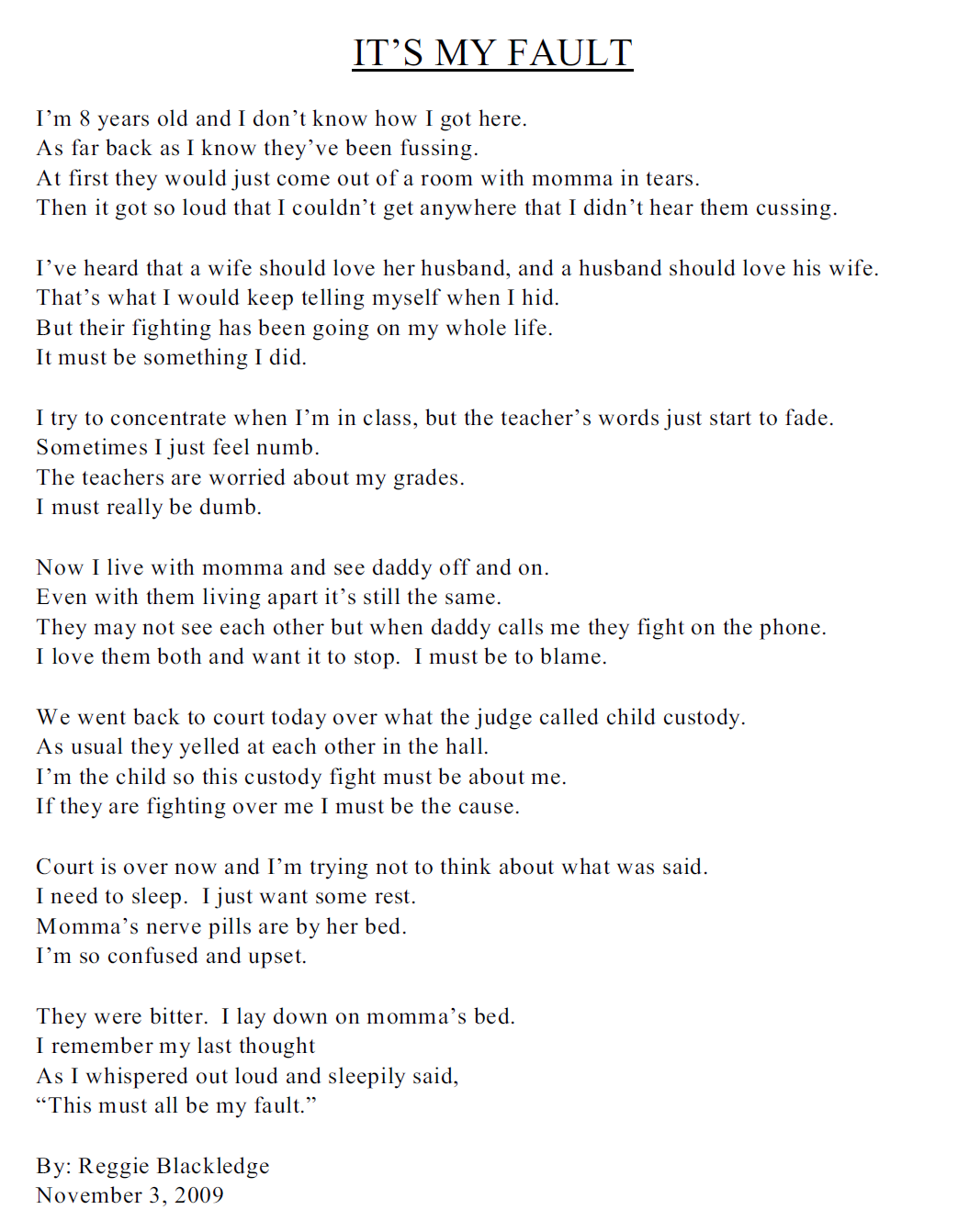
Yesterday I posted about children caught in the middle of divorce conflict. In response, Reggie Blackledge, a lawyer in Collins, MS, sent me this poem he wrote, with permission to share it with you.
CHILDREN IN THE VORTEX
February 1, 2012 § Leave a comment
The maelstrom of conflict between parents in a divorce or custody battle often catches up the children and dashes them against the same rocks that brought the marriage to destruction. Even the mildest custody conflict can damage children and their relationships with one or both parents, but the injury can be severe when the conflict is intense and where one or both parties bring the children into the vortex.
As an attorney, you stand in a position to influence your clients to minimize the damage. Here are some thoughts to share with your custody clients:
- A custody dispute is not about winning or losing. Custody is decided on the basis of what is in the best interest of the children. No matter what the judge decides, his or her decision will be based on what is best for the children. Help your client understand the Albright factors, how they apply in her case, and how to maximize her strong points while minimizing her exposure on the weak points.
- Hate and revenge do not help. If your client’s motivation for custody is hate and/or revenge, he will be operating under a considerable disadvantage because (1) those are not positive factors under Albright for custody, and (2) they communicate to the children that they are spoils of war to be won instead of children who are to be loved no matter what the controversy is between the parents.
- Never allow the children to make the custody decision. Children do not know what is best for them. They are subject to all sorts of influences, the strongest of which appeal to what they believe they want. It is appropriate to ask a mature child’s opinion, but only as input, never as a final decision. The parent or lawyer who tells a child “You will get to decide when you reach x age” is doing the child a great disservice because the law never gives the child a right to finally decide; that decision is always up to the judge. Children who are made to decide often feel that they have betrayed one parent or the other. Making a child decide is putting the child squarely in the middle of the conflict.
- Children who are placed in the middle learn to manipulate. Parents who put their children in the middle usually find that the children become master manipulaters, playing both sides against each other to gain whatever it is that the child wants or thinks he wants.
- Putting the children in the middle complicates the case. When the parties put the children in the middle, the resulting conflict spawns contempts, modifications, more discovery about all kinds of perpheral matters, and adds expense, stress, conflict and injured relationships to everyone’s plates.
- Drop the drama. The only enjoyable thing about a divorce or custody battle for most people is the attention and sympathy they derive from others over the suffering and pain they are having to endure. So when they find their friends’ and family’s attention wandering, they will ramp up the drama to regain the spotlight. That’s self-defeating because it usually takes some kind of negative action to stimulate the other side into conflict. The best and most productive policy is to drop the drama and act like an adult and a caring parent.
- Act like an adult. The best behavior you can model for your children is to act like an adult. Treat the other party with the respect he or she deserves as parent of your child. Eschew juvenile name-calling. Turn your back on invitations to argue. Avoid sarcasm and profanity. No threats, veiled or otherwise. Your children are watching and learning from your every move.
Lawyers are in a superior position to advise clients about where to expect to find pitfalls and landmines as they navigate the no-man’s land of child custody litigation. Don’t be reticent when it comes to guiding your clients and even bringing them up short whan they get out of line. That’s part of what you’re there for.
MANIFESTLY NOT IN ERROR
November 30, 2011 § 3 Comments
In several recent cases the COA affirmed chancellors where the trial court’s conclusions were supported by substantial evidence and were in line with the applicable law.
In Love v. Love, decided November 15, 2011, the court upheld the chancellor’s award of custody to the mother, Jennifer, over the father, Aaron, in spite of Jennifer’s less-then-stellar behavior. Judge Maxwell’s opinion stated at ¶36:
“The cold record, Aaron argues, is fraught with examples of Jennifer’s alleged misconduct and neglect. But the chancellor had an important hands-on benefit that we lack—her personal assessments of Jennifer’s and Aaron’s credibility—both at the custody hearing and post-trial hearing. Based on these interactions, the chancellor discounted some of the negative testimony about Jennifer, accepted much of it, and evaluated all of the testimony against the evidence of Jennifer’s care for Tommy. The chancellor ultimately found Jennifer had slightly better parenting skills and that it was in Tommy’s best interest that Jennifer be awarded custody and Aaron liberal visitation. Admittedly, this is a close case. But because the chancellor supported her decision with substantial evidence, we find our deferential standard requires us to affirm.”
Love highlights an important consideration in chancery cases: that the trial judge is in the best position to weigh the credibility of the witnesses. The cold record simply does not convey the way a witness presents himself or herself, the tone of voice, the hesitations, the body language, the facial expressions. In a close case credibility can hinge on how the witness presents himself or herself. A defensive, hostile witness who snaps answers off in a sarcastic tone will come across as less worthy of weight and credibility than one who presents herself as open, honest and matter-of-fact with nothing to hide. And yet the trial transcript will present both witnesses in the same light.
In Nichols v. Nichols, also decided November 15, 2011, the COA affirmed the chancellor’s award of custody to the father, stating at ¶11 that “We find that there was substantial evidence in the record to support the chancellor’s decision to award custody of the children to [the father].”
Only the week before, in Powell v. Powell, the COA had upheld the chancellor’s decision in equitable distribution, again finding that the chancellor had applied the law properly, and that his findings were supported by substantial evidence.
In Smullins v. Smullins, decided November 29, 2011, the COA upheld the chancellor’s Albright analysis based on a finding that it was supported by substantial evidence. The opinion was rendered on rehearing, and replaced an earlier opinion that had reversed the chancellor.
There have been other decisions along these lines dating back into 2010.
In my opinion, these cases are among a growing number of COA decisions where the court is refusing to second-guess chancellors and is limiting its scrutiny to a determination whether the chancellor’s decision was supported by substantial evidence, unless the chancellor abused his discretion, was manifestly wrong, was clearly erroneous, or an erroneous legal standard was applied, as the familiar introductory paragraph to every chancery court appellate decision recites.
If this continues, the bonus for lawyers and judges alike will be that there will be fewer anomalous decisions, and the proliferation of case law with which we have to deal will grow at a more manageable rate. Two trends that we all can applaud.
REVISITING TRIAL CHECKLISTS
November 22, 2011 § 2 Comments
Every few months I try to remind lawyers about the importance of putting on proof of the factors spelled out by the appellate courts that are required to make your case. This may also come in handy for any newcomers who haven’t stumbled on prior posts on the subject.
I’ve referred to it as trial by checklist. If you’re not putting on proof of the factors when they apply in your case, you are wasting your and the court’s time, as well as your client’s money, and you are committing malpractice to boot.
Many lawyers have told me that they print out these checklists and use them at trial. I encourage you to copy these checklists and use them in your trial notebooks. And while you’re at it, you’re free to copy any post for your own personal use, but not for commercial use. Lawyers have told me that they are building notebooks tabbed with various subjects and inserting copies of my posts (along with other useful material, I imagine). Good. If it improves practice and makes your (and my) job easier and more effective, I’m all for it.
Here is a list of links to the checklists I’ve posted:
Doing an accounting in a probate matter.
Income tax dependency exemption.
Modification of child support.
Periodic and rehabilitative alimony.
To make it easier to find checklists, I’ve added a category that you can search by using the category search tool on the right side of the page.
Next time the court denies your claim for attorney’s fees or for your client to claim the tax exemption for the children, ask yourself whether you put on the necessary proof. Not only is it crucial to your case at trial to prove all of the applicable factors, but you can’t expect to have a prayer on appeal without the requisite proof in the record.
4 WAYS TO LOSE THE NATURAL PARENT PRESUMPTION
November 2, 2011 § 3 Comments
It’s an axiom of Mississippi law that the natural parents, if fit, are presumed to have the first right against everyone else in the world to have custody of their children. K.D.F. v. J.L.H., 933 So.2d 971, 980 (Miss. 2006). This means that, if the natural parent is challenged for custody by a non-parent, there must be a showing of unfitness that will trigger an Albright analysis to determine the best interest of the children.
That presumption, however, can be lost. Here are the 4 ways:
- Voluntary Court Order. If the parent voluntarily relinquishes custody and there is a court order to that effect, the presumption is lost, and the party to whom custody is relinquished gets custody until there can be shown to be a material change in that person’s household that is having an adverse effect on the children, and it is in the best interest of the children to change custody. Grant v. Martin, 757 So.2d 264 (Miss. 2000). In Grant, the MSSC held that the natural mother who had agreed by court order giving her parents custody had given up the natural parent presumption, with the effect that she had to prove material change-adverse effect-best interest to regain custody. Under Grant, it is immaterial whether the natural parent is unfit or has abandoned or deserted the children; the operative fact is the agreement memorialized by a court order. Note that the court has declined to extend Grant to include temporary orders. Vaughn v. Davis, 36 So.3d 1261, 1266 (Miss. 2010).
- Abandonment. A parent who is shown by “clear proof” to have abandoned the children has lost the presumption. McKee v. Flynt, 630 So.2d 44, 47 (Miss. 1993). Abandonment is ” … any conduct on the part of the parent which evinces a settled purpose to forego all duties and relinquish all parental claims to the child …” In re Leverock and Hamby, 23 So.3d 424, 429 (Miss. 2009), citing Ainsworth v. Natural Father, 414 So.2d 417, 419-20 (Miss. 1982), which defined abandonment as including both active relinquishment and avoidance of duty.
- Desertion. Inaction or avoidance of duty toward the children. Requires clear and convincing evidence. In Leverock, at 33, the Court found that a father had deserted his son by completely avoiding both his moral and legal duties and obligations as a father for more than two years, during which time he had showed a complete disregard for the welfare of his son. The court said that the father had chosen “ ‘to take an extended holiday from the responsibilities of parenthood’ and we find that he should not now be able to claim the benefit of his status as a natural parent….” Once the finding of desertion is made based on clear and convincing evidence, the court must embark on an Albright analysis.
- Adjudication of Unfitness. When the court awards custody to a third party based on the natural parent’s unfitness, the presumption no longer applies, and the material change-adverse effect-best interest standard applies. Adams v. Johnson, 33 So.3d 551, 555 (Miss. App. 2010).
 The Better Chancery Practice Blog