





Update on the Contest
January 10, 2018 § 21 Comments
Back in November I reported that the BCPB had come in second overall in the Expert Institute’s Best Legal Blogs contest. As I posted here on November 8, that is quite an achievement thanks to all of you.
I reckoned that that was the end of that, but I was wrong.
During the holidays a package arrived in the mail from the Expert Institute. Inside was an attractive box adorned with a blue ribbon.


Inside was this letter …
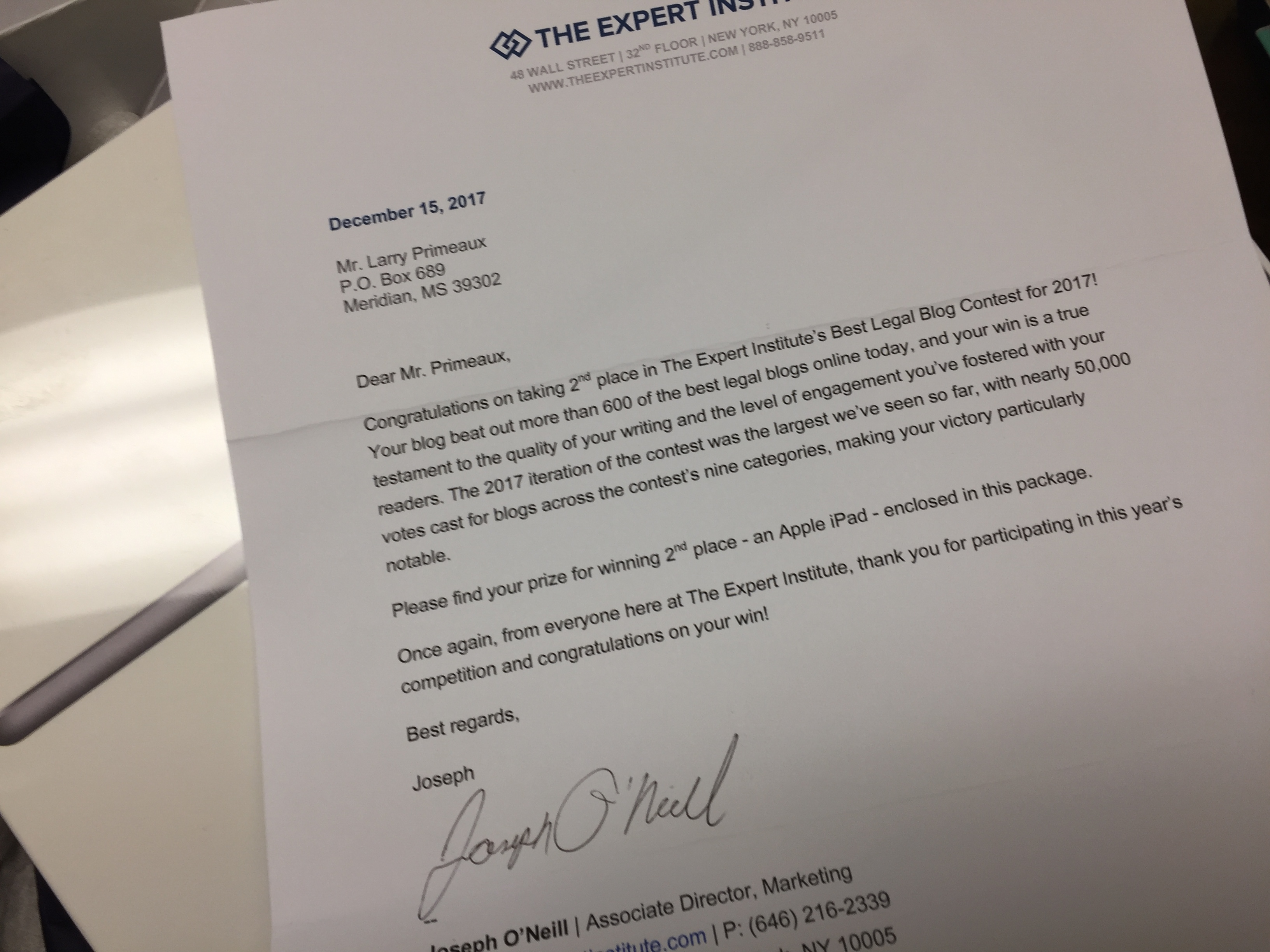
As promised also enclosed was an iPad, new and unopened, sealed in its own packaging. Wow. Something I never expected. Oh, and add in two pens, a journal, and a t-shirt.
So, once again, thanks to all of you who voted. You brought the blog this recognition and earned me this prize. And to whomever made the nomination and started this process, thank you.
It’s heartening to know I have a loyal readership. I hope each of you gets a sound return on the investment of time you make reading here. Thanks again.
Adverse Possession: How You Got There Makes All the Difference
January 9, 2018 § Leave a comment
The Joneses filed suit against the Pruitts claiming that they had acquired title to two parcels of the Pruitt’s land. They claimed adverse possession as to one part, and a prescriptive easement as to another.
The chancellor ruled in favor of the Pruitts, and the Joneses appealed.
in Estate of Jones, et al. v. Pruitt, decided September 26, 2017, the COA affirmed. For purposes of this post, we will focus on the permissive nature of the use. Judge Irving wrote for a more-or-less unanimous court (two judges “concur in part and in result without separate written opinion”):
¶13. The Joneses argue that the chancery court erred in denying their claims for adverse possession or a prescriptive easement with respect to the 455-foot roadway, and for adverse possession with respect to the deer-camp structure. Mississippi Code Annotated section 15-1-13(1) (Rev. 2012) provides:
Ten (10) years’ actual adverse possession by any person claiming to be the owner for that time of any land, uninterruptedly continued for ten (10) years by occupancy, descent, conveyance, or otherwise, in whatever way such occupancy may have commenced or continued, shall vest in every actual occupant or possessor of such land a full and complete title . . . .
“The standard and burden of proof to establish a prescriptive easement is the same as a claim for adverse possession of land.” Morris v. W.R. Fairchild Constr. Co., 792 So. 2d 282, 284 (¶7) (Miss. Ct. App. 2001) (citation omitted). In either claim, the following elements must be proven: that use of the property is “(1) under a claim of ownership; (2) actual or hostile; (3) open, notorious and visible; (4) continuous and uninterrupted for a period of ten years; (5) exclusive; and (6) peaceful.” Webb v. Drewrey, 4 So. 3d 1078, 1082 (¶12) (Miss. Ct. App. 2009). “The person claiming the possession has the burden of proving each of these elements by clear and convincing evidence.” Biddix v. McConnell, 911 So. 2d 468, 475 (¶18) (Miss. 2005) (citation omitted).
a. Roadway
¶14. First, the Joneses maintain that the chancery court erred in finding that their use of the 455-foot roadway was permissive—and therefore insufficient to satisfy the hostility requirement of adverse possession or a prescriptive easement—on the basis that the Pruitts had given them verbal permission to use the roadway. In support of their argument, the Joneses cite this Court’s decision in Delancey v. Mallette, 912 So. 2d 483, 489 (¶17) (Miss. Ct. App. 2005), in which we held that “[w]hen a use of the lands of another for roadway purposes has been open, visible, continuous and unmolested since some point in time anterior to the aged inhabitants of the community, such use will be presumed to have originated adversely.” (Quotations omitted). Further, the Joneses argue that “[r]equiring a litigant who is attempting to establish adverse possession or a prescriptive easement to prove that there was no permission for use would be unreasonable. The law typically frowns upon requiring a party to prove a negative averment.” Morris, 792 So. 2d at 284 (¶9).
¶15. In response, the Pruitts contend that one of the most basic principles in establishing adverse possession or a prescriptive easement is that the use must be hostile, and that “permissive use by the possessor of the property in question defeats the claim of adverse possession.” Ellison v. Meek, 820 So. 2d 730, 735 (¶15) (Miss. Ct. App. 2002) (citation omitted). In support of their argument, the Pruitts cite the testimony at trial that the Pruitts and Joneses had a friendly relationship up until this dispute. The Pruitts further argue that the fact that Sidney kept the gate locked is consistent with Bocee’s testimony at trial that she allowed him to cross into her land as long as he watched out for her property. Additionally, the Pruitts argue that the fact that Sidney never gave Bocee a key is irrelevant, as Sidney, himself, admitted that the Pruitts did not need a key to access the Joneses’ property.
¶16. This Court held in Cleveland v. Killen, 966 So. 2d 848, 851 (¶11) (Miss. Ct. App. 2007):
As a general rule, permissive possession of lands, even if long continued, does not confer title in the person in permissive possession until a positive assertion of a right hostile to the owner has been made known to him. If there was never a request or a grant of permission to use the land, however, the use would not be permissive, but would be adverse. It is a fact question for a chancellor to determine whether a use is prescriptive or permissive.
(Internal citations and quotations omitted). Furthermore, we reiterated:
Use of property by permission does not evolve into a hostile or adverse use until the permission ends. The time period for obtaining adverse possession or a prescriptive easement, when express or implied permission is previously given, does not begin to run until some form of objection to the use is made by the landowner.
Id. at 852 (¶15).
¶17. Chancellor Harvey-Goree, in her order, found that “all the testimony revealed that the use [of the roadway] was peaceable and permissive.” Chancellor Clark made similar findings in his order on the Joneses’ motion for reconsideration or for a new trial, and affirmed Chancellor Harvey-Goree’s holding with respect to the roadway. We affirm. The record is void of any evidence suggesting that the Joneses’ use of the roadway was anything but peaceful. Furthermore, Irozenell even testified at trial that she never sought to bar the Joneses from using the roadway; rather, she merely sought to have them remove their lock from the gate on the roadway. As such, the Joneses have failed to establish that their use of the roadway was hostile, and their claim for adverse possession or a prescriptive easement thereto is unsuccessful.
That language in the statute, ” … in whatever way such occupancy may have commenced or continued … ,” simply does not embrace occupancy that was commenced or continued by permission because it is not hostile or adverse.
Here the Pruitts gave the Joneses permission to be on the property. The same result would obtain if the occupancy were commenced pursuant to a lease. Both Judge Mason and I have had adverse possession cases involving leases.
Another important point to leave with is that the elements of adverse possession must all be proven by clear and convincing evidence in order to establish a prescriptive easement.
Understanding the MEC Privacy Requirements
January 8, 2018 § 2 Comments
Section 9(A) of the MEC administrative procedures imposes a duty to protect sensitive information of parties and children in filings with the court. Social Security numbers, names of minor children, dates of birth, and financial account numbers are prohibited and must be redacted. Attorneys are directed to use caution with personal identifying numbers (e.g., driver’s license numbers), medical records, employment history, individual financial information, and proprietary or trade-secret information.
There are exceptions, however, set out in Section 9(B). It states:
The redaction requirement shall not apply to the following:
- The record of an administrative or agency proceeding.
- The record of a court or tribunal, if that record was not subject to the redaction requirement when originally filed. See Section 5(D) for a listing of restricted access cases.
- Documents filed under seal.
- Documents filed as Restricted Access if the private information is necessary and relevant to the case. See Section 5(D) for listing of restricted access cases.
Section 5(D) designates certain cases as “Restricted Access” (RA), meaning that persons other than the attorneys of record and clerks will only be able to view remotely the case’s docket page; as with other unsealed cases, the public may view documents on file in RA cases at the terminal in the clerk’s office.
Cases designated as RA include:
Debt Collection; Garnishment; Replevin; Child Custody/Visitation; Child Support; Divorce, both fault and irreconcilable differences; Modification; Paternity; Termination of Parental Rights; Birth Certificate Correction; Conservatorship; Guardianship; Minor’s Settlement; Protection from Domestic Abuse Law.
Note that adoption is not listed. That’s because adoptions are under seal, and so are exempted under 9(B)(3), above.
Also not listed are estates. That means that the redaction requirements do, indeed, apply to them.
Even if your case is not designated in the rule as an RA case, you may still move the court to restrict a document or the entire case for good cause, per Section 5(D)(3).
Just because your case falls in an RA category does not mean that can or should ignore your client’s right to privacy. Social Security numbers, financial account numbers, passwords, and personal identifying numbers should always be scrubbed from documents filed with the court, exchanged in discovery, and introduced into evidence, unless your client has specifically authorized you to release that specific information.
And remember that MRCP 5.1 extends the MEC privacy rules to districts using non-MEC electronic filing.
“Quote Unquote”
January 5, 2018 § Leave a comment
“The core and the surface
Are essentially the same
Words making them seem different
Only to express appearance.
If name be needed, wonder names them both:
From wonder into wonder existence opens.” — Laozi
“Wonder is the beginning of wisdom.” — Socrates
“Philosophy is the product of wonder.” — Alfred North Whitehead

Off to the Races!
January 3, 2018 § 1 Comment
The qualifying period for judicial elections is now open, and will be until the first Tuesday in May, 2018. General election is in November, 2018.
I am hearing that there will be a significant number of positions that will come open by retirement or resignation. In my local courts, for instance, one chancery position will be open due to Judge Mason’s retirement at the end of the year, as will one circuit position due to Judge Williamson’s retirement. Another circuit court slot is being held by an appointee who must stand for election, as is one county court position. Of course, all trial judges in office stand for election this year and may face opposition.
We are not unique over here in East Mississippi. I understand that there will be openings and contested elections across the state. In one district, the 14th, all three chancellors are stepping aside (unless there is a change of heart).
There is a saying: “May you live in interesting times.” It’s a pleasant-sounding but ironic statement actually intended to be a curse, the subtlety being that interesting times are often dangerous, fraught with uncertainty, and full of often unpleasant surprises.
2018 will be an interesting time for Mississippi’s judiciary.
 The Better Chancery Practice Blog