TEMPORARY SUPPORT AND ITS IMPACT ON THE FINAL OUTCOME
December 6, 2011 § Leave a comment
I argued with sporadic success when I was in practice that the court should consider the amount of temporary spousal support paid when making its final determination of equitable distribution. It’s only logical, when you think about it. The paying spouse is having to defer further accumulation of wealth to support the other, and, in some cases, is required to deplete a separate estate to do so. Many divorce cases take months, even years, to come to trial, and the payments for temporary support do mount up.
So what is the likelihood that you can prevail with such an argument?
A case you can cite for authority is Wells v. Wells, 35 So.3d 1250, 1258 (Miss.App. 2010). In that case, the chancellor had considered in her Ferguson analysis under “Any Other Factors That Should be Considered” the fact that the husband had paid the wife over $80,000 a year since the temporary judgment, including $1,500 a month in temporary alimony, and $650 a month as a grocery allowance. The COA affirmed the chancellor’s division of the marital estate, concluding that “We cannot find that the chancellor’s division was clearly erroneous. The Ferguson factors were thoroughly considered, and the division was made in such a way as to eliminate alimony.”
An arrow you might want to have in your quiver next time you’re looking to score a bullseye for your client.
UCCR 8.05, AMENDED
December 5, 2011 § Leave a comment
The Mississippi Supreme Court approved an amendment to the financial reporting form requirement on December 1, 2011. You can read the entire, amended rule here.
The amendment adds the following language:
The disclosures shall include any and all assets and liabilities, whether marital or non-marital. A party is under a duty to supplement prior disclosures if that party knows that the disclosure, though correct when made, no longer accurately reflects any and all actual income and expenses and assets and liabilities, as required by this Rule.
The amendment adds two significant provisions: (1) The duty to disclose both marital and non-marital financial matters; and (2) the duty to supplement.
Both of the added requirements clarify the duty of disclosure and give the courts clearcut authority when called upon to address less than candid financial reporting.
If I were practicing nowadays, I would create a handout for my clients detailing the duty of disclosure and the duty to supplement, and I would have my client sign a receipt for the handout to keep in my file. It could come in handy when the client gets burned to a charred ember for false or inadequate disclosure, and the client tries to point the finger of blame at the attorney.
I would also take great care with my 8.05’s. I would go over them with my clients to make sure they are complete and accurate.
If you still aren’t convinced of the importance of adequate, timely, up-to-date and supplemented 8.05 statements, I invite you to read yet again about the disastrous (for the non-disclosing party) case of Trim v. Trim. Fair warning, however: don’t read Trim right before bed time; it might keep you awake.
I’ve tried to stress on this blog just how crucial it is to your case to present a well-prepared financial statement. Here are some links:
“QUOTE UNQUOTE”
December 2, 2011 § 1 Comment
 “There is no earthly reward for our spiritual efforts. There isn’t even a connection. The payoff for turning to God is more God, not more world.” — Hugh Prather
“I have only a small flickering light to guide me in the darkness of a thick forest. Up comes a theologian and blows it out.” — Denis Diderot
“That you need God more than anything you know at all times in your heart. But don’t you know also that God needs you — in the fullness of his eternity, you?” — Martin Buber
RIP BILL WALLER
December 1, 2011 § Leave a comment
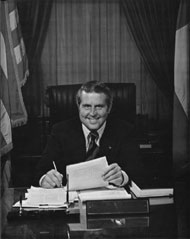
Gov. Waller at work
Former Mississippi governor (1972-1976) and distinguished member of the bar, William Lowe Waller, Sr., died November 30, 2011. He was 85.
He was a champion of the people, and was ahead of his time on civil rights issues. As a District Attorney, he unsuccessfully attempted to prosecute Byron De La Beckwith for the murder of Medgar Evers. He did away with the state’s spy agency, the infamous Sovereignty Commission, by vetoing its appropriations. He opened state government jobs to African Americans, appointing many to fill positions. His son, William L. Waller, Jr., is Chief Justice of the Mississippi Supreme Court.
Philip Thomas’s reminiscence of the governor as adverse counsel is worth a read.
ELOQUENCE FROM THE GRAVE
December 1, 2011 § Leave a comment
We all have had a client or two who wished to wax eloquent in his or her will. You know what I’m talking about: a sermonette; a poem; an admonishment; a reproof; or even a love note. It happens, and you accommodate the client, blending the proffered language into your more prosaic will form, tucked strategically in among the bequests and devises.
I came across a rather extreme example in the blog Futility Closet, and decided to share it with you:
At a dinner for law alumni of New York University in 1907, Walter Lloyd Smith of the New York Supreme Court read “the most remarkable document that ever came into his possession” — the will of an inmate of the Cook County Insane Asylum at Dunning, Ill.:
I, Charles Lounsbury, being of sound mind and disposing memory, do hereby make and publish this, my last will and testament, in order as justly as may be to distribute my interest in the world among succeeding men.
That part of my interest which is known in law and recognized in the sheep-bound volumes as my property, being inconsiderable and of no account, I make no disposal of in this my will.
My right to live, being but a life estate, is not at my disposal, but these things excepted all else in the world I now proceed to devise and bequeath.
Item: I give to good fathers and mothers, in trust for their children, all good little words of praise and encouragement, and all quaint pet names and endearments, and I charge said parents to use them justly and generously, as the needs of their children may require.
Item: I leave to children inclusively, but only for the term of their childhood, all and every, the flowers of the fields, and the blossoms of the woods, with the right to play among them freely according to the customs of children, warning them at the same time against thistles and thorns. And I devise to children the banks of the brooks, and the golden sands beneath the waters thereof, and the odors of the willows that dip therein, and the white clouds that float high over the giant trees. And I leave the children the long, long days to be merry in, in a thousand ways, and the night and the moon and the train of the Milky Way to wonder at, but subject nevertheless to the rights hereinafter given to lovers.
Item: I devise to boys jointly all the useful idle fields and commons where ball may be played; all pleasant waters where one may swim; all snowclad hills where one may coast, and all streams and ponds where one may fish, or where, when grim Winter comes, one may skate; to have and to hold the same for the period of their boyhood. And all meadows with the clover blossoms and butterflies thereof, the woods and their appurtenances, the squirrels and the birds, and echoes and strange noises, and all distant places which may be visited, together with the adventures there found. And I give to said boys each his own place at the fireside at night, with all pictures that may be seen in the burning wood, to enjoy without let or hindrance and without any incumbrance of care.
Item: To lovers I devise their imaginary world with whatever they may need; as the stars of the sky; the red roses by the wall; the bloom of the hawthorn; the sweet strains of music, and aught else by which they may desire to figure to each others the lastingness and beauty of their love.
Item: To young men jointly, I devise and bequeath all boisterous, inspiring sports of rivalry, and I give to them the disdain of weakness and undaunted confidence in their own strength, though they are rude; I give them the power to make lasting friendships, and of possessing companions, and to them exclusively I give all merry songs and brave choruses, to sing with lusty voices.
Item: And to those who are no longer children or youths or lovers, I leave memory, and I bequeath to them the volumes of the poems of Burns and Shakespeare and of other poets, if there be others, to the end that they may live over the old days again, freely and fully, without tithe or diminution.
Item: To our loved ones with snowy crowns I bequeath the happiness of old age, the love and gratitude of their children until they fall asleep.
The original, it turns out, was written by Williston Fish in 1897 and published in Harper’s Weekly the following year. He had intended it as a poetic trifle, but newspapers around the country had picked it up and run it as fact, often embellishing the language, until, Fish wrote in 1908, “this one of my pieces has been translated into all the idiot tongues of English.” Charles Lounsbury was the name of an old relative of his — “a big, strong all-around good kind of man,” but not, evidently, insane.
 The Better Chancery Practice Blog