MR. FAULKNER UP CLOSE AND PERSONAL
January 28, 2011 § Leave a comment
I found this remarkable material on Oxford’s William Faulkner recently. Some of the photos are priceless, like the one of Faulkner and Welty. The Q and A session offers an insight into one of America’s greatest authors — at least as he saw writing and the world in that still-unsettled era in the aftermath of World War II and at the beginning of the Cold War.
* * * * *
In spring of 1947, the English department of the University of Mississippi had William Faulkner address one class a day for a week. The teacher of each class was barred from attending the sessions.
Faulkner spent the entire time answering questions from students.

In the side yard at Rowan Oak
Q: Which of your books do you consider best?
WILLIAM FAULKNER: As I Lay Dying was easier and more interesting. The Sound and The Fury still continues to move me. Go Down, Moses – I started it as a collection of short stories. After I reworked it, it became seven different facets of one field. It is simply a collection of short stories.
Q: In what form does the initial idea of a story come to you?
WF: It depends. The Sound and The Fury began with the impression of a little girl playing in a branch and getting her panties wet. This idea was attractive to me, and from it grew the novel.
Q: How do you go about choosing your words?
WF: In the heat of putting it down you might put down some extra words. If you rework it, and the words still ring true, leave them in.
Q: What reason did you have for arranging the chapters of The Wild Palms as you did?
WF: It was merely a mechanical device to bring out the story I was telling, which was one of two types of love. I did send both stories to the publisher separately, but they were rejected because they were too short. So I alternated the chapters of them.
Q: How much do you know about how a book will turn out before you start writing it?
WF: Very little. The character develops with the book, and the book with the writing of it.
Q: Why do you present the picture you do of our area?
WF: I have seen no other. I try to tell the truth of man. I use imagination when I have to and cruelty as a last resort. The area is incidental. That’s just all I know.
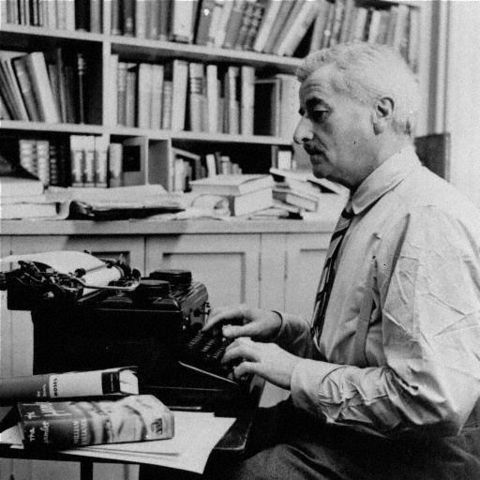
The writer at his craft
Q: Since you do represent this picture, don’t you think it gives a wrong impression?
WF: Yes, and I’m sorry. I feel I’m written out. I don’t think I’ll write much more. You only have so much steam and if you don’t use it up in writing it’ll get off by itself.
Q: Did you write Sanctuary at the boilers just to draw attention to yourself?
WF: The basic reason was that I needed money. Two or three books that had already been published were not selling and I was broke. I wrote Sanctuary to sell. After I sent it to the publisher, he informed me, “Good God, we can’t print this. We’d both be put in jail.” The blood and guts period hadn’t arrived yet. My other books began selling, so I got the galleys of Sanctuary back from the publisher for correction. I knew that I would either have to rework the whole thing or throw it away. I was obligated to the publisher financially and morally and upon continued insistence I agreed to have it published. I reworked the whole thing and had to pay for having the new galleys made. For these reasons, I didn’t like it then and I don’t like it now.
Q: Should one re-write?
WF: No. If you are going to write, write something new.
Q: How do you find time to write?
WF: You can always find time to write. Anybody who says he can’t is living under false pretenses. To that extent depend on inspiration. Don’t wait. When you have an inspiration put it down. Don’t wait until later and when you have more time and then try to recapture the mood and add flourishes. You can never recapture the mood with the vividness of its first impression.

At Rowan Oak
Q: How long does it take you to write a book?
WF: A hack writer can tell. As I Lay Dying took six weeks. The Sound and The Fury took three years.
Q: I understand you can keep two stories going at one time. If that is true, is it advisable? WF: It’s all right to keep two stories going at the samet ime. But don’t write for deadlines. Write just as long as you have something to say.
Q: What is the best training for writing? Courses in writing? Or what?
WF: Read, read, read! Read everything – trash, classics, good and bad; see how they do it. When a carpenter learns his trade, he does so by observing. Read! You’ll absorb it. Write. If it is good you’ll find out. If it’s not, throw it out the window.
Q: Is it good to copy a style?
WF: If you have something to say, use your own style: it will choose its own type of telling, its own style. What you have liked will show through in your style.
Q: Do you realize your standing in England?
WF: I know that I am better thought of abroad than here. I don’t read any reviews. The only people with time to read are women and rich people. More Europeans read than do Americans.
Q: Why do so many people prefer Sanctuary to As I Lay Dying?
WF: That’s another phase of our American nature. The former just has more commercial color.
Q: Are we degenerating?
WF: No. Reading is something that is in a way necessary like heaven or a clean collar, but not important. We want culture but don’t want to go to any trouble to get it. We prefer reading condensations.
Q: That sounds like a slam on our way of living.
WF: Our way of living needs slamming. Everybody’s aim is to help people, turn them to heaven. You write to help people. The existence of this class in creative writing is good in that you take time off to learn to write and you are in a period where time is your most valuable possession.
Q: What is the best age for writing?
WF: For fiction the best age is from 35-45. Your fire is not all used up and you know more. Fiction is slower. For poetry the best age is from 17 to 26. Poetry writing is more like a skyrocket with all your fire condensed in one rocket.

Q: How about Shakespeare?
WF: There are exceptions.
Q: Why did you quit writing poetry?
WF: When I found poetry not suited to what I had to say, I changed my medium. At 21 I thought my poetry very good. At 22 I began to change my mind. At 23 I quit. I use a poetic quality in my writing. After all, prose is poetry.
Q: Do you read a good bit?
WF: Up until 15 years ago I read everything I could get a hold of. I don’t even know fiction writers’ names much now. I have a few favorites I read over and over again.
Q: Has “The Great American Novel” been written yet?
WF: People will read Huck Finn for a long time. However, Twain has never written a novel. His work is too loose. We’ll assume that a novel has set rules. His is a mass of stuff – just a series of events.
Q: I understand you use a minimum of restrictions.
WF: I let the novel write itself – no length or style compunctions.
Q: What do you think of movie scriptwriting?
WF: A person is rehired the next year on the basis of how many times his name appeared on the screen the previous year. Much bribery ensues. In the old days they could give a producer three hundred pounds of sugar and be reasonable sure of getting their names on the screen. They really fight about it and for it.
Q: To what extent did you write the script for Slave Ship?
WF: I’m a motion picture doctor. When they find a section of a script they don’t like I rewrite it and continue to rewrite it until they are satisfied. I reworked sections in this picture. I don’t write scripts. I don’t know enough about it.

The "motion picture doctor" in Hollywood
Q: It is rumored that once you asked your boss in Hollywood if it would be permissible for you to go home to work. He gave his approval. Thinking you meant Beverly Hills, he called you at that address and found that by home you had meant Oxford, Mississippi. Is there anything to this story?
WF: That story’s better than mine. I had been doing some patching for Howard Hawks on my first job. When the job was over, Howard suggested that I stay and pick up some of that easy money. I had got $6,000 for my work. That was more money than I had ever seen, and I thought it was more than was in Mississippi. I told him I would telegraph him when I was ready to go to work again. I stayed in Oxford a year, and sure enough the money was gone. I wired him and within a week I got a letter from William B. Hawks, his brother and my agent. Enclosed was a check for a week’s work less agent’s commission. These continued for a year with them thinking I was in Hollywood. Once a friend of mine came back from England after two years stay and found 104 checks enclosed in letters that had been pushed under his door. They are showing a little more efficiency now, so those things don’t happen much anymore.
Q: How do you like Hollywood?
WF: I don’t like the climate, the people, their way of life. Nothing ever happens and then one morning you wake up and find that you are 65. I prefer Florida.
Q: On your walking trip through Europe how did you find everything?
WF: At that time the French were impoverished, the Germans naturally servile, I didn’t find too much.
Q: Did your perspective change after travel to Europe and to other places?
WF: No. When you are young you are sensitive but don’t know it. Later you seem to know it. A wider view is not caused by what you have seen but by war itself. Some can survive anything and get something good out of it, but the masses get no good from war. War is a dreadful price to pay for experience. About the only good coming from war is that it does allow men to be freer with womenfolks without being blacklisted for it.
Q: What effect did the R.C.A.F. have on you?
WF: I like to believe I was tough enough that it didn’t hurt me too much. It didn’t help much. I hope I have lived down the harm it did me.
Q: Which World War do you think was tougher?
WF: Last war we lived in constant fear of the thing catching on fire. We didn’t have to watch all those instruments and dials. All we did was pray the place didn’t burn up. We didn’t have parachutes. Not much choice. World War II must have been tougher.
Q: Is association (such as a boarding house) good or bad as a background for writing?
WF: Neither good nor bad. You might store the facts in mind for future reference in case you ever want to write about a boarding house.
Q: How much should one notice printed criticism?
WF: It is best not to pay too much attention to a printed criticism. It is a trade tool for making money. A few critics are sound and worth reading, but not many.

Faulkner and Welty
Q: Whom do you consider the five most important contemporary writers?
WF: 1. Thomas Wolfe. 2. Dos Passos. 3. Ernest Hemingway. 4. Willa Cather. 5. John Steinbeck.
Q: If you don’t think it too personal, how do you rank yourself with contemporary writers?
WF: 1. Thomas Wolfe: he had much courage and wrote as if he didn’t have long to live; 2. William Faulkner; 3. Dos Passos; 4. Ernest Hemingway: he has no courage, has never crawled out on a limb. He has never been known to use a word that might cause a reader to check with a dictionary to see if it is properly used. 5. John Steinbeck: at one time I had great hopes for him – now I don’t know.
Q: What one obstacle do you consider greatest in writing?
WF: I’m not sure I understand what you mean. What do you want to do? Write something that will sell?
Q: I mean whether the obstacle is internal conflict or external conflict.
WF: Internal conflict is the first obstacle to pass. Satisfy yourself with what you are writing. First be sure you have something to say. Then say it and say it right.
Q: Mr. Faulkner, do you mind our repeating anything we have heard outside of class?
WF: No. It was true yesterday, is true today, and will be true tomorrow. If I were reincarnated, I’d want to come back a buzzard. Nothing hates him or envies him or wants him or needs him. He is never bothered or in danger, and he can eat anything.

Faulkner's interment at St. Peter's Cemetery in Oxford, July 7, 1962
Thanks to This Recording blog.
THE LAST BATTLE OF THE CIVIL WAR
August 28, 2010 § 2 Comments
Through the spring and summer most of my reading has been books dealing with the South in general and Mississippi in particular in the last half of the twentieth century, the era of the struggle for civil rights I still have a few more to read on the topic before I move on to other interests.
One of the seminal events of the civil rights era was the admission of James Meredith as a student at the University of Mississippi in 1962. The confrontation at Ole Miss between the determined Meredith, backed by the power of the federal government, and Mississippi’s segregationist state government culminated in a bloody battle that resulted in two deaths and a shattering blow to the strategies of “massive resistance,” “interposition,” and “states rights” that had been employed to stymie the rights of black citizens in our state.
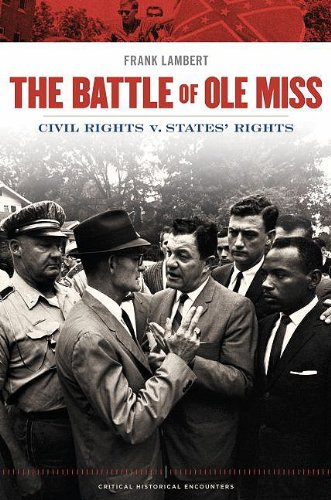 Frank Lambert has authored a gem of a book in THE BATTLE OF OLE MISS: Civil Rights v. States Rights, published this year by the Oxford University Press. If you have any interest in reading about that that troublesome time, you should make this book a starting point.
Lambert, who is a professor of history at Purdue University, not only was a student at Ole Miss in 1962 and an eye-witness to many of the events, he was also a member of the undefeated football team at the time, and his recollection of the chilling address delivered by Governor Ross Barnett at the half-time of the Ole Miss-Kentucky football game on the eve of the battle is a must-read.
This is a small book, only 193 pages including footnotes and index, but it is meticulously researched. As a native Mississippian and eyewitness, Lambert is able not only to relate the historical events, he also is able to describe the context in which they happened.
The book lays out the social milieu that led to the ultimate confrontation. There is a chapter on Growing Up Black in Mississippi, as well as Growing up White in Mississippi. Lambert describes how the black veterans of World War II and the Korean conflict had experienced cultures where they were not repressed because of their race, and they made up their minds that they would challenge American apartheid when they returned home. Meredith was one of those veterans, and he set his sights on attending no less than the state’s flagship university because, as he saw it, a degree from Ole Miss was the key to achievement in the larger society. He also realized that if he could breach the ramparts at Ole Miss, so much more would come tumbling down.
The barriers put up against Meredith because of his race were formidable. He was aware of the case of Clyde Kennard, another black veteran who had tried to enroll at what is now the University of Southern Mississippi, but was framed with trumped-up charges of stolen fertilizer and sentenced to Parchman, eventually dying at age 36. And surely he knew of Clennon King, another black who had managed to enroll at Ole Miss only to be committed to a mental institution for his trouble. Even among civil rights leadrs, Meredith met resistance. He was discouraged by Medgar and Charles Evers, who were designing their own strategy to desegregate Ole Miss, and felt that Meridith did not have the mettle to pull it off. Against all of these obstacles, and in defiance of a society intent on destroying him, Meredith pushed and strove until at last he triumphed.
But his triumph was not without cost. Armed racists from throughout Mississippi, Alabama and other parts of the South streamed to Oxford in response Barnett’s rallying cry for resistance. The governor’s public rabble-rousing was cynically at odds with his private negotiations with President John Kennedy and US Attorney General Bobby Kennedy, with whom he sought to negotiate a face-saving way out. The ensuing battle claimed two lives, injured 160 national guardsmen and US marshals, resulted in great property damage, sullied the reputation of the university, tarred the State of Mississippi in the eyes of the world, led to armed occupation of Lafayette County by more than 10,000 federal troops, and forever doomed segregation. Ironically, the cataclysmic confrontation that Barnett and his ilk intended to be the decisive battle that would turn back the tide of civil rights was instead the catalyst by which Ole Miss became Mississippi’s first integrated state university. It was in essence the final battle of the Civil War, the coup de grace to much of what had motivated that conflict in the first place and had never been finally resolved.
As for Meredith, the personal cost to him was enormous. He was subjected to taunts and derision, as well as daily threats of violence and even death. He found himself isolated on campus, and did not even have a roommate until the year he graduated, when the second black student, Cleveland Donald, was admitted. Meredith described himself in 1963 as “The most segregated Negro in the world.”
The admission of James Meredith to Ole Miss not only opened the doors of Mississippi’s universities to blacks, it also helped begin the process in which Mississippians of both races had to confront and come to terms with each other as the barriers fell one by one. As former mayor Richard Howorth of Oxford recently told a reporter: ” … other Americans have the luxury of a sense of security that Mississippi is so much worse than their community. That gives them a sense of adequacy about their racial views and deprives them of the opportunity we’ve had to confront these issues and genuinely understand our history.”
Meredith’s legacy is perhaps best summed up in the fact that, forty years after his struggle, his own son graduated from the University of Mississippi as the Outstanding Doctoral Student in the School of Business, an event that Meredith said, ” … vindicates my entire life.” His son’s achievement is the culmination of Meredith’s singular sacrifice. What Meredith accomplished for his son has accrued to the benefit of blacks and whites alike in Mississippi, and has helped our state begin to unshackle itself from its slavery to racism.
 The Better Chancery Practice Blog