The Judge as Grand Inquisitor
December 8, 2014 § 1 Comment
Some judges sit through a trial impassively, leaving counsel to wonder whether hizzoner is paying any attention at all. Other judges take an active part, hurling questions like shrapnel through the courtroom. Still other judges fit somewhere in between the two extremes.
It’s a phenomenon I’ve posted about before here and here.
In the COA case SKL Investments v. Hardin and Torrence, decided November 18, 2014, the appellant charged that the chancellor erred when he “continually mischaracterized testimony [and] interrupted and veraciously ‘crossed’ [SKL’s] witnesses while protecting other witnesses in a manner that hindered [SKL’s] development of its case[.]” [My emphasis] I will leave it up to the reader to look up the definition of ‘veraciously.’
So, did the learned chancellor cross a line in his interrogation in this case? No, said the court, in an opinion penned by Judge Irving:
¶16. … While the record reveals that the chancery court interrogated witnesses and even sometimes interrupted witnesses as they testified, a contextual reading of the record also reveals that the chancery court did not “overstep[ ] its judicial authority” as SKL now claims.
¶17. The chancery court was within its right to “interrogate witnesses, whether called by itself or by a party.” Powell v. Ayars, 792 So. 2d 240, 248 (¶29) (Miss. 2001); see also M.R.E. 614(b). Certainly, it would have been “‘grounds for reversal if the [chancery court had] abuse[d] the authority to call or question a witness[,] abandoning [its] impartial position as a judge and assuming an adversarial role.’” Copeland v. Copeland, 904 So. 2d 1066, 1074 (¶27) (Miss. 2004) (citing Powell, 792 So. 2d at 248 (¶29)). However, “there [was] no requirement for the [chancery court] solely to be a silent observer.” Copeland, 904 So. 2d at 1074 (¶28) (citation omitted). After reviewing the record, we find that the chancery court did not abuse its discretion in its examination of the witnesses. This issue is without merit. Accordingly, we affirm.
There is the oft-cited apocryphal tale of the chancellor who interrupted and took over questioning of a witness, only to be interrupted in turn by counsel, who pleaded, “Judge, I don’t mind you questioning the witness, but please don’t lose the case for me.”
Another point: if you’re going to accuse the judge of going overboard, at least use an adverb that fits the conduct.
The View from the Tip of the Iceberg
August 19, 2014 § 2 Comments
This is for the young lawyers out there.
Imagine yourself perched at the pinnacle of what appears to you to be a mountain in the middle of the ocean. You examine your environs as closely as you can, and gather that you are on a peak of ice, surrounded by miles of water. The mountain is relatively featureless, save for a few large stones here and there. The slopes descend into the sea and nothing beneath the surface of the water is visible. Everything you know about your location is what you can see. You conclude that you are on an iceberg, and you guess that there is much more to it that is hidden from you below the waterline, but you have no actual knowledge of the size or dimensions of what lies below.
That view from the tip of the iceberg is what the judge has at the conclusion of a trial in chancery.
The judge knows that there is so much more that is not in the record, but all the judge may go on is what has been revealed. The scope of the judge’s knowledge of the case is limited by the rules of evidence, the MRCP, the pleadings, the discovery, the skill of the lawyers, and the ability of the witnesses to articulate. All of those things are filters through which the facts are passed and reduced to the concentrated mass that the judge must consider in making a ruling. And the judge must make his or her ruling based only on the competent proof in the record.
Remember that you and opposing counsel know ten times or more about your case than the judge will ever know. And never forget that your client and the party opposite know ten times more about the case than they will ever share with the attorneys.
If you don’t put something into the record, the judge not only will not know about it, she can not even consider it. And I am talking about the record as in via evidence. Pleadings are not evidence. Just because you alleged a fact in a pleading does not mean that it is proven so that the judge can consider it.
As you plan out your case for trial, take a minute and imagine that view from the iceberg. Ask yourself what it is you see if you identify all of the competent evidence that you get into the record. Is it enough? Does it include all the judge needs to know? Is there enough evidence to support every factor you need to prove in order to prevail? Have you made a thorough enough record to support your argument on appeal?
THAT CERTAIN “JE NE SAIS QUOI”
May 10, 2011 § 2 Comments
If you’ve ever tried a case with a LEP, you know just how excruciatingly difficult it can be without the right help. Excuse me? You don’t know what a LEP is? Well, a LEP is neither contagious nor a Biblical outcast. LEP is jargon for a person who has Limited English Proficiency. That is, they have trouble speaking and understanding English, which, naturally, is quite an impediment in a Mississippi court.
In my experience practicing law, I tried a number of cases in Choctaw Tribal Court where every case involved one LEP, and sometimes a full cast of LEP’s. You would ask a question and the designated interpreter would repeat the question in Choctaw to the witness. The interpreter would listen studiously as the witness droned on in reply for several minutes, whereupon the interpreter would say earnestly, “He said no.” I have always suspected that something had been lost in the translation.
I tried a memorably hilarious case once against a local attorney who later gave up the law to become rich as a stockbroker, probably in no small part due to this case. My client was a more or less LEP European-trained, ethnic Chinese physician from Indonesia, and the opposing party was a completely LEP Chinese PhD student from Beijing who was studying at the University of X___g__n__c__ao (I never got that one straight, which I guess makes me a LCP). She had come to this country to attempt a reconciliation with her husband, my client, but the attempted reconciliation unhappily failed, propelling them to court that day for a temporary hearing. Our “translator” spoke and understood one particular strain of Chinese, and neither party spoke or understood the same strain. To compound the comedy, it was the court reporter’s first, nervous day on the job — straight out of the Ole Miss court reporting school. She almost broke down in tears when my client was asked where he graduated from medical school, and in his proudest Chinese-flavored German, he responded “Heinrich Heine Universität, Universitätsklinikum, Düsseldorf, Chermany.” Who wouldn’t be proud of that? We stumbled along until the trial’s dramatic crescendo, which occurred when the opposing party futiley tried repeatedly to describe how her piece-of-junk car would not work. She finally blurted out in LEP exasperation, “Cah no vroom,” while twisting her right hand in a key-in-ignition fashion. We all pretty much understood that, LEP or no LEP. In fact, it was the most understandable thing any witness or interpreter said that day.
All of which brings me at last to my point. The Administrative Office of Courts (AOC) is seeking comments on proposed rules for use of interpreters in the courts. The goal is state-wide credentialing of certified interpreters, with a roster available for all chancery, circuit, county, youth, municipal and justice courts, as well as grand juries. You can access the announcement and links here. As for the philosophy behind it, AOC said:
“It is essential that any communication barrier be removed, as far as possible, so that these limited English proficiency (LEP) individuals are placed on equal footing with similarly situated persons for whom there is no such barrier. Interpreters are highly skilled professionals who fulfill an essential role in the administration of justice. As officers of the court, interpreters help assure that LEP individuals enjoy equal access to justice and that court proceedings and court support services function efficiently and effectively.”
Translation: “We need qualified interpreters when we have persons in court who do not speak or understand English well.”
Based on my years in chancery court, I am wondering whether we need also to have interpreters for our own fellow citizens who do not speak any recognized foreign tongue, but are LEP’ed in their ability to speak or understand plain English. But I guess that’s a project further down the road, to be tackled after we have dealt with the aliens in our midst.
SURREBUTTAL SURVIVES
April 28, 2011 § Leave a comment
Not long ago an attorney asked to be allowed surrebuttal. I refused the request and quipped that surrebuttal had been deep-sixed by the MRCP.
I was wrong. About the MRCP, anyway.
Actually, the MRCP does not even mention surrebuttal. I do remember a discussion about surrebuttal in the various seminars we had around 1982-3 in preparation for the effective date of the “new” rules. The common wisdom in those sessions was that the old practice in chancery for liberal surrebuttal was going away. In the ancient, pre-rules days it was common practice to get trampled by an older lawyer who was invariably afforded one or even more “surrebuttals” that he used skillfully to repair whatever damage you had done or points you had scored in your examination of a witness.
After the new rules went into effect, that practice thankfully died out in our district, and every other one where I set foot, and since then one rarely hears requests for surrebuttal — as on that day in my court not long ago.
The matter is covered by UCCR 3.02, which provides in part:
The examination of witnesses shall be limited to the direct examination, the cross-examination, and the redirect examination concerning matters brought out on cross-examination. Counsel for either party may be permitted, on request, to inquire about new matters pertinent to the issues which may have been inadvertently omitted. Opposing counsel may also inquire concerning the same matter.
There you have it. It’s what we used to call surrebuttal.
Nowadays it arises mainly in situations where the court allows evidence in over the objection that the question is “outside the scope of rebuttal.” In McGaughy v. State, 742 So2d 1091, 1094 (Miss. 1999), the court said, “Where there is doubt as to whether the evidence is properly case-in-chief or rebuttal evidence, the trial court should resolve the doubt in favor of reception in rebuttal if: (1) its reception will not consume so much additional time as to give an undue weight in practical probative force to the evidence so received in rebuttal, and (2) the opposite party would be substantially as well prepared to meet it by surrebuttal as if the testimony had been offered in chief, and (3) the opposite party upon request therefor is given the opportunity to reply by surrebuttal.”
It is error to permit the introduction of case-in-chief evidence in rebuttal where the evidence clearly should have been offered in the case in chief. Hosford v. State, 525 So.2d 789, 791-92 (Miss. 1988). But where it is not clear, introduction is within the discretion of the trial judge and will be reversed only if the decision is found to be arbitrary and capricious. Smith at 1095.
After the court has allowed in the testimony, you may request further questioning under UCCR 3.02.
To preserve the point for appeal, you need to object timely when your opponent offers evidence in rebuttal that should have been offered in the case in chief. If the court overrules the objection, ask immediately for surrebuttal or explain to the court why you will be unable to meet the evidence and how it will prejudice your client.
In the case in my court, I did not see that surrebuttal was necessary or desirable to meet anything offered in rebuttal, but it’s an interesting point that arises rarely in chancery court.
LOSING: NOT THE NEXT BEST THING TO WINNING
December 28, 2010 § 1 Comment
This from Philip Thomas’s excellent blog Mississippi Litigation Review & Commentary. If these thoughts do not resonate with with your experience as a litigator, you might consider some tamer undertaking …
Losing Sucks
Posted on March 3, 2010 by Philip Thomas
You heard me. Losing a trial sucks. On multiple levels. Sorry if you don’t like my vocabulary.
Even worse, a win does not even out a loss. Tennis great Andre Agassi described it as well as anyone that I’ve heard even though he was talking about tennis and not trials:
Now that I’ve won a slam, I know something that very few people on earth are permitted to know. A win doesn’t feel as good as a loss feels bad, and the good feeling doesn’t last as long as the bad. Not even close.
Shortly after I started my first job as a lawyer I heard veteran trial lawyer Natie Caraway say basically the same thing. It took personal experience winning and losing trials to understand it.
For me a loss on appeal does not feel bad as a loss at a trial. And the loss of a bench trial does not feel as bad as the loss of a jury trial. The loss of a jury trial feels the worst because you hang it all on the line for twelve people who you don’t know and you are shattered when you find out that you could not convince them. And if you believe in your clients case–and most lawyers do–you think that the jury got it wrong. That makes it worse.
I have no answer for the best way to deal with a loss. But I agree with Chicago lawyer John Tucker on this point:
Courtroom lawyers and people who play sports are engaged in an endeavor where there is a winner and loser of every contest, and no matter how good they are, sometimes they lose.In fact, in both endeavors it is often true that the better they are the harder their contests and the more often they will lose. You don’t have to like it-in fact, you had better not-but you won’t last long if you don’t learn to get over it, or at least put it far enough behind you to go on to the next case.
Some lawyers lose a big trial and never recover. They are habitually afraid to re-enter the courtroom for fear of losing again. The best lawyers get over it and seek the adrenalin rush of going back in and putting it all on the line again.
ATTICUS FINCH FIFTY YEARS LATER
July 15, 2010 § 1 Comment
He had an unremarkable law practice in the backwater town of Maycomb, Alabama, in the 1930’s. He was a widower with two small children to raise, an earnest son named Jem and a tomboyish daughter named Scout. In one steaming southern summer his bravery and devotion to the rule of law elevated him into one of the most towering exemplars of integrity and the best of the legal profession. And yet, he never existed in real life. His name is Atticus Finch, hero of Harper Lee’s Pulitzer Prize-winning novel, To Kill a Mockingbird, which observes the 50th anniversary of its publication this week.
The book is a powerful evocation of small-town life in the south in the sleepy, destitute era long before the civil rights awakening of the 1960’s. Rosa Parks had not yet sat in the front of a bus in Montgomery. There were no freedom riders then. No protest marches with German Shepherds and fire hoses. In the time of the story there is no political movement bearing the characters forward; there is only a black man wrongly accused and this small-time lawyer in a “tired, old” Alabama town doing what his profession and his own personal convictions demanded of him, and doing it with honor, courage and single-minded devotion to the interest of his client, heedless of the personal danger that his unpopular actions brought him. And through it all Atticus Finch the lawyer was a wise, attentive and devoted father and rock for his children.
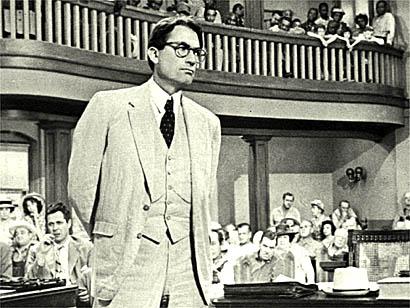 To many of us, Atticus Finch is inescapably Gregory Peck, who played the role in the 1962 film and won an Oscar as best actor. The movie won three Academy Awards out of eight nominations, and today is considered one of the great American classics. Its black-and-white images remain etched in our minds. I am sure that I am not the only southern teenager who saw the movie in those days and was inspired to be a lawyer just like Atticus some day.
Half a century after he appeared, Atticus Finch remains a model and a contemporary inspiration. In a recent poll practicing lawyers voted him an influence on their careers; strong stuff for a fictional character.
Here is Atticus Finch in his own words:
- “Mockingbirds don’t do one thing but make music for us to enjoy… but sing their hearts out for us. That’s why it’s a sin to kill a mockingbird.”
- “The one place where a man ought to get a square deal is in a courtroom, be he any color of the rainbow, but people have a way of carrying their resentments right into a jury box.”
- “You never really understand a person until you consider things from his point of view – until you climb into his skin and walk around in it.”
- “The one thing that doesn’t abide by majority rule is a person’s conscience.”
- “There’s a lot of ugly things in this world, son. I wish I could keep ’em all away from you. That’s never possible.”
- “Courage is not a man with a gun in his hand. It’s knowing you’re licked before you begin but you begin anyway and you see it through no matter what. You rarely win, but sometimes you do.”
- “When a child asks you something, answer him, for goodness sake. But don’t make a production of it. Children are children, but they can spot an evasion faster than adults, and evasion simply muddles ’em.”
- “Bad language is a stage all children go through, and it dies with time when they learn they’re not attracting attention with it.”
- “Best way to clear the air is to have it all out in the open.”
 The Better Chancery Practice Blog